brake LOTUS ELISE 2005 Owners Manual
[x] Cancel search | Manufacturer: LOTUS, Model Year: 2005, Model line: ELISE, Model: LOTUS ELISE 2005Pages: 205, PDF Size: 4.51 MB
Page 4 of 205
8. INSTRUMENTS & SWITCHES
Ignition Switch/Steering Lock ..........................................
44
Engine Start Button .........................................................
45
Warning ‘Tell Tale’ Lamps ...............................................
46
Bulb Check ................................................................
46
Turn Tell Tale .............................................................
46
Seat Belt Tell Tale ......................................................
47
Brake Tell Tale ...........................................................
47
Oil Pressure Tell Tale ................................................
47
Low Fuel Level Tell Tale ............................................
48
ABS Tell Tale ............................................................
48
High Beam Tell Tale ..................................................
48
Airbag Tell Tale ..........................................................
48
Battery Charging Tell Tale .........................................
48
Engine Malfunction Indicator Lamp ...........................
49
Security/RPM Tell Tale ..............................................
49
Instruments .................................................................
51
Speedometer .............................................................
51
Tachometer ...............................................................
51
LCD Display Panel ....................................................
52
Fuel Level Display ...............................................
52
Coolant Temperature Display ..............................
53
Odometer ............................................................
53
Trip Recorder .......................................................
53
Dashboard Switches .......................................................
54
Parking Lamp Switch ................................................
54
Headlamp Switch ......................................................
54
Lights-on Buzzer .......................................................
55
Hazard Warning Lamps Switch .................................
55
Instrument Illumination ..............................................
56
Auxiliary Power Socket .............................................
57
Column Switches & Horn ................................................
58
Headlamp High/Low Beam/Flasher/Turn Indicators .
58
Windscreen Wiper/Washer .......................................
59
Horn .................................................................
60
Audio Equipment ............................................................
60
9. HEATING, VENTILATION & AIR CONDITIONING
Air Conditioning ..............................................................
61
Air Re-circulation ............................................................
62
Heater Temperature ........................................................
62
Fan Speed .................................................................
62
Air Distribution ................................................................
63
Engine Bay Ventilation ....................................................
65
Contents
2
oh_croft_InD.indd 220/05/2004 07:58:39ProCarManuals.com
Page 5 of 205
10. DRIVING CONTROLS
Foot Pedals .................................................................
66
Footwell Carpets .............................................................
66
Clutch Pedal .................................................................
66
Footbrake .................................................................
67
Anti-Lock Brake System .................................................
67
Parking Brake .................................................................
70
Gear Lever .................................................................
71
11. STARTING PROCEDURE & ENGINE BREAK-IN
Starting a Cold or Warm Engine .....................................
72
Idle Speed .................................................................
73
Engine Break-In ..............................................................
73
Engine Special Features .................................................
74
12. EXTERNAL OPERATIONS
Fuel Requirement ...........................................................
75
Fuel Filling .................................................................
76
Front Service Access Panels ..........................................
78
Engine Cover/Trunk Lid ..................................................
79
Child Entrapment ......................................................
80
Removable Roof Concept ...............................................
81
Soft Top Roof Fitting ..................................................
82
Soft Top Roof Removal .............................................
84
Hard Top Roof Fitting ................................................
85
Hard Top Roof Removal ............................................
90
13. SERVICING & MAINTENANCE
Bodycare .................................................................
93
B
ody Features ...........................................................93
Paint Care .................................................................
94
Ventilation .................................................................
94
Paintwork Polishing ...................................................
95
Washing .................................................................
95
Soft Top Roof ............................................................
96
Windscreen Cleaning ................................................
96
Alloy Road Wheels ....................................................
96
Upholstery Cleaning ..................................................
97
Seat Belts Cleaning ...................................................
97
Footwell Cleaning ......................................................
97
Owner Maintenance ........................................................
98
Engine Oil Level Check .............................................
99
Engine Oil Change ..................................................
100
Oil Filter ...............................................................
102
Used Engine Oil ......................................................
103
Contents
3
oh_croft_InD.indd 320/05/2004 07:58:40ProCarManuals.com
Page 6 of 205
Transmission Oil .....................................................103
Cooling System .......................................................
106
Anti-Freeze/Corrosion Inhibitor ...............................
107
Coolant Drain/Refill Procedure ................................
108
Washer Reservoir ...................................................
109
Wiper Blade .............................................................
109
Brake Fluid Reservoir ............................................... 110
Brake Pads ............................................................... 111
Brake Pipes and Hoses ............................................112
Air Cleaner Element ................................................. 113
Auxiliary Drive Belt ................................................... 114
Sparking Plugs ......................................................... 114
14. TIRES & WHEE
LS
Tires ................................................................ 115
Glossary of Terms .................................................... 115
T
ire Safety ................................................................ 115
Tire Care ................................................................ 117
Replacement Tires ................................................... 118
Tire Characteristics .................................................. 119
Winter T
ires .............................................................. 119
Tire Cha
ins ..............................................................120
Uniform T
ire Quality Grading ...................................120
Tire Placard
/Label ...................................................121
Steps
for Determining Correct Load Limit ...............122
Tire Ma
rkings ..........................................................123
T ire Inflator Aerosol .................................................
124
Wheels ...............................................................
126
Wheel Bolts .............................................................
126
Wheel Alignment & Tire Balance .............................
126
Wheel Replacement ................................................
127
15. ELECTRICAL
Battery ...............................................................129
Battery Access ........................................................
129
Disconnecting the Battery .......................................
129
Reconnecting the Battery ........................................
131
Battery Charging .....................................................
131
‘Jump’ Starting ........................................................
133
Electrical Accessories ...................................................
134
Inertia Switch ...............................................................
135
Fuses ...............................................................
135
Contents
4
oh_croft_InD.indd 420/05/2004 07:58:40ProCarManuals.com
Page 11 of 205
• Powerful anti-lock four wheel disc brakes.
• High geared responsive steering requiring only small steering
wheel movements to alter course
• Exceptional road holding with optimised handling character
-
istics
You and your passenger cannot take full advantage of these
safety features unless you remain sitting in a proper position
and always wear your seat belt properly. In fact, some safety
features can contribute to injuries if they are not used properly. Drivers should be aware of their own limitations as well as
those of the car, and ensure that all road driving is conducted
well within both sets of capabilities, particularly on wet roads, or under adverse weather conditions.
Remember:
Driving a car requires:
• Care;
• Attention; and
• Sensible judgement.
Be aware that any motor car has the potential to cause death
or injury both to its occupants and/or other persons, and must
be used only in a responsible and cautious manner. This entire
handbook is filled with important safety information.
Please
read it carefully.
Remember:
• ALWAYS WEAR YOUR SEAT BELT.
• Never drive while under the influence of alcohol or drugs.
• Never drive when excessively tired.
• Never use mobile phones, map read or attempt other distract
-
ing activities whilst driving.
• Always obey all speed and traffic laws and regulations and never drive faster than the posted speed limit or than condi
-
tions allow.
• Be particularly careful driving on slippery or wet surfaces.
• Familiarise yourself with the car and always drive prudently, being aware of your own limitations and the limitations of the
car. Failure to operate the car properly can result in an ac
-
cident and serious injury.
Safety Information
9
oh_croft_InD.indd 920/05/2004 07:58:41ProCarManuals.com
Page 49 of 205
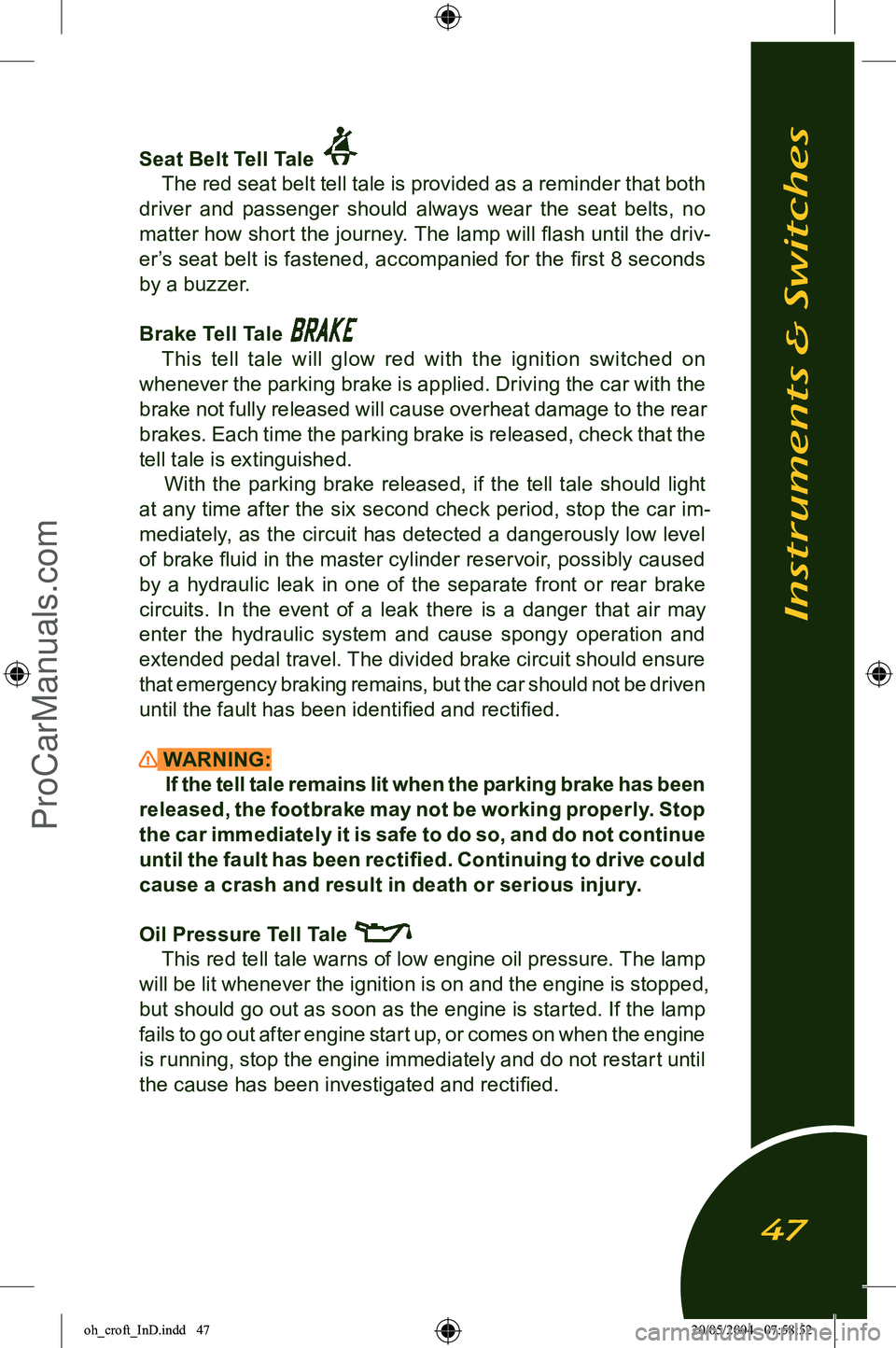
Seat Belt Tell Tale
The red seat belt tell tale is provided as a reminder that both
driver and passenger should always wear the seat belts, no
matter how short the journey. The lamp will flash until the driv
-
er’s seat belt is fastened, accompanied for the first 8 seconds by a buzzer.
Brake Tell Tale
This tell tale will glow red with the ignition switched on
whenever the parking brake is applied. Driving the car with the brake not fully released will cause overheat damage to the rear
brakes. Each time the parking brake is released, check that the
tell tale is extinguished. With the parking brake released, if the tell tale should light
at any time after the six second check period, stop the car im
-
mediately, as the circuit has detected a dangerously low level of brake fluid in the master cylinder reservoir, possibly caused
by a hydraulic leak in one of the separate front or rear brake
circuits. In the event of a leak there is a danger that air may enter the hydraulic system and cause spongy operation and
extended pedal travel. The divided brake circuit should ensure
that emergency braking remains, but the car should not be driven until the fault has been identified and rectified.
WARNING: If the tell tale remains lit when the parking brake has been
released, the footbrake may not be working properly. Stop
the car immediately it is safe to do so, and do not continue until the fault has been rectified. Continuing to drive could cause a crash and result in death or serious injury.
Oil Pressure Tell Tale
This red tell tale warns of low engine oil pressure. The lamp
will be lit whenever the ignition is on and the engine is stopped, but should go out as soon as the engine is started. If the lamp
fails to go out after engine start up, or comes on when the engine is running, stop the engine immediately and do not restart until
the cause has been investigated and rectified.
Instruments & Switches
47
oh_croft_InD.indd 4720/05/2004 07:58:52ProCarManuals.com
Page 50 of 205
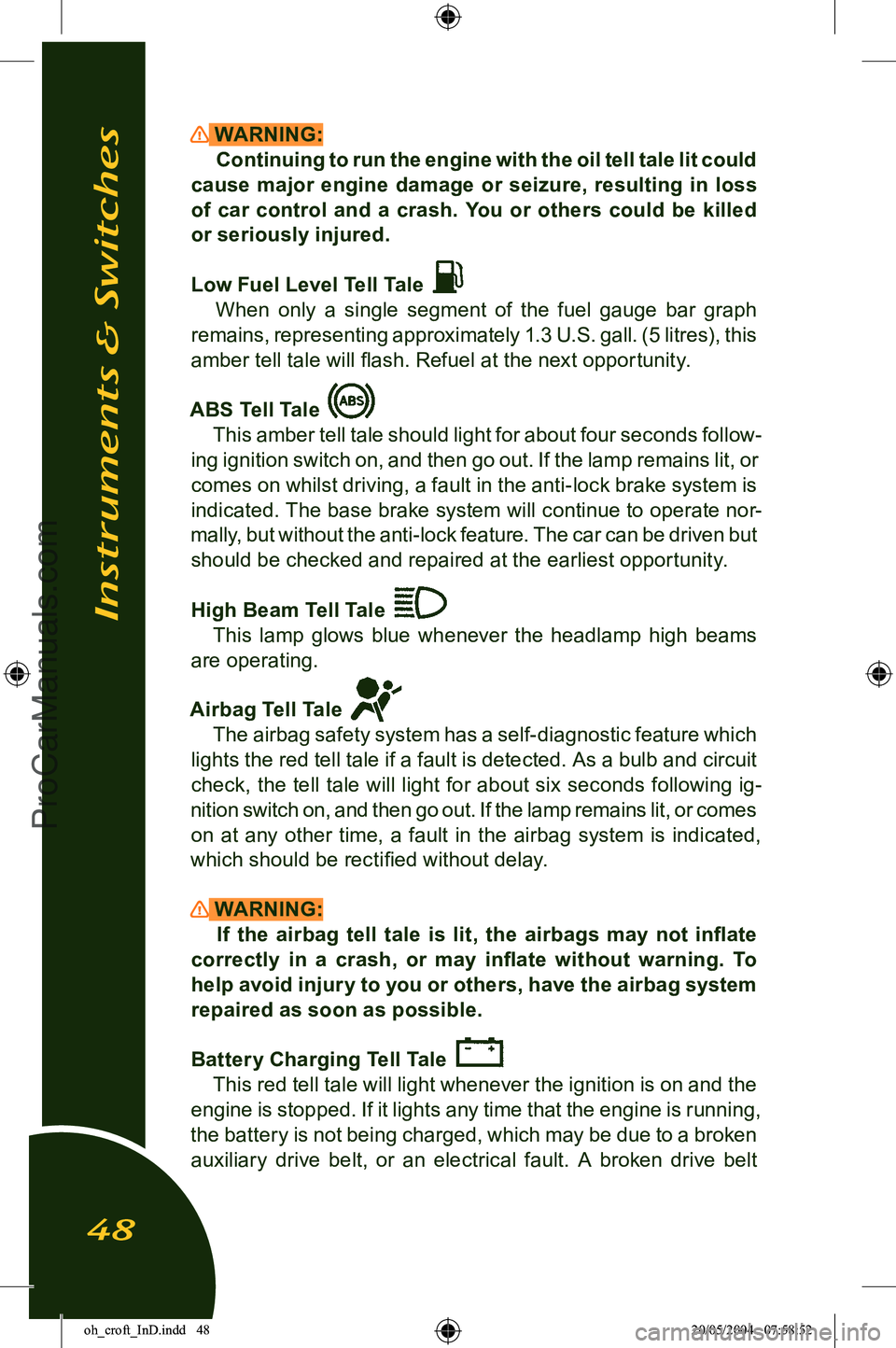
WARNING:Continuing to run the engine with the oil tell tale lit could
cause major engine damage or seizure, resulting in loss
of car control and a crash. You or others could be killed
or seriously injured.
Low Fuel Level Tell Tale
When only a single segment of the fuel gauge bar graph
remains, representing approximately 1.3 U.S. gall. (5 litres), this
amber tell tale will flash. Refuel at the next opportunity.
ABS Tell Tale
This amber tell tale should light for about four seconds follow-
ing ignition switch on, and then go out. If the lamp remains lit, or
comes on whilst driving, a fault in the anti-lock brake system is
indicated. The base brake system will continue to operate nor
-
mally, but without the anti-lock feature. The car can be driven but should be checked and repaired at the earliest opportunity.
High Beam Tell Tale
This lamp glows blue whenever the headlamp high beams
are operating.
Airbag Tell Tale
The airbag safety system has a self-diagnostic feature which
lights the red tell tale if a fault is detected. As a bulb and circuit
check, the tell tale will light for about six seconds following ig
-
nition switch on, and then go out. If the lamp remains lit, or comes on at any other time, a fault in the airbag system is indicated,
which should be rectified without delay.
WARNING: If the airbag tell tale is lit, the airbags may not inflate
correctly in a crash, or may inflate without warning. To
help avoid injury to you or others, have the airbag system repaired as soon as possible.
Battery Charging Tell Tale
This red tell tale will light whenever the ignition is on and the
engine is stopped. If it lights any time that the engine is running,
the battery is not being charged, which may be due to a broken
auxiliary drive belt, or an electrical fault. A broken drive belt
Instruments & Switches
48
oh_croft_InD.indd 4820/05/2004 07:58:52ProCarManuals.com
Page 68 of 205
DRIVING CONTROLS
Foot PedalsThe clutch pedal, brake pedal and accelerator pedal are ar
-
ranged in the usual positions, and are grouped closely together for ready access and refined driving technique.
WARNING: Do not attempt to drive the car without suitable narrow
soled, flat heeled footwear. Bare feet may inhibit the ap
-
plication of full pressure to the brake pedal, and adversely affect your control of the car. Bare feet could also suffer
burns from sun heated metal surfaces in the car
Footwell Carpets
WARNING: It is essential that any floor covering in the footwell is
properly secured. Loose mats can interfere with the opera
-
tion of the pedals causing possible loss of control and a crash in which you or others could be killed or seriously
injured.
The carpets fitted in the footwells of the Elise are secured by
two button screws at the rear, and Velcro strips beneath the front edge. Always ensure that the carpets are replaced and secured
correctly, and never fit any loose mats on top.
Clutch Pedal NOTICE:
• To avoid unnecessary clutch wear, do not, for more than
a few moments, slip the clutch to ‘hold’ the car on a slope;
apply the parking brake until ready to drive off.
• The clutch pedal must be fully depressed during each
gear shift.
• Do not drive with the left foot resting on the clutch pedal, as
rapid wear of the clutch components can result. A left foot rest
is provided for comfort and convenience.
Driving Controls
66
oh_croft_InD.indd 6620/05/2004 07:58:57ProCarManuals.com
Page 69 of 205
FootbrakeVentilated disc brakes are fitted to all four wheels of the
Elise. These are operated by separate front and rear hydraulic
circuits, supplied from a tandem master cylinder with vacuum
servo. Anti-lock control is provided by a microprocessor based
electro-hydraulic unit, integrated into the base braking system. The braking system is designed to provide good pedal feed
-
back, with efficient disc cooling to inhibit brake fade. With a
new car, or new brake system components, maximum braking
efficiency will be achieved if, for the first few hundred miles, needless heavy braking is avoided. Allow the brake pads and discs to ‘bed in’ fully before using the brakes to their full potential.
Pedal effort will reduce as the brakes are bedded in, and as they
are warmed from cold to normal working temperature. Note that
the hard grade pad material may give rise to a certain amount of brake noise under some conditions; such noise is not harmful
and does not affect the life or efficiency of the brakes.
WARNING:
• After driving through a ford, or a flooded road, some loss of braking response may be experienced until the brakes
have dried out. As soon as it is safe to do so after such an encounter, apply the brakes until normal operation
is restored. Failure to do so may result in an accident in
which you or others may be killed or seriously injured.
• The brake assistance servo uses vacuum supplied from the engine intake plenum, such that assistance is avail
-
able only when the engine is running. Never coast down
-
hill with the engine stopped. If this situation accidently arises, avoid repeated application of the brakes, or the
stored vacuum supply will be rapidly used up. Greater
pedal pressures will be required. This may adversely affect performance of the brakes which may result in an
accident in which you or others may be killed or seriously
injured.
Anti-lock Brake System The Anti-lock Brake System (ABS) is used to optimise brake
performance in extreme conditions and reduce the potential
for any wheel to lock up. Under most conditions, the maximum braking force is provided by a wheel which is rotating at about
90% of road speed. Apart from the likelihood of increasing the
Driving Controls
67
oh_croft_InD.indd 6720/05/2004 07:58:57ProCarManuals.com
Page 70 of 205
stopping distance, a locked wheel provides little or no steering
force, such that with both front wheels locked, movement of the steering wheel has no effect on car direction. With the anti-lock
system, even panic braking results in controlled deceleration and the retention of steering response. ABS is especially ad
-
vantageous when braking on slippery road surfaces and in bad driving conditions, but it is important to realise that the ABS
cannot increase the friction level at the road surface, but can only make optimum use of the grip available.
WARNING: When driving in adverse weather, or on poor road sur
-
faces, always be alert to the possibility of slippery condi
-
tions and make the necessary allowance for increased stop
-
ping distances. Failure to do so may result in an accident in which you or others may be killed or seriously injured.
Normal braking, controlled by the pressure applied to the
brake pedal, occurs when the road conditions allow for decel
-
eration to be achieved without danger of wheel lock. The relative
speeds of the four wheels are continuously monitored by the
ABS when the brakes are applied, and if one or more wheels begin to lock, the brake pressure to that wheel(s) is modulated
by the ABS to help keep the wheel rotating and provide the
maximum controlled braking force. The wheels may appear
to lock momentarily as the wheel speed rapidly changes, and some tire noise (intermittent screeching) may be heard which is normal and will vary with road and tire conditions. Note that the
ABS does not function at speeds below 5 mph (7 km/h). When the ABS is activated, the driver is will feel a ‘pulsing’
sensation at the brake pedal as the fluid pressure is modulated, and also by audible clicking sounds. These signals indicate to
the driver that maximum braking is occuring, and that driving style should be modified to suit the conditions.
The minimum stopping distance is achieved by applying the
brakes firmly and steadily, and allowing the ABS to modulate
hydraulic pressure. The driver should not attempt to emulate
this process by ‘pumping’ the brake pedal, as modulation at the pedal will treat all four wheels similarly, rather than the individual
wheel control allowed by the electronics. An ABS tell tale lamp in the instrument panel is provided
to warn of any problems in the system and to indicate that the
Driving Controls
68
oh_croft_InD.indd 6820/05/2004 07:58:57ProCarManuals.com
Page 71 of 205
integral self diagnostics have switched out the anti-lock function.
See ‘ABS tell tale lamp’.
WARNING:
• The increased control that ABS provides should not induce you to take more risks with your safety. ABS will
not prevent a skid caused by abrupt steering movements,
or attempting to corner too quickly.
• Always maintain a safe following distance from other cars relative to the road surface and weather conditions.
Obey all traffic laws.
• Risk of accidents due to inappropriate speed cannot be reduced even by ABS. The driver is responsible for the
judgement of safe speed.
• The control unit of the ABS is set for standard tire size. If non-standard Tires are fitted, the control unit may mis-
interpret the speed of the car, because of the variant data
it receives from the wheel speed sensors. Fitting non standard tires would seriously affect the performance of
your ABS.
• The amber ABS tell tale in the instrument panel should light for about 4 seconds following ignition switch on, and
then go out. If the lamp remains lit, or comes on whilst driving, a fault in the anti-lock brake system is indicated.
The base brake system will continue to operate normally,
but without ABS. The car can be driven but should be
checked and repaired at the earliest opportunity.
• Activation of the ABS will vary according to the level of grip available at the Tires. On dry surfaces, activation
will occur only with a high pedal pressure. On slippery
surfaces, only a low pressure will be needed.
• On loose or uneven surfaces, such as gravel or snow, a car with ABS may need a longer stopping distance. Allow
a greater distance between cars in these conditions.
Driving Controls
69
oh_croft_InD.indd 6920/05/2004 07:58:57ProCarManuals.com