high LOTUS ELISE 2005 User Guide
[x] Cancel search | Manufacturer: LOTUS, Model Year: 2005, Model line: ELISE, Model: LOTUS ELISE 2005Pages: 205, PDF Size: 4.51 MB
Page 52 of 205
Note that the tell tale also functions as a high engine speed
(rpm) warning - see ‘Tachometer’.
NOTICE: The car is not fitted with a low pressure tell tale. You should check the tire condition and pressure regularly. See
section in the handbook on tires which specifies tire care and pressures.
Instruments & Switches
50
oh_croft_InD.indd 5020/05/2004 07:58:53ProCarManuals.com
Page 53 of 205
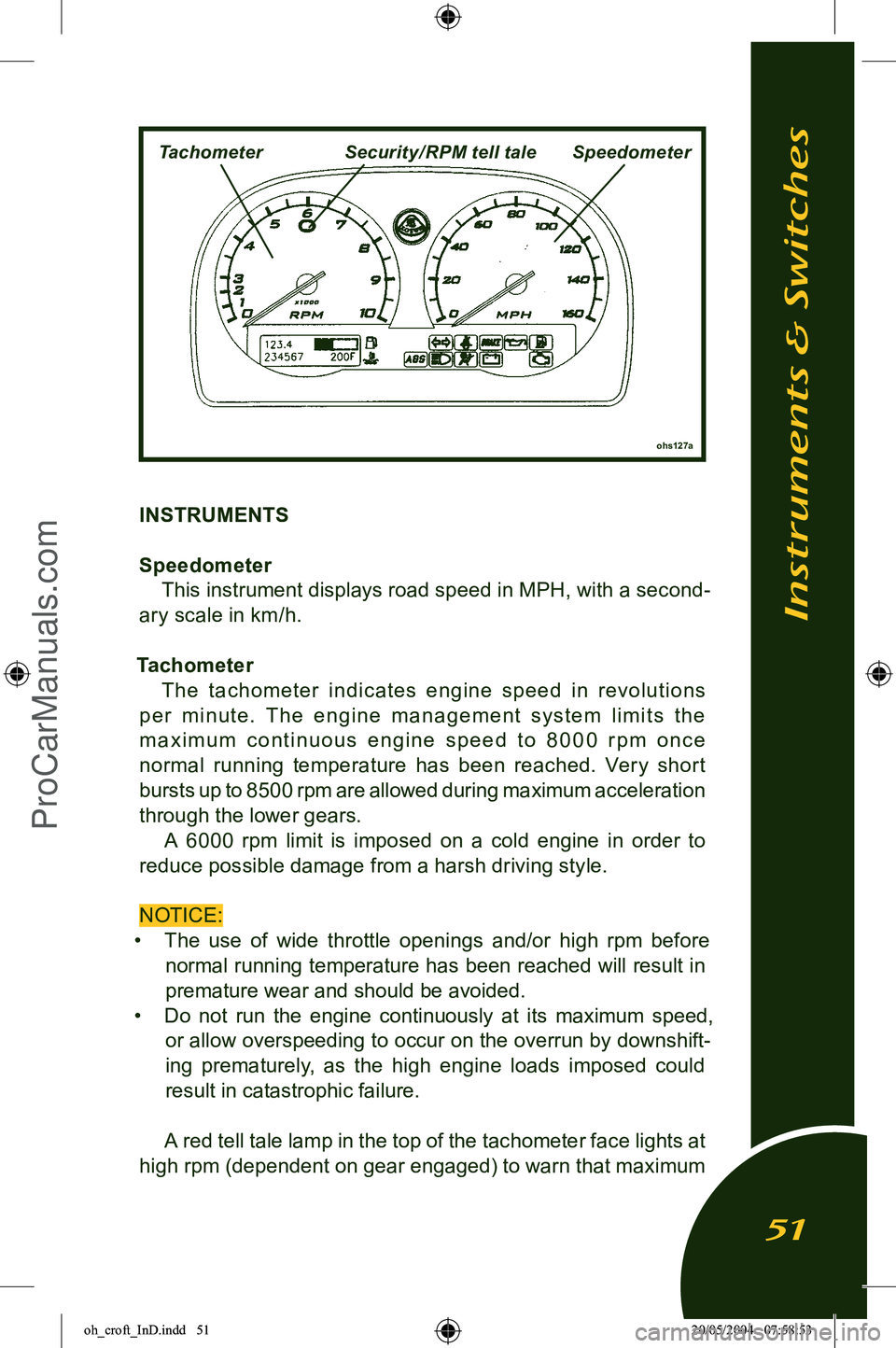
INSTRUMENTS
Speedometer This instrument displays road speed in MPH, with a second
-
ary scale in km/h.
Tachometer The t achometer indic ates engine speed in revolutions
p e r m i nu te. T h e e n g i n e m a n a g e m e nt sy s te m li m i t s t h e
m a x i m u m c o n t i n u o u s e n g i n e s p e e d t o 8 0 0 0 r p m o n c e
normal running temperature has been reached. Ver y shor t bursts up to 8500 rpm are allowed during maximum acceleration
through the lower gears. A 6000 rpm limit is imposed on a cold engine in order to
reduce possible damage from a harsh driving style.
NOTICE:
• The use of wide throttle openings and/or high rpm before
normal running temperature has been reached will result in
premature wear and should be avoided.
• Do not run the engine continuously at its maximum speed,
or allow overspeeding to occur on the overrun by downshift
-
ing prematurely, as the high engine loads imposed could
result in catastrophic failure.
A red tell tale lamp in the top of the tachometer face lights at
high rpm (dependent on gear engaged) to warn that maximum
Instruments & Switches
51
ohs127a
TachometerSecurity/ RPM tell taleSpeedometer
oh_croft_InD.indd 5120/05/2004 07:58:53ProCarManuals.com
Page 55 of 205
When only a single segment remains, representing approxi-
mately 1.3 U.S. gall. (5 litres), the amber low fuel tell tale will
flash. Refuel at the next opportunity.
NOTICE: Do not allow the tank to run completely dry, as this may damage the catalytic converter and fuel pump. This may
affect the terms of your warranty.
Coolant Temperature Display The engine coolant temperature will be displayed at the bot
-
tom right hand corner of the panel as soon as the temperature reaches 162°F. The running temperature will fluctuate a cer
-
tain amount as the operating conditions change, and during periods of idling or in heavy traffic, the temperature may rise to
over 212°F, with the cooling fans switching on at half speed at
approximately 208°F and at full speed at approximately 217°F.
The temperature display will flash at temperatures over 226°F to prompt closer monitoring by the driver of high temperatures.
The pressurised cooling system has a boiling point of over 248°F.
If the temperature approaches this level then the driver should be concerned. If this should occur, allow the engine to idle for a
few minutes whilst monitoring the temperature, and if it continues to rise, switch off and seek qualified assistance.
NOTICE: After a heavy snowfall, ensure that the radiator cooling
outlet grilles in the front body are cleared of snow before driving
the car, or overheating may occur.
Odometer An odometer (total distance recorder) reading is displayed at
the bottom left hand corner of the panel.
Trip Recorder A trip distance recorder is provided at the top left hand corner
of the panel. In order to zero the trip display, switch on the ignition, and
press for a moment (less than 1 second), the small button
on the steering column shroud ahead of the ignition switch.
This dual function button also controls the panel illumination
- see ‘Instrument & Switch Illumination’.
Instruments & Switches
53
oh_croft_InD.indd 5320/05/2004 07:58:53ProCarManuals.com
Page 56 of 205
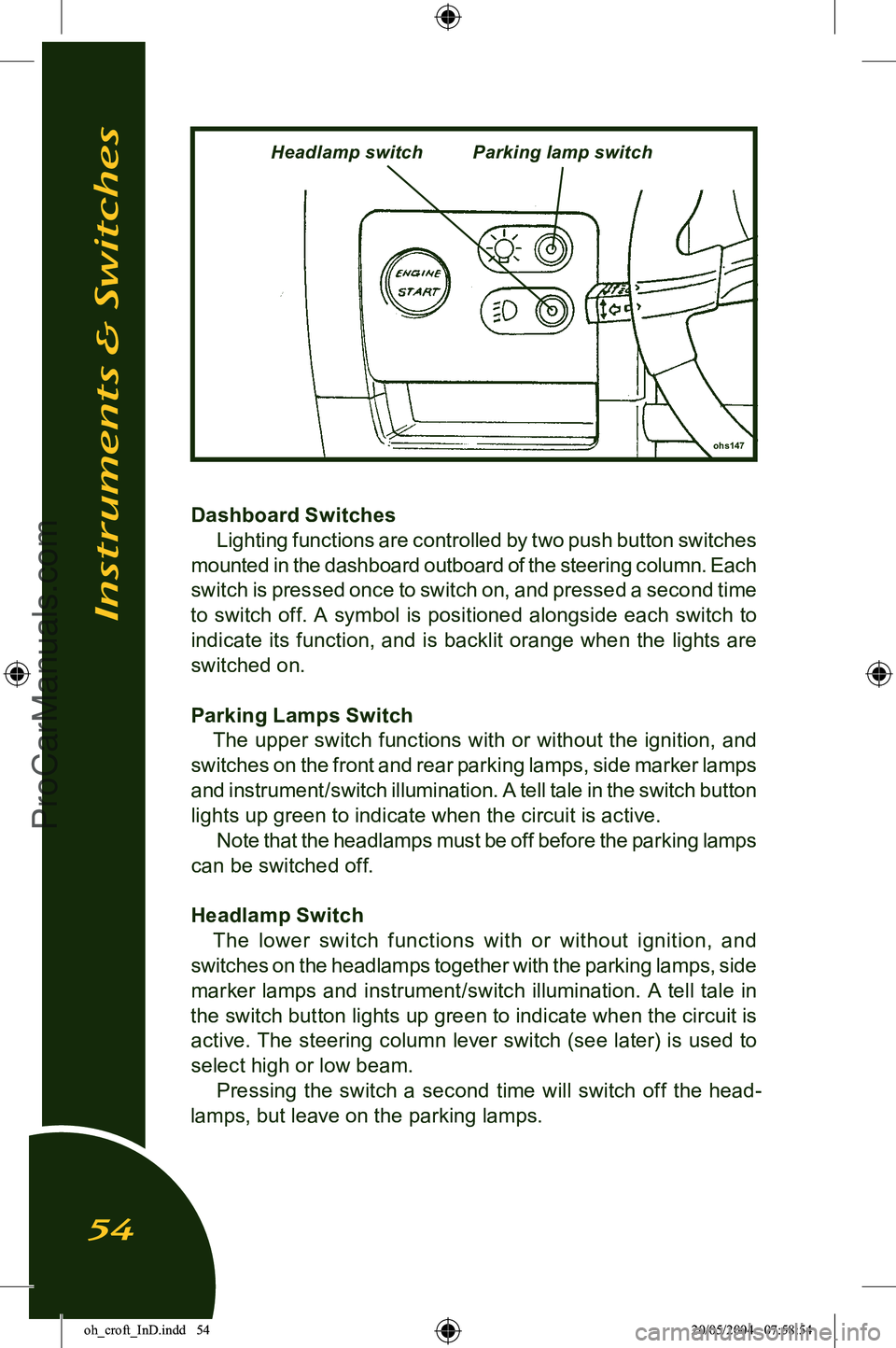
Dashboard SwitchesLighting functions are controlled by two push button switches
mounted in the dashboard outboard of the steering column. Each
switch is pressed once to switch on, and pressed a second time
to switch off. A symbol is positioned alongside each switch to indicate its function, and is backlit orange when the lights are
switched on.
Parking Lamps Switch The upper switch functions with or without the ignition, and
switches on the front and rear parking lamps, side marker lamps and instrument/switch illumination. A tell tale in the switch button
lights up green to indicate when the circuit is active. Note that the headlamps must be off before the parking lamps
can be switched off.
Headlamp Switch The lower switch functions with or without ignition, and
switches on the headlamps together with the parking lamps, side marker lamps and instrument/switch illumination. A tell tale in
the switch button lights up green to indicate when the circuit is
active. The steering column lever switch (see later) is used to
select high or low beam. Pressing the switch a second time will switch off the head
-
lamps, but leave on the parking lamps.
Instruments & Switches
54
ohs147
Headlamp switchParking lamp switch
oh_croft_InD.indd 5420/05/2004 07:58:54ProCarManuals.com
Page 57 of 205
‘Lights On’ Buzzer If the lights are on when the ignition is switched off, a ‘lights on’
reminder buzzer will sound when the driver’s door is opened.
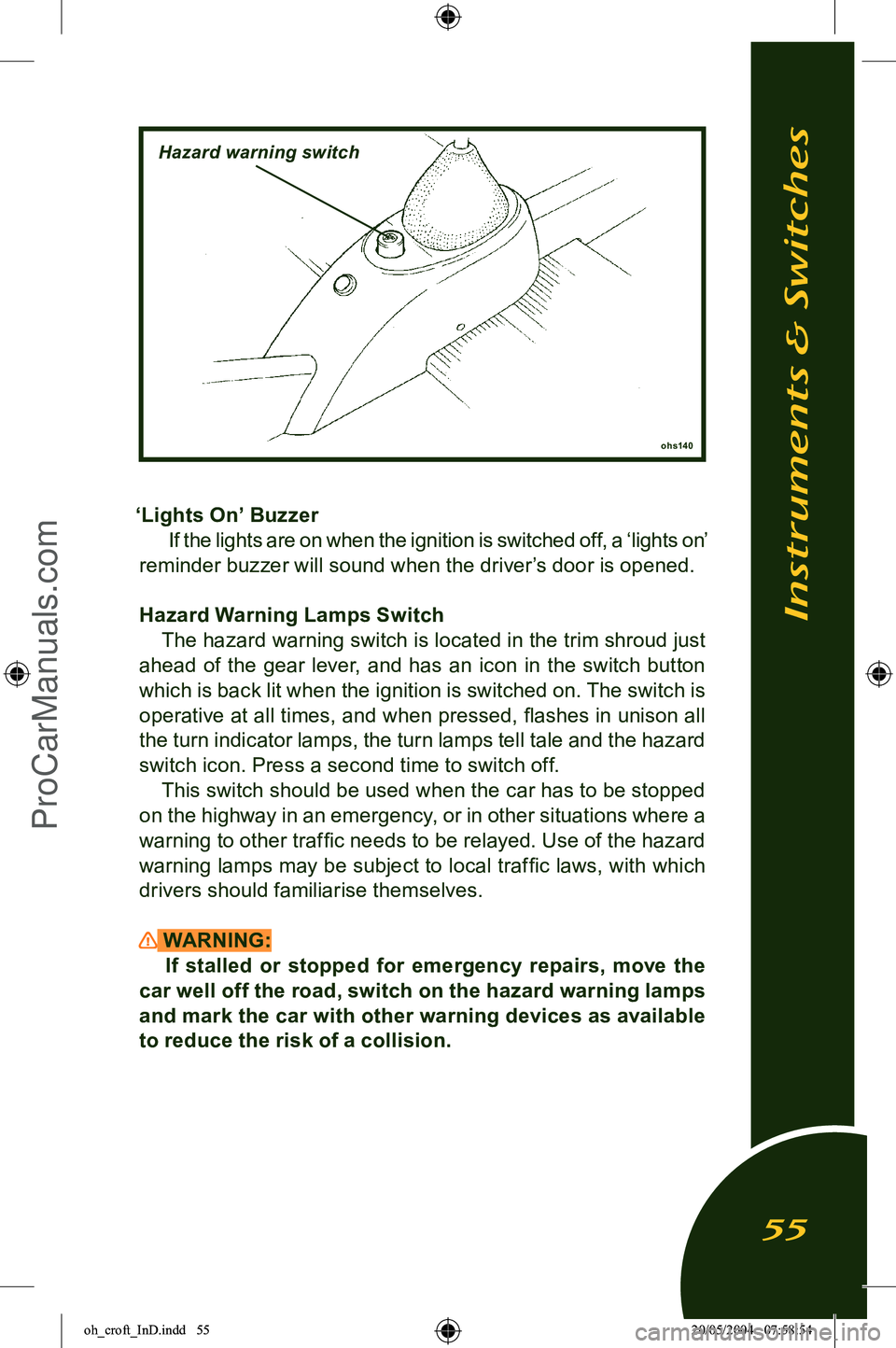
Hazard Warning Lamps Switch The hazard warning switch is located in the trim shroud just
ahead of the gear lever, and has an icon in the switch button
which is back lit when the ignition is switched on. The switch is operative at all times, and when pressed, flashes in unison all
the turn indicator lamps, the turn lamps tell tale and the hazard switch icon. Press a second time to switch off. This switch should be used when the car has to be stopped
on the highway in an emergency, or in other situations where a
warning to other traffic needs to be relayed. Use of the hazard
warning lamps may be subject to local traffic laws, with which drivers should familiarise themselves.
WARNING: If stalled or stopped for emergency repairs, move the
car well off the road, switch on the hazard warning lamps
and mark the car with other warning devices as available
to reduce the risk of a collision.
Instruments & Switches
55
ohs140
Hazard warning switch
oh_croft_InD.indd 5520/05/2004 07:58:54ProCarManuals.com
Page 60 of 205
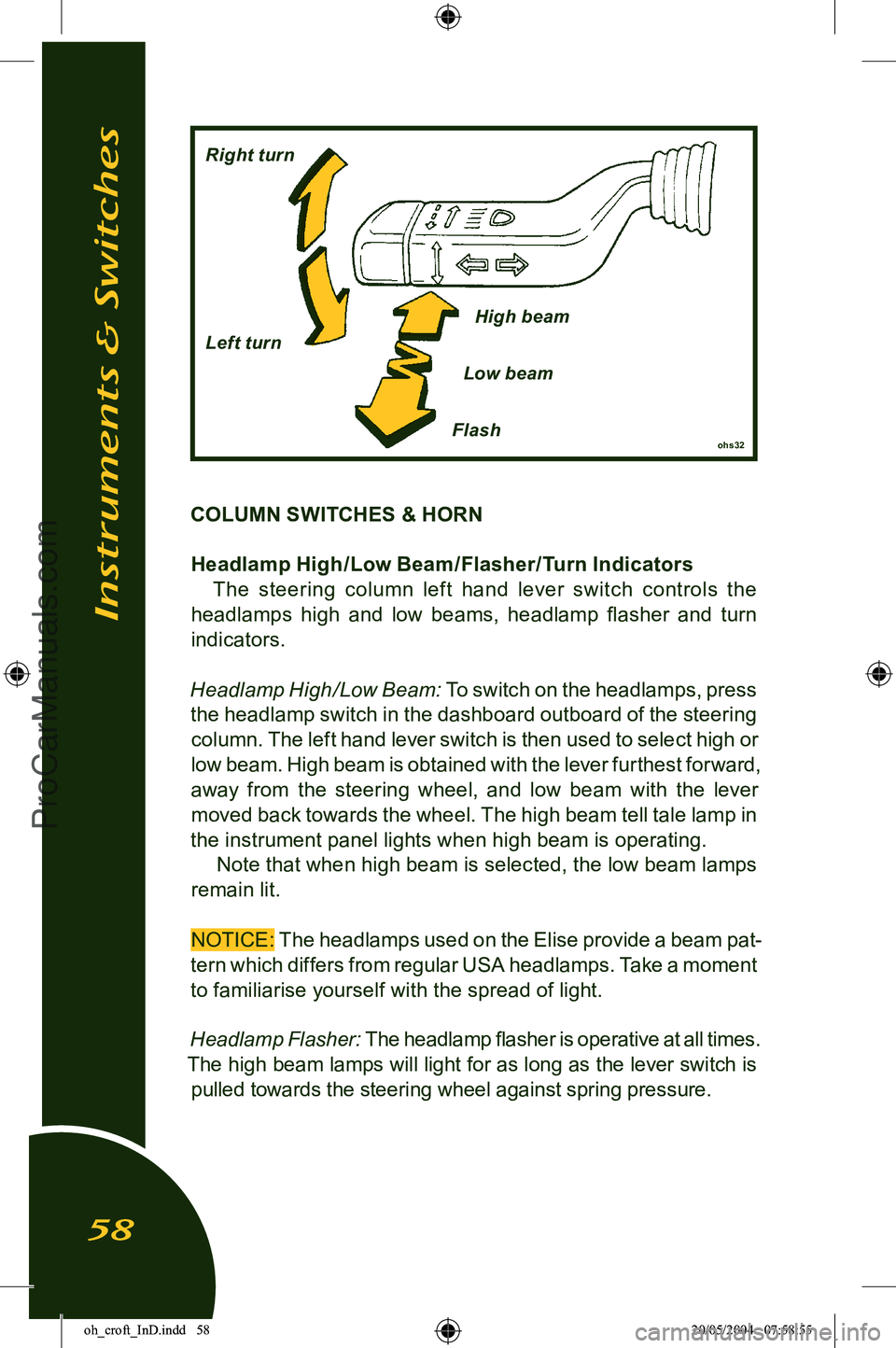
COLUMN SWITCHES & HORNHeadlamp High /Low Beam /Flasher/Turn Indicators The steering column lef t hand lever switch controls the
headlamps high and low beams, headlamp flasher and turn
indicators.
Headlamp High/Low Beam:
To switch on the headlamps, press
the headlamp switch in the dashboard outboard of the steering column. The left hand lever switch is then used to select high or
low beam. High beam is obtained with the lever furthest forward,
away from the steering wheel, and low beam with the lever moved back towards the wheel. The high beam tell tale lamp in
the instrument panel lights when high beam is operating.
Note that when high beam is selected, the low beam lamps
remain lit.
NOTICE:
The headlamps used on the Elise provide a beam pat-
tern which differs from regular USA headlamps. Take a moment
to familiarise yourself with the spread of light.
Headlamp Flasher:
The headlamp flasher is operative at all times.
The high beam lamps will light for as long as the lever switch is pulled towards the steering wheel against spring pressure.
Instruments & Switches
58
ohs32Flash
Right turn
Left turn
High beam
Low beam
oh_croft_InD.indd 5820/05/2004 07:58:55ProCarManuals.com
Page 71 of 205
integral self diagnostics have switched out the anti-lock function.
See ‘ABS tell tale lamp’.
WARNING:
• The increased control that ABS provides should not induce you to take more risks with your safety. ABS will
not prevent a skid caused by abrupt steering movements,
or attempting to corner too quickly.
• Always maintain a safe following distance from other cars relative to the road surface and weather conditions.
Obey all traffic laws.
• Risk of accidents due to inappropriate speed cannot be reduced even by ABS. The driver is responsible for the
judgement of safe speed.
• The control unit of the ABS is set for standard tire size. If non-standard Tires are fitted, the control unit may mis-
interpret the speed of the car, because of the variant data
it receives from the wheel speed sensors. Fitting non standard tires would seriously affect the performance of
your ABS.
• The amber ABS tell tale in the instrument panel should light for about 4 seconds following ignition switch on, and
then go out. If the lamp remains lit, or comes on whilst driving, a fault in the anti-lock brake system is indicated.
The base brake system will continue to operate normally,
but without ABS. The car can be driven but should be
checked and repaired at the earliest opportunity.
• Activation of the ABS will vary according to the level of grip available at the Tires. On dry surfaces, activation
will occur only with a high pedal pressure. On slippery
surfaces, only a low pressure will be needed.
• On loose or uneven surfaces, such as gravel or snow, a car with ABS may need a longer stopping distance. Allow
a greater distance between cars in these conditions.
Driving Controls
69
oh_croft_InD.indd 6920/05/2004 07:58:57ProCarManuals.com
Page 72 of 205
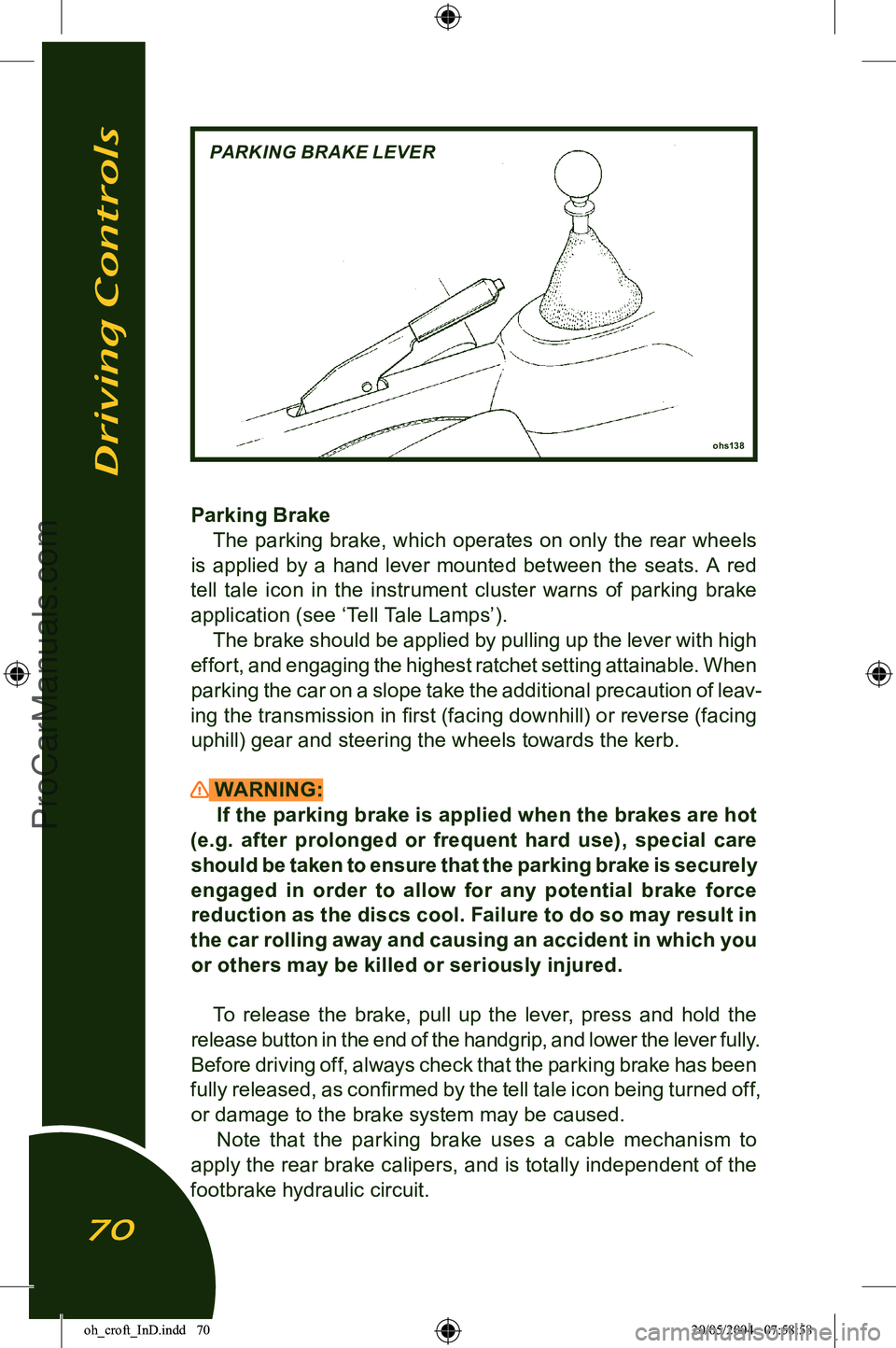
Parking BrakeThe parking brake, which operates on only the rear wheels
is applied by a hand lever mounted between the seats. A red
tell tale icon in the instrument cluster warns of parking brake application (see ‘Tell Tale Lamps’). The brake should be applied by pulling up the lever with high
effort, and engaging the highest ratchet setting attainable. When
parking the car on a slope take the additional precaution of leav
-
ing the transmission in first (facing downhill) or reverse (facing uphill) gear and steering the wheels towards the kerb.
WARNING: If the parking brake is applied when the brakes are hot
(e.g. after prolonged or frequent hard use), special care
should be taken to ensure that the parking brake is securely engaged in order to allow for any potential brake force
reduction as the discs cool. Failure to do so may result in
the car rolling away and causing an accident in which you
or others may be killed or seriously injured.
To release the brake, pull up the lever, press and hold the
release button in the end of the handgrip, and lower the lever fully.
Before driving off, always check that the parking brake has been
fully released, as confirmed by the tell tale icon being turned off,
or damage to the brake system may be caused. Note that the parking brake uses a cable mechanism to
apply the rear brake calipers, and is totally independent of the
footbrake hydraulic circuit.
Driving Controls
70
ohs138
PARKING BRAKE LEVER
oh_croft_InD.indd 7020/05/2004 07:58:58ProCarManuals.com
Page 75 of 205
NOTICE: The use of wide throttle openings and/or high rpm before the engine has reached normal running temperature will
result in premature wear, and should be avoided.
Idle Speed Engine idle speed is controlled electronically by the engine
management computer, and is normally about 850 rpm. A
raised idle speed is required under certain operating conditions
including the engine warm up phase, when the increased speed helps the catalytic converter to reach operating temperature, as
well as inhibiting engine stall. Idle speed will return to normal automatically when the engine has warmed sufficiently.
Engine Break-In Although the Elise powertrain is built to close tolerances
using modern technology, the progressive and sympathetic
breaking-in (or bedding-in) of a new engine and transmission
remains a major factor in attaining ef ficient operation with
smooth, durable and economic performance to last throughout
the life of the car.
NOTICE: Failure to comply with the following break-in provi
-
sions could invalidate the terms of the car warranty:
It is important during the car’s early life to limit the workload on
the engine and thus control the heat generated within it, which is primarily a function of throttle opening and rpm. However, being
too sympathetic on the car will not allow the piston rings to bed in
satisfactorily, so a balance of spirited and gentle use is required.
For the first 600 miles (1,000 km), use no more than moderate
throttle openings (about half of the available accelerator pedal
travel) and do not run the engine continuously at engine speeds over 4,500 rpm. Occasional short bursts at wider throttle and
higher rpm will be beneficial, as will a constantly changing cruis
-
ing speed and making full use of the gearbox. Do not allow the
engine to labour in too high a gear ratio, but change down and
let the engine operate in its natural power band. When changing gear, use only a light touch on the gear lever.
Forcing the change will cause unnecessary wear on the system components and result in higher shift efforts being required. Al
-
low the brakes to bed-in by avoiding needless heavy braking for
the first 100 miles (160 km). Both gearchange and brake pedal
Starting & Engine Break-In
73
oh_croft_InD.indd 7320/05/2004 07:58:59ProCarManuals.com
Page 76 of 205
efforts are likely to reduce during the break-in process.After 600 miles (1,000 km) have been covered, full throttle
and/or maximum rpm may be used for short periods, but not
until the first ‘After Sales’ service has been carried out should
full car performance be exploited. Note that various operating parameters are continuously
monitored and recorded in the engine electronic controller. This
data may be downloaded by Lotus dealers on demand to assist
fault diagnosis and identify vehicle misuse.
Tires:
New tires also require a short ‘break-in’ period before
providing optimum grip.
Engine Special Features The engine of the Elise is designated V VTL-i for ‘Variable
Valve Timing and Lift - intelligent’. Using microprocessor control, the inlet camshaft timing is advanced or retarded according to
immediate operating conditions, and the lift of both inlet and
exhaust valves is increased at high engine speed. This technol
-
ogy is used to provide high power output whilst retaining good
low speed response.
Starting & Engine Break-In
74
oh_croft_InD.indd 7420/05/2004 07:58:59ProCarManuals.com