high LOTUS ELISE 2005 Owner's Guide
[x] Cancel search | Manufacturer: LOTUS, Model Year: 2005, Model line: ELISE, Model: LOTUS ELISE 2005Pages: 205, PDF Size: 4.51 MB
Page 121 of 205
handling feel and minimum steering wheel shake, it is very
important that the radial and lateral run out of the Tires are to the high standard required by Lotus Cars. If any difficulty is experienced with replacement Tires, refer to
the tire manufacturer.
Tire Characteristics The Yokohama AD07 or A048 Tires fitted to the Elise
are suitable for all normal weather conditions, but are optimised for dry road sports driving. The constructions
of both tire types have been specially tailored for the
Elise and are identified by the letters ‘LTS’ moulded on the tire sidewalls. Ensure that any replacement Tires are similarly marked. The tire characteristics include good
feedback (‘feel’) from the road surface to the steering
wheel, a high level of steering linearity and response, and little performance degradation with the high temperatures
which may be reached in sports use. However, tire performance will decrease at low ambi
-
ent temperatures, resulting in reduced levels of grip and
an increased susceptibility to damage from impacts. In
these conditions, especially below 15°F (-10°C), it is recommended to fit a car set of the recommended winter
Tires (see below).
Winter Tires If the car is to be used in ver y cold territories, or
driven on snow covered roads, it is recommended to fit a
car set of winter Tires developed specifically for such
conditions. Lotus approves the use of Pirelli 210 (front)
and 240 (rear) Snowsport winter Tires in sizes specified
in ‘Technical Data’. These Tires should be fitted on regular
Elise wheels.
WARNING:
• Winter Tires are optimised for use on snow covered roads. When used on roads free of snow, winter
Tires will produce different handling characteristics and less grip compared with regular Tires.
• When winter Tires are fitted, a maximum speed of 118 mph (190 km/h) must be observed.
• Pirelli Snowsport Tires are NOT suitable for stud
-
Tires & Wheels
119
oh_croft_InD.indd 11920/05/2004 07:59:10ProCarManuals.com
Page 122 of 205
ding.
Tire Chains In extreme weather conditions, Lotus approves the fit
-
ment of Pewag Neon X3 - NX373 snow chains, used only in conjunction with winter Tires (see above) and fitted only on the rear wheels. Close attention should be paid
to the fitting and tensioning instructions supplied with the chains, and the chains should be removed as soon as
road conditions allow.
Uniform Tire Quality Grading Quality grades can be found where applicable on the
tire sidewall between tread shoulder and maximum section
width. For example:
Treadwear 200 Traction AA Temperature A
The following information relates to the system de
-
veloped by the United States National Highway Traffic
Safety Administration, which grades Tires by treadwear, traction and temperature performance (This applies only
to cars sold in the United States). The grades are moulded on the sidewalls of most
passenger car Tires. The Uniform Tire Quality Grading system does not apply to deep tread, winter-type snow
Tires, space-saver or temporary use spare Tires, Tires with nominal rim diameters of 10 to 12 inches (25 to 30 cm), or to some limited-production Tires. While the Tires available on Lotus cars may vary with
respect to these grades, they must also conform to federal safety requirements.
Treadwear The treadwear grade is a comparative rating based
on the wear rate of the tire when tested under controlled
conditions on a specified government test course. For example, a tire graded 150 would wear one and a half
(1.5) times as well on the government course as a tire graded 100. The relative performance of Tires depends
upon the actual conditions of their use, however, and may depart significantly from the norm due to variations in
driving habits, service practices, and differences in road
Tires & Wheels
120
oh_croft_InD.indd 12020/05/2004 07:59:10ProCarManuals.com
Page 123 of 205
characteristics and climates.
Traction - AA, A, B, C: The traction grades, from highest to lowest are: A A, A, B, and C. They represent the tires ability to stop on wet pavement as measured under con
-
trolled conditions on specified government test surfaces of asphalt and concrete. A tire marked ‘C’ may have poor
traction performance.
WARNING: The traction grade assigned to this tire is based
on braking (straight ahead) traction tests and does
not include acceleration, cornering, hydroplaning, or
peak traction characteristics.
Temperature - A, B, C: The temperature grades are A (the highest), B, and C, representing the tire’s resistance to the generation of heat and its ability to dissipate heat when
tested under controlled conditions on a specified indoor laboratory test wheel. Sustained high temperature can cause the material of the tire to degenerate and reduce tire
life, and excessive temperature can lead to sudden tire fail
-
ure. The grade ‘C’ corresponds to a level of performance
which all passenger car Tires must meet under Federal Motor Car Safety Standard No. 109. Grades ‘B’ and ‘A’ represent higher levels of performance on the laboratory
test wheel than the minimum required by law.
WARNING: The temperature grade for this tire is established
for a tire that is properly inflated and not overloaded. Excessive speed, underinflation, or excessive load
-
ing, either separately or in combination, can cause
heat buildup and possible tire failure.
These grades are moulded onto the sidewalls of pas
-
senger car tires. All passenger car tires must conform to Federal safety requirements in addition to these grades.
Tire Placard/Label The tire and loading Information label stuck on the
driver’s door jamb specifies the correct size and pres
-
Tires & Wheels
121
oh_croft_InD.indd 12120/05/2004 07:59:11ProCarManuals.com
Page 138 of 205
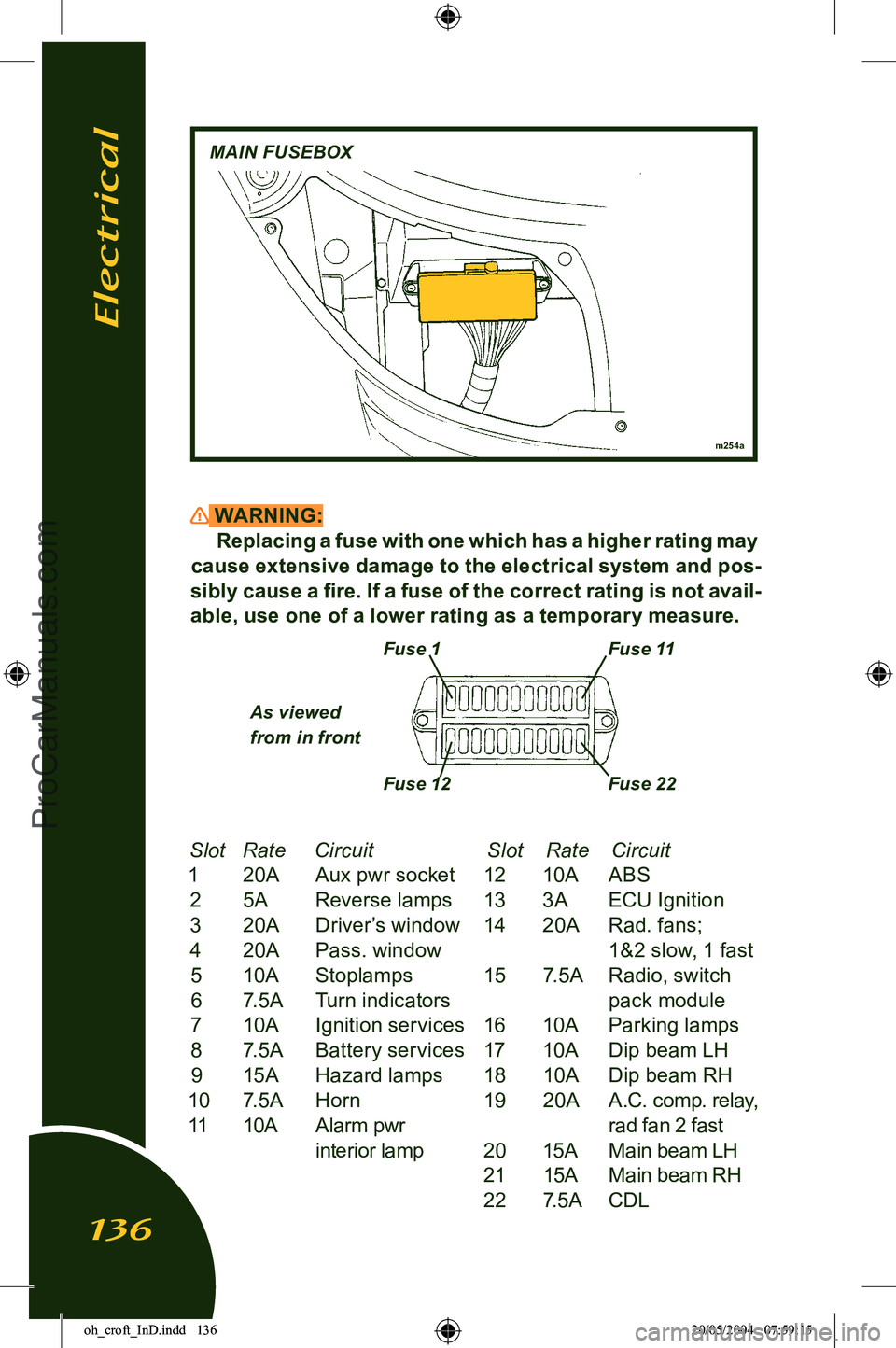
WARNING:Replacing a fuse with one which has a higher rating may
cause extensive damage to the electrical system and pos
-
sibly cause a fire. If a fuse of the correct rating is not avail
-
able, use one of a lower rating as a temporary measure.
Slot
Rate Circuit Slot Rate Circuit
1 20A Aux pwr socket 12 10A ABS 2 5A Reverse lamps 13 3A ECU Ignition
3 20A Driver’s window 14 20A Rad. fans;
4 20A Pass. window 1&2 slow, 1 fast 5 10A Stoplamps 15 7.5A Radio, switch6 7.5A Turn indicators pack module
7 10A Ignition services 16 10A Parking lamps
8 7.5A Battery services 17 10A Dip beam LH9 15A Hazard lamps 18 10A Dip beam RH
10 7.5A Horn 19 20A A.C. comp. relay,
11 10A Alarm pwr rad fan 2 fast interior lamp 20 15A Main beam LH
21 15A Main beam RH
22 7.5A CDL
m254a
MAIN FUSEBOX
Fuse 1Fuse 11
Fuse 12 Fuse 22
As viewed
from in front
Electrical
136
oh_croft_InD.indd 13620/05/2004 07:59:15ProCarManuals.com
Page 142 of 205
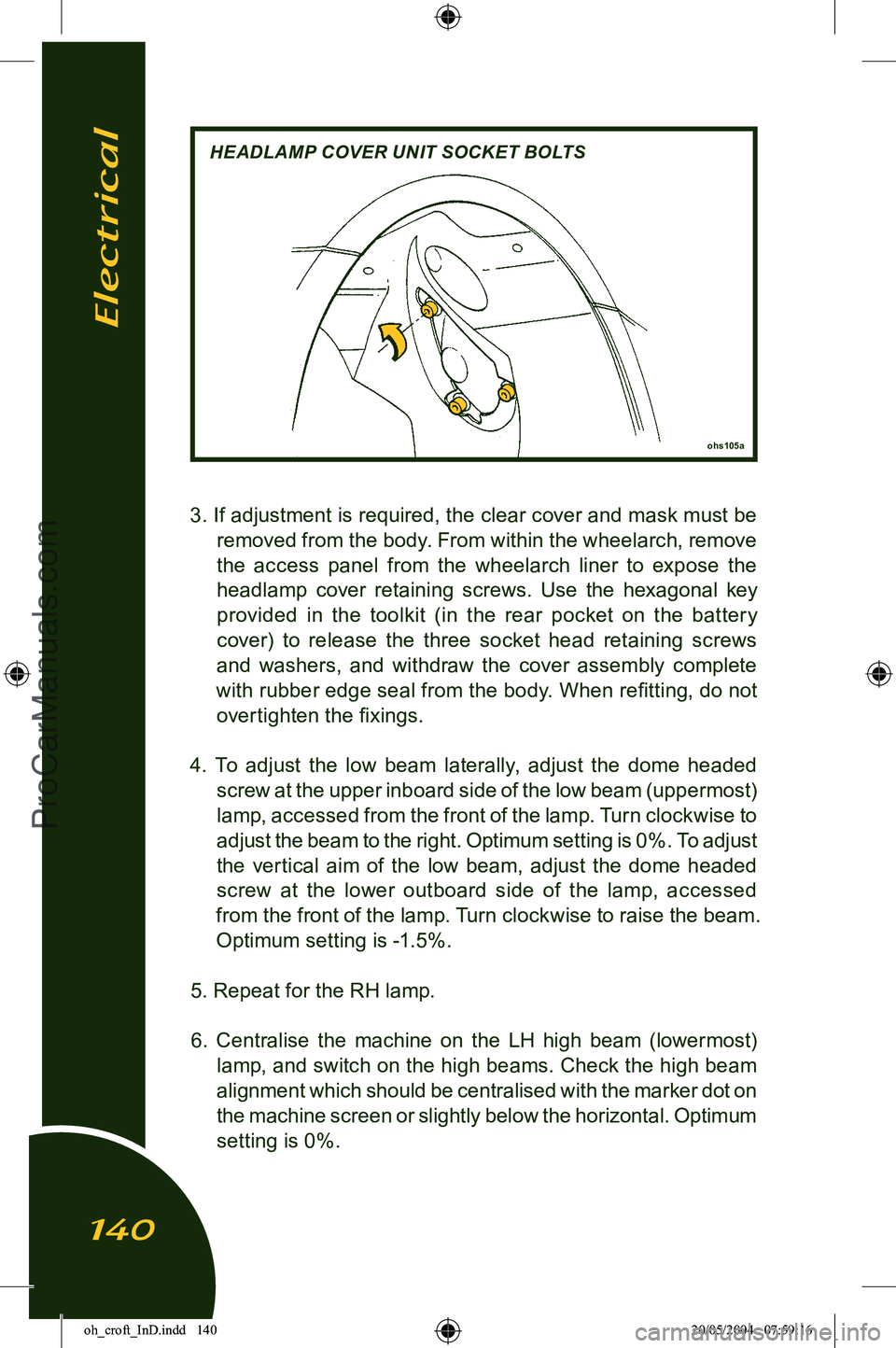
3. If adjustment is required, the clear cover and mask must be removed from the body. From within the wheelarch, remove
the access panel from the wheelarch liner to expose the
headlamp cover retaining screws. Use the hexagonal key provided in the toolkit (in the rear pocket on the batter y
cover) to release the three socket head retaining screws and washers, and withdraw the cover assembly complete
with rubber edge seal from the body. When refitting, do not overtighten the fixings.
4. To adjust the low beam laterally, adjust the dome headed screw at the upper inboard side of the low beam (uppermost)
lamp, accessed from the front of the lamp. Turn clockwise to
adjust the beam to the right. Optimum setting is 0%. To adjust
the vertical aim of the low beam, adjust the dome headed screw at the lower outboard side of the lamp, accessed
from the front of the lamp. Turn clockwise to raise the beam.
Optimum setting is -1.5%.
5. Repeat for the RH lamp. 6. Centralise the machine on the LH high beam (lowermost) lamp, and switch on the high beams. Check the high beam
alignment which should be centralised with the marker dot on
the machine screen or slightly below the horizontal. Optimum
setting is 0%.
ohs105a
HEADLAMP COVER UNIT SOCKET BOLTS
Electrical
140
oh_croft_InD.indd 14020/05/2004 07:59:16ProCarManuals.com
Page 143 of 205
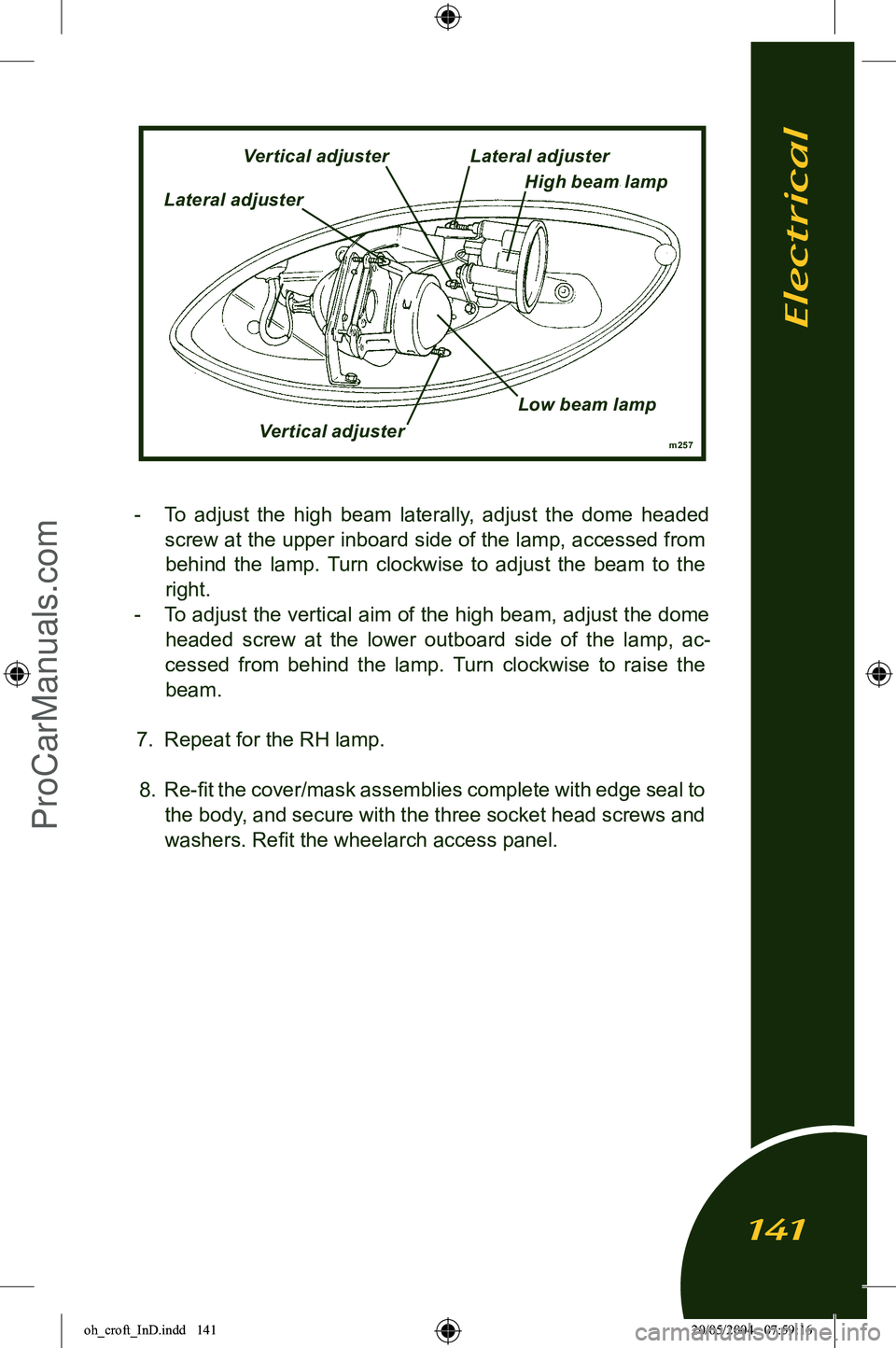
- To adjust the high beam laterally, adjust the dome headed screw at the upper inboard side of the lamp, accessed from behind the lamp. Turn clockwise to adjust the beam to the
right.
- To adjust the vertical aim of the high beam, adjust the dome headed screw at the lower outboard side of the lamp, ac
-
cessed from behind the lamp. Turn clockwise to raise the
beam.
7. Repeat for the RH lamp. 8. Re-fit the cover/mask assemblies complete with edge seal to the body, and secure with the three socket head screws and
washers. Refit the wheelarch access panel.
m257
Vertical adjuster
Lateral adjuster Lateral adjuster
High beam lamp
Vertical adjuster
Low beam lamp
Electrical
141
oh_croft_InD.indd 14120/05/2004 07:59:16ProCarManuals.com
Page 144 of 205
BULB REPLACEMENT
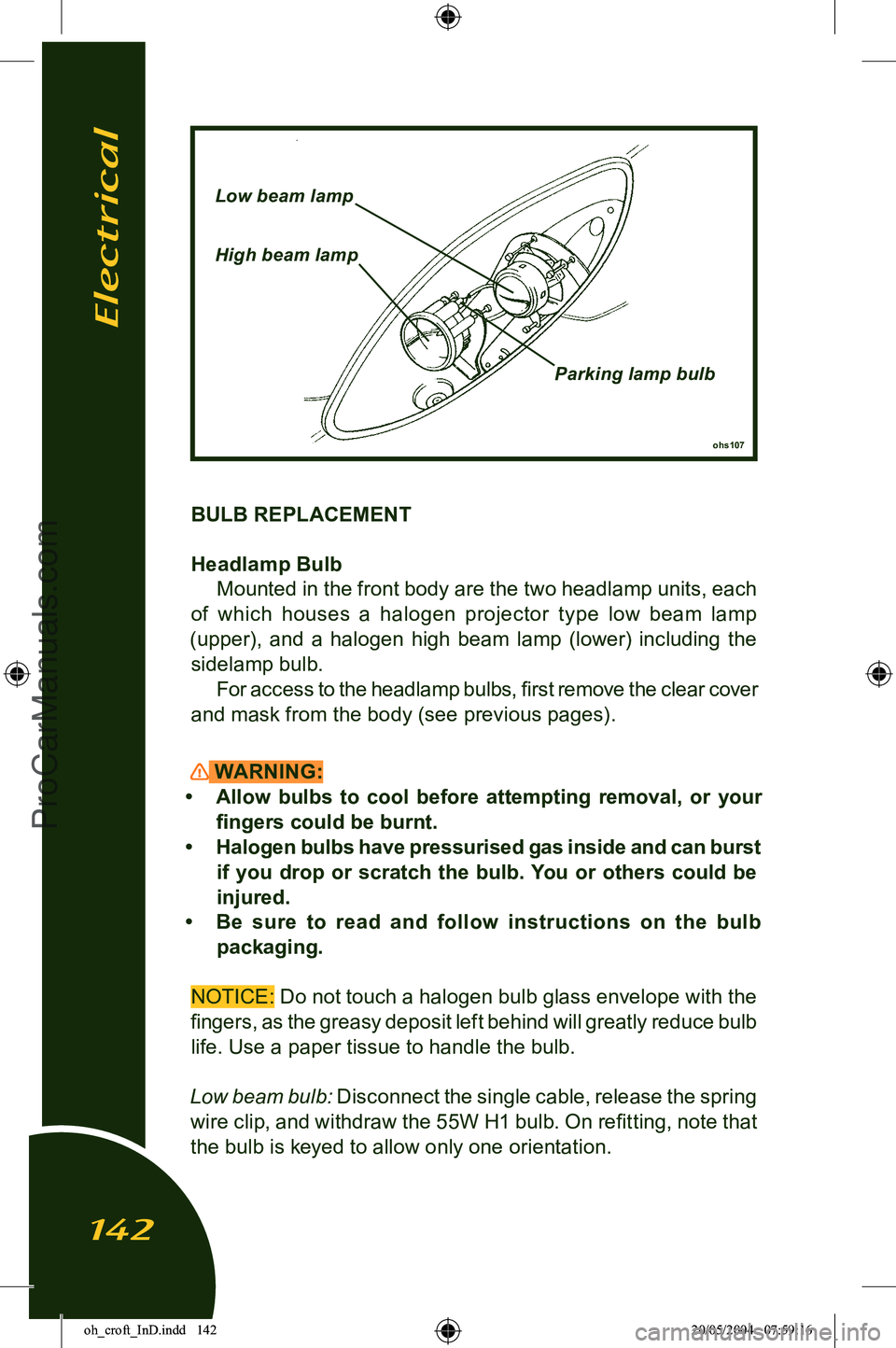
Headlamp BulbMounted in the front body are the two headlamp units, each
of which houses a halogen projector type low beam lamp
(upper), and a halogen high beam lamp (lower) including the sidelamp bulb. For access to the headlamp bulbs, first remove the clear cover
and mask from the body (see previous pages).
WARNING:
• Allow bulbs to cool before attempting removal, or your fingers could be burnt.
• Halogen bulbs have pressurised gas inside and can burst if you drop or scratch the bulb. You or others could be
injured.
• Be sure to read and follow instructions on the bulb
packaging.
NOTICE: Do not touch a halogen bulb glass envelope with the
fingers, as the greasy deposit left behind will greatly reduce bulb life. Use a paper tissue to handle the bulb.
Low beam bulb: Disconnect the single cable, release the spring wire clip, and withdraw the 55W H1 bulb. On refitting, note that the bulb is keyed to allow only one orientation.
ohs107
Low beam lamp
High beam lamp
Parking lamp bulb
Electrical
142
oh_croft_InD.indd 14220/05/2004 07:59:16ProCarManuals.com
Page 145 of 205
High beam bulb: Disconnect the two cables from the bulb, re-
lease the spring wire clip, and withdraw the 55W H7 bulb. On re
-
fitting, note that the bulb is keyed to allow only one orientation.
Parking lamp: Twist the bulb holder counterclockwise to release
from the main beam lamp, and withdraw the bayonet fitting T4
W bulb.
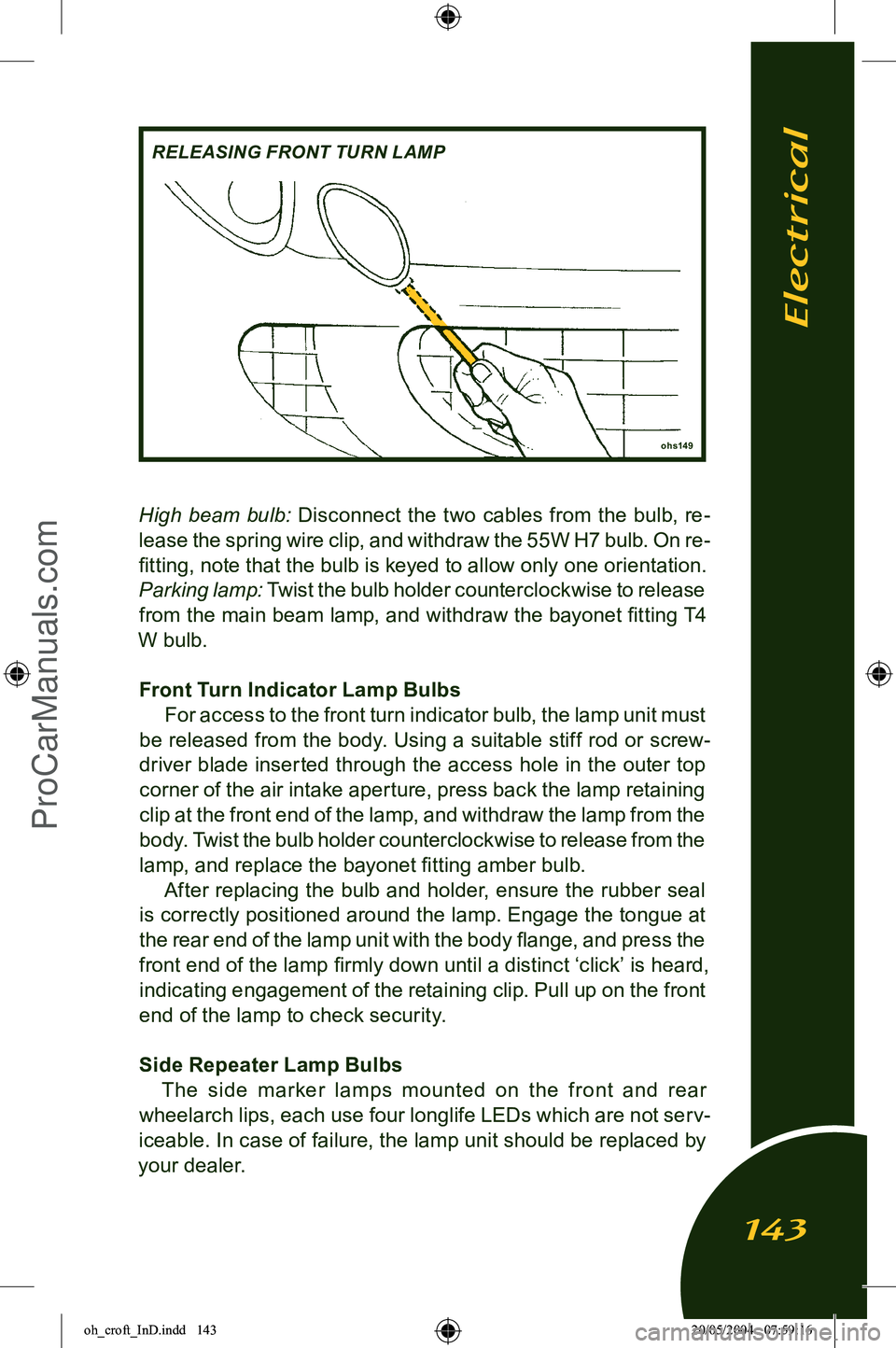
Front Turn Indicator Lamp Bulbs For access to the front turn indicator bulb, the lamp unit must
be released from the body. Using a suitable stiff rod or screw
-
driver blade inserted through the access hole in the outer top
corner of the air intake aperture, press back the lamp retaining
clip at the front end of the lamp, and withdraw the lamp from the body. Twist the bulb holder counterclockwise to release from the
lamp, and replace the bayonet fitting amber bulb. After replacing the bulb and holder, ensure the rubber seal
is correctly positioned around the lamp. Engage the tongue at
the rear end of the lamp unit with the body flange, and press the
front end of the lamp firmly down until a distinct ‘click’ is heard, indicating engagement of the retaining clip. Pull up on the front
end of the lamp to check security.
Side Repeater Lamp Bulbs The side mar ker lamps mounted on the front and rear
wheelarch lips, each use four longlife LEDs which are not serv
-
iceable. In case of failure, the lamp unit should be replaced by
your dealer.
ohs149
RELEASING FRONT TURN LAMP
Electrical
143
oh_croft_InD.indd 14320/05/2004 07:59:16ProCarManuals.com
Page 146 of 205
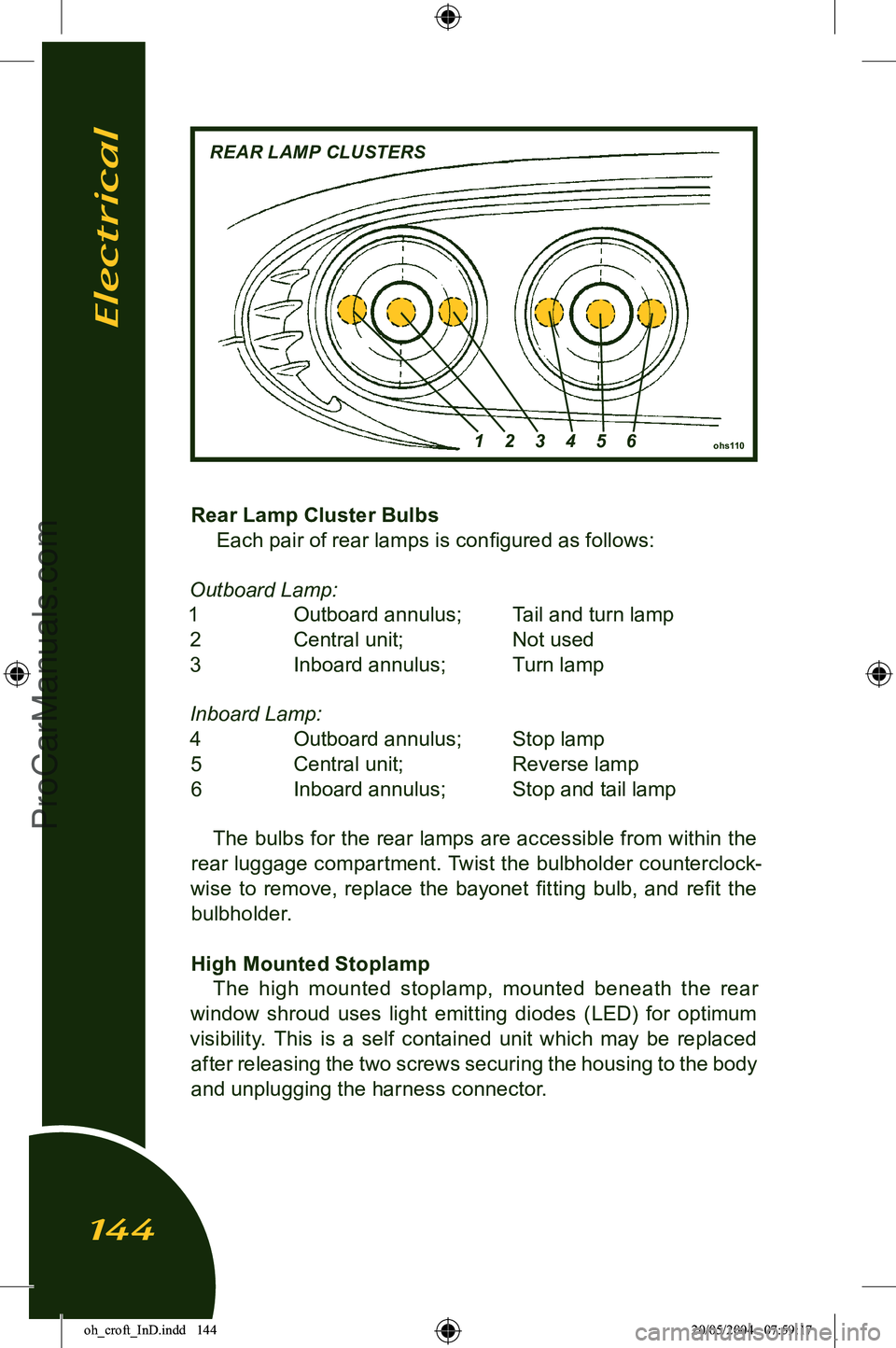
Rear Lamp Cluster BulbsEach pair of rear lamps is configured as follows:
Outboard Lamp:
1 Outboard annulus; Tail and turn lamp 2 Central unit; Not used
3 Inboard annulus; Turn lamp
Inboard Lamp: 4 Outboard annulus; Stop lamp 5 Central unit; Reverse lamp
6 Inboard annulus; Stop and tail lamp
The bulbs for the rear lamps are accessible from within the
rear luggage compartment. Twist the bulbholder counterclock
-
wise to remove, replace the bayonet fitting bulb, and refit the bulbholder.
High Mounted Stoplamp The high mounted stoplamp, mounted beneath the rear
window shroud uses light emitting diodes (LED) for optimum
visibility. This is a self contained unit which may be replaced after releasing the two screws securing the housing to the body
and unplugging the harness connector.
ohs110
REAR LAMP CLUSTERS
1 2 3 4 5 6
Electrical
144
oh_croft_InD.indd 14420/05/2004 07:59:17ProCarManuals.com
Page 154 of 205
Storing Your EliseIf you intend to store your Elise for a prolonged period, con
-
sult your Lotus dealer who will be pleased to advise you. We recommend that the car is stored inside a secure garage. The
following guidelines are provided for your information:
• Ensure the engine oil and filter, coolant and brake fluid have recently been renewed. The a.c. system should be in good
working order and fully charged.
• Thoroughly clean the inside and outside of the car, including the engine compartment. If necessary, use a ‘jet’ washer to remove dirt and salt deposits from the underside, but do not
use around bearings, hydraulic components, painted surfaces or the soft top roof. Allow to dry completely.
• Chock the road wheels, leave off the parking brake, and engage reverse gear.
• Increase the tire pressures to 60 psi (4 bar). If possible, move the car slightly every month to help avoid flat spots on the
Tires.
• Either leave the battery in the car and connect a battery management (conditioner) type of charger, or remove the battery and trickle charge every two months. Note that with
the battery disconnected or removed, the alarm system is
de-activated.
• Unless the garage is equipped with a de-humidifier, the use of drying agents (Silica-Gel) is recommended in cars with
leather upholstery and in conditions of high humidity.
• The use of unapproved car covers may have a detrimental effect on the car’s paint finish and such damage will not be
covered by your car’s warranty.
In general, the Elise will be kept in best operating condition
by regular use.
Accessories
152
oh_croft_InD.indd 15220/05/2004 07:59:19ProCarManuals.com