key LOTUS ELISE 2005 User Guide
[x] Cancel search | Manufacturer: LOTUS, Model Year: 2005, Model line: ELISE, Model: LOTUS ELISE 2005Pages: 205, PDF Size: 4.51 MB
Page 41 of 205
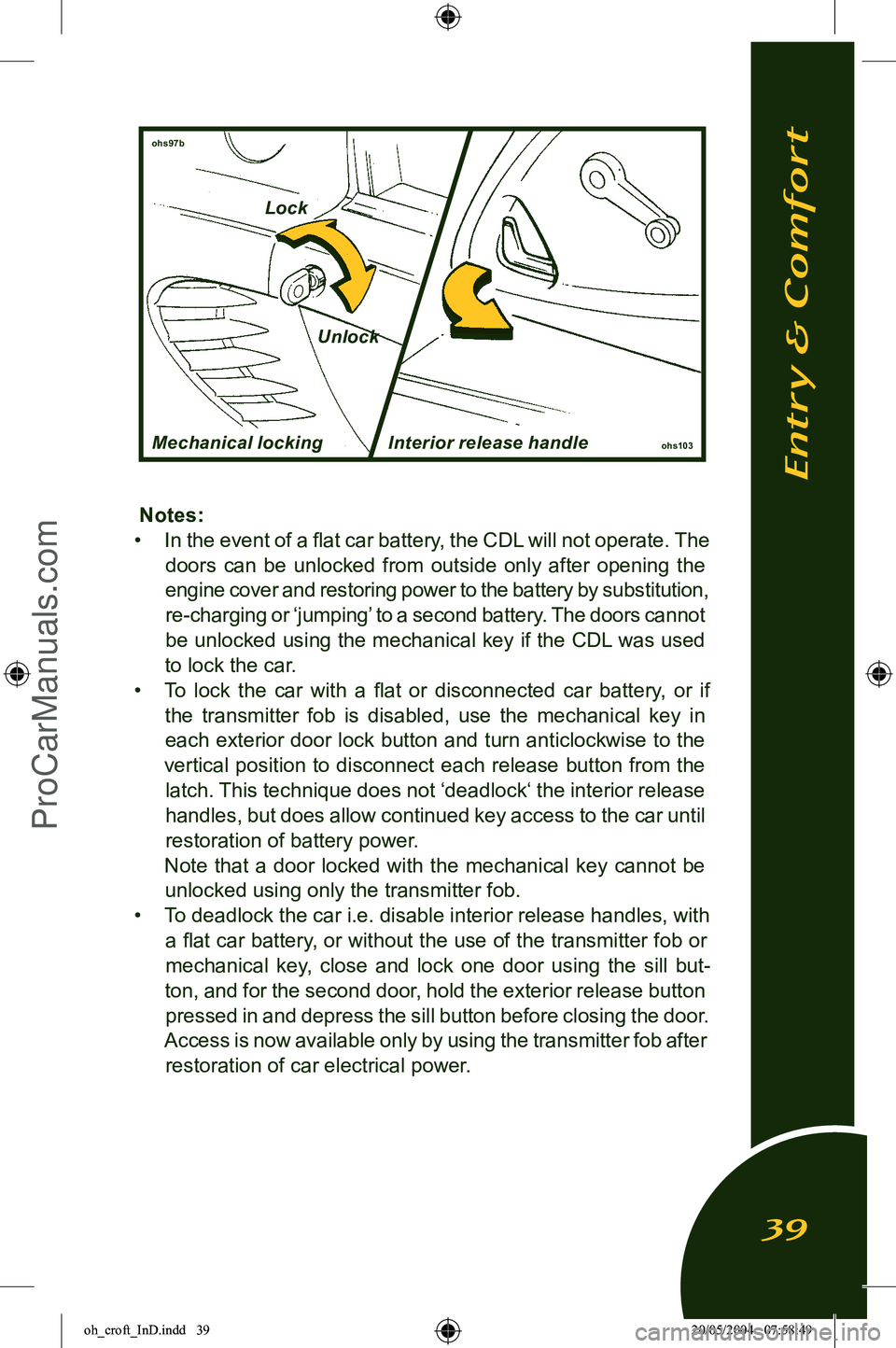
Notes:
• In the event of a flat car battery, the CDL will not operate. The
doors can be unlocked from outside only after opening the
engine cover and restoring power to the battery by substitution,
re-charging or ‘jumping’ to a second battery. The doors cannot
be unlocked using the mechanical key if the CDL was used
to lock the car.
• To lock the car with a flat or disconnected car battery, or if
the transmitter fob is disabled, use the mechanical key in each exterior door lock button and turn anticlockwise to the
vertical position to disconnect each release button from the latch. This technique does not ‘deadlock‘ the interior release
handles, but does allow continued key access to the car until restoration of battery power.
Note that a door locked with the mechanical key cannot be
unlocked using only the transmitter fob.
• To deadlock the car i.e. disable interior release handles, with
a flat car battery, or without the use of the transmitter fob or mechanical key, close and lock one door using the sill but
-
ton, and for the second door, hold the exterior release button pressed in and depress the sill button before closing the door.
Access is now available only by using the transmitter fob after restoration of car electrical power.
ohs97b
ohs103
Mechanical locking Interior release handle
Entry & Comfort
39
LockUnlock
oh_croft_InD.indd 3920/05/2004 07:58:49ProCarManuals.com
Page 44 of 205
Door WindowsIn frosty or icy weather conditions, the windows may become
frozen to the weatherstrip seals. Use a windscreen de-icer spray
to free the glass before operating the windows.
WARNING:
• Before closing a window, always check that no persons or objects will be trapped; incautious window operation
could be dangerous, especially to children. Ensure that any passenger is also made aware of this danger.
• To guard against incautious electric window operation, do not leave small children unattended in the car with
the ignition key in position.
• Do not leave children or animals in a parked car with the roof and windows closed, in hot weather conditions as
they may suffocate and/or experience heat exhaustion.
Manual Winders: Each door window may be raised or lowered by the winder
handle near the front of the door.
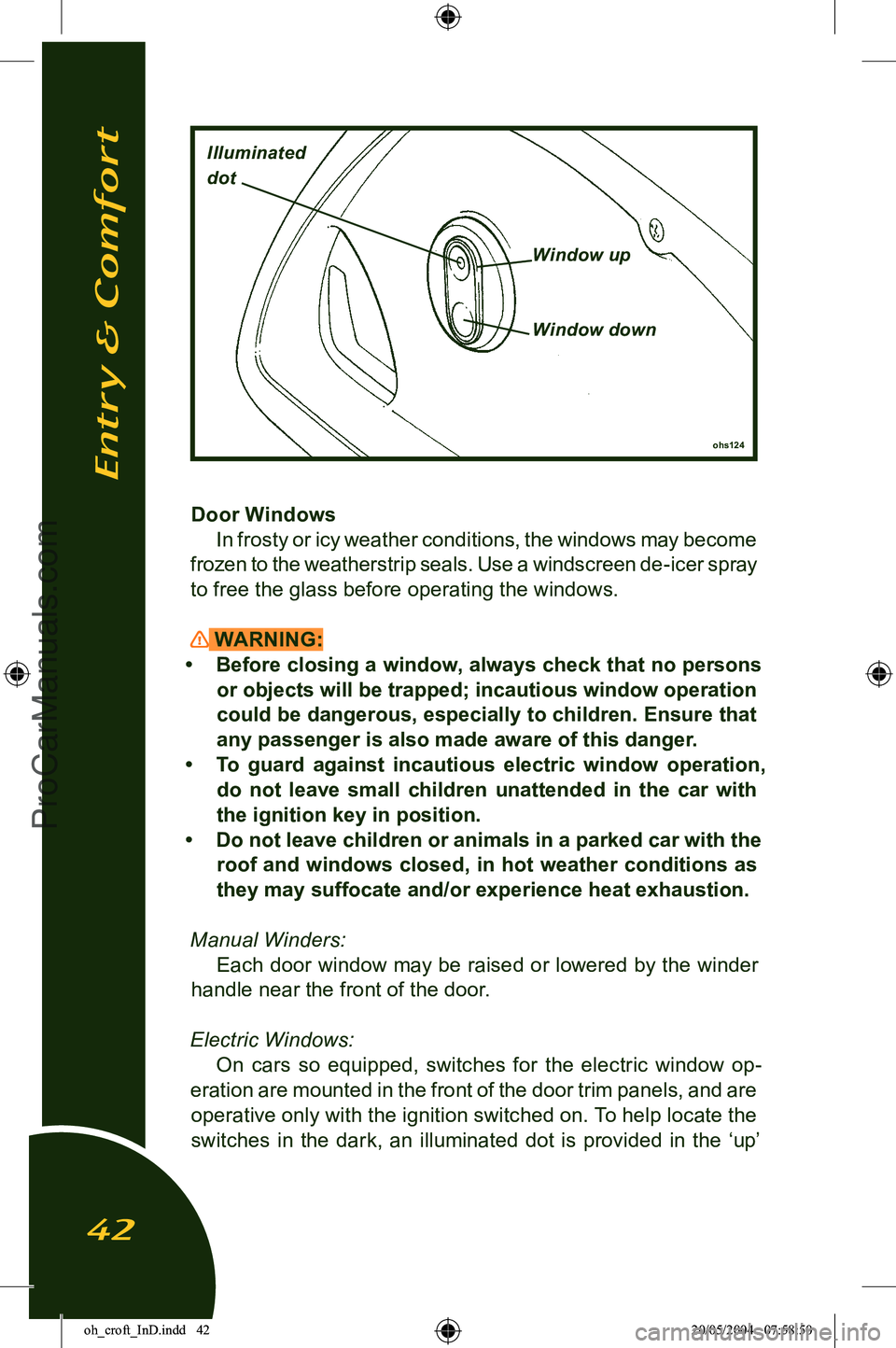
Electric Windows: On cars so equipped, switches for the electric window op
-
eration are mounted in the front of the door trim panels, and are operative only with the ignition switched on. To help locate the
switches in the dark, an illuminated dot is provided in the ‘up’
Entry & Comfort
42
ohs124
Illuminated
dot
Window up
Window down
oh_croft_InD.indd 4220/05/2004 07:58:50ProCarManuals.com
Page 46 of 205
oh33e
Key insert /removeColumn unlocked
Ignition auxilliaries
Position not used
INSTRUMENTS & SWITCHES
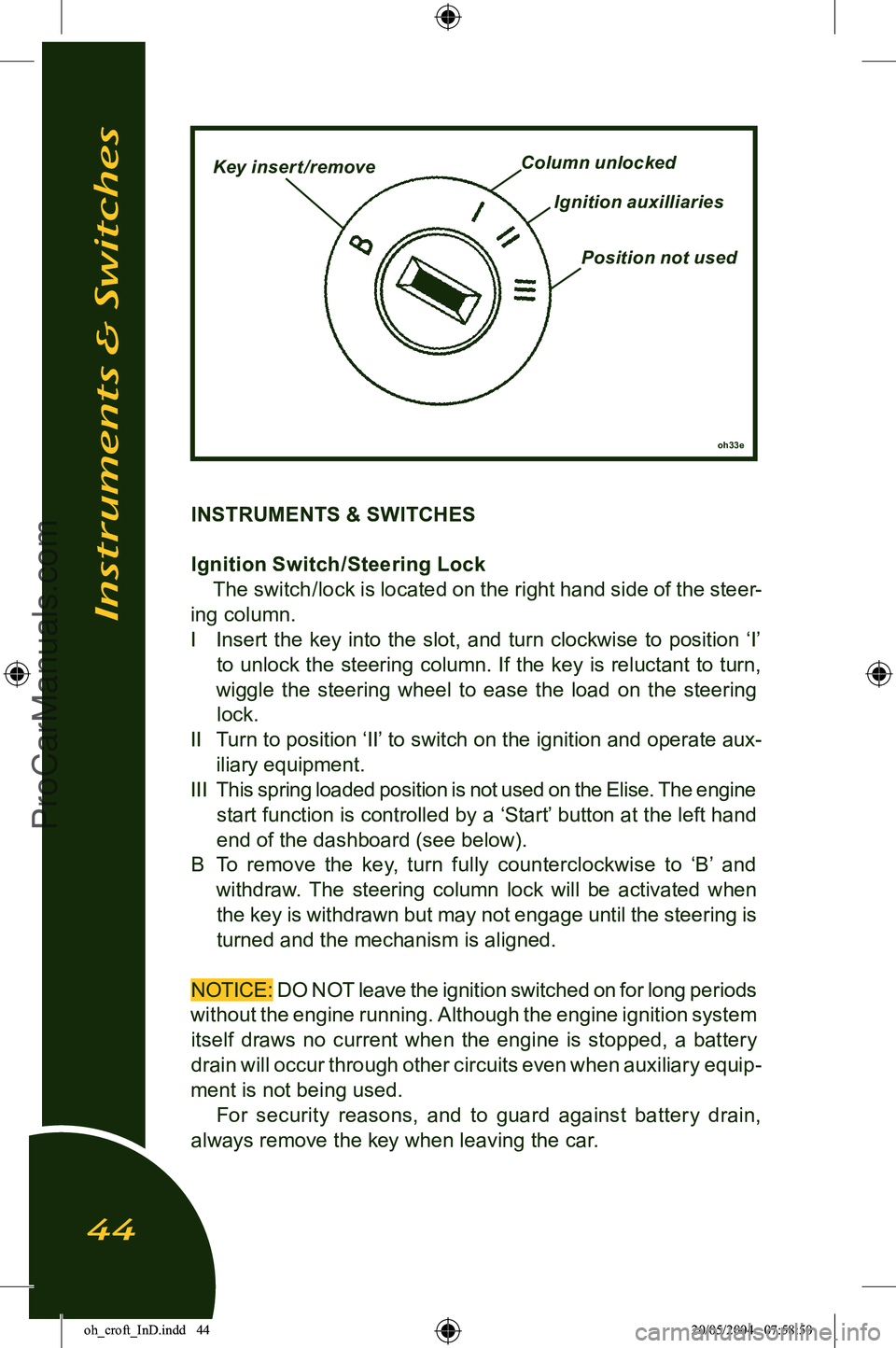
Ignition Switch /Steering LockThe switch/lock is located on the right hand side of the steer
-
ing column.
I Insert the key into the slot, and turn clockwise to position ‘I’ to unlock the steering column. If the key is reluctant to turn,
wiggle the steering wheel to ease the load on the steering
lock.
II Turn to position ‘II’ to switch on the ignition and operate aux-
iliary equipment.
III This spring loaded position is not used on the Elise. The engine
start function is controlled by a ‘Start’ button at the left hand
end of the dashboard (see below).
B To remove the key, turn fully counterclockwise to ‘B’ and withdraw. The steering column lock will be activated when the key is withdrawn but may not engage until the steering is
turned and the mechanism is aligned.
NOTICE: DO NOT leave the ignition switched on for long periods
without the engine running. Although the engine ignition system itself draws no current when the engine is stopped, a battery drain will occur through other circuits even when auxiliary equip
-
ment is not being used. For security reasons, and to guard against battery drain,
always remove the key when leaving the car.
Instruments & Switches
44
oh_croft_InD.indd 4420/05/2004 07:58:50ProCarManuals.com
Page 47 of 205
WARNING:
• Do not push or tow the car unless the key is first used to unlock the column and is then left in the lock. With
-
drawing the key will cause the steering to lock.
• Never remove the key from the ignition switch or turn off the ignition while the car is moving. Withdrawing the key
will cause the steering to lock and may cause an accident
resulting in serious injury or death.
• To reduce the risk of theft, or danger to a child remaining in the car, always remove the key when leaving a parked
car.
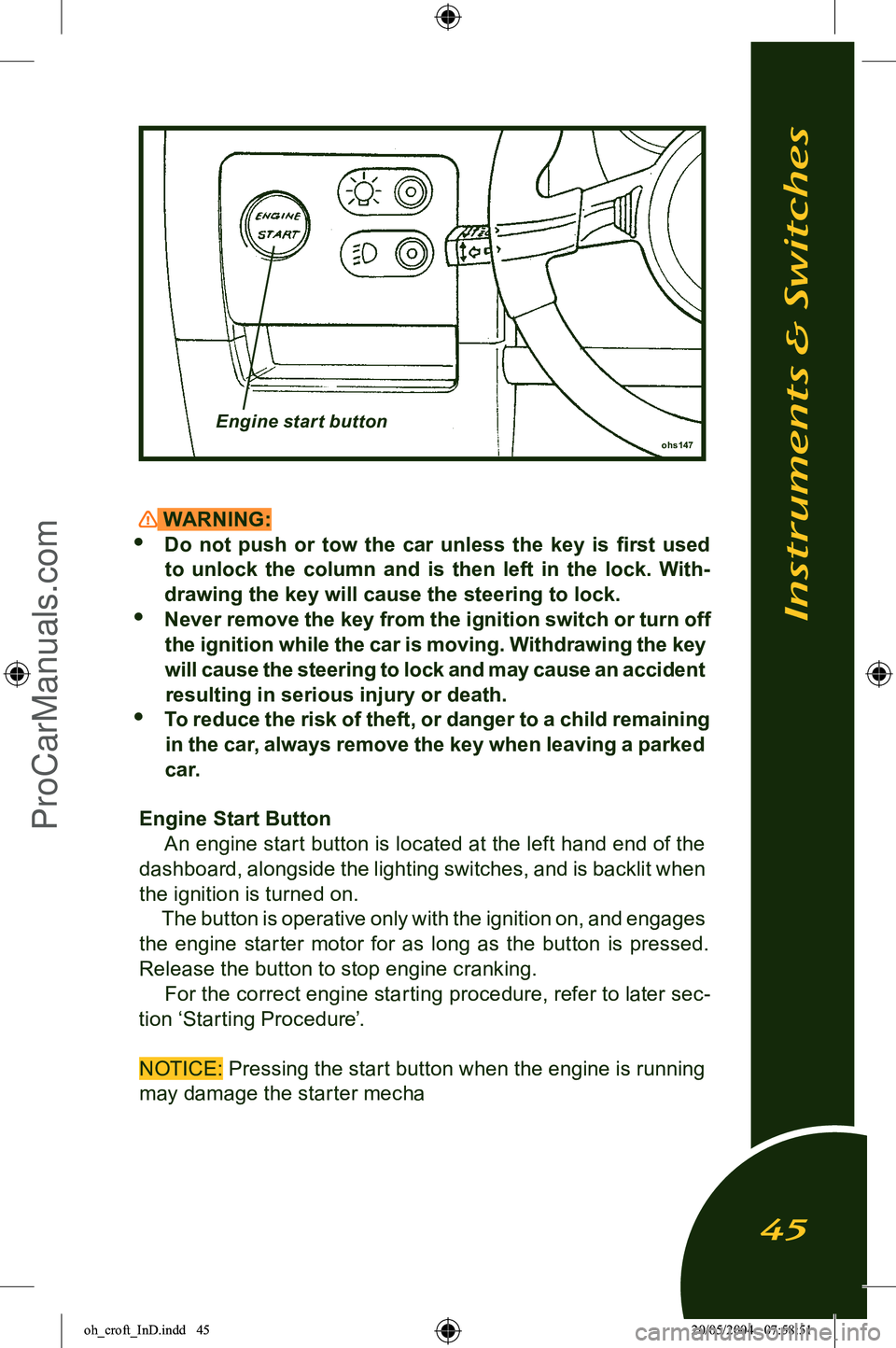
Engine Start Button An engine start button is located at the left hand end of the
dashboard, alongside the lighting switches, and is backlit when
the ignition is turned on. The button is operative only with the ignition on, and engages
the engine starter motor for as long as the button is pressed. Release the button to stop engine cranking.
For the correct engine starting procedure, refer to later sec
-
tion ‘Starting Procedure’.
NOTICE: Pressing the start button when the engine is running may damage the starter mecha
ohs147Engine start button
Instruments & Switches
45
oh_croft_InD.indd 4520/05/2004 07:58:51ProCarManuals.com
Page 62 of 205
Windscreen Washer: Two windscreen washer jets are provided,
one each side of the wiper spindle. Pulling the control lever to
-
wards the steering wheel will operate both the washer pump and the wiper. When the switch is released, the wiper will continue
for a further four sweeps.
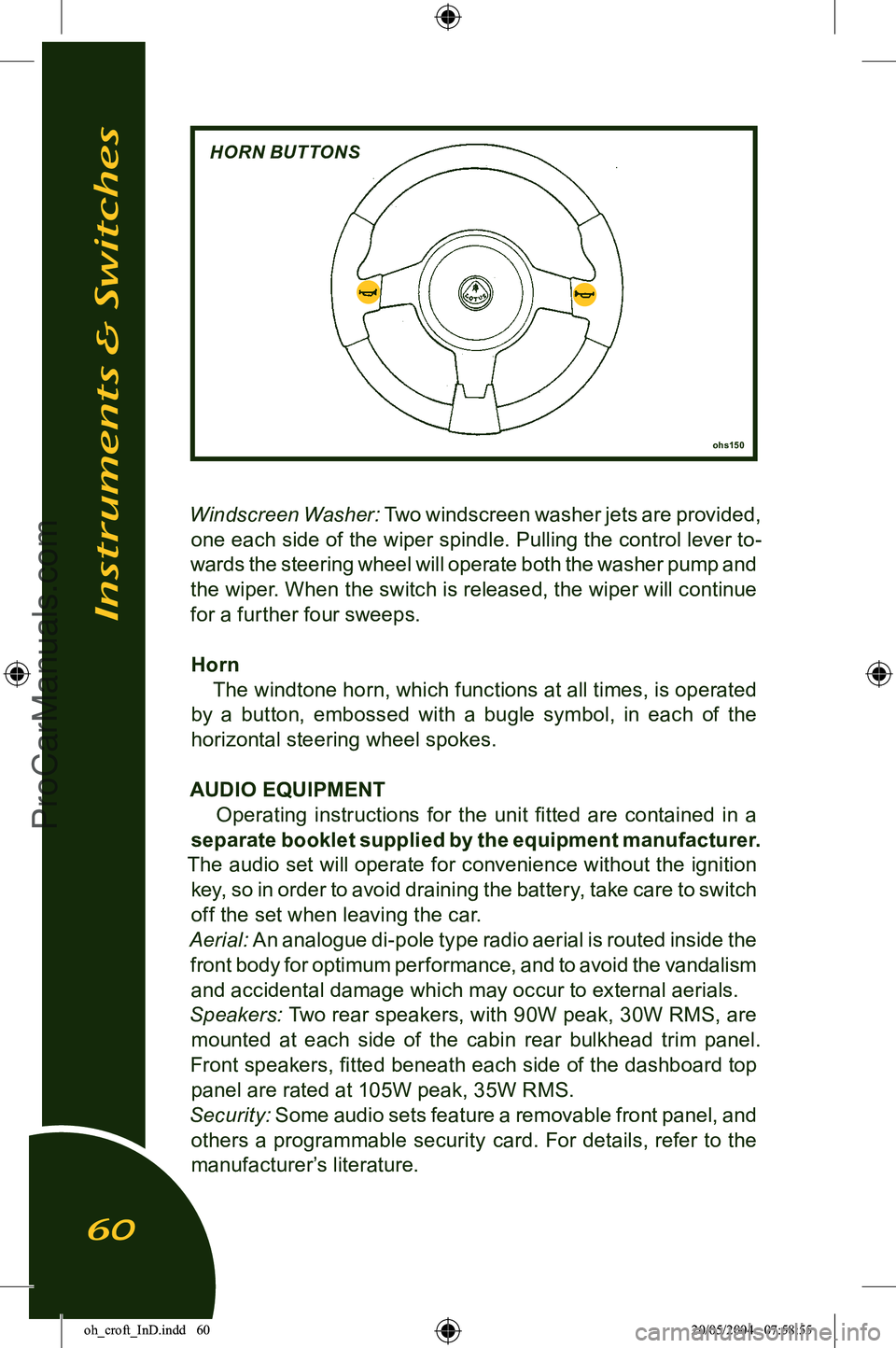
Horn The windtone horn, which functions at all times, is operated
by a button, embossed with a bugle symbol, in each of the
horizontal steering wheel spokes.
AUDIO EQUIPMENT Operating instructions for the unit fitted are contained in a
separate booklet supplied by the equipment manufacturer.
The audio set will operate for convenience without the ignition key, so in order to avoid draining the battery, take care to switch
off the set when leaving the car.
Aerial:
An analogue di-pole type radio aerial is routed inside the
front body for optimum performance, and to avoid the vandalism and accidental damage which may occur to external aerials.
Speakers:
Two rear speakers, with 90W peak, 30W RMS, are
mounted at each side of the cabin rear bulkhead trim panel.
Front speakers, fitted beneath each side of the dashboard top
panel are rated at 105W peak, 35W RMS.
Security:
Some audio sets feature a removable front panel, and
others a programmable security card. For details, refer to the
manufacturer’s literature.
Instruments & Switches
60
ohs150
HORN BUTTONS
oh_croft_InD.indd 6020/05/2004 07:58:55ProCarManuals.com
Page 74 of 205
STARTING PROCEDURE & ENGINE BREAK-IN
WARNING:CARBON MONOXIDE - Be aware of the danger of carbon
monoxide! Never run the engine in an enclosed space. The
exhaust gases contain carbon monoxide, a deadly gas
which is particularly dangerous, as being colourless odour
-
less and tasteless, its presence is very difficult to detect.
Before starting the engine, always check that the parking
brake is firmly applied, the transmission is in neutral, and as
an extra precaution, depress the clutch pedal. Switch off any
unnecessary electrical loads.
Starting a Cold or Warm Engine
The fuel injection and engine management system controls fuel delivery and engine settings under all normal operating conditions.
i) Insert the key into the steering lock/ignition switch and turn to
position ‘l’ to unlock the column. Before turning on the igni
-
tion; if the security tell tale in the tachometer face is flashing, mobilise the engine by pressing once, and for a full second,
the larger of the two buttons on the transmitter fob.
ii) Turn the key to position ‘II’ to switch on the ignition, and pause
for a moment to allow the fuel system to prime.
iii) Depress the clutch pedal as a precaution, and without moving
the accelerator, press the ‘Start’ button at the left hand end of
the dashboard to engage the starter motor. Release the button
as soon as the engine starts. Allow a cold engine to idle for
10 seconds before driving off, but if ambient temperatures are below freezing, allow the engine and screen heating systems
to warm up for a few minutes before driving.
iv) If the engine fails to start within 15 seconds, stop cranking
and pause for 10 seconds before a second attempt.
v) If further efforts are unsuccessful, contact your dealer or seek
other expert help.
WARNING:
An unattended car with a running engine is potentially
hazardous. Turn off the engine before leaving the car.
Starting & Engine Break-In
72
oh_croft_InD.indd 7220/05/2004 07:58:58ProCarManuals.com
Page 80 of 205
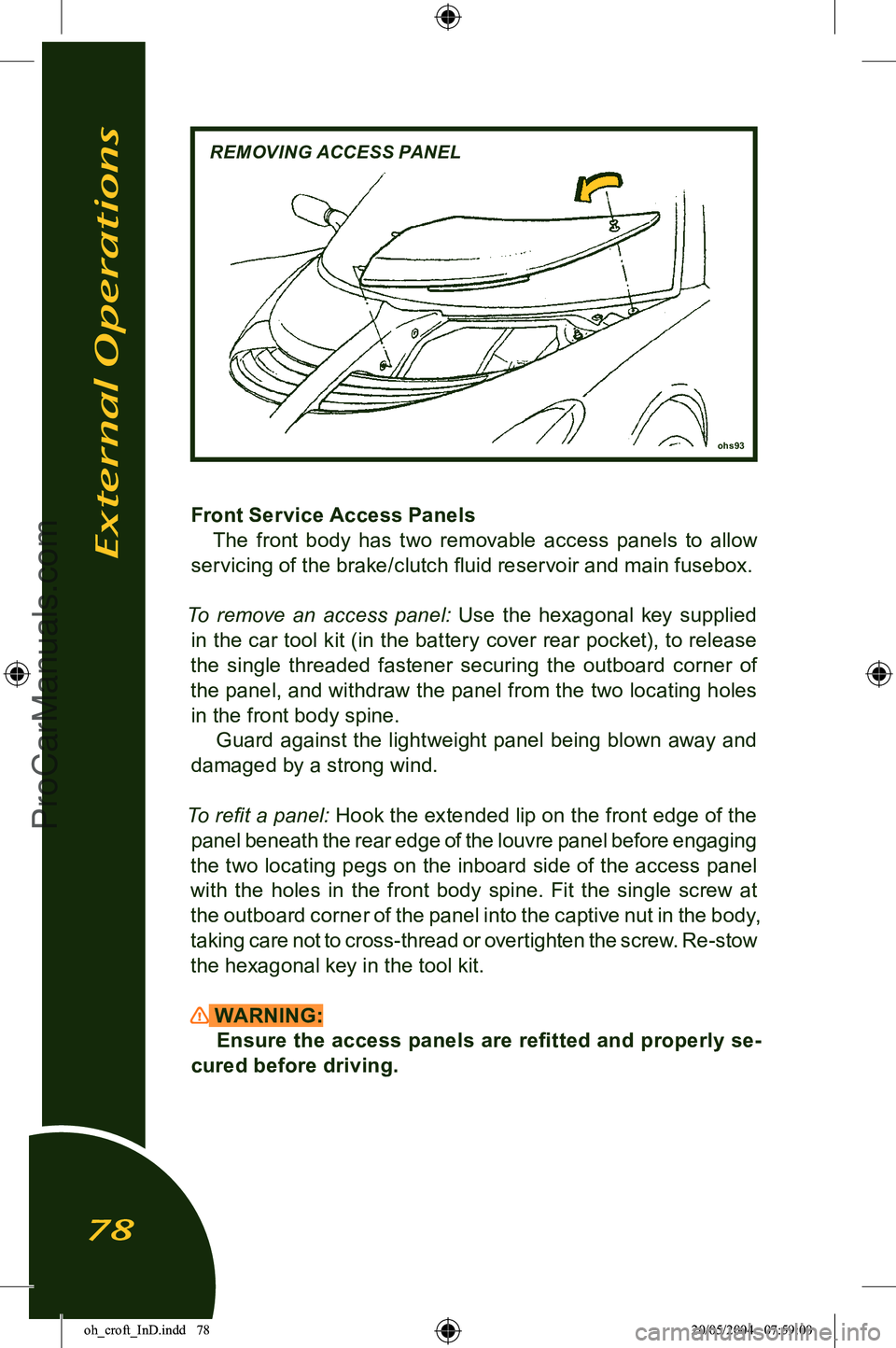
ohs93
REMOVING ACCESS PANEL
Front Service Access PanelsThe front body has two removable access panels to allow
servicing of the brake/clutch fluid reservoir and main fusebox.
To remove an access panel:
Use the hexagonal key supplied
in the car tool kit (in the battery cover rear pocket), to release
the single threaded fastener securing the outboard corner of
the panel, and withdraw the panel from the two locating holes in the front body spine. Guard against the lightweight panel being blown away and
damaged by a strong wind.
To refit a panel: Hook the extended lip on the front edge of the panel beneath the rear edge of the louvre panel before engaging
the two locating pegs on the inboard side of the access panel
with the holes in the front body spine. Fit the single screw at
the outboard corner of the panel into the captive nut in the body,
taking care not to cross-thread or overtighten the screw. Re-stow
the hexagonal key in the tool kit.
WARNING: Ensure the access panels are refitted and properly se
-
cured before driving.
External Operations
78
oh_croft_InD.indd 7820/05/2004 07:59:00ProCarManuals.com
Page 81 of 205
Engine Cover/Trunk LidThe engine cover/trunk lid provides access to the engine and
rear luggage compartment.
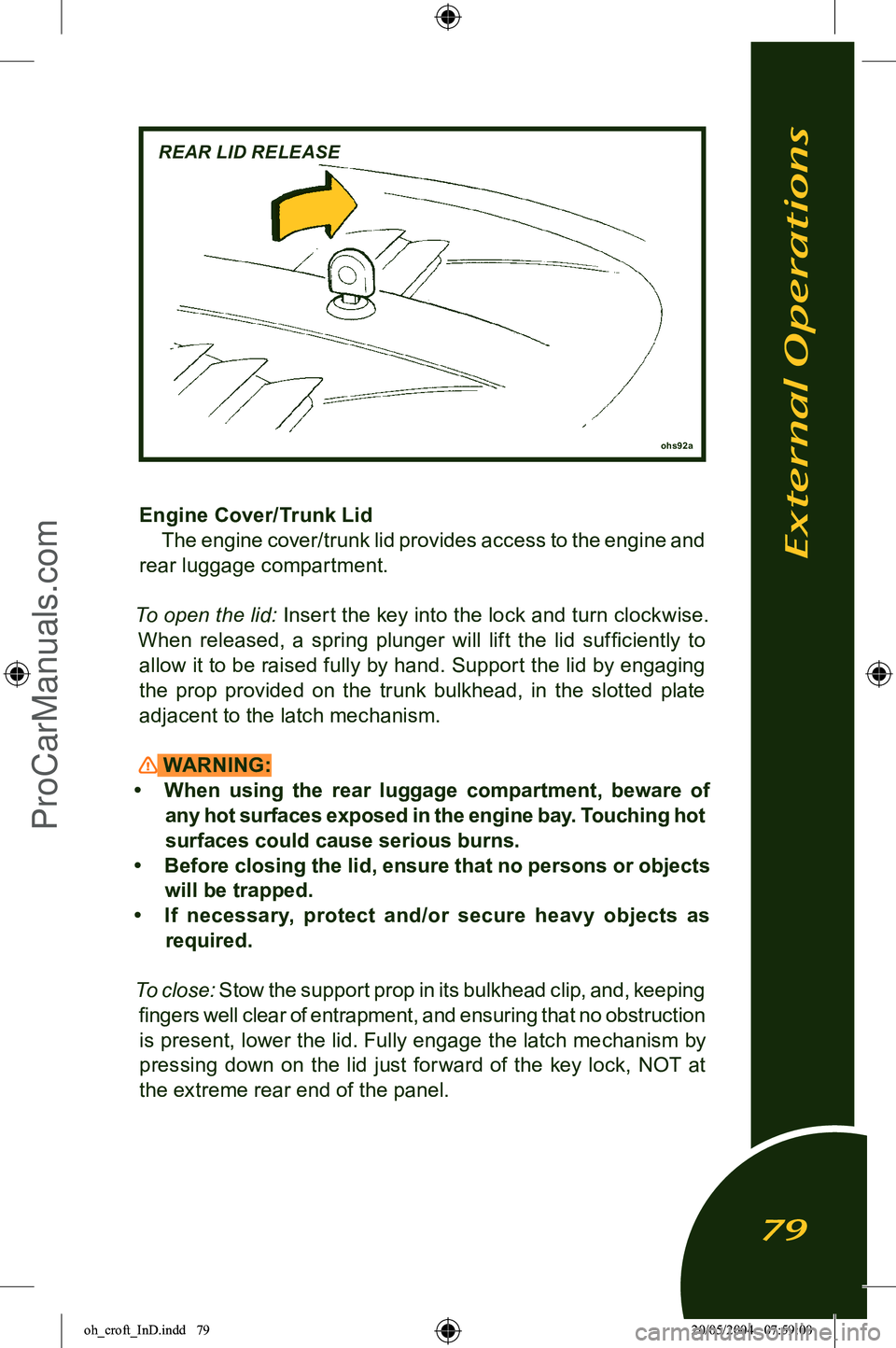
To open the lid: Insert the key into the lock and turn clockwise. When released, a spring plunger will lift the lid sufficiently to allow it to be raised fully by hand. Support the lid by engaging
the prop provided on the trunk bulkhead, in the slotted plate adjacent to the latch mechanism.
WARNING:
• When using the rear luggage compartment, beware of any hot surfaces exposed in the engine bay. Touching hot
surfaces could cause serious burns.
• Before closing the lid, ensure that no persons or objects
will be trapped.
• If necessary, protect and/or secure heavy objects as required.
To close: Stow the support prop in its bulkhead clip, and, keeping
fingers well clear of entrapment, and ensuring that no obstruction is present, lower the lid. Fully engage the latch mechanism by pressing down on the lid just forward of the key lock, NOT at
the extreme rear end of the panel.
ohs92a
REAR LID RELEASE
External Operations
79
oh_croft_InD.indd 7920/05/2004 07:59:00ProCarManuals.com
Page 84 of 205

b332
FITTING ROOF STAYS
Soft Top Roof - Fitting
WARNING:Do not attempt to fit the soft top roof whilst the car is in
motion. This could cause a crash in which you or others
could be killed or seriously injured.
1. From its stowage bag in the rear luggage compartment, with-
draw the roof assembly and support stays. Lower both door
windows, or open both doors.
2. Insert the two, identical, roof support stays, with the arrows pointing forwards, into the slots above the rear window, and
in the windscreen header rail. Note that the slots are keyed
to allow fitment of the stays in only the correct orientation.
3. Lay the soft top roof across the centre of the roof space with
the arrows on the side rails pointing forwards.
External Operations
82
Arrows
point for ward
Rear end keyway
oh_croft_InD.indd 8220/05/2004 07:59:01ProCarManuals.com
Page 102 of 205
pressing firmly to ensure that the handle is fully seated. With-
draw the dipstick again to inspect the oil level, which should lie between the two dimples on the end of the stick. The oil level
should be maintained at the upper of these two marks in order
to provide optimum engine protection.
Topping Up
: If topping up is necessary, unscrew the oil filler cap
from the left hand end of the cam cover. Add a suitable quantity of the recommended engine oil (see ‘Recommended Lubricants’)
taking care not to spill any oil onto engine or electrical compo
-
nents; use a funnel if necessary. The difference between high and low dipstick marks is equiv
-
alent to 1.6 U.S. quarts (1.5 litre). Allow several minutes for the oil to drain through to the sump before re-checking the oil level.
Do NOT over fill, or lubrication will be degraded and consump
-
tion increased as the oil becomes aerated. Refit the filler cap,
turning clockwise until secure.
Engine Oil Change The use of high quality oil, renewed at the specified intervals,
is the key to engine longevity and sustained performance. Ad
-
here strictly to the engine oil and filter change intervals specified
in the Maintenance Schedule.
For access to the engine sump and filter, the engine bay
undertray must first be removed. This is most easily achieved
with the car raised on a garage hydraulic lift, or alternatively, parked over an inspection pit.
The drain plug is located at the rear of the sump, and should
be removed to drain the sump immediately after a run when
the oil is warm and the impurities are still held in suspension.
On cars fitted with front mounted oil coolers, it is not necessary routinely to attempt to drain the cooler circuit. Servicing & Maintenance
100
oh_croft_InD.indd 10020/05/2004 07:59:05ProCarManuals.com