lock LOTUS ELISE 2005 User Guide
[x] Cancel search | Manufacturer: LOTUS, Model Year: 2005, Model line: ELISE, Model: LOTUS ELISE 2005Pages: 205, PDF Size: 4.51 MB
Page 34 of 205
Arming the AlarmRemove the ignition key, close (and lock) both doors, and
check that the engine cover and front body access panels are
secure. The roof may be either closed or open. Press once, and for a full second, the larger of the two buttons on the trans
-
mitter fob (on cars with central door locking, this action will automatically lock both doors - see later). This command will
be acknowledged by:
- 2 flashes of the hazard warning lamps;
- Continuous flashing of the security tell tale.
Check that these indications occur. If not, press the button a
second time, as the first press may have only switched off the passive immobilisation (see above). Note that if the system is armed when a door or engine cover/
front access panel is not fully closed or if the interior lamp is in the ‘off’ position, a continuous buzz will be heard as warning. If still open after expiry of the arming period, (see below)
the alarm will be armed with that switch group (both doors, or
front/rear access lids) excluded from the circuit.
After arming the system, the engine is immediately immo
-
bilised, but a period of approximately 45 seconds must elapse
before all functions and sensors become fully active. After
this time, the alarm will be triggered by any of the following actions:
- Interruption of the car battery power supply.
- Energising the ignition circuit (‘hot wiring’).
- Opening a door;
- Opening the engine cover or a front access panel.
- Movement detected within the cabin.
When the alarm is triggered, the hazard warning lamps will
flash and the electronic wailing siren will sound for a period of approximately 30 seconds before closing down and resetting, ready for any further triggering input. If a trigger is continuously
present, the alarm will repeat after a short delay, and continue
in this sequence for about 10 cycles. To silence the siren when triggered, press once, and for a full
second, the larger button on the transmitter fob. This will not affect the status of the alarm which will remain armed.
Keys & Car Security Alarm
32
oh_croft_InD.indd 3220/05/2004 07:58:47ProCarManuals.com
Page 36 of 205
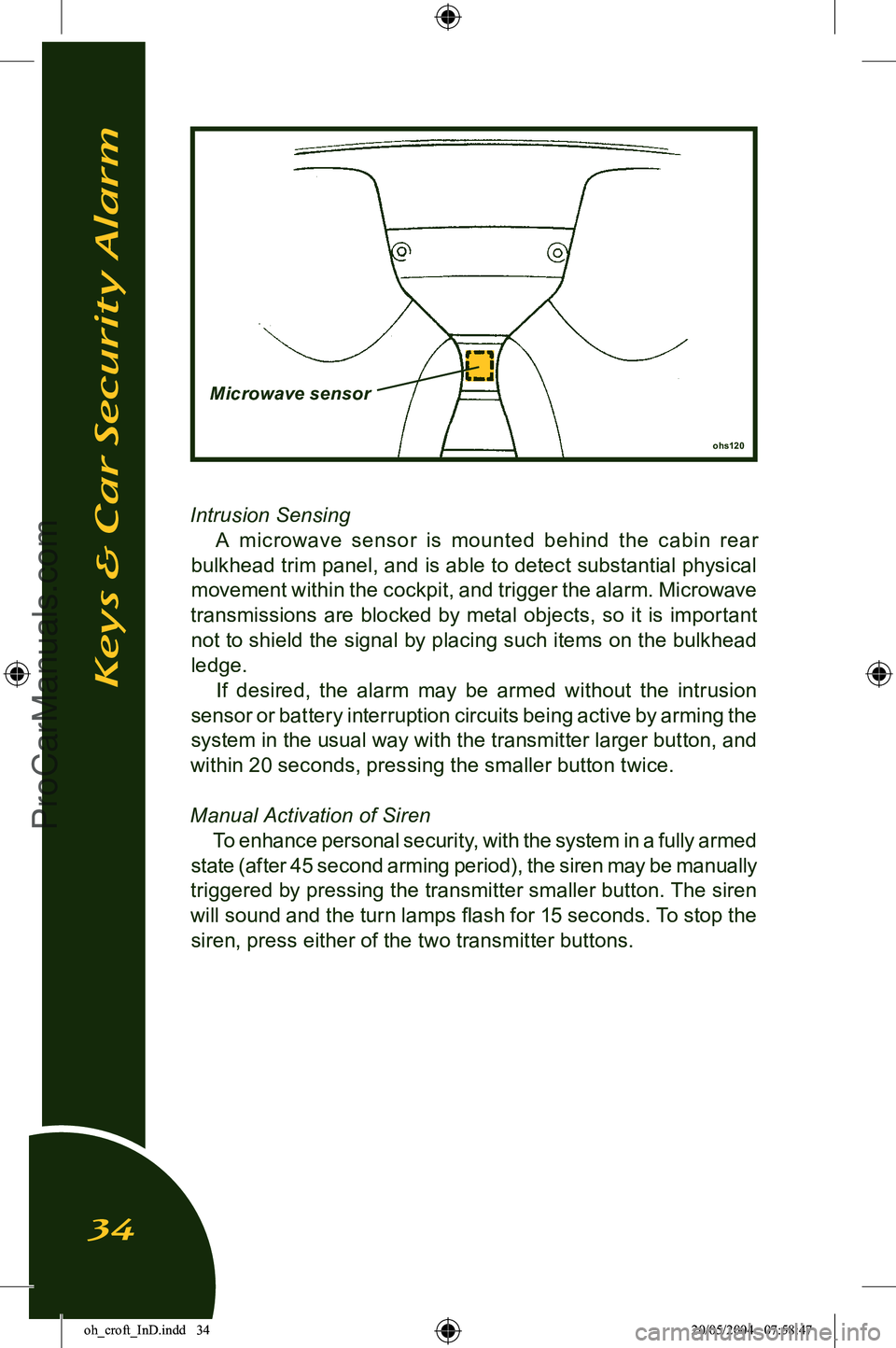
Intrusion SensingA microwave sensor is mounted behind the cabin rear
bulkhead trim panel, and is able to detect substantial physical
movement within the cockpit, and trigger the alarm. Microwave
transmissions are blocked by metal objects, so it is important not to shield the signal by placing such items on the bulkhead ledge.
If desired, the alarm may be armed without the intrusion
sensor or battery interruption circuits being active by arming the
system in the usual way with the transmitter larger button, and
within 20 seconds, pressing the smaller button twice.
Manual Activation of Siren To enhance personal security, with the system in a fully armed
state (after 45 second arming period), the siren may be manually
triggered by pressing the transmitter smaller button. The siren
will sound and the turn lamps flash for 15 seconds. To stop the siren, press either of the two transmitter buttons.
ohs120
Keys & Car Security Alarm
34
Microwave sensor
oh_croft_InD.indd 3420/05/2004 07:58:47ProCarManuals.com
Page 39 of 205
ENTRY & COMFORT
WARNING:
• In very hot/cold territories, or under conditions of extreme solar heating, be aware of exposed metal surfaces in the
cabin. Take suitable precautions to guard against burn
injuries from hot or cold metal.
• Unlocked doors can be dangerous. Young children who get into unlocked cars may be unable to get out.
Always lock your car whenever you leave it.
Central Door Locking (CDL) The central door locking (CDL) operates on the driver’s and
passenger’s doors in conjunction with the security alarm system.
For full details of the alarm system, see page 30.
To unlock from outside: To unlock the doors from outside, press once, for a full second,
the larger button on the transmitter fob. The alarm will be dis
-
armed and both doors unlocked. Press the exterior lock button and pull open the door using the fingergrip below the button. If
the door is swung fully open, a spring detent mechanism on the hinge will aid restraint of the door for convenience whilst entering or exiting the car, but the door should be manually held in windy
conditions, or if the car is parked on a slope.
From inside the car, pull the door firmly shut using the recess
provided at the top of the door trim panel.
WARNING: Before closing a door take care to ensure that no persons
or objects will be trapped to avoid injury or damage.
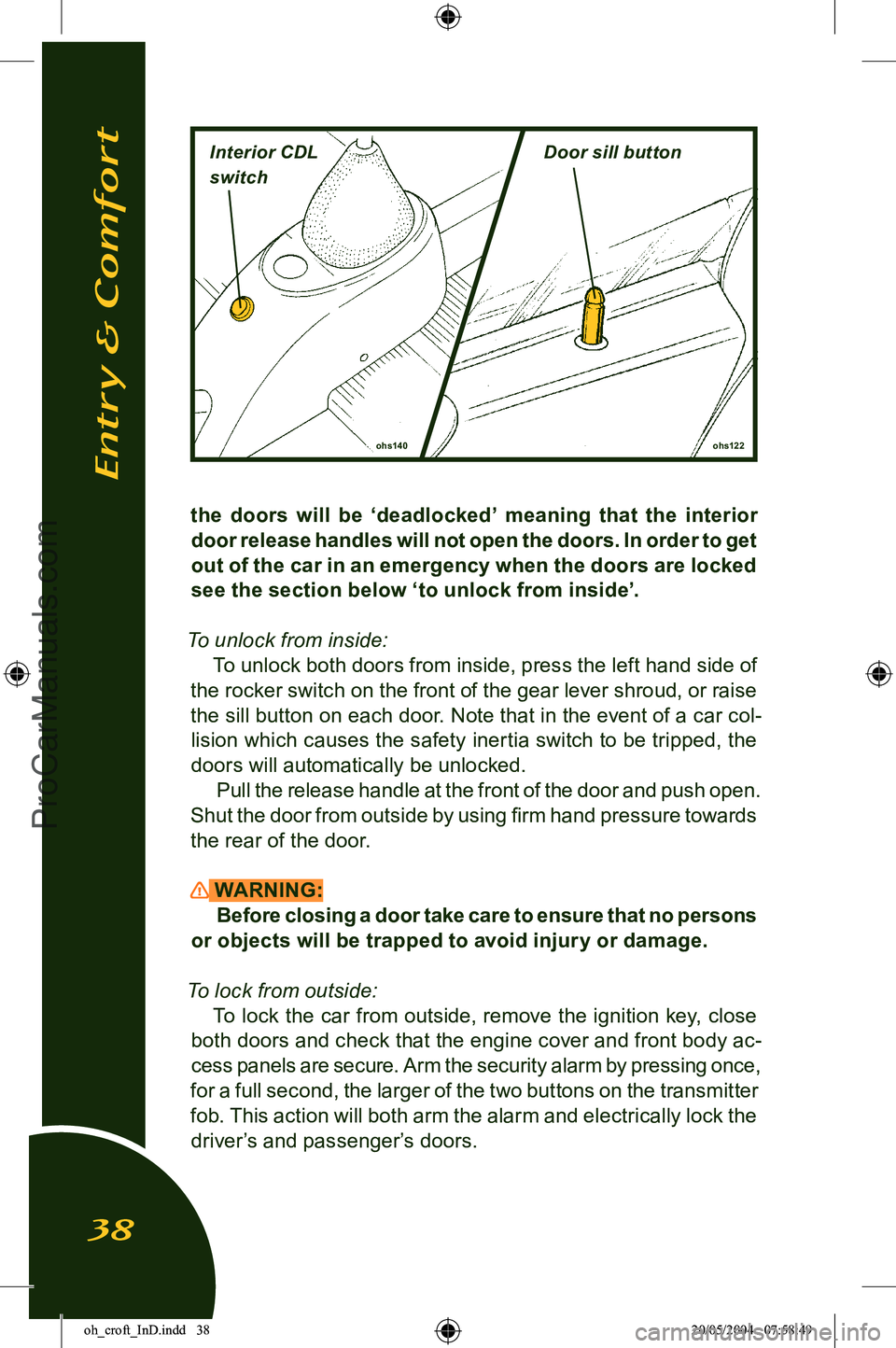
To lock from inside: If it is desired to lock the doors from inside the car, for example
to deter highjack attempts, press the right hand side of the CDL
rocker switch on the front of the gear lever shroud to lock both
doors with or without the ignition switched on. Alternatively, the
doors can be locked individually by depressing the button at the rear end of each door sill.
WARNING: Whether locked using the rocker switch or sill buttons,
Entry & Comfort
37
oh_croft_InD.indd 3720/05/2004 07:58:48ProCarManuals.com
Page 40 of 205
the doors will be ‘deadlocked’ meaning that the interior door release handles will not open the doors. In order to get
out of the car in an emergency when the doors are locked
see the section below ‘to unlock from inside’.
To unlock from inside: To unlock both doors from inside, press the left hand side of
the rocker switch on the front of the gear lever shroud, or raise
the sill button on each door. Note that in the event of a car col
-
lision which causes the safety inertia switch to be tripped, the doors will automatically be unlocked.
Pull the release handle at the front of the door and push open.
Shut the door from outside by using firm hand pressure towards the rear of the door.
WARNING: Before closing a door take care to ensure that no persons
or objects will be trapped to avoid injury or damage.
To lock from outside: To lock the car from outside, remove the ignition key, close
both doors and check that the engine cover and front body ac
-
cess panels are secure. Arm the security alarm by pressing once,
for a full second, the larger of the two buttons on the transmitter
fob. This action will both arm the alarm and electrically lock the driver’s and passenger’s doors.
ohs122
ohs140
Entry & Comfort
38
Interior CDL
switchDoor sill button
oh_croft_InD.indd 3820/05/2004 07:58:49ProCarManuals.com
Page 41 of 205
Notes:
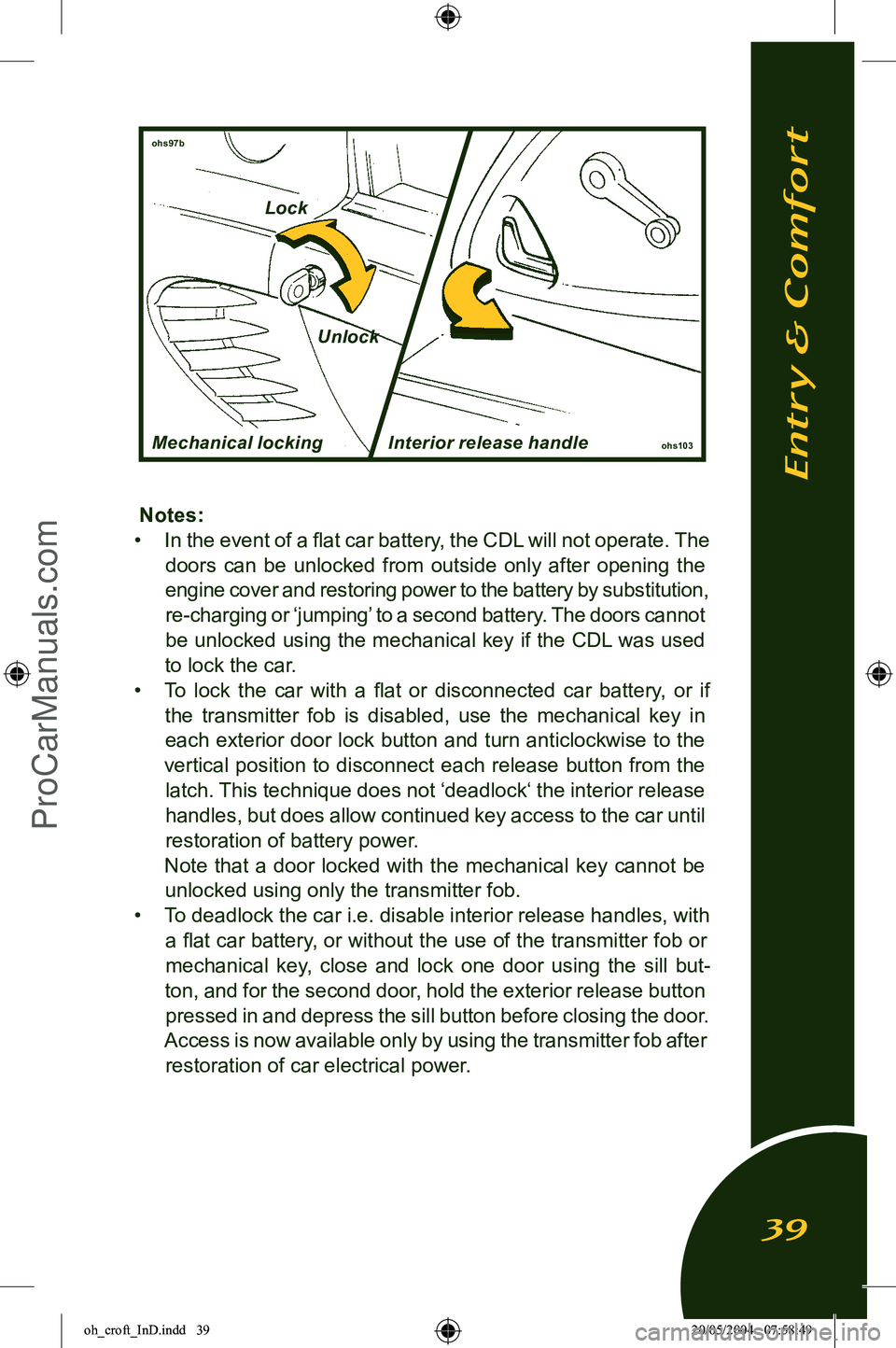
• In the event of a flat car battery, the CDL will not operate. The
doors can be unlocked from outside only after opening the
engine cover and restoring power to the battery by substitution,
re-charging or ‘jumping’ to a second battery. The doors cannot
be unlocked using the mechanical key if the CDL was used
to lock the car.
• To lock the car with a flat or disconnected car battery, or if
the transmitter fob is disabled, use the mechanical key in each exterior door lock button and turn anticlockwise to the
vertical position to disconnect each release button from the latch. This technique does not ‘deadlock‘ the interior release
handles, but does allow continued key access to the car until restoration of battery power.
Note that a door locked with the mechanical key cannot be
unlocked using only the transmitter fob.
• To deadlock the car i.e. disable interior release handles, with
a flat car battery, or without the use of the transmitter fob or mechanical key, close and lock one door using the sill but
-
ton, and for the second door, hold the exterior release button pressed in and depress the sill button before closing the door.
Access is now available only by using the transmitter fob after restoration of car electrical power.
ohs97b
ohs103
Mechanical locking Interior release handle
Entry & Comfort
39
LockUnlock
oh_croft_InD.indd 3920/05/2004 07:58:49ProCarManuals.com
Page 46 of 205
oh33e
Key insert /removeColumn unlocked
Ignition auxilliaries
Position not used
INSTRUMENTS & SWITCHES
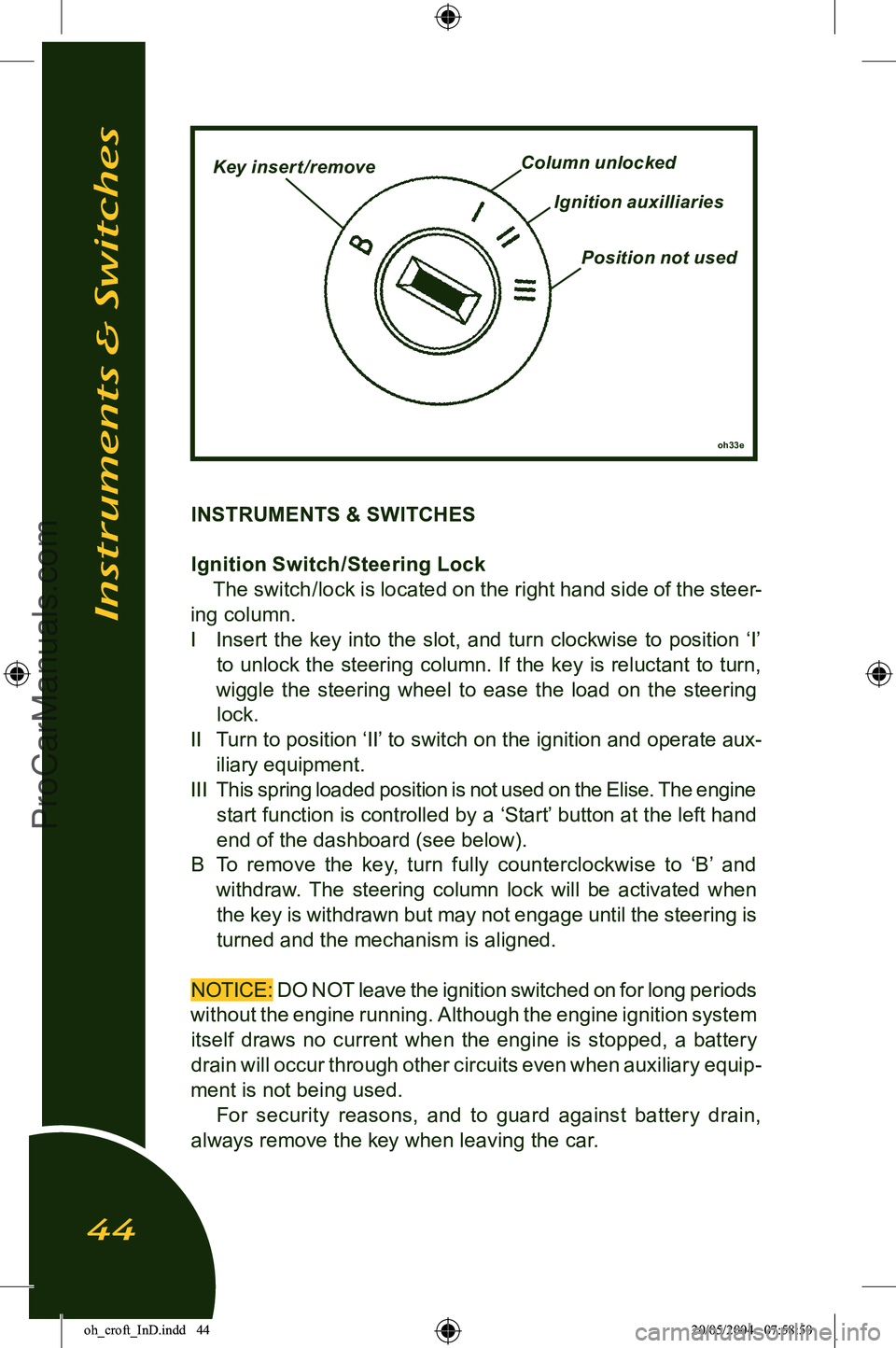
Ignition Switch /Steering LockThe switch/lock is located on the right hand side of the steer
-
ing column.
I Insert the key into the slot, and turn clockwise to position ‘I’ to unlock the steering column. If the key is reluctant to turn,
wiggle the steering wheel to ease the load on the steering
lock.
II Turn to position ‘II’ to switch on the ignition and operate aux-
iliary equipment.
III This spring loaded position is not used on the Elise. The engine
start function is controlled by a ‘Start’ button at the left hand
end of the dashboard (see below).
B To remove the key, turn fully counterclockwise to ‘B’ and withdraw. The steering column lock will be activated when the key is withdrawn but may not engage until the steering is
turned and the mechanism is aligned.
NOTICE: DO NOT leave the ignition switched on for long periods
without the engine running. Although the engine ignition system itself draws no current when the engine is stopped, a battery drain will occur through other circuits even when auxiliary equip
-
ment is not being used. For security reasons, and to guard against battery drain,
always remove the key when leaving the car.
Instruments & Switches
44
oh_croft_InD.indd 4420/05/2004 07:58:50ProCarManuals.com
Page 47 of 205
WARNING:
• Do not push or tow the car unless the key is first used to unlock the column and is then left in the lock. With
-
drawing the key will cause the steering to lock.
• Never remove the key from the ignition switch or turn off the ignition while the car is moving. Withdrawing the key
will cause the steering to lock and may cause an accident
resulting in serious injury or death.
• To reduce the risk of theft, or danger to a child remaining in the car, always remove the key when leaving a parked
car.
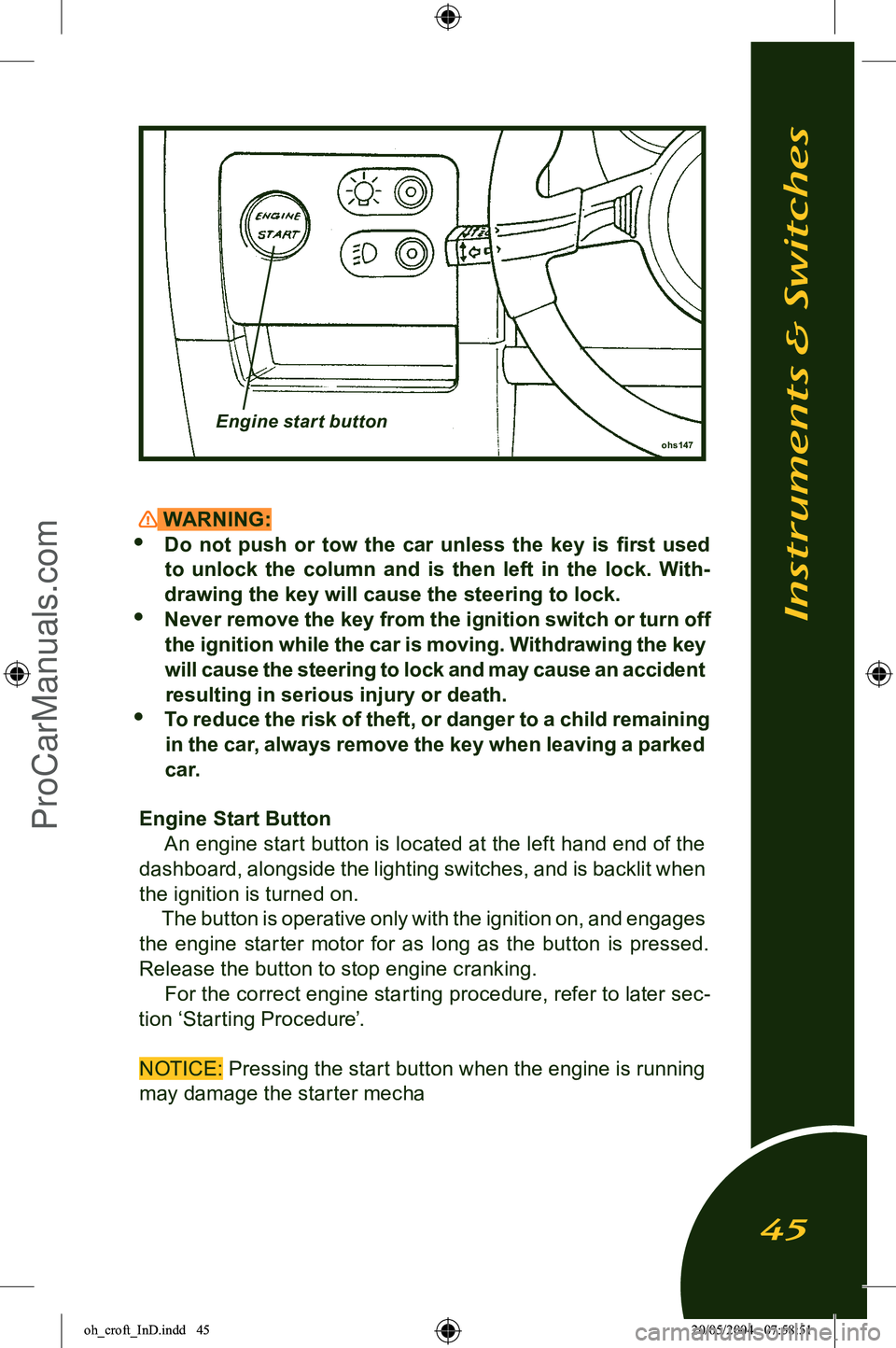
Engine Start Button An engine start button is located at the left hand end of the
dashboard, alongside the lighting switches, and is backlit when
the ignition is turned on. The button is operative only with the ignition on, and engages
the engine starter motor for as long as the button is pressed. Release the button to stop engine cranking.
For the correct engine starting procedure, refer to later sec
-
tion ‘Starting Procedure’.
NOTICE: Pressing the start button when the engine is running may damage the starter mecha
ohs147Engine start button
Instruments & Switches
45
oh_croft_InD.indd 4520/05/2004 07:58:51ProCarManuals.com
Page 48 of 205
Passive Ilisation: The start button will operate only when the
security tell tale in the tachometer face is out. If the tell tale is
flashing, the engine is immobilised; Press once,
and for a full second, the larger of the two buttons on the trans
-
mitter fob. The security tell tale will be extinguished. For further
information see ‘Car Security Alarm’.
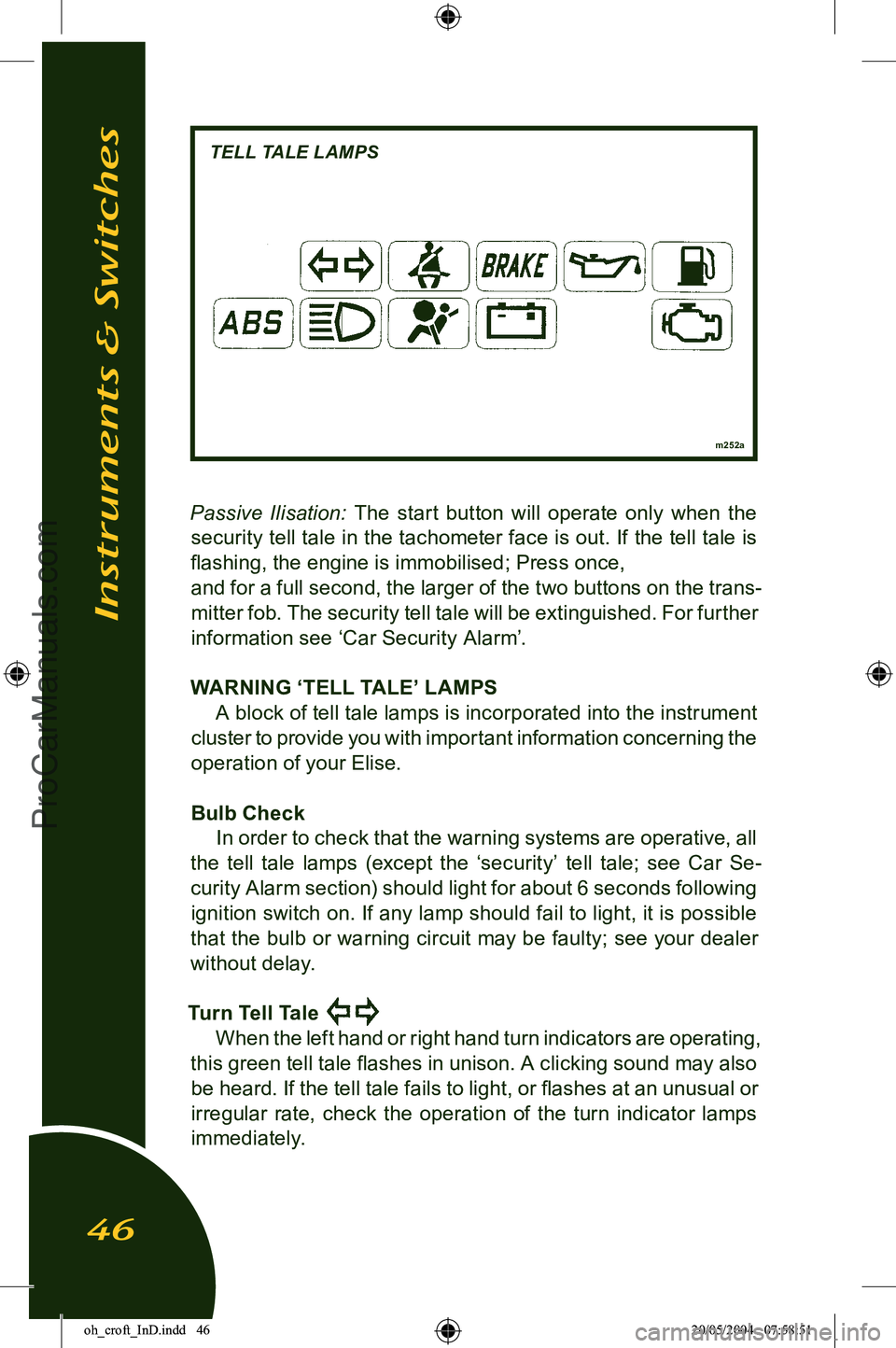
WARNING ‘TELL TALE’ LAMPS A block of tell tale lamps is incorporated into the instrument
cluster to provide you with important information concerning the
operation of your Elise.
Bulb Check In order to check that the warning systems are operative, all
the tell tale lamps (except the ‘security’ tell tale; see Car Se
-
curity Alarm section) should light for about 6 seconds following ignition switch on. If any lamp should fail to light, it is possible
that the bulb or warning circuit may be faulty; see your dealer
without delay.
Turn Tell Tale
When the left hand or right hand turn indicators are operating,
this green tell tale flashes in unison. A clicking sound may also be heard. If the tell tale fails to light, or flashes at an unusual or
irregular rate, check the operation of the turn indicator lamps
immediately.
m252a
Instruments & Switches
46
TELL TALE LAMPS
oh_croft_InD.indd 4620/05/2004 07:58:51ProCarManuals.com
Page 50 of 205
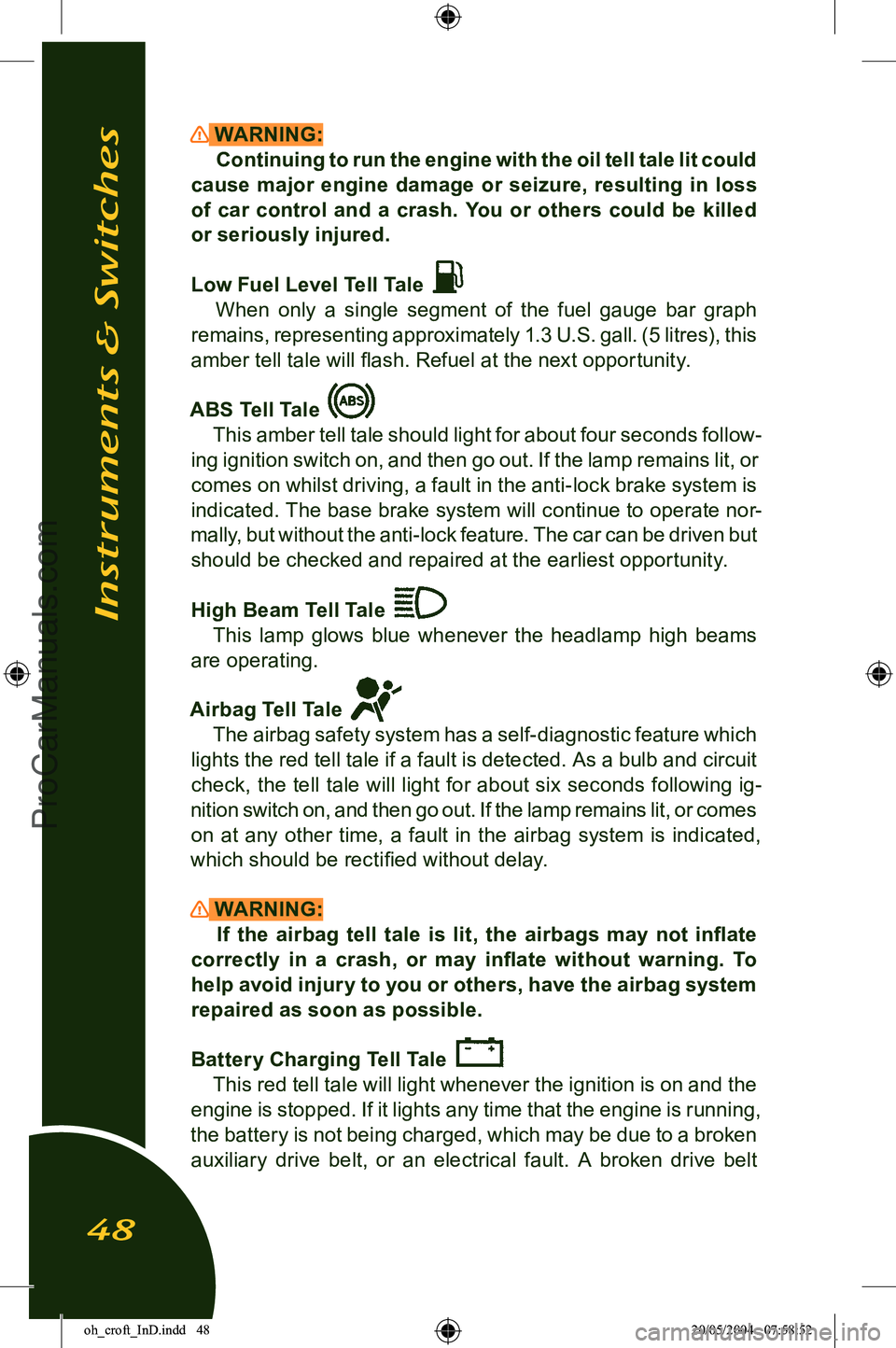
WARNING:Continuing to run the engine with the oil tell tale lit could
cause major engine damage or seizure, resulting in loss
of car control and a crash. You or others could be killed
or seriously injured.
Low Fuel Level Tell Tale
When only a single segment of the fuel gauge bar graph
remains, representing approximately 1.3 U.S. gall. (5 litres), this
amber tell tale will flash. Refuel at the next opportunity.
ABS Tell Tale
This amber tell tale should light for about four seconds follow-
ing ignition switch on, and then go out. If the lamp remains lit, or
comes on whilst driving, a fault in the anti-lock brake system is
indicated. The base brake system will continue to operate nor
-
mally, but without the anti-lock feature. The car can be driven but should be checked and repaired at the earliest opportunity.
High Beam Tell Tale
This lamp glows blue whenever the headlamp high beams
are operating.
Airbag Tell Tale
The airbag safety system has a self-diagnostic feature which
lights the red tell tale if a fault is detected. As a bulb and circuit
check, the tell tale will light for about six seconds following ig
-
nition switch on, and then go out. If the lamp remains lit, or comes on at any other time, a fault in the airbag system is indicated,
which should be rectified without delay.
WARNING: If the airbag tell tale is lit, the airbags may not inflate
correctly in a crash, or may inflate without warning. To
help avoid injury to you or others, have the airbag system repaired as soon as possible.
Battery Charging Tell Tale
This red tell tale will light whenever the ignition is on and the
engine is stopped. If it lights any time that the engine is running,
the battery is not being charged, which may be due to a broken
auxiliary drive belt, or an electrical fault. A broken drive belt
Instruments & Switches
48
oh_croft_InD.indd 4820/05/2004 07:58:52ProCarManuals.com
Page 64 of 205
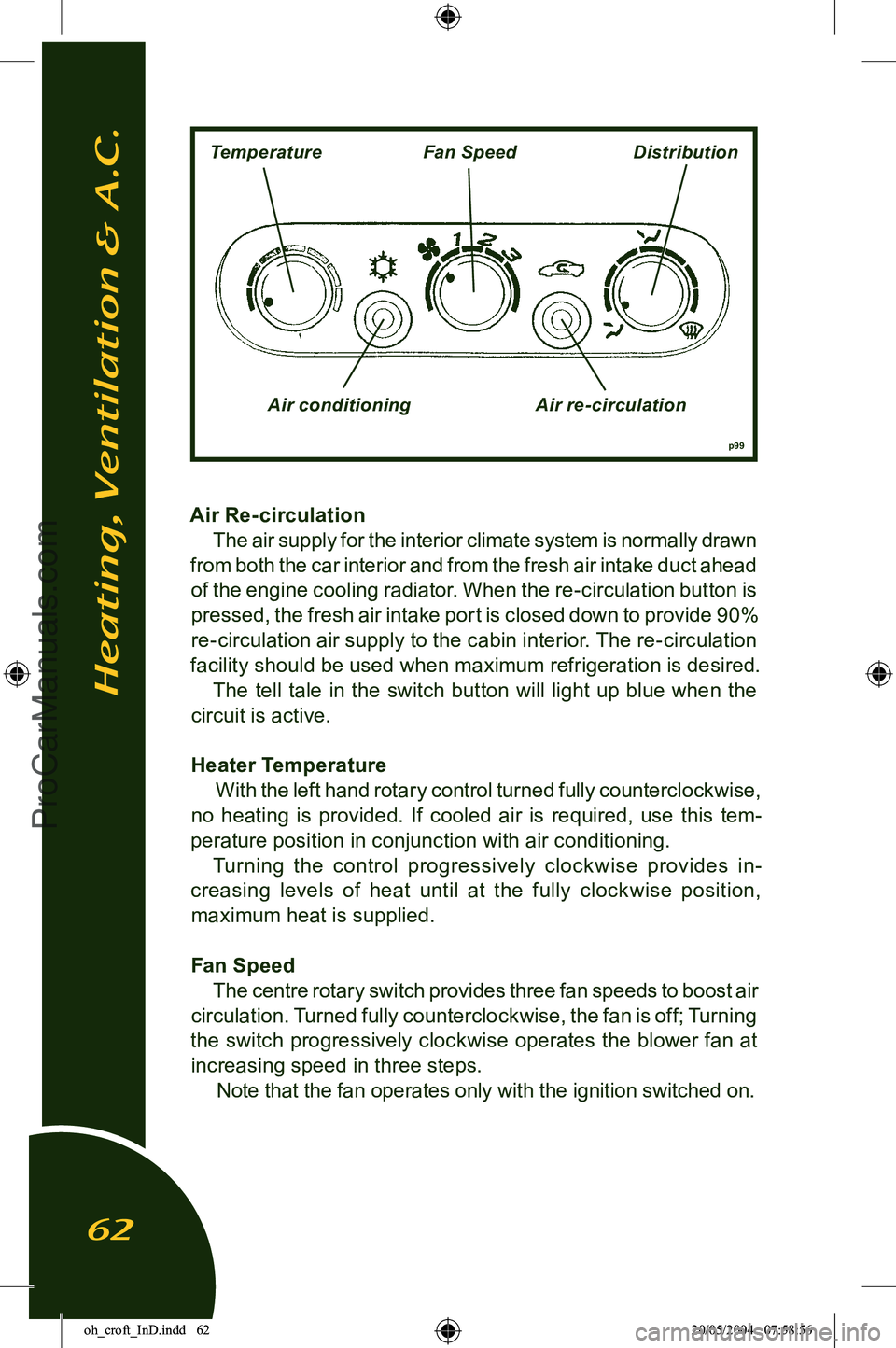
Air Re- circulation The air supply for the interior climate system is normally drawn
from both the car interior and from the fresh air intake duct ahead
of the engine cooling radiator. When the re-circulation button is pressed, the fresh air intake port is closed down to provide 90%
re-circulation air supply to the cabin interior. The re-circulation
facility should be used when maximum refrigeration is desired.
The tell tale in the switch button will light up blue when the
circuit is active.
Heater Temperature With the left hand rotary control turned fully counterclockwise,
no heating is provided. If cooled air is required, use this tem
-
perature position in conjunction with air conditioning. Turning the control progressively clock wise provides in
-
creasing levels of heat until at the fully clockwise position, maximum heat is supplied.
Fan Speed The centre rotary switch provides three fan speeds to boost air
circulation. Turned fully counterclockwise, the fan is off; Turning
the switch progressively clockwise operates the blower fan at increasing speed in three steps. Note that the fan operates only with the ignition switched on.
Heating, Ventilation & A.C.
62
p99
TemperatureFan SpeedDistribution
Air conditioning Air re-circulation
oh_croft_InD.indd 6220/05/2004 07:58:56ProCarManuals.com