low LOTUS ELISE 2005 User Guide
[x] Cancel search | Manufacturer: LOTUS, Model Year: 2005, Model line: ELISE, Model: LOTUS ELISE 2005Pages: 205, PDF Size: 4.51 MB
Page 22 of 205
WARNING:
• Lotus strongly recommends that you do not carry children
as passengers in your Elise.
• Because the Elise is fitted with a non-switchable pas
-
senger airbag, a rear facing child seat must never be
used.
• Never use one belt around two people, or allow a child to be carried on a driver’s or passenger’s lap.
• Refer to Child Restraints section of handbook.
WARNING:
• No modifications or additions should be made to the inertia reel assemblies or seat belts. Do not attempt to
adjust the seat belt tension by altering the mechanism.
• The seat belt should be replaced if webbing becomes frayed, contaminated, or damaged. Inspect regularly.
• It is essential to replace the entire seat belt assembly
if it has been used in a severe impact, even if damage
to the assembly is not obvious. In situations where the airbags have been deployed, the belt tensioner systems must also be replaced. Seat belt anchorage points must
also be rigorously checked.
• Not checking or maintaining seat belts can result in serious injury or death if the seat belts do not work
properly when needed. Check the belts regularly and have any problem corrected immediately.
• No one should sit in a seat with an in-operative seat belt.
Care should be taken to avoid contamination of the webbing
with polishes, oils or chemicals and particularly battery acid. Use
only a mild detergent to clean the webbing, never use bleach or
dye, and allow the belt to dry fully before using the car. Ensure
that the buckle mechanism is kept free of dirt contamination as disassembly for cleaning is not possible.Seating & Safety Restraints
20
oh_croft_InD.indd 2020/05/2004 07:58:44ProCarManuals.com
Page 24 of 205
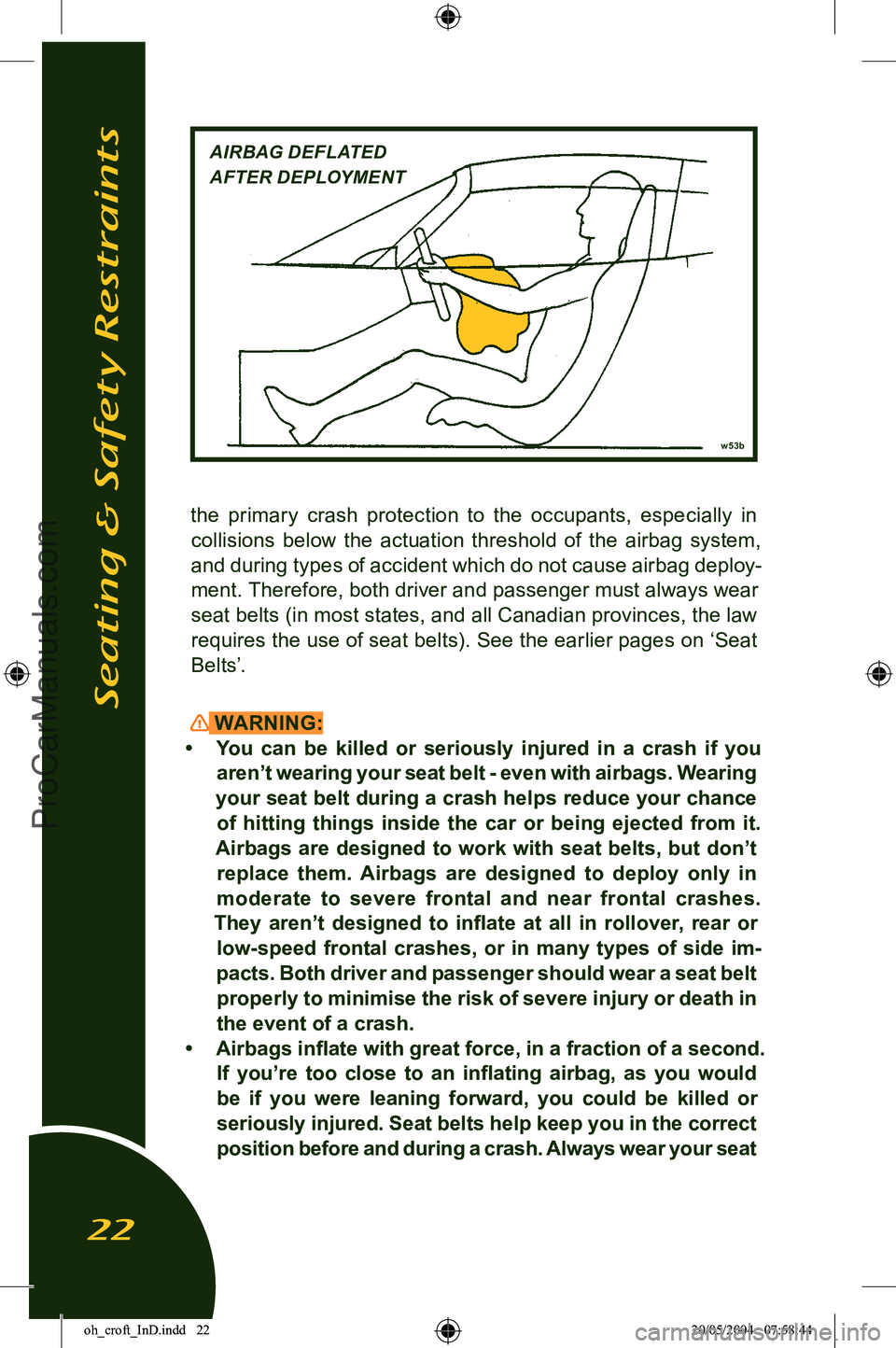
the primary crash protection to the occupants, especially in collisions below the actuation threshold of the airbag system, and during types of accident which do not cause airbag deploy
-
ment. Therefore, both driver and passenger must always wear
seat belts (in most states, and all Canadian provinces, the law
requires the use of seat belts). See the earlier pages on ‘Seat
Belts’.
WARNING:
• You can be killed or seriously injured in a crash if you aren’t wearing your seat belt - even with airbags. Wearing
your seat belt during a crash helps reduce your chance of hitting things inside the car or being ejected from it.
Airbags are designed to work with seat belts, but don’t replace them. Airbags are designed to deploy only in
moderate to severe frontal and near frontal crashes.
They aren’t designed to inflate at all in rollover, rear or low-speed frontal crashes, or in many types of side im
-
pacts. Both driver and passenger should wear a seat belt properly to minimise the risk of severe injury or death in
the event of a crash.
• Airbags inflate with great force, in a fraction of a second. If you’re too close to an inflating airbag, as you would
be if you were leaning forward, you could be killed or seriously injured. Seat belts help keep you in the correct
position before and during a crash. Always wear your seat
Seating & Safety Restraints
22
w53b
AIRBAG DEFLATED
AFTER DEPLOYMENT
oh_croft_InD.indd 2220/05/2004 07:58:44ProCarManuals.com
Page 25 of 205
belt, even with airbags. Sit as far back from the steering
wheel as is comfortable, whilst ensuring that full control can be maintained.
• Airbags plus lap-shoulder seat belts offer the best protection for adults, but not for young children and
infants. Neither the car ’s seat belt system nor its
airbag system is designed for them. Young children and
infants need the protection that a child restraint system can
provide. See later section on ‘Child Restraints’.
• If an object is between a person and an airbag, the bag
might not inflate properly or it might force the object into
that person causing death or serious injury. The path of an inflating airbag must be kept clear. Don’t put anything between an occupant and an airbag, and don’t attach or
put anything on the steering wheel hub or on or near any
passenger dashboard air bag covering.
• Do not lean against the inside of the doors; always hold the steering wheel by the outer rim; never rest your hands
on the airbag panel.
• Never transport heavy objects on or in front of the pas
-
senger seat.
• Give your passenger all of the information in this sec
-
tion.
• Do not attempt to de-activate the airbags, or make any other changes to the wiring or components of the airbag
system. Do not undertake any wiring for electrical ac
-
cessory equipment in the vicinity of the airbag wiring harnesses. Doing so may disable the airbag system, or
cause its unintended deployment.
• Adjust the driver’s seat to ensure that your chest is at
least 10 inches (250mm) from the steering wheel.
• If the airbag trim cover on the passenger side of the dash
-
board is accidently knocked off, the passenger airbag will
not operate correctly. Improper protection could result
in death or serious injury to a passenger in a crash. Do
not attempt to refit or repair the trim cover, but have the
fault rectified immediately by your dealer.
Airbag Tell Tale There is an airbag warning light (‘tell tale’) on the instrument
panel which shows the airbag symbol. The system checks the
following airbag electrical circuits for malfunction:
Seating & Safety Restraints
23
oh_croft_InD.indd 2320/05/2004 07:58:45ProCarManuals.com
Page 26 of 205
• Drivers airbag circuit;
• Passenger airbag circuit;
• Seatbelts pre-tensioner circuit;
• Internal componentry of the sensor and diagnostic module.
As a bulb and circuit check, the tell tale will light briefly when
the ignition is switched on, and then go out. If the lamp lights at any other time, a fault in the airbag system is indicated, which
should be rectified without delay by your Lotus dealer.
WARNING: If the airbag tell tale does not light up as the ignition is
turned on, or remains lit for more than a few seconds, have
the fault rectified immediately by your dealer. Ignoring the
tell tale can result in serious injury or death if the airbags do not inflate when needed.
Airbag Deployment If a crash or collision causes the airbags to inflate, you may
see what looks like smoke, but is actually powder from the airbag
surface used to aid smooth deployment. Although the powder is not harmful, people with respiratory problems may experience
some temporary discomfort. If this occurs, get out of the car if possible as soon as it is safe to do so. After airbag deployment, the airbags, seat belt tensioners
and electronic control unit must be replaced by a Lotus dealer
or other suitably qualified organisation. Component parts of the airbag system are located in various
sites around the car. Any technician working on the car should be advised that the car is fitted with airbags to allow suitable
precautions to be taken.
WARNING:
• For up to 20 seconds after the ignition has been turned off and the battery disconnected, an airbag can still
inflate if improper servicing occurs. You can be injured
if you are close to an airbag when it inflates.
• Airbag system components should be serviced only by an authorised Lotus dealer. Do not work on the airbag
system yourself.
• The disposal of used airbag units is subject to stringent
Seating & Safety Restraints
24
oh_croft_InD.indd 2420/05/2004 07:58:45ProCarManuals.com
Page 28 of 205
Child Restraints
WARNING:
Lotus strongly recommends that children are not car
-
ried in the Elise due to the risk of death or serious injury if the child is too close to the dashboard when the airbag
inflates.
Accident statistics show that children are safer when properly
restrained in the back seats of cars, an option unavailable on
this model. In addition, your car is equipped with a passenger’s airbag which poses serious risks to children - particularly infants
and small children. If, nevertheless, a child is to be carried in the
car, the following notes are provided for guidance:
When a child is of a physical size whereby the standard
fitment lap and diagonal seat belt will fit satisfactorily, with the belt positioned over the collar bone and against the centre of
the chest, the standard seat and seat belt should be used. If the
belt touches or crosses the child’s neck, the child should NOT
be carried in the Elise.
WARNING:
• Children should not be carried in the Elise unless they are large enough to be able properly to use the standard
seat belt without any child seat or booster seat.
• Child restraint systems (other than belt positioning booster seats) are designed to be secured in the car seat
by the lap belt portion of the lap/shoulder belt. READ
ALL INSTRUCTIONS THAT ACCOMPANY THE CHILD RESTRAINT OR BOOSTER SEAT.
• I n f a n t s w h o a r e u n a b l e t o s i t u p b y t h e m s e l v e s ,
unsupported, should NOT be carried in the Elise.
• Never put a rear-facing child seat in the passenger seat
of the Elise. If the airbag inflates, it can hit the child or
the back of the child seat with enough force to kill or very seriously injure an infant.
• There is no provision on the Elise to switch off or disable
the passenger airbag.
WARNING: Children who are not properly restrained can be killed
or seriously injured in an accident.
Seating & Safety Restraints
26
oh_croft_InD.indd 2620/05/2004 07:58:45ProCarManuals.com
Page 29 of 205
Behaviour: It is essential that the behaviour of any child trav-
elling in the car is such that they remain correctly seated and belted, and it is the responsibility of the driver to ensure that
this occurs.
The following wording has been included to comply with
National Highway Traffic Safety Authority requirements,
however;
WARNING: Lotus str ongly recommen ds that you do not fit any type
of child seat into the Elise due to the risk of death or seri
-
ous injury if the c hild is too close to the dashboard when
the airbag inflates.
Procedure for Proper Fitment of For ward- Facing Child
Seat
A utomatic Locking Retractor: The safety belt for the passen-
ger’s seat is equipped with an automatic locking retractor that
must be used for securing a forward-facing child restraint sy
s-
tem. When activated , this retractor allows you to securely fas
-
ten the child restraint system.
Activating the Automatic Retracto r:
1. Pull the passenger seat safety belt completely
out . At this
point, the locking mechanism is activated.
2.
P lace the forward-facing child seat in the passenger seat,
using the safety belt to secure the child seat,
fo llowing the
instructions that come with the child seat
.
3. Insert the safety tongu e into the buckle and make sure that
it is properl y latched.
4. Allow the safety belt to retract until it is tight on the child seat.
You may further tighten the belt by pulling on it to allow more of
it to retract. Check to make sure the child seat is secured, and
that the belt is snug and will not pull out.
Releasing the safety bel t and child seat:
1. Unbuckle the safety belt. 2. Remove the child seat.
3. Make sure that the belt has fully retracted. At this point the
automatic locking feature is disengaged.
Seating & Safety Restraints
27
oh_croft_InD.indd 2720/05/2004 07:58:46ProCarManuals.com
Page 32 of 205
Car Security AlarmThe Lotus Elise is fitted with a Cobra 8186 immobiliser/alarm
which includes the following features:
• ‘Dynamic coding’ of the transmitter fobs; Each time the trans
-
mitters are used, the operating frequency is random changed
to guard against unauthorised code copying.
• Automatic (passive) engine immobilisation to prevent the engine from being started without the transmitter fob.
• Sensing switches on doors, front body access panels and the engine cover, meaning the alarm sounds if someone tries to
force entry.
• Personal protection by ‘on demand’ activation of the siren.
• Selectable cockpit intrusion sensing using a microwave
sensor.
• Self powered siren to maintain protection if the car battery is
disconnected.
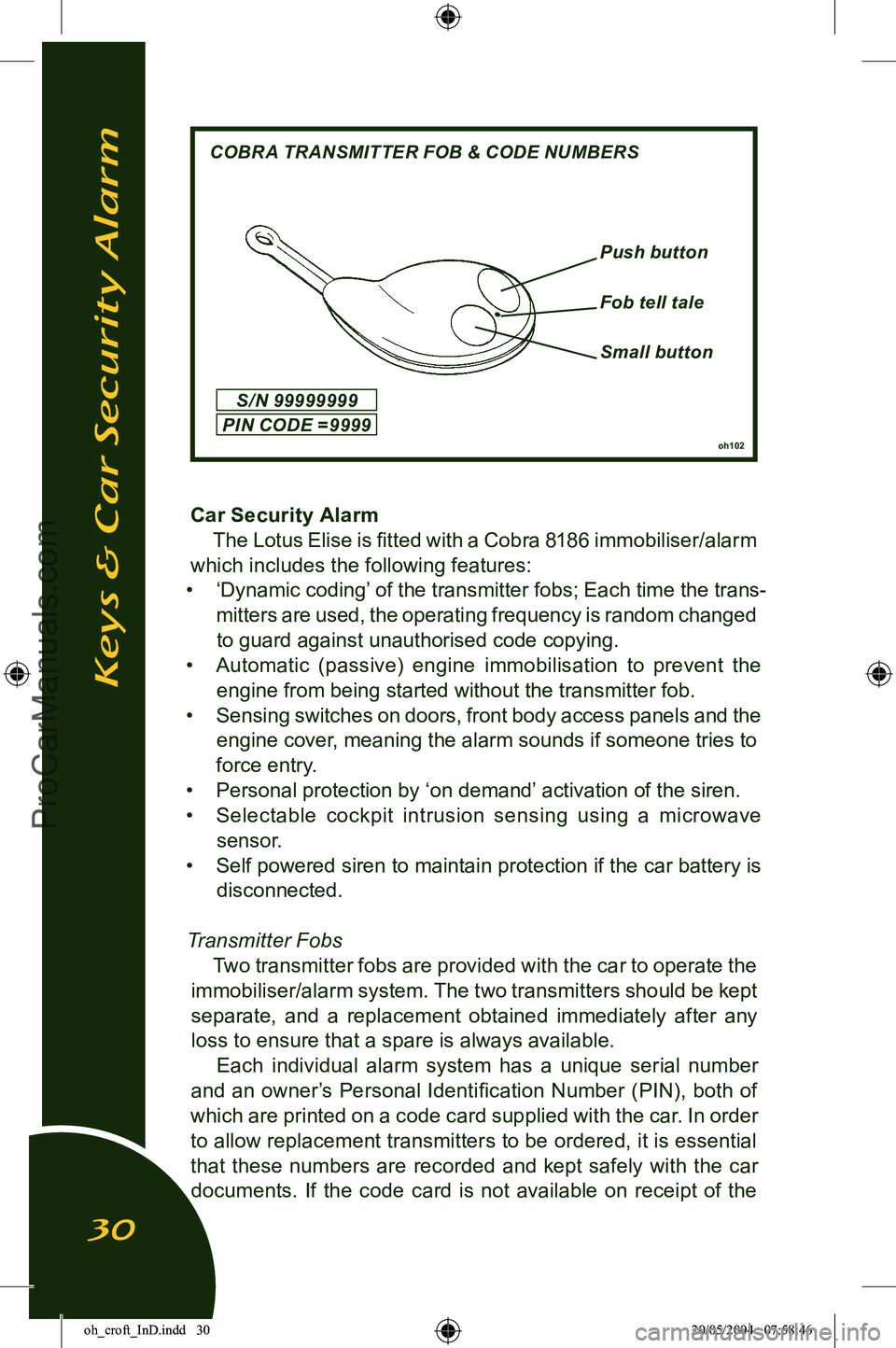
Transmitter Fobs Two transmitter fobs are provided with the car to operate the
immobiliser/alarm system. The two transmitters should be kept
separate, and a replacement obtained immediately after any loss to ensure that a spare is always available.
Each individual alarm system has a unique serial number
and an owner’s Personal Identification Number (PIN), both of
which are printed on a code card supplied with the car. In order to allow replacement transmitters to be ordered, it is essential
that these numbers are recorded and kept safely with the car
documents. If the code card is not available on receipt of the
oh102
Small button
Keys & Car Security Alarm
30
COBRA TRANSMITTER FOB & CODE NUMBERS
Push button
Fob tell tale
S / N 99999999
PIN CODE = 9999
oh_croft_InD.indd 3020/05/2004 07:58:46ProCarManuals.com
Page 33 of 205
car, enquire with the dealer immediately.
Engine Immobiliser In order to provide a measure of car security, independent
of any driver action, the system will ‘passively’ immobilise the
engine’s cranking and running circuits after the first occurring of the following:
i) Four minutes after switching off the ignition;
ii) Two minutes after a mobilising command (see below); or
iii) One minute after switching off the ignition and opening the driver’s door.
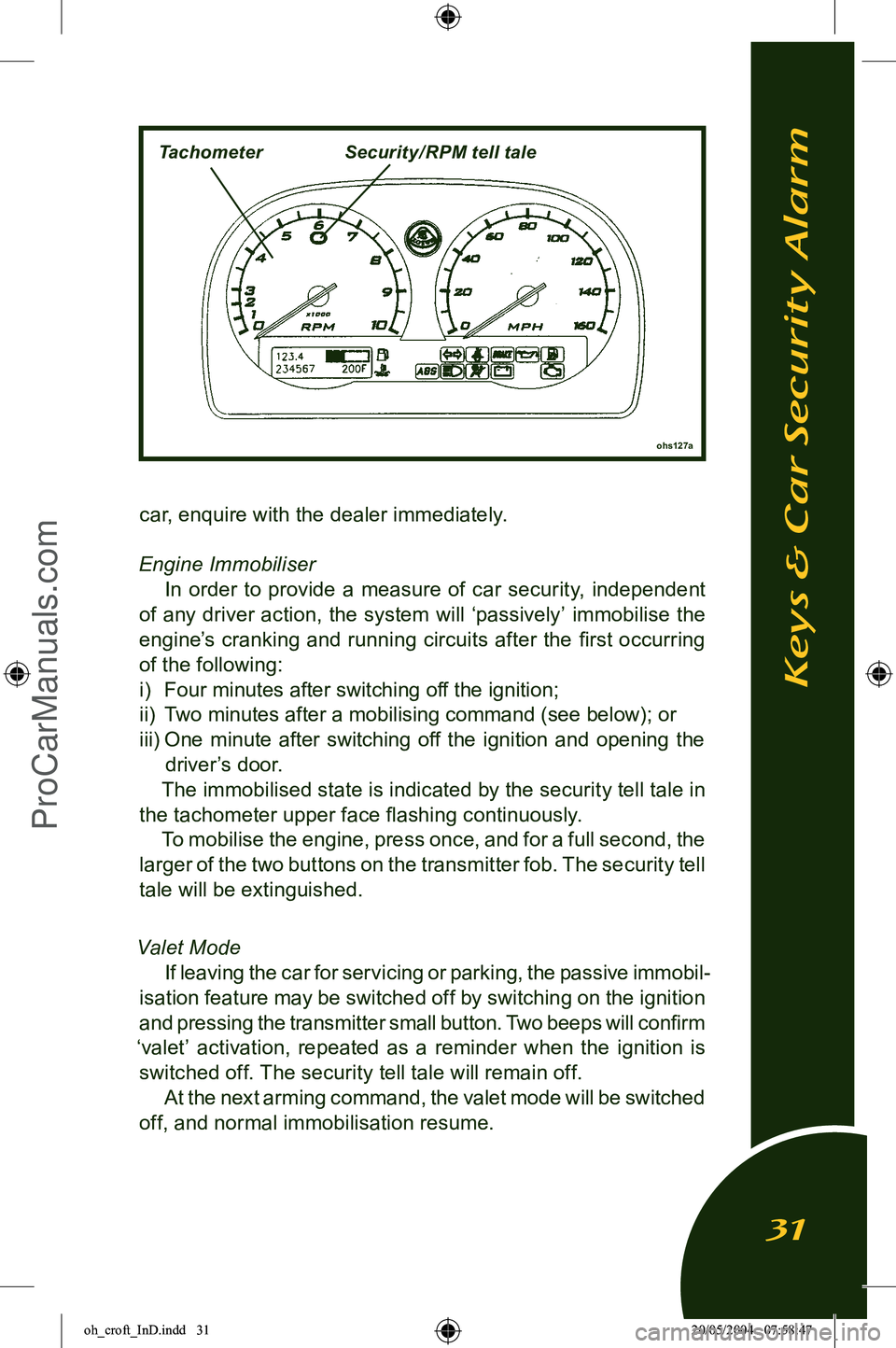
The immobilised state is indicated by the security tell tale in
the tachometer upper face flashing continuously. To mobilise the engine, press once, and for a full second, the
larger of the two buttons on the transmitter fob. The security tell
tale will be extinguished.
Valet Mode
If leaving the car for servicing or parking, the passive immobil
-
isation feature may be switched off by switching on the ignition
and pressing the transmitter small button. Two beeps will confirm
‘valet’ activation, repeated as a reminder when the ignition is switched off. The security tell tale will remain off. At the next arming command, the valet mode will be switched
off, and normal immobilisation resume.
ohs127a
Keys & Car Security Alarm
31
TachometerSecurity/ RPM tell tale
oh_croft_InD.indd 3120/05/2004 07:58:47ProCarManuals.com
Page 34 of 205
Arming the AlarmRemove the ignition key, close (and lock) both doors, and
check that the engine cover and front body access panels are
secure. The roof may be either closed or open. Press once, and for a full second, the larger of the two buttons on the trans
-
mitter fob (on cars with central door locking, this action will automatically lock both doors - see later). This command will
be acknowledged by:
- 2 flashes of the hazard warning lamps;
- Continuous flashing of the security tell tale.
Check that these indications occur. If not, press the button a
second time, as the first press may have only switched off the passive immobilisation (see above). Note that if the system is armed when a door or engine cover/
front access panel is not fully closed or if the interior lamp is in the ‘off’ position, a continuous buzz will be heard as warning. If still open after expiry of the arming period, (see below)
the alarm will be armed with that switch group (both doors, or
front/rear access lids) excluded from the circuit.
After arming the system, the engine is immediately immo
-
bilised, but a period of approximately 45 seconds must elapse
before all functions and sensors become fully active. After
this time, the alarm will be triggered by any of the following actions:
- Interruption of the car battery power supply.
- Energising the ignition circuit (‘hot wiring’).
- Opening a door;
- Opening the engine cover or a front access panel.
- Movement detected within the cabin.
When the alarm is triggered, the hazard warning lamps will
flash and the electronic wailing siren will sound for a period of approximately 30 seconds before closing down and resetting, ready for any further triggering input. If a trigger is continuously
present, the alarm will repeat after a short delay, and continue
in this sequence for about 10 cycles. To silence the siren when triggered, press once, and for a full
second, the larger button on the transmitter fob. This will not affect the status of the alarm which will remain armed.
Keys & Car Security Alarm
32
oh_croft_InD.indd 3220/05/2004 07:58:47ProCarManuals.com
Page 35 of 205
Disarming the AlarmTo disarm the alarm, press once, and for a full second, the
larger button on the transmitter fob. This command will be
acknowledged by:
- 1 flash of the hazard warning lamps;
- Extinguishing of the security tell tale. If the alarm had been triggered during the last armed period,
the disarm command will be acknowledged by the hazard lamps
flashing 4 times, and the buzzer sounding 4 times. The security tell tale will then flash a code to indicate the triggering source:
- 1 pulse flashing: door, engine cover/boot lid or body front access panel.
- 2 pulse flashing: movement detected in cabin by microwave sensor.
- 4 pulse flashing: tampering with ignition circuit.
- 6 pulse flashing: interruption of battery supply.
The coding will be deleted when the ignition is next turned
on.
Emergency disarming /mobilising If the transmitter fobs are lost or damaged, the alarm system
owner’s unique PIN may be used to disarm the alarm and/or
mobilise the engine provided that access is available to the
cabin. Follow the transmitter fob programming instructions (see
page 18) from step 3.
Keys & Car Security Alarm
33
oh_croft_InD.indd 3320/05/2004 07:58:47ProCarManuals.com