low LOTUS ELISE 2005 Workshop Manual
[x] Cancel search | Manufacturer: LOTUS, Model Year: 2005, Model line: ELISE, Model: LOTUS ELISE 2005Pages: 205, PDF Size: 4.51 MB
Page 76 of 205
efforts are likely to reduce during the break-in process.After 600 miles (1,000 km) have been covered, full throttle
and/or maximum rpm may be used for short periods, but not
until the first ‘After Sales’ service has been carried out should
full car performance be exploited. Note that various operating parameters are continuously
monitored and recorded in the engine electronic controller. This
data may be downloaded by Lotus dealers on demand to assist
fault diagnosis and identify vehicle misuse.
Tires:
New tires also require a short ‘break-in’ period before
providing optimum grip.
Engine Special Features The engine of the Elise is designated V VTL-i for ‘Variable
Valve Timing and Lift - intelligent’. Using microprocessor control, the inlet camshaft timing is advanced or retarded according to
immediate operating conditions, and the lift of both inlet and
exhaust valves is increased at high engine speed. This technol
-
ogy is used to provide high power output whilst retaining good
low speed response.
Starting & Engine Break-In
74
oh_croft_InD.indd 7420/05/2004 07:58:59ProCarManuals.com
Page 77 of 205
EXTERNAL OPERATIONS
Fuel Requirement USE UNLEADED PREMIUM GR ADE GASOLINE.
Use only unleaded gasoline meeting ASTM specifications.
Use of fuels not meeting ASTM specifications could cause poor performance and increase emissions.
For optimum car performance and fuel economy, the use
of super or premium unleaded gasoline, with a minimum
octane rating of 91 (RON+MON)/2 is recommended. Where
super or premium fuel is not available, the Elise will operate
satisfactorily on unleaded gasoline having a minimum rating
of 87 (RON+MON)/2, but car performance and economy will be reduced. Using fuel with a lower octane rating may cause knocking
(pinking) which, if severe, can cause serious engine damage.
Light knocking may occasionally be heard for short periods when accelerating or driving up hills, and this should cause no concern,
although using a lower gear would be advised. If, however, you hear persistent heavy knocking when using the specified fuel,
consult your dealer without delay.
The use of good quality fuels containing proper detergent ad
-
ditives is advised for good performance and emission control.
NOTICE: Do NOT use leaded fuel: damage caused by the use of leaded or other improper fuel is not covered by the New Car
or Emission Control System Warranty. The effectiveness of
the catalytic converter decreases after as little as one tankful
of leaded fuel. Also, the car is fitted with a fuel injection system
which includes an oxygen sensor. Leaded fuel will damage the sensor, and cause emission control to deteriorate.
Gasolines Containing Alcohol - Some gasolines sold at service stations contain alcohol although they may not be so identified.
Use of fuels containing alcohol is not recommended, unless the nature of the blend can be determined as being satisfactory.
Gasohol - A mixture of 10% ethanol (grain alcohol) and 90% unleaded gasoline may be used in the Lotus Elise. If driveabil
-
ity problems are experienced as a result of using gasohol, it is recommended that the car is operated on gasoline.
External Operations
75
oh_croft_InD.indd 7520/05/2004 07:58:59ProCarManuals.com
Page 78 of 205
Methanol - Do not use gasolines containing methanol (wood
alcohol). Use of this type of alcohol can result in car performance deterioration and damage to critical parts in the fuel system. Fuel
system damage and car performance problems, resulting from
the use of gasolines containing methanol, may not be covered by your car warranty.
Fuels Containing MMT - Some North American fuels contain methylcyclopentadienyl manganese tricarbonyl (MMT), which
is an octane enhancing additive. Such fuels may damage the
emission control system and are NOT recommended.
Diesel
- The Lotus Elise will not operate on diesel fuel.
Fuel Filling
WARNING:
• Gasoline and its attendant fumes are highly explosive. You can be burned or seriously injured when handling
fuel. Before stopping at a filling station, switch off mobile phones and other electronic equipment, ensure that all
cigarettes are extinguished and that no naked flames or
other potential ignition sources are present. Switch off
the engine before refuelling.
• Remove the filler cap slowly to allow any pressure to bleed off gradually. Hasty removal may result in a small amount
of fuel spray with a possible health or fire hazard. External Operations
76
oh_croft_InD.indd 7620/05/2004 07:58:59ProCarManuals.com
Page 80 of 205
ohs93
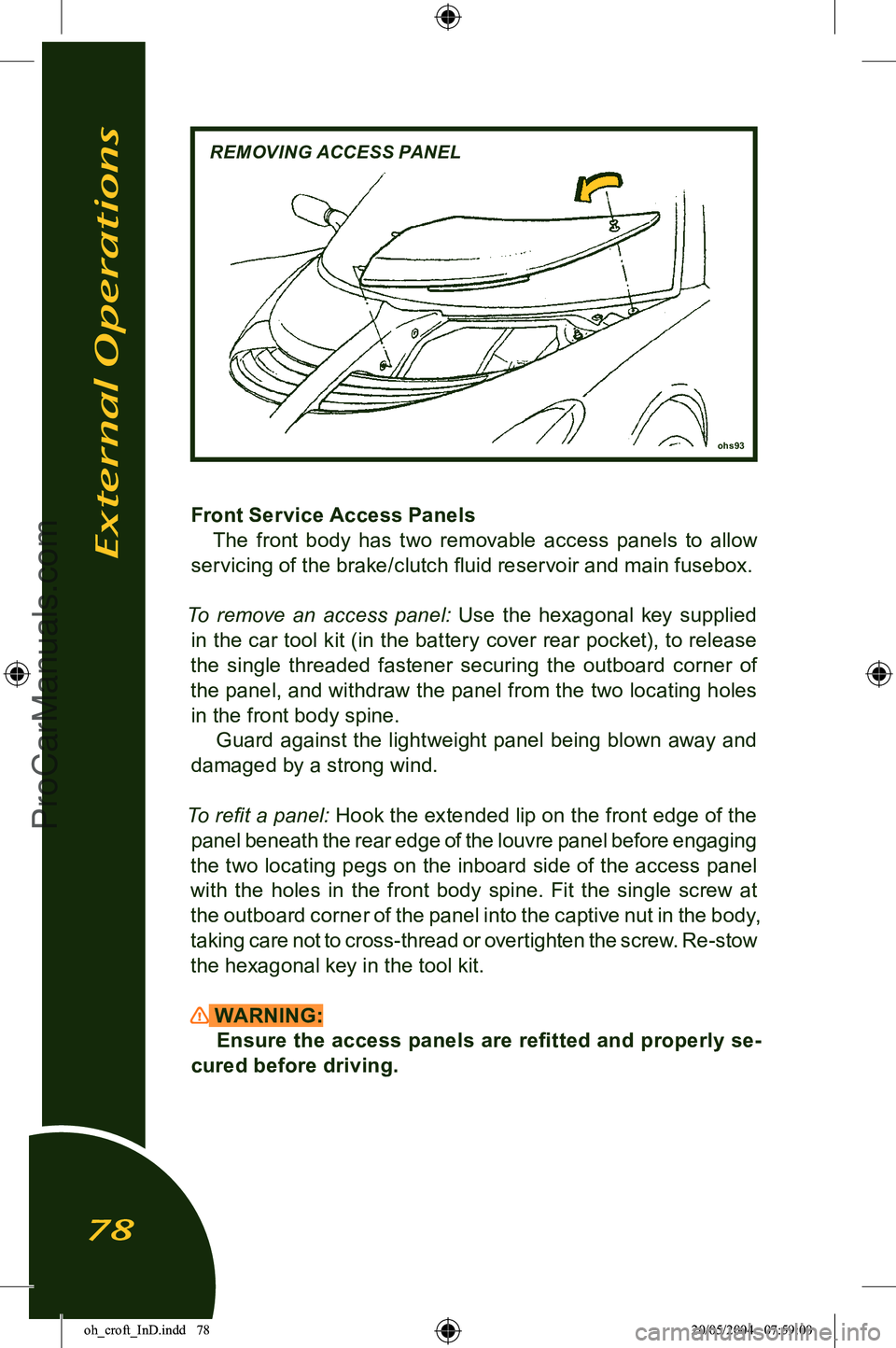
REMOVING ACCESS PANEL
Front Service Access PanelsThe front body has two removable access panels to allow
servicing of the brake/clutch fluid reservoir and main fusebox.
To remove an access panel:
Use the hexagonal key supplied
in the car tool kit (in the battery cover rear pocket), to release
the single threaded fastener securing the outboard corner of
the panel, and withdraw the panel from the two locating holes in the front body spine. Guard against the lightweight panel being blown away and
damaged by a strong wind.
To refit a panel: Hook the extended lip on the front edge of the panel beneath the rear edge of the louvre panel before engaging
the two locating pegs on the inboard side of the access panel
with the holes in the front body spine. Fit the single screw at
the outboard corner of the panel into the captive nut in the body,
taking care not to cross-thread or overtighten the screw. Re-stow
the hexagonal key in the tool kit.
WARNING: Ensure the access panels are refitted and properly se
-
cured before driving.
External Operations
78
oh_croft_InD.indd 7820/05/2004 07:59:00ProCarManuals.com
Page 81 of 205
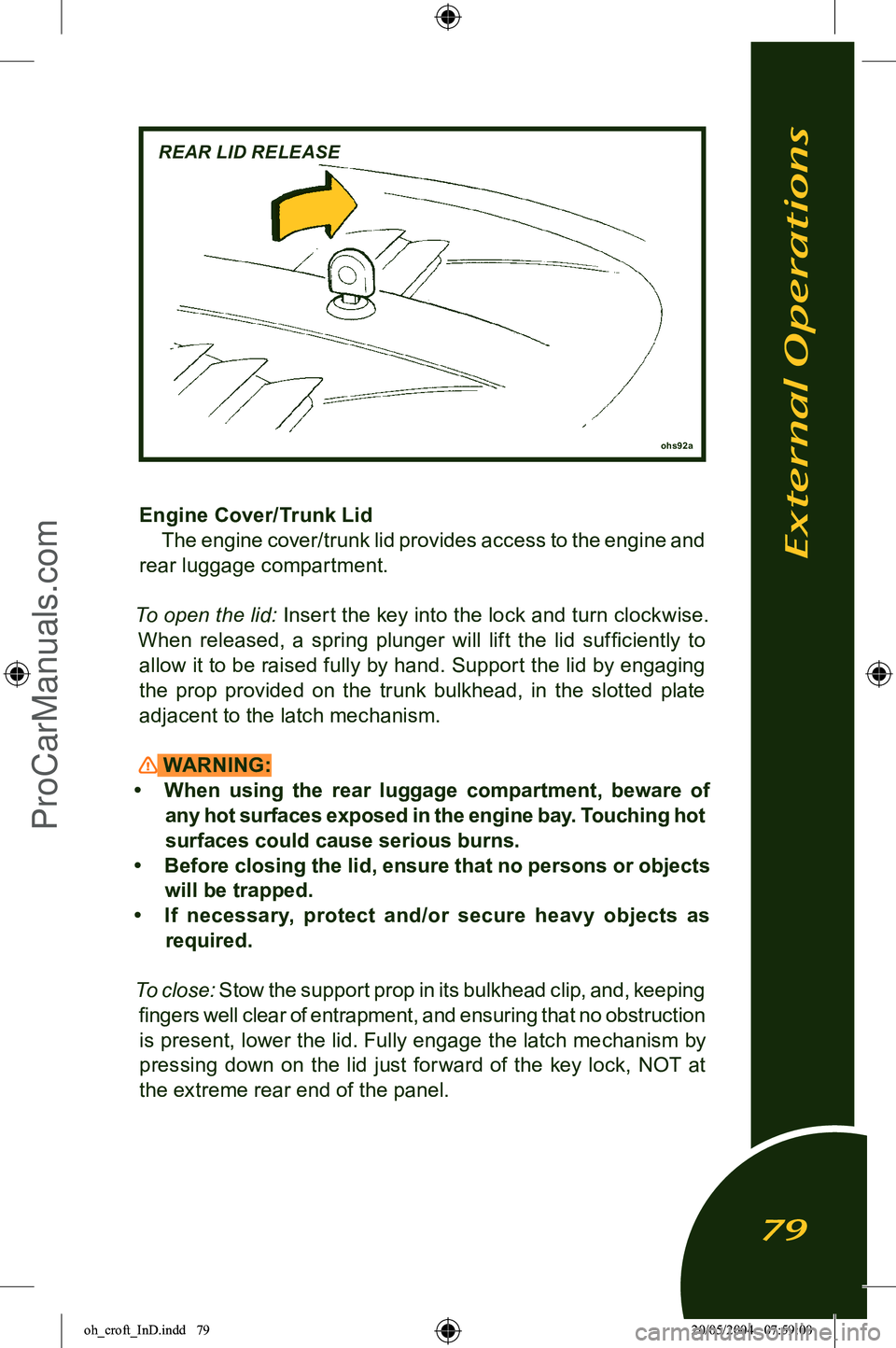
Engine Cover/Trunk LidThe engine cover/trunk lid provides access to the engine and
rear luggage compartment.
To open the lid: Insert the key into the lock and turn clockwise. When released, a spring plunger will lift the lid sufficiently to allow it to be raised fully by hand. Support the lid by engaging
the prop provided on the trunk bulkhead, in the slotted plate adjacent to the latch mechanism.
WARNING:
• When using the rear luggage compartment, beware of any hot surfaces exposed in the engine bay. Touching hot
surfaces could cause serious burns.
• Before closing the lid, ensure that no persons or objects
will be trapped.
• If necessary, protect and/or secure heavy objects as required.
To close: Stow the support prop in its bulkhead clip, and, keeping
fingers well clear of entrapment, and ensuring that no obstruction is present, lower the lid. Fully engage the latch mechanism by pressing down on the lid just forward of the key lock, NOT at
the extreme rear end of the panel.
ohs92a
REAR LID RELEASE
External Operations
79
oh_croft_InD.indd 7920/05/2004 07:59:00ProCarManuals.com
Page 83 of 205

REMOVABLE ROOF CONCEPTThe Lotus Elise has been designed to exploit the pleasures
of open top motoring, the better to enjoy exposure to the natu
-
ral environment, without the restrictions and confinement of a
cockpit roof.
In order to provide some weather protection to the occupants
and car interior, and allow the continued enjoyment of the car in unfavourable weather conditions, a simple hard or soft top roof may be fitted. The constant changing of loads and strains
to which a car is subject to when driving on roads, and the
tolerances required to allow for repeated removal and refitting of the roof, means that minor wind noise, and seepage at joints between the roof, body and doors cannot be completely sealed
in certain areas. Therefore small leaks are considered normal
for this model.
NOTICE: Do not take the car through an automatic car wash.
The soft top may suffer damage by the brushes or suffer leaks due to the high pressure water streams directed in areas which
would not apply in normal driving conditions.
WARNING: The soft or hard top roofs should be removed only whilst
the car is safely parked. Do not attempt to remove the soft
or hard top roof whilst the car is in motion.
External Operations
81
oh_croft_InD.indd 8120/05/2004 07:59:00ProCarManuals.com
Page 84 of 205

b332
FITTING ROOF STAYS
Soft Top Roof - Fitting
WARNING:Do not attempt to fit the soft top roof whilst the car is in
motion. This could cause a crash in which you or others
could be killed or seriously injured.
1. From its stowage bag in the rear luggage compartment, with-
draw the roof assembly and support stays. Lower both door
windows, or open both doors.
2. Insert the two, identical, roof support stays, with the arrows pointing forwards, into the slots above the rear window, and
in the windscreen header rail. Note that the slots are keyed
to allow fitment of the stays in only the correct orientation.
3. Lay the soft top roof across the centre of the roof space with
the arrows on the side rails pointing forwards.
External Operations
82
Arrows
point for ward
Rear end keyway
oh_croft_InD.indd 8220/05/2004 07:59:01ProCarManuals.com
Page 86 of 205

ohs149
RELEASING ROOF SIDE RAIL
Soft Top - Removal
WARNING:Do not attempt to remove the soft top roof whilst the
car is in motion. This could cause a crash in which you or
others could be killed or seriously injured.
1. With the car stationary, open both doors or lower both door windows.
2. On the inside face of the right hand roof side rail, locate the
two latch release levers: Pull the two lever handles towards each other to release the side rail latches (press down on the
side rail if necessary to relieve the load on the latch pins), and rotate the rail upwards to release the canopy tension.
3. Repeat step (2) for the
left hand side rail.
NOTICE: Releasing the right hand roof side rail first, will minimise
the possibility of the canopy tensioning cable adjusters causing damage to the roof seals.
4. Free the front and rear tensioning cables from the gutters be
-
fore carefully rolling up each side of the roof canopy towards the centre. Lift the roof assembly off the car, and pack in the
roof bag.
External Operations
84
oh_croft_InD.indd 8420/05/2004 07:59:01ProCarManuals.com
Page 87 of 205
5. Unhook the two roof stays and pack in the roof bag. Stow the
bag in the rear luggage compartment.
NOTICE: If the roof is not fully dry, it should be stowed for no longer than 1 or 2 days before unrolling or refitting and allowing
to air dry completely. Prolonged stowage of a wet or damp roof
will promote rotting of the fabric.
HARD TOP ROOF
NOTICE:
• The hard top roof has been designed to provide a seasonal,
rather than single trip option. Some owners may prefer to
entrust the fitting and removal of the hard top roof to their
dealer.
• When stowing the roof off the car, care should be taken to
avoid damage to the roof corners; e.g. use a suitable soft
floor covering on which to stand the roof. Note that there is
no provision for on-board hard top roof stowage.
• Fitment or removal of the hardtop is made considerably easier
with the assistance of a second person.
• Use only the ‘Torx’ tool supplied in the car tool kit (in the
battery cover rear pocket), to tighten or release the roof
fixing screws.
• The hardtop roof fixings are tethered to the roof panel to guard
against their loss.
WARNING:
Take care to avoid trapping hands or fingers when fitting
or removing the hard top.
External Operations
85
oh_croft_InD.indd 8520/05/2004 07:59:01ProCarManuals.com
Page 88 of 205

b330
FRONT SPIGOT BRACKET
Hard Top - Fitting
1. Open both doors, and preferably with the aid of an assistant, lower the roof onto the car holding aside the loose tethered
fixings to avoid their entrapment or their causing paint damage. Position the rear edge of the roof first before locating the front
edge against the windscreen header rail.
2. Locate a front spigot bracket into its latch plate lower slot (lifting the roof slightly to allow this) and retain to the roof with the Torx bolt. Use only the special Torx tool supplied in the car tool kit (stowed in the battery cover pocket), and do not
fully tighten at this stage.
3. Repeat step (2) for the opposite front spigot bracket.
External Operations
86
oh_croft_InD.indd 8620/05/2004 07:59:02ProCarManuals.com