water LOTUS ELISE 2005 User Guide
[x] Cancel search | Manufacturer: LOTUS, Model Year: 2005, Model line: ELISE, Model: LOTUS ELISE 2005Pages: 205, PDF Size: 4.51 MB
Page 112 of 205
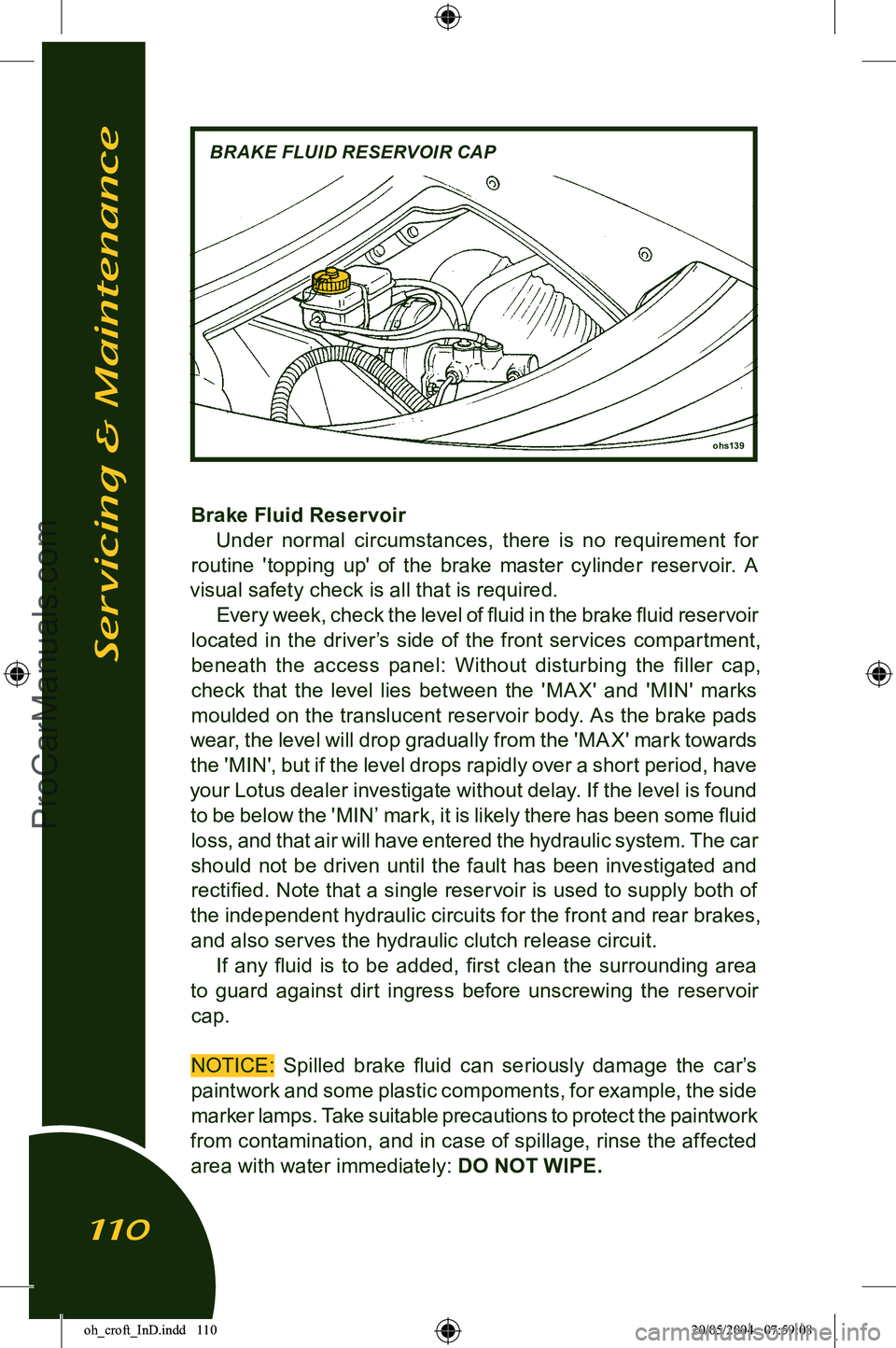
Brake Fluid ReservoirUnder normal circumstances, there is no requirement for
routine 'topping up' of the brake master cylinder reservoir. A
visual safety check is all that is required. Every week, check the level of fluid in the brake fluid reservoir
located in the driver’s side of the front services compartment, beneath the access panel: Without disturbing the filler cap,
check that the level lies between the 'MA X' and 'MIN' marks moulded on the translucent reservoir body. As the brake pads
wear, the level will drop gradually from the 'MA X' mark towards the 'MIN', but if the level drops rapidly over a short period, have
your Lotus dealer investigate without delay. If the level is found
to be below the 'MIN’ mark, it is likely there has been some fluid loss, and that air will have entered the hydraulic system. The car
should not be driven until the fault has been investigated and rectified. Note that a single reservoir is used to supply both of
the independent hydraulic circuits for the front and rear brakes, and also serves the hydraulic clutch release circuit. If any fluid is to be added, first clean the surrounding area
to guard against dirt ingress before unscrewing the reservoir cap.
NOTICE: Spilled brake fluid can seriously damage the car’s paintwork and some plastic compoments, for example, the side
marker lamps. Take suitable precautions to protect the paintwork
from contamination, and in case of spillage, rinse the affected area with water immediately: DO NOT WIPE.
ohs139
BRAKE FLUID RESERVOIR CAP
Servicing & Maintenance
110
oh_croft_InD.indd 11020/05/2004 07:59:08ProCarManuals.com
Page 113 of 205
Use only a non-mineral type DOT 4 brake fluid from a sealed
container marked with a yellow and black (non-mineral) symbol.
Do not use DOT 5 silicone fluid, or any fluid which has been
exposed to the atmosphere for more than a brief period, or
any fluid suspected of being wet, dirty or contaminated. Do not over fill, and replace the cap securely. Brake fluid, being hygroscopic, absorbs water from the atmos
-
phere over a period of time, resulting in a lowering of the boiling
point of the fluid, and corrosion of the hydraulic system. For
optimum safety and brake performance, the brake fluid should be renewed every twelve months by your Lotus Dealer.
WARNING:
• Brake fluid is hazardous to health and may be fatal if swallowed. Keep out of children’s reach.
• Using the wrong type of brake fluid can damage brake system components and result in brake failure causing a
crash in which you and others could be killed or seriously
injured. See ‘Recommended Lubricants’.
Brake Pads The thickness of the brake pad lining material should be
checked at every service, and under no circumstances be al
-
lowed to fall below 0.1 inch (2.5 mm). If the brakes are in very frequent or arduous use, as when driving in mountainous terrain,
or on race circuits, it is recommended that they be examined
more frequently. The pads should be renewed if of insufficient
thickness to ensure safe braking until the next scheduled service.
Note that in order to ensure that brake pads with the correct
material specification are used, only genuine Lotus replacement parts should be fitted, and in the interests of safety, pad renewal
should be entrusted to your Lotus dealer.
WARNING: Using incorrect brake pads, or pads below 0.1 inch
(2.5mm) thickness, may cause a crash in which you or
others could be killed or seriously injured. With a new car, or new brake system components, maxi
-
mum braking efficiency will be achieved if, for the first few
hundred miles, needless heavy braking is avoided, and the
brake pads and discs are allowed to ‘bed in’ fully before
being used to their full potential (see also ‘Footbrake’).
Servicing & Maintenance
111
oh_croft_InD.indd 11120/05/2004 07:59:08ProCarManuals.com
Page 116 of 205
Auxiliary Drive BeltA single, multi-rib type auxiliary belt is used to transmit drive
from the crankshaft to the alternator, water pump, and (if fitted)
air conditioning compressor. The belt is automatically tensioned,
and requires no periodic maintenance other than a visual check of its condition. If the belt exhibits any evidence of physical dam
-
age, cracking, fraying, perishing, abrasion or contamination, it
should be renewed. In the case of contamination, the cause
must be identified and rectified, and each of the pulleys must be thoroughly degreased before the new belt is fitted. It is recommended that auxiliary belt replacement be en
-
trusted to your Lotus dealer.
Sparking Plugs The Elise uses a direct ignition system with an individual
high tension coil mounted atop each of the four spark plugs and protected by a plastic cover, screw fixed to the engine.
WARNING: The voltages produced with this ignition system can
cause serious and potentially fatal injur y. Never touch
any ignition components when the engine is running or being cranked.
The spark plugs should be renewed in accordance with the
Maintenance Schedule, with the gaps set to 0.043 in. (1.1 mm).
This operation should be entrusted to your Lotus dealer.
Servicing & Maintenance
114
oh_croft_InD.indd 11420/05/2004 07:59:09ProCarManuals.com
Page 119 of 205
Always use the size and type of tires recommended
in this handbook.
• Using incorrect tires or tires which are excessively worn or improperly inflated can cause a crash in
which you can be killed or seriously injured.
• Please note your car is not fitted with a low tire pressure tell tale lamp so it is especially important
that you regularly check the tire pressures.
When driving on wet roads, surface water is squeezed
out from between the tire and road. However excessive
speed or water depth can overwhelm the water clearing capability of the tread and lead to a condition called 'aq
-
uaplaning' or ‘hydroplaning’, where the tire rides on a film of water and provides little or no grip on the road surface,
leading to a loss of control. This condition is more likely
to occur with worn tires having little depth of tread, or with incorrect tire pressures. Drivers should keep a vigilant check on tire wear and condition, and moderate their
speed in adverse weather conditions.
Tire Care Wear indicators are moulded into the bottom of the
tread grooves at intervals around the tire, indicated by small pointers on the outer tread blocks. The tires should
be replaced before being worn to this minimum legal
tread depth. The cold tire pressures should be checked every week,
or every 1,000 miles (1,700 km), whichever is the sooner,
and corrections made as necessary. See ‘Technical Data’
at the back of the handbook for tire pressures. For track
use, tire condition and pressures should be checked be
-
fore each run. Under-inflation will cause excessive wear, rapid deterioration of the tire sidewalls and heavy steering,
whereas over-inflation results in a hard ride and increased susceptibility to tire damage. Both conditions will cause a degradation in the handling qualities. It is important that the tire pressures are adjusted only
when the Tires are cold (when the car has been standing for a minimum of 3 hours, or driven less than 1 mile), as the pressures may increase by 0.3 - 0.5 bar (4 - 8 lb/in²)
when the Tires are warmed to normal running temperature.
Tires & Wheels
117
oh_croft_InD.indd 11720/05/2004 07:59:09ProCarManuals.com
Page 131 of 205
ELECTRICAL
BATTERY
WARNING:
POISON/DANGER - CAUSES SEVERE BURNS KEEP OUT
OF REACH OF CHILDREN.
• Contains sulphuric acid - avoid contact with skin, eyes or clothing. If in contact with skin or eyes; flush with copious amounts of water. Remove contaminated clothing. Seek
immediate medical attention. If ingested; seek immediate
medical attention. Do not induce vomiting or give fluids
to drink.
• Batteries produce explosive gases. Keep sparks, flames and cigarettes away. Ventilate when charging or using in
enclosed space. Always shield eyes when working near
batteries.
RISK OF SHORT CIRCUIT AND FIRE
• Observe all warning notes on the battery.
• Disconnect the battery during all work on the electrical system.
• Do not lay tools or other metal objects on the battery as they could cause a short circuit across the battery
terminals.
Battery Access The ‘maintenance free’ battery is located at the left hand
front of the rear luggage compartment. No routine inspection or topping up of the electrolyte is required, but at inter vals
specified in the Maintenance Schedule, the battery terminals
should be checked for security and condition, and protected
with petroleum jelly. For access to the terminals, first unclip the battery cover
from the floor and ease the cover from around the left hand rear corner of the battery.
Disconnecting the Battery
WARNING: Failure to follow the correct battery disconnection pro
-
cedure detailed below could result in serious burns.
Electrical
129
oh_croft_InD.indd 12920/05/2004 07:59:13ProCarManuals.com
Page 134 of 205
charged. If, in an emergency, the car has to be ‘jump’ started,
the subsequent conditions of car use may not allow for sufficient alternator charging of the battery to achieve a fully charged
state. The battery should be trickle charged until 12.8 volts is recorded, which process may take 24 hours or longer. Putting
the battery into service at a lower state of charge will reduce
the time period for which the car can be parked. A battery left
in a fully discharged state for a prolonged period, may not be recoverable to its original condition.
WARNING:
• Hydrogen gas generated by the battery could cause an explosion, resulting in severe personal injuries.
• Charge battery in a well ventilated area.
• Never charge a frozen battery. It may explode because of gas trapped in the ice. Allow a frozen battery to thaw
out first.
• If you get electrolyte, which is an acid, in your eyes or on your skin, immediately rinse with cold water for several minutes and call a doctor.
Unless you are using an automatic batter y management
conditioner, the battery should be removed from the car for
recharging, to a well ventilated area to avoid a build up of fumes
in the luggage compartment and to prevent damage to the car's
electrical system. Observe the safety precautions listed above
when removing the battery and take care to avoid sharp knocks
or shocks, keeping the battery as upright as possible. Beware
of the considerable weight of a battery, and take necessary precautions against personal injury. Check that the electrolyte level is between the upper and
lower markers on the battery case, and if necessary add dis
-
tilled water. The recommended bench charge rate is 4 amps.
When the battery is fully charged (12.8 volts), allow the battery
to stand for an hour before refitting to the car and reconnecting
the leads - see above.
Electrical
132
oh_croft_InD.indd 13220/05/2004 07:59:13ProCarManuals.com
Page 155 of 205
RECOMMENDED LUBRICANTS
EngineIn order to enhance the longevity and reliability of the car, it
is most important that only the specified lubricants are used. It
is an entirely false economy to try to save money by using lower quality oils, which may break down before the next change in
-
terval and provide inadequate protection before the end of the
term. High oil consumption may also result.
For topping up purposes during the running-in period prior to
the First After Sales Service, a top quality mineral or semi-syn
-
thetic 5W/40 oil should be used. At the First After Sales Service and completion of the running-in period, a fully synthetic 5W/40
oil such as Texaco Havoline Synthetic should be used. This oil
has been tested in all climatic conditions likely to be encountered,
and offers advantages in ease of cranking, smooth cold running
and fuel economy at low temperatures, in combination with good
wear protection at elevated temperatures and at high engine speeds. If Texaco/Havoline products are not available, an oil meeting the following specification should be used.
NOTICE: Note that Lotus does not recommend the use of any oil additives and use of such additives may invalidate the terms
of your car’s warranty.
Viscosity: 5W/40
Quality Standard: API SJEC; ILSAC; ACEA A3
Capacity - refill inc. filter 4.4 litre
(Cars fitted with front mounted oil coolers contain an additional
3.5 litres, but this oil is not drained during routine servicing) Difference between high & low dipstick marks
1.5 litre
Oil change interval Refer to Maintenance Schedule
‘Severe Service’ Conditions Certain operating conditions can cause rapid degradation of
the oil quality, either by the accumulation of dirt particles, or by
the absorption of water from condensation. If any of the ‘severe
service’ conditions described below apply, it is recommended
that the oil and filter be changed twice as frequently as is listed in the Maintenance Schedule.
Recommended Lubricants
153
oh_croft_InD.indd 15320/05/2004 07:59:19ProCarManuals.com
Page 167 of 205
cars imported into the USA which are not manufactured to a
USA specification.
(c) MAINTENANCE; SERVICE ITEMS; WEAR & TEAR.
Maintenance services are not covered , these include (al-
though this list is not exhaustive):
i) maintenance services such as tune-ups, cleaning, polishing, lubrication, wheel balancing and alignment, brake, clutch, belt
and other normal adjustments,
ii) recharging or replacement of the battery where the car is not used for prolonged periods and a battery charger is not
used,
iii) the repair or replacement of service items such as lubri
-
cants, fluids, spark plugs, wiper blades, filters, belts, hoses, brake pads and linings clutch components, light bulbs or glass,
or,
iv) after the first three months of service (unless as part of a
warranty repair), the air conditioner refrigerant, or
v) the deterioration of paintwork, upholstery (see para 5n) or any other part, assembly or component as a consequence of
normal wear and tear or exposure to the elements, including
airborne fallout (chemicals, tree sap etc.).
vi) body panel, glass and trim adjustments may intermittently be required to prevent excessive water ingress, or noise and
vibration and so should be considered as routine mainte
-
nance.
(d) INCIDENTAL AND CONSEQUENTIAL DAMAGES. UNLESS OTHERWISE EXPRESSLY PROVIDED BY LAW
THIS WARRANTY NEITHER COVERS NOR EXTENDS TO ANY INCIDENTAL OR CONSEQUENTIAL DAMAGE OR EXPENSE. SUCH DAMAGE AND EXPENSE INCLUDES
(ALTHOUGH IT IS NOT AN EXHAUSTIVE LIST) INCONVEN
-
IENCE, HOTEL OR RESTAURANT EXPENSES, TOWING
OR PARKING FEES, CAR RENTALS OR THE LOSS OF
TIME OR USE OF THE CAR.
SOME STATES DO NOT ALLOW THE EXCLUSION OR LIMITATION OF INCIDENTAL OR CONSEQUENTIAL DAM
-
AGES, SO THE ABOVE LIMITATION OR EXCLUSIONS MAY NOT APPLY.
(e) ACCIDENTS AND SIMILAR EVENTS.
Car’s malfunctions or damage resulting from accidents, col-
Limited Warranty
165
oh_croft_InD.indd 16520/05/2004 07:59:21ProCarManuals.com
Page 168 of 205

lision, fire, theft or climatic conditions are not covered under
this warranty.
(f) ODOMETER ALTERATION.
Warranty coverages do not apply if the odometer has stopped,
been altered or the car’s correct mileage cannot accurately
and easily be determined.
(g) This Limited Warranty excludes
the emission control
system, the Federal and California warranties for which are
detailed on pages 171 through 187.
(h) Malfunctions, defects or damage caused by
any non-
Lotus part or accessory
are not covered by this warranty. If
a part which is covered by the Limited Warranty fails during
the warranty period and in turn this failure causes a failure of
a non-warranted part, then Lotus will consider replacing the
non-warranted part.
(j) If any after-market sport parts are fitted to your car, such parts are not covered by the Limited Warranty. Such parts
are covered by any warranty which accompanies the sale of
that particular part. Defects arising from track use will not be covered by your Limited Warranty. Any original part affected
or damaged by the fitment of any off road or track part may
not be covered by your Limited Warranty.
k) Minor wind noise and minor water ingress from the hard or
soft top roofs.
NOTICE: The car is a speciality sports car not intended to go
through automatic car washes. If the car is taken through a
car wash any damage is not covered by the warranty.
l) If it is determined that paint on the car must be repaired because of an item covered under warranty the paint colour
matching of repaired or replaced body panels will be achieved
within practicable limits as determined by the Company. Paint
-
ing of the entire car solely for the purpose of paint colour matching will not be covered under the warranty.
m) Noise and vibration are a normal and necessary feature of a mechanical device such as a motor car. The nature and
Limited Warranty
166
oh_croft_InD.indd 16620/05/2004 07:59:21ProCarManuals.com