wheel LOTUS ELISE 2005 User Guide
[x] Cancel search | Manufacturer: LOTUS, Model Year: 2005, Model line: ELISE, Model: LOTUS ELISE 2005Pages: 205, PDF Size: 4.51 MB
Page 62 of 205
Windscreen Washer: Two windscreen washer jets are provided,
one each side of the wiper spindle. Pulling the control lever to
-
wards the steering wheel will operate both the washer pump and the wiper. When the switch is released, the wiper will continue
for a further four sweeps.
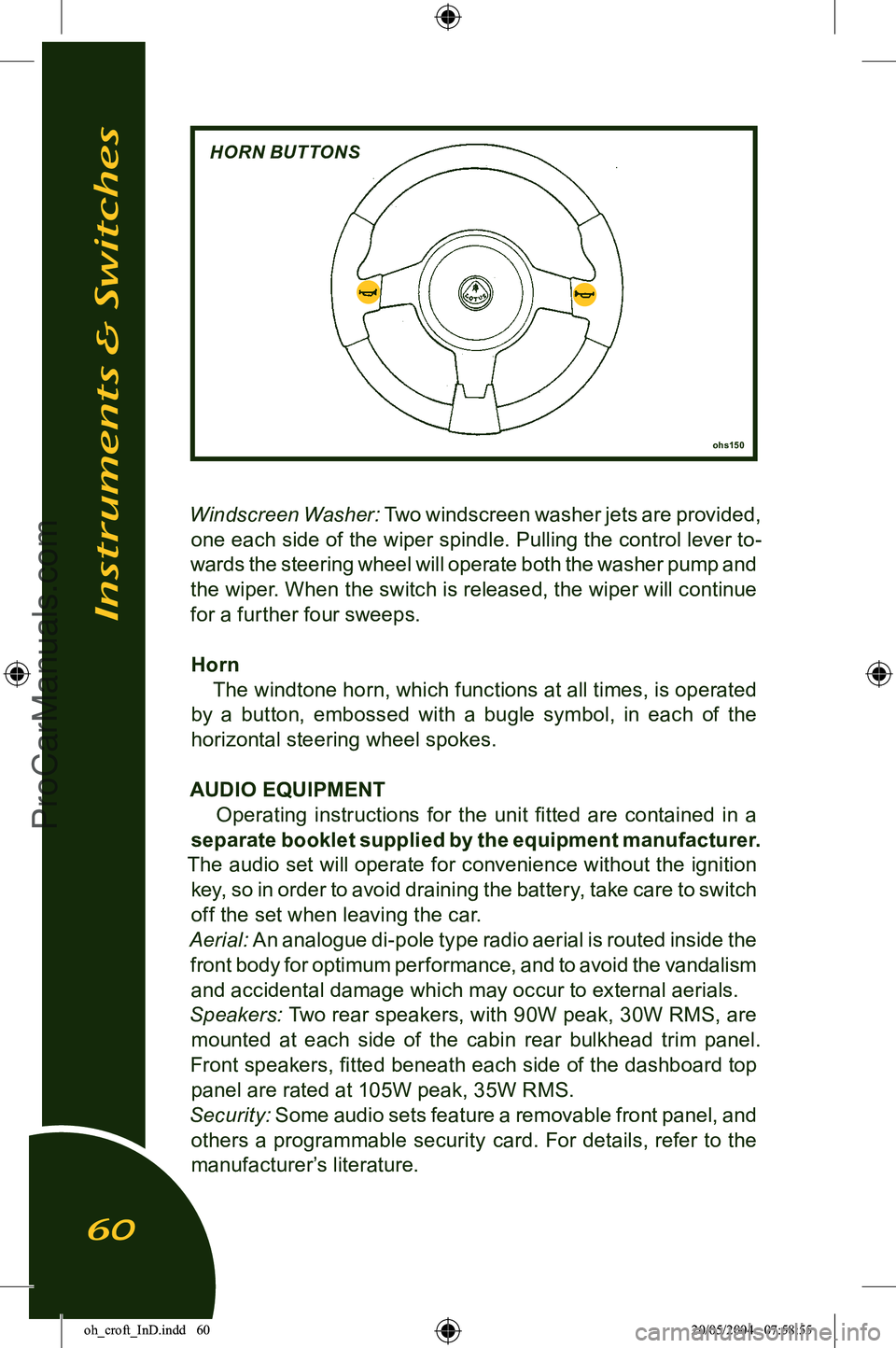
Horn The windtone horn, which functions at all times, is operated
by a button, embossed with a bugle symbol, in each of the
horizontal steering wheel spokes.
AUDIO EQUIPMENT Operating instructions for the unit fitted are contained in a
separate booklet supplied by the equipment manufacturer.
The audio set will operate for convenience without the ignition key, so in order to avoid draining the battery, take care to switch
off the set when leaving the car.
Aerial:
An analogue di-pole type radio aerial is routed inside the
front body for optimum performance, and to avoid the vandalism and accidental damage which may occur to external aerials.
Speakers:
Two rear speakers, with 90W peak, 30W RMS, are
mounted at each side of the cabin rear bulkhead trim panel.
Front speakers, fitted beneath each side of the dashboard top
panel are rated at 105W peak, 35W RMS.
Security:
Some audio sets feature a removable front panel, and
others a programmable security card. For details, refer to the
manufacturer’s literature.
Instruments & Switches
60
ohs150
HORN BUTTONS
oh_croft_InD.indd 6020/05/2004 07:58:55ProCarManuals.com
Page 69 of 205
FootbrakeVentilated disc brakes are fitted to all four wheels of the
Elise. These are operated by separate front and rear hydraulic
circuits, supplied from a tandem master cylinder with vacuum
servo. Anti-lock control is provided by a microprocessor based
electro-hydraulic unit, integrated into the base braking system. The braking system is designed to provide good pedal feed
-
back, with efficient disc cooling to inhibit brake fade. With a
new car, or new brake system components, maximum braking
efficiency will be achieved if, for the first few hundred miles, needless heavy braking is avoided. Allow the brake pads and discs to ‘bed in’ fully before using the brakes to their full potential.
Pedal effort will reduce as the brakes are bedded in, and as they
are warmed from cold to normal working temperature. Note that
the hard grade pad material may give rise to a certain amount of brake noise under some conditions; such noise is not harmful
and does not affect the life or efficiency of the brakes.
WARNING:
• After driving through a ford, or a flooded road, some loss of braking response may be experienced until the brakes
have dried out. As soon as it is safe to do so after such an encounter, apply the brakes until normal operation
is restored. Failure to do so may result in an accident in
which you or others may be killed or seriously injured.
• The brake assistance servo uses vacuum supplied from the engine intake plenum, such that assistance is avail
-
able only when the engine is running. Never coast down
-
hill with the engine stopped. If this situation accidently arises, avoid repeated application of the brakes, or the
stored vacuum supply will be rapidly used up. Greater
pedal pressures will be required. This may adversely affect performance of the brakes which may result in an
accident in which you or others may be killed or seriously
injured.
Anti-lock Brake System The Anti-lock Brake System (ABS) is used to optimise brake
performance in extreme conditions and reduce the potential
for any wheel to lock up. Under most conditions, the maximum braking force is provided by a wheel which is rotating at about
90% of road speed. Apart from the likelihood of increasing the
Driving Controls
67
oh_croft_InD.indd 6720/05/2004 07:58:57ProCarManuals.com
Page 70 of 205
stopping distance, a locked wheel provides little or no steering
force, such that with both front wheels locked, movement of the steering wheel has no effect on car direction. With the anti-lock
system, even panic braking results in controlled deceleration and the retention of steering response. ABS is especially ad
-
vantageous when braking on slippery road surfaces and in bad driving conditions, but it is important to realise that the ABS
cannot increase the friction level at the road surface, but can only make optimum use of the grip available.
WARNING: When driving in adverse weather, or on poor road sur
-
faces, always be alert to the possibility of slippery condi
-
tions and make the necessary allowance for increased stop
-
ping distances. Failure to do so may result in an accident in which you or others may be killed or seriously injured.
Normal braking, controlled by the pressure applied to the
brake pedal, occurs when the road conditions allow for decel
-
eration to be achieved without danger of wheel lock. The relative
speeds of the four wheels are continuously monitored by the
ABS when the brakes are applied, and if one or more wheels begin to lock, the brake pressure to that wheel(s) is modulated
by the ABS to help keep the wheel rotating and provide the
maximum controlled braking force. The wheels may appear
to lock momentarily as the wheel speed rapidly changes, and some tire noise (intermittent screeching) may be heard which is normal and will vary with road and tire conditions. Note that the
ABS does not function at speeds below 5 mph (7 km/h). When the ABS is activated, the driver is will feel a ‘pulsing’
sensation at the brake pedal as the fluid pressure is modulated, and also by audible clicking sounds. These signals indicate to
the driver that maximum braking is occuring, and that driving style should be modified to suit the conditions.
The minimum stopping distance is achieved by applying the
brakes firmly and steadily, and allowing the ABS to modulate
hydraulic pressure. The driver should not attempt to emulate
this process by ‘pumping’ the brake pedal, as modulation at the pedal will treat all four wheels similarly, rather than the individual
wheel control allowed by the electronics. An ABS tell tale lamp in the instrument panel is provided
to warn of any problems in the system and to indicate that the
Driving Controls
68
oh_croft_InD.indd 6820/05/2004 07:58:57ProCarManuals.com
Page 71 of 205
integral self diagnostics have switched out the anti-lock function.
See ‘ABS tell tale lamp’.
WARNING:
• The increased control that ABS provides should not induce you to take more risks with your safety. ABS will
not prevent a skid caused by abrupt steering movements,
or attempting to corner too quickly.
• Always maintain a safe following distance from other cars relative to the road surface and weather conditions.
Obey all traffic laws.
• Risk of accidents due to inappropriate speed cannot be reduced even by ABS. The driver is responsible for the
judgement of safe speed.
• The control unit of the ABS is set for standard tire size. If non-standard Tires are fitted, the control unit may mis-
interpret the speed of the car, because of the variant data
it receives from the wheel speed sensors. Fitting non standard tires would seriously affect the performance of
your ABS.
• The amber ABS tell tale in the instrument panel should light for about 4 seconds following ignition switch on, and
then go out. If the lamp remains lit, or comes on whilst driving, a fault in the anti-lock brake system is indicated.
The base brake system will continue to operate normally,
but without ABS. The car can be driven but should be
checked and repaired at the earliest opportunity.
• Activation of the ABS will vary according to the level of grip available at the Tires. On dry surfaces, activation
will occur only with a high pedal pressure. On slippery
surfaces, only a low pressure will be needed.
• On loose or uneven surfaces, such as gravel or snow, a car with ABS may need a longer stopping distance. Allow
a greater distance between cars in these conditions.
Driving Controls
69
oh_croft_InD.indd 6920/05/2004 07:58:57ProCarManuals.com
Page 72 of 205
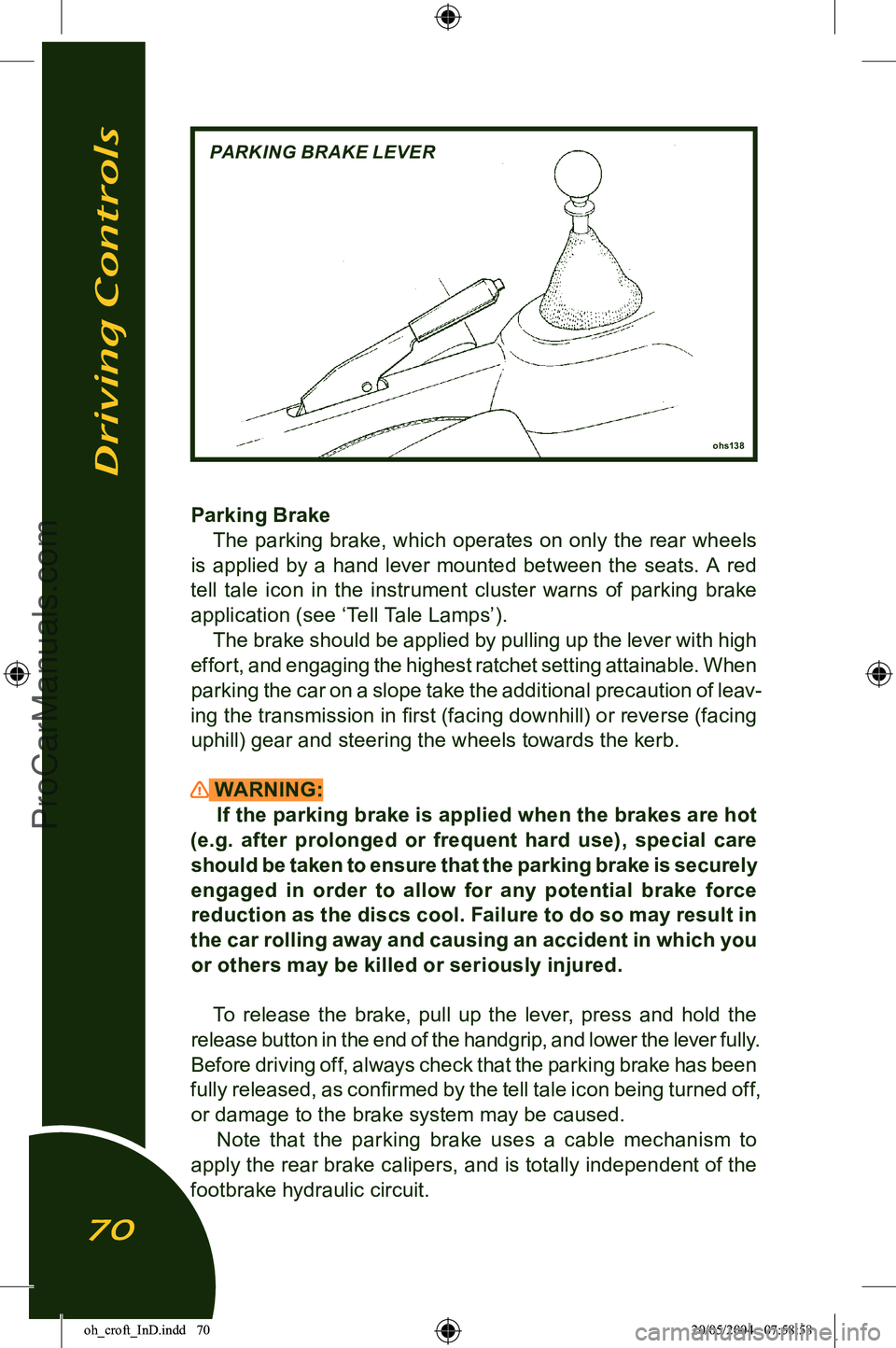
Parking BrakeThe parking brake, which operates on only the rear wheels
is applied by a hand lever mounted between the seats. A red
tell tale icon in the instrument cluster warns of parking brake application (see ‘Tell Tale Lamps’). The brake should be applied by pulling up the lever with high
effort, and engaging the highest ratchet setting attainable. When
parking the car on a slope take the additional precaution of leav
-
ing the transmission in first (facing downhill) or reverse (facing uphill) gear and steering the wheels towards the kerb.
WARNING: If the parking brake is applied when the brakes are hot
(e.g. after prolonged or frequent hard use), special care
should be taken to ensure that the parking brake is securely engaged in order to allow for any potential brake force
reduction as the discs cool. Failure to do so may result in
the car rolling away and causing an accident in which you
or others may be killed or seriously injured.
To release the brake, pull up the lever, press and hold the
release button in the end of the handgrip, and lower the lever fully.
Before driving off, always check that the parking brake has been
fully released, as confirmed by the tell tale icon being turned off,
or damage to the brake system may be caused. Note that the parking brake uses a cable mechanism to
apply the rear brake calipers, and is totally independent of the
footbrake hydraulic circuit.
Driving Controls
70
ohs138
PARKING BRAKE LEVER
oh_croft_InD.indd 7020/05/2004 07:58:58ProCarManuals.com
Page 98 of 205
Soft Top Roof
1. Careful vacuuming of the soft top before washing may be
helpful in removing excess dust and other foreign particles.
2. Wash in partial shade rather than strong sunlight.
3. Using only clean lukewarm water and a sponge (a chamois or
cloth will leave lint, and a brush may abrade the threads), wash
the entire soft top uniformly. Do NOT use a detergent, which may
affect the waterproofing properties of the material.
4. Rinse the whole car to prevent streaking on the paintwork. 5. Remove surface water with a sponge and allow to air dry in direct sunlight. Ensure that the roof is fully dry before stow
-
ing, as prolonged stowage of a wet or damp roof will promote
rotting of the fabric.
Keeping the soft top clean by regular washing will enhance
the life and maintain the appearance of the roof, and facilitate subsequent cleaning. The use of stronger cleansers should be left to professionals experienced in handling this type of fabric
as discoloration and degradation of the material may result.
The application of wax finishes, dressings or preservatives may cause stains, and should be avoided. Your dealer will be able to advise on current Lotus approved soft top care products.
Windscreen Cleaning When washing the windscreen, take care to lift the wiper
blade only a small distance from the glass in order not to dam
-
age the wiper arm mechanism. Wash the wiper blade with
clean water.
Alloy Road Wheels It is recommended that the aluminium alloy road wheels
are washed with the same preparation as is used to wash the bodywork. Use a brush having only nylon bristles. During the
winter months, particularly when salt has been used on the
roads for the dispersal of snow and ice, remove all the wheels,
and wash thoroughly to remove all accumulated road filth from
the wheels and Tires. Be aware that on cars fitted with optional clear anodised
forged alloy wheels (with 7 twin-spokes), the anodised surface
finish may be attacked by some proprietary wheel cleaning products. Wash only using hot soapy water or car bodywork
shampoo. Advise tire fitting companies accordingly.
Servicing & Maintenance
96
oh_croft_InD.indd 9620/05/2004 07:59:04ProCarManuals.com
Page 115 of 205
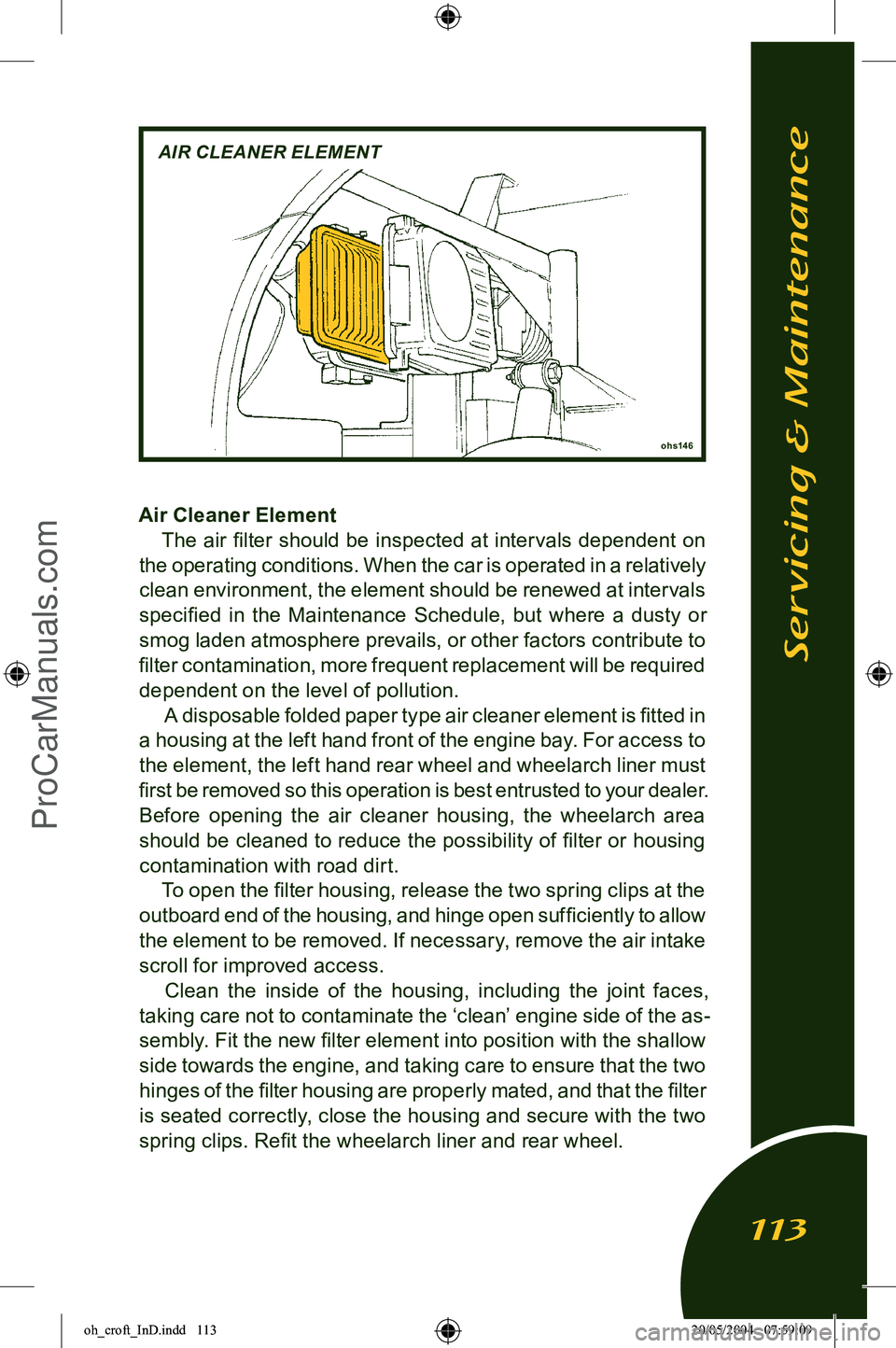
Air Cleaner ElementThe air filter should be inspected at intervals dependent on
the operating conditions. When the car is operated in a relatively
clean environment, the element should be renewed at intervals
specified in the Maintenance Schedule, but where a dusty or
smog laden atmosphere prevails, or other factors contribute to
filter contamination, more frequent replacement will be required
dependent on the level of pollution. A disposable folded paper type air cleaner element is fitted in
a housing at the left hand front of the engine bay. For access to
the element, the left hand rear wheel and wheelarch liner must
first be removed so this operation is best entrusted to your dealer.
Before opening the air cleaner housing, the wheelarch area
should be cleaned to reduce the possibility of filter or housing contamination with road dirt. To open the filter housing, release the two spring clips at the
outboard end of the housing, and hinge open sufficiently to allow
the element to be removed. If necessary, remove the air intake scroll for improved access. Clean the inside of the housing, including the joint faces,
taking care not to contaminate the ‘clean’ engine side of the as
-
sembly. Fit the new filter element into position with the shallow
side towards the engine, and taking care to ensure that the two
hinges of the filter housing are properly mated, and that the filter
is seated correctly, close the housing and secure with the two
spring clips. Refit the wheelarch liner and rear wheel.
ohs146
AIR CLEANER ELEMENT
Servicing & Maintenance
113
oh_croft_InD.indd 11320/05/2004 07:59:09ProCarManuals.com
Page 117 of 205
TIRES AND WHEELS
TiresGlossary of Terms:Recommended inflation pressure: The cold tire inflation pressure which is recommended for this car and is speci
-
fied in the ‘Technical Data’ section of this handbook.
Cold tire inflation pressure: All tires must be cold, meaning
that the car has been stationary for a minimum of 3 hours, or has been driven less than 1 mile. Adjust pressures only
in ambient conditions.
Maximum inflation pressure: The maximum inflation pres
-
sure to which the tire should be subjected. For the Elise,
use only the recommended inflation pressure.
Lotus engineers have worked with tire manufacturers
to produce tire specifications for the Elise which optimise performance on both road and track. To ensure that any
replacement tires are to the correct Lotus specification,
always refer to your Lotus dealer, who will have the latest recommendations.
WARNING: In order to achieve the optimum handling char
-
acteristics, the wheel and tire sizes on the Elise are different front and rear. This means that interchanging
of wheels and tires between axles is not permissible.
Failure to adhere to this requirement will adversely affect the handling of the car and may result in an
accident in which you or others could be killed or seriously injured,
The tires should be regularly inspected for signs of cuts,
abrasions or other damage, and for any uneven tread
wear patterns. Uneven treadwear may indicate that the suspension geometry or dampers require attention from
your dealer.
Tires & Wheels
115
oh_croft_InD.indd 11520/05/2004 07:59:09ProCarManuals.com
Page 118 of 205
NOTICE:
• On cars used on a race track or in a competitive manner,
special vigilance is required due to the severity of tire operating conditions, with careful inspections carried
out between sessions.
• Take care when parking to avoid tire contact with high
or sharp edged kerbs. Such mistreatment can cause
internal damage to the tire structure and this may not be readily apparent. The wheel rims may also be distorted or damaged by careless parking, and result in wheel
imbalance or loss of tire pressure. Similar damage may also be caused by potholes, rocks or other highway
debris.
WARNING:
• Damage to wheels and tires may cause an accident in which you or others may be killed or seriously
injured. If the wheels or tires have been damaged,
have them replaced.
• Safety considerations should always be paramount when assessing tire condition and serviceability, and the tires replaced if any doubt exists, or if the
legal tread depth limits are approached.
• Poorly maintained and improperly used tires are dangerous.
• Overloading your tires can cause overheating as a result of too much friction. You could have a blow
out and a serious accident in which you could be killed or seriously injured. See ‘Tire Placard La
-
bel’.
• Underinflated tires pose the same danger as over loaded tires. The resulting accident could cause serious injury, or death. Check all tires frequently
and maintain at the recommended pressure. Tire
pressures should be checked only when the tires
are cold.
• Overinflated tires are more likely to be cut, punc- tured or broken by a sudden impact - such as hitting a pothole. Keep tires at the recommended pressure.
• Installing improper tires on your car can affect handling and stability. This can cause a crash
in which you can be killed or seriously injured.
Tires & Wheels
116
oh_croft_InD.indd 11620/05/2004 07:59:09ProCarManuals.com
Page 119 of 205
Always use the size and type of tires recommended
in this handbook.
• Using incorrect tires or tires which are excessively worn or improperly inflated can cause a crash in
which you can be killed or seriously injured.
• Please note your car is not fitted with a low tire pressure tell tale lamp so it is especially important
that you regularly check the tire pressures.
When driving on wet roads, surface water is squeezed
out from between the tire and road. However excessive
speed or water depth can overwhelm the water clearing capability of the tread and lead to a condition called 'aq
-
uaplaning' or ‘hydroplaning’, where the tire rides on a film of water and provides little or no grip on the road surface,
leading to a loss of control. This condition is more likely
to occur with worn tires having little depth of tread, or with incorrect tire pressures. Drivers should keep a vigilant check on tire wear and condition, and moderate their
speed in adverse weather conditions.
Tire Care Wear indicators are moulded into the bottom of the
tread grooves at intervals around the tire, indicated by small pointers on the outer tread blocks. The tires should
be replaced before being worn to this minimum legal
tread depth. The cold tire pressures should be checked every week,
or every 1,000 miles (1,700 km), whichever is the sooner,
and corrections made as necessary. See ‘Technical Data’
at the back of the handbook for tire pressures. For track
use, tire condition and pressures should be checked be
-
fore each run. Under-inflation will cause excessive wear, rapid deterioration of the tire sidewalls and heavy steering,
whereas over-inflation results in a hard ride and increased susceptibility to tire damage. Both conditions will cause a degradation in the handling qualities. It is important that the tire pressures are adjusted only
when the Tires are cold (when the car has been standing for a minimum of 3 hours, or driven less than 1 mile), as the pressures may increase by 0.3 - 0.5 bar (4 - 8 lb/in²)
when the Tires are warmed to normal running temperature.
Tires & Wheels
117
oh_croft_InD.indd 11720/05/2004 07:59:09ProCarManuals.com