air LOTUS ELISE 2005 Owner's Manual
[x] Cancel search | Manufacturer: LOTUS, Model Year: 2005, Model line: ELISE, Model: LOTUS ELISE 2005Pages: 205, PDF Size: 4.51 MB
Page 50 of 205
WARNING:Continuing to run the engine with the oil tell tale lit could
cause major engine damage or seizure, resulting in loss
of car control and a crash. You or others could be killed
or seriously injured.
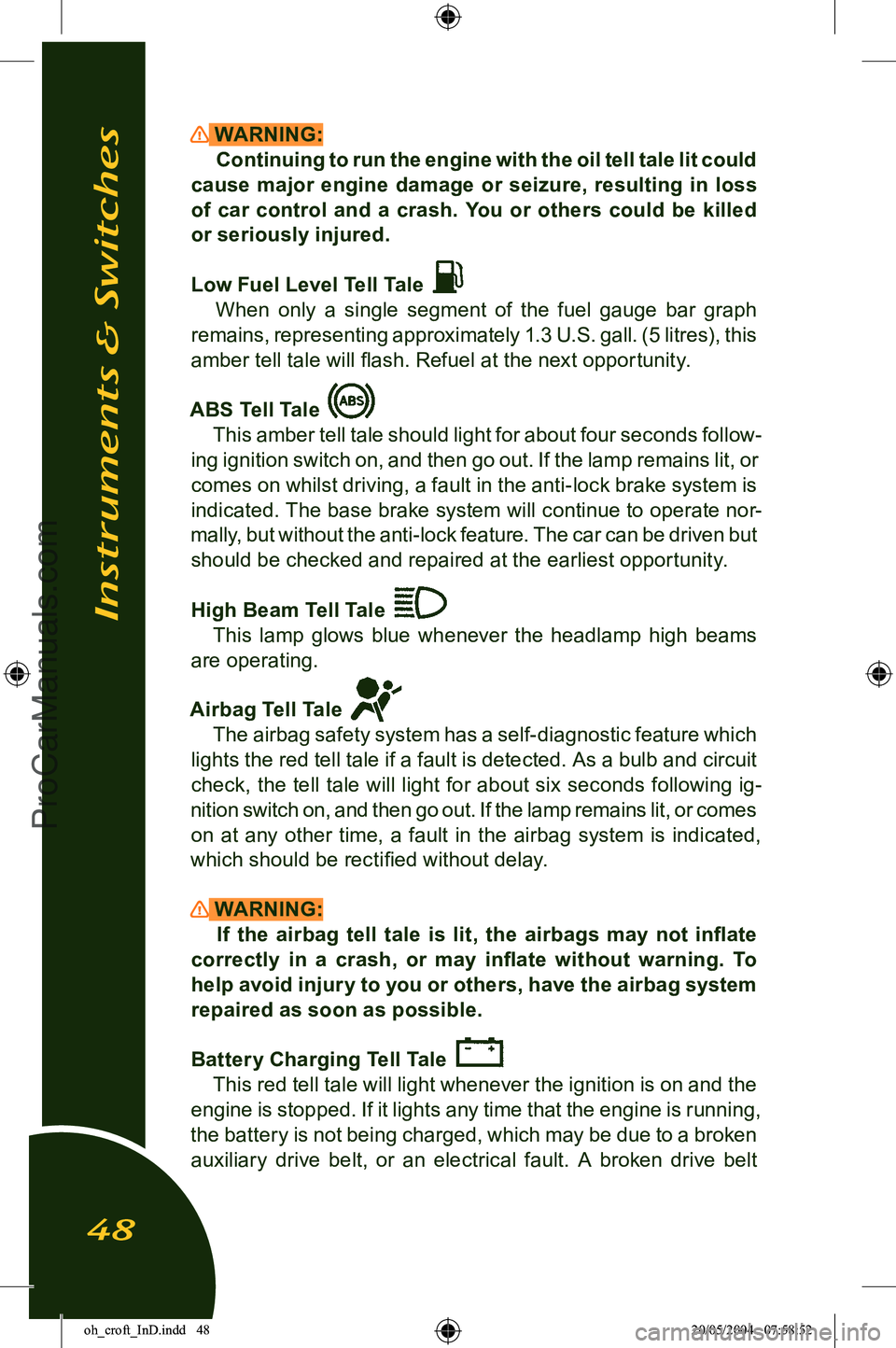
Low Fuel Level Tell Tale
When only a single segment of the fuel gauge bar graph
remains, representing approximately 1.3 U.S. gall. (5 litres), this
amber tell tale will flash. Refuel at the next opportunity.
ABS Tell Tale
This amber tell tale should light for about four seconds follow-
ing ignition switch on, and then go out. If the lamp remains lit, or
comes on whilst driving, a fault in the anti-lock brake system is
indicated. The base brake system will continue to operate nor
-
mally, but without the anti-lock feature. The car can be driven but should be checked and repaired at the earliest opportunity.
High Beam Tell Tale
This lamp glows blue whenever the headlamp high beams
are operating.
Airbag Tell Tale
The airbag safety system has a self-diagnostic feature which
lights the red tell tale if a fault is detected. As a bulb and circuit
check, the tell tale will light for about six seconds following ig
-
nition switch on, and then go out. If the lamp remains lit, or comes on at any other time, a fault in the airbag system is indicated,
which should be rectified without delay.
WARNING: If the airbag tell tale is lit, the airbags may not inflate
correctly in a crash, or may inflate without warning. To
help avoid injury to you or others, have the airbag system repaired as soon as possible.
Battery Charging Tell Tale
This red tell tale will light whenever the ignition is on and the
engine is stopped. If it lights any time that the engine is running,
the battery is not being charged, which may be due to a broken
auxiliary drive belt, or an electrical fault. A broken drive belt
Instruments & Switches
48
oh_croft_InD.indd 4820/05/2004 07:58:52ProCarManuals.com
Page 51 of 205
will also disable the engine coolant pump and result in rapid overheating; stop the engine as soon as it is safe to do so, and
summon assistance. If the drive belt is intact and the cooling
system unaffected, it may be possible in favourable daylight conditions, to drive a short distance to a repair facility, but do not, under any circumstances, allow the battery to become
completely discharged by continuing to drive.
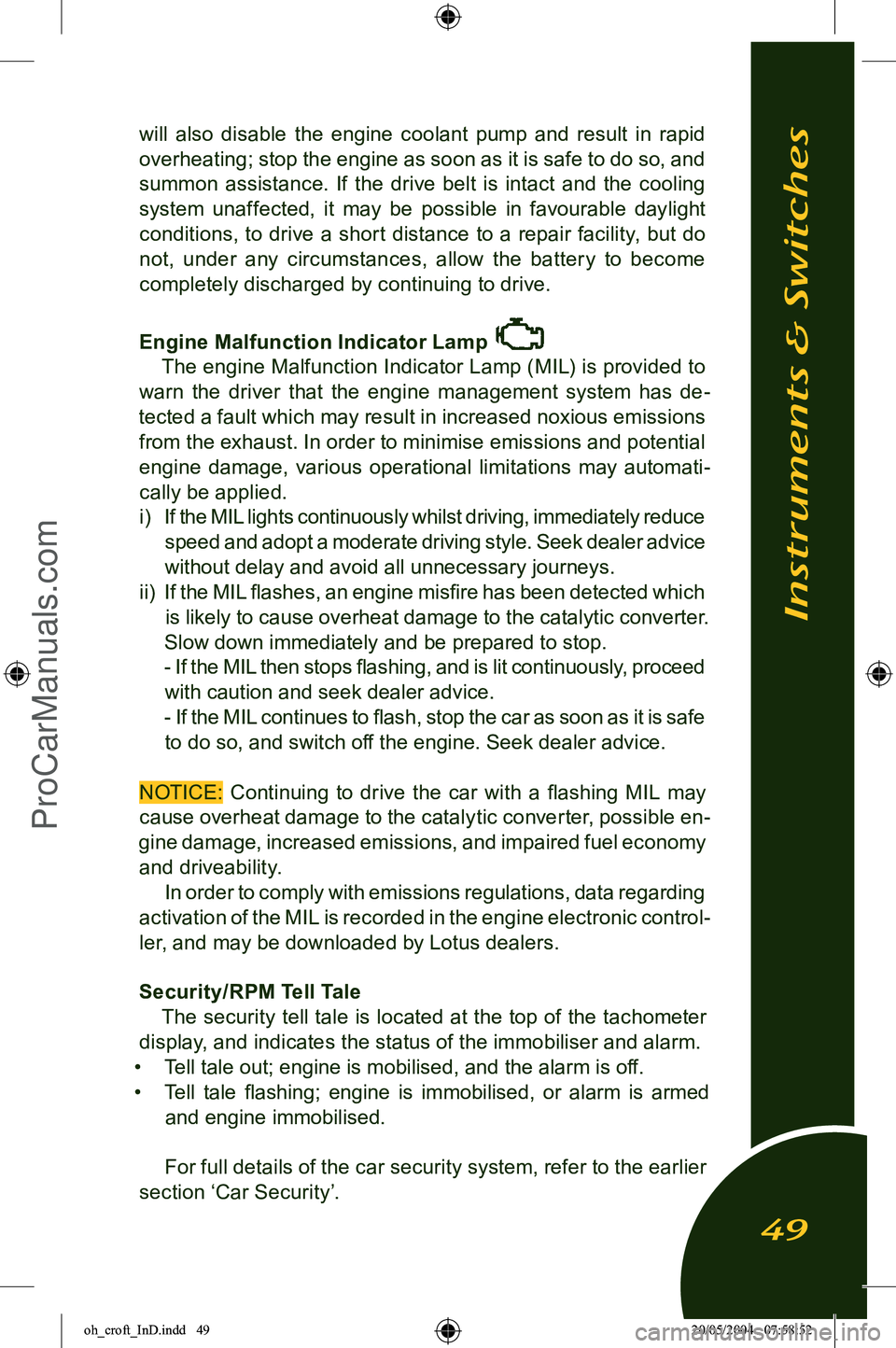
Engine Malfunction Indicator Lamp
The engine Malfunction Indicator Lamp (MIL) is provided to
warn the driver that the engine management system has de
-
tected a fault which may result in increased noxious emissions from the exhaust. In order to minimise emissions and potential
engine damage, various operational limitations may automati
-
cally be applied. i) If the MIL lights continuously whilst driving, immediately reduce
speed and adopt a moderate driving style. Seek dealer advice
without delay and avoid all unnecessary journeys.
ii) If the MIL flashes, an engine misfire has been detected which is likely to cause overheat damage to the catalytic converter.
Slow down immediately and be prepared to stop.
- If the MIL then stops flashing, and is lit continuously, proceed with caution and seek dealer advice.
- If the MIL continues to flash, stop the car as soon as it is safe to do so, and switch off the engine. Seek dealer advice.
NOTICE:
Continuing to drive the car with a flashing MIL may
cause overheat damage to the catalytic converter, possible en
-
gine damage, increased emissions, and impaired fuel economy and driveability.
In order to comply with emissions regulations, data regarding
activation of the MIL is recorded in the engine electronic control
-
ler, and may be downloaded by Lotus dealers.
Security/RPM Tell Tale The security tell tale is located at the top of the tachometer
display, and indicates the status of the immobiliser and alarm.
• Tell tale out; engine is mobilised, and the alarm is off.
• Tell tale flashing; engine is immobilised, or alarm is armed
and engine immobilised.
For full details of the car security system, refer to the earlier
section ‘Car Security’.
Instruments & Switches
49
oh_croft_InD.indd 4920/05/2004 07:58:52ProCarManuals.com
Page 57 of 205
‘Lights On’ Buzzer If the lights are on when the ignition is switched off, a ‘lights on’
reminder buzzer will sound when the driver’s door is opened.
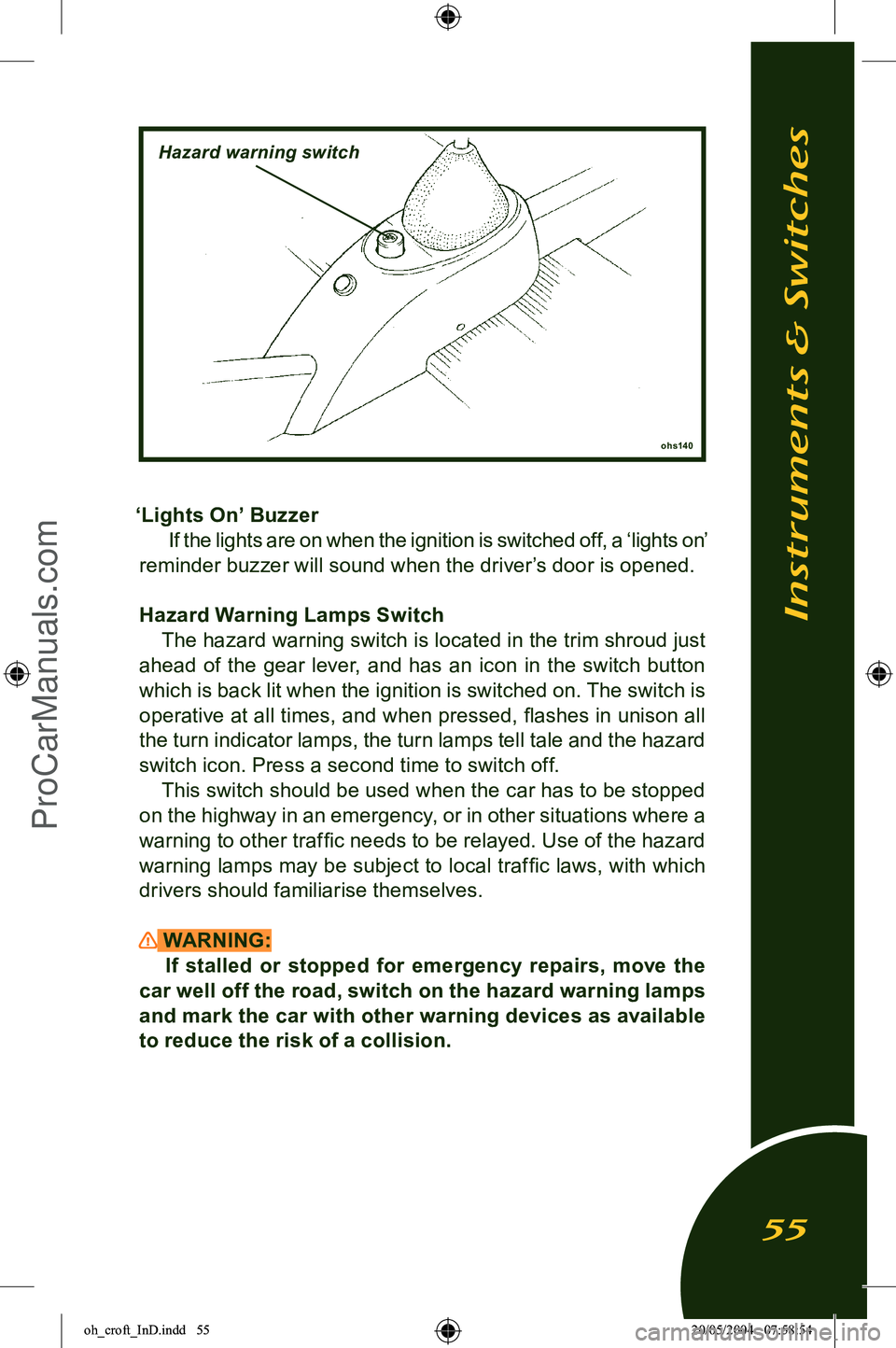
Hazard Warning Lamps Switch The hazard warning switch is located in the trim shroud just
ahead of the gear lever, and has an icon in the switch button
which is back lit when the ignition is switched on. The switch is operative at all times, and when pressed, flashes in unison all
the turn indicator lamps, the turn lamps tell tale and the hazard switch icon. Press a second time to switch off. This switch should be used when the car has to be stopped
on the highway in an emergency, or in other situations where a
warning to other traffic needs to be relayed. Use of the hazard
warning lamps may be subject to local traffic laws, with which drivers should familiarise themselves.
WARNING: If stalled or stopped for emergency repairs, move the
car well off the road, switch on the hazard warning lamps
and mark the car with other warning devices as available
to reduce the risk of a collision.
Instruments & Switches
55
ohs140
Hazard warning switch
oh_croft_InD.indd 5520/05/2004 07:58:54ProCarManuals.com
Page 63 of 205
HEATING, VENTILATION & AIR CONDITIONINGThe small size of the Elise together with the method of
construction and emphasis on lightweight, have resulted in heating and a.c. sytems which perform well under non-extreme
climatic conditions. In extreme temperatures and humidity the operational limits of the systems may be reached before the
desired temperature, or rate of temperature change inside the
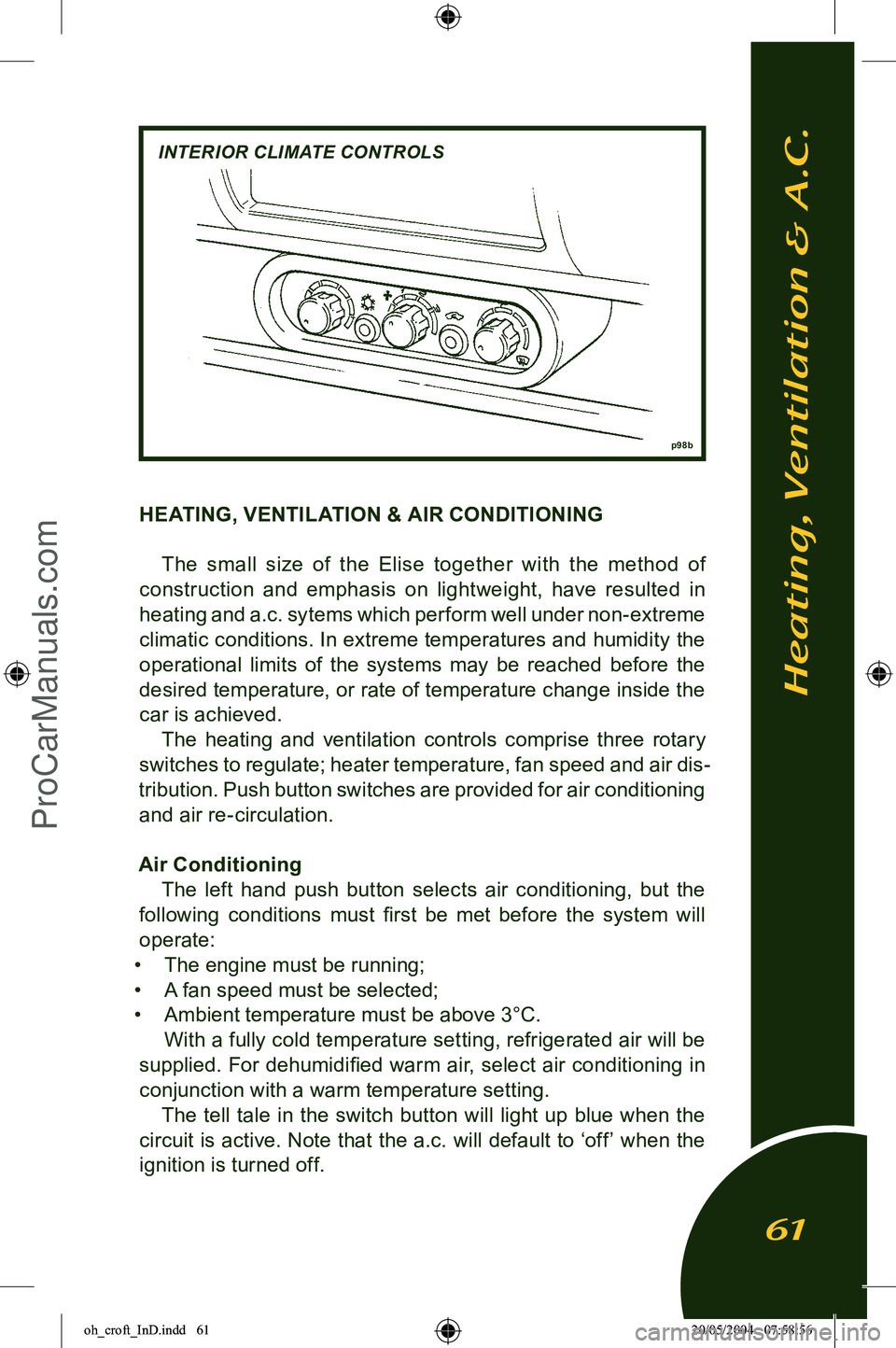
car is achieved. The heating and ventilation controls comprise three rotary
switches to regulate; heater temperature, fan speed and air dis
-
tribution. Push button switches are provided for air conditioning and air re-circulation.
Air Conditioning The left hand push button selects air conditioning, but the
following conditions must first be met before the system will
operate:
• The engine must be running;
• A fan speed must be selected;
• Ambient temperature must be above 3°C.
With a fully cold temperature setting, refrigerated air will be
supplied. For dehumidified warm air, select air conditioning in
conjunction with a warm temperature setting. The tell tale in the switch button will light up blue when the
circuit is active. Note that the a.c. will default to ‘off’ when the ignition is turned off.
Heating, Ventilation & A.C.
61
p 98b
INTERIOR CLIMATE CONTROLS
oh_croft_InD.indd 6120/05/2004 07:58:56ProCarManuals.com
Page 64 of 205
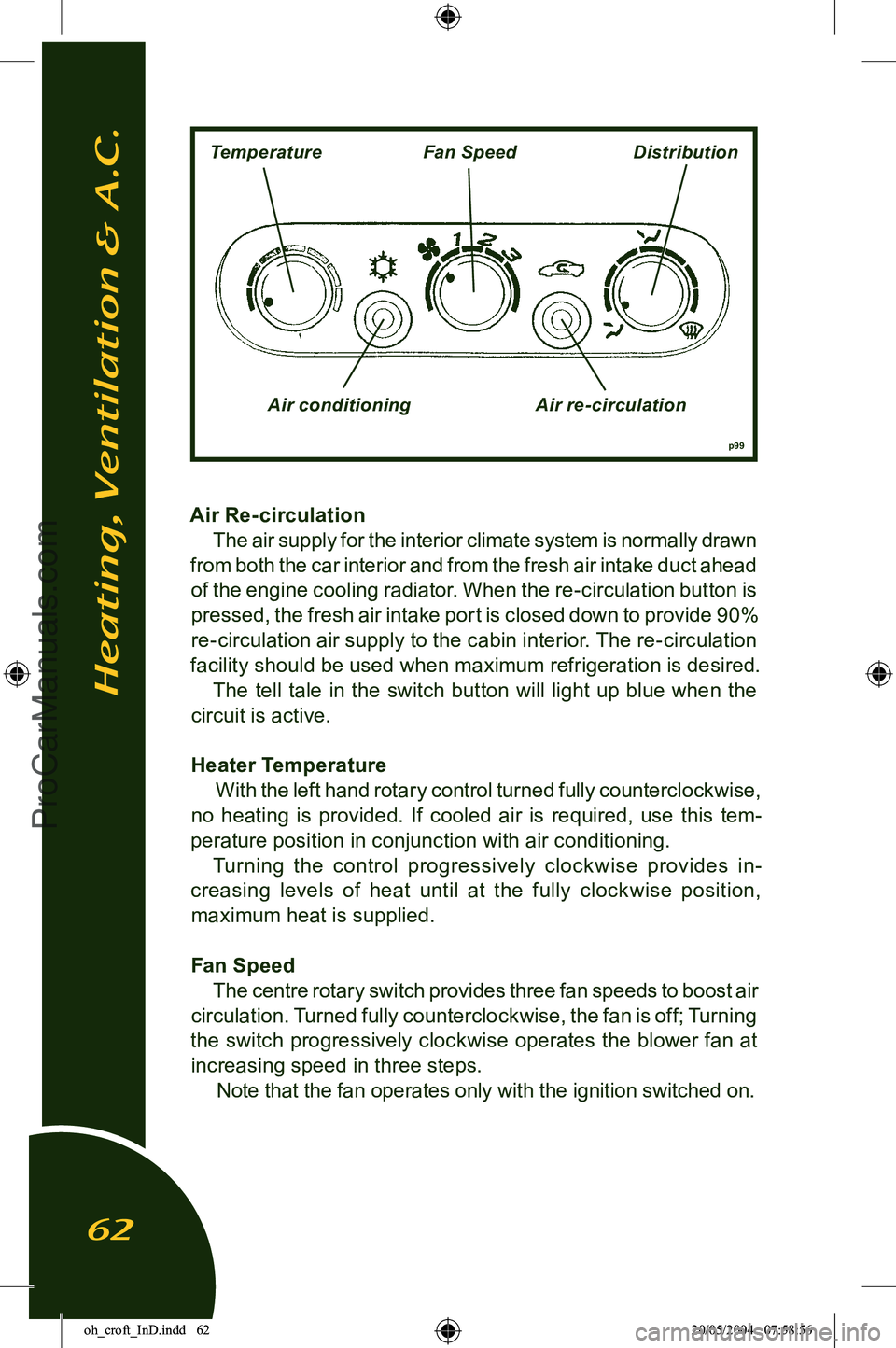
Air Re- circulation The air supply for the interior climate system is normally drawn
from both the car interior and from the fresh air intake duct ahead
of the engine cooling radiator. When the re-circulation button is pressed, the fresh air intake port is closed down to provide 90%
re-circulation air supply to the cabin interior. The re-circulation
facility should be used when maximum refrigeration is desired.
The tell tale in the switch button will light up blue when the
circuit is active.
Heater Temperature With the left hand rotary control turned fully counterclockwise,
no heating is provided. If cooled air is required, use this tem
-
perature position in conjunction with air conditioning. Turning the control progressively clock wise provides in
-
creasing levels of heat until at the fully clockwise position, maximum heat is supplied.
Fan Speed The centre rotary switch provides three fan speeds to boost air
circulation. Turned fully counterclockwise, the fan is off; Turning
the switch progressively clockwise operates the blower fan at increasing speed in three steps. Note that the fan operates only with the ignition switched on.
Heating, Ventilation & A.C.
62
p99
TemperatureFan SpeedDistribution
Air conditioning Air re-circulation
oh_croft_InD.indd 6220/05/2004 07:58:56ProCarManuals.com
Page 65 of 205
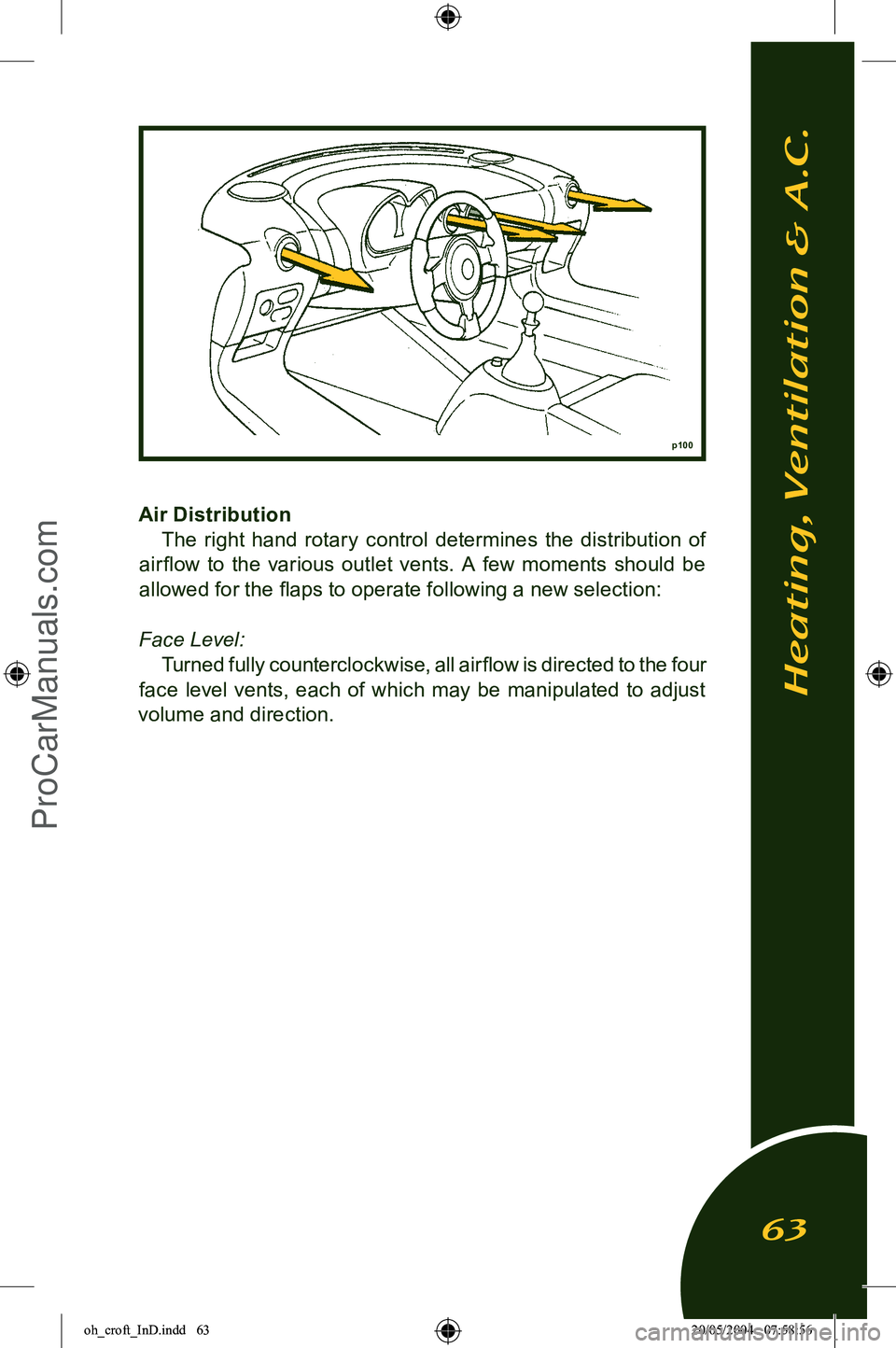
Air DistributionThe right hand rotary control determines the distribution of
air flow to the various outlet vents. A few moments should be
allowed for the flaps to operate following a new selection:
Face Level: Turned fully counterclockwise, all airflow is directed to the four
face level vents, each of which may be manipulated to adjust
volume and direction.
p100
Heating, Ventilation & A.C.
63
oh_croft_InD.indd 6320/05/2004 07:58:56ProCarManuals.com
Page 66 of 205
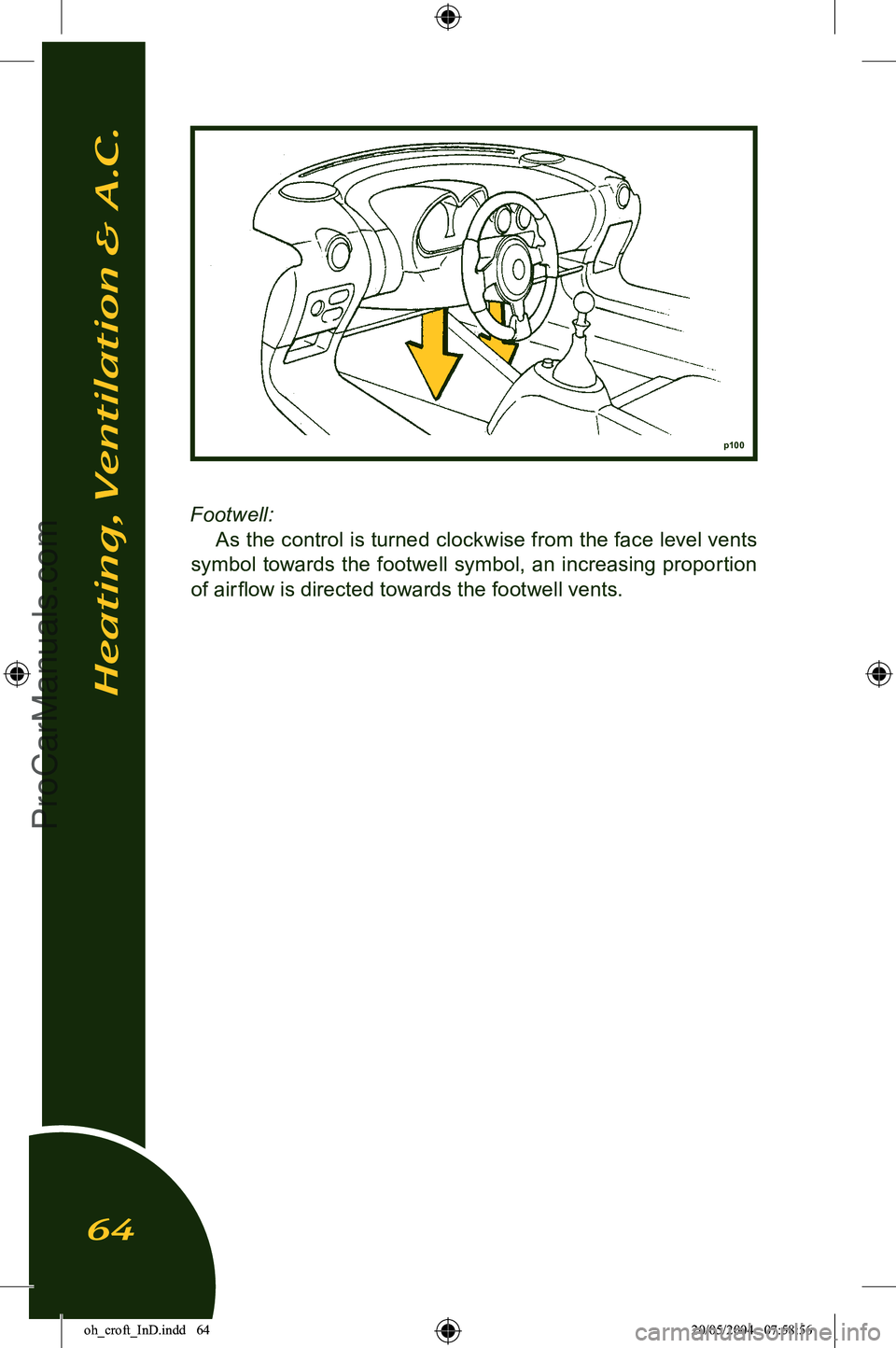
Footwell:
As the control is turned clockwise from the face level vents
symbol towards the footwell symbol, an increasing proportion
of air flow is directed towards the footwell vents.
p100
Heating, Ventilation & A.C.
64
oh_croft_InD.indd 6420/05/2004 07:58:56ProCarManuals.com
Page 67 of 205
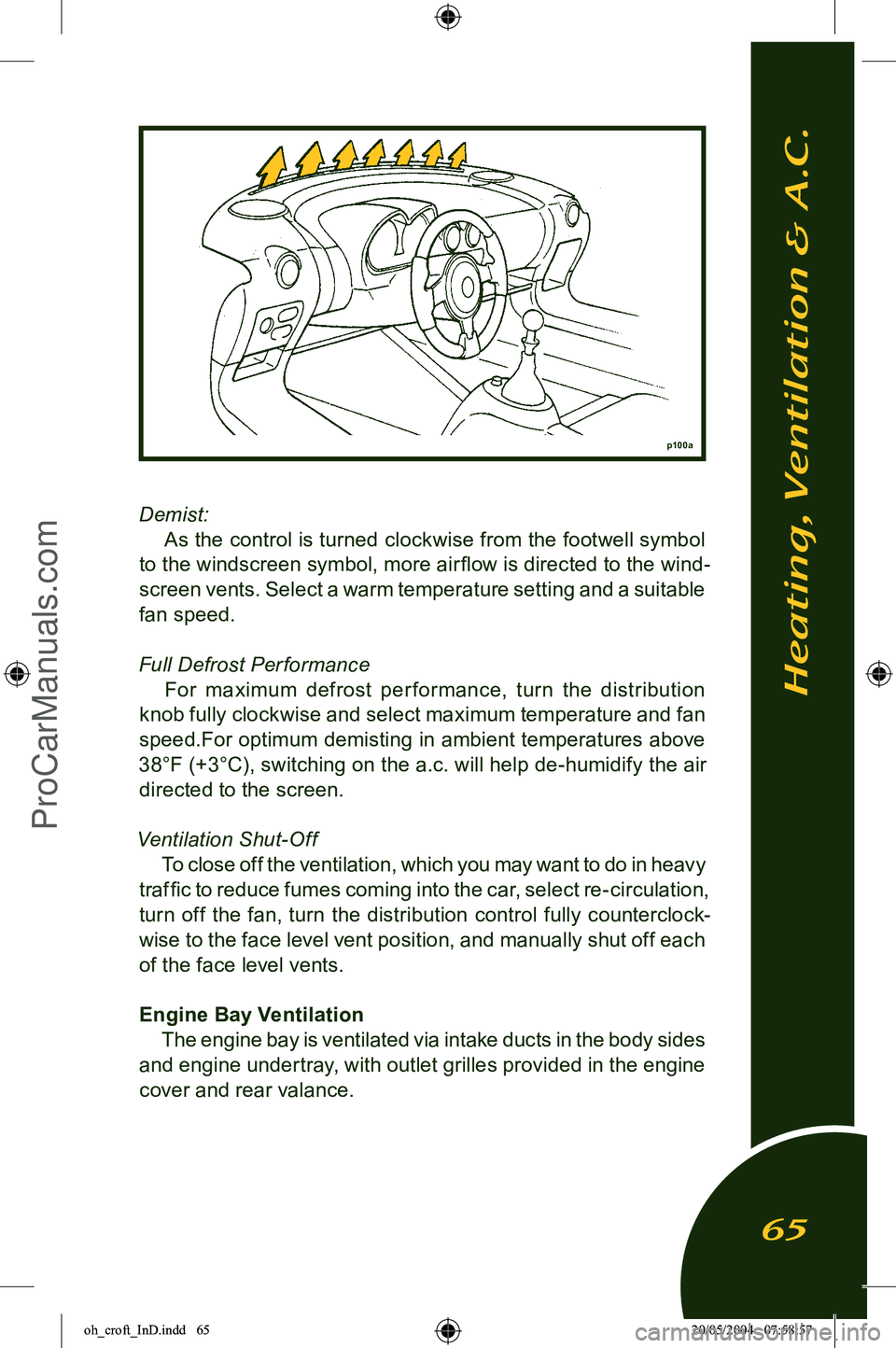
Demist:
As the control is turned clockwise from the footwell symbol
to the windscreen symbol, more air flow is directed to the wind
-
screen vents. Select a warm temperature setting and a suitable
fan speed.
Full Defrost Per formance For maximum defrost per formance, turn the distribution
knob fully clockwise and select maximum temperature and fan
speed.For optimum demisting in ambient temperatures above
38°F (+3°C), switching on the a.c. will help de-humidify the air directed to the screen.
Ventilation Shut-Off To close off the ventilation, which you may want to do in heavy
traffic to reduce fumes coming into the car, select re-circulation,
turn off the fan, turn the distribution control fully counterclock
-
wise to the face level vent position, and manually shut off each of the face level vents.
Engine Bay Ventilation The engine bay is ventilated via intake ducts in the body sides
and engine undertray, with outlet grilles provided in the engine
cover and rear valance.
p100a
Heating, Ventilation & A.C.
65
oh_croft_InD.indd 6520/05/2004 07:58:57ProCarManuals.com
Page 71 of 205
integral self diagnostics have switched out the anti-lock function.
See ‘ABS tell tale lamp’.
WARNING:
• The increased control that ABS provides should not induce you to take more risks with your safety. ABS will
not prevent a skid caused by abrupt steering movements,
or attempting to corner too quickly.
• Always maintain a safe following distance from other cars relative to the road surface and weather conditions.
Obey all traffic laws.
• Risk of accidents due to inappropriate speed cannot be reduced even by ABS. The driver is responsible for the
judgement of safe speed.
• The control unit of the ABS is set for standard tire size. If non-standard Tires are fitted, the control unit may mis-
interpret the speed of the car, because of the variant data
it receives from the wheel speed sensors. Fitting non standard tires would seriously affect the performance of
your ABS.
• The amber ABS tell tale in the instrument panel should light for about 4 seconds following ignition switch on, and
then go out. If the lamp remains lit, or comes on whilst driving, a fault in the anti-lock brake system is indicated.
The base brake system will continue to operate normally,
but without ABS. The car can be driven but should be
checked and repaired at the earliest opportunity.
• Activation of the ABS will vary according to the level of grip available at the Tires. On dry surfaces, activation
will occur only with a high pedal pressure. On slippery
surfaces, only a low pressure will be needed.
• On loose or uneven surfaces, such as gravel or snow, a car with ABS may need a longer stopping distance. Allow
a greater distance between cars in these conditions.
Driving Controls
69
oh_croft_InD.indd 6920/05/2004 07:58:57ProCarManuals.com
Page 87 of 205
5. Unhook the two roof stays and pack in the roof bag. Stow the
bag in the rear luggage compartment.
NOTICE: If the roof is not fully dry, it should be stowed for no longer than 1 or 2 days before unrolling or refitting and allowing
to air dry completely. Prolonged stowage of a wet or damp roof
will promote rotting of the fabric.
HARD TOP ROOF
NOTICE:
• The hard top roof has been designed to provide a seasonal,
rather than single trip option. Some owners may prefer to
entrust the fitting and removal of the hard top roof to their
dealer.
• When stowing the roof off the car, care should be taken to
avoid damage to the roof corners; e.g. use a suitable soft
floor covering on which to stand the roof. Note that there is
no provision for on-board hard top roof stowage.
• Fitment or removal of the hardtop is made considerably easier
with the assistance of a second person.
• Use only the ‘Torx’ tool supplied in the car tool kit (in the
battery cover rear pocket), to tighten or release the roof
fixing screws.
• The hardtop roof fixings are tethered to the roof panel to guard
against their loss.
WARNING:
Take care to avoid trapping hands or fingers when fitting
or removing the hard top.
External Operations
85
oh_croft_InD.indd 8520/05/2004 07:59:01ProCarManuals.com