air LOTUS ELISE 2005 Owner's Guide
[x] Cancel search | Manufacturer: LOTUS, Model Year: 2005, Model line: ELISE, Model: LOTUS ELISE 2005Pages: 205, PDF Size: 4.51 MB
Page 95 of 205
SERVICING AND MAINTENANCEBODYCARE
Body Features Lotus are among the world leaders in the field of automotive
composite moulding design and manufacturing techniques.
Composite materials have major advantages for specialist car bodies, and these brief notes introduce some features of the
construction and service properties of automotive composite bodies. The manufacturing process enables the thickness of com
-
posite mouldings to be varied in order to provide ef ficient structures of high strength and low weight. Composites will not
corrode, so the strength of composite components is retained regardless of age, unless physical damage is sustained. On
the Elise, the body construction utilises several mouldings to
form a single unit for the whole of the nose and front wings, and
a second unit for the whole of the rear body aft of the doors.
These two moulded assemblies are fixed using threaded fasten
-
ers to permit easy removal for access to chassis or powertrain
components, or to allow simple and economic accident repair.
Other composite mouldings include the door shells, sills, front access panels, windscreen frame and rear bulkhead, some panels being bonded to the aluminium alloy chassis with an
elastomeric adhesive.
Several different processes are used to manufacture the
various panels depending on the functional requirements, with the main outer panels using an injection compression mould
-
ing technique which eliminates the ‘gelcoat’ used on the outer
surface of conventionally manufactured composite panels. This
process provides considerably increased resistance to surface
damage from minor knocks, where a conventional composite panel would suffer cracking of the gel coat, or a steel panel be
-
come dented. If severe damage is caused to a composite panel
where the underlying structure is broken, repairs may take the
form of panel replacement, or of panel repair using techniques
where new composite material is integrated with the old to result in undiminished panel strength.
Servicing & Maintenance
93
oh_croft_InD.indd 9320/05/2004 07:59:03ProCarManuals.com
Page 98 of 205
Soft Top Roof
1. Careful vacuuming of the soft top before washing may be
helpful in removing excess dust and other foreign particles.
2. Wash in partial shade rather than strong sunlight.
3. Using only clean lukewarm water and a sponge (a chamois or
cloth will leave lint, and a brush may abrade the threads), wash
the entire soft top uniformly. Do NOT use a detergent, which may
affect the waterproofing properties of the material.
4. Rinse the whole car to prevent streaking on the paintwork. 5. Remove surface water with a sponge and allow to air dry in direct sunlight. Ensure that the roof is fully dry before stow
-
ing, as prolonged stowage of a wet or damp roof will promote
rotting of the fabric.
Keeping the soft top clean by regular washing will enhance
the life and maintain the appearance of the roof, and facilitate subsequent cleaning. The use of stronger cleansers should be left to professionals experienced in handling this type of fabric
as discoloration and degradation of the material may result.
The application of wax finishes, dressings or preservatives may cause stains, and should be avoided. Your dealer will be able to advise on current Lotus approved soft top care products.
Windscreen Cleaning When washing the windscreen, take care to lift the wiper
blade only a small distance from the glass in order not to dam
-
age the wiper arm mechanism. Wash the wiper blade with
clean water.
Alloy Road Wheels It is recommended that the aluminium alloy road wheels
are washed with the same preparation as is used to wash the bodywork. Use a brush having only nylon bristles. During the
winter months, particularly when salt has been used on the
roads for the dispersal of snow and ice, remove all the wheels,
and wash thoroughly to remove all accumulated road filth from
the wheels and Tires. Be aware that on cars fitted with optional clear anodised
forged alloy wheels (with 7 twin-spokes), the anodised surface
finish may be attacked by some proprietary wheel cleaning products. Wash only using hot soapy water or car bodywork
shampoo. Advise tire fitting companies accordingly.
Servicing & Maintenance
96
oh_croft_InD.indd 9620/05/2004 07:59:04ProCarManuals.com
Page 99 of 205
Upholstery Cleaning
Cloth Trim:
Normal cleaning consists of an occasional light wipe
over with a cloth dampened in a mild soap and water solution; it
is important that the cloth is only dampened, not soaked. Alter
-
natively, a proprietary upholstery cleaner may be used.
Leather Trim:
The leather should be wiped over occasionally with
a cloth dampened in warm soapy water. Use a mild, non-caustic
toilet soap or soap flakes. Repeat the operation using a fresh
cloth and water only, but avoid flooding the leather. Finish by drying and polishing with a soft dry cloth. The manufacturers
of the leather do not recommend the use of any hide 'food',
and prohibit the use of petrol or detergents, furniture creams
and polishes.
NOTICE: Lotus cars are upholstered with premium quality
leather specifically tanned and dyed for automotive use. As a
natural material, leather ages in various ways and may, over time,
exhibit signs of cracking, scuffing, shrinking, etc. Such wear is not an indication of a defect, but rather the natural maturing of
the leather.
Seat Belts Cleaning The seat belts may be sponged with warm water and should
be allowed to air dry naturally before use. Do not use chemical
cleaners and never attempt to bleach or dye the webbing.
Footwell Cleaning Each time the car is washed, the footwell carpet mats should
be lifted and the floor surface cleaned and dried.
NOTICE: Use only correctly retained Lotus approved carpet mats in the footwells. Floor coverings made from plastic or other
non-breathable materials may trap moisture and initiate surface
corrosion of the footwell floors. Any damage caused by the use of incorrect mats will not be covered by your Limited Warranty.
Servicing & Maintenance
97
oh_croft_InD.indd 9720/05/2004 07:59:04ProCarManuals.com
Page 100 of 205
OWNER MAINTENANCERemember that fuel consumption and wear and tear of the
car are affected considerably by the way the car is driven and maintained. Be sure to carry out the simple maintenance checks detailed below, and to have your car serviced regularly by your
Lotus dealer, in order to ensure maximum safety, reliability,
longevity and pleasure of ownership.
NOTICE: Failure to follow and comply with the Maintenance
Schedule may invalidate the terms of the warranty.
The Lotus Elise has been designed as a road going sports
car. It is recognised that owners may wish to use the car occa
-
sionally on closed circuit tracks to experience the car’s full range of dynamic capabilities. However, use of the car in a competitive
manner, including timed runs or laps, is not endorsed by Lotus.
Using the car on the track may cause a greater degree of wear and tear on parts and such wear and tear on parts and compo
-
nents will not be covered by your Limited Warranty.
WARNING: Any type of timed, competitive car use will invalidate
warranty and require appropriate levels of expert car prepa
-
ration and servicing.
WARNING:
• Attempts at car servicing with inadequate knowledge, tools or equipment, could result in car damage as well as
endangering you, your passenger and other road users.
Consult your Lotus dealer in all cases of doubt.
• Beware of hot surfaces in the engine bay. You could be seriously burned if you touch a hot engine part.
• Take great care not to drop flammable liquids or objects onto a hot engine and start a fire.
• Ensure that only Lotus dealers or suitably qualified tech
-
nicians work on the airbag system.
• Beware of rotating engine components; to avoid injury,
guard against entrapment of tools, body parts and loose
clothing.
• The front mounted electric fans can start up and cause injury even when the engine is not running. Keep tools,
hands and clothing well away.
Servicing & Maintenance
98
oh_croft_InD.indd 9820/05/2004 07:59:04ProCarManuals.com
Page 108 of 205
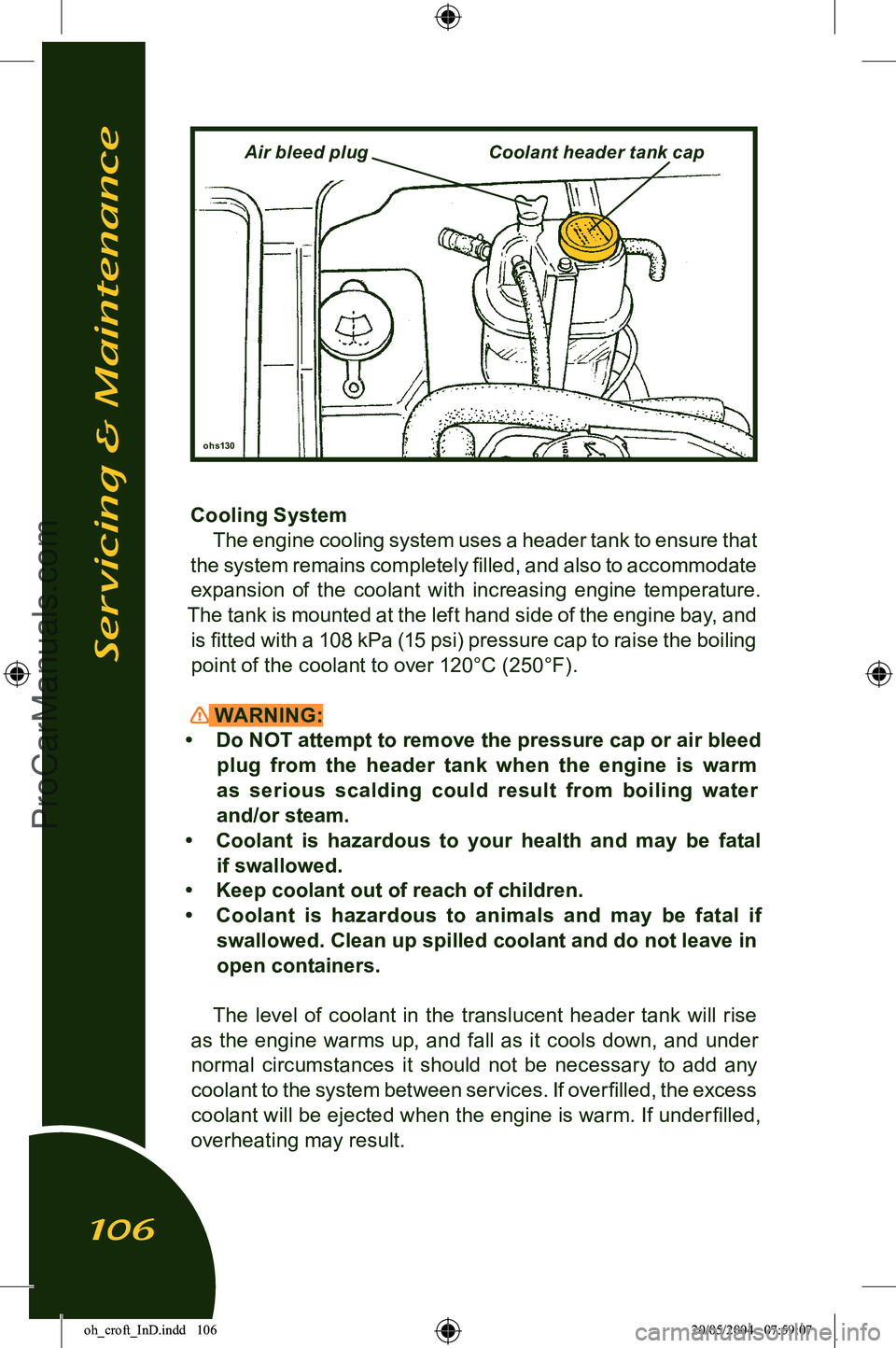
Cooling SystemThe engine cooling system uses a header tank to ensure that
the system remains completely filled, and also to accommodate
expansion of the coolant with increasing engine temperature.
The tank is mounted at the left hand side of the engine bay, and is fitted with a 108 kPa (15 psi) pressure cap to raise the boiling point of the coolant to over 120°C (250°F).
WARNING:
• Do NOT attempt to remove the pressure cap or air bleed plug from the header tank when the engine is warm
as serious scalding could result from boiling water
and/or steam.
• Coolant is hazardous to your health and may be fatal
if swallowed.
• Keep coolant out of reach of children.
• Coolant is hazardous to animals and may be fatal if
swallowed. Clean up spilled coolant and do not leave in
open containers.
The level of coolant in the translucent header tank will rise
as the engine warms up, and fall as it cools down, and under
normal circumstances it should not be necessary to add any
coolant to the system between services. If overfilled, the excess
coolant will be ejected when the engine is warm. If under filled, overheating may result.
Servicing & Maintenance
106
ohs130
Air bleed plugCoolant header tank cap
oh_croft_InD.indd 10620/05/2004 07:59:07ProCarManuals.com
Page 109 of 205
As a precaution, every week when the engine is completely
COLD, and without disturbing the filler cap, check that the level of coolant in the translucent tank is between the ‘FULL’
and ‘LOW’ marks moulded on the front of the tank. If topping
up is required, wait until the coolant has fully cooled before
turning the cap a quarter turn counterclockwise and allowing any remaining pressure to escape. Only then may the cap be
completely unscrewed. In order to maintain protection from freezing damage and
metal corrosion, use only an approved coolant mixture (see below) to top up the tank to the ‘FULL’ mark. Refit the cap, and
turn clockwise until the leg on the cap locates in the slot at the
front of the tank.
NOTICE: If the cap is removed when the engine is warm, the coolant may boil and a small coolant loss may occur. The com
-
pletely cold header tank level should be checked at the first subsequent opportunity.
Cooling Fans
: Two cooling fans are fitted below the radiator in
the air intake duct. The fans are energised at high coolant tem
-
peratures, or when the air conditioning (if fitted) is selected. The
fans will also run if certain types of engine fault are detected, and
may operate during a 20 minute period following ignition switch off to prevent ‘hot soak’ boiling. An electric coolant circulation pump may also be heard running during this period.
WARNING: Keep hands, tools and clothing away from the radiator
cooling fan area, as personal injury could result from the
fans starting up without warning.
At service intervals, the air duct and matrices of the engine
cooling radiator, a.c. condenser and oil coolers, should be
checked externally for clogging by insects, leaves or other debris,
and if necessary, a water jet used to clear the finning. Take care not to damage or distort the delicate finning of the radiator or
the cooling performance will be degraded.
Anti-Freeze/Corrosion Inhibitor It is most important that the correct coolant specification is
used in order to inhibit boiling and protect the engine and heat
Servicing & Maintenance
107
oh_croft_InD.indd 10720/05/2004 07:59:07ProCarManuals.com
Page 110 of 205
exchangers from both frost damage, and metal corrosion. The
Elise is factory filled with a 50% concentration of Havoline XLC
Extended Life Coolant, which contains Organic Acid Technology
(OAT) based corrosion inhibitors to provide long coolant change intervals combined with freedom from environmentally damaging phosphates, silicates and nitrites.
NOTICE: No other type of coolant should be mixed with this
OAT coolant.
Havoline XLC may be identified by its orange colouration, and
by a label around the header tank filler neck. The 50% concen
-
tration provides freezing protection down to - 40°F (- 40°C), and is recommended to be maintained throughout the life of the car.
Stronger concentrations should not be used. In an emergency, if an OAT coolant is not available, the
cooling system should be topped up using water only, but the reduction in freezing protection should be recognised, and the
concentration corrected promptly. In areas where the tap water is extremely hard (exceeding 250 parts per million), distilled, de-ionised or filtered rain water should be used for the water
content of the coolant mix. The effective level of ethylene glycol (anti-freeze) in the sys
-
tem may be measured by your dealer using a hydrometer, but in order to ensure that the required level of corrosion protection is
maintained, the coolant should be renewed every 4 years. For coolant capacity, refer to ‘Recommended Lubricants‘
and ‘Technical Data’.
NOTICE: Using an incorrect coolant mixture may result in ex
-
pensive damage to your engine and/or other car parts caused by overheating, freezing or corrosion effects. This damage would
not be covered by your new car warranty.
Coolant Drain /Refill Procedure The cooling system of the Lotus Elise has been carefully
optimised to allow the required cooling performance using the
minimum volume of coolant. This provides for high cooling sys
-
tem efficiency, with quick engine warm up and interior heating. When refilling the cooling system, it is vital to ensure that
the correct bleeding procedure is followed, and that no air pockets remain. This operation should be entrusted to your
Lotus dealer.
Servicing & Maintenance
108
oh_croft_InD.indd 10820/05/2004 07:59:07ProCarManuals.com
Page 112 of 205
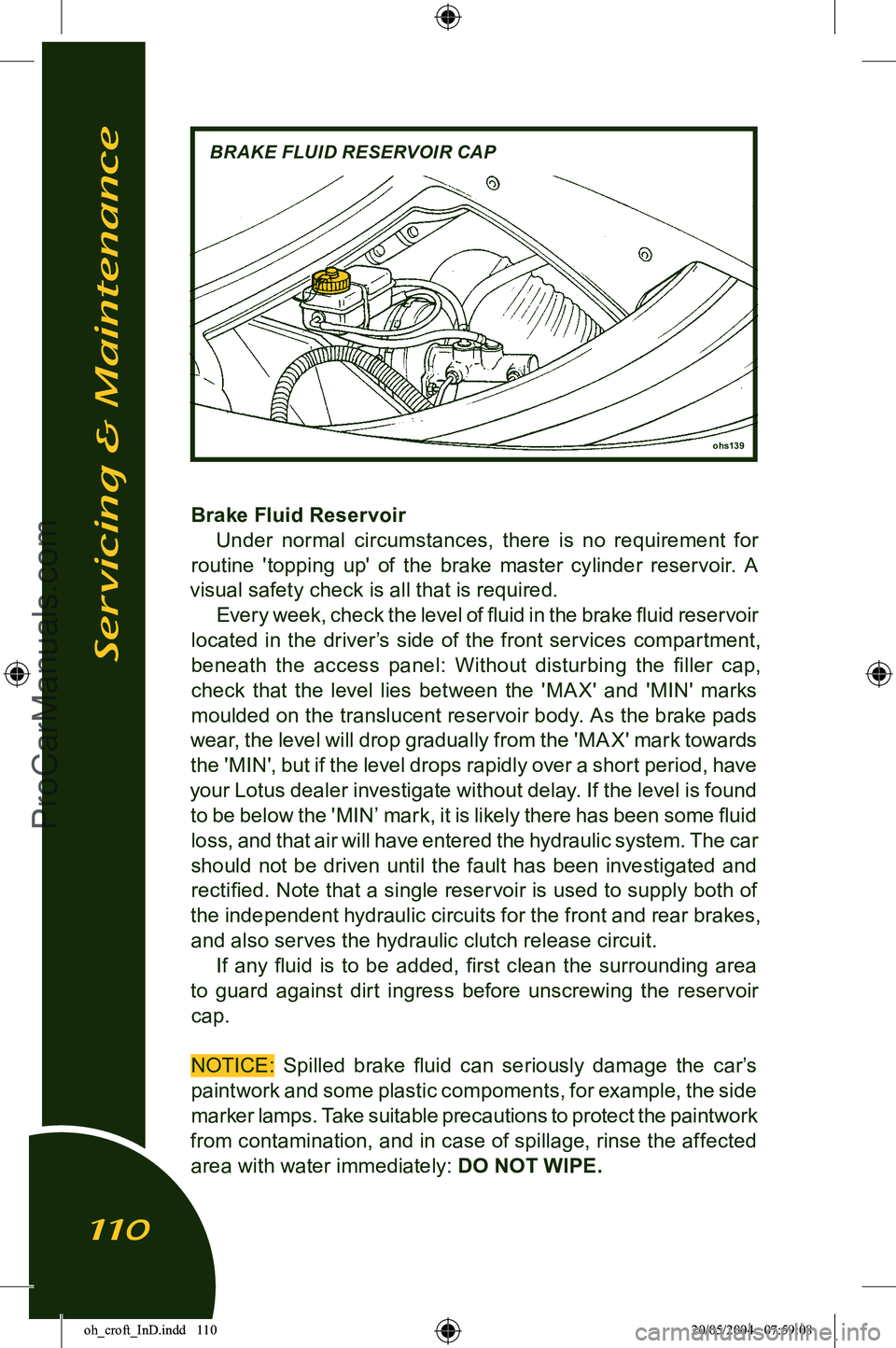
Brake Fluid ReservoirUnder normal circumstances, there is no requirement for
routine 'topping up' of the brake master cylinder reservoir. A
visual safety check is all that is required. Every week, check the level of fluid in the brake fluid reservoir
located in the driver’s side of the front services compartment, beneath the access panel: Without disturbing the filler cap,
check that the level lies between the 'MA X' and 'MIN' marks moulded on the translucent reservoir body. As the brake pads
wear, the level will drop gradually from the 'MA X' mark towards the 'MIN', but if the level drops rapidly over a short period, have
your Lotus dealer investigate without delay. If the level is found
to be below the 'MIN’ mark, it is likely there has been some fluid loss, and that air will have entered the hydraulic system. The car
should not be driven until the fault has been investigated and rectified. Note that a single reservoir is used to supply both of
the independent hydraulic circuits for the front and rear brakes, and also serves the hydraulic clutch release circuit. If any fluid is to be added, first clean the surrounding area
to guard against dirt ingress before unscrewing the reservoir cap.
NOTICE: Spilled brake fluid can seriously damage the car’s paintwork and some plastic compoments, for example, the side
marker lamps. Take suitable precautions to protect the paintwork
from contamination, and in case of spillage, rinse the affected area with water immediately: DO NOT WIPE.
ohs139
BRAKE FLUID RESERVOIR CAP
Servicing & Maintenance
110
oh_croft_InD.indd 11020/05/2004 07:59:08ProCarManuals.com
Page 115 of 205
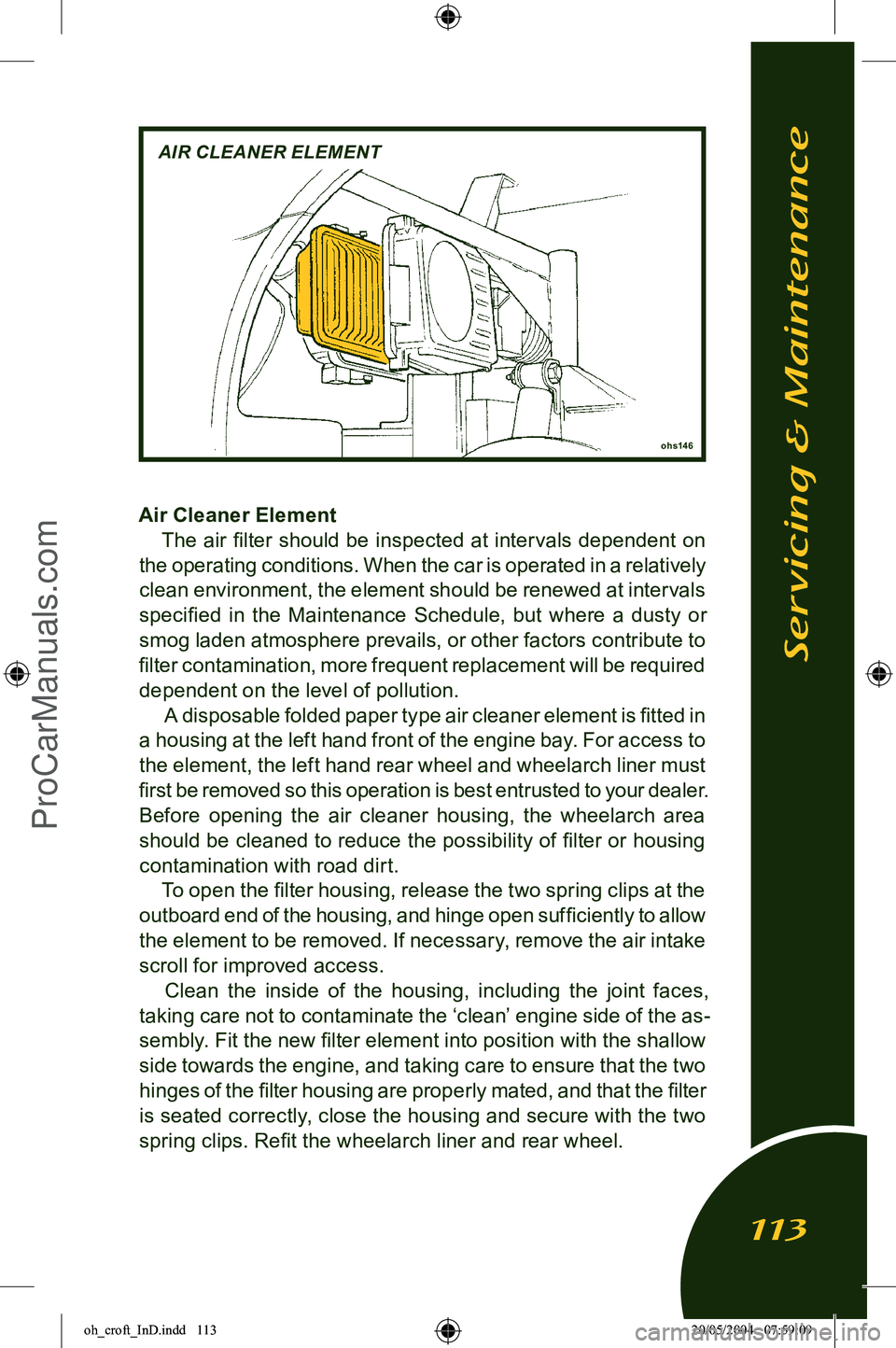
Air Cleaner ElementThe air filter should be inspected at intervals dependent on
the operating conditions. When the car is operated in a relatively
clean environment, the element should be renewed at intervals
specified in the Maintenance Schedule, but where a dusty or
smog laden atmosphere prevails, or other factors contribute to
filter contamination, more frequent replacement will be required
dependent on the level of pollution. A disposable folded paper type air cleaner element is fitted in
a housing at the left hand front of the engine bay. For access to
the element, the left hand rear wheel and wheelarch liner must
first be removed so this operation is best entrusted to your dealer.
Before opening the air cleaner housing, the wheelarch area
should be cleaned to reduce the possibility of filter or housing contamination with road dirt. To open the filter housing, release the two spring clips at the
outboard end of the housing, and hinge open sufficiently to allow
the element to be removed. If necessary, remove the air intake scroll for improved access. Clean the inside of the housing, including the joint faces,
taking care not to contaminate the ‘clean’ engine side of the as
-
sembly. Fit the new filter element into position with the shallow
side towards the engine, and taking care to ensure that the two
hinges of the filter housing are properly mated, and that the filter
is seated correctly, close the housing and secure with the two
spring clips. Refit the wheelarch liner and rear wheel.
ohs146
AIR CLEANER ELEMENT
Servicing & Maintenance
113
oh_croft_InD.indd 11320/05/2004 07:59:09ProCarManuals.com
Page 116 of 205
Auxiliary Drive BeltA single, multi-rib type auxiliary belt is used to transmit drive
from the crankshaft to the alternator, water pump, and (if fitted)
air conditioning compressor. The belt is automatically tensioned,
and requires no periodic maintenance other than a visual check of its condition. If the belt exhibits any evidence of physical dam
-
age, cracking, fraying, perishing, abrasion or contamination, it
should be renewed. In the case of contamination, the cause
must be identified and rectified, and each of the pulleys must be thoroughly degreased before the new belt is fitted. It is recommended that auxiliary belt replacement be en
-
trusted to your Lotus dealer.
Sparking Plugs The Elise uses a direct ignition system with an individual
high tension coil mounted atop each of the four spark plugs and protected by a plastic cover, screw fixed to the engine.
WARNING: The voltages produced with this ignition system can
cause serious and potentially fatal injur y. Never touch
any ignition components when the engine is running or being cranked.
The spark plugs should be renewed in accordance with the
Maintenance Schedule, with the gaps set to 0.043 in. (1.1 mm).
This operation should be entrusted to your Lotus dealer.
Servicing & Maintenance
114
oh_croft_InD.indd 11420/05/2004 07:59:09ProCarManuals.com