steering LOTUS ELISE 2005 Owner's Manual
[x] Cancel search | Manufacturer: LOTUS, Model Year: 2005, Model line: ELISE, Model: LOTUS ELISE 2005Pages: 205, PDF Size: 4.51 MB
Page 119 of 205
Always use the size and type of tires recommended
in this handbook.
• Using incorrect tires or tires which are excessively worn or improperly inflated can cause a crash in
which you can be killed or seriously injured.
• Please note your car is not fitted with a low tire pressure tell tale lamp so it is especially important
that you regularly check the tire pressures.
When driving on wet roads, surface water is squeezed
out from between the tire and road. However excessive
speed or water depth can overwhelm the water clearing capability of the tread and lead to a condition called 'aq
-
uaplaning' or ‘hydroplaning’, where the tire rides on a film of water and provides little or no grip on the road surface,
leading to a loss of control. This condition is more likely
to occur with worn tires having little depth of tread, or with incorrect tire pressures. Drivers should keep a vigilant check on tire wear and condition, and moderate their
speed in adverse weather conditions.
Tire Care Wear indicators are moulded into the bottom of the
tread grooves at intervals around the tire, indicated by small pointers on the outer tread blocks. The tires should
be replaced before being worn to this minimum legal
tread depth. The cold tire pressures should be checked every week,
or every 1,000 miles (1,700 km), whichever is the sooner,
and corrections made as necessary. See ‘Technical Data’
at the back of the handbook for tire pressures. For track
use, tire condition and pressures should be checked be
-
fore each run. Under-inflation will cause excessive wear, rapid deterioration of the tire sidewalls and heavy steering,
whereas over-inflation results in a hard ride and increased susceptibility to tire damage. Both conditions will cause a degradation in the handling qualities. It is important that the tire pressures are adjusted only
when the Tires are cold (when the car has been standing for a minimum of 3 hours, or driven less than 1 mile), as the pressures may increase by 0.3 - 0.5 bar (4 - 8 lb/in²)
when the Tires are warmed to normal running temperature.
Tires & Wheels
117
oh_croft_InD.indd 11720/05/2004 07:59:09ProCarManuals.com
Page 121 of 205
handling feel and minimum steering wheel shake, it is very
important that the radial and lateral run out of the Tires are to the high standard required by Lotus Cars. If any difficulty is experienced with replacement Tires, refer to
the tire manufacturer.
Tire Characteristics The Yokohama AD07 or A048 Tires fitted to the Elise
are suitable for all normal weather conditions, but are optimised for dry road sports driving. The constructions
of both tire types have been specially tailored for the
Elise and are identified by the letters ‘LTS’ moulded on the tire sidewalls. Ensure that any replacement Tires are similarly marked. The tire characteristics include good
feedback (‘feel’) from the road surface to the steering
wheel, a high level of steering linearity and response, and little performance degradation with the high temperatures
which may be reached in sports use. However, tire performance will decrease at low ambi
-
ent temperatures, resulting in reduced levels of grip and
an increased susceptibility to damage from impacts. In
these conditions, especially below 15°F (-10°C), it is recommended to fit a car set of the recommended winter
Tires (see below).
Winter Tires If the car is to be used in ver y cold territories, or
driven on snow covered roads, it is recommended to fit a
car set of winter Tires developed specifically for such
conditions. Lotus approves the use of Pirelli 210 (front)
and 240 (rear) Snowsport winter Tires in sizes specified
in ‘Technical Data’. These Tires should be fitted on regular
Elise wheels.
WARNING:
• Winter Tires are optimised for use on snow covered roads. When used on roads free of snow, winter
Tires will produce different handling characteristics and less grip compared with regular Tires.
• When winter Tires are fitted, a maximum speed of 118 mph (190 km/h) must be observed.
• Pirelli Snowsport Tires are NOT suitable for stud
-
Tires & Wheels
119
oh_croft_InD.indd 11920/05/2004 07:59:10ProCarManuals.com
Page 129 of 205
Scheduled wheel alignment and balancing are not required.
However, if you notice unusual tire wear or the car pulling to one side or the other, the alignment may need to be reset. If
you notice the car or steering wheel vibrating when driving on a smooth road, the wheels may need to be re-balanced.
Wheel Replacement Replace any wheel that is bent, cracked, badly corroded or
otherwise damaged. If the wheel bolts come loose after having been correctly fitted, the wheel and bolts should be replaced.
If the wheel leaks air, have it replaced. See your Lotus dealer if any of these conditions should arise.
Ensure that only Lotus approved wheels and wheel bolts
are used.
WARNING:
• Using incorrect, or non-approved replacement wheels or wheel bolts could be dangerous. It could affect the brak
-
ing and handling of your car, or cause tire deflation, and result in a crash in which you or others could be killed
or seriously injured. Always use Lotus approved wheels
and wheel bolts.
• Putting a used wheel on your car is dangerous. It may have been subjected to a heavy impact and suffered
structural damage which cannot be seen. It could break
and cause a crash in which you and others could be killed
or seriously injured.
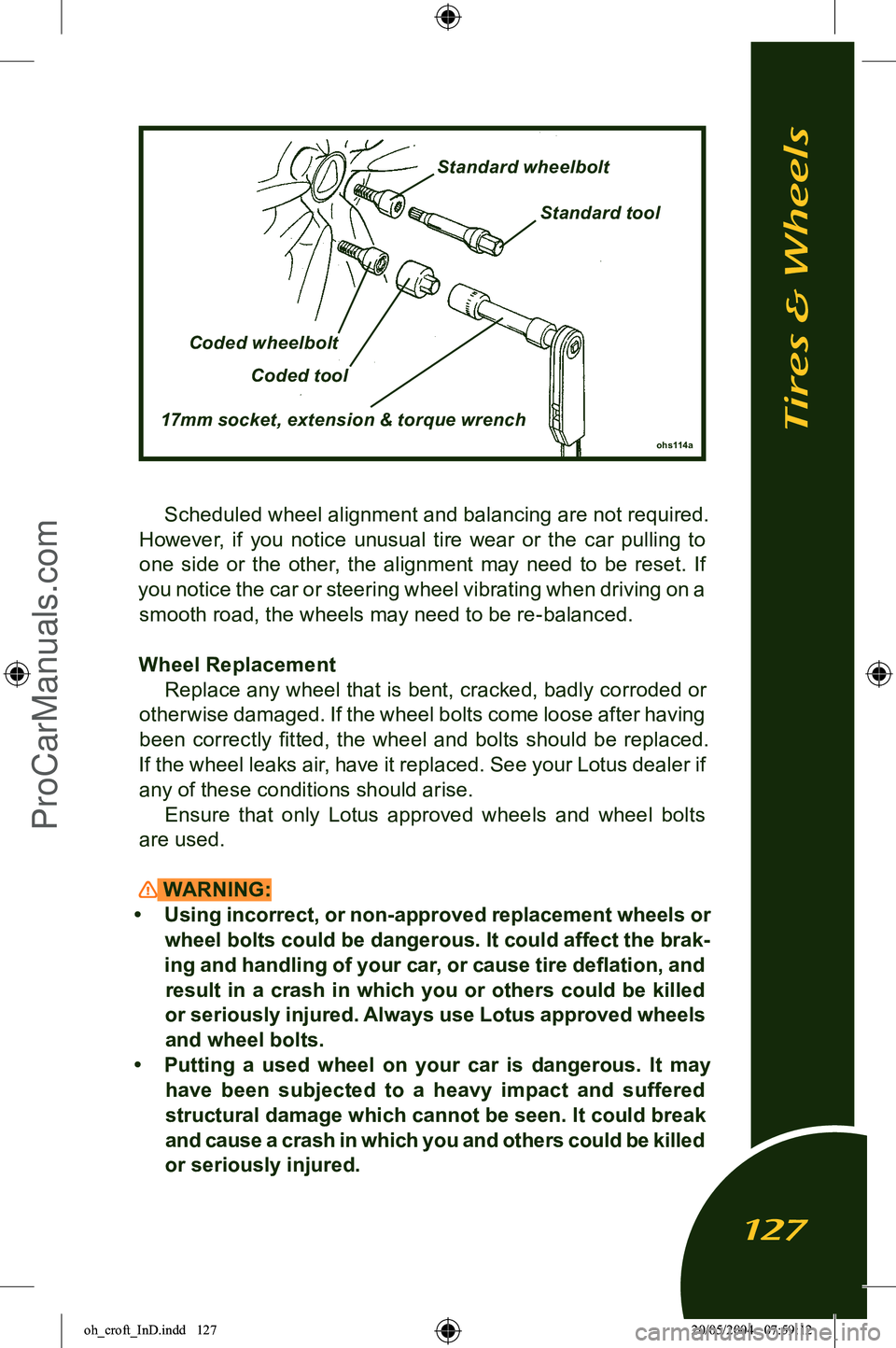
ohs114a
Coded wheelbolt
Coded tool
17mm socket, extension & torque wrench
Standard wheelbolt
Standard tool
Tires & Wheels
127
oh_croft_InD.indd 12720/05/2004 07:59:12ProCarManuals.com
Page 148 of 205
LIFTING AND TOWING
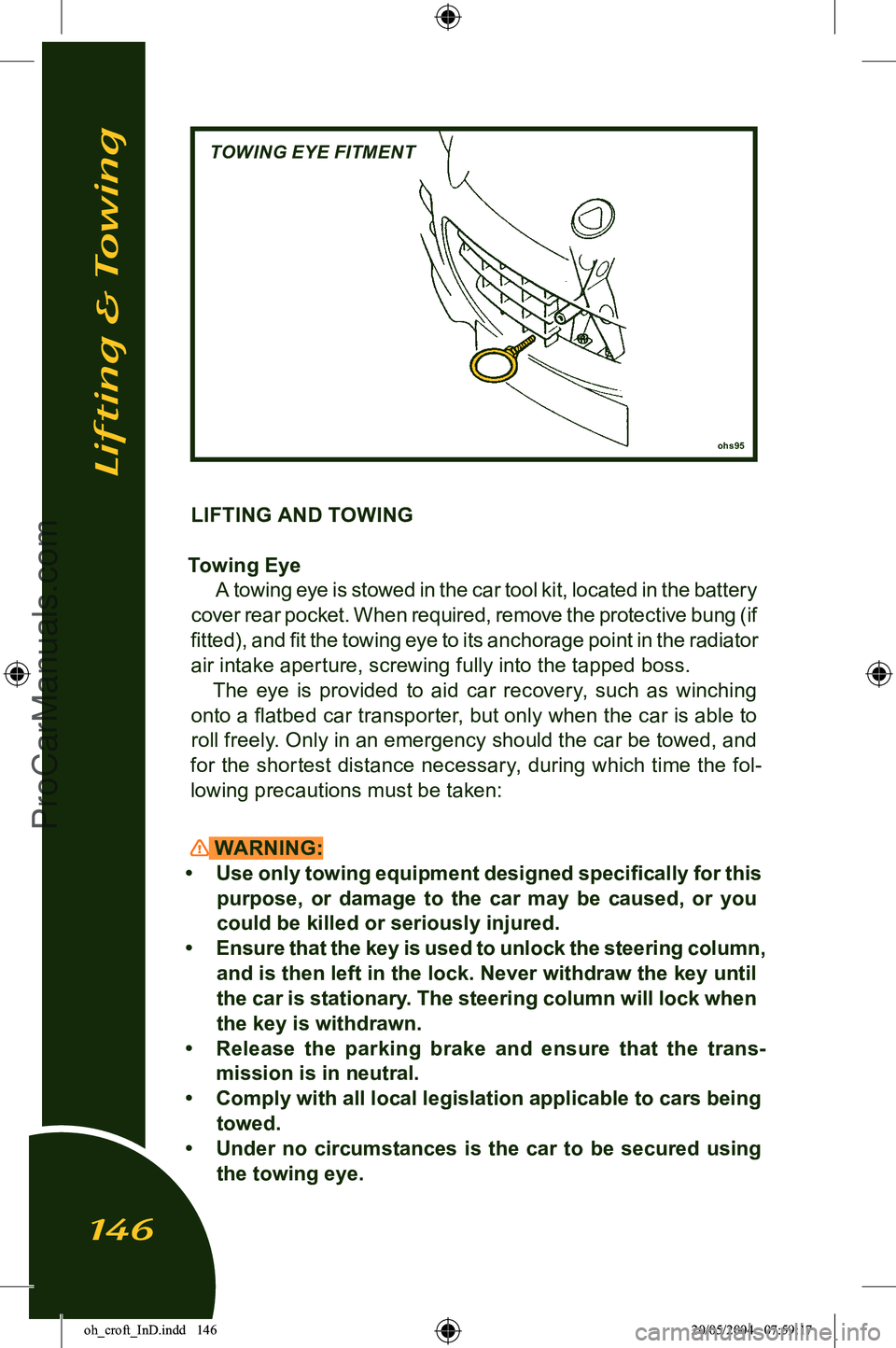
Towing Eye A towing eye is stowed in the car tool kit, located in the battery
cover rear pocket. When required, remove the protective bung (if
fitted), and fit the towing eye to its anchorage point in the radiator air intake aperture, screwing fully into the tapped boss.
The eye is provided to aid car recovery, such as winching
onto a flatbed car transporter, but only when the car is able to roll freely. Only in an emergency should the car be towed, and
for the shortest distance necessary, during which time the fol
-
lowing precautions must be taken:
WARNING:
• Use only towing equipment designed specifically for this purpose, or damage to the car may be caused, or you
could be killed or seriously injured.
• Ensure that the key is used to unlock the steering column, and is then left in the lock. Never withdraw the key until
the car is stationary. The steering column will lock when
the key is withdrawn.
• Release the parking brake and ensure that the trans
-
mission is in neutral.
• Comply with all local legislation applicable to cars being
towed.
• Under no circumstances is the car to be secured using
the towing eye.
ohs95
TOWING EYE FITMENT
Lifting & Towing
146
oh_croft_InD.indd 14620/05/2004 07:59:17ProCarManuals.com
Page 153 of 205
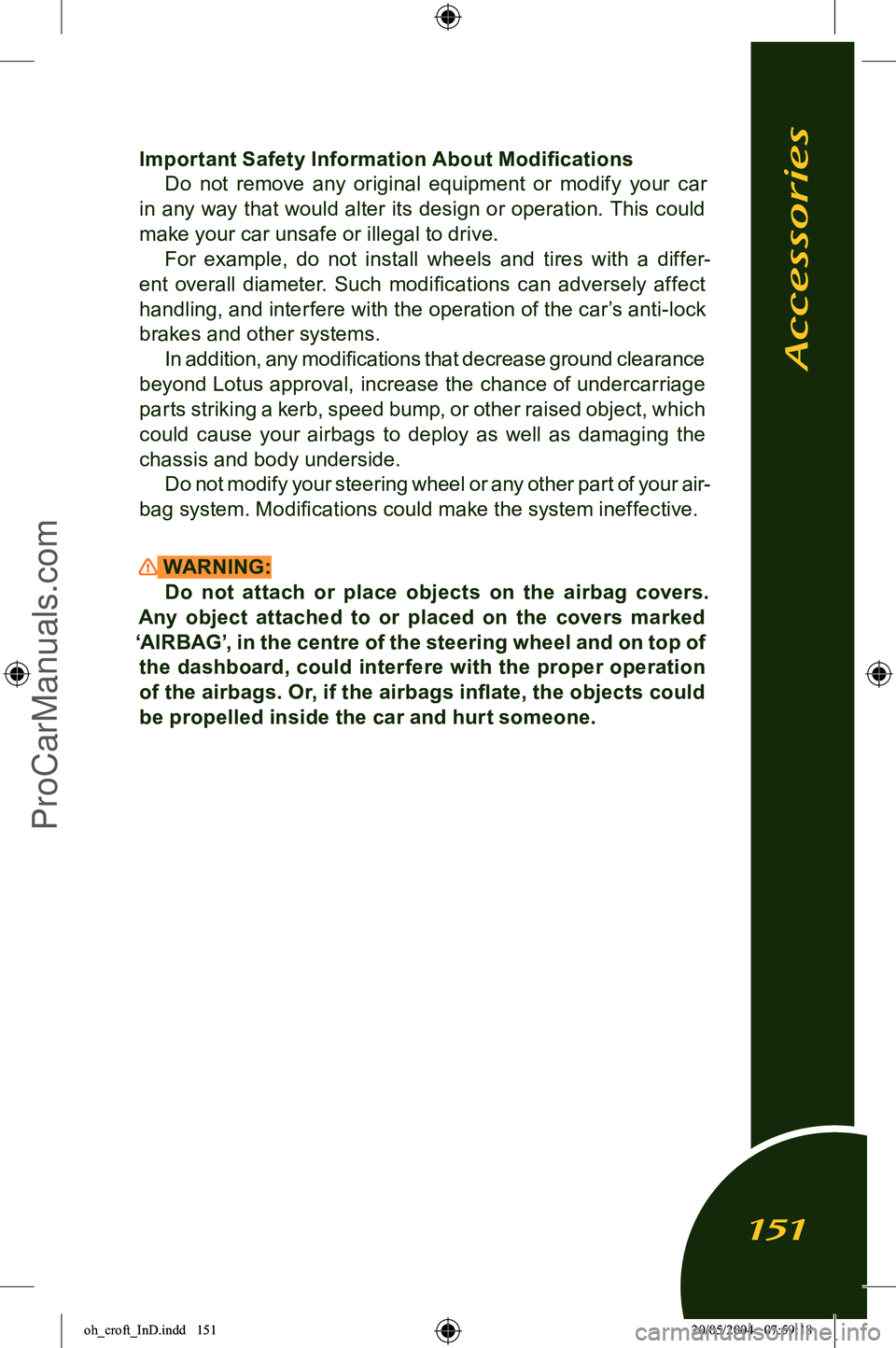
Important Safety Information About ModificationsDo not remove any original equipment or modify your car
in any way that would alter its design or operation. This could
make your car unsafe or illegal to drive. For example, do not install wheels and tires with a differ
-
ent overall diameter. Such modifications can adversely affect handling, and interfere with the operation of the car’s anti-lock
brakes and other systems. In addition, any modifications that decrease ground clearance
beyond Lotus approval, increase the chance of undercarriage
parts striking a kerb, speed bump, or other raised object, which
could cause your airbags to deploy as well as damaging the
chassis and body underside. Do not modify your steering wheel or any other part of your air
-
bag system. Modifications could make the system ineffective.
WARNING: Do not attach or place objects on the airbag covers.
Any object attached to or placed on the covers marked
‘AIRBAG’, in the centre of the steering wheel and on top of the dashboard, could interfere with the proper operation of the airbags. Or, if the airbags inflate, the objects could be propelled inside the car and hurt someone.
Accessories
151
oh_croft_InD.indd 15120/05/2004 07:59:18ProCarManuals.com
Page 158 of 205
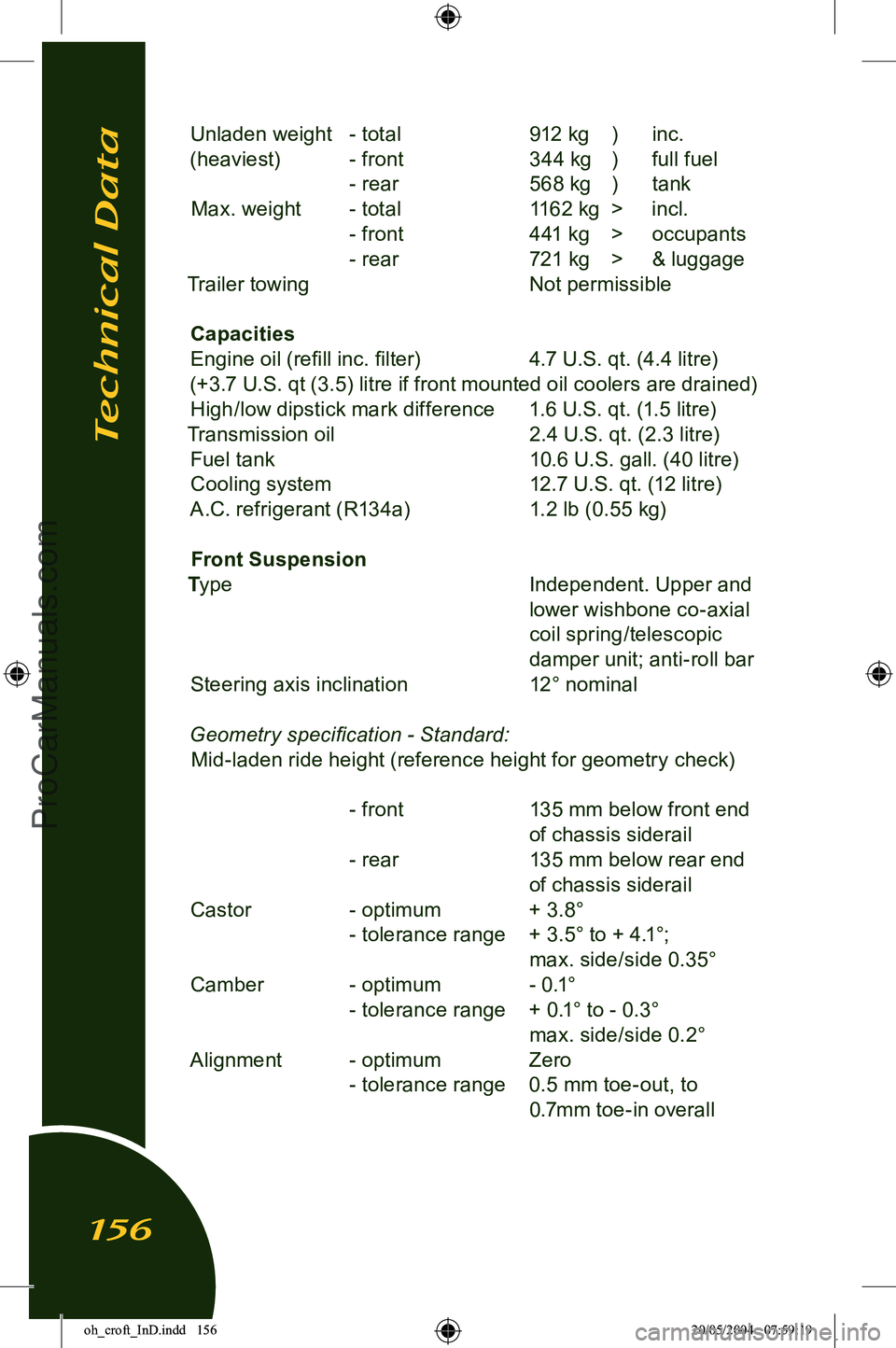
Unladen weight - total 912 kg ) inc.
(heaviest) - front 344 kg ) full fuel
- rear 568 kg ) tank
Max. weight - total 1162 kg > incl.
- front 441 kg > occupants
- rear 721 kg > & luggage
Trailer towing Not permissible
Capacities Engine oil (refill inc. filter) 4.7 U.S. qt. (4.4 litre)
(+3.7 U.S. qt (3.5) litre if front mounted oil coolers are drained) High/low dipstick mark difference 1.6 U.S. qt. (1.5 litre)
Transmission oil 2.4 U.S. qt. (2.3 litre)
Fuel tank 10.6 U.S. gall. (40 litre)
Cooling system 12.7 U.S. qt. (12 litre)
A.C. refrigerant (R134a) 1.2 lb (0.55 kg)
Front Suspension
T ype Independent. Upper and
lower wishbone co-axial
coil spring/telescopic
damper unit; anti-roll bar
Steering axis inclination 12° nominal
Geometry specification - Standard: Mid-laden ride height (reference height for geometry check)
- front 135 mm below front end
of chassis siderail
- rear 135 mm below rear end
of chassis siderail
Castor - optimum + 3.8°
- tolerance range + 3.5° to + 4.1°;
max. side/side 0.35°
Camber - optimum - 0.1°
- tolerance range + 0.1° to - 0.3°
max. side/side 0.2°
Alignment - optimum Zero - tolerance range 0.5 mm toe-out, to
0.7mm toe-in overall
Technical Data
156
oh_croft_InD.indd 15620/05/2004 07:59:19ProCarManuals.com
Page 192 of 205
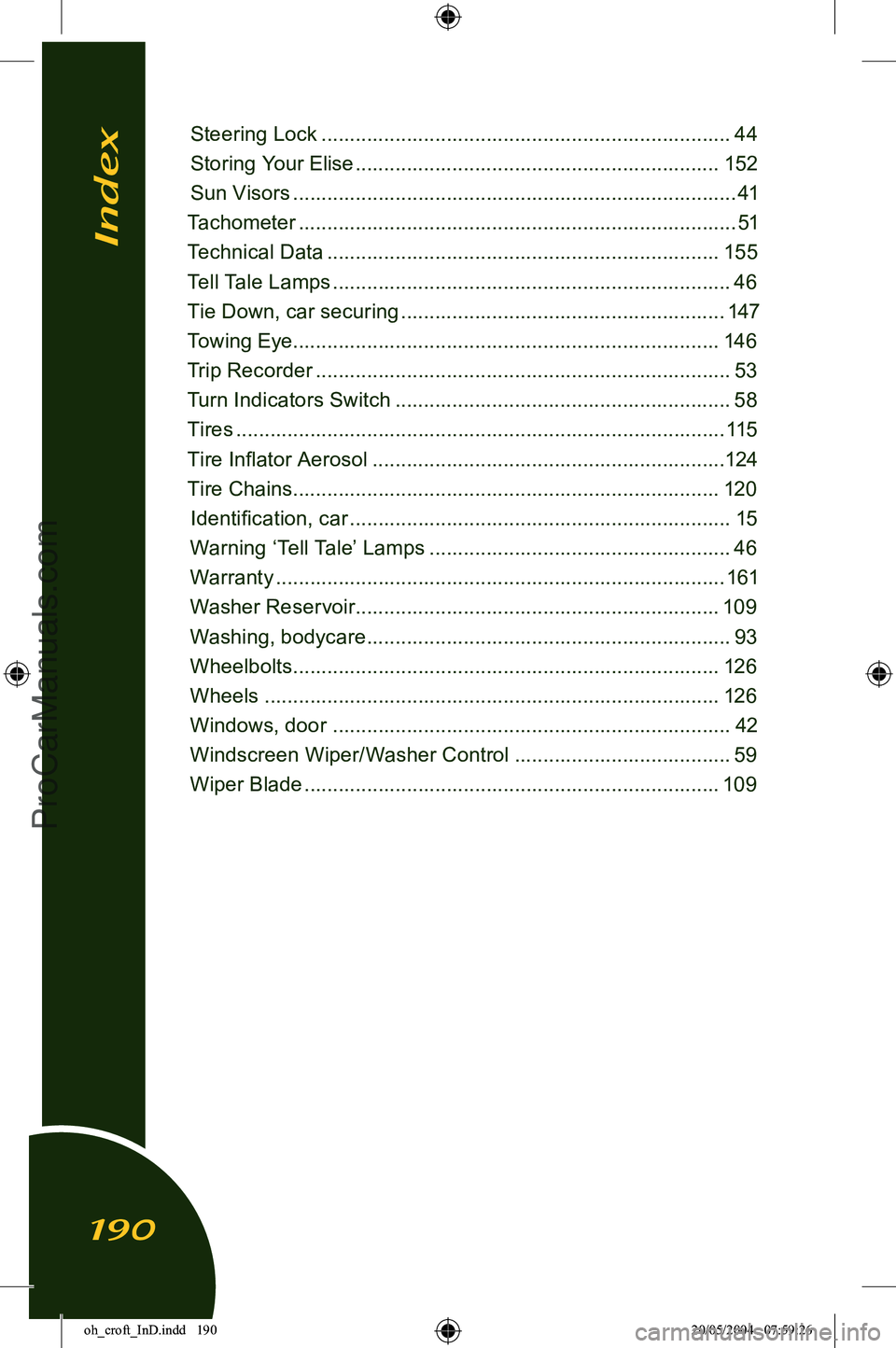
Steering Lock ........................................................................44
Storing Your Elise ................................................................ 152
Sun Visors .............................................................................. 41
Tachometer ............................................................................. 51
Technical Data ..................................................................... 155
Tell Tale Lamps ...................................................................... 46
Tie Down, car securing ......................................................... 147
Towing Eye ........................................................................... 146
Trip Re corder ......................................................................... 53
Turn Indicators Switch ........................................................... 58
Tires ...................................................................................... 115
Tire Inflator Aerosol .............................................................. 124
Tire Chains ........................................................................... 120
Identification, car ................................................................... 15
Warning ‘Tell Tale ’ Lamps ..................................................... 46
Warranty ............................................................................... 161
Washer Reservoir ................................................................ 109
Washing, bodycare ................................................................ 93
Wheelbolts ........................................................................... 126
Wheels ................................................................................ 126
Windows, door ...................................................................... 42
Windscreen Wiper/ Washer Control ...................................... 59
Wiper Blade ......................................................................... 109
Index
190
oh_croft_InD.indd 19020/05/2004 07:59:26ProCarManuals.com