tire LOTUS ELISE 2005 Owner's Manual
[x] Cancel search | Manufacturer: LOTUS, Model Year: 2005, Model line: ELISE, Model: LOTUS ELISE 2005Pages: 205, PDF Size: 4.51 MB
Page 125 of 205
5) Determine the combined weight of luggage and cargo being loaded on the car. That weight may not safely exceed the available cargo and luggage load capacity
calculated in Step 4.
6) Your Elise should never be used to tow a trailer
In the case of the Elise:
• The combined cargo and luggage load capacity is 551
lb (250 kg).
• The maximum load in the luggage compartment is 110
lb (50 kg).
• The maximum combined weight of the driver and pas
-
senger is 441 lb (200 kg).
WARNING: Exceeding any of the above loadings may cause
unstable handling or car or tire damage which could cause a crash in which you or others could be seri
-
ously injured or killed.
Tire Markings Designation:Example; Yokohama Advan A048 195/50 R16 84W
Yokohama = manufacturer. Advan A048 = tire model. 195 = nominal section width in mm. 50 = height of tire cross-section expressed as percentage of width. R =
radial construction. 16 = rim diameter in inches. 84 =
load capacity index, indicating the load in kg the tire can carry at the speed corresponding to the speed rating. W
= speed rating indicating the speed (in this case 168 mph) at which the tire can carry the load corresponding to the load capacity index.
Tire Identification Number: On the left hand sidewall as fitted to the car. Commences with DOT (Department of
Transpor tation) followed by a two digit manufacturing plant code, a two digit tire size code, a three digit tire construction code, and a four digit date code for the week
and year of production.
‘LTS’
: Indicates Lotus specific construction.
Tires & Wheels
123
oh_croft_InD.indd 12320/05/2004 07:59:11ProCarManuals.com
Page 126 of 205
Uniform Tire Quality Grading Standard: Example; Tread-
wear 60 Traction A A Temperature A. See page 120
Other tire markings are self explanatory.
Tire Inflator Aerosol (if fitted) In order fully to exploit the benefits of light weight, and
to maximise stowage space, the Elise has no provision for spare wheel carriage or lifting jack. A temporary puncture
repair facility is provided in the form of a tire inflator aerosol
which is mounted in spring clips at the extreme right hand front corner of the rear luggage compartment. If possible avoid driving on a deflated tire, or irreparable damage to
the tire may be caused. When the aerosol is connected to the tire valve, and the
button pressed, a mixture of liquid latex and propellant is
injected into the tire, such that the solidifying latex is forced
into the puncture site at the same time as the tire is inflated, effecting a temporary repair and enabling the car to be driven at low speed to the nearest tire repair facility.
WARNING:
• Use of the aerosol does not constitute a permanent repair, but is designed to allow the car to be driven
to the nearest tire repair facility. At the earliest op
-
portunity, the tire should be either professionally repaired or replaced dependent on the severity of
the damage.
• Until the tire is repaired or replaced, the car should be driven in a moderate manner, not exceeding 30
mph (45 km/h).
• Do not use the aerosol for large holes or repairs, or when the tire sidewall has been damaged, or if the
tire has been displaced from the rim.
• For safety reasons, the aerosol should at all times be carried only in the designated secure stowage
position. Never carry loose in the passenger com
-
partment.
Tires & Wheels
124
oh_croft_InD.indd 12420/05/2004 07:59:11ProCarManuals.com
Page 127 of 205
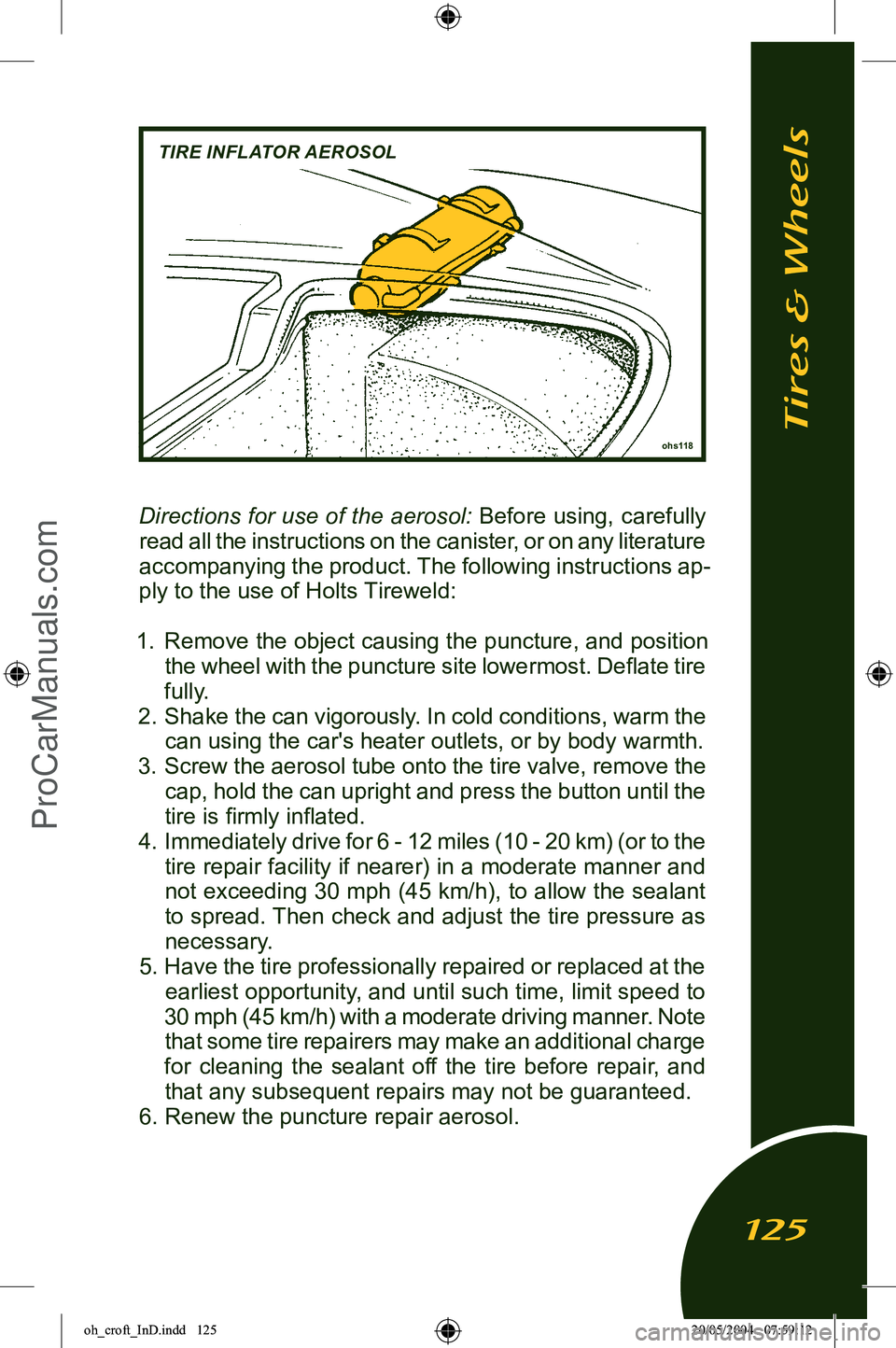
Directions for use of the aerosol: Before using, carefully read all the instructions on the canister, or on any literature
accompanying the product. The following instructions ap
-
ply to the use of Holts Tireweld:
1. Remove the object causing the puncture, and position the wheel with the puncture site lowermost. Deflate tire
fully.
2. Shake the can vigorously. In cold conditions, warm the
can using the car's heater outlets, or by body warmth.
3. Screw the aerosol tube onto the tire valve, remove the cap, hold the can upright and press the button until the
tire is firmly inflated.
4. Immediately drive for 6 - 12 miles (10 - 20 km) (or to the tire repair facility if nearer) in a moderate manner and not exceeding 30 mph (45 km/h), to allow the sealant
to spread. Then check and adjust the tire pressure as necessary.
5. Have the tire professionally repaired or replaced at the earliest opportunity, and until such time, limit speed to
30 mph (45 km/h) with a moderate driving manner. Note that some tire repairers may make an additional charge
for cleaning the sealant off the tire before repair, and
that any subsequent repairs may not be guaranteed.
6. Renew the puncture repair aerosol.
ohs118
TIRE INFLATOR AEROSOL
Tires & Wheels
125
oh_croft_InD.indd 12520/05/2004 07:59:12ProCarManuals.com
Page 128 of 205
WheelsEnsure that only original equipment, or Lotus approved wheel
and tire combinations are fitted. After the car has been used
on track, or in competition conditions, the wheels should be removed and thoroughly inspected for damage.
WARNING: After striking a pothole or kerb, the wheels should be
removed and the wheel and tire thoroughly inspected for
damage. Renew the wheel and /or tire if necessary. Safety
considerations should always be paramount and new parts
fitted in any cases of doubt.
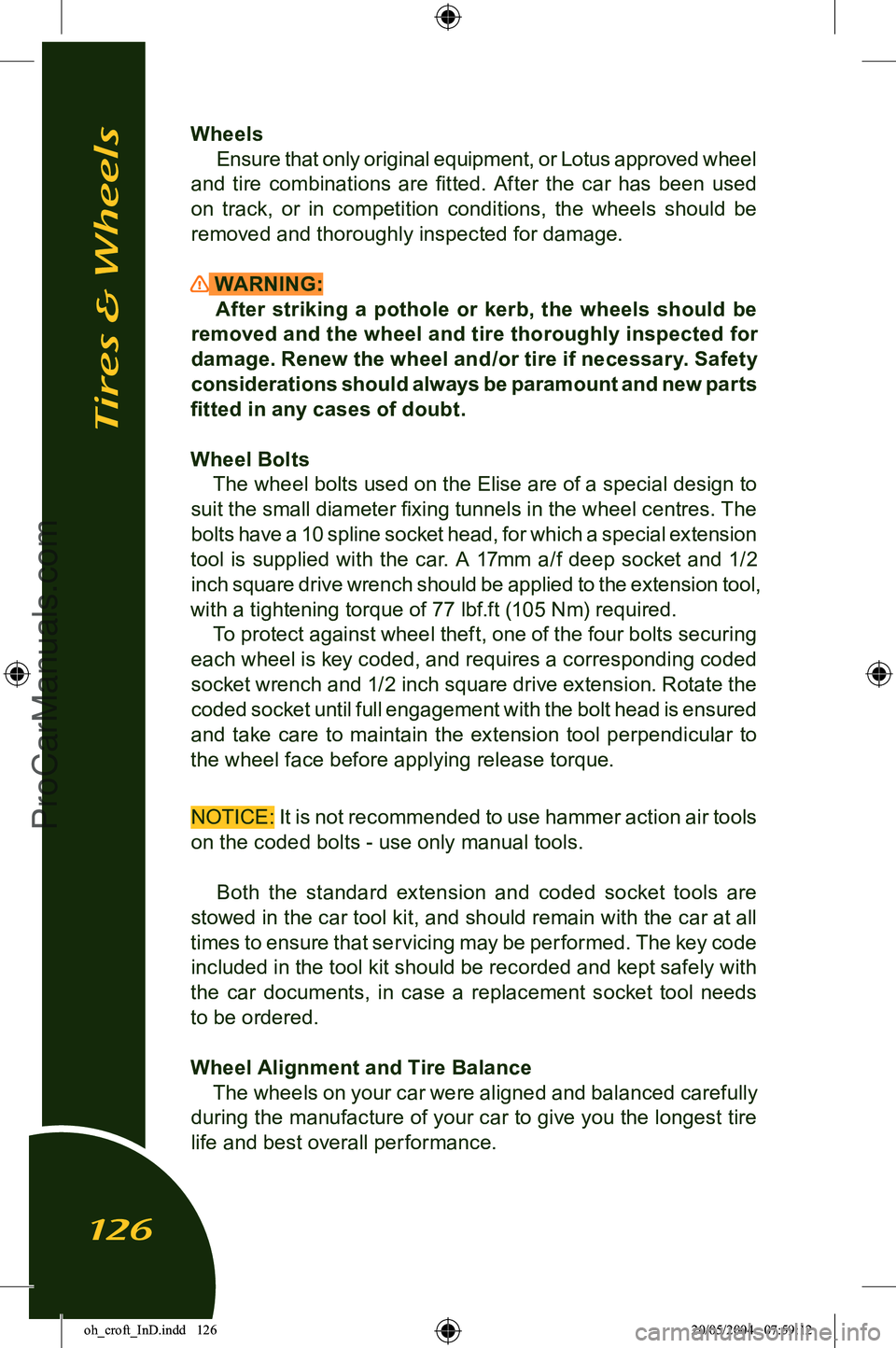
Wheel Bolts The wheel bolts used on the Elise are of a special design to
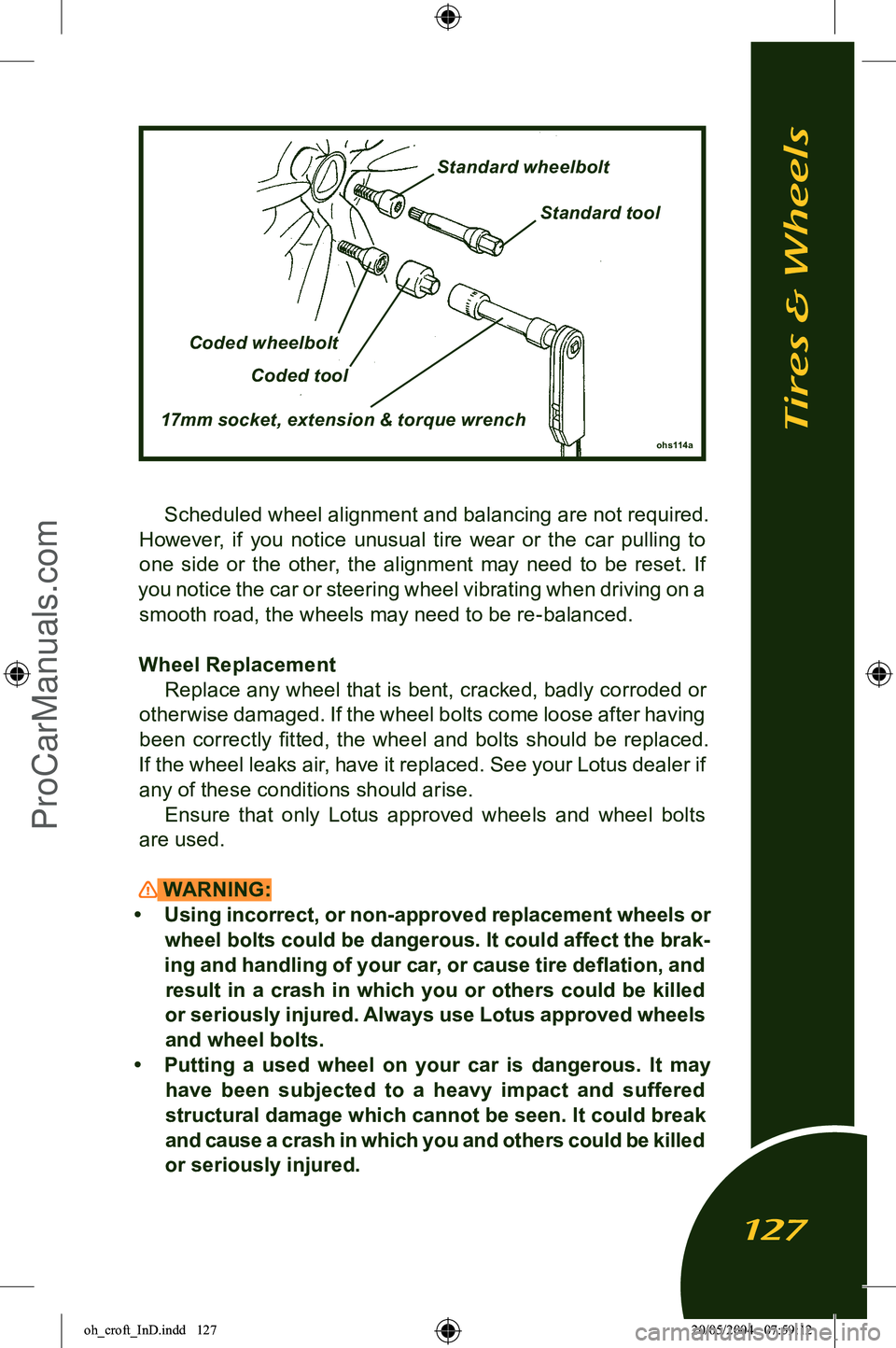
suit the small diameter fixing tunnels in the wheel centres. The bolts have a 10 spline socket head, for which a special extension
tool is supplied with the car. A 17mm a/f deep socket and 1/2
inch square drive wrench should be applied to the extension tool,
with a tightening torque of 77 lbf.ft (105 Nm) required. To protect against wheel theft, one of the four bolts securing
each wheel is key coded, and requires a corresponding coded
socket wrench and 1/2 inch square drive extension. Rotate the coded socket until full engagement with the bolt head is ensured and take care to maintain the extension tool perpendicular to
the wheel face before applying release torque.
NOTICE: It is not recommended to use hammer action air tools on the coded bolts - use only manual tools.
Both the standard extension and coded socket tools are
stowed in the car tool kit, and should remain with the car at all
times to ensure that servicing may be performed. The key code
included in the tool kit should be recorded and kept safely with
the car documents, in case a replacement socket tool needs
to be ordered.
Wheel Alignment and Tire Balance The wheels on your car were aligned and balanced carefully
during the manufacture of your car to give you the longest tire
life and best overall performance.
Tires & Wheels
126
oh_croft_InD.indd 12620/05/2004 07:59:12ProCarManuals.com
Page 129 of 205
Scheduled wheel alignment and balancing are not required.
However, if you notice unusual tire wear or the car pulling to one side or the other, the alignment may need to be reset. If
you notice the car or steering wheel vibrating when driving on a smooth road, the wheels may need to be re-balanced.
Wheel Replacement Replace any wheel that is bent, cracked, badly corroded or
otherwise damaged. If the wheel bolts come loose after having been correctly fitted, the wheel and bolts should be replaced.
If the wheel leaks air, have it replaced. See your Lotus dealer if any of these conditions should arise.
Ensure that only Lotus approved wheels and wheel bolts
are used.
WARNING:
• Using incorrect, or non-approved replacement wheels or wheel bolts could be dangerous. It could affect the brak
-
ing and handling of your car, or cause tire deflation, and result in a crash in which you or others could be killed
or seriously injured. Always use Lotus approved wheels
and wheel bolts.
• Putting a used wheel on your car is dangerous. It may have been subjected to a heavy impact and suffered
structural damage which cannot be seen. It could break
and cause a crash in which you and others could be killed
or seriously injured.
ohs114a
Coded wheelbolt
Coded tool
17mm socket, extension & torque wrench
Standard wheelbolt
Standard tool
Tires & Wheels
127
oh_croft_InD.indd 12720/05/2004 07:59:12ProCarManuals.com
Page 130 of 205
NOTICE: Using incorrect wheel/tire equipment can also cause problems with wheel bearing life, brake cooling, speedo and
odometer calibration, headlamp aim, ground clearance and tire
clearance to the body.
WARNING: Dirt or corrosion on a wheel or hub mounting flange or
wheel bolts, can result in the wheel bolts coming loose.
The wheel could come off and cause a crash in which you and others could be killed or seriously injured. Thoroughly
clean these components or fit new Lotus approved replace
-
ments before fitting a wheel. Never use oil or grease on the wheel bolts or hub threads.
If you do, the bolts could come loose and the wheel could
come off, causing a crash in which you and others could be killed or seriously injured. Using incorrect wheel bolts, or the wrong tightening
torque could cause the bolts to come loose and the wheel to come off, resulting in a crash in which you and others could be killed or seriously injured. Use only the correct Lotus
approved wheel bolts tightened to 77 lbf.ft (105 Nm).
NOTICE: Improperly tightened wheel bolts, or dirt on the wheel
to hub mounting face can cause brake pulsation and judder, and damage the brake discs. To avoid expensive brake repairs,
ensure complete cleanliness on assembly and tighten the wheel
bolts in a diagonal sequence to the correct torque.
For advice and information on lifting the Elise, refer to ‘Lifting
Points’ on page 148Tires & Wheels
128
oh_croft_InD.indd 12820/05/2004 07:59:12ProCarManuals.com
Page 151 of 205
C; Garage use with 4-point lift. Do not use if the diffuser panel is
fitted. Beneath the outboard end of the chassis crossmember ahead of the rear wheelarches. Take care to position the jack
between the fixing screws for the fuel tank bay perforated
undershield. Avoid the fuel tank brackets.
D; Do not use if the diffuser panel is fitted. Beneath the rear
subframe, close to the lower wishbone rearmost mountings.
NOTICE: In order fully to exploit the benefits of light weight, and
to maximise stowage space, the Elise has no provision for spare
wheel carriage or lifting jack. A temporary puncture repair facility is provided in the form of a tire inflator aerosol (see page 124).
Fuel Tank Undershield
WARNING: The perforated panel enclosing the underside of the fuel
tank bay, contributes to the structural rigidity of the chassis
frame. Do not use the car with this panel removed.
Lifting & Towing
149
oh_croft_InD.indd 14920/05/2004 07:59:18ProCarManuals.com
Page 153 of 205
Important Safety Information About ModificationsDo not remove any original equipment or modify your car
in any way that would alter its design or operation. This could
make your car unsafe or illegal to drive. For example, do not install wheels and tires with a differ
-
ent overall diameter. Such modifications can adversely affect handling, and interfere with the operation of the car’s anti-lock
brakes and other systems. In addition, any modifications that decrease ground clearance
beyond Lotus approval, increase the chance of undercarriage
parts striking a kerb, speed bump, or other raised object, which
could cause your airbags to deploy as well as damaging the
chassis and body underside. Do not modify your steering wheel or any other part of your air
-
bag system. Modifications could make the system ineffective.
WARNING: Do not attach or place objects on the airbag covers.
Any object attached to or placed on the covers marked
‘AIRBAG’, in the centre of the steering wheel and on top of the dashboard, could interfere with the proper operation of the airbags. Or, if the airbags inflate, the objects could be propelled inside the car and hurt someone.
Accessories
151
oh_croft_InD.indd 15120/05/2004 07:59:18ProCarManuals.com
Page 154 of 205
Storing Your EliseIf you intend to store your Elise for a prolonged period, con
-
sult your Lotus dealer who will be pleased to advise you. We recommend that the car is stored inside a secure garage. The
following guidelines are provided for your information:
• Ensure the engine oil and filter, coolant and brake fluid have recently been renewed. The a.c. system should be in good
working order and fully charged.
• Thoroughly clean the inside and outside of the car, including the engine compartment. If necessary, use a ‘jet’ washer to remove dirt and salt deposits from the underside, but do not
use around bearings, hydraulic components, painted surfaces or the soft top roof. Allow to dry completely.
• Chock the road wheels, leave off the parking brake, and engage reverse gear.
• Increase the tire pressures to 60 psi (4 bar). If possible, move the car slightly every month to help avoid flat spots on the
Tires.
• Either leave the battery in the car and connect a battery management (conditioner) type of charger, or remove the battery and trickle charge every two months. Note that with
the battery disconnected or removed, the alarm system is
de-activated.
• Unless the garage is equipped with a de-humidifier, the use of drying agents (Silica-Gel) is recommended in cars with
leather upholstery and in conditions of high humidity.
• The use of unapproved car covers may have a detrimental effect on the car’s paint finish and such damage will not be
covered by your car’s warranty.
In general, the Elise will be kept in best operating condition
by regular use.
Accessories
152
oh_croft_InD.indd 15220/05/2004 07:59:19ProCarManuals.com
Page 155 of 205
RECOMMENDED LUBRICANTS
EngineIn order to enhance the longevity and reliability of the car, it
is most important that only the specified lubricants are used. It
is an entirely false economy to try to save money by using lower quality oils, which may break down before the next change in
-
terval and provide inadequate protection before the end of the
term. High oil consumption may also result.
For topping up purposes during the running-in period prior to
the First After Sales Service, a top quality mineral or semi-syn
-
thetic 5W/40 oil should be used. At the First After Sales Service and completion of the running-in period, a fully synthetic 5W/40
oil such as Texaco Havoline Synthetic should be used. This oil
has been tested in all climatic conditions likely to be encountered,
and offers advantages in ease of cranking, smooth cold running
and fuel economy at low temperatures, in combination with good
wear protection at elevated temperatures and at high engine speeds. If Texaco/Havoline products are not available, an oil meeting the following specification should be used.
NOTICE: Note that Lotus does not recommend the use of any oil additives and use of such additives may invalidate the terms
of your car’s warranty.
Viscosity: 5W/40
Quality Standard: API SJEC; ILSAC; ACEA A3
Capacity - refill inc. filter 4.4 litre
(Cars fitted with front mounted oil coolers contain an additional
3.5 litres, but this oil is not drained during routine servicing) Difference between high & low dipstick marks
1.5 litre
Oil change interval Refer to Maintenance Schedule
‘Severe Service’ Conditions Certain operating conditions can cause rapid degradation of
the oil quality, either by the accumulation of dirt particles, or by
the absorption of water from condensation. If any of the ‘severe
service’ conditions described below apply, it is recommended
that the oil and filter be changed twice as frequently as is listed in the Maintenance Schedule.
Recommended Lubricants
153
oh_croft_InD.indd 15320/05/2004 07:59:19ProCarManuals.com