check LOTUS ELISE 2005 Service Manual
[x] Cancel search | Manufacturer: LOTUS, Model Year: 2005, Model line: ELISE, Model: LOTUS ELISE 2005Pages: 205, PDF Size: 4.51 MB
Page 133 of 205
WARNING:When lifting the battery out of, or into the car, be aware
of the considerable weight and take all appropriate precau
-
tions to safeguard personal health. Injury can result from improperly lifting the battery.
Keep the battery upright, and protect from sharp knocks
and shocks.
Reconnecting the Battery
WARNING: Failure to follow the correct battery re- connection pro
-
cedure detailed above could result in serious burns.
Refit the battery, with its terminals outboard, by reversing the
above procedure. Remember to push on the breather pipe (if
applicable), and reconnect the battery cables as detailed below.
Refit the battery cover.
i) Check again that all electrical loads are switched off.
ii) Connect the positive battery cable first, followed by the neg
-
ative (earth) cable.
iii) After reconnection, a change in the engine performance
characteristics may be noted for a period whilst the computer
controlled engine management system ‘re-learns’ some of its
settings.
iv) If necessary, enter the security code into audio equipment.
Battery Charging Under conditions of normal daily use, it should not be nec
-
essary to use external battery charging equipment. In a low usage regime, however, it is important to maintain the charge
state of the battery using a trickle charger, or an automatic bat
-
tery management conditioner such as that available through Lotus Dealers. Starting difficulties may be encountered after an
unattended period of 3 weeks. A battery conditioner is able to continuously monitor battery charge state and switch on and off automatically in order to maintain the battery in a fully charged
state without danger of damage through overcharging.
If the battery becomes discharged to the extent that the
car cannot be started, the recommended course of action is
to fit a substitute battery whilst the original battery is trickle
Electrical
131
oh_croft_InD.indd 13120/05/2004 07:59:13ProCarManuals.com
Page 134 of 205
charged. If, in an emergency, the car has to be ‘jump’ started,
the subsequent conditions of car use may not allow for sufficient alternator charging of the battery to achieve a fully charged
state. The battery should be trickle charged until 12.8 volts is recorded, which process may take 24 hours or longer. Putting
the battery into service at a lower state of charge will reduce
the time period for which the car can be parked. A battery left
in a fully discharged state for a prolonged period, may not be recoverable to its original condition.
WARNING:
• Hydrogen gas generated by the battery could cause an explosion, resulting in severe personal injuries.
• Charge battery in a well ventilated area.
• Never charge a frozen battery. It may explode because of gas trapped in the ice. Allow a frozen battery to thaw
out first.
• If you get electrolyte, which is an acid, in your eyes or on your skin, immediately rinse with cold water for several minutes and call a doctor.
Unless you are using an automatic batter y management
conditioner, the battery should be removed from the car for
recharging, to a well ventilated area to avoid a build up of fumes
in the luggage compartment and to prevent damage to the car's
electrical system. Observe the safety precautions listed above
when removing the battery and take care to avoid sharp knocks
or shocks, keeping the battery as upright as possible. Beware
of the considerable weight of a battery, and take necessary precautions against personal injury. Check that the electrolyte level is between the upper and
lower markers on the battery case, and if necessary add dis
-
tilled water. The recommended bench charge rate is 4 amps.
When the battery is fully charged (12.8 volts), allow the battery
to stand for an hour before refitting to the car and reconnecting
the leads - see above.
Electrical
132
oh_croft_InD.indd 13220/05/2004 07:59:13ProCarManuals.com
Page 135 of 205

‘Jump’ StartingIf the battery becomes discharged to the extent that the en
-
gine cannot be started, proprietary good quality ‘jumper cables’ may be used to connect with the battery of a second car in order
to provide the energy necessary for starting.
WARNING: It is most important that the correct procedure is fol
-
lowed in order to avoid damage to either car’s electrical system, and most importantly, to minimise the danger of a
spark induced battery explosion. Check that the slave car
also has a NEGATIVE EARTH electrical system.
i) With the engine of the slave car running at a fast idle, use one jumper cable (red) to connect the positive (+) terminal of
one battery to the positive terminal of the other battery. Take
care during this process to avoid inadvertently earthing a free end of this cable to the metal body or chassis of either car.
ii) Connect one end of the other jumper cable (black) to the negative (-) terminal of the discharged battery.
iii) A spark will occur when the other end of this cable (the final connection) is connected to an earth on the slave car. This
connection should therefore be made to a point away from
the battery, and away from any fuel vapour area or moving
parts. An engine hanger bracket is often ideal.
iv) Start the car in the usual way, and run at a fast idle.
ohs14c
JUMP STARTING
Electrical
133
oh_croft_InD.indd 13320/05/2004 07:59:14ProCarManuals.com
Page 141 of 205
Headlamp AlignmentThe headlamps of your Elise were correctly adjusted during
the manufacture of the car, and should only require subsequent
adjustment if the headlamp assembly or front body is disturbed.
Simply replacing the bulb will not affect alignment. Incorrectly adjusted headlamps can cause poor lighting performance or dazzle to oncoming traf fic. Special headlamp setting equip
-
ment is required to correctly set the headlamps, such that only
qualified technicians using appropriate equipment should be
entrusted with this procedure:
1. Using beam setting equipment compatible with local regu
-
lations, position the machine between 300 and 700mm in
front of the LH headlamp, and parallel with the two headlamp
units using the sight bar or similar device dependent on the machine design, to ensure cross car match. Use the guides provided on the machine to ensure the correct height and
lateral setting.
2. Switch on the headlamp low beams (uppermost lamps) and check the lateral beam alignment. The ‘knee point’ of the beam cut off line must lie within a tolerance of 2% to the pas
-
senger side, and 0%. Check the vertical alignment of the low beam which must lie within a tolerance of - 0.5% and -2%.
Electrical
139
oh_croft_InD.indd 13920/05/2004 07:59:15ProCarManuals.com
Page 142 of 205
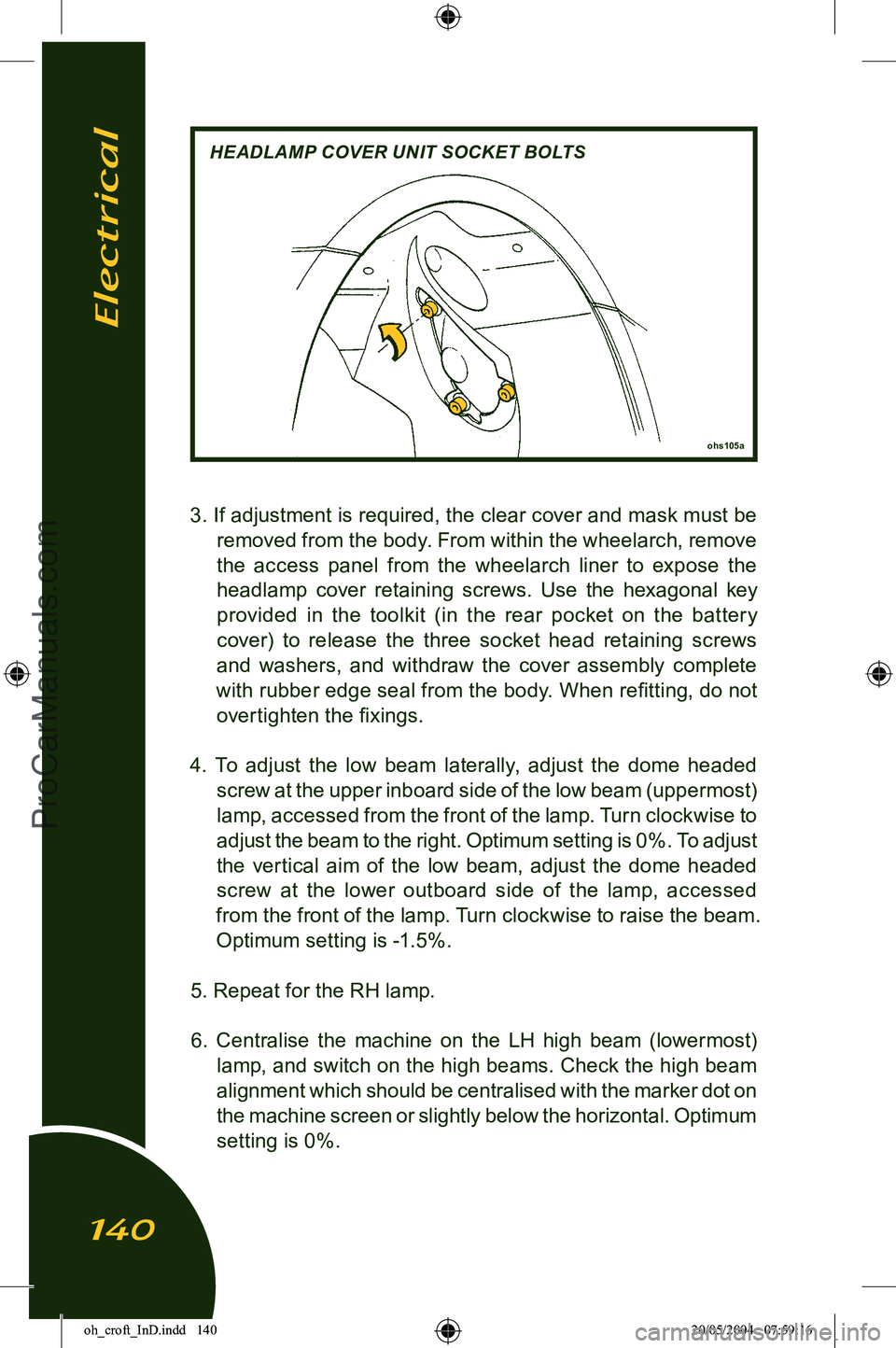
3. If adjustment is required, the clear cover and mask must be removed from the body. From within the wheelarch, remove
the access panel from the wheelarch liner to expose the
headlamp cover retaining screws. Use the hexagonal key provided in the toolkit (in the rear pocket on the batter y
cover) to release the three socket head retaining screws and washers, and withdraw the cover assembly complete
with rubber edge seal from the body. When refitting, do not overtighten the fixings.
4. To adjust the low beam laterally, adjust the dome headed screw at the upper inboard side of the low beam (uppermost)
lamp, accessed from the front of the lamp. Turn clockwise to
adjust the beam to the right. Optimum setting is 0%. To adjust
the vertical aim of the low beam, adjust the dome headed screw at the lower outboard side of the lamp, accessed
from the front of the lamp. Turn clockwise to raise the beam.
Optimum setting is -1.5%.
5. Repeat for the RH lamp. 6. Centralise the machine on the LH high beam (lowermost) lamp, and switch on the high beams. Check the high beam
alignment which should be centralised with the marker dot on
the machine screen or slightly below the horizontal. Optimum
setting is 0%.
ohs105a
HEADLAMP COVER UNIT SOCKET BOLTS
Electrical
140
oh_croft_InD.indd 14020/05/2004 07:59:16ProCarManuals.com
Page 145 of 205
High beam bulb: Disconnect the two cables from the bulb, re-
lease the spring wire clip, and withdraw the 55W H7 bulb. On re
-
fitting, note that the bulb is keyed to allow only one orientation.
Parking lamp: Twist the bulb holder counterclockwise to release
from the main beam lamp, and withdraw the bayonet fitting T4
W bulb.
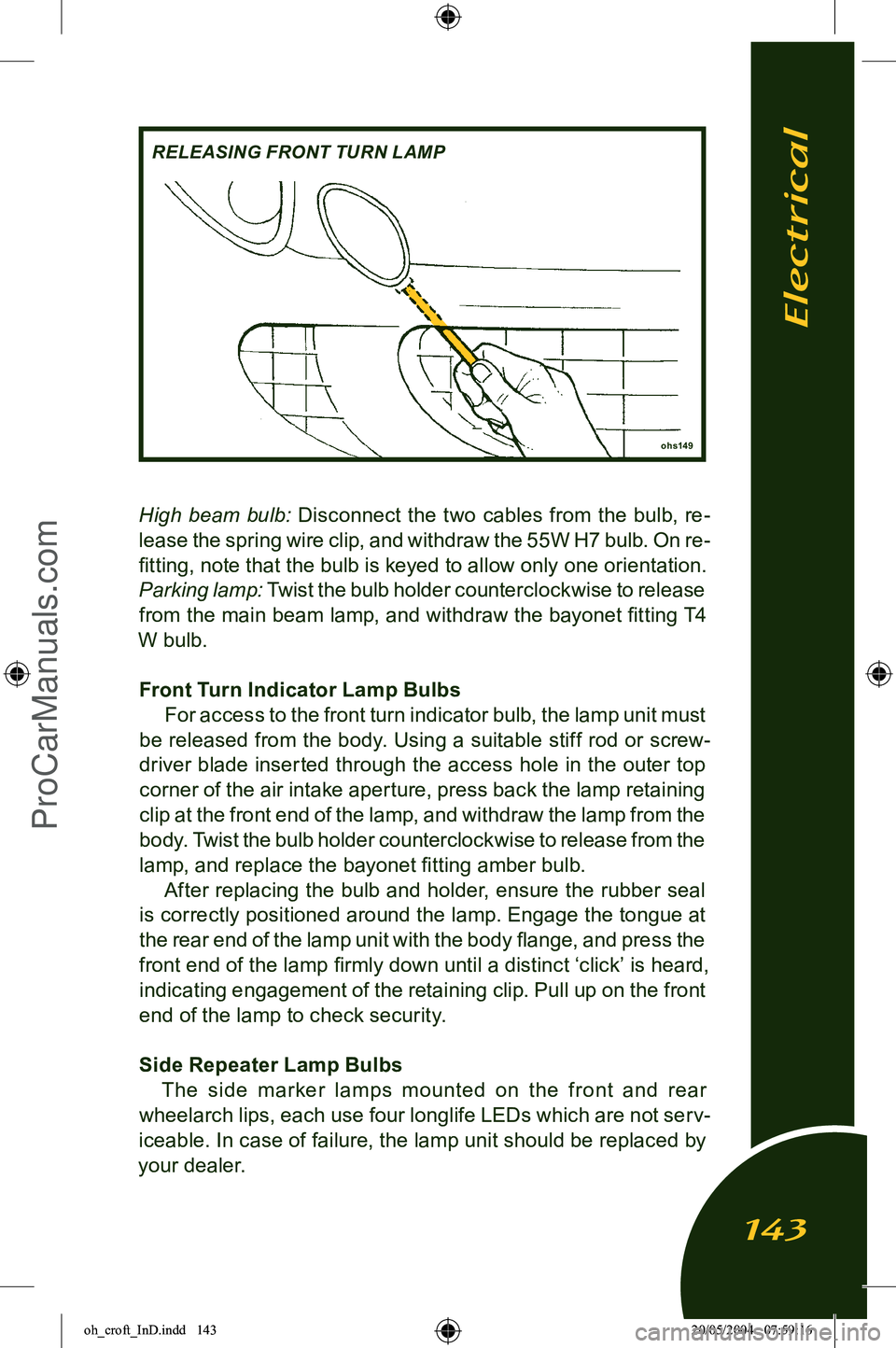
Front Turn Indicator Lamp Bulbs For access to the front turn indicator bulb, the lamp unit must
be released from the body. Using a suitable stiff rod or screw
-
driver blade inserted through the access hole in the outer top
corner of the air intake aperture, press back the lamp retaining
clip at the front end of the lamp, and withdraw the lamp from the body. Twist the bulb holder counterclockwise to release from the
lamp, and replace the bayonet fitting amber bulb. After replacing the bulb and holder, ensure the rubber seal
is correctly positioned around the lamp. Engage the tongue at
the rear end of the lamp unit with the body flange, and press the
front end of the lamp firmly down until a distinct ‘click’ is heard, indicating engagement of the retaining clip. Pull up on the front
end of the lamp to check security.
Side Repeater Lamp Bulbs The side mar ker lamps mounted on the front and rear
wheelarch lips, each use four longlife LEDs which are not serv
-
iceable. In case of failure, the lamp unit should be replaced by
your dealer.
ohs149
RELEASING FRONT TURN LAMP
Electrical
143
oh_croft_InD.indd 14320/05/2004 07:59:16ProCarManuals.com
Page 158 of 205
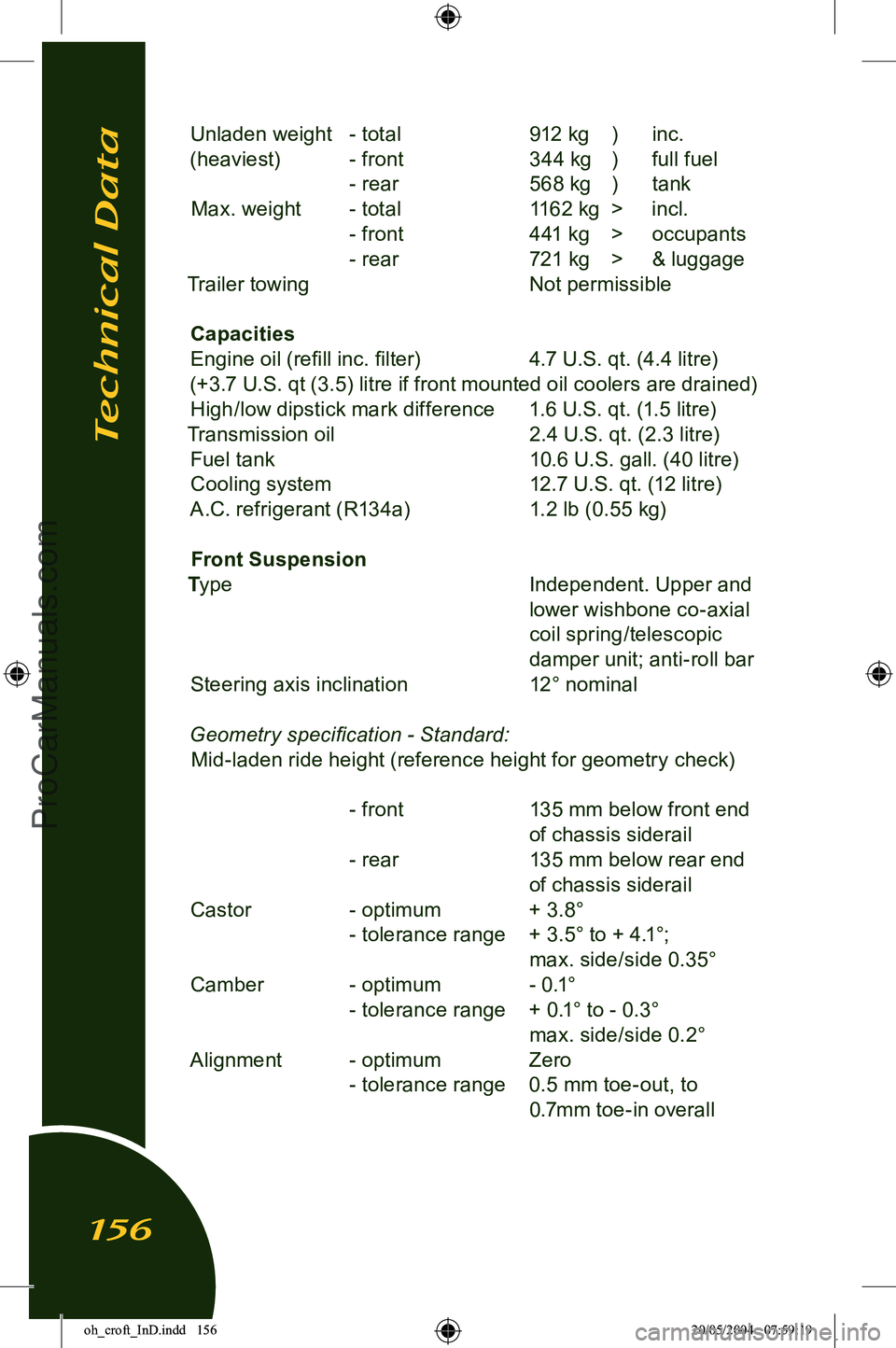
Unladen weight - total 912 kg ) inc.
(heaviest) - front 344 kg ) full fuel
- rear 568 kg ) tank
Max. weight - total 1162 kg > incl.
- front 441 kg > occupants
- rear 721 kg > & luggage
Trailer towing Not permissible
Capacities Engine oil (refill inc. filter) 4.7 U.S. qt. (4.4 litre)
(+3.7 U.S. qt (3.5) litre if front mounted oil coolers are drained) High/low dipstick mark difference 1.6 U.S. qt. (1.5 litre)
Transmission oil 2.4 U.S. qt. (2.3 litre)
Fuel tank 10.6 U.S. gall. (40 litre)
Cooling system 12.7 U.S. qt. (12 litre)
A.C. refrigerant (R134a) 1.2 lb (0.55 kg)
Front Suspension
T ype Independent. Upper and
lower wishbone co-axial
coil spring/telescopic
damper unit; anti-roll bar
Steering axis inclination 12° nominal
Geometry specification - Standard: Mid-laden ride height (reference height for geometry check)
- front 135 mm below front end
of chassis siderail
- rear 135 mm below rear end
of chassis siderail
Castor - optimum + 3.8°
- tolerance range + 3.5° to + 4.1°;
max. side/side 0.35°
Camber - optimum - 0.1°
- tolerance range + 0.1° to - 0.3°
max. side/side 0.2°
Alignment - optimum Zero - tolerance range 0.5 mm toe-out, to
0.7mm toe-in overall
Technical Data
156
oh_croft_InD.indd 15620/05/2004 07:59:19ProCarManuals.com
Page 159 of 205
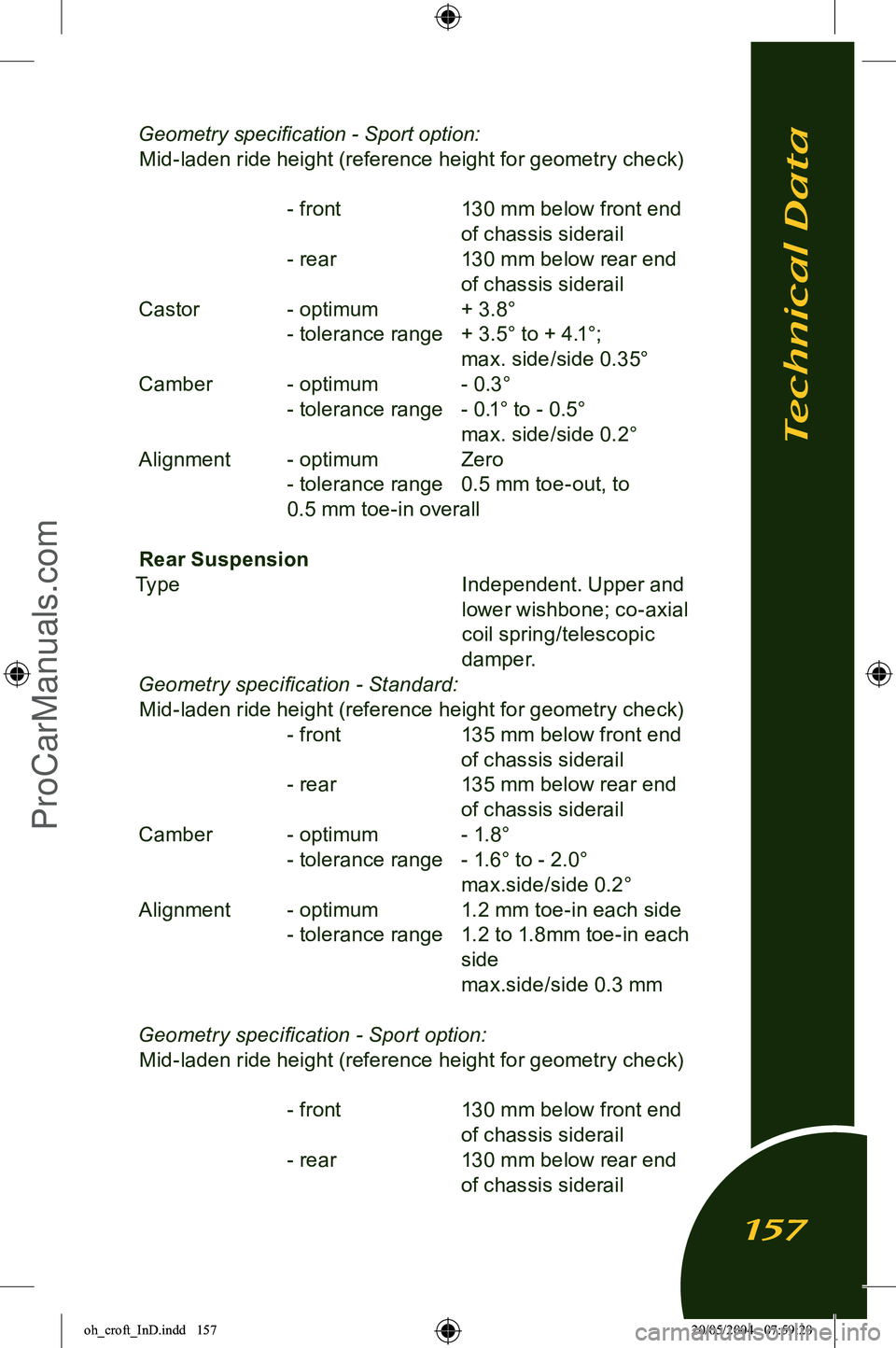
Geometry specification - Sport option:Mid-laden ride height (reference height for geometry check)
- front 130 mm below front end
of chassis siderail
- rear 130 mm below rear end
of chassis siderail
Castor - optimum + 3.8°
- tolerance range + 3.5° to + 4.1°;
max. side/side 0.35°
Camber - optimum - 0.3°
- tolerance range - 0.1° to - 0.5°
max. side/side 0.2°
Alignment - optimum Zero - tolerance range 0.5 mm toe-out, to
0.5 mm toe-in overall
Rear Suspension
Type Independent. Upper and
lower wishbone; co-axial
coil spring/telescopic
damper.
Geometry specification - Standard: Mid-laden ride height (reference height for geometry check)
- front 135 mm below front end
of chassis siderail
- rear 135 mm below rear end
of chassis siderail
Camber - optimum - 1.8°
- tolerance range - 1.6° to - 2.0°
max.side/side 0.2°
Alignment - optimum 1.2 mm toe-in each side - tolerance range 1.2 to 1.8mm toe-in each
side
max.side/side 0.3 mm
Geometry specification - Sport option: Mid-laden ride height (reference height for geometry check)
- front 130 mm below front end
of chassis siderail
- rear 130 mm below rear end
of chassis siderail
Technical Data
157
oh_croft_InD.indd 15720/05/2004 07:59:20ProCarManuals.com
Page 176 of 205
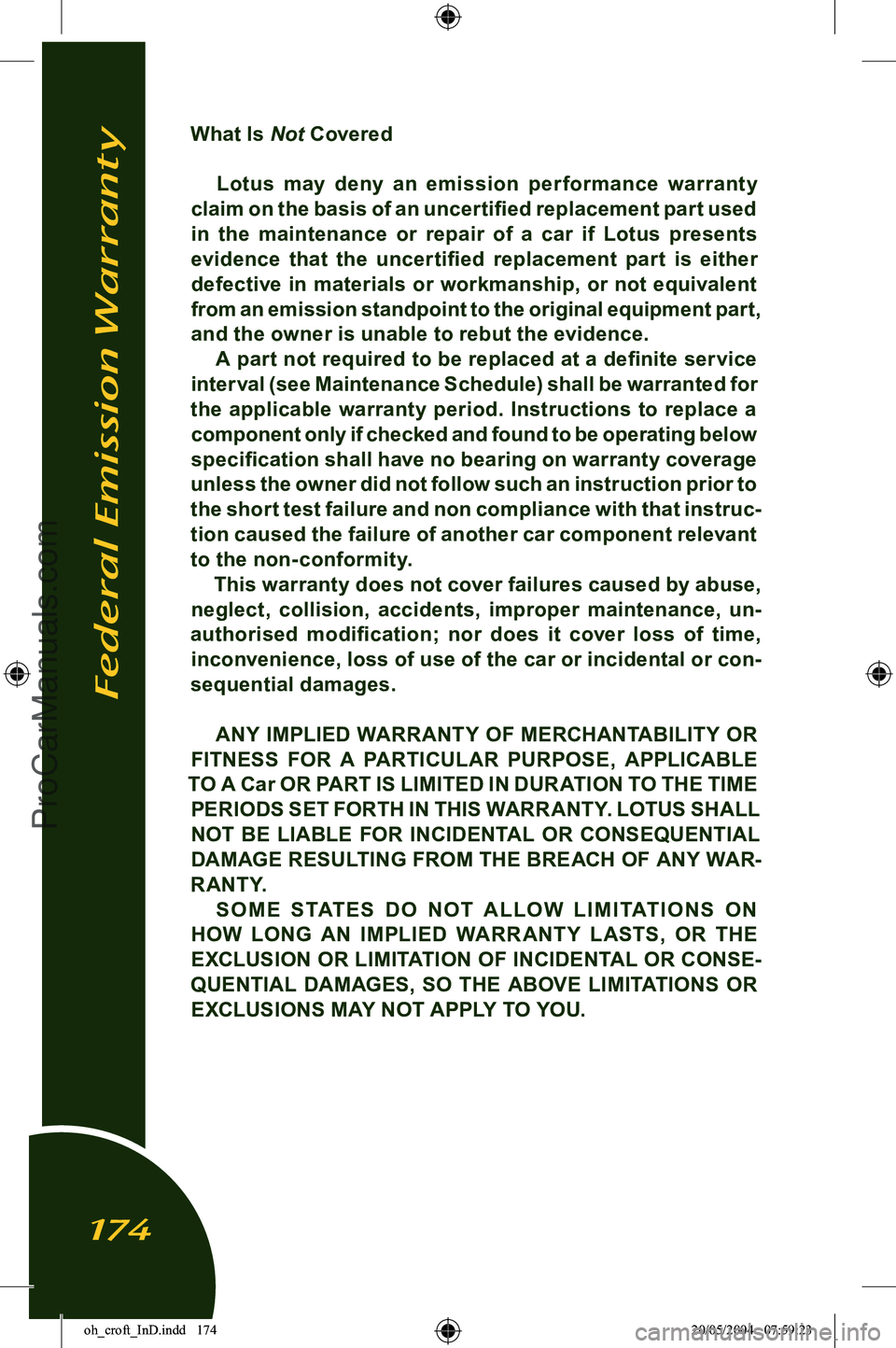
What Is Not CoveredLotus may deny an emission per formance warranty
claim on the basis of an uncertified replacement part used in the maintenance or repair of a car if Lotus presents evidence that the uncertified replacement part is either
defective in materials or workmanship, or not equivalent
from an emission standpoint to the original equipment part, and the owner is unable to rebut the evidence. A part not required to be replaced at a definite service
interval (see Maintenance Schedule) shall be warranted for
the applicable warranty period. Instructions to replace a
component only if checked and found to be operating below specification shall have no bearing on warranty coverage
unless the owner did not follow such an instruction prior to
the short test failure and non compliance with that instruc
-
tion caused the failure of another car component relevant
to the non- conformity.
This warranty does not cover failures caused by abuse,
neglect, collision, accidents, improper maintenance, un
-
authorised modification; nor does it cover loss of time, inconvenience, loss of use of the car or incidental or con
-
sequential damages.
ANY IMPLIED WARRANTY OF MERCHANTABILITY OR
FITNESS FOR A PARTICULAR PURPOSE, APPLICABLE
TO A Car OR PART IS LIMITED IN DURATION TO THE TIME PERIODS SET FORTH IN THIS WARRANTY. LOTUS SHALL
NOT BE LIABLE FOR INCIDENTAL OR CONSEQUENTIAL
DAMAGE RESULTING FROM THE BREACH OF ANY WAR
-
RANTY. S O M E S TAT E S D O N OT A L LO W L I M I TAT I O N S O N
HOW LONG AN IMPLIED WARR ANT Y L ASTS, OR THE
EXCLUSION OR LIMITATION OF INCIDENTAL OR CONSE
-
QUENTIAL DAMAGES, SO THE ABOVE LIMITATIONS OR EXCLUSIONS MAY NOT APPLY TO YOU.
Federal Emission Warranty
174
oh_croft_InD.indd 17420/05/2004 07:59:23ProCarManuals.com
Page 182 of 205
CALIFORNIA EMISSION CONTROL WARRANTY STATEMENT
YOUR WARRANTY RIGHTS AND OBLIGATIONS The California Air Resources Board and Lotus Cars
Limited are pleased to explain the emission control system
warranty on your new, USA specification, Lotus Elise. In
California, new motor cars must be designed, built and equipped to meet the State’s stringent anti-smog standards.
Lotus must warrant the emission control system on your
Elise for the periods of time listed below provided there has been no abuse, neglect or improper maintenance of
your car. Your emission control system may include parts such as the carburettor or fuel injection system, the igni
-
tion system, catalytic conver tor, and engine computer.
Also included may be hoses, belts, connectors and other
emission-related assemblies. Where a warrantable condition exists, Lotus will repair
your car at no cost to you including diagnosis, parts and labour.
MANUFACTURER’S WARRANTY COVERAGE
- For
3 years or 50,000 miles (whichever first occurs):
1) If your car fails a Smog Check inspection, all necessary repairs and adjustments will be made by Lotus to ensure that
your car passes the inspection. This is your emission control
system PERFORMANCE WARRANTY.
2 ) I f a n y e m i s s i o n r e l a t e d p a r t o n y o u r c a r i s d e f e c-
t i v e , t h e p a r t w i l l b e r e p a i r e d o r r e p l a c e d b y L o t u s .
This is your short-term emission control system
DEFECTS
WARRANTY.
- For
7 years or 70,000 miles (whichever first occurs):
1) If an emission related part listed in this warranty booklet specially noted with coverage for 7 years or 70,000 miles
is defective, the part will be repaired or replaced by Lotus.
This is your long term emission control system DEFECTS
WARRANTY.
California Emission Warranty
180
oh_croft_InD.indd 18020/05/2004 07:59:24ProCarManuals.com