light MASERATI GHIBLI 2019 Owners Manual
[x] Cancel search | Manufacturer: MASERATI, Model Year: 2019, Model line: GHIBLI, Model: MASERATI GHIBLI 2019Pages: 384, PDF Size: 13.33 MB
Page 348 of 384
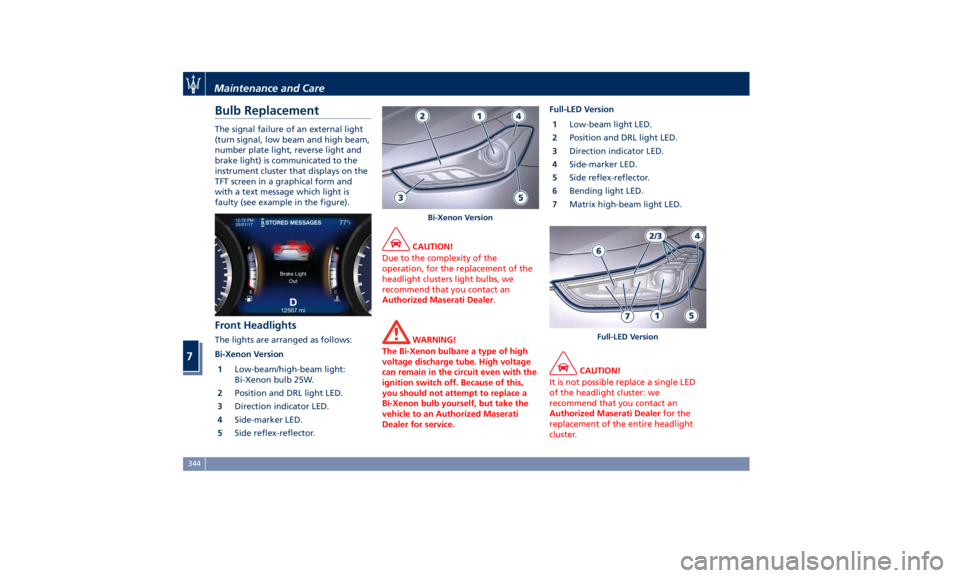
Bulb Replacement The signal failure of an external light
(turn signal, low beam and high beam,
number plate light, reverse light and
brake light) is communicated to the
instrument cluster that displays on the
TFT screen in a graphical form and
with a text message which light is
faulty (see example in the figure).
Front Headlights The lights are arranged as follows:
Bi-Xenon Version
1 Low-beam/high-beam light:
Bi-Xenon bulb 25W.
2 Position and DRL light LED.
3 Direction indicator LED.
4 Side-marker LED.
5 Side reflex-reflector. CAUTION!
Due to the complexity of the
operation, for the replacement of the
headlight clusters light bulbs, we
recommend that you contact an
Authorized Maserati Dealer .
WARNING!
The Bi-Xenon bulbare a type of high
voltage discharge tube. High voltage
can remain in the circuit even with the
ignition switch off. Because of this,
you should not attempt to replace a
Bi-Xenon bulb yourself, but take the
vehicle to an Authorized Maserati
Dealer for service. Full-LED Version
1 Low-beam
light LED.
2 Position and DRL light LED.
3 Direction indicator LED.
4 Side-marker LED.
5 Side reflex-reflector.
6 Bending light LED.
7 Matrix high-beam light LED.
CAUTION!
It is not possible replace a single LED
of the headlight cluster: we
recommend that you contact an
Authorized Maserati Dealer for the
replacement of the entire headlight
cluster.Bi-Xenon Version
Full-LED VersionMaintenance and Care
7
344
Page 349 of 384
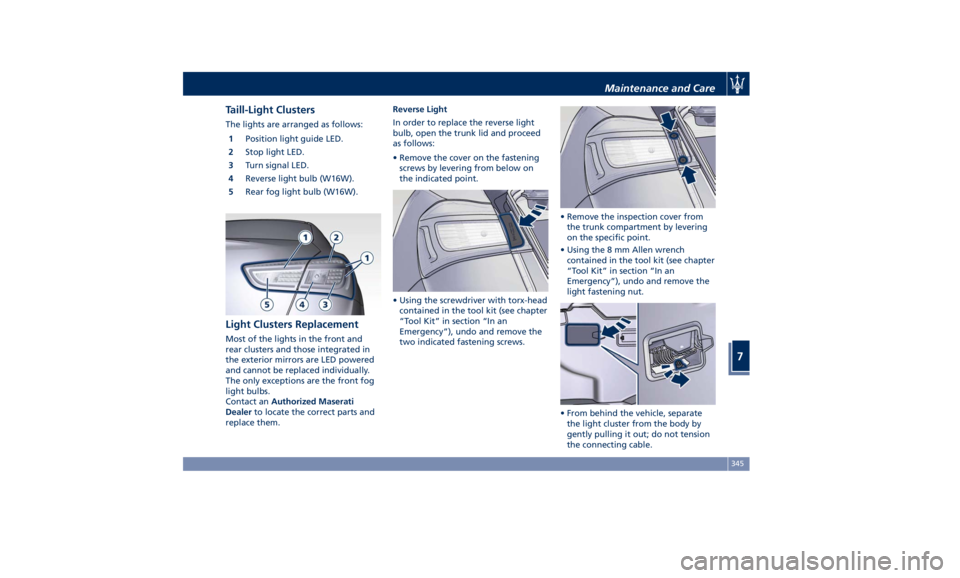
Taill-Light Clusters The lights are arranged as follows:
1 Position light guide LED.
2 Stop light LED.
3 Turn signal LED.
4 Reverse light bulb (W16W).
5 Rear fog light bulb (W16W).
Light Clusters Replacement Most of the lights in the front and
rear clusters and those integrated in
the exterior mirrors are LED powered
and cannot be replaced individually.
The only exceptions are the front fog
light bulbs.
Contact an Authorized Maserati
Dealer to locate the correct parts and
replace them. Reverse Light
In order to replace the reverse light
bulb, open the trunk lid and proceed
as follows:
• Remove the cover on the fastening
screws by levering from below on
the indicated point.
• Using the screwdriver with torx-head
contained in the tool kit (see chapter
“Tool Kit” in section “In an
Emergency”), undo and remove the
two indicated fastening screws. • Remove the inspection cover from
the trunk compartment by levering
on the specific point.
• Using the 8 mm Allen wrench
contained in the tool kit (see chapter
“Tool Kit” in section “In an
Emergency”), undo and remove the
light fastening nut.
• From behind the vehicle, separate
the light cluster from the body by
gently pulling it out; do not tension
the connecting cable.Maintenance and Care
7
345
Page 350 of 384
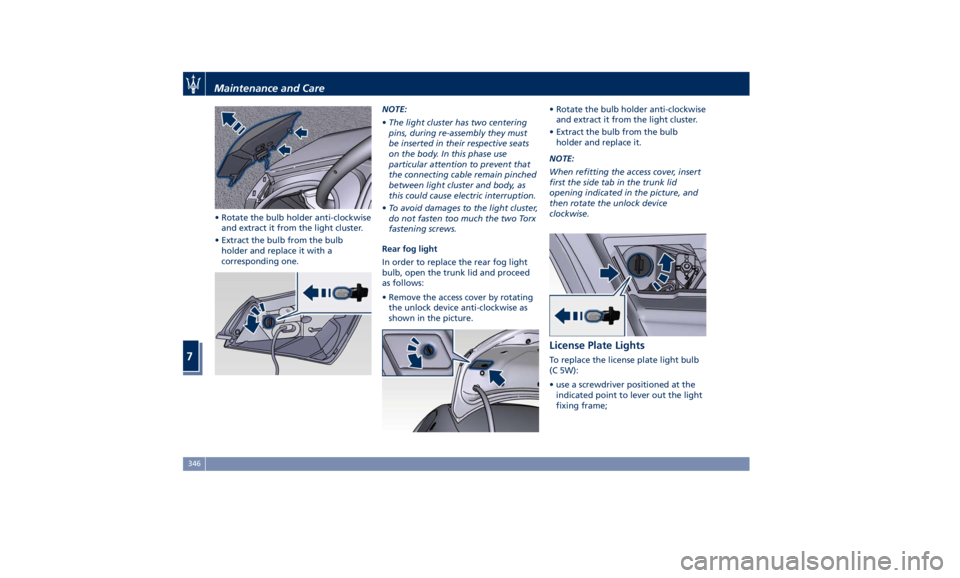
• Rotate the bulb holder anti-clockwise
and extract it from the light cluster.
• Extract the bulb from the bulb
holder and replace it with a
corresponding one. NOTE:
• The light cluster has two centering
pins, during re-assembly they must
be inserted in their respective seats
on the body. In this phase use
particular attention to prevent that
the connecting cable remain pinched
between light cluster and body, as
this could cause electric interruption.
• To avoid damages to the light cluster,
do not fasten too much the two Torx
fastening screws.
Rear fog light
In order to replace the rear fog light
bulb, open the trunk lid and proceed
as follows:
• Remove the access cover by rotating
the unlock device anti-clockwise as
shown in the picture. • Rotate the bulb holder anti-clockwise
and extract it from the light cluster.
• Extract the bulb from the bulb
holder and replace it.
NOTE:
When refitting the access cover, insert
first the side tab in the trunk lid
opening indicated in the picture, and
then rotate the unlock device
clockwise.
License Plate Lights To replace the license plate light bulb
(C 5W):
• use a screwdriver positioned at the
indicated point to lever out the light
fixing frame;Maintenance and Care
7
346
Page 351 of 384
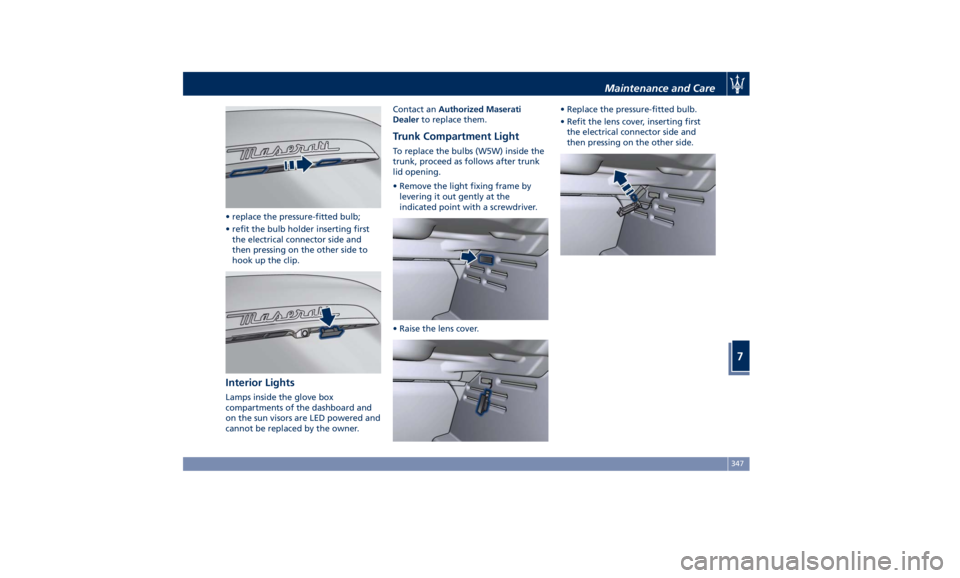
• replace the pressure-fitted bulb;
• refit the bulb holder inserting first
the electrical connector side and
then pressing on the other side to
hook up the clip.
Interior Lights Lamps inside the glove box
compartments of the dashboard and
on the sun visors are LED powered and
cannot be replaced by the owner. Contact an Authorized Maserati
Dealer to replace them.
Trunk Compartment Light To replace the bulbs (W5W) inside the
trunk, proceed as follows after trunk
lid opening.
• Remove the light fixing frame by
levering it out gently at the
indicated point with a screwdriver.
• Raise the lens cover. • Replace the pressure-fitted bulb.
• Refit the lens cover, inserting first
the electrical connector side and
then pressing on the other side.
Maintenance and Care
7
347
Page 355 of 384
wax products having high protective
power;
• spraying of plastic materials, with a
protective function, in the most
exposed points: underneath the
doors, inside part of the mud guards,
edges, etc.;
• use of ventilated box sections,
coated with protective wax products,
to avoid condensation and trapped
water which could encourage the
formation of internal rust.
Useful Advice to Keep the
Bodywork in Good Condition Paint
The paintwork does not only have an
aesthetic function but also protects
the underlying metal sheets. In the
event of abrasions or deep scratches,
we recommend to have the necessary
touch-ups made immediately, to avoid
any rust formation. Touch-ups do not
feature particular difficulties, even on
metallic finishes.
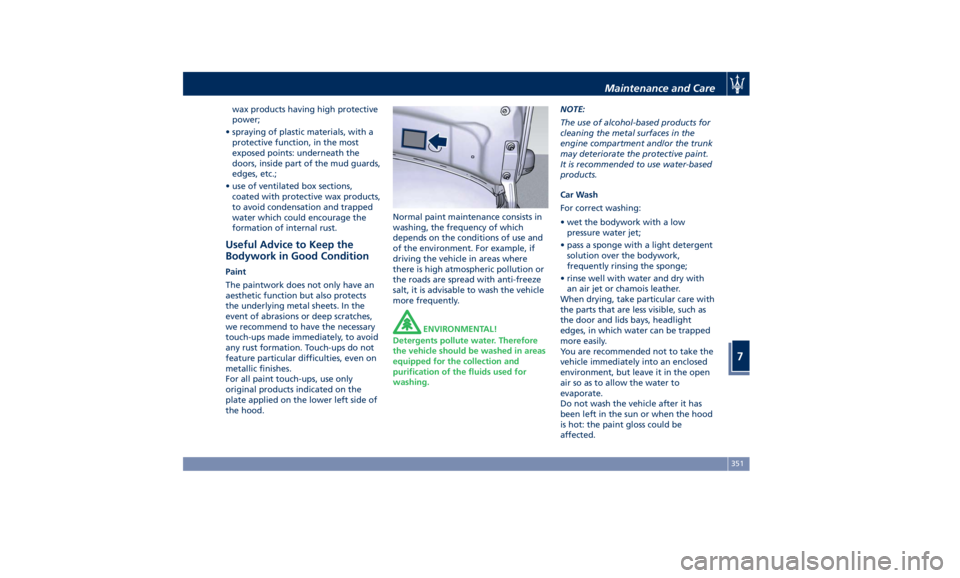
For all paint touch-ups, use only
original products indicated on the
plate applied on the lower left side of
the hood. Normal paint maintenance consists in
washing, the frequency of which
depends on the conditions of use and
of the environment. For example, if
driving the vehicle in areas where
there is high atmospheric pollution or
the roads are spread with anti-freeze
salt, it is advisable to wash the vehicle
more frequently.
ENVIRONMENTAL!
Detergents pollute water. Therefore
the vehicle should be washed in areas
equipped for the collection and
purification of the fluids used for
washing. NOTE:
The use of alcohol-based products for
cleaning the metal surfaces in the
engine compartment and/or the trunk
may deteriorate the protective paint.
It is recommended to use water-based
products.
Car Wash
For correct washing:
• wet the bodywork with a low
pressure water jet;
• pass a sponge with a light detergent
solution over the bodywork,
frequently rinsing the sponge;
• rinse well with water and dry with
an air jet or chamois leather.
When drying, take particular care with
the parts that are less visible, such as
the door and lids bays, headlight
edges, in which water can be trapped
more easily.
You are recommended not to take the
vehicle immediately into an enclosed
environment, but leave it in the open
air so as to allow the water to
evaporate.
Do not wash the vehicle after it has
been left in the sun or when the hood
is hot: the paint gloss could be
affected.Maintenance and Care
7
351
Page 356 of 384
External plastic parts must be cleaned
with the same procedure followed for
the normal washing of the bodywork.
Avoid, as far as possible, parking the
vehicle under trees; the resinous
substances that very often drop from
the trees give the paint a dull
appearance and increase the possibility
of originating corrosive processes.
It is important that the drain holes in
the lower sides of the doors, rocker
panels, and trunk bottom be kept clear
and open.
CAUTION!
• Bird droppings must be washed off
immediately and thoroughly, since
their acidity is particularly corrosive.
• To provide better protection for the
paint, polish the vehicle at intervals
with a suitable product leaving a
protective film on the paint.
• If the vehicle is washed using
high-pressure water jets or cleaners,
it is important that the nozzle of the
jet be kept at a distance of at least
16 in (40 cm) from the bodywork to
avoid damaging it. Glass Surfaces
All
glass surfaces
should be cleaned on
a regular basis with any commercial
household-type glass cleaner.
Never use an abrasive type cleaner.
Use caution when cleaning the inside
rear window equipped with electric
defrosters. Do not use scrapers or
other sharp instrument that may
scratch the elements.
When cleaning the rearview mirror,
spray cleaner on the towel or rag that
you are using. Do not spray cleaner
directly on the mirror.
Labels can be peeled off after soaking
with warm water.
When cleaning is performed, keep all
metal objects at a safe distance from
the window.
Cleaning Headlights
Your vehicle has plastic headlights that
are lighter and less susceptible to
stone breakage than glass headlights.
Plastic is not as scratch-resistant as
glass and therefore different lens
cleaning procedures must be followed.
To minimize the possibility of
scratching the lenses and reducing
light output, avoid wiping with a dry
cloth. To remove road dirt, wash with
a mild soap solution followed by
rinsing. Do not use abrasive cleaning
components, solvents, steel wool or
other aggressive material to clean the
lenses.
Condensation and Fogging on the
Light Clusters
With cold or humid climates, after a
driving rain or after cleaning the car,
the surface of the front and rear light
clusters could fog and/or form
condensate drops on the inside. This is
a natural phenomenon due to the
temperature and humidity differences
between the lens internal and external
surface, which nevertheless does not
indicate a fault and does not
compromise the regular operation of
the lights. The fogging/condensate
disappears when switching on the
lights, starting from the centre of the
diffuser and gradually going to the
edges.
Moldings and Aluminum Trims
• For cleaning moldings and aluminum
trims, avoid the use of acidic or
alkaline cleaning agents that can
destroy the protecting surface
treatment.
• After washing aluminum trim with
warm water, apply the cleaning
agent with a clean tissue or a soft
sponge on the surface. Do not useMaintenance and Care
7
352
Page 360 of 384
• With the transmission in N (Neutral),
let the engine idle for several
minutes.
WARNING!
The engine idle must be performed
outdoors. Exhaust gases contain
carbon monoxide which is strongly
toxic and potentially lethal.
WARNING!
California Proposition 65
Operating, servicing and maintaining
a passenger vehicle or off-road vehicle
can expose you to chemicals including
such as, engine exhaust, carbon
monoxide, phthalates and lead, that
which are known to the State of
California to cause cancer and birth
defects or other reproductive harm. To
minimize exposure, avoid breathing
exhaust, do not idle the engine except
as necessary, service your vehicle in a
well-ventilated area and wear gloves
or wash your hands frequently when
servicing your vehicle. For more
information go to:
www.P65Warnings.ca.gov/passenger-
vehicle Battery Statement Battery Statement Status of
Charge To avoid problems with ignition and/or
the electrical system in general when
you are driving, the battery charge
status is constantly maintained and
guaranteed by the vehicle's recharge
circuit; the main component of which
is the alternator. This circuit is only
able to supply voltage to the battery
when the vehicle is traveling.
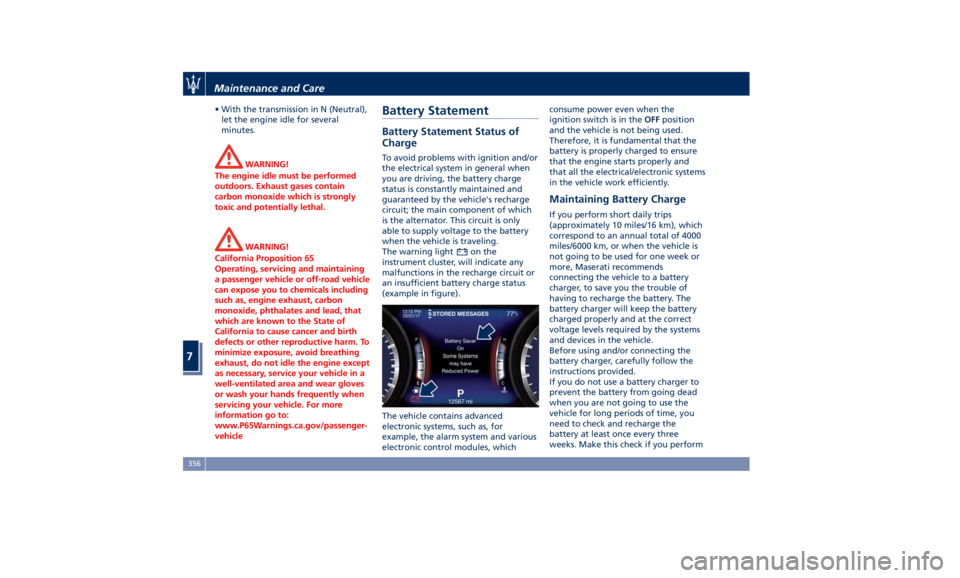
The warning light
on the
instrument cluster, will indicate any
malfunctions in the recharge circuit or
an insufficient battery charge status
(example in figure).
The vehicle contains advanced
electronic systems, such as, for
example, the alarm system and various
electronic control modules, which consume power even when the
ignition switch is in the OFF position
and the vehicle is not being used.
Therefore, it is fundamental that the
battery is properly charged to ensure
that the engine starts properly and
that all the electrical/electronic systems
in the vehicle work efficiently.
Maintaining Battery Charge If you perform short daily trips
(approximately 10 miles/16 km), which
correspond to an annual total of 4000
miles/6000 km, or when the vehicle is
not going to be used for one week or
more, Maserati recommends
connecting the vehicle to a battery
charger, to save you the trouble of
having to recharge the battery. The
battery charger will keep the battery
charged properly and at the correct
voltage levels required by the systems
and devices in the vehicle.
Before using and/or connecting the
battery charger, carefully follow the
instructions provided.
If you do not use a battery charger to
prevent the battery from going dead
when you are not going to use the
vehicle for long periods of time, you
need to check and recharge the
battery at least once every three
weeks. Make this check if you performMaintenance and Care
7
356
Page 370 of 384
Wheels NOTE:
• Maserati recommends Maserati Genuine Tires marked with “MGT” logo specifically designed for its models.
• In order to maintain high performance and safety level, Maserati recommends to use tires equivalent to the original
size.
WARNING!
• The maximum speed reachable with the tires is indicated by the tire manufacturer. Always comply with the regulations
in force in the Country you are driving in.
• Never exceed the maximum speed indicated for the tires: failure to respect the max. speed may damage these tires.
Danger: risk of accident!
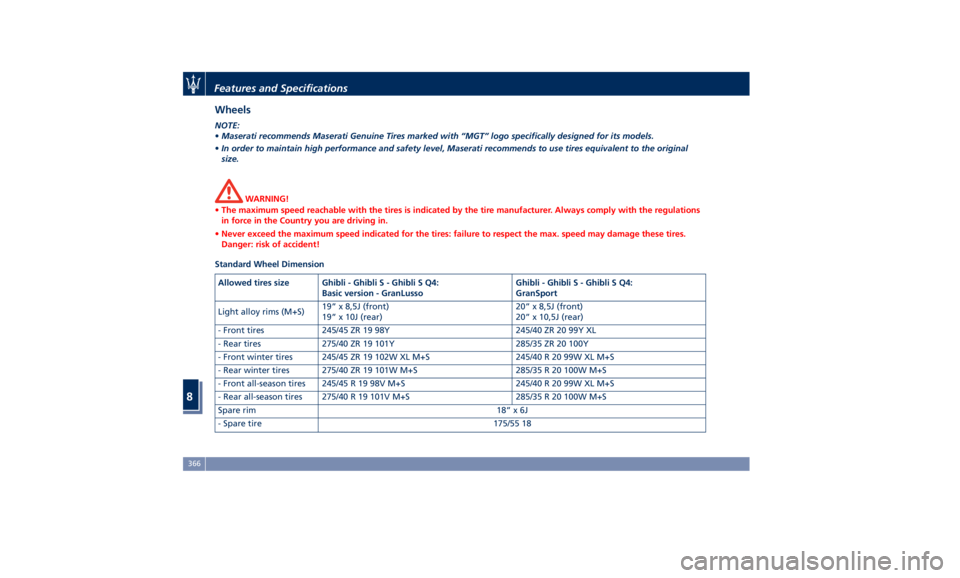
Standard Wheel Dimension
Allowed tires size Ghibli - Ghibli S - Ghibli S Q4:
Basic version - GranLusso Ghibli - Ghibli S - Ghibli S Q4:
GranSport
Light alloy rims (M+S) 19” x 8,5J (front)
19” x 10J (rear) 20” x 8,5J (front)
20” x 10,5J (rear)
- Front tires 245/45 ZR 19 98Y 245/40 ZR 20 99Y XL
- Rear tires 275/40 ZR 19 101Y 285/35 ZR 20 100Y
- Front winter tires 245/45 ZR 19 102W XL M+S 245/40 R 20 99W XL M+S
- Rear winter tires 275/40 ZR 19 101W M+S 285/35 R 20 100W M+S
- Front all-season tires 245/45 R 19 98V M+S 245/40 R 20 99W XL M+S
- Rear all-season tires 275/40 R 19 101V M+S 285/35 R 20 100W M+S
Spare rim 18” x 6J
- Spare tire 175/55 18Features and Specifications
8
366
Page 371 of 384
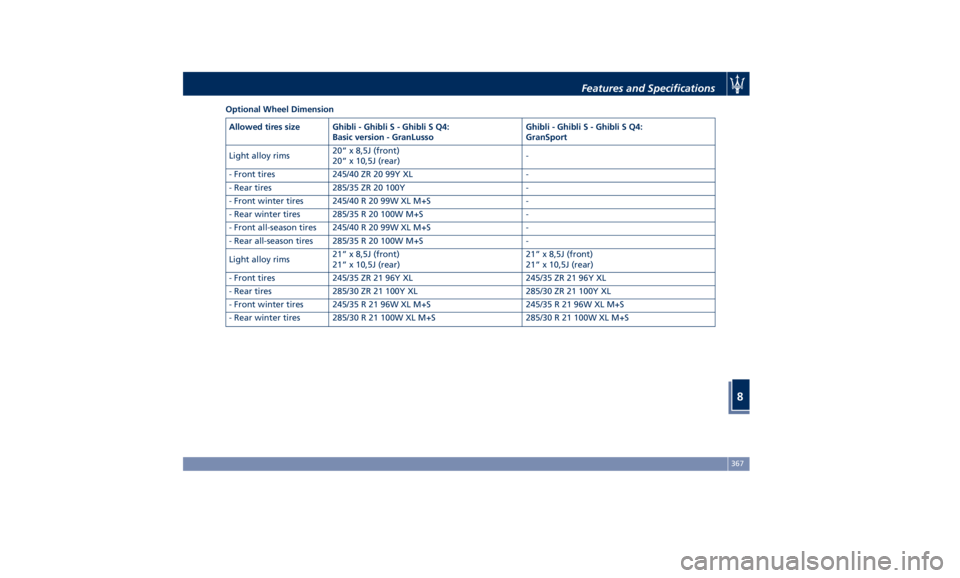
Optional Wheel Dimension
Allowed tires size Ghibli - Ghibli S - Ghibli S Q4:
Basic version - GranLusso Ghibli - Ghibli S - Ghibli S Q4:
GranSport
Light alloy rims 20” x 8,5J (front)
20” x 10,5J (rear) -
- Front tires 245/40 ZR 20 99Y XL -
- Rear tires 285/35 ZR 20 100Y -
- Front winter tires 245/40 R 20 99W XL M+S -
- Rear winter tires 285/35 R 20 100W M+S -
- Front all-season tires 245/40 R 20 99W XL M+S -
- Rear all-season tires 285/35 R 20 100W M+S -
Light alloy rims 21” x 8,5J (front)
21” x 10,5J (rear) 21” x 8,5J (front)
21” x 10,5J (rear)
- Front tires 245/35 ZR 21 96Y XL 245/35 ZR 21 96Y XL
- Rear tires 285/30 ZR 21 100Y XL 285/30 ZR 21 100Y XL
- Front winter tires 245/35 R 21 96W XL M+S 245/35 R 21 96W XL M+S
- Rear winter tires 285/30 R 21 100W XL M+S 285/30 R 21 100W XL M+S Features and Specifications
8
367
Page 377 of 384
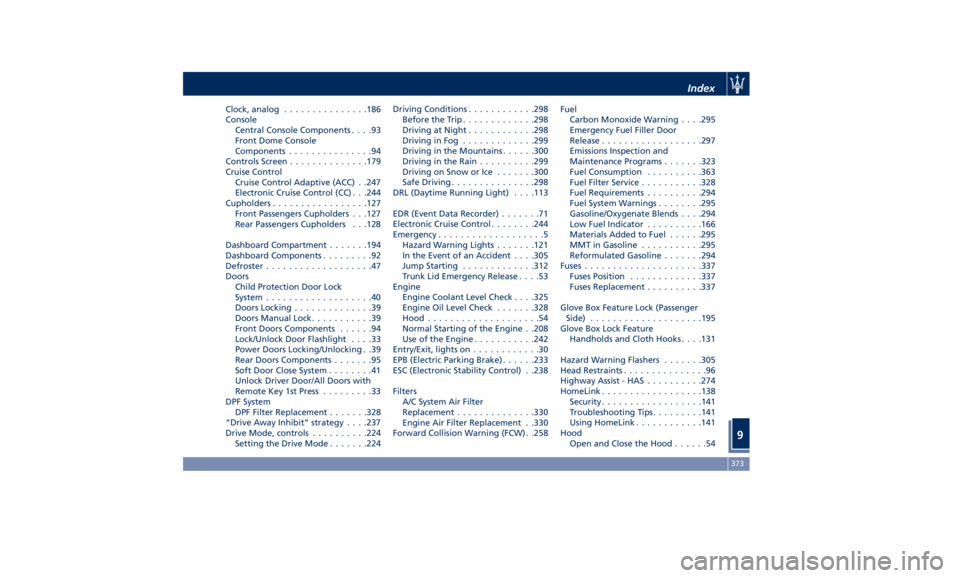
Clock, analog .............. .186
Console
Central Console Components ....93
Front Dome Console
Components ...............94
Controls Screen ............. .179
Cruise Control
Cruise Control Adaptive (ACC) . .247
Electronic Cruise Control (CC) . . .244
Cupholders ................ .127
Front Passengers Cupholders . . .127
Rear Passengers Cupholders . . .128
Dashboard Compartment ...... .194
Dashboard Components .........92
Defroster ...................47
Doors
Child Protection Door Lock
System ...................40
Doors Locking ..............39
Doors Manual Lock ...........39
Front Doors Components ......94
Lock/Unlock Door Flashlight ....33
Power Doors Locking/Unlocking . .39
Rear Doors Components .......95
Soft Door Close System ........41
Unlock Driver Door/All Doors with
Remote Key 1st Press .........33
DPF System
DPF Filter Replacement ...... .328
“Drive Away Inhibit” strategy . . . .237
Drive Mode, controls ......... .224
Setting the Drive Mode ...... .224 Driving Conditions ........... .298
Before the Trip ............ .298
Driving at Night ........... .298
Driving in Fog ............ .299
Driving in the Mountains ..... .300
Driving in the Rain ......... .299
Driving on Snow or Ice ...... .300
Safe Driving .............. .298
DRL (Daytime Running Light) . . . .113
EDR (Event Data Recorder) .......71
Electronic Cruise Control ....... .244
Emergency ...................5
Hazard Warning Lights ...... .121
In the Event of an Accident . . . .305
Jump Starting ............ .312
Trunk Lid Emergency Release ....53
Engine
Engine Coolant Level Check . . . .325
Engine Oil Level Check ......
.328
Hood ....................
5 4
Normal
Starting of the Engine . .208
Use of the Engine .......... .242
Entry/Exit, lights on ............30
EPB (Electric Parking Brake) ..... .233
ESC (Electronic Stability Control) . .238
Filters
A/C System Air Filter
Replacement ............. .330
Engine Air Filter Replacement . .330
Forward Collision Warning (FCW) . .258 Fuel
Carbon Monoxide Warning . . . .295
Emergency Fuel Filler Door
Release ................. .297
Emissions Inspection and
Maintenance Programs ...... .323
Fuel Consumption ......... .363
Fuel Filter Service .......... .328
Fuel Requirements ......... .294
Fuel System Warnings ....... .295
Gasoline/Oxygenate Blends . . . .294
Low Fuel Indicator ......... .166
Materials Added to Fuel ..... .295
MMT in Gasoline .......... .295
Reformulated Gasoline ...... .294
Fuses .................... .337
Fuses Position ............ .337
Fuses Replacement ......... .337
Glove Box Feature Lock (Passenger
Side) ................... .195
Glove Box Lock Feature
Handholds and Cloth Hooks . . . .131
Hazard Warning Flashers ...... .305
Head Restraints ...............96
Highway Assist - HAS ......... .274
HomeLink ................. .138
Security ................. .141
Troubleshooting Tips ........ .141
Using HomeLink ........... .141
Hood
Open and Close the Hood ......54Index
9 373