warning MASERATI GHIBLI 2019 Owner's Guide
[x] Cancel search | Manufacturer: MASERATI, Model Year: 2019, Model line: GHIBLI, Model: MASERATI GHIBLI 2019Pages: 384, PDF Size: 13.33 MB
Page 67 of 384
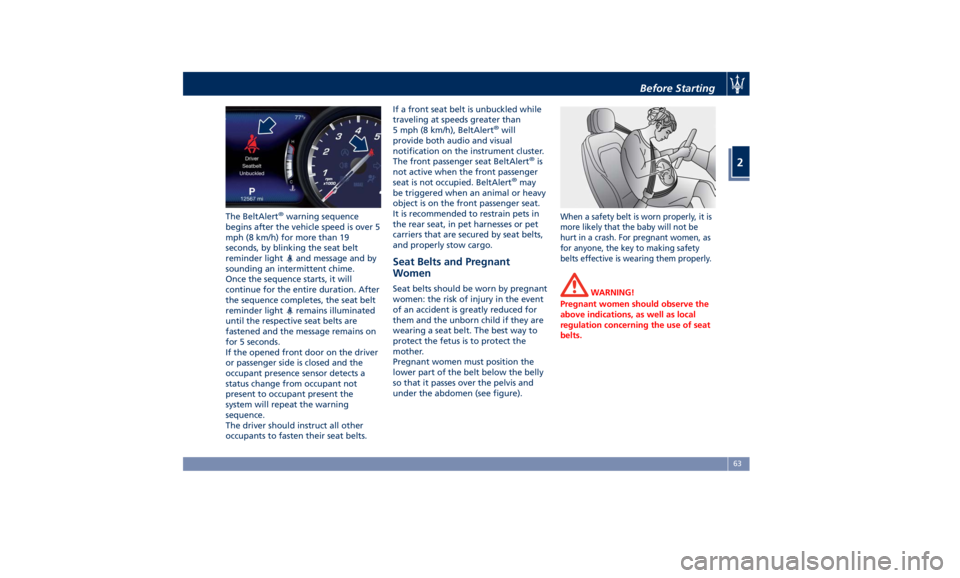
The BeltAlert ®
warning sequence
begins after the vehicle speed is over 5
mph (8 km/h) for more than 19
seconds, by blinking the seat belt
reminder light
and message and by
sounding an intermittent chime.
Once the sequence starts, it will
continue for the entire duration. After
the sequence completes, the seat belt
reminder light
remains illuminated
until the respective seat belts are
fastened and the message remains on
for 5 seconds.
If the opened front door on the driver
or passenger side is closed and the
occupant presence sensor detects a
status change from occupant not
present to occupant present the
system will repeat the warning
sequence.
The driver should instruct all other
occupants to fasten their seat belts. If a front seat belt is unbuckled while
traveling at speeds greater than
5 mph (8 km/h), BeltAlert ®
will
provide both audio and visual
notification on the instrument cluster.
The front passenger seat BeltAlert ®
is
not active when the front passenger
seat is not occupied. BeltAlert ®
may
be triggered when an animal or heavy
object is on the front passenger seat.
It is recommended to restrain pets in
the rear seat, in pet harnesses or pet
carriers that are secured by seat belts,
and properly stow cargo.
Seat Belts and Pregnant
Women Seat belts should be worn by pregnant
women: the risk of injury in the event
of an accident is greatly reduced for
them and the unborn child if they are
wearing a seat belt. The best way to
protect the fetus is to protect the
mother.
Pregnant women must position the
lower part of the belt below the belly
so that it passes over the pelvis and
under the abdomen (see figure). When a safety belt is worn properly, it is
more likely that the baby will not be
hurt in a crash. For pregnant women, as
for anyone, the key to making safety
belts effective is wearing them properly.
WARNING!
Pregnant women should observe the
above indications, as well as local
regulation concerning the use of seat
belts.Before Starting
2
63
Page 68 of 384

Supplemental Restraint
System (SRS) — Air Bags This vehicle has front air bags and
lap/shoulder belts for both the driver
and front passenger. The front air bags
are a supplement to the seat belt
restraints systems.
The driver's advanced front air bag is
mounted in the center of the steering
wheel in the area shown in the
picture. On this area is embossed the
word “SRS AIRBAG” for easier
recognition.
The passenger's advanced front air bag
is mounted in the dashboard, above
the glove compartment in the area
shown in the picture. On this area is
embossed the word “AIRBAG” for
easier recognition.
In addition, the vehicle is equipped
with a supplemental driver side knee
air bag mounted in the dashboard
below the steering column.
NOTE:
These air bags are designed to the
advanced air bag regulatory
requirements. The advanced front air bags have a
multistage inflator design. This allows
the air bag to have different rates of
inflation based on the severity and
type of collision.
This vehicle is equipped with driver
and front passenger seat track position
sensors that may adjust the inflation
level of the advanced front air bags
based upon seat position.
This vehicle is also equipped with a
front passenger seat belt buckle sensor
that detects whether the front
passenger seat belt is fastened. The
seat belt buckle sensor may adjust the
inflation rate of the advanced front air
bag.
This vehicle is equipped with
Supplemental Side Air Bag Inflatable
Curtains (SABIC) to protect the heads
of front and rear outer occupants. The
SABIC air bags are located above the side windows and their covers are also
labeled “AIR bag”.
This vehicle is also equipped with
Supplemental Seat-Mounted Side Air
Bags (SAB) for driver and passenger
pelvis-chest-shoulder protection during
a side impact. The Supplemental
Seat-Mounted Side Air Bags are
mounted on front seats and are
located in the outboard side of the
front seats.
NOTE:
After any accident, the vehicle should
be taken to the Authorized Maserati
Dealer immediately.
Air Bag System Components Your vehicle may be equipped with the
following air bag system components:
• Occupant Restraint Controller (ORC);
• Air bag warning light on the
instrument cluster;
• Steering wheel and column;
• Instrument cluster;
• Driver advanced front air bag;
• Passenger advanced front air bag;
• Supplemental driver side knee air
bag.
• Supplemental Seat-Mounted Side Air
Bags (SAB);Before Starting
2
64
Page 69 of 384
• Supplemental Side Air Bag Inflatable
Curtains (SABIC);
• Front and side impact sensors;
• Front seat belt pretensioners;
• Seat belt buckle switch;
• Seat track position sensors;
• Pyrotechnical charge to cut power
from the battery; it is located on the
positive battery terminal.
WARNING!
The air bag is not a substitute for the
seat belts. Correct use of the seat
belts, in combination with the air bag,
will offer protection for the driver and
passenger in the front seat in the
event of a head-on collision.
Advanced Front Air Bags
Properties The advanced front air bag system has
multistage driver and front passenger
air bags. This system provides air bag
inflation rates which are appropriate
to the severity and type of collision as
determined by the Occupant Restraint
Controller (ORC), which may receive
information from the front impact
sensors. The first stage inflator is triggered
immediately during an impact that
requires air bag deployment. This
inflation rate is used in less severe
collisions. A higher energy output,
inflation rate, is used for more severe
collisions.
CAUTION!
• The airbag system must be ready to
protect you in a collision. The
Occupant Restraint Controller (ORC)
monitors the internal circuits and
interconnecting wiring associated with
electrical Air Bag System Components
listed below:
– Occupant Restraint Controller
(ORC)
– Airbag Warning light on the
instrument cluster
– Steering Wheel and Column
– Instrument Cluster
– Driver advanced front air bag
– Passenger advanced front air bag
– Supplemental Seat-Mounted Side
Air Bags (SAB) Air Bags
– Supplemental Side Air Bag
Inflatable Curtains (SABIC)
– Front and side Impact Sensors
– Front seat belt pretensioners
– Seat Belt Buckle Switch – Seat Track Position Sensors
– Pyrotechnical charge to cut the
power from the battery: it is
located on the positive battery
terminal
• The electronic control unit provides
for the activation of the
pretensioners, front air bags or side
air bags (front and rear) based on
different criteria, according to the
type of impact. Failure of one or
more systems to activate is not
indicative of a system malfunction.
• The front and/or lateral air bags may
inflate if the vehicle suffers a violent
impact involving the underbody
area, for example in case of violent
impacts against steps, sidewalks,
speed bumps, or when the vehicle
falls into potholes, or similar.
WARNING!
• No objects should be placed over or
near the air bag on the instrument
panel or steering wheel because any
such objects could cause harm if the
vehicle is in a collision severe
enough to cause the air bag to
inflate.
(Continued)Before Starting
2
65
Page 70 of 384
(Continued)
• Do not place anything on or around
the air bag covers or attempt to
open them manually. You may
damage the air bags and you could
be injured because the air bags may
no longer be functional. The
protective covers for the air bag are
designed to open only when the air
bags are inflating.
• Always drive with your hands on the
steering wheel rim, so that the air
bag can inflate freely if required.
During the drive your back must be
as upright as comfort allows and be
against the seat back with the seat
belt properly fastened.
• Do not apply stickers or other
objects on the steering wheel, on
the dashboard in the passenger’s
side air bag area, on roof side trims
or on the seats.
• Do not travel with objects in your
lap, in front of your chest or
especially with a pipe, pencil or
other objects in your mouth. In the
event of a collision, the intervention
of the air bag could result in serious
injury.
• EXTREME HAZARD! Do not place a
rearward-facing infant seat onto the
front seat (see warning plate on the dashboard and above and behind
the sun visors). Deployment of the
air bag in an accident could cause
fatal injuries to the baby regardless
of the severity of the collision.
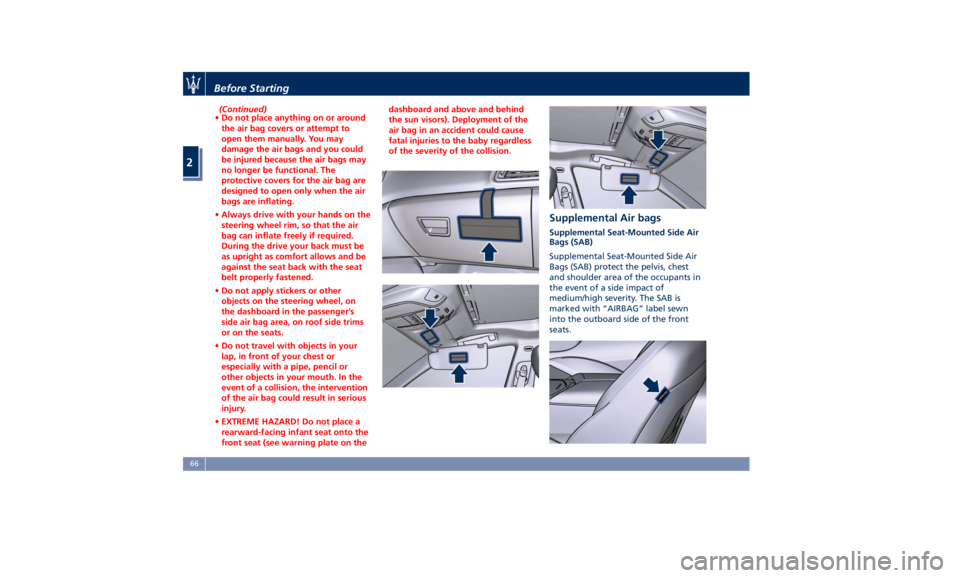
Supplemental Air bags Supplemental Seat-Mounted Side Air
Bags (SAB)
Supplemental Seat-Mounted Side Air
Bags (SAB) protect the pelvis, chest
and shoulder area of the occupants in
the event of a side impact of
medium/high severity. The SAB is
marked with “AIRBAG” label sewn
into the outboard side of the front
seats.Before Starting
2
66
Page 71 of 384
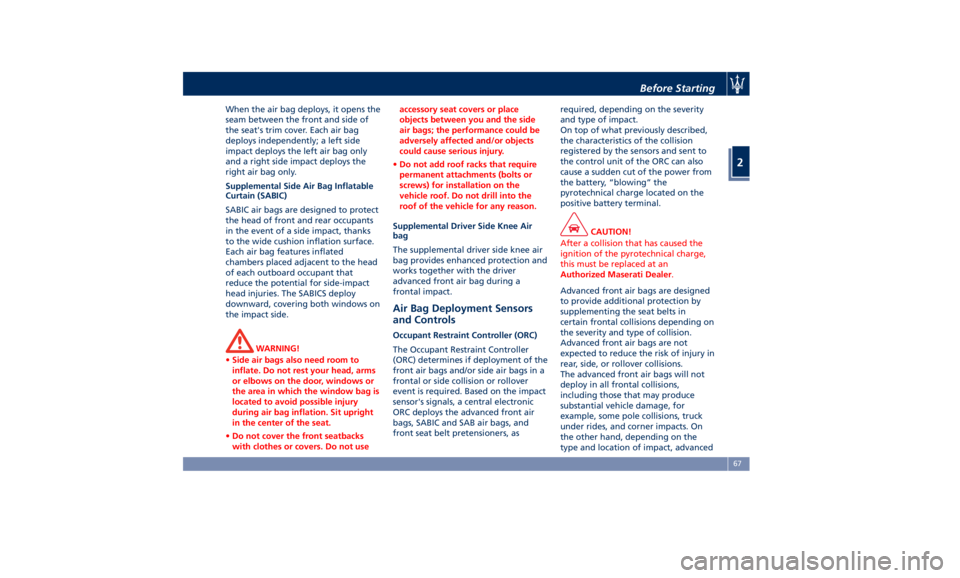
When the air bag deploys, it opens the
seam between the front and side of
the seat's trim cover. Each air bag
deploys independently; a left side
impact deploys the left air bag only
and a right side impact deploys the
right air bag only.
Supplemental Side Air Bag Inflatable
Curtain (SABIC)
SABIC air bags are designed to protect
the head of front and rear occupants
in the event of a side impact, thanks
to the wide cushion inflation surface.
Each air bag features inflated
chambers placed adjacent to the head
of each outboard occupant that
reduce the potential for side-impact
head injuries. The SABICS deploy
downward, covering both windows on
the impact side.
WARNING!
• Side air bags also need room to
inflate. Do not rest your head, arms
or elbows on the door, windows or
the area in which the window bag is
located to avoid possible injury
during air bag inflation. Sit upright
in the center of the seat.
• Do not cover the front seatbacks
with clothes or covers. Do not use accessory seat covers or place
objects between you and the side
air bags; the performance could be
adversely affected and/or objects
could cause serious injury.
• Do not add roof racks that require
permanent attachments (bolts or
screws) for installation on the
vehicle roof. Do not drill into the
roof of the vehicle for any reason.
Supplemental Driver Side Knee Air
bag
The
supplemental driver side knee air
bag provides enhanced protection and
works together with the driver
advanced front air bag during a
frontal impact.
Air Bag Deployment Sensors
and Controls Occupant Restraint Controller (ORC)
The Occupant Restraint Controller
(ORC) determines if deployment of the
front air bags and/or side air bags in a
frontal or side collision or rollover
event is required. Based on the impact
sensor's signals, a central electronic
ORC deploys the advanced front air
bags, SABIC and SAB air bags, and
front seat belt pretensioners, as required, depending on the severity
and type of impact.
On top of what previously described,
the characteristics of the collision
registered by the sensors and sent to
the control unit of the ORC can also
cause a sudden cut of the power from
the battery, “blowing” the
pyrotechnical charge located on the
positive battery terminal.
CAUTION!
After a collision that has caused the
ignition of the pyrotechnical charge,
this must be replaced at an
Authorized Maserati Dealer .
Advanced front air bags are designed
to
provide additional protection by
supplementing the seat belts in
certain frontal collisions depending on
the severity and type of collision.
Advanced front air bags are not
expected to reduce the risk of injury in
rear, side, or rollover collisions.
The advanced front air bags will not
deploy in all frontal collisions,
including those that may produce
substantial vehicle damage, for
example, some pole collisions, truck
under rides, and corner impacts. On
the other hand, depending on the
type and location of impact, advancedBefore Starting
2
67
Page 72 of 384
front air bags may deploy in crashes
with little vehicle front-end damage
but that produce a severe initial
deceleration.
The side air bags will not deploy in all
side collisions. Side air bag deployment
will depend on the severity and type
of collision. Because air bag sensors
measure vehicle deceleration over
time, vehicle speed and damage
merely are not good indicators of
whether or not an air bag should have
deployed.
Seat belts are necessary for your
protection in all accidents, and also are
needed to help keep you in position,
away from an inflating air bag. The
ORC monitors the readiness of the
electronic parts of the air bag system
whenever the ignition switch is in the
RUN position. If the ignition switch is
in the OFF position, in the ACC
position, or not active, the air bag
system is not activated and the air
bags will not inflate.
The ORC contains a backup power
supply system that may deploy the air
bags even if the battery has low power
or it becomes disconnected prior to
deployment. When starting the
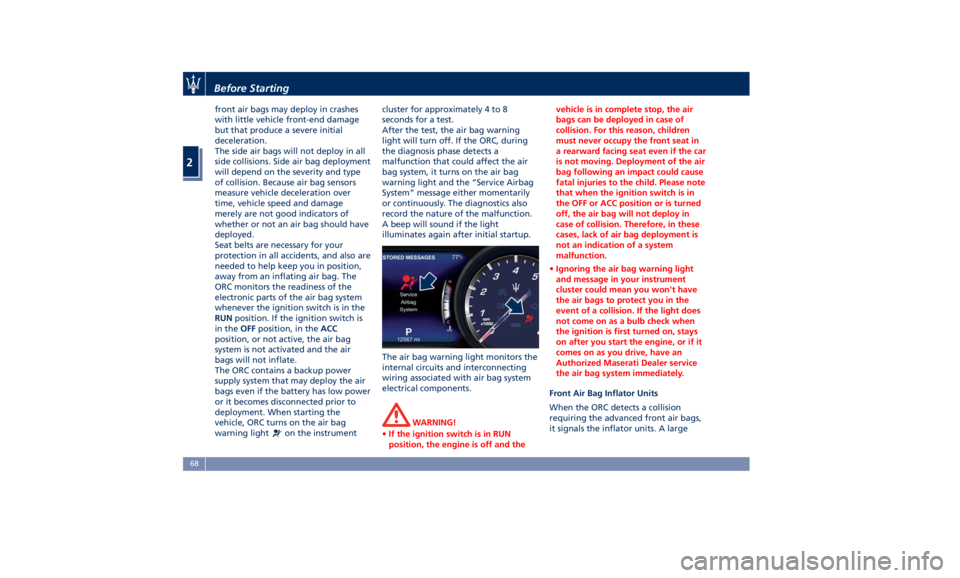
vehicle, ORC turns on the air bag
warning light
on the instrument cluster for approximately 4 to 8
seconds for a test.
After the test, the air bag warning
light will turn off. If the ORC, during
the diagnosis phase detects a
malfunction that could affect the air
bag system, it turns on the air bag
warning light and the “Service Airbag
System” message either momentarily
or continuously. The diagnostics also
record the nature of the malfunction.
A beep will sound if the light
illuminates again after initial startup.
The air bag warning light monitors the
internal circuits and interconnecting
wiring associated with air bag system
electrical components.
WARNING!
• If the ignition switch is in RUN
position, the engine is off and the vehicle is in complete stop, the air
bags can be deployed in case of
collision. For this reason, children
must never occupy the front seat in
a rearward facing seat even if the car
is not moving. Deployment of the air
bag following an impact could cause
fatal injuries to the child. Please note
that when the ignition switch is in
the OFF or ACC position or is turned
off, the air bag will not deploy in
case of collision. Therefore, in these
cases, lack of air bag deployment is
not an indication of a system
malfunction.
• Ignoring the air bag warning light
and message in your instrument
cluster could mean you won't have
the air bags to protect you in the
event of a collision. If the light does
not come on as a bulb check when
the ignition is first turned on, stays
on after you start the engine, or if it
comes on as you drive, have an
Authorized Maserati Dealer service
the air bag system immediately.
Front Air Bag Inflator Units
When
the ORC detects a collision
requiring the advanced front air bags,
it signals the inflator units. A largeBefore Starting
2
68
Page 74 of 384
• disconnect the battery with a
pyrotechnic charge.
Air Bag Deployment Result
The advanced front air bags are
designed to deflate immediately after
deployment.
If you do have a collision which
deploys the air bags, any or all of the
following may occur:
• The nylon air bag material may
sometimes cause abrasions and/or
skin reddening to the driver and
front passenger as the air bags
deploy and unfold.
• As the air bags deflate, you may see
some smoke-like particles. The
particles are a normal by-product of
the process that generates the
non-toxic gas used for air bag
inflation. These airborne particles
may irritate the skin, eyes, nose, or
throat. If these particles settle on
your clothing, follow the garment
manufacturer's instructions for
cleaning. Do not drive your vehicle
after the air bags have deployed. If
you are involved in another collision,
the air bags will not be in place to
protect you. ENVIRONMENTAL!
Air bag inflation releases a small
amount of powder. This powder is not
harmful to the environment.
WARNING!
California Proposition 65
Operating, servicing and maintaining
a passenger vehicle or off-road vehicle
can expose you to chemicals including
such as, engine exhaust, carbon
monoxide, phthalates and lead, that
which are known to the State of
California to cause cancer and birth
defects or other reproductive harm. To
minimize exposure, avoid breathing
exhaust, do not idle the engine except
as necessary, service your vehicle in a
well-ventilated area and wear gloves
or wash your hands frequently when
servicing your vehicle. For more
information go to:
www.P65Warnings.ca.gov/passenger-
vehicle
WARNING!
• Deployed air bags and seat belt pretensioners cannot protect you in
another collision. Have the air bags,
seat belt pretensioners, and the
front seat belt retractor assemblies
replaced by a Maserati Service
Center. Also, have the Occupant
Restraint Controller (ORC) system
serviced as well.
• Have the air bag checked, serviced
and replaced only by an Authorized
Maserati Dealer.
Air Bag System Maintenance
WARNING!
• Modifications to any part of the air
bag system could cause it to fail;
thus you could be injured if the air
bag system is not there to protect
you. Do not modify the components
or wiring. Do not modify the front
bumper, vehicle body structure, or
add aftermarket side steps or
running boards.
• It is dangerous to try to repair any
part of the air bag system without
the necessary know-how.
• Do not attempt to modify any part
of your air bag system. The air bag
may inflate accidentally or may notBefore Starting
2
70
Page 75 of 384
function properly if modifications
are made. Take your vehicle to an
Authorized Maserati Dealer for any
air bag system service. If your seat
including your trim cover and
cushion needs to be serviced in any
way (including removal or
loosening/tightening of seat
attachment bolts), take the vehicle
to an Authorized Maserati Dealer.
• Only Maserati manufacturer
approved seat accessories may be
used. If it is necessary to modify the
air bag system for persons with
disabilities, contact an Authorized
Maserati Dealer.
• If the speedometer, Rev Counter, or
any engine related gauges are not
working, the Occupant Restraint
Controller (ORC) may also be
disabled. The air bags may not be
ready to inflate for your protection.
Promptly check the fuse block for
blown fuses. To identify the air bag
fuse see “Fuse Replacement” in
section "Maintenance and Care". See
an Authorized Maserati Dealer if the
fuse does not fix the problem. Transport of persons with
disability If it is necessary to modify the
advanced air bag system of your
vehicle to accommodate a person with
disabilities, contact an Authorized
Maserati Dealer .
WARNING!
• The advanced air bag system of your
vehicle is not designed to protect
adults with disabilities that require
deactivation of the passenger or
driver air bag.
• If you or another occupant is an
adult with a medical condition that
requires air bag deactivation, please
contact an Authorized Maserati
Dealer. For further information on
disabled driver or passengers see
http://www.safercar.gov.
• As long as the air bag is activated,
persons with disabilities are advised
not to travel in the front seat in
order to avoid the risk of serious
injuries or death, even in minor
crashes. Event Data Recorder (EDR) This vehicle is equipped with an event
data recorder (EDR). The main purpose
of an EDR is to record, in certain crash
or near crash-like situations, such as an
air bag deployment or hitting a road
obstacle, data that will assist in
understanding how a vehicle’s systems
have performed.
The EDR is designed to record data
related to vehicle dynamics and safety
systems for a short period of time,
typically 30 seconds or less.
The EDR in this vehicle is designed to
record such data as:
• how various systems in your vehicle
were operating;
• whether or not the driver and
passenger safety belts were
buckled/fastened;
• how far (if at all) the driver was
depressing the accelerator and/or
brake pedal; and
• how fast the vehicle was traveling.
These data can help provide a better
understanding of the circumstances in
which crashes and injuries occur.Before Starting
2
71
Page 76 of 384
NOTE:
EDR data are recorded by your vehicle
only if a non-trivial crash situation
occurs; no data are recorded by the
EDR under normal driving conditions
and no personal data (e.g., name,
gender, age, and crash location) are
recorded. However, other parties, such
as law enforcement, could combine
the EDR data with the type of
personally identifying data routinely
acquired during a crash investigation.
To read data recorded by an EDR,
special equipment is required, and
access to the vehicle or the EDR is
needed.
In addition to the vehicle
manufacturer, other parties, such as
law enforcement, that have the special
equipment, can read the information
if they have access to vehicle or the
EDR. Child Restraint Systems NOTE:
A child restraint system can help
protect a child in a vehicle so ensure
that the child restraint selected has a
certification label applicable to FMVSS
213 in the U.S., or CMVSS 213 in
Canada.
Everyone in your vehicle must be
buckled up all the time, including
babies and children. Every state in the
United States and all Canadian
provinces require that small children
ride in proper restraint systems. Please
be reminded that you can be
prosecuted for ignoring this law.
Children 12 years or younger should
ride properly buckled up in a rear seat,
if available. According to crash
statistics, children are safer when
properly restrained in the rear seats
rather than in the front.
WARNING!
In a collision, an unrestrained child,
even a baby, can become a projectile
inside the vehicle. The force required
to hold even an infant on your lap
could become so great that you could not hold the child, no matter how
strong you are. The child and others
could be badly injured or killed. Any
child riding in your vehicle should
always be in a proper restraint system
suitable for the child’s size.
There are different sizes and types of
restraint
systems for children from
newborn size to the child almost large
enough for an adult safety belt.
Always refer to the manual provided
with child seat to ensure it is the
proper type according the travelling
child. Use the restraint system that is
correct for your child.
Infants and Child Restraints Safety experts recommend that
children ride rearwardfacing in the
vehicle until they are two years old or
until they reach either the height or
weight limit of their rear facing child
seat.
Two types of child restraint systems
can be used rearward-facing: infant
carriers and convertible child seats.
The infant carrier is only used
rearward-facing in the vehicle. It is
recommended for children from birth
until they reach the weight or height
limit of the infant carrier.Before Starting
2
72
Page 77 of 384
Convertible child seats can be used
either rearward-facing or
forward-facing in the vehicle.
Convertible child seats often have a
higher weight limit in the
rearward-facing direction than infant
carriers do, so they can be used
rearward-facing by children who have
outgrown their infant carrier but are
still younger than at least two years
old.
Children should remain rearward-
facing until they reach the highest
weight or height allowed by their
child seat. Both types of child restraint
systems are fixed to the car by the
lap/shoulder belt or the LATCH child
restraint anchor system. Refer to
“Lower Anchors and Tether for
CHildren (LATCH)” in this section.
WARNING!
• Never place a rear facing infant seat
in front of an air bag. A deploying
Passenger Advanced Front Air Bag
can cause death or serious injury to
a child 12 years or younger,
including a child in a rearward
facing infant seat. • Only use a rearward-facing child
restraint in a vehicle with a rear
seat.
Older Children and Child
Restraints Children who are two years old or
who have outgrown their rear-facing
child seat can ride forward-facing in
the vehicle. Forward-facing child seats
and convertible child seats used in the
forward-facing direction are for
children who are over two years old or
who have outgrown the rear-facing
weight or height limit of their
rear-facing child seat.
Children should remain in a
forward-facing child seat with a
harness for as long as possible, up to
the highest weight or height allowed
by the child seat. These child seats are
also fixed to the car by the
lap/shoulder belt or the LATCH child
restraint anchorage system. Refer to
“Lower Anchors and Tether for
CHildren (LATCH)” in this section.
All children whose weight or height is
above the forward-facing limit for the
child seat should use a belt-
positioning booster seat until the
vehicle’s seat belts fit properly. If the
child cannot sit with knees bent over the vehicle’s seat cushion while the
back is against the seatback, they
should use a belt-positioning booster
seat.
The child and belt-positioning booster
seat are fixed to the car by the
lap/shoulder belt.
Children Too Large for Booster
Seats Children who are large enough to
wear the shoulder belt comfortably
and whose legs are long enough to
bend over the front of the seat when
their back is against the seatback
should use the lap/shoulder belt in a
rear seat.
• Make sure that the child is upright in
the seat.
• The lap portion should be low on
the hips and as snug as possible.
• Check belt fit periodically. A child’s
squirming or slouching can move the
belt out of position.
• If the shoulder belt contacts the face
or neck, move the child closer to the
center of the vehicle. Never allow a
child to put the shoulder belt under
an arm or behind their back.Before Starting
2
73