wheel MASERATI GHIBLI 2019 Manual Online
[x] Cancel search | Manufacturer: MASERATI, Model Year: 2019, Model line: GHIBLI, Model: MASERATI GHIBLI 2019Pages: 384, PDF Size: 13.33 MB
Page 313 of 384
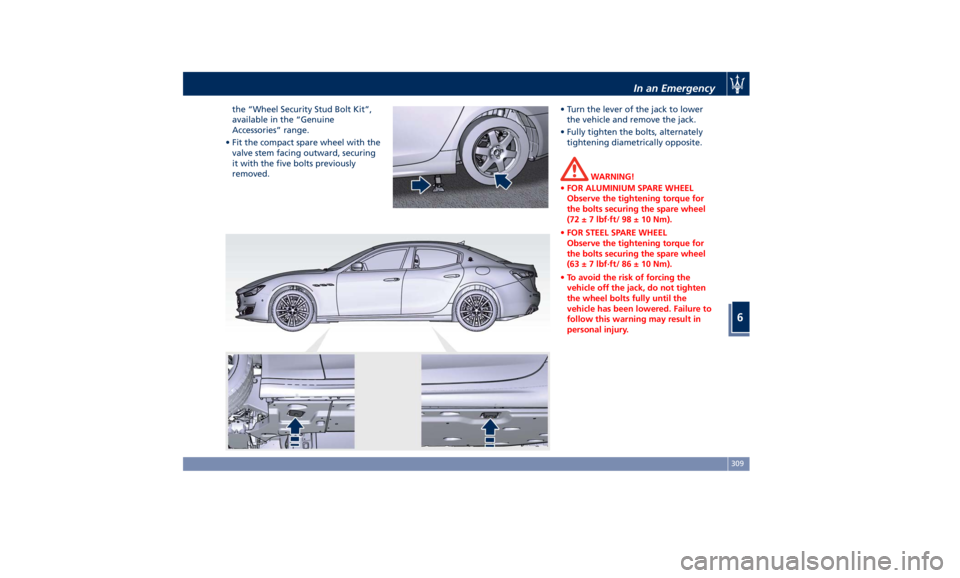
the “Wheel Security Stud Bolt Kit”,
available in the “Genuine
Accessories” range.
• Fit the compact spare wheel with the
valve stem facing outward, securing
it with the five bolts previously
removed. • Turn the lever of the jack to lower
the vehicle and remove the jack.
• Fully tighten the bolts, alternately
tightening diametrically opposite.
WARNING!
• FOR ALUMINIUM SPARE WHEEL
Observe the tightening torque for
the bolts securing the spare wheel
(72 ± 7 lbf·ft/ 98 ± 10 Nm).
• FOR STEEL SPARE WHEEL
Observe the tightening torque for
the bolts securing the spare wheel
(63 ± 7 lbf·ft/ 86 ± 10 Nm).
• To avoid the risk of forcing the
vehicle off the jack, do not tighten
the wheel bolts fully until the
vehicle has been lowered. Failure to
follow this warning may result in
personal injury.In an Emergency
6
309
Page 314 of 384
WARNING!
• The spare wheel is narrower than
standard wheels and must only be
used to travel the distance required
to reach a service station, where the
punctured tire can be repaired or
replaced.
• Do not exceed a maximum speed of
50 mph (80 km/h) when using the
compact spare wheel; when this
limit is exceeded, the stability, road
holding and braking of the vehicle
will be compromised. Avoid
accelerating to full speed, heavy
braking and fast cornering.
• The compact spare wheel must be
inflated to the recommended tire
pressure (see “Tire Inflation
Pressure” in section “Features and
Specifications”). • For safety reasons, it is absolutely
forbidden to drive with more than
one compact spare wheel fitted on
the vehicle.
• Snow chains cannot be fitted on the
compact spare wheel.
• The spare wheel can travel a
maximum of 1,800 mi (3.000 km).
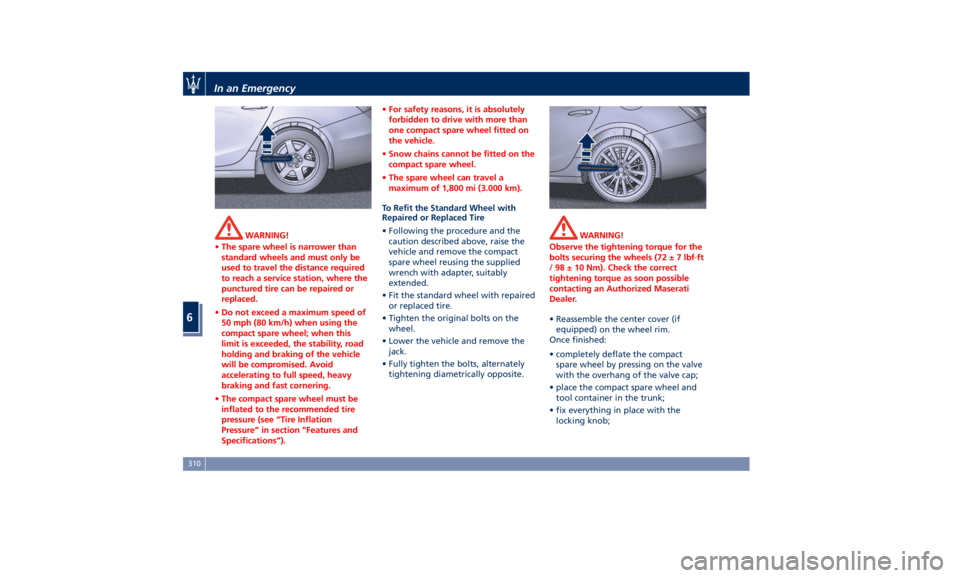
To Refit the Standard Wheel with
Repair
ed or Replaced Tire
• Following the procedure and the
caution described above, raise the
vehicle and remove the compact
spare wheel reusing the supplied
wrench with adapter, suitably
extended.
• Fit the standard wheel with repaired
or replaced tire.
• Tighten the original bolts on the
wheel.
• Lower the vehicle and remove the
jack.
• Fully tighten the bolts, alternately
tightening diametrically opposite. WARNING!
Observe the tightening torque for the
bolts securing the wheels (72 ± 7 lbf·ft
/ 98 ± 10 Nm). Check the correct
tightening torque as soon possible
contacting an Authorized Maserati
Dealer.
• Reassemble the center cover (if
equipped)
on the wheel rim.
Once finished:
• completely deflate the compact
spare wheel by pressing on the valve
with the overhang of the valve cap;
• place the compact spare wheel and
tool container in the trunk;
• fix everything in place with the
locking knob;In an Emergency
6
310
Page 315 of 384
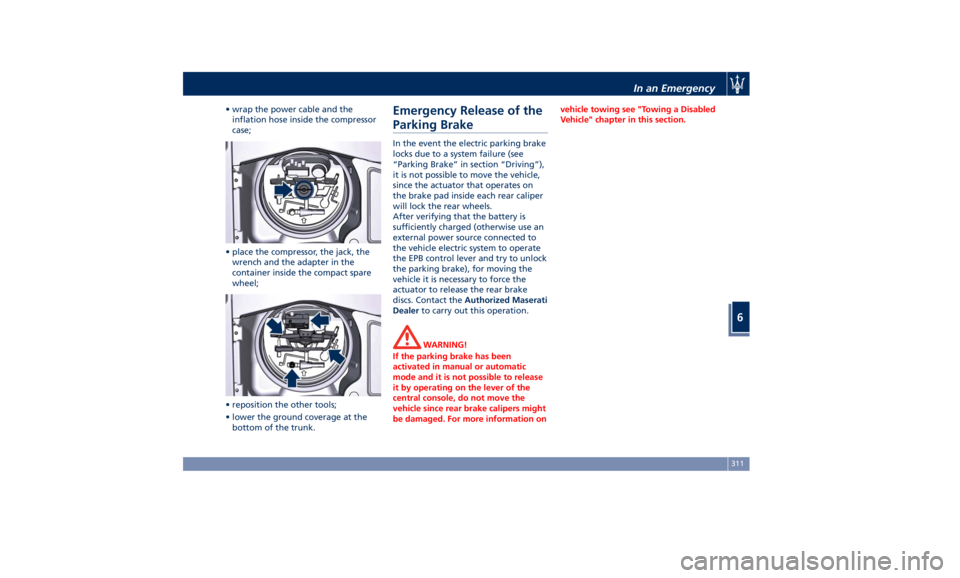
• wrap the power cable and the
inflation hose inside the compressor
case;
• place the compressor, the jack, the
wrench and the adapter in the
container inside the compact spare
wheel;
• reposition the other tools;
• lower the ground coverage at the
bottom of the trunk. Emergency Release of the
Parking Brake In the event the electric parking brake
locks due to a system failure (see
“Parking Brake” in section “Driving”),
it is not possible to move the vehicle,
since the actuator that operates on
the brake pad inside each rear caliper
will lock the rear wheels.
After verifying that the battery is
sufficiently charged (otherwise use an
external power source connected to
the vehicle electric system to operate
the EPB control lever and try to unlock
the parking brake), for moving the
vehicle it is necessary to force the
actuator to release the rear brake
discs. Contact the Authorized Maserati
Dealer to carry out this operation.
WARNING!
If the parking brake has been
activated in manual or automatic
mode and it is not possible to release
it by operating on the lever of the
central console, do not move the
vehicle since rear brake calipers might
be damaged. For more information on vehicle towing see "Towing a Disabled
Vehicle" chapter in this section.
In an Emergency
6
311
Page 319 of 384
• Disconnect the terminal clamp of the
positive jumper cable from the
remote positive (+) post of the
discharged vehicle.
NOTE:
If frequent jump-starting is required
to start your vehicle you should have
the battery and charging system
inspected at an Authorized Maserati
Dealer center.
WARNING!
California Proposition 65
Operating, servicing and maintaining
a passenger vehicle or off-road vehicle
can expose you to chemicals including
such as, engine exhaust, carbon
monoxide, phthalates and lead, that
which are known to the State of
California to cause cancer and birth
defects or other reproductive harm. To
minimize exposure, avoid breathing
exhaust, do not idle the engine except
as necessary, service your vehicle in a
well-ventilated area and wear gloves
or wash your hands frequently when
servicing your vehicle. For more
information go to:
www.P65Warnings.ca.gov/passenger-
vehicle Towing a Disabled Vehicle Proper towing or lifting equipment is
required to prevent damage to your
vehicle.
CAUTION!
Any improper maneuver and use of
unsuitable equipment for recovering
vehicle in an emergency from off road
location could seriously damage the
vehicle. Contact an Authorized
Maserati Dealer .
Manual Release of
Transmission with Low Battery In order to push or tow the vehicle if
unable to shift the transmission out of
P (Park) (such as a discharged battery),
a manual park release is available. In
this case it is necessary to manually
release the shift lever and release the
parking brake if inserted (see
“Emergency Release of the Parking
Brake” in this section).
Follow the steps as indicated in
“Transmission Manual Release of P
(Park) Position” in this section to
manually disengage the transmission. Vehicle Towing Conditions Maserati only allows vehicle towing
either on a flatbed or with all four
wheels off the ground.
Towing an RWD Vehicle
If flatbed equipment is not available,
and the transmission is still operable, a
RWD vehicle may be flat towed (with
all four wheels on the ground) under
the following conditions.
• The shift lever must be in N
(Neutral).
• The distance to be traveled must not
exceed 30 mi (50 km).
• The towing speed must not exceed
30 mph (50 km/h).
If the transmission is not operable, or
the RWD vehicle must be towed faster
than 30 mph (50 km/h) or farther than
30 mi (50 km) (for example on a
highway), tow with the rear driving
wheels off the ground and on a
platform of a rescue vehicle, or with
the rear wheels raised using a wheel
lift.
CAUTION!
If you have to tow the RWD vehicle
with 2 wheels raised, ensure that the
(Continued)In an Emergency
6
315
Page 320 of 384
(Continued)
ignition switch is in the OFF position. If
this is not observed, when the ESC is
active, the ECU will store a
malfunction and the relative warning
light
will illuminate on the
instrument cluster display. This
requires the intervention of an
Authorized Maserati Dealer to reset
the system.
Towing an AWD Vehicle
WARNING!
Single axle towing or use of a tow
dolly is not allowed since it will
severely damage components of an
AWD vehicle.
WARNING!
Use of a tow dolly on front wheels is
strictly forbidden since front wheels
may still receive a residual amount of
torque and disengage the vehicle from
the tow dolly and affect safety of
both rescuers and other road users. Use the Tow Hook of the Tool
Kit CAUTION!
The tow hook should only be used for
towing the car on flat roads. Do not
use the tow hook to remove the car
that is stuck on off road stretches.
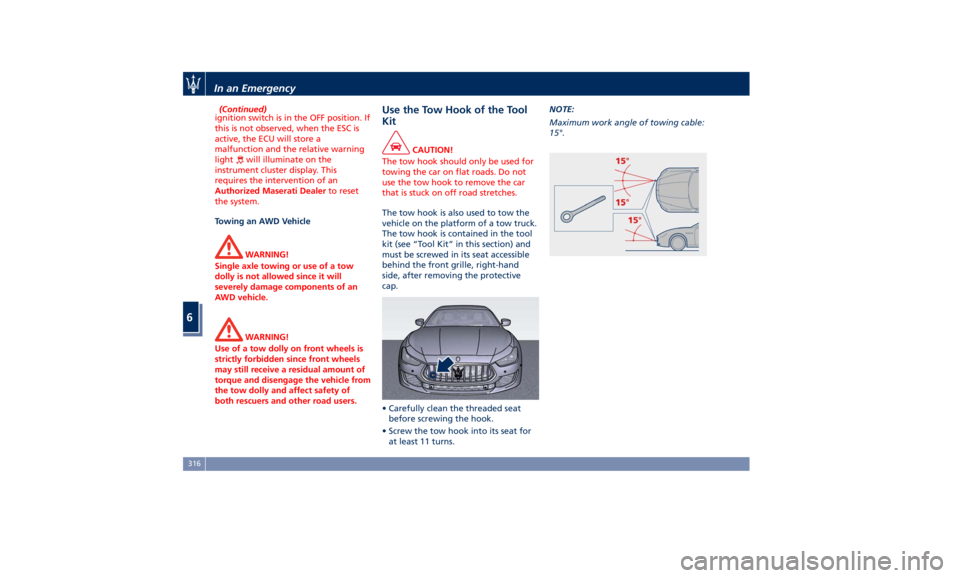
The tow hook is also used to tow the
vehicle
on the
platform of a tow truck.
The tow hook is contained in the tool
kit (see “Tool Kit” in this section) and
must be screwed in its seat accessible
behind the front grille, right-hand
side, after removing the protective
cap.
• Carefully clean the threaded seat
before screwing the hook.
• Screw the tow hook into its seat for
at least 11 turns. NOTE:
Maximum work angle of towing cable:
15°.
In an Emergency
6
316
Page 321 of 384
7 – Maintenance and Care Scheduled Maintenance Service ............................ 318
Scheduled Service Plan ................................... 319
Maintenance Procedures ................................. 324
Maintenance-Free Battery ................................ 332
Fuse Replacement ...................................... 337
Bulb Replacement ...................................... 344
A/C System Maintenance ................................. 348
Wheels Maintenance .................................... 349
Bodywork Maintenance and Care .......................... 350
Interior Maintenance and Care ............................ 353
Vehicle Stored for Long Periods ............................ 355
Restarting the Vehicle ................................... 355
Battery Statement ...................................... 356
317
Page 346 of 384
Ref. Type Function
34 Mini – 20A Soft Door Close
latch
35 – –
36 Mini – 10A Transmission
lever, TPMS
module, Navtrak,
Hands Free access
module
37 Mini – 50A Power
liftgate/trunk lid
module
38 Mini – 25A RH front seat
movement
40 Maxi – 20A Trunk power
outlet
41 – –
42 – –
43 Mini – 20A Seat passenger
heater module
44 – –
45 – –
46 Mini – 5A Rear camera
47 Mini – 5A Navtrak
48 Mini – 5A Surround view Ref. Type Function
49 Mini – 10A Internal
temperature
sensor, internal
mirror and HALF
50 – –
51 Mini – 25A Rear seat and
steering wheel
heater module
52 – –
53 – –
54 Mini – 7,5A Blind Spot
module
55 – –
56 Mini – 7,5A Blower front
HVAC coil relay
57 – –
58 – –
59 Mini – 10A SDC module,
transmission
lever, ASBM, rear
tunnel stack
switch
60 Mini – 10A SDC module
61 Mini – 25A Front console
power outlet and
cigar lighter
62 Mini – 7,5A HVAC module Ref. Type Function
63 – –
64 Mini – 10A Wi-fi
65 Mini – 10A Intelligent
battery sensor
66 Mini – 10A Wi-fi
67 Mini – 7,5A USB charge
outlet, sunroof
68 Mini – 20A Rear sunshade
module
69 Mini – 25A Rear console
power outlet and
cigar lighter
70 Mini – 10A HVAC module
and Parking Aid
Module (PAM)Maintenance and Care
7
342
Page 353 of 384
Wheels Maintenance Tires Maintenance CAUTION!
To obtain the best performances and
the longest mileage from the tires,
take the following precautions during
the first 310 mi (500 km):
• do not drive at the vehicle’s
maximum speed;
• drive at low speed on curves;
• avoid sudden steering;
• avoid sudden braking;
• avoid sudden acceleration;
• do not drive at high speeds for too
long.
The tires inflation pressure must
correspond
to the prescribed values
(see the chapter “Tire Inflation
Pressure” in section “Features and
Specifications”) and should be
checked only when the tires have
cooled down. In fact, the pressure
increases as the tire temperature
progressively increases.
Never reduce the pressure if tires are
hot (see “Tires – General Information”
chapter in section “Driving”). Insufficient tire inflating pressure can
cause tire overheating and possible
internal damage.
CAUTION!
After inspecting or adjusting the tire
pressure, always reinstall the valve
stem cap. This will prevent moisture
and dirt from entering the valve stem,
which could damage it.
Impacts with curbs, holes, and
obstacles
in the road, and prolonged
trips on rough roads can cause tire
damage which may not be visible to
the naked eye.
Check your tires regularly for any signs
of damage (e.g. scratches, cuts, cracks,
bulges, etc.). If sharp objects penetrate
the tires, they can cause structural
damage which is only visible when the
tire is removed.
In any case, any possible damage must
be inspected by an experienced
technician, as it may seriously reduce
the tire life.
Remember that tires deteriorate with
time, even if used little or not at all.
Cracks in the tire tread and sides,
alongside possible bulging, are a sign
of deterioration. WARNING!
• Check the inflating pressure of the
tires when cold, at least every two
weeks and before long trips.
• Have old tires inspected by an
experienced technician, to make
sure they can still be used safely. If
the same tire has been on your
vehicle for 4 or 5 years, have it
inspected anyway by an
experienced technician.
• Never fit tires of uncertain origin.
• “Directional” tires have an arrow on
their side showing the rolling
direction. To keep the best
performance when replacing a tire,
make sure that the rolling direction
corresponds to the one shown by
the arrow.
• During the tire life, the rolling
direction used for the first fitting
should always be observed, also in
case of “nondirectional” tires.
• Check the depth of the tire tread at
regular intervals. The thinner is the
tread, the greater is the risk of
skidding.
• Drive carefully on wet roads to
decrease the risk of aquaplaning.Maintenance and Care
7
349
Page 354 of 384
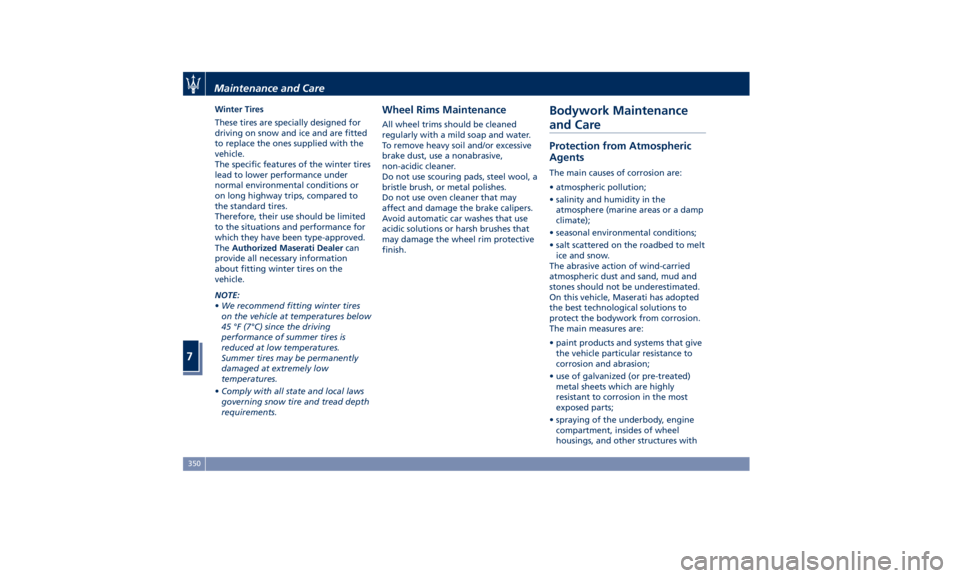
Winter Tires
These tires are specially designed for
driving on snow and ice and are fitted
to replace the ones supplied with the
vehicle.
The specific features of the winter tires
lead to lower performance under
normal environmental conditions or
on long highway trips, compared to
the standard tires.
Therefore, their use should be limited
to the situations and performance for
which they have been type-approved.
The Authorized Maserati Dealer can
provide all necessary information
about fitting winter tires on the
vehicle.
NOTE:
• We recommend fitting winter tires
on the vehicle at temperatures below
45 °F (7°C) since the driving
performance of summer tires is
reduced at low temperatures.
Summer tires may be permanently
damaged at extremely low
temperatures.
• Comply with all state and local laws
governing snow tire and tread depth
requirements. Wheel Rims Maintenance All wheel trims should be cleaned
regularly with a mild soap and water.
To remove heavy soil and/or excessive
brake dust, use a nonabrasive,
non-acidic cleaner.
Do not use scouring pads, steel wool, a
bristle brush, or metal polishes.
Do not use oven cleaner that may
affect and damage the brake calipers.
Avoid automatic car washes that use
acidic solutions or harsh brushes that
may damage the wheel rim protective
finish.
Bodywork Maintenance
and Care Protection from Atmospheric
Agents The main causes of corrosion are:
• atmospheric pollution;
• salinity and humidity in the
atmosphere (marine areas or a damp
climate);
• seasonal environmental conditions;
• salt scattered on the roadbed to melt
ice and snow.
The abrasive action of wind-carried
atmospheric dust and sand, mud and
stones should not be underestimated.
On this vehicle, Maserati has adopted
the best technological solutions to
protect the bodywork from corrosion.
The main measures are:
• paint products and systems that give
the vehicle particular resistance to
corrosion and abrasion;
• use of galvanized (or pre-treated)
metal sheets which are highly
resistant to corrosion in the most
exposed parts;
• spraying of the underbody, engine
compartment, insides of wheel
housings, and other structures withMaintenance and Care
7
350
Page 369 of 384
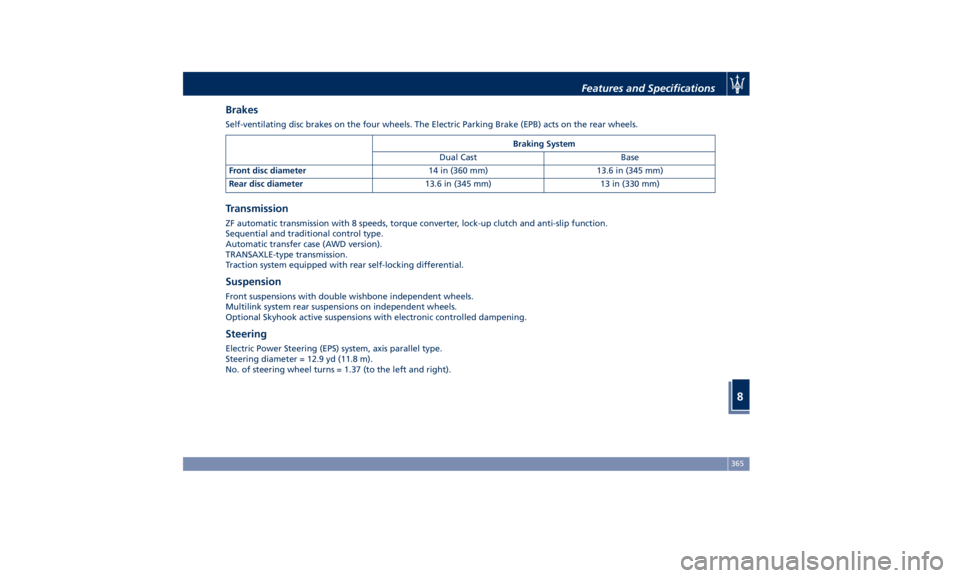
Brakes Self-ventilating disc brakes on the four wheels. The Electric Parking Brake (EPB) acts on the rear wheels.
Braking System
Dual Cast Base
Front disc diameter 14 in (360 mm) 13.6 in (345 mm)
Rear disc diameter 13.6 in (345 mm) 13 in (330 mm)
Transmission ZF automatic transmission with 8 speeds, torque converter, lock-up clutch and anti-slip function.
Sequential and traditional control type.
Automatic transfer case (AWD version).
TRANSAXLE-type transmission.
Traction system equipped with rear self-locking differential.
Suspension Front suspensions with double wishbone independent wheels.
Multilink system rear suspensions on independent wheels.
Optional Skyhook active suspensions with electronic controlled dampening.
Steering Electric Power Steering (EPS) system, axis parallel type.
Steering diameter = 12.9 yd (11.8 m).
No. of steering wheel turns = 1.37 (to the left and right). Features and Specifications
8
365