dashboard MASERATI GRANTURISMO 2019 User Guide
[x] Cancel search | Manufacturer: MASERATI, Model Year: 2019, Model line: GRANTURISMO, Model: MASERATI GRANTURISMO 2019Pages: 286, PDF Size: 8.08 MB
Page 51 of 286
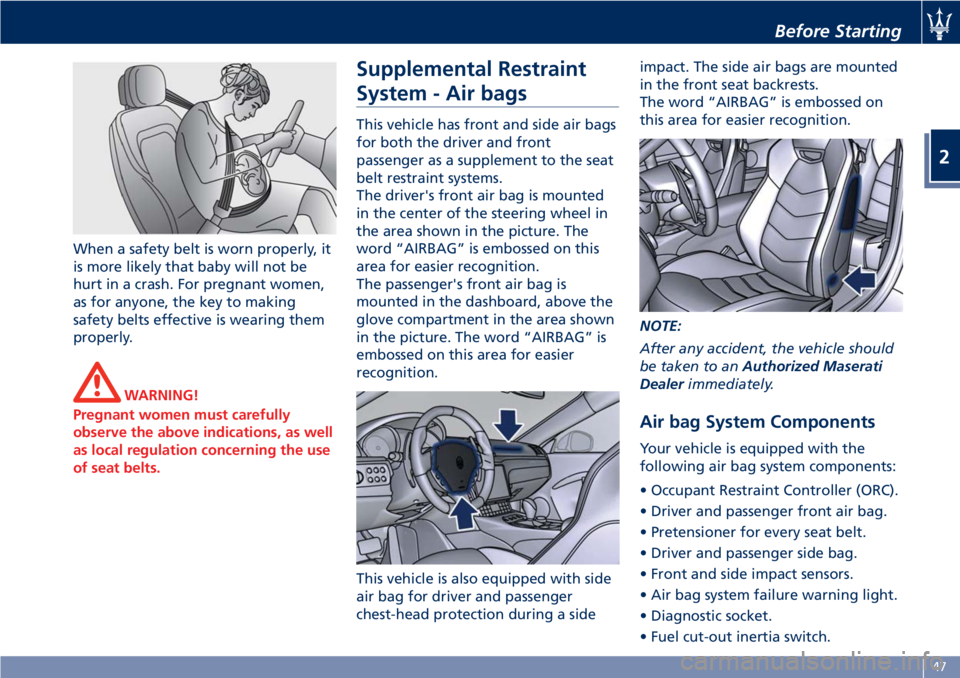
When a safety belt is worn properly, it
is more likely that baby will not be
hurt in a crash. For pregnant women,
as for anyone, the key to making
safety belts effective is wearing them
properly.
WARNING!
Pregnant women must carefully
observe the above indications, as well
as local regulation concerning the use
of seat belts. Supplemental Restraint
System - Air bags This vehicle has front and side air bags
for both the driver and front
passenger as a supplement to the seat
belt restraint systems.
The driver's front air bag is mounted
in the center of the steering wheel in
the area shown in the picture. The
word “AIRBAG” is embossed on this
area for easier recognition.
The passenger's front air bag is
mounted in the dashboard, above the
glove compartment in the area shown
in the picture. The word “AIRBAG” is
embossed on this area for easier
recognition.
This vehicle is also equipped with side
air bag for driver and passenger
chest-head protection during a side impact. The side air bags are mounted
in the front seat backrests.
The word “AIRBAG” is embossed on
this area for easier recognition.
NOTE:
After any accident, the vehicle should
be taken to an Authorized Maserati
Dealer immediately.
Air bag System Components Your vehicle is equipped with the
following air bag system components:
• Occupant Restraint Controller (ORC).
• Driver and passenger front air bag.
• Pretensioner for every seat belt.
• Driver and passenger side bag.
• Front and side impact sensors.
• Air bag system failure warning light.
• Diagnostic socket.
• Fuel cut-out inertia switch.Before Starting
2
47
Page 52 of 286
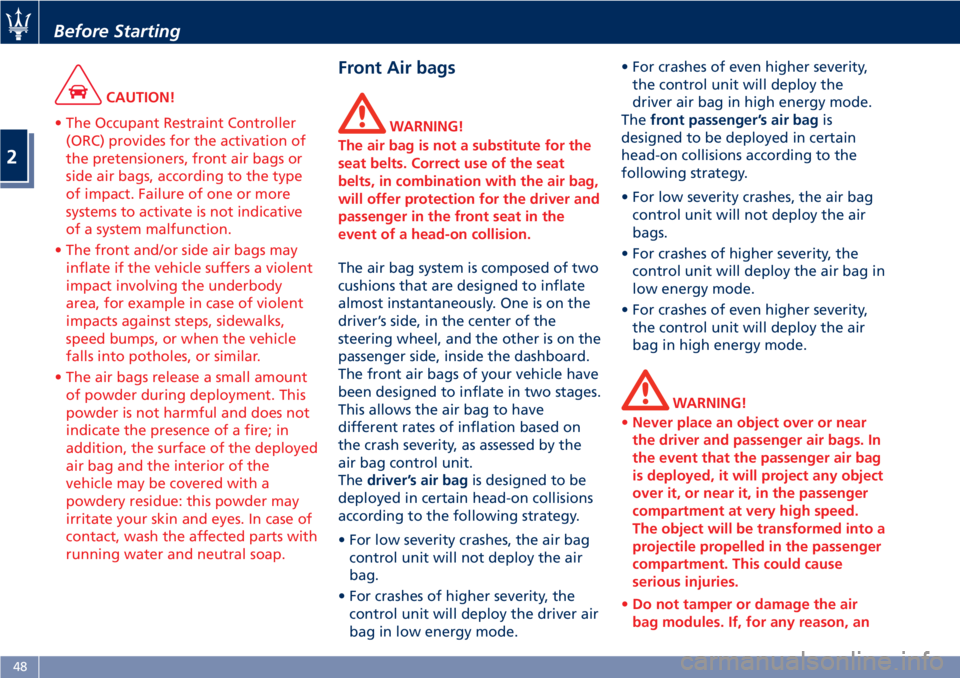
CAUTION!
• The Occupant Restraint Controller
(ORC) provides for the activation of
the pretensioners, front air bags or
side air bags, according to the type
of impact. Failure of one or more
systems to activate is not indicative
of a system malfunction.
• The front and/or side air bags may
inflate if the vehicle suffers a violent
impact involving the underbody
area, for example in case of violent
impacts against steps, sidewalks,
speed bumps, or when the vehicle
falls into potholes, or similar.
• The air bags release a small amount
of powder during deployment. This
powder is not harmful and does not
indicate the presence of a fire; in
addition, the surface of the deployed
air bag and the interior of the
vehicle may be covered with a
powdery residue: this powder may
irritate your skin and eyes. In case of
contact, wash the affected parts with
running water and neutral soap. Front Air bags WARNING!
The air bag is not a substitute for the
seat belts. Correct use of the seat
belts, in combination with the air bag,
will offer protection for the driver and
passenger in the front seat in the
event of a head-on collision.
The air bag system is composed of two
cushions
that are designed to inflate
almost instantaneously. One is on the
driver’s side, in the center of the
steering wheel, and the other is on the
passenger side, inside the dashboard.
The front air bags of your vehicle have
been designed to inflate in two stages.
This allows the air bag to have
different rates of inflation based on
the crash severity, as assessed by the
air bag control unit.
The driver’s air bag is designed to be
deployed in certain head-on collisions
according to the following strategy.
• For low severity crashes, the air bag
control unit will not deploy the air
bag.
• For crashes of higher severity, the
control unit will deploy the driver air
bag in low energy mode. • For crashes of even higher severity,
the control unit will deploy the
driver air bag in high energy mode.
The front passenger’s air bag is
designed to be deployed in certain
head-on collisions according to the
following strategy.
• For low severity crashes, the air bag
control unit will not deploy the air
bags.
• For crashes of higher severity, the
control unit will deploy the air bag in
low energy mode.
• For crashes of even higher severity,
the control unit will deploy the air
bag in high energy mode.
WARNING!
• Never place an object over or near
the driver and passenger air bags. In
the event that the passenger air bag
is deployed, it will project any object
over it, or near it, in the passenger
compartment at very high speed.
The object will be transformed into a
projectile propelled in the passenger
compartment. This could cause
serious injuries.
• Do not tamper or damage the air
bag modules. If, for any reason, anBefore Starting
2
48
Page 54 of 286
Improper intervention involving the
system components can cause failures
or undesired activation of the air bags
with damage resulting.
The air bag system components have
been specially designed for this specific
vehicle model. Do not attempt to use
them on other vehicles, as this could
cause serious injuries to passengers in
the event of an accident.
To scrap the vehicle, please contact an
Authorized Maserati Dealer to have
the air bag system disposed of
properly.
If the vehicle has been stolen or there
has been an attempted theft, have the
air bag system checked by an
Authorized Maserati Dealer .
WARNING!
The air bag modules must be replaced
at the expiration date indicated in the
label on the right-hand side of the
dashboard, even if the vehicle was not
involved in collisions.
Please contact an Authorized Maserati
Dealer for replacement of the air bag
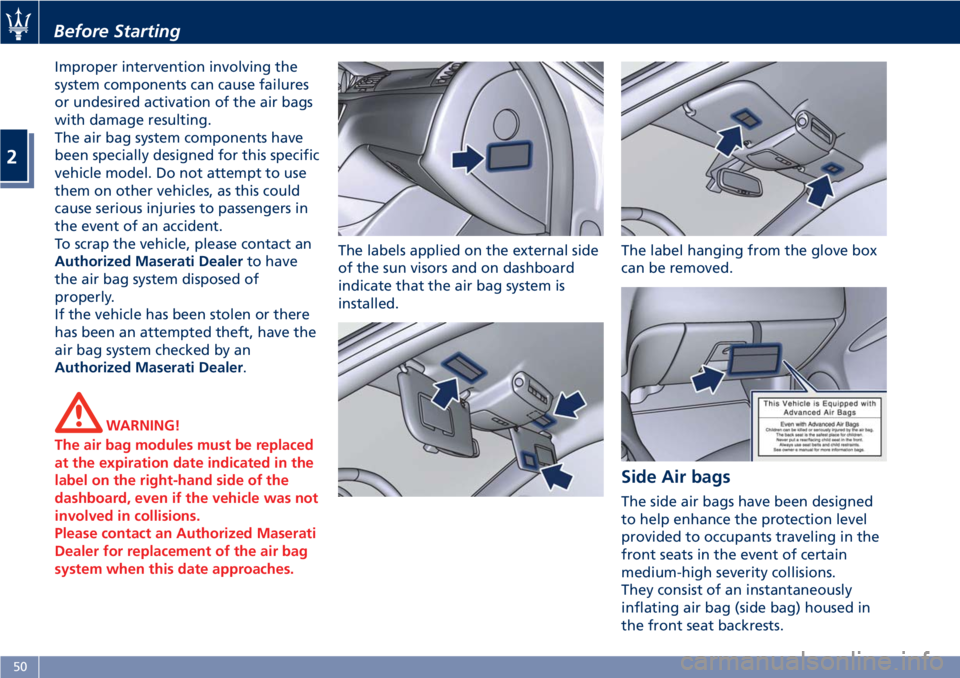
system when this date approaches. The labels applied on the external side
of
the sun visors and on dashboard
indicate that the air bag system is
installed. The label hanging from the glove box
can be removed.
Side Air bags The side air bags have been designed
to help enhance the protection level
provided to occupants traveling in the
front seats in the event of certain
medium-high severity collisions.
They consist of an instantaneously
inflating air bag (side bag) housed in
the front seat backrests.Before Starting
2
50
Page 65 of 286
Always stop when the acoustic
signal becomes steady.
Stop & Go Feature This function is enabled by the
manufacturer and it can be disabled
by the MTC+ (see chapter "MTC+
Settings" in section "Dashboard
Instruments and Controls"), select and
tick the “Stop & Go Parking Sensors”
feature.
When vehicle speed is equal to or
lower than 6 mph (10 km/h), this
function helps the driver under special
traffic conditions as it signals that the
vehicle before you is at a min.
distance.
System with Enabled Stop &
Go Feature When the "Stop & Go" feature is
enabled through the MTC+, all sensors
are automatically enabled with the
key in the ignition switch turned to
MAR (ON) position, but they are not
displayed on the instrument cluster.
When the R (Reverse) gear is engaged
or an obstacle is detected, the
corresponding detection areas are
displayed on the instrument cluster. As
soon as the R (Reverse) gear is
disengaged, all sensors are still active: the rear ones for approx. 10 seconds
or until a speed of approx. 6 mph
(10 km/h) is exceeded, and the front
ones until a speed of approx. 6 mph
(10 km/h) is exceeded. When driving at
a speed equal to or lower than 6 mph
(10 km/h), as soon as the system
detects an obstacle, the front sensor
detection areas are displayed, and the
acoustic signals start to be emitted. If
no obstacle is detected for 10 seconds,
the displayed information disappears.
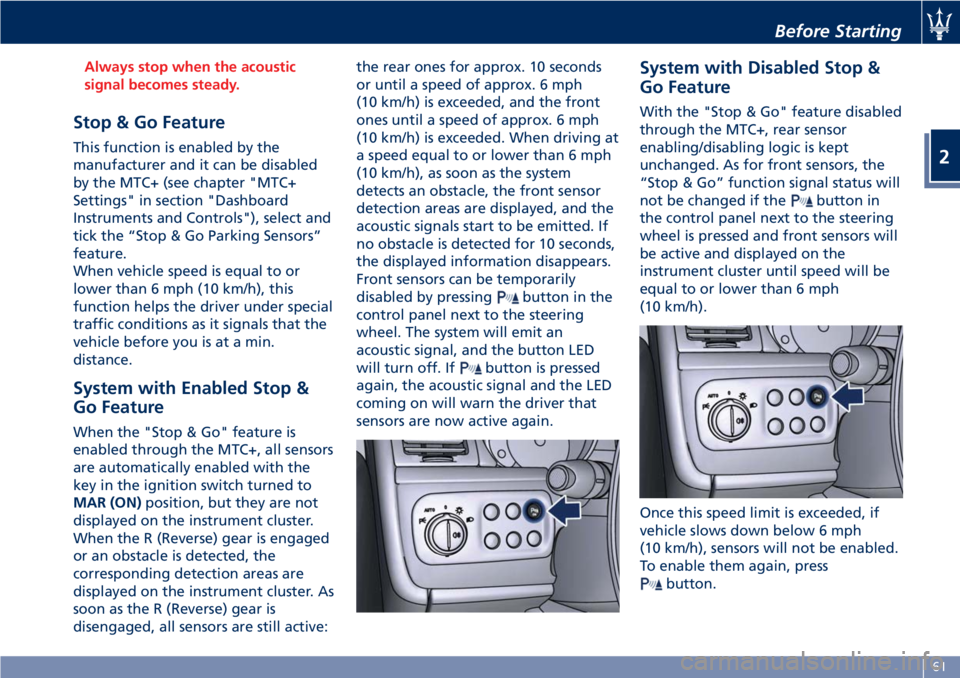
Front sensors can be temporarily
disabled by pressing
button in the
control panel next to the steering
wheel. The system will emit an
acoustic signal, and the button LED
will turn off. If
button is pressed
again, the acoustic signal and the LED
coming on will warn the driver that
sensors are now active again. System with Disabled Stop &
Go Feature With the "Stop & Go" feature disabled
through the MTC+, rear sensor
enabling/disabling logic is kept
unchanged. As for front sensors, the
“Stop & Go” function signal status will
not be changed if the
button in
the control panel next to the steering
wheel is pressed and front sensors will
be active and displayed on the
instrument cluster until speed will be
equal to or lower than 6 mph
(10 km/h).
Once this speed limit is exceeded, if
vehicle slows down below 6 mph
(10 km/h), sensors will not be enabled.
To enable them again, press
button.Before Starting
2
61
Page 66 of 286
NOTE:
Front sensors are enabled only when
button LED is illuminated. In
addition, any pressing of
button
when vehicle speed is above 6 mph
(10 km/h) will be ignored by the
system.
Obstacle Signalling The acoustic signals are emitted by
two buzzers, one under the dashboard
and one in proximity of the luggage
shelf.
When the obstacle is located at a
distance of less than 14 in (35 cm) from
the bumper, the beep is continuous.
The warning beep stops immediately if
the distance between the vehicle and
the obstacle increases. The tone cycle is
constant if the distance measured by
the central sensors remains unaltered.
If this occurs with the lateral sensors,
the signal stops after approximately 7
seconds, to prevent for example
continuous beeps in the event of
maneuvers alongside walls.
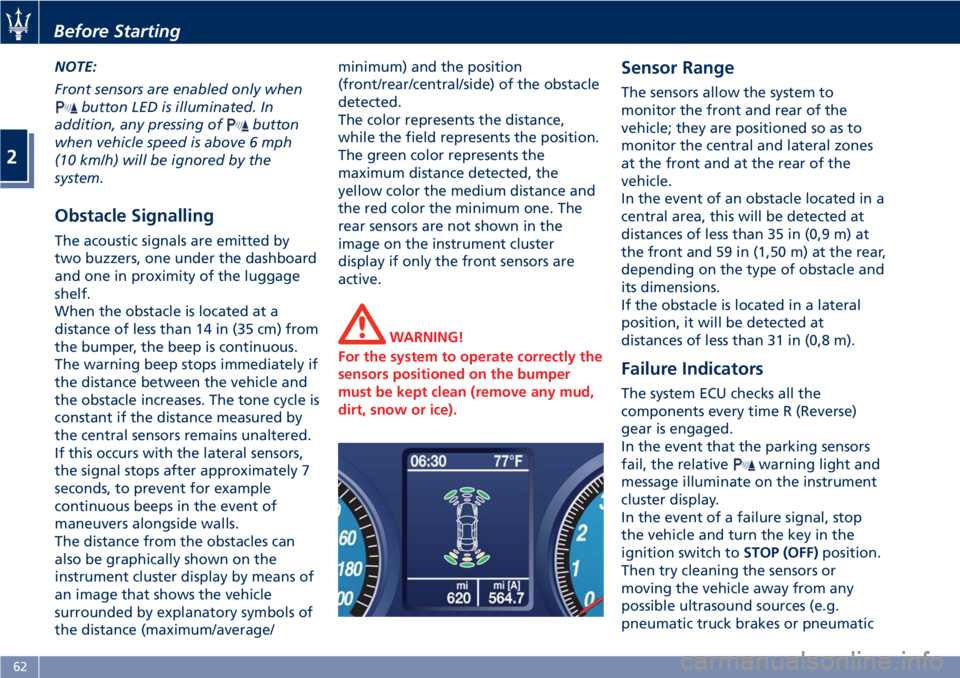
The distance from the obstacles can
also be graphically shown on the
instrument cluster display by means of
an image that shows the vehicle
surrounded by explanatory symbols of
the distance (maximum/average/ minimum) and the position
(front/rear/central/side) of the obstacle
detected.
The color represents the distance,
while the field represents the position.
The green color represents the
maximum distance detected, the
yellow color the medium distance and
the red color the minimum one. The
rear sensors are not shown in the
image on the instrument cluster
display if only the front sensors are
active.
WARNING!
For the system to operate correctly the
sensors positioned on the bumper
must be kept clean (remove any mud,
dirt, snow or ice). Sensor Range The sensors allow the system to
monitor the front and rear of the
vehicle; they are positioned so as to
monitor the central and lateral zones
at the front and at the rear of the
vehicle.
In the event of an obstacle located in a
central area, this will be detected at
distances of less than 35 in (0,9 m) at
the front and 59 in (1,50 m) at the rear,
depending on the type of obstacle and
its dimensions.
If the obstacle is located in a lateral
position, it will be detected at
distances of less than 31 in (0,8 m).
Failure Indicators The system ECU checks all the
components every time R (Reverse)
gear is engaged.
In the event that the parking sensors
fail, the relative
warning light and
message illuminate on the instrument
cluster display.
In the event of a failure signal, stop
the vehicle and turn the key in the
ignition switch to STOP (OFF) position.
Then try cleaning the sensors or
moving the vehicle away from any
possible ultrasound sources (e.g.
pneumatic truck brakes or pneumaticBefore Starting
2
62
Page 70 of 286
WARNING!
California Proposition 65
Operating, servicing and maintaining
a passenger vehicle or off-road vehicle
can expose you to chemicals including
such as, engine exhaust, carbon
monoxide, phthalates and lead, that
which are know to the State of
California to cause cancer and birth
defects or other reproductive harm. To
minimize exposure, avoid breathing
exhaust, do not idle the engine except
as necessary, service your vehicle in a
well-ventilated area and wear gloves
or wash your hands frequently when
servicing your vehicle. For more
information go to:
www.P65Warnings.ca.gov/passenger-
vehicle
Vehicle Safety Checks Seat Belts
• Inspect the belt system periodically,
checking for cuts, frays, and loose
parts. Damaged parts must be
replaced immediately.
• Do not disassemble or modify the
system.
• If the belt has been sharply pulled,
for example as the result of an accident, the safety belt, together
with the anchoring devices, the
anchoring device mounting screws
and the pretensioner must be
completely replaced. Even if the belt
does not present any exterior signs
of wear or damage, it may have lost
its restraining properties.
Air bag Warning Light
The
warning light should illuminate
and remain lit for a few seconds bulb
checking when the key in the ignition
switch is turned in MAR (ON) position
(see “Supplemental Restraint System
(SRS) — Air bags” chapter in this
section).
•Ifthe
warning light does not
illuminate while starting, contact an
Authorized Maserati Dealer .
•Ifthe
warning light stays on,
flickers, or comes on while driving,
have the system checked by an
Authorized Maserati Dealer .
Defroster
Check operation by selecting the
defrost mode and place the fan system
on high speed (see “Air Conditioning
Controls” chapter in section
“Dashboard Instruments and
Controls”). You should be able to feel the air
directed against the windshield and
front side windows. Contact an
Authorized Maserati Dealer for service
if your defroster is inoperable.
Floor Mat
Always use floor mats designed to fit
the footwell of your vehicle. Use only
floor mats that leave the pedal area
unobstructed and that are firmly
secured so that they cannot slip out of
position and interfere with the pedals
or impair safe operation of your
vehicle.
NOTE:
The Authorized Maserati Dealer can
provide you with any information
about the available Maserati floor
mats included in the “Genuine
Accessories” range.
WARNING!
Pedals that cannot move freely can
cause loss of vehicle control and
increase the risk of serious personal
injury.
• Always make sure that floor mats
are properly attached to the proper
fasteners.Before Starting
2
66
Page 71 of 286
• Never place or install floor mats or
other floor coverings in the vehicle
that cannot be properly secured to
prevent them from moving and
interfering with the pedals.
• Never put floor mats or other floor
coverings on top of already installed
floor mats. Additional floor mats
and other coverings will reduce the
size of the pedal area and interfere
with the pedals.
• Check mounting of mats on a
regular basis. Always properly
reinstall and secure floor mats that
have been removed for cleaning.
• Always make sure that objects
cannot fall into the driver footwell
while the vehicle is moving. Objects
can become trapped under the
brake pedal and accelerator pedal
causing a loss of vehicle control.
• Mounting posts must be properly
installed, if not equipped from the
factory. Failure to properly follow
floor mat installation or mounting
can cause interference with the
brake pedal and accelerator pedal
operation causing loss of control of
the vehicle. Tires
•
Examine tires for excessive tread
wear and uneven wear patterns.
• Check for stones, nails, glass, or
other objects lodged in the tread or
sidewall.
• Inspect the tread for cuts and cracks.
• Inspect sidewalls for cuts, cracks and
bulges.
• Check the wheel nuts for tightness.
• Check the tires (see “Tire Inflation
Pressure” chapter in section
“Features and Specifications”) for
proper cold inflation pressure.
Lights and Indicator Lights
• Have someone observe the
operation of exterior lights while
you operate the controls (see
“Lights” chapter in section
“Understanding the Vehicle”).
• Check turn signal and high beam
indicator lights on the instrument
cluster (see “Instrument Cluster”
chapter in section “Dashboard
Instruments and Controls”).
Door Latches
• Check for positive closing, latching,
and locking of doors and trunk lid
(see chapter “Doors” and “Open and
Close the Trunk Lid” in this section). Fluid Leaks
• Check area under vehicle after
overnight parking for recent fluid
leaks (oil, fuel, etc.).
• If gasoline fumes are detected or
fluid leaks are suspected, contact an
Authorized Maserati Dealer .
WARNING!
California Proposition 65
Operating, servicing and maintaining
a passenger vehicle or off-road vehicle
can expose you to chemicals including
such as, engine exhaust, carbon
monoxide, phthalates and lead, that
which are know to the State of
California to cause cancer and birth
defects or other reproductive harm. To
minimize exposure, avoid breathing
exhaust, do not idle the engine except
as necessary, service your vehicle in a
well-ventilated area and wear gloves
or wash your hands frequently when
servicing your vehicle. For more
information go to:
www.P65Warnings.ca.gov/passenger-
vehicleBefore Starting
2
67
Page 74 of 286
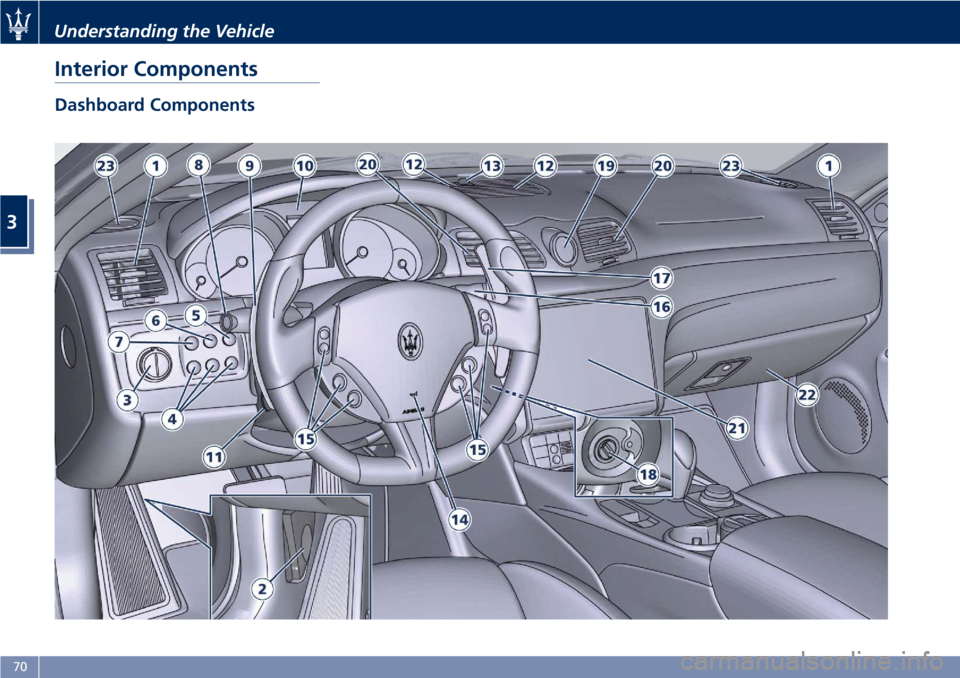
Interior Components Dashboard ComponentsUnderstanding the Vehicle
3
70
Page 90 of 286
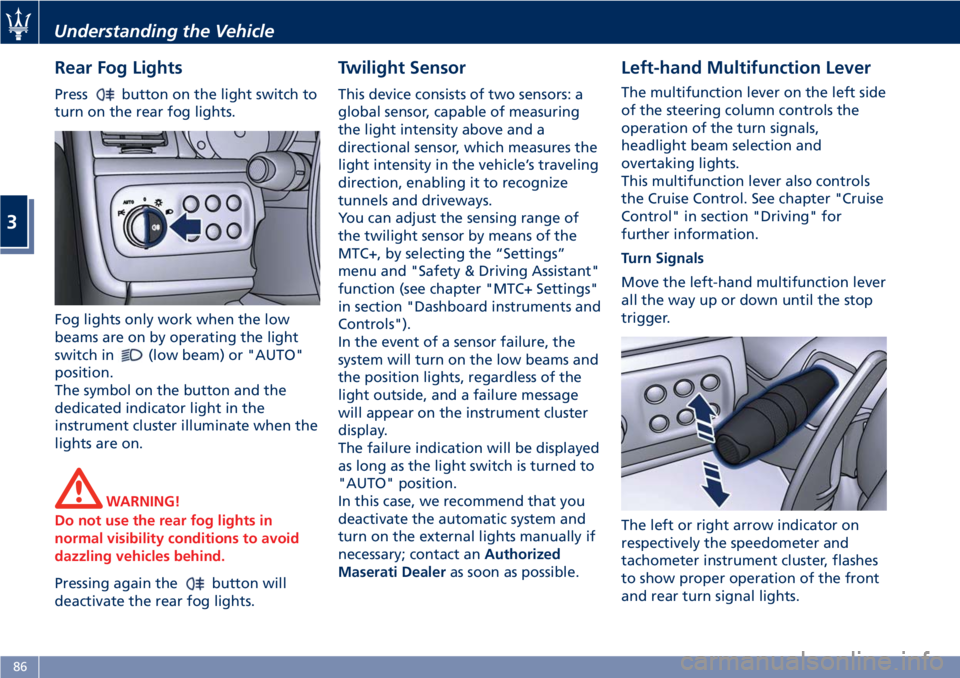
Rear Fog Lights Press button on the light switch to
turn on the rear fog lights.
Fog lights only work when the low
beams are on by operating the light
switch in
(low beam) or "AUTO"
position.
The symbol on the button and the
dedicated indicator light in the
instrument cluster illuminate when the
lights are on.
WARNING!
Do not use the rear fog lights in
normal visibility conditions to avoid
dazzling vehicles behind.
Pressing again the
button will
deactivate the rear fog lights. Twilight Sensor This device consists of two sensors: a
global sensor, capable of measuring
the light intensity above and a
directional sensor, which measures the
light intensity in the vehicle’s traveling
direction, enabling it to recognize
tunnels and driveways.
You can adjust the sensing range of
the twilight sensor by means of the
MTC+, by selecting the “Settings”
menu and "Safety & Driving Assistant"
function (see chapter "MTC+ Settings"
in section "Dashboard instruments and
Controls").
In the event of a sensor failure, the
system will turn on the low beams and
the position lights, regardless of the
light outside, and a failure message
will appear on the instrument cluster
display.
The failure indication will be displayed
as long as the light switch is turned to
"AUTO" position.
In this case, we recommend that you
deactivate the automatic system and
turn on the external lights manually if
necessary; contact an Authorized
Maserati Dealer as soon as possible. Left-hand Multifunction Lever The multifunction lever on the left side
of the steering column controls the
operation of the turn signals,
headlight beam selection and
overtaking lights.
This multifunction lever also controls
the Cruise Control. See chapter "Cruise
Control" in section "Driving" for
further information.
Turn Signals
Move the left-hand multifunction lever
all the way up or down until the stop
trigger.
The left or right arrow indicator on
respectively the speedometer and
tachometer instrument cluster, flashes
to show proper operation of the front
and rear turn signal lights.Understanding the Vehicle
3
86
Page 106 of 286
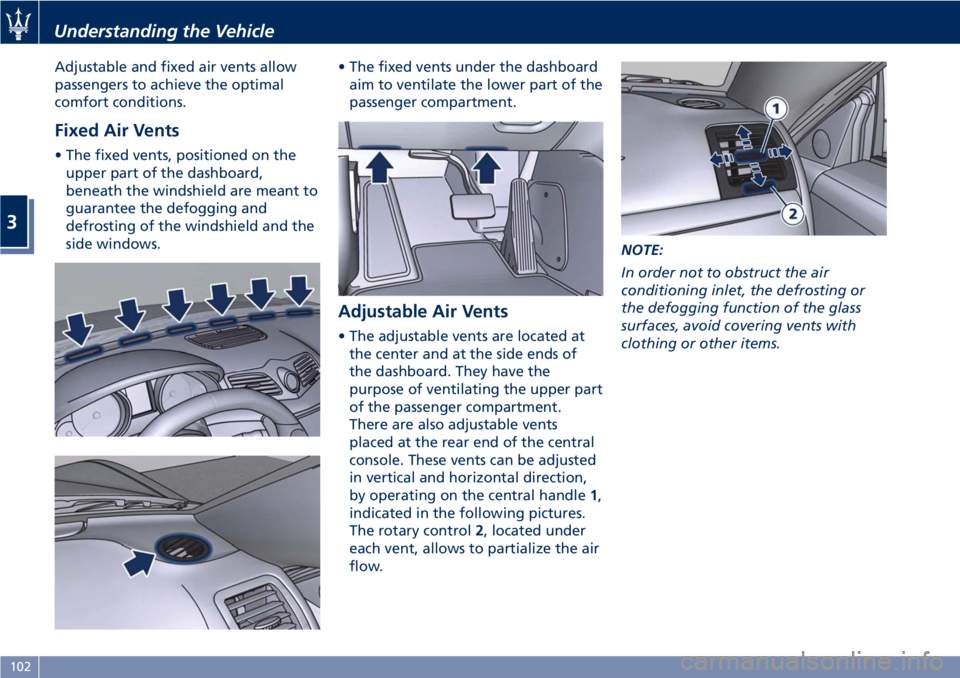
Adjustable and fixed air vents allow
passengers to achieve the optimal
comfort conditions.
Fixed Air Vents • The fixed vents, positioned on the
upper part of the dashboard,
beneath the windshield are meant to
guarantee the defogging and
defrosting of the windshield and the
side windows. • The fixed vents under the dashboard
aim to ventilate the lower part of the
passenger compartment.
Adjustable Air Vents • The adjustable vents are located at
the center and at the side ends of
the dashboard. They have the
purpose of ventilating the upper part
of the passenger compartment.
There are also adjustable vents
placed at the rear end of the central
console. These vents can be adjusted
in vertical and horizontal direction,
by operating on the central handle 1 ,
indicated in the following pictures.
The rotary control 2 , located under
each vent, allows to partialize the air
flow. NOTE:
In order not to obstruct the air
conditioning inlet, the defrosting or
the defogging function of the glass
surfaces, avoid covering vents with
clothing or other items.Understanding the Vehicle
3
102