Stop MASERATI GRANTURISMO 2019 Service Manual
[x] Cancel search | Manufacturer: MASERATI, Model Year: 2019, Model line: GRANTURISMO, Model: MASERATI GRANTURISMO 2019Pages: 286, PDF Size: 8.08 MB
Page 164 of 286
(gears are shifted at low engine
speeds).
In NORMAL mode, the system
controlling suspension damping uses a
shock absorber "softer" setting (see
"Skyhook Suspension" in section
"Understanding the Vehicle").
As SPORT mode has a lower priority
than ICE (low-grip) mode, if this is
already active when activating SPORT
mode, the system will ignore the
command.
CAUTION!
• Vs NORMAL mode, SPORT mode is
characterized by faster gearshifting,
electronic suspension management
(Skyhook), opening of by-pass
exhaust valves (above 3000 rpm with
the vehicle in motion).
• In addition to enhancing
performance, opening of the exhaust
also increases noise levels of the
vehicle.
In SPORT mode, fast gearshifting
however
, always depends on the
accelerator pedal travel and on the
engine rpm, as in NORMAL mode.
When in SPORT mode, the system
controlling suspension damping uses a
shock absorber "harder" setting (see "Skyhook Suspension" in section
"Understanding the Vehicle").
In MANUAL mode, DOWN-shifts with
the accelerator pedal released, will
have a braking effect approaching the
skidding limit of the driving wheels on
dry asphalt.
Under sports-style driving conditions
with gearshifts at high engine rpm,
double-clutching when up-shifting is
performed automatically.
WARNING!
It is advisable not to use SPORT mode
on roads with low or medium grip
conditions (e.g. ice, snow, or wet
roads) as the driving wheels could skid
during gearshifts.
Therefore, excessive use of the vehicle
in SPORT mode is advisable only on
race tracks.
If you use MANUAL and SPORT mode
in
combination for sports-style driving,
when starting-off or shifting gears,
you may perceive an initial slipping of
the driving wheels even on dry roads.
ICE (low-grip) Mode
This mode can be used on particularly
slippery road surfaces (e.g., rain, snow,
ice). To activate/deactivate this mode, press button "ICE" on the central
console. The word “ICE” will illuminate
on the instrument cluster display.
In “low-grip” mode, the system uses
2nd instead of 1st gear; this means
that 2nd gear will automatically be
engaged (gearshift lever in D (Drive)
position) in the event of standing
starts in automatic mode; on the other
hand, when in sequential manual
mode (transmission lever in MANUAL
"+"), moving the transmission lever
from N (Neutral), or R (Reverse) or
when the vehicle stops, 2nd gear will
automatically be engaged.
When sequential manual mode is
selected with 2nd gear engaged, a
downshift request will be ignored.
While driving, the system
automatically switches to the upper
gear if the engine reaches the
preestablished speed rate (3000 rpm).
ICE (low-grip) mode has priority over
SPORT mode and assists the ESC
system.
WARNING!
A downshift request from 6th to 5th
gear will only be accepted if the
engine speed rate in 5th gear is lower
than 3000 rpm. As ICE (low-grip) modeDriving
5
160
Page 165 of 286
can be activated at any time and the
system limits the engine speed rate to
3000 rpm in all gears except for the
6th, unrequested gearshifts could take
place.
In any case, it is advisable to
deactivate
SPORT mode before
selecting ICE (low-grip) mode.
When sequential manual gearshifting
is active, regardless of the mode set
(NORMAL / SPORT / ICE), the
transmission will automatically upshift
or downshift when reaching the
minimum and maximum rpm. This is
to prevent engine overrevving or
underrevving.
(ESC Off) Mode
The ESC system is designed to
automatically activate every time the
engine is started and can be
deactivated by pressing
(ESC Off)
button on the central console for
about 2 seconds. The
(ESC Off)
amber warning light illuminates on
the instrument cluster as well as on
the display, where it is accompanied
by a specific message.
The ESC (Electronic Stability Control)
antiyawing system incorporates all of
the vehicle control systems: ABS, EBD,
ASR and MSR (see "Brake and Stability Control System" in this section for
further information).
The system is fitted with a unit that
predicts the vehicle behavior with
extreme accuracy. The system can
detect when the driver is about to lose
control of the vehicle. In this case, it
can activate the brake calipers
individually and engine control, in
order to create a torque sufficient to
resist the vehicle’s yawing moment.
Press
(ESC Off) button again to
reactivate the system.
The
(ESC On) amber warning light
on the instrument cluster flashes
during all the operating phases.
, the system is automatically disabled
and cannot be re-activated. While
driving, this condition is signaled by
the
(ESC On) amber warning light,
that illuminates both on the
instrument cluster as well as on the
multi-function display, where it is
accompanied by the message “ESC
unavailable go to dealer”.
When the engine is started, the system
malfunction is indicated by the
illumination of the
(ESC On) amber
warning light. CAUTION!
• In the event of a fault, and with the
ESC system disabled ( (ESC Off)
button pressed), the vehicle behaves
as if it were not equipped with this
system: however, we recommend
you contact the Authorized Maserati
Dealer as soon as possible to have
the system checked.
• If you have to tow the vehicle with 2
wheels raised, make sure the key in
the ignition switch is in the STOP
(OFF) position. Otherwise, with the
ESC system active (
(ESC Off)
button not pressed), the control unit
will store a malfunction with
consequent illumination of the
(ESC On) amber warning lights on
the instrument cluster and on the
display. Should this occur, contact
the Authorized Maserati Dealer to
have the system repaired.
• In low- and medium-grip conditions
(e.g., rain, snow, ice, sand, etc.) it is
advisable not to activate SPORT
mode, even with the ESC system
active (
(ESC Off) button not
pressed). Driving
5
161
Page 168 of 286
Parking Brake The vehicle is equipped with an
electric automatic parking brake, also
called EPB (Electric Parking Brake).
It can be automatically engaged when
the engine is turned off and it is
disengaged when, with the engine
running, the accelerator pedal is
depressed.
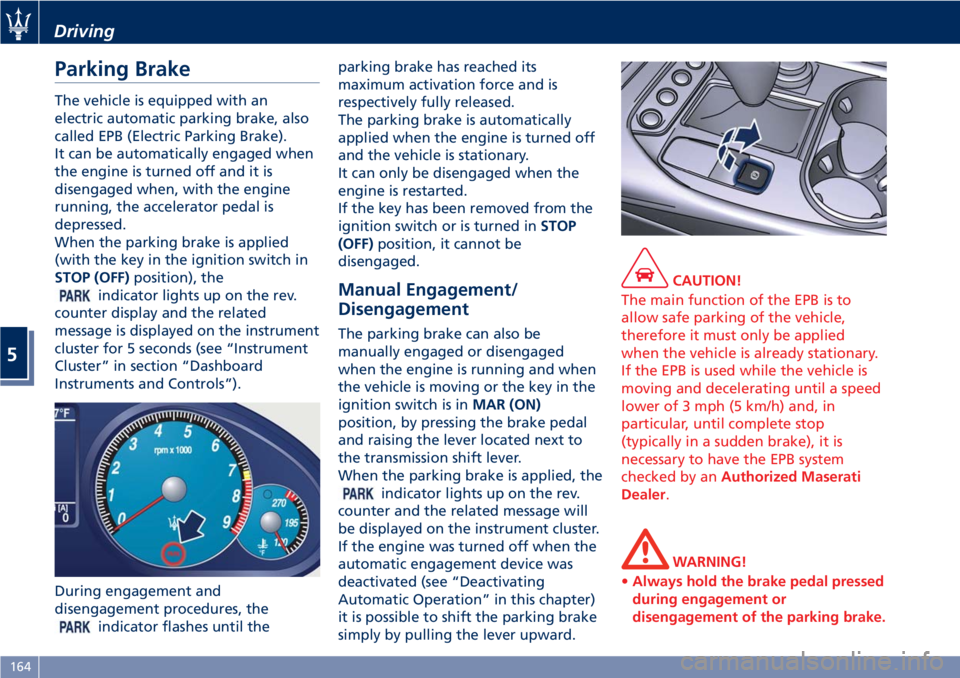
When the parking brake is applied
(with the key in the ignition switch in
STOP (OFF) position), the
indicator lights up on the rev.
counter display and the related
message is displayed on the instrument
cluster for 5 seconds (see “Instrument
Cluster” in section “Dashboard
Instruments and Controls”).
During engagement and
disengagement procedures, the
indicator flashes until the parking brake has reached its
maximum activation force and is
respectively fully released.
The parking brake is automatically
applied when the engine is turned off
and the vehicle is stationary.
It can only be disengaged when the
engine is restarted.
If the key has been removed from the
ignition switch or is turned in STOP
(OFF) position, it cannot be
disengaged.
Manual Engagement/
Disengagement The parking brake can also be
manually engaged or disengaged
when the engine is running and when
the vehicle is moving or the key in the
ignition switch is in MAR (ON)
position, by pressing the brake pedal
and raising the lever located next to
the transmission shift lever.
When the parking brake is applied, the
indicator lights up on the rev.
counter and the related message will
be displayed on the instrument cluster.
If the engine was turned off when the
automatic engagement device was
deactivated (see “Deactivating
Automatic Operation” in this chapter)
it is possible to shift the parking brake
simply by pulling the lever upward. CAUTION!
The main function of the EPB is to
allow safe parking of the vehicle,
therefore it must only be applied
when the vehicle is already stationary.
If the EPB is used while the vehicle is
moving and decelerating until a speed
lower of 3 mph (5 km/h) and, in
particular, until complete stop
(typically in a sudden brake), it is
necessary to have the EPB system
checked by an Authorized Maserati
Dealer .
WARNING!
• Always hold the brake pedal pressed
during engagement or
disengagement of the parking brake.Driving
5
164
Page 169 of 286
If you attempt to disengage the
parking brake without having
depressed the service brake pedal, a
message will be displayed to warn
you to do so.
• The EPB command activation while
running, generates a deceleration of
the vehicle with strong deceleration
(Dynamic Braking). It is therefore
recommended to use of this feature
only in case of emergency. The
stability of the car is guaranteed by
the action of the activated ESC
system.
Deactivating Automatic
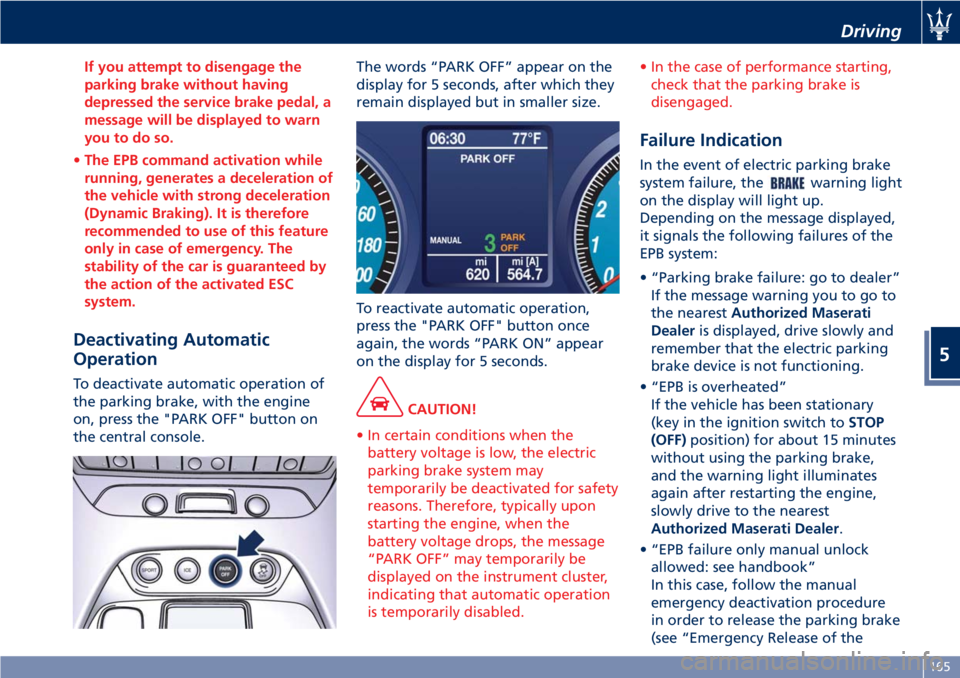
Operation To deactivate automatic operation of
the parking brake, with the engine
on, press the "PARK OFF" button on
the central console. The words “PARK OFF” appear on the
display for 5 seconds, after which they
remain displayed but in smaller size.
To reactivate automatic operation,
press the "PARK OFF" button once
again, the words “PARK ON” appear
on the display for 5 seconds.
CAUTION!
• In certain conditions when the
battery voltage is low, the electric
parking brake system may
temporarily be deactivated for safety
reasons. Therefore, typically upon
starting the engine, when the
battery voltage drops, the message
“PARK OFF” may temporarily be
displayed on the instrument cluster,
indicating that automatic operation
is temporarily disabled. • In the case of performance starting,
check that the parking brake is
disengaged.
Failure Indication In the event of electric parking brake
system failure, the
warning light
on the display will light up.
Depending on the message displayed,
it signals the following failures of the
EPB system:
• “Parking brake failure: go to dealer”
If the message warning you to go to
the nearest Authorized Maserati
Dealer is displayed, drive slowly and
remember that the electric parking
brake device is not functioning.
• “EPB is overheated”
If the vehicle has been stationary
(key in the ignition switch to STOP
(OFF) position) for about 15 minutes
without using the parking brake,
and the warning light illuminates
again after restarting the engine,
slowly drive to the nearest
Authorized Maserati Dealer .
• “EPB failure only manual unlock
allowed: see handbook”
In this case, follow the manual
emergency deactivation procedure
in order to release the parking brake
(see “Emergency Release of the Driving
5
165
Page 170 of 286
Parking Brake” in section “In an
Emergency”).
• “Parking Brake system revision: go to
dealer”
The EPB system requires
maintenance, therefore contact an
Authorized Maserati Dealer to have
the system corrected.
WARNING!
In the event of an EPB failure, take
your vehicle to the nearest Authorized
Maserati Dealer as soon as possible.
Initialize the EPB System after a
Battery
Disconnecting
After the detachment and the
subsequent connection of the battery,
on the instrument cluster display the
warning light will light up.
To initialize the EPB system lift, release
and lift again the lever located next to
the transmission shift lever.
Emergency Disengagement
In case of brake lock with complete
electrical system failure, it is necessary
to act on the electric actuator using
the special tool provided in the tool kit
to release the pressure of the parking
brake shoes (see “Emergency Release of the Parking Brake” chapter in
section “In an Emergency”).
EPB Operation with
Overheated Brakes Driving on mountain roads with steep
slopes or a sports use of the vehicle
could overheat the brake system
components. In these conditions,
parking brake must not be used since
the push of the power actuator might
not be sufficient to ensure vehicle
braking, especially on a slope.
Drive normally without braking to
allow the brakes to cool down a few
minutes before stopping. In this way,
the automatic or manual activation of
the parking brake will ensure vehicle
braking. Parking Straighten the wheels and turn off the
engine.
Before leaving the vehicle, make sure
that the parking brake is fully applied
in automatic or manual mode and
place the transmission lever in the P
(Park) position.
Remove the key from the ignition
switch.
WARNING!
• Always check that the vehicle is
locked before leaving it.
• Never leave children unattended in
the vehicle.
• Do not park the vehicle on paper,
grass, dry leaves or other flammable
materials. They could catch fire if
they come into contact with hot
parts of the exhaust system.
• Do not leave the engine running
while the vehicle is unattended.
CAUTION!
When you need to park the vehicle on
a steep slope, both with the engine on
and off, it is recommended not only toDriving
5
166
Page 174 of 286
WARNING!
The ABS helps prevent the wheels
from locking, but it does not increase
the physical grip limits between the
tires and the road. Therefore, always
keep a safe distance from the vehicle
in front of yours and reduce your
speed when entering a curve.
NOTE:
• When
the vehicle's speed is higher
than 7 mph (11 km/h), you may also
hear a slight clicking sound as well as
other motor noises. The system is
performing a self-check cycle to
ensure that the ABS is working
properly.
• This self-check occurs each time the
vehicle is started and accelerated
past 7 mph (11 km/h).
ABS is activated during braking under
certain road or stopping conditions.
ABS-inducing conditions can include
ice, snow, gravel, bumps, railroad
tracks, loose debris.
You may also experience the following
when the brake system goes into Anti-
Lock: • The ABS motor running (it may
continue to run for a short time after
the vehicle stops).
• The clicking sound of solenoid valves.
• Brake pedal pulsations.
• A slight drop or fall away of the
brake pedal at the end of the stop.
These are all normal characteristics of
ABS functioning.
WARNING!
• The ABS contains sophisticated
electronic equipment that may be
susceptible to interference caused by
improperly-installed or high-output
radio transmitting equipment. This
interference can cause possible loss
of anti-lock braking capability.
Installation of such equipment
should be performed by qualified
Maserati personnel.
• Pumping the Anti-Lock Brakes will
diminish their effectiveness and may
lead to a collision. Pumping brakes
makes the stopping distance longer.
Just press firmly and continuously on
your brake pedal when you need to
slow down or stop ABS and EBD System Failure
In
the event of a failure the ABS
system will be deactivated, but this will
not affect the efficiency of the
standard braking system.
The failure will be indicated by the
illumination of the
amber warning
light on the instrument cluster.
An EBD system failure is indicated by
the illumination of the
red
warning light on the instrument
cluster.
In this case we recommend that you
contact the nearest Authorized
Maserati Dealer in order to identify
the fault as soon as possible, by means
of the system self-diagnostic function.
WARNING!
• The
failure warning light usually
illuminates with the engine running
to indicate a malfunction in the ABS
system only. In this case, the braking
system will remain fully functioning,
but will not use the ABS. In these
conditions, also the EBD system
efficiency may be affected. Drive
with the greatest care in order to
avoid sudden braking and have the
system immediately checked by theDriving
5
170
Page 175 of 286
nearest Centre of the Authorized
Maserati Dealer.
• The warning light illuminates
when the engine is running to
indicate an EBD system malfunction.
In this case, sharp braking may
cause an early locking of the rear
wheels, and the vehicle may skid.
Drive with the greatest care and
have the system immediately
checked by the nearest Centre of the
Authorized Maserati Dealer.
Hydraulic Brake Assistance
(HBA) HBA completes the ABS system by
optimizing the vehicle braking
capacity during emergency braking.
In the event of a critical situation,
where the vehicle must stop in the
shortest possible distance, the driver
usually depresses the brake pedal
quickly, but often not strongly
enough: this increases the braking
distance. HBA has been designed to
solve this problem and acts by
applying the maximum braking force
during emergency braking, in order to
stop the vehicle in the shortest
possible distance.
HBA recognizes the emergency
condition by analyzing some parameters, such as the pressure on
the brake servo, the wheel speed and
activation of the third stop. The ABS
control unit cross-checks this data and
substitutes the driver by activating the
braking system’s full power and so
ensures optimal braking performance
in the shortest possible distance.
Brake Override System (BOS) To complete the range of systems that
assist braking, the vehicle is equipped
with BOS , which is designed to stop
the vehicle even when it is being
accelerated. If the brake pedal is
depressed together with the
accelerator, the engine power should
be automatically reduced and, if the
driver continues to depress the
accelerator, the system may even cause
the vehicle to come to a complete
stop.
Additionally, if the brake pedal is
released when the accelerator is still
depressed, the corresponding engine
torque can be reached gradually.Using the Brakes CAUTION!
To obtain a good performance of
brake pads and discs, avoid sudden
braking during the first 190 mi
(300 km).
The pad wear limit is indicated by the
illumination
of the
warning light,
on the instrument cluster display.
In this event, please contact an
Authorized Maserati Dealer .
WARNING!
• Riding the brakes can lead to brake
failure and possibly an accident.
Driving with your foot resting or
riding on the brake pedal can result
in abnormally high brake
temperatures, excessive lining wear,
and possible brake damage. In an
emergency full braking capacity may
be impaired.
• If the
red warning light
illuminates when the engine is
running with the message that
indicates an insufficient brake fluid
level, stop the vehicle and check the
(Continued)Driving
5
171
Page 176 of 286
(Continued)
brake fluid level immediately (see
"Maintenance Procedure" in section
“Maintenance and Care”). If fluid is
below the minimum level, top up
with the recommended fluid and
contact an Authorized Maserati
Dealer immediately to have the
system checked. Brake fluid leaks
affect the operation of the braking
systems.
• The brake system performance in
terms of active safety is not a reason
for the driver to run unnecessary
risks. The driving style shall always
be suited to weather conditions,
range of visibility and traffic.
• The maximum deceleration that can
be obtained always depends on the
tire grip on the road surface. With
snow or ice on the road the grip is
obviously reduced and the braking
distance is very high, even with the
ABS system.
Brake Pads and Brake Discs Wear on the brake pads and brake
discs depends to a great extent on the
driving style and the conditions of use
and therefore cannot be expressed in
actual kilometers driven on the road. The high-performance brake system is
designed for optimal braking effect at
all speeds and temperatures.
Certain speeds, braking forces and
ambient conditions (e.g. temperature,
humidity and long outdoor stopping
periods) can therefore cause the
brakes to "squeal". This is normal and
will cease after a few brakings.
New Brake Pads and/or Brake
Discs New brake pads have to be “broken
in”, and therefore only attain optimal
friction to the brake disc when the
vehicle has covered several
hundreds km.
During this first period, the slightly
reduced braking ability must be
compensated for by pressing the brake
pedal harder. This applies whenever
the brake pads and/or brake discs are
replaced.
Brake Overheating Driving on mountain roads with steep
slopes or a sports use of the vehicle
could overheat the brake system
components. In these conditions,
parking brake must not be used since
the push on the brake shoes of the
power actuator might not be sufficient to ensure vehicle braking, especially on
a slope.
Drive normally without braking to
allow the brakes to cool down a few
minutes before stopping. In this way,
the automatic or manual activation of
the parking brake will ensure vehicle
braking.Driving
5
172
Page 180 of 286
the speed stored. Every time rotating
section is reset, the speed is increased
or decrease by approx. 0.6 mph (1
Km/h). Keep the rotating section
turned to vary the speed
continuously. When a new speed is
reached, it will automatically remain
constant.
• Button "RCL" at end of left
multifunction lever is used to resume
the speed stored.
NOTE:
• When the key in the ignition switch
is turned to STOP (OFF) position or
ON/OFF switch is in the "OFF"
position, the speed stored is erased
and the system deactivated.
• The CC must be deactivated when
not in use.
WARNING!
Leaving the Cruise Control system on
when not in use is dangerous. You
could accidentally set the system or
cause it to go faster than you want.
Always leave the CC off when you are
not using it. Storing a Speed
T
urn the ON/OFF switch to "ON" and
reach the desired speed driving
normally. Turn the rotating section in
the middle of the left multifunction
lever to "+" for at least 3 seconds and
then release it.
The vehicle speed is stored and the
accelerator pedal can be released.
The vehicle will proceed at the
constant speed stored until the brake
pedal is pressed.
If necessary, (for example, to pass
another vehicle), you can accelerate by
simply pressing the accelerator pedal.
Afterward, when you release the
accelerator pedal, the vehicle will
return to the speed previously stored.
Resuming the Speed Stored
If the CC has been deactivated after
braking, the speed previously stored
can be resumed as follows:
• gradually accelerate until you reach a
speed close to that stored;
• engage the gear selected when the
speed was stored (4th, 5th or 6th
gear);
• press button "RCL".
Increasing the Speed Stored
The speed stored can be increased in
two ways: • by pressing the accelerator and then
storing the new speed reached (turn
the rotating section in the middle of
the left multifunction lever for more
than 3 seconds); or
• by turning the rotating section to
position "+": each impulse
transmitted by the rotating section
will cause a slight increase in speed
(about 0.6 mph/1 Km/h), whereas a
constant pressure on the same
rotating section will cause a
continuous increase in speed. When
the rotating section is released, the
new speed will be automatically
stored in the memory.
Decreasing the Speed Stored
The speed stored can be reduced in
two ways:
• by deactivating the CC, pressing the
brake pedal and then storing the
new speed (turning the rotating
section to position “+” for at least 3
seconds); or
• by keeping the rotating section
turned to position “-” until reaching
the new speed, which will be stored
automatically.
Resetting the Speed Stored
The speed stored is automatically
reset:Driving
5
176
Page 183 of 286
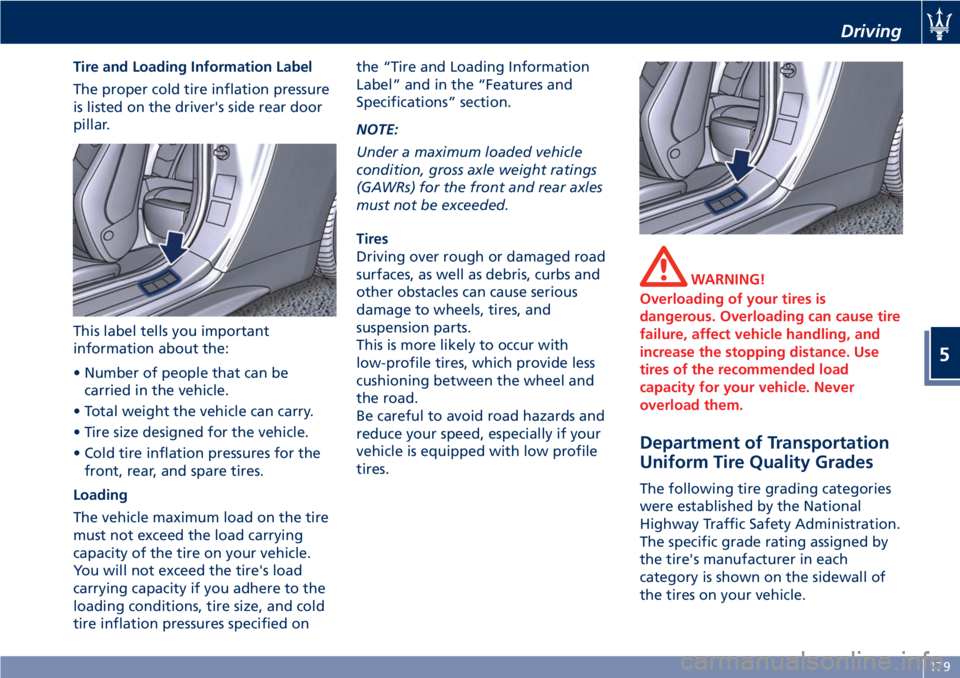
Tire and Loading Information Label
The proper cold tire inflation pressure
is listed on the driver's side rear door
pillar.
This label tells you important
information about the:
• Number of people that can be
carried in the vehicle.
• Total weight the vehicle can carry.
• Tire size designed for the vehicle.
• Cold tire inflation pressures for the
front, rear, and spare tires.
Loading
The vehicle maximum load on the tire
must not exceed the load carrying
capacity of the tire on your vehicle.
You will not exceed the tire's load
carrying capacity if you adhere to the
loading conditions, tire size, and cold
tire inflation pressures specified on the “Tire and Loading Information
Label” and in the “Features and
Specifications” section.
NOTE:
Under a maximum loaded vehicle
condition, gross axle weight ratings
(GAWRs) for the front and rear axles
must not be exceeded.
Tires
Driving over rough or damaged road
surfaces, as well as debris, curbs and
other obstacles can cause serious
damage to wheels, tires, and
suspension parts.
This is more likely to occur with
low-profile tires, which provide less
cushioning between the wheel and
the road.
Be careful to avoid road hazards and
reduce your speed, especially if your
vehicle is equipped with low profile
tires. WARNING!
Overloading of your tires is
dangerous. Overloading can cause tire
failure, affect vehicle handling, and
increase the stopping distance. Use
tires of the recommended load
capacity for your vehicle. Never
overload them.
Department of Transportation
Uniform Tire Quality Grades The following tire grading categories
were established by the National
Highway Traffic Safety Administration.
The specific grade rating assigned by
the tire's manufacturer in each
category is shown on the sidewall of
the tires on your vehicle. Driving
5
179