ESP MASERATI GRANTURISMO 2019 Repair Manual
[x] Cancel search | Manufacturer: MASERATI, Model Year: 2019, Model line: GRANTURISMO, Model: MASERATI GRANTURISMO 2019Pages: 286, PDF Size: 8.08 MB
Page 258 of 286
Wheels Maintenance Tires Maintenance CAUTION!
To obtain the best performances and
the longest mileage from the tires,
take the following precautions during
the first 310 mi (500 km):
• do not drive at the vehicle’s
maximum speed;
• drive at low speed on curves;
• avoid sudden steering;
• avoid sudden braking;
• avoid sudden acceleration;
• do not drive at high speeds for too
long.
The tires inflation pressure must
correspond
to the prescribed values
(see the chapter “Tire Inflation
Pressure” in section “Features and
Specifications”) and should be checked
only when the tires have cooled down.
In fact, the pressure increases as the
tire temperature progressively
increases.
Never reduce the pressure if tires are
hot (see “Tires – General Information”
chapter in section “Driving”). Insufficient tire inflating pressure can
cause tire overheating and possible
internal damage, which may even lead
to the tire destruction.
CAUTION!
After inspecting or adjusting the tire
pressure, always reinstall the valve
stem cap. This will prevent moisture
and dirt from entering the valve stem,
which could damage it.
Impacts with curbs, holes, and
obstacles
in the road, and prolonged
trips on rough roads can cause tire
damage which may not be visible to
the naked eye.
Check your tires regularly for any signs
of damage (e.g. scratches, cuts, cracks,
bulges, etc.). If sharp objects penetrate
the tires, they can cause structural
damage which is only visible when the
tire is removed.
In any case, any possible damage must
be inspected by an experienced tire
fitter, as it may seriously reduce the
tire life.
Remember that tires deteriorate with
time, even if used little or not at all.
Cracks in the tire tread and sides,
alongside possible bulging, are a sign
of deterioration. WARNING!
• Check the inflating pressure of the
tires when cold, at least every two
weeks and before long trips.
• Have the old tires inspected by an
experienced technician, to make sure
they can still be used safely. If the
same tire has been on your vehicle
for 4 or 5 years, have it inspected
anyway by an experienced
technician.
• Never fit tires of uncertain origin.
• “Directional” tires have an arrow on
their side showing the rolling
direction. To keep the best
performance when replacing a tire,
make sure that the rolling direction
corresponds to the one shown by
the arrow.
• During the tire life, the rolling
direction used for the first fitting
shall always be observed, also in
case of “nondirectional” tires.
• Check the depth of the tire tread at
regular intervals. The minimum
allowed value is 0.06 in (1,6 mm) at
that point the wear indicators on the
tire will be visible (see “Tires –
General Information” in sectionMaintenance and Care
7
254
Page 265 of 286
that all the electrical/electronic
systems in the vehicle work efficiently.
Maintaining Battery Charge If you perform short daily trips
(approximately 10 miles/16 km), which
correspond to an annual total of 4000
miles/6000 km, or when the vehicle is
not going to be used for one week or
more, Maserati recommends
connecting the vehicle to a battery
charger, to save you the trouble of
having to recharge the battery (see
“Battery Charge Maintainer
Operation” in this chapter).
The battery charge maintainer will
keep the battery charged properly and
at the correct voltage levels required
by the systems and devices in the
vehicle.
Before using the battery charge
maintainer, carefully follow the
instructions provided.
If you do not use a battery charge
maintainer to prevent the battery
from going dead when you are not
going to use the vehicle for long
periods of time, you need to check
and recharge the battery at least once
every three weeks. Make this check if
you perform short daily trips
(approximately 10 mi/16 km) which
correspond to an annual total of 4000 miles/6000 km. Please note that
allowing the battery to go dead
repeatedly can cause premature wear
on the internal cells and greatly
reduce their life, leading to problems
with the ignition system and other
electrical/electronic systems.
The Authorized Maserati Dealer is
available to advise you on how to
recharge your battery correctly and
give you useful information on battery
care and maintenance.
NOTE:
The Authorized Maserati Dealer can
provide you with any information
about the Maserati approved “Battery
Charger and Conditioner”, available in
the “Genuine Accessories” range.
WARNING!
The process of charging or recharging
the battery produces hydrogen, a
dangerous gas that can explode and
cause serious injuries. When charging
or recharging the battery, follow the
recommended precautions at all
times:
• always charge or recharge the
battery in a well-ventilated
environment; • never charge or recharge a battery
that has frozen: it can explode due
to hydrogen trapped inside the ice
crystals;
• ensure that any sparks or open
flames are nowhere near the battery
while it is charging;
• before using a charger to charge or
maintain the battery charge status,
carefully follow the instructions
provided to ensure the charger is
connected to the battery safely and
correctly.
Battery Charge Maintainer
Operation Charge Maintainer Socket
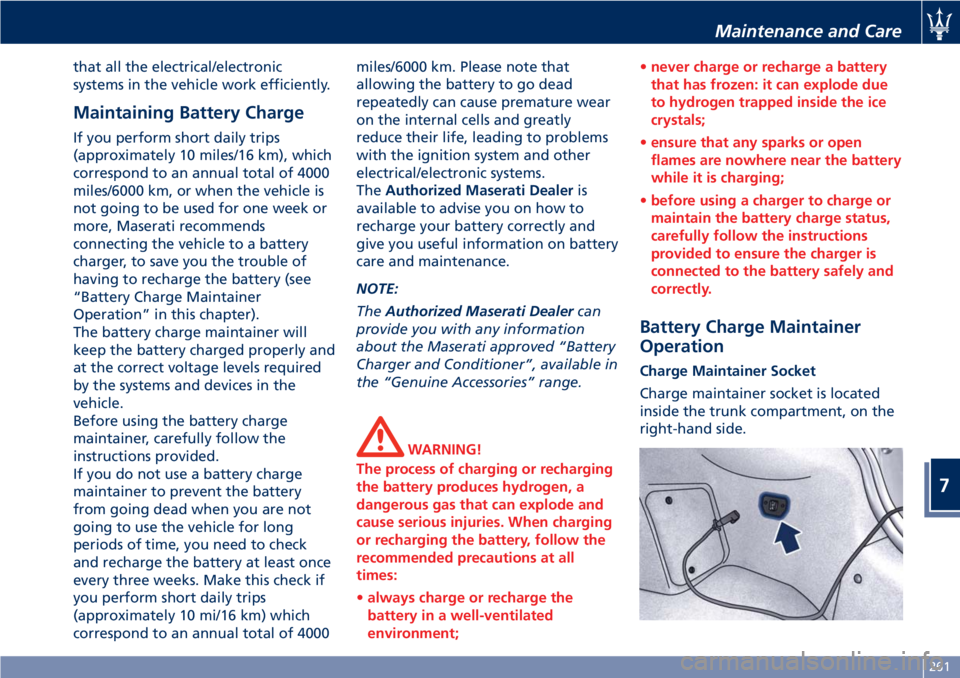
Charge maintainer socket is located
inside the trunk compartment, on the
right-hand side.Maintenance and Care
7
261
Page 274 of 286
Engine Data Cylinder number and position 8 - 90° V
Number of valves per cylinder 4
Bore x stroke 94 x 84,5 mm
Total displacement 4691 cu.cm
Compression ratio 11.2 +/- 0.2 : 1
Maximum power output (EC) (*) 338 kW – 460 CV
- corresponding rpm 7000 rpm
Maximum torque (EC) 520 Nm – 53 kgm
- corresponding rpm 4750 rpm
(*) Values obtained in SPORT drive mode with 98 R.O.N.
Timing System The timing system uses two overhead camshafts. The
camshafts are equipped with timing variator. The timing
control is done by two chains.
Lubrication
System The lubrication system is controlled by the wet sump system
through an oil pump and the relative suction screen,
incorporated in the crankcase.
Cooling System Engine cooling is ensured by an anti-freeze mixture
circulating inside a circuit equipped with radiator,
centrifugal pump and expansion tank.
Injection –
Ignition System High-pressure direct fuel injection system. Static ignition
with digital electronic control system included and
controlled by a single microprocessor ECU.Features and Specifications
8
270
Page 275 of 286
Brakes Self-ventilating disc brakes on the four
wheels.
• Front disc diameter: 14.1 in (360
mm).
• Rear disc diameter: 13 in (330 mm).
• 6-piston front brake caliper
(Dual-cast technology).
• 4-piston rear brake caliper.
The Electric Parking Brake (EPB) acts
on the rear wheels.
Transmission Electro-hydraulically controlled
automatic transmission with 6 gears
(plus reverse), torque converter,
lock-up clutch and anti-slip function.
TRANSAXLE-type transmission.
Traction system equipped with rear
self-locking differential.
Suspension Front and rear articulated
quadrilateral suspensions.
Skyhook adjustable damping
suspension (optional on MC version)
that allows the driver to choose two
settings for the shock absorbers,
depending on the road surface
conditions, speed and comfort. Steering Hydraulic speed-sensitive steering with
cooling exchanger system.
Steering diameter = 11.7 yd (10,7 m).
No. of steering wheel turns = 1.5 (to
the left and right).
Wheels NOTE:
In order to maintain high performance
and safety level, Maserati
recommends to use tires equivalent to
the original size.
WARNING!
• The maximum speed reachable with
the tires (including winter tires) is
indicated by the tire manufacturer.
Always comply with the regulations
in force in the Country you are
driving in.
• Never exceed the maximum speed
indicated for the tires (including
winter tires): failure to respect the
max. speed may damage these tires.
Danger: risk of accident! CAUTION!
• While respecting the specified sizes,
for the safe operation of the vehicle
it is also essential that it is equipped
with the same brand and type of
tires on all wheels.
• Do not use an inner tube with
Tubeless tires.
Standard Wheel Dimension
Light alloy rims 20” x 8.5J
(front)
20” x 10.5J
(rear)
- Front tires 245/35 ZR 20
- Rear tires 285/35 ZR 20
- Front winter tires 245/35 ZR 20
- Rear winter tires 285/35 ZR 20
Light alloy spare rim
(optional) 18”x6J
- Spare tire 175/55 R 18
Performance
NOTE:
• The specifications described can
change without prior modification.
(Continued)Features and Specifications
8
271