ESP MASERATI GRANTURISMO 2019 Workshop Manual
[x] Cancel search | Manufacturer: MASERATI, Model Year: 2019, Model line: GRANTURISMO, Model: MASERATI GRANTURISMO 2019Pages: 286, PDF Size: 8.08 MB
Page 194 of 286
CAUTION!
• Maserati strongly recommends the
use of Premium unleaded fuel ONLY.
Use of lesser grade fuel (other than
Premium) will lead to reduced
engine performance, and poor fuel
economy and can lead to the
Malfunction Indicator Light (MIL)
illuminating on the instrument
cluster. Continued use of lesser grade
fuel (other than Premium fuel) can
lead to engine misfire problems and
possible catalytic converter damage.
• The anti-pollution devices of the
vehicle require unleaded fuel to be
used at all times. Under no
circumstance, not even in an
emergency, should leaded fuel be
supplied to the fuel tank, not even a
minimum quantity. This would
irreparably damage the catalytic
converters. An inefficient catalytic
converter results in noxious exhaust
emissions which damage the
environment.
Reformulated Gasoline
Many areas of the country require the
use of cleaner burning gasoline,
referred to as “Reformulated Gasoline”. Reformulated gasoline
contains oxygenates and are
specifically blended to reduce vehicle
emissions and improve air quality.
Maserati supports the use of
reformulated gasoline. Properly
blended reformulated gasoline will
provide excellent performance and
durability of engine and fuel system
components.
Gasoline/Oxygenate Blends Some fuel suppliers blend unleaded
gasoline with oxygenates such as
Ethanol. Fuels blended with oxygenates
may be used in your vehicle.
CAUTION!
DO NOT use gasoline containing
Methanol or gasoline containing more
than 10% Ethanol. Use of these blends
may result in starting and driveability
problems, damage critical fuel system
components, cause emissions to exceed
the applicable standard, and/or cause
the
Malfunction Indicator Light
(MIL) to illuminate (see “Instrument
Cluster” in section “Dashboard
Instruments and Controls”. Pump
labels should clearly communicate if a
fuel contains greater than 10%
Ethanol. Problems that result from using
gasoline
containing Methanol or
gasoline containing more than 10%
Ethanol are not the responsibility of
Maserati and may not be covered
under warranty.
MMT in Gasoline MMT (Methylcyclopentadienyl
Manganese Tricarbonyl) is a
manganese containing metallic
additive that is blended into some
gasoline to increase octane.
Gasoline blended with MMT provides
no performance advantage beyond
gasoline of the same octane number
without MMT.
Maserati recommends gasoline
without MMT to be used in your
vehicle. The MMT content of gasoline
may not be indicated on the gasoline
pump; therefore, you should ask the
gasoline station operator whether or
not the gasoline contains MMT.
It is even more important to look for
gasoline without MMT in Canada,
because MMT can be used at levels
higher than those allowed in the
United States. MMT is prohibited in
Federal and California reformulated
gasoline.Driving
5
190
Page 195 of 286
Materials Added to Fuel All gasoline sold in the United States is
required to contain effective
detergent additives. Use of additional
detergents or other additives is not
needed under normal conditions and
they would result in additional cost.
Therefore, you should not have to add
anything to the fuel.
Fuel System Warnings WARNING!
Follow these guidelines to maintain
your vehicle's performance:
•
The use of leaded gasoline is
prohibited by Federal and Provincial
law. Using leaded gasoline can impair
engine performance and damage the
emissions control system.
• The use of fuel additives, which are
now being sold as octane enhancers,
is not recommended. Most of these
products contain high
concentrations of methanol. Fuel
system damage or vehicle
performance problems resulting
from the use of such fuels or
additives is not the responsibility of
Maserati. NOTE:
Intentional
tampering with the
emissions control system can result in
civil penalties civil penalties and could
void the vehicle warranty.
Carbon Monoxide Warnings WARNING!
Carbon monoxide (CO) in exhaust
gases is deadly. Follow the
precautions below to prevent carbon
monoxide poisoning:
• Do not inhale exhaust gases. They
contain carbon monoxide, a
colorless and odorless gas, which
can kill. Never run the engine in a
closed area, such as a garage, and
never sit in a parked vehicle with
the engine running for an extended
period. If the vehicle is stopped in
an open area with the engine
running for more than a short
period, adjust the ventilation system
to force fresh, outside air into the
vehicle.
• Guard against carbon monoxide
with proper maintenance. Have the
exhaust system inspected every time
the vehicle is raised. Have any abnormal conditions repaired
promptly. Until repaired, drive with
all side windows fully open.
WARNING!
California Proposition 65
Operating, servicing and maintaining
a passenger vehicle or off-road vehicle
can expose you to chemicals including
such as, engine exhaust, carbon
monoxide, phthalates and lead, that
which are know to the State of
California to cause cancer and birth
defects or other reproductive harm. To
minimize exposure, avoid breathing
exhaust, do not idle the engine except
as necessary, service your vehicle in a
well-ventilated area and wear gloves
or wash your hands frequently when
servicing your vehicle. For more
information go to:
www.P65Warnings.ca.gov/passenger-
vehicle Driving
5
191
Page 198 of 286
Driving Conditions Before the Trip Check the following at regular
intervals and always before long trips:
• tire pressure and condition;
• levels of fluids and lubricants;
• conditions of the windshield wiper
blades;
• clean the glass on the external light
and all other glass surfaces;
• proper operation of the indicator
lights and of the external lights.
CAUTION!
It is however advisable to perform
these checks at least every 500 mi
(800 km) and always following the
maintenance schedule reported in
section “Maintenance and Care”.
Before you drive:
•
adjust seat position, steering wheel
and rearview mirrors in order to have
the best driving position;
• ensure that nothing (mat covers, etc.)
is obstructing the pedals movement;
• carefully arrange and secure any
objects in the trunk, to prevent them from moving forward in case of
sudden stops;
• avoid heavy meals before a trip. A
light snack helps keep your reflexes
sharp. In particular, avoid drinking
alcohol.
WARNING!
Beyond being prohibited by law, it is
extremely dangerous to ride inside the
trunk or on the hood. In the event of
an accident, passengers sitting here
are more exposed to the risk of
serious injury. Passengers must only
travel seated in the vehicle seats, with
the seat belts fastened. Always check
that the driver and all passengers
have the seat belts correctly fastened.
Safe Driving Although the vehicle is equipped with
active and passive safety devices, the
driver's conduct is always a decisive
factor for road safety.
Some simple rules for traveling safely
in different conditions are listed
below. Some of them will probably
already sound familiar but, in any case,
it would be useful to read them
carefully. Driving at Night
The main guidelines to follow when
driving at night are set out below.
• Drive carefully. Night conditions
demand more focus and attention.
• Reduce your speed, especially on
roads with no streetlights.
• Stop at early signs of drowsiness.
Continuing to drive would be a risk
for yourself and for others. Have a
rest before continuing your trip.
• Keep the vehicle at a greater
distance from vehicles in front of you
than you would during the day: it is
difficult to assess the speed of other
vehicles when you only see the lights.
• Use the high beams only outside of
densely-populated areas and when
you are sure that they will not
disturb other drivers.
• When another vehicle is
approaching, switch from high
beams (if on) to low beams.
• Keep lights and headlights clean.
• Outside of densely-populated areas,
beware of animals crossing the road.
Driving in the Rain
Rain and wet roads are dangerous. On
a wet road all maneuvers are more
difficult since wheel grip on theDriving
5
194
Page 201 of 286
• Do not exceed 5 mph (8 km/h) when
driving through standing water. This
will minimize wave effects.
• Driving through standing water may
cause damage to your vehicle
drivetrain components. After driving
through standing water, do not drive
if you are not sure about drivetrain
condition. Such damage is not
covered by the New Vehicle
Warranty.
• Getting water inside your vehicle
engine can cause it to lock up and
stall out, and cause serious internal
damage to the engine. Such damage
is not covered by the New Vehicle
Warranty.
• After driving through standing
water always have the fluids (engine
oil, transmission oil, etc) checked for
contamination at an Authorized
Maserati Dealer .
WARNING!
• Driving through standing water
limits your vehicle traction
capabilities. Do not exceed 5 mph
(8 km/h) when driving through
standing water.
• Driving through standing water limits your vehicle braking
capabilities, which increases
stopping distances. Therefore, after
driving through standing water,
drive slowly and lightly press on the
brake pedal several times to
progressively dry the brakes discs
and pads.
• Getting water inside your vehicle
engine can cause it to lock up and
stall out.
• Failure to follow these warnings
may result in injuries that are
serious or fatal to you, your
passengers, and others around you. Pollution Control Devices Even if the vehicle is fitted with
antipollution devices, the environment
deserves the greatest respect from
every one of us.
By following a few simple rules, the
driver can avoid damaging the
environment and very often can
reduce fuel consumption as well.
In this regard, some useful
information is listed here below;
please read it carefully.
• The first precaution is to follow the
Scheduled Service Plan scrupulously
(see “Scheduled Service Plan” in
section “Maintenance and Care”.
• The correct operation of the
antipollution devices not only helps
respect for the environment, but
also has an impact on vehicle
efficiency. Keeping these devices in
good working conditions is the first
rule for driving both ecologically
sound and economically.
• Always use unleaded fuel.
• If starting is difficult, do not make
prolonged attempts. In particular,
avoid push starts, towing or
downhill starts: these are all
maneuvers that can damage the
catalytic converters. For any Driving
5
197
Page 207 of 286
In the Event of an
Accident It is important always to keep calm.
• If not directly involved, stop at a safe
distance of at least 10 yards away
from the accident area.
• If on a highway, stop without
obstructing the emergency lane and
be especially careful if you need to
exit the vehicle.
• Turn off the engine and switch on
the hazard warning flashers.
• At night, illuminate the accident
area with the headlights.
• Always act with caution to avoid the
risk of being crashed into by other
drivers.
• Indicate that an accident has
occurred by placing the emergency
triangle (if equipped) in a well
visible position and at the prescribed
distance.
• Call the emergency services,
providing as much information as
possible. On the highway, use the
special call boxes.
• Remove the ignition key (if present)
from the vehicles involved.
• If fuel or other chemical products
can be smelled, do not smoke and ask people around you to put their
cigarettes out.
• To extinguish fires, even small ones,
use a fire extinguisher, blankets,
sand or earth. Never use water.
• In multiple accidents occurred on
highways, particularly where
visibility is poor, there is a high risk
of being involved in other collisions.
Leave the vehicle immediately and
move away from the area.
In case of Injured Persons • Never leave the injured person
alone. Persons not directly involved
in the accident are also required to
give assistance.
• Do not crowd around injured
persons.
• Reassure the injured person that
help is on the way.
WARNING!
California Proposition 65
Operating, servicing and maintaining
a passenger vehicle or off-road vehicle
can expose you to chemicals including
such as, engine exhaust, carbon
monoxide, phthalates and lead, that
which are know to the State of
California to cause cancer and birth defects or other reproductive harm. To
minimize exposure, avoid breathing
exhaust, do not idle the engine except
as necessary, service your vehicle in a
well-ventilated area and wear gloves
or wash your hands frequently when
servicing your vehicle. For more
information go to:
www.P65Warnings.ca.gov/passenger-
vehicleIn an Emergency
6
203
Page 214 of 286
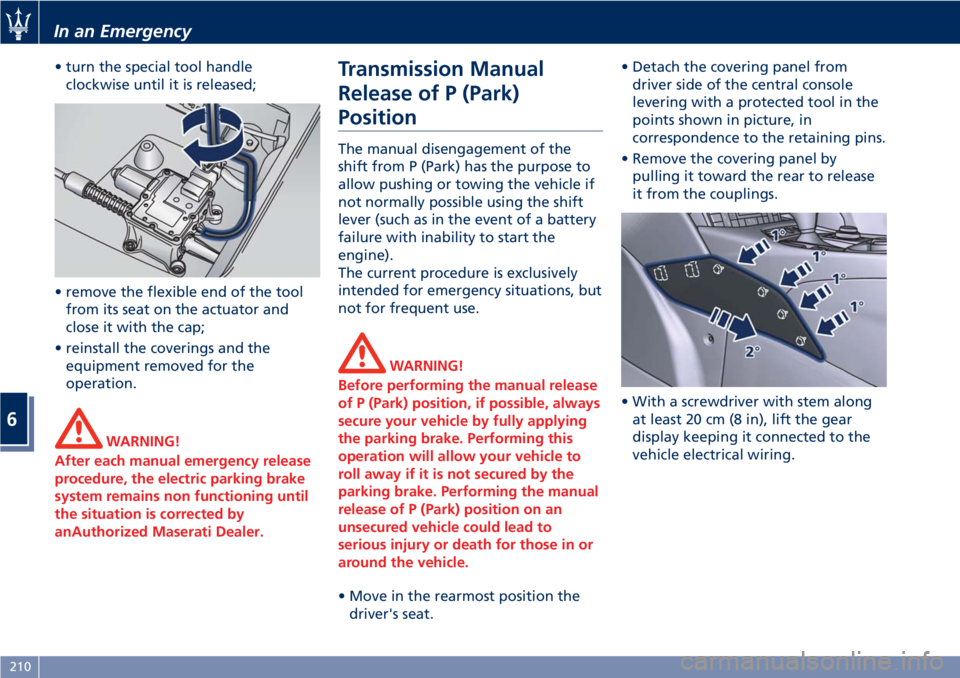
• turn the special tool handle
clockwise until it is released;
• remove the flexible end of the tool
from its seat on the actuator and
close it with the cap;
• reinstall the coverings and the
equipment removed for the
operation.
WARNING!
After each manual emergency release
procedure, the electric parking brake
system remains non functioning until
the situation is corrected by
anAuthorized Maserati Dealer. Transmission Manual
Release of P (Park)
Position The manual disengagement of the
shift from P (Park) has the purpose to
allow pushing or towing the vehicle if
not normally possible using the shift
lever (such as in the event of a battery
failure with inability to start the
engine).
The current procedure is exclusively
intended for emergency situations, but
not for frequent use.
WARNING!
Before performing the manual release
of P (Park) position, if possible, always
secure your vehicle by fully applying
the parking brake. Performing this
operation will allow your vehicle to
roll away if it is not secured by the
parking brake. Performing the manual
release of P (Park) position on an
unsecured vehicle could lead to
serious injury or death for those in or
around the vehicle.
• Move in the rearmost position the
driver's
seat. • Detach the covering panel from
driver side of the central console
levering with a protected tool in the
points shown in picture, in
correspondence to the retaining pins.
• Remove the covering panel by
pulling it toward the rear to release
it from the couplings.
• With a screwdriver with stem along
at least 20 cm (8 in), lift the gear
display keeping it connected to the
vehicle electrical wiring.In an Emergency
6
210
Page 226 of 286
Scheduled Maintenance
Service Correct maintenance is clearly the best
way to guarantee vehicle performance
and safety features, ensure respect for
the environment and low operating
costs.
NOTE:
Also remember that the scrupulous
observance of the maintenance
procedures is essential for keeping
your vehicle operating properly. Not
adhering to the “Scheduled Service
Plan” can impact your vehicle’s
warranty.
Interval Running Coupons Maserati has therefore provided for a
series of checks and maintenance
operations involving the 1 st
service
when the vehicle mileage reaches
12500 mi (20000 km) or after 2 years of
the vehicle's life, and subsequently
every 12500 mi (20000 km) or every 2
years.
After the 12 th
service, maintenance
must be restarted with the operations
scheduled for the 1 st
,2 nd
and 3 rd
service. CAUTION!
The Scheduled Maintenance services
are prescribed by the Manufacturer.
Failure to have the services carried out
can affect your warranty.
The Scheduled Maintenance service is
provided
by the whole Authorized
Maserati Dealer . In the event that,
when a service is performed, further
replacements or repairs are found to
be necessary in addition to the
scheduled operations, these can be
carried out only with the specific
consent of the Customer.
CAUTION!
You are advised to notify the
Authorized Maserati Dealer of any
minor operating problem, without
waiting for the next scheduled service.
NOTE:
• Change
your vehicle's oil if it has
been 2 years since your last oil
change.
• Change your engine oil more often if
you drive your vehicle off-road for an
extended period of time or short trips without reaching operation
temperature.
• Under no circumstances should oil
change intervals exceed 12500 mi
(20000 km) or at least after 2 years.
CAUTION!
Failure to perform the required
maintenance items may result in
damage to the vehicle.
Scheduled Maintenance
(Service) Indicator When the deadlines for maintenance
Scheduled Maintenance services are
approaching, a message on the
instrument cluster display indicates
that service is due. The deadline may
be expressed in miles/Km or days,
whichever comes first.
The message is displayed only once,
upon activating the instrument cluster,
at decreasing intervals expressed in
mi/km (100, 50...... 1800, 1600,) or in
days (27, 24, ....... 6, 3), accompanied
by the
specific symbol.Maintenance and Care
7
222
Page 231 of 286
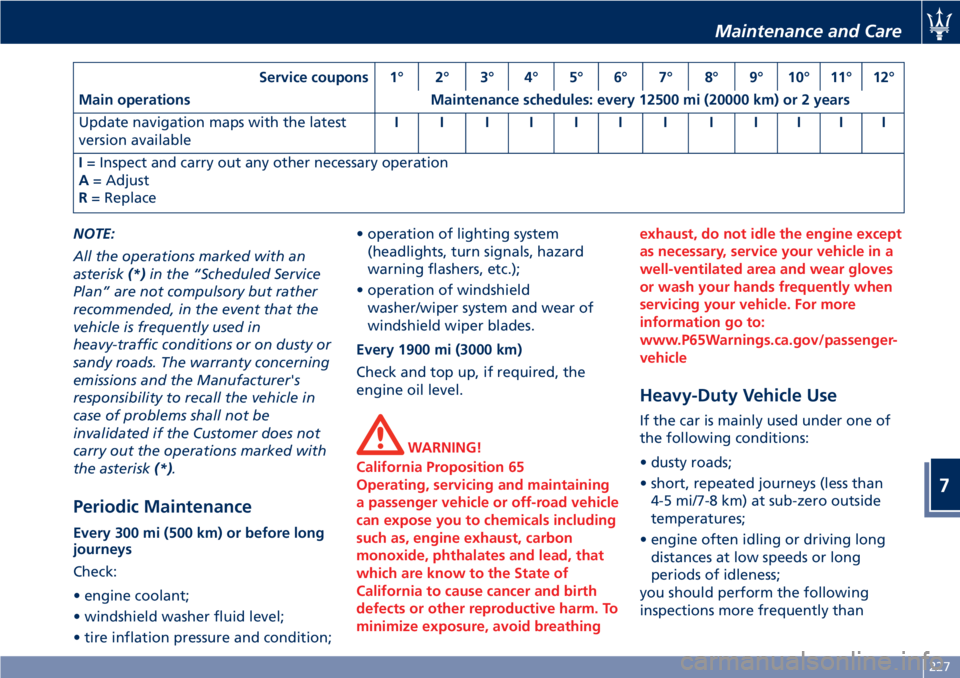
Service coupons 1° 2° 3° 4° 5° 6° 7° 8° 9° 10° 11° 12°
Main operations Maintenance schedules: every 12500 mi (20000 km) or 2 years
Update navigation maps with the latest
version available IIIIIIIIIIII
I = Inspect and carry out any other necessary operation
A = Adjust
R = Replace
NOTE:
All the operations marked with an
asterisk (*) in the “Scheduled Service
Plan” are not compulsory but rather
recommended, in the event that the
vehicle is frequently used in
heavy-traffic conditions or on dusty or
sandy roads. The warranty concerning
emissions and the Manufacturer's
responsibility to recall the vehicle in
case of problems shall not be
invalidated if the Customer does not
carry out the operations marked with
the asterisk (*) .
Periodic Maintenance Every 300 mi (500 km) or before long
journeys
Check:
• engine coolant;
• windshield washer fluid level;
• tire inflation pressure and condition; • operation of lighting system
(headlights, turn signals, hazard
warning flashers, etc.);
• operation of windshield
washer/wiper system and wear of
windshield wiper blades.
Every 1900 mi (3000 km)
Check and top up, if required, the
engine oil level.
WARNING!
California Proposition 65
Operating, servicing and maintaining
a passenger vehicle or off-road vehicle
can expose you to chemicals including
such as, engine exhaust, carbon
monoxide, phthalates and lead, that
which are know to the State of
California to cause cancer and birth
defects or other reproductive harm. To
minimize exposure, avoid breathing exhaust, do not idle the engine except
as necessary, service your vehicle in a
well-ventilated area and wear gloves
or wash your hands frequently when
servicing your vehicle. For more
information go to:
www.P65Warnings.ca.gov/passenger-
vehicle
Heavy-Duty Vehicle Use If the car is mainly used under one of
the following conditions:
• dusty roads;
• short, repeated journeys (less than
4-5 mi/7-8 km) at sub-zero outside
temperatures;
• engine often idling or driving long
distances at low speeds or long
periods of idleness;
you should perform the following
inspections more frequently thanMaintenance and Care
7
227
Page 235 of 286
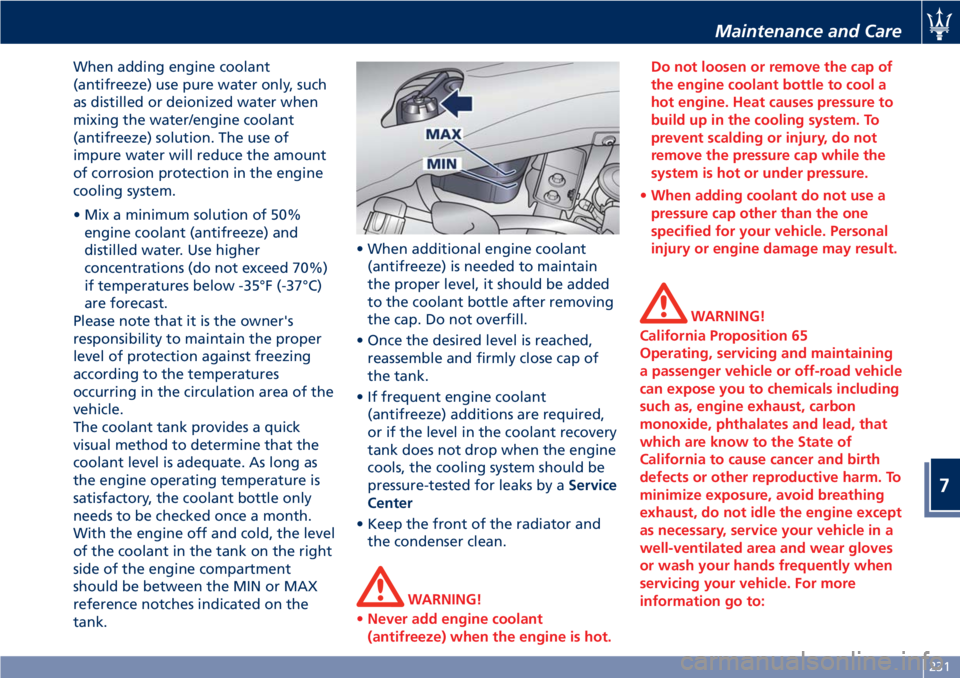
When adding engine coolant
(antifreeze) use pure water only, such
as distilled or deionized water when
mixing the water/engine coolant
(antifreeze) solution. The use of
impure water will reduce the amount
of corrosion protection in the engine
cooling system.
• Mix a minimum solution of 50%
engine coolant (antifreeze) and
distilled water. Use higher
concentrations (do not exceed 70%)
if temperatures below -35°F (-37°C)
are forecast.
Please note that it is the owner's
responsibility to maintain the proper
level of protection against freezing
according to the temperatures
occurring in the circulation area of the
vehicle.
The coolant tank provides a quick
visual method to determine that the
coolant level is adequate. As long as
the engine operating temperature is
satisfactory, the coolant bottle only
needs to be checked once a month.
With the engine off and cold, the level
of the coolant in the tank on the right
side of the engine compartment
should be between the MIN or MAX
reference notches indicated on the
tank. • When additional engine coolant
(antifreeze) is needed to maintain
the proper level, it should be added
to the coolant bottle after removing
the cap. Do not overfill.
• Once the desired level is reached,
reassemble and firmly close cap of
the tank.
• If frequent engine coolant
(antifreeze) additions are required,
or if the level in the coolant recovery
tank does not drop when the engine
cools, the cooling system should be
pressure-tested for leaks by a Service
Center
• Keep the front of the radiator and
the condenser clean.
WARNING!
• Never add engine coolant
(antifreeze) when the engine is hot. Do not loosen or remove the cap of
the engine coolant bottle to cool a
hot engine. Heat causes pressure to
build up in the cooling system. To
prevent scalding or injury, do not
remove the pressure cap while the
system is hot or under pressure.
• When adding coolant do not use a
pressure cap other than the one
specified for your vehicle. Personal
injury or engine damage may result.
WARNING!
California Proposition 65
Operating, servicing and maintaining
a passenger vehicle or off-road vehicle
can expose you to chemicals including
such as, engine exhaust, carbon
monoxide, phthalates and lead, that
which are know to the State of
California to cause cancer and birth
defects or other reproductive harm. To
minimize exposure, avoid breathing
exhaust, do not idle the engine except
as necessary, service your vehicle in a
well-ventilated area and wear gloves
or wash your hands frequently when
servicing your vehicle. For more
information go to:Maintenance and Care
7
231
Page 245 of 286
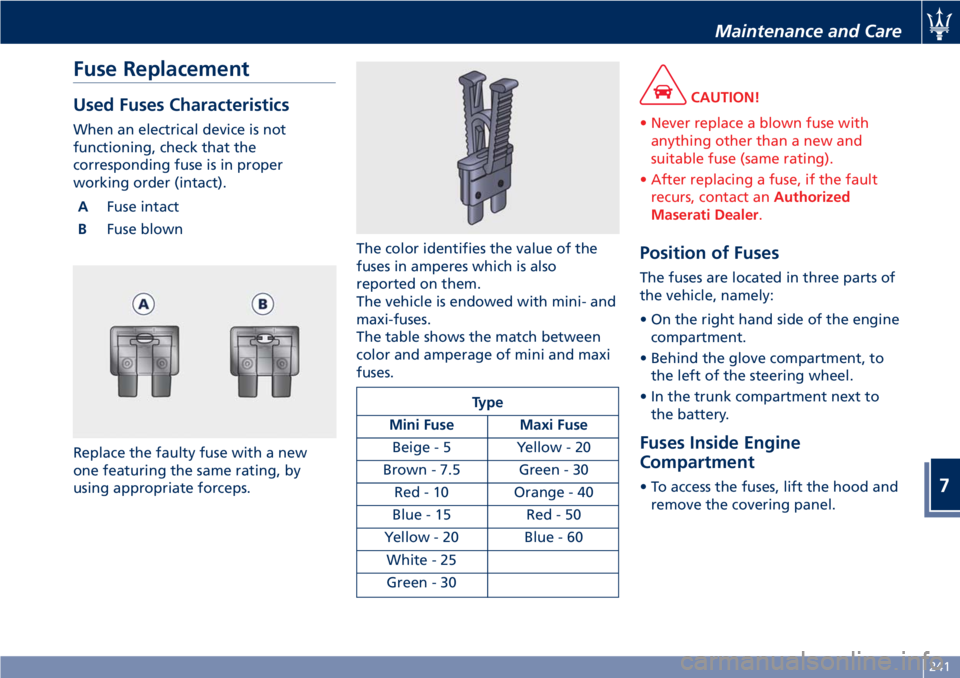
Fuse Replacement Used Fuses Characteristics When an electrical device is not
functioning, check that the
corresponding fuse is in proper
working order (intact).
A Fuse intact
B Fuse blown
Replace the faulty fuse with a new
one featuring the same rating, by
using appropriate forceps. The color identifies the value of the
fuses in amperes which is also
reported on them.
The vehicle is endowed with mini- and
maxi-fuses.
The table shows the match between
color and amperage of mini and maxi
fuses.
Type
Mini Fuse Maxi Fuse
Beige - 5 Yellow - 20
Brown - 7.5 Green - 30
Red - 10 Orange - 40
Blue - 15 Red - 50
Yellow - 20 Blue - 60
White - 25
Green - 30 CAUTION!
• Never replace a blown fuse with
anything other than a new and
suitable fuse (same rating).
• After replacing a fuse, if the fault
recurs, contact an Authorized
Maserati Dealer .
Position of Fuses The fuses are located in three parts of
the vehicle, namely:
• On the right hand side of the engine
compartment.
• Behind the glove compartment, to
the left of the steering wheel.
• In the trunk compartment next to
the battery.
Fuses Inside Engine
Compartment • To access the fuses, lift the hood and
remove the covering panel.Maintenance and Care
7
241