transmission MASERATI GRANTURISMO 2020 Service Manual
[x] Cancel search | Manufacturer: MASERATI, Model Year: 2020, Model line: GRANTURISMO, Model: MASERATI GRANTURISMO 2020Pages: 286, PDF Size: 6.7 MB
Page 219 of 286
open flames or cigarettes that could
generate sparks.
NOTE:
If you need to disconnect the battery
from the vehicle electrical system, see
“Maintenance - Free Battery” in
section “Maintenance and Care”).
Access the Battery
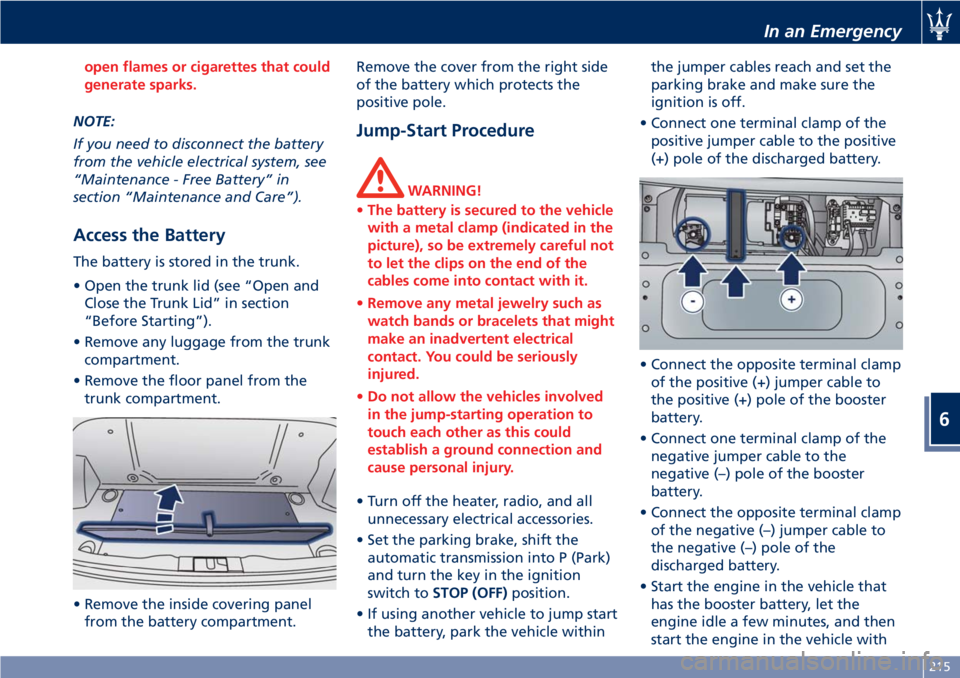
The battery is stored in the trunk.
• Open the trunk lid (see “Open and
Close the Trunk Lid” in section
“Before Starting”).
• Remove any luggage from the trunk
compartment.
• Remove the floor panel from the
trunk compartment.
• Remove the inside covering panel
from the battery compartment.Remove the cover from the right side
of the battery which protects the
positive pole.
Jump-Start Procedure
WARNING!
•The battery is secured to the vehicle
with a metal clamp (indicated in the
picture), so be extremely careful not
to let the clips on the end of the
cables come into contact with it.
•Remove any metal jewelry such as
watch bands or bracelets that might
make an inadvertent electrical
contact. You could be seriously
injured.
•Do not allow the vehicles involved
in the jump-starting operation to
touch each other as this could
establish a ground connection and
cause personal injury.
• Turn off the heater, radio, and all
unnecessary electrical accessories.
• Set the parking brake, shift the
automatic transmission into P (Park)
and turn the key in the ignition
switch toSTOP (OFF)position.
• If using another vehicle to jump start
the battery, park the vehicle withinthe jumper cables reach and set the
parking brake and make sure the
ignition is off.
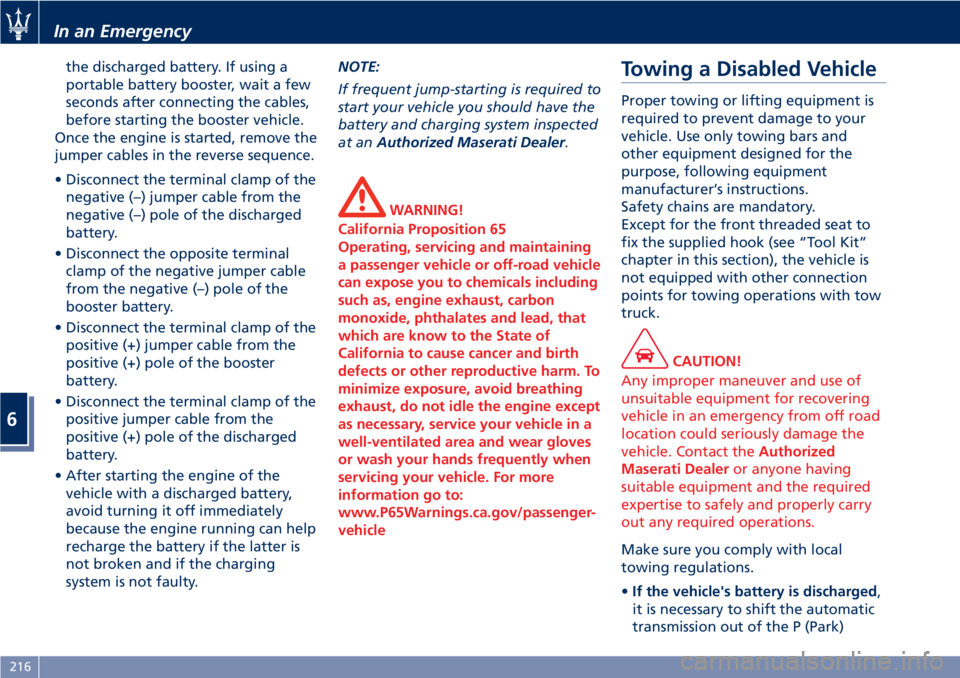
• Connect one terminal clamp of the
positive jumper cable to the positive
(+) pole of the discharged battery.
• Connect the opposite terminal clamp
of the positive (+) jumper cable to
the positive (+) pole of the booster
battery.
• Connect one terminal clamp of the
negative jumper cable to the
negative (–) pole of the booster
battery.
• Connect the opposite terminal clamp
of the negative (–) jumper cable to
the negative (–) pole of the
discharged battery.
• Start the engine in the vehicle that
has the booster battery, let the
engine idle a few minutes, and then
start the engine in the vehicle with
In an Emergency
6
215
Page 220 of 286
the discharged battery. If using a
portable battery booster, wait a few
seconds after connecting the cables,
before starting the booster vehicle.
Once the engine is started, remove the
jumper cables in the reverse sequence.
• Disconnect the terminal clamp of the
negative (–) jumper cable from the
negative (–) pole of the discharged
battery.
• Disconnect the opposite terminal
clamp of the negative jumper cable
from the negative (–) pole of the
booster battery.
• Disconnect the terminal clamp of the
positive (+) jumper cable from the
positive (+) pole of the booster
battery.
• Disconnect the terminal clamp of the
positive jumper cable from the
positive (+) pole of the discharged
battery.
• After starting the engine of the
vehicle with a discharged battery,
avoid turning it off immediately
because the engine running can help
recharge the battery if the latter is
not broken and if the charging
system is not faulty.NOTE:
If frequent jump-starting is required to
start your vehicle you should have the
battery and charging system inspected
at anAuthorized Maserati Dealer.
WARNING!
California Proposition 65
Operating, servicing and maintaining
a passenger vehicle or off-road vehicle
can expose you to chemicals including
such as, engine exhaust, carbon
monoxide, phthalates and lead, that
which are know to the State of
California to cause cancer and birth
defects or other reproductive harm. To
minimize exposure, avoid breathing
exhaust, do not idle the engine except
as necessary, service your vehicle in a
well-ventilated area and wear gloves
or wash your hands frequently when
servicing your vehicle. For more
information go to:
www.P65Warnings.ca.gov/passenger-
vehicle
Towing a Disabled Vehicle
Proper towing or lifting equipment is
required to prevent damage to your
vehicle. Use only towing bars and
other equipment designed for the
purpose, following equipment
manufacturer’s instructions.
Safety chains are mandatory.
Except for the front threaded seat to
fix the supplied hook (see “Tool Kit”
chapter in this section), the vehicle is
not equipped with other connection
points for towing operations with tow
truck.
CAUTION!
Any improper maneuver and use of
unsuitable equipment for recovering
vehicle in an emergency from off road
location could seriously damage the
vehicle. Contact theAuthorized
Maserati Dealeror anyone having
suitable equipment and the required
expertise to safely and properly carry
out any required operations.
Make sure you comply with local
towing regulations.
•If the vehicle's battery is discharged,
it is necessary to shift the automatic
transmission out of the P (Park)
In an Emergency
6
216
Page 221 of 286
Position and release the parking
brake (see “ Transmission Manual
Release of P (Park) position” and
“Emergency Release of the Parking
Brake” in this section).
•If the vehicle battery is still charged,
turn off the engine and disengage
the parking brake manually (if
automatically engaged) by using the
command at the side of the
transmission shift lever (see “Parking
Brake” chapter in section “Driving”).
Shift then manually the transmission
out of P (Park) as described in
“Transmission Manual Release of P
(Park) Position” chapter of this
section. If you need to use the
accessories (wipers, defrosters, etc.)
while being towed, the key in the
ignition switch must be turned in
MAR (ON)position, do not use the
ACCposition.
Vehicle Towing Conditions
Maserati only allows vehicle towing
either on a flatbed or with all four
wheels off the ground.
If flatbed equipment is not available,
and the transmission is still operable,
the vehicle may be flat towed (with all
four wheels on the ground) under the
following conditions.• The shift lever must be in N
(Neutral).
• The distance to be traveled must not
exceed 30 mi (50 km ).
• The towing speed must not exceed
30 mph (50 km/h).
If the transmission is not operable, or
the vehicle must be towed faster than
30 mph (50 km/h ) or farther than 30
mi (50 km) (for example on a
highway), tow with the rear driving
wheels off the ground and on a
platform of a rescue vehicle, or with
the rear wheels raised using a wheel
lift.
CAUTION!
If you have to tow the vehicle with 2
wheels raised, ensure that the key in
the ignition switch is in theSTOP (OFF)
position. If this is not observed, when
the ESC is active, the ECU will store a
malfunction and the relative indicator
light
will illuminate on the
instrument cluster display. This
requires the intervention of an
Authorized Maserati Dealerto reset
the system.
Use the Vehicle Tow Hook of
the Tool Kit
CAUTION!
The tow hook should only be used for
towing the car on flat roads. Do not
use the tow hook to remove the car
that is stuck on off road stretches.
The tow hook can also be used to tow
the vehicle on the platform of a tow
truck.
It is necessary to inform the operators
of the rescue vehicle about the vehicle
minimum height to avoid, during its
loading, any contact of the lower ends
of the front or rear bumper with the
tow truck loading ramp.
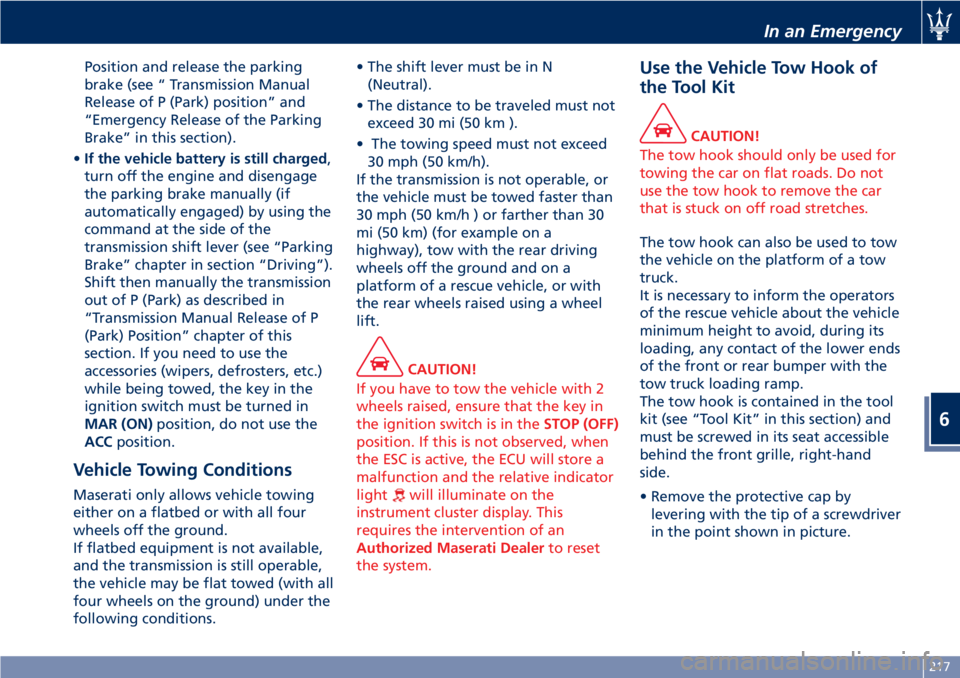
The tow hook is contained in the tool
kit (see “Tool Kit” in this section) and
must be screwed in its seat accessible
behind the front grille, right-hand
side.
• Remove the protective cap by
levering with the tip of a screwdriver
in the point shown in picture.
In an Emergency
6
217
Page 229 of 286
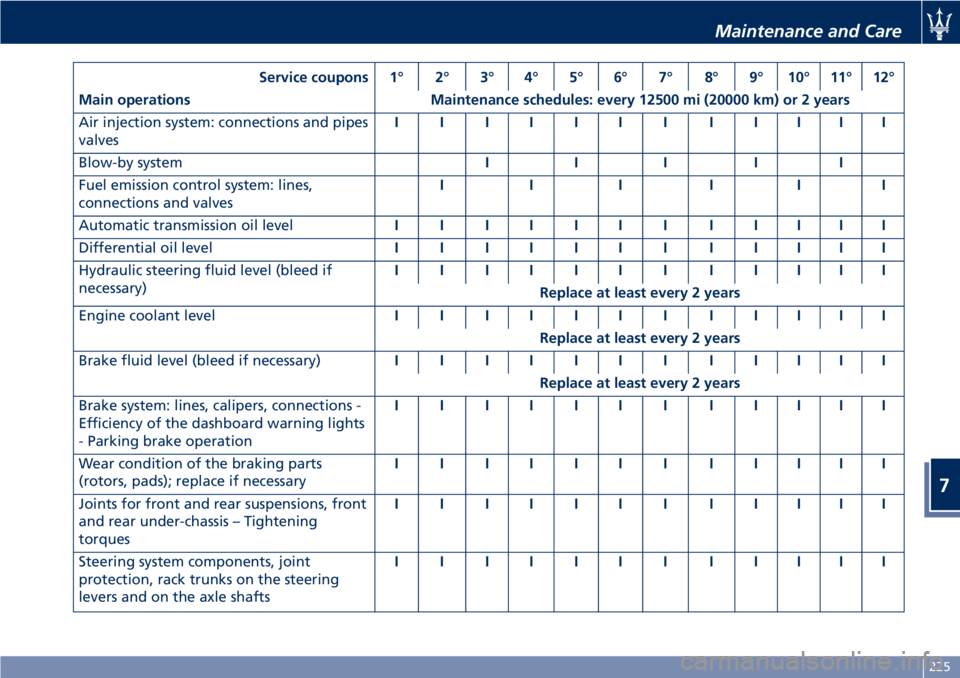
Service coupons 1° 2° 3° 4° 5° 6° 7° 8° 9° 10° 11° 12°
Main operations Maintenance schedules: every 12500 mi (20000 km) or 2 years
Air injection system: connections and pipes
valvesIIIIIIIIIIII
Blow-by systemIII II
Fuel emission control system: lines,
connections and valvesIII III
Automatic transmission oil levelIIIIIIIIIIII
Differential oil levelIIIIIIIIIIII
Hydraulic steering fluid level (bleed if
necessary)IIIIIIIIIIII
Replace at least every 2 years
Engine coolant levelIIIIIIIIIIII
Replace at least every 2 years
Brake fluid level (bleed if necessary)IIIIIIIIIIII
Replace at least every 2 years
Brake system: lines, calipers, connections -
Efficiency of the dashboard warning lights
- Parking brake operationIIIIIIIIIIII
Wear condition of the braking parts
(rotors, pads); replace if necessaryIIIIIIIIIIII
Joints for front and rear suspensions, front
and rear under-chassis – Tightening
torquesIIIIIIIIIIII
Steering system components, joint
protection, rack trunks on the steering
levers and on the axle shaftsIIIIIIIIIIII
Maintenance and Care
7
225
Page 232 of 286
recommended on the “Scheduled
Service Plan”:
• check front disc brake pad conditions
and wear;
• check cleanliness of hood and trunk
locks, cleanliness and lubrication of
linkage;
• visually inspect conditions of: engine,
transmission, pipes and hoses
(exhaust - fuel system - brakes) and
rubber elements (trunks - sleeves -
bushes - etc.);
• check battery charge;
• visually inspect condition of the
accessory drive belts;
• check and, if necessary, change
engine oil and replace oil filter;
• check and, if necessary, replace
pollen filter of the A/C system;
• check and, if necessary, replace air
cleaner filter.
CAUTION!
All maintenance operations for the
vehicle must be carried out by the
Authorized Maserati Dealer. For
routine and minor maintenance
operations which you can carry out
yourself, make sure that you have the
necessary experience and always usesuitable equipment, originalMaserati
spare parts (or equivalent) and the
prescribed fluids. Shall this not be the
case, do not carry any operation on
your own and contact anAuthorized
Maserati Dealer.
Onboard Diagnostic System
Your vehicle is equipped with a
sophisticated onboard diagnostic
system. This system monitors the
performance of the emissions, engine,
and automatic transmission control
systems. When these systems are
operating properly, your vehicle will
provide excellent performance and
fuel economy, as well as engine
emissions suited to current
government regulations.
If any of these systems require service,
the system will turn on the
Malfunction Indicator Light on the
instrument cluster display (refer to
“Instrument Cluster” in section
“Dashboard Instruments and
Controls”). The system stores as well
diagnostic codes and other
information to assist your service
technician by performing repairs.
Although the vehicle will be driveable
and will not need towing, contact anAuthorized Maserati Dealerfor service
as soon as possible.
CAUTION!
• Prolonged driving with the
MIL
on could cause further damage to
the emissions control system. It could
also affect fuel economy and
drivability. The vehicle must be
serviced before any emissions tests
can be performed.
•Ifthe
MIL is flashing while the
engine is running, severe catalytic
converter damage and power loss
will soon occur. Immediate service at
theAuthorized Maserati Dealeris
required.
Spare Parts
Use of genuine parts for normal or
scheduled maintenance and repairs is
highly recommended to ensure
excellent performance.
Damage or failures caused by
non-genuine spare parts used for
maintenance and repairs will not be
covered by the manufacturer's
warranty.
Maintenance and Care
7
228
Page 233 of 286
Maintenance Procedures
The following pages contain the
“required” maintenance standards
determined by Maserati engineers.
Besides those maintenance items
specified in the “Scheduled Service
Plan”, there are other components
which may require service or
replacement in the future.
To perform most of the services, it is
necessary to open the hood (see
“Open and Close the Hood” in section
“Before Starting”).
The following images show the
position of all components involved in
the maintenance service.
CAUTION!
• Failure to properly maintain your
vehicle or perform repairs and
service when necessary could result
in more costly repairs, damage to
other components or negatively
impact vehicle performance.
Immediately have potential
malfunctions examined by an
Authorized Maserati Dealeror a
qualified repair center.
• Your vehicle has been equipped with
improved fluids that protect the
performance and durability of yourvehicle and also allow extended
maintenance intervals. Do not use
chemical flushes for washing as the
chemicals can damage your engine,
transmission, power steering or air
conditioning. Such damages are not
covered by the New Vehicle Limited
Warranty. If a flush is needed
because of component malfunction,
use only a specific product for the
flushing procedure.
Maintenance and Care
7
229
Page 239 of 286
• Return the cap and dipstick to their
position and wait for a few minutes
to allow the oil to reach the oil pan.
• Check the level again.
After topping up, the
engine oil
level warning light may not go off for
some time while the system is
performing the necessary checks. This
is normal.
Engine Oil Filter Replacement
The engine oil filter should be
replaced with a new filter at every oil
change.
Contact anAuthorized Maserati
Dealerto perform this service.
Automatic Transmission Oil Check
Contact anAuthorized Maserati
Dealerfor the oil level check.
Power Steering Fluid Level Check
With the vehicle on a level ground
and the engine cold, check the fluid
level of the power steering reservoir.
• To carry out the check, unscrew the
cap, clean the dipstick with a dry and
clean cloth.
• Retighten the cap then unscrew it
again and check the level: it should
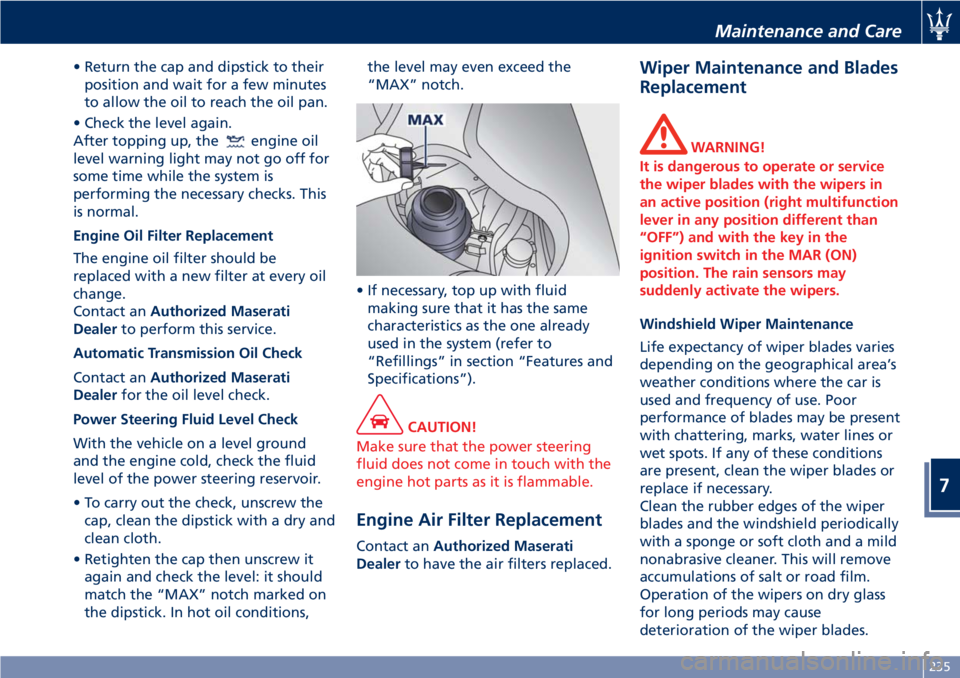
match the “MAX” notch marked on
the dipstick. In hot oil conditions,the level may even exceed the
“MAX” notch.
• If necessary, top up with fluid
making sure that it has the same
characteristics as the one already
used in the system (refer to
“Refillings” in section “Features and
Specifications”).
CAUTION!
Make sure that the power steering
fluid does not come in touch with the
engine hot parts as it is flammable.
Engine Air Filter Replacement
Contact anAuthorized Maserati
Dealerto have the air filters replaced.
Wiper Maintenance and Blades
Replacement
WARNING!
It is dangerous to operate or service
the wiper blades with the wipers in
an active position (right multifunction
lever in any position different than
“OFF”) and with the key in the
ignition switch in the MAR (ON)
position. The rain sensors may
suddenly activate the wipers.
Windshield Wiper Maintenance
Life expectancy of wiper blades varies
depending on the geographical area’s
weather conditions where the car is
used and frequency of use. Poor
performance of blades may be present
with chattering, marks, water lines or
wet spots. If any of these conditions
are present, clean the wiper blades or
replace if necessary.
Clean the rubber edges of the wiper
blades and the windshield periodically
with a sponge or soft cloth and a mild
nonabrasive cleaner. This will remove
accumulations of salt or road film.
Operation of the wipers on dry glass
for long periods may cause
deterioration of the wiper blades.
Maintenance and Care
7
235
Page 264 of 286
Restarting the Vehicle
Before restarting the vehicle after a
long period of inactivity, we
recommend that you carry out the
following operations.
• Check the tires for pressure and for
any damages, cuts or cracks. If this is
the case, have them replaced.
• Do not dry-rub the external surface
of the vehicle.
• Visually inspect if there are any fluid
leaks (oil, brake and clutch fluid,
engine coolant etc.).
• Have the engine oil and filter
replaced.
• Check the fluid levels in the brake
system, as well as the engine coolant
level.
• Check the air filter and have them
replaced if necessary.
• Reconnect the battery after checking
the charge status (refer to
“Maintenance-Free Battery” in this
section) and perform the initializing
procedure if applicable.
• With the transmission in N (Neutral),
let the engine idle for several
minutes.WARNING!
The engine idle must be performed
outdoors. Exhaust gases contain
carbon monoxide which is strongly
toxic and potentially lethal.
WARNING!
California Proposition 65
Operating, servicing and maintaining
a passenger vehicle or off-road vehicle
can expose you to chemicals including
such as, engine exhaust, carbon
monoxide, phthalates and lead, that
which are know to the State of
California to cause cancer and birth
defects or other reproductive harm. To
minimize exposure, avoid breathing
exhaust, do not idle the engine except
as necessary, service your vehicle in a
well-ventilated area and wear gloves
or wash your hands frequently when
servicing your vehicle. For more
information go to:
www.P65Warnings.ca.gov/passenger-
vehicle
Battery Statement
Battery Statement Status of
Charge
To avoid problems with ignition and/or
the electrical system in general when
you are driving, the battery charge
status is constantly maintained and
guaranteed by the vehicle's recharge
circuit; the main component of which
is the alternator. This circuit is only
able to supply voltage to the battery
when the vehicle is traveling.
The
warning light on the
instrument cluster (see “Instrument
Cluster” in section “Dashboard
Instruments and Controls”), will
indicate any malfunctions in the
recharge circuit or an insufficient
battery charge status (flashing).
The vehicle is fitted with advanced
electronic systems, such as, for
example, the alarm system and various
electronic control modules, which
consume power even when the key in
the ignition switch is in theSTOP (OFF)
position and the vehicle is not being
used.
Therefore, it is fundamental that the
battery is properly charged to ensure
that the engine starts properly and
Maintenance and Care
7
260
Page 271 of 286
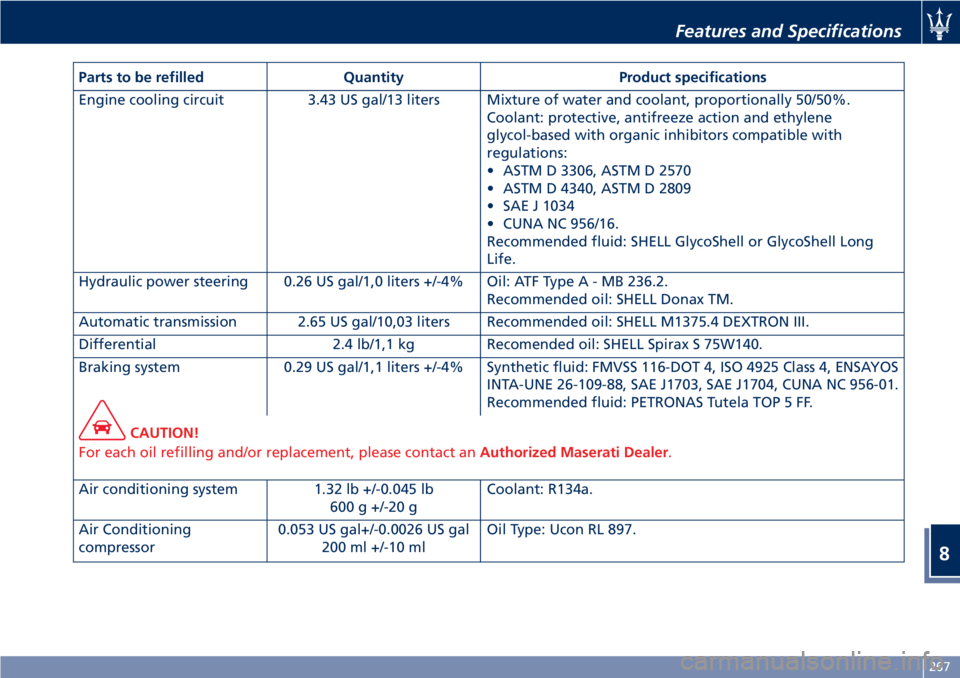
Parts to be refilled Quantity Product specifications
Engine cooling circuit 3.43 US gal/13 liters Mixture of water and coolant, proportionally 50/50%.
Coolant: protective, antifreeze action and ethylene
glycol-based with organic inhibitors compatible with
regulations:
• ASTM D 3306, ASTM D 2570
• ASTM D 4340, ASTM D 2809
• SAE J 1034
• CUNA NC 956/16.
Recommended fluid: SHELL GlycoShell or GlycoShell Long
Life.
Hydraulic power steering 0.26 US gal/1,0 liters +/-4% Oil: ATF TypeA-MB236.2.
Recommended oil: SHELL Donax TM.
Automatic transmission 2.65 US gal/10,03 liters Recommended oil: SHELL M1375.4 DEXTRON III.
Differential 2.4 lb/1,1 kg Recomended oil: SHELL Spirax S 75W140.
Braking system 0.29 US gal/1,1 liters +/-4% Synthetic fluid: FMVSS 116-DOT 4, ISO 4925 Class 4, ENSAYOS
INTA-UNE 26-109-88, SAE J1703, SAE J1704, CUNA NC 956-01.
Recommended fluid: PETRONAS Tutela TOP 5 FF.
CAUTION!
For each oil refilling and/or replacement, please contact anAuthorized Maserati Dealer.
Air conditioning system 1.32 lb +/-0.045 lb
600 g +/-20 gCoolant: R134a.
Air Conditioning
compressor0.053 US gal+/-0.0026 US gal
200 ml +/-10 mlOil Type: Ucon RL 897.
Features and Specifications
8
267
Page 275 of 286
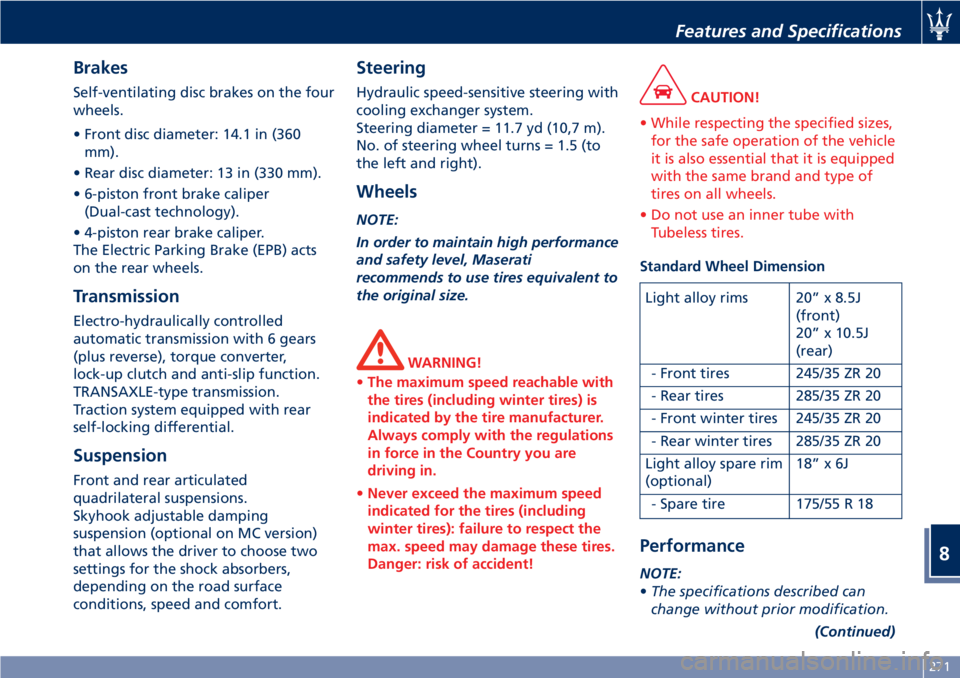
Brakes
Self-ventilating disc brakes on the four
wheels.
• Front disc diameter: 14.1 in (360
mm).
• Rear disc diameter: 13 in (330 mm).
• 6-piston front brake caliper
(Dual-cast technology).
• 4-piston rear brake caliper.
The Electric Parking Brake (EPB) acts
on the rear wheels.
Transmission
Electro-hydraulically controlled
automatic transmission with 6 gears
(plus reverse), torque converter,
lock-up clutch and anti-slip function.
TRANSAXLE-type transmission.
Traction system equipped with rear
self-locking differential.
Suspension
Front and rear articulated
quadrilateral suspensions.
Skyhook adjustable damping
suspension (optional on MC version)
that allows the driver to choose two
settings for the shock absorbers,
depending on the road surface
conditions, speed and comfort.
Steering
Hydraulic speed-sensitive steering with
cooling exchanger system.
Steering diameter = 11.7 yd (10,7 m).
No. of steering wheel turns = 1.5 (to
the left and right).
Wheels
NOTE:
In order to maintain high performance
and safety level, Maserati
recommends to use tires equivalent to
the original size.
WARNING!
•The maximum speed reachable with
the tires (including winter tires) is
indicated by the tire manufacturer.
Always comply with the regulations
in force in the Country you are
driving in.
•Never exceed the maximum speed
indicated for the tires (including
winter tires): failure to respect the
max. speed may damage these tires.
Danger: risk of accident!
CAUTION!
• While respecting the specified sizes,
for the safe operation of the vehicle
it is also essential that it is equipped
with the same brand and type of
tires on all wheels.
• Do not use an inner tube with
Tubeless tires.
Standard Wheel Dimension
Light alloy rims 20” x 8.5J
(front)
20” x 10.5J
(rear)
- Front tires 245/35 ZR 20
- Rear tires 285/35 ZR 20
- Front winter tires 245/35 ZR 20
- Rear winter tires 285/35 ZR 20
Light alloy spare rim
(optional)18”x6J
- Spare tire 175/55 R 18
Performance
NOTE:
•The specifications described can
change without prior modification.
(Continued)
Features and Specifications
8
271