lock MASERATI GRANTURISMO 2020 Workshop Manual
[x] Cancel search | Manufacturer: MASERATI, Model Year: 2020, Model line: GRANTURISMO, Model: MASERATI GRANTURISMO 2020Pages: 286, PDF Size: 6.7 MB
Page 171 of 286
engage the parking brake, but also to
shift the transmission shift lever to P
(Park) before leaving the vehicle.
When parking on hill roads, it is
important to turn the front wheels
toward the curb on a downhill grade
and away from the curb on an uphill
grade.
Apply the parking brake before
placing the shift lever in P (Park),
otherwise the load on the
transmission locking mechanism may
make it difficult to move the shift
lever out of P (Park).
In certain conditions, it is however
advisable to disengage the parking
brake manually and slightly apply the
service brake for starting off. This is
advisable when there are obstacles
very close to the vehicle in the
direction in which you intend to move.
Brake and Stability
Control System
The vehicle is equipped with an
Electronic Stability Control (ESC)
anti-yawing system, which helps to
maintain directional control in the event
of loss of grip of the tires. The system is
able to detect potentially dangerous
situations for the stability of the vehicle
and automatically sets the brakes on all
four wheels in a differentiated manner,
in order to provide a torque settlement
of the vehicle.
ESC includes the following subsystems:
• ASR (Anti-Slip Regulation)
• ABS (Anti-lock Braking System)
• EBD (Electronic Brake-force
Distribution)
• HBA (Hydraulic Brake Assistance)
• BOS (Brake Override System)
WARNING!
•These systems cannot prevent the
natural laws of physics from
affecting the vehicle, nor can they
increase traction, braking or steering
efficiency beyond that afforded by
the condition of the vehicle brakes
and tires.•These systems cannot prevent
collisions, including those resulting
from excessive speed in turns,
following another vehicle too
closely, or hydroplaning.
•The capabilities of a vehicle
equipped with these systems must
never be exploited in a reckless or
dangerous manner that could
jeopardize the driver’s and the
passenger’s safety or the safety of
others.
Electronic Stability Control
(ESC)
This system enhances directional
control and stability of the vehicle
under various driving conditions. The
ESC corrects over steering and under
steering of the vehicle by applying the
brake to the appropriate wheel.
Engine power may also be reduced to
assist in counteracting the conditions
of instability and maintain the right
direction. The system is also able to
reduce the engine power.
Through sensors fitted on the vehicle,
the ESC system detects the driver’s
chosen direction comparing it to the
one maintained while running. In case
of discrepancy between the required
trajectory and the current one, the
Driving
5
167
Page 173 of 286
• in the event of loss of grip on wet
roads (aquaplaning).
The ASR system works in combination
with the electronic suspension control
system: in normal conditions (SPORT
mode off), stability in low and
medium grip conditions has priority,
while with SPORT mode active, the
system favors traction, thereby
optimizing vehicle performance on dry
asphalt.
The ASR system is automatically
activated every time the engine is
started and can be deactivated by
pressing
(ESC Off) button (see
"Drive Mode" in this section).
ASR System Failure
In the event of a fault, the system is
automatically disabled and cannot be
re-activated. While driving, this
condition is signaled by the
amber
warning light on the instrument
cluster display, which illuminates
together with the message “ASR
unavailable go to dealer”. Also the
(ESC On) amber warning light
illuminates inside the tachometer with
the message indicating that the ESC
system is unavailable. In this case drive
with the greatest care and have the
system immediately checked by the
nearestAuthorized Maserati Dealer.MSR Function
The ASR system also controls the
engine braking torque when the
accelerator pedal is released under
low grip conditions (e.g., snow, ice,
etc.): in these conditions, the high
braking torque provided by the
engine may cause instability of the
vehicle.
The system, using the same sensors as
the ABS, detects skidding of one or
both driving wheels when the
accelerator is released and opens the
motor-driven throttle of the engine
fuel system thereby reducing the
braking torque and re-establishing the
maximum grip conditions for the
driving wheels.
WARNING!
The maximum deceleration that can
be obtained with the engine brake
always depends on the tire grip on
the road surface. Snow or ice
obviously reduce grip values.
WARNING!
California Proposition 65
Operating, servicing and maintaining
a passenger vehicle or off-road vehiclecan expose you to chemicals including
such as, engine exhaust, carbon
monoxide, phthalates and lead, that
which are know to the State of
California to cause cancer and birth
defects or other reproductive harm. To
minimize exposure, avoid breathing
exhaust, do not idle the engine except
as necessary, service your vehicle in a
well-ventilated area and wear gloves
or wash your hands frequently when
servicing your vehicle. For more
information go to:
www.P65Warnings.ca.gov/passenger-
vehicle
Anti-Lock Braking System (ABS)
and Electronic Brake-force
Distribution (EBD)
The Anti-Lock Brake System (ABS)
provides increased vehicle stability and
brake performance under most
braking conditions. The system
automatically “pumps” the brakes
during severe braking to prevent
wheel lock-up.
The Electronic Brake-force Distribution
(EBD) prevents the rear wheels from
over-braking and provides greater
control of available braking forces
applied to the rear axle.
Driving
5
169
Page 174 of 286
WARNING!
The ABS helps prevent the wheels
from locking, but it does not increase
the physical grip limits between the
tires and the road. Therefore, always
keep a safe distance from the vehicle
in front of yours and reduce your
speed when entering a curve.
NOTE:
•When the vehicle's speed is higher
than 7 mph (11 km/h), you may also
hear a slight clicking sound as well as
other motor noises. The system is
performing a self-check cycle to
ensure that the ABS is working
properly.
•This self-check occurs each time the
vehicle is started and accelerated
past 7 mph (11 km/h).
ABS is activated during braking under
certain road or stopping conditions.
ABS-inducing conditions can include
ice, snow, gravel, bumps, railroad
tracks, loose debris.
You may also experience the following
when the brake system goes into Anti-
Lock:• The ABS motor running (it may
continue to run for a short time after
the vehicle stops).
• The clicking sound of solenoid valves.
• Brake pedal pulsations.
• A slight drop or fall away of the
brake pedal at the end of the stop.
These are all normal characteristics of
ABS functioning.WARNING!
•The ABS contains sophisticated
electronic equipment that may be
susceptible to interference caused by
improperly-installed or high-output
radio transmitting equipment. This
interference can cause possible loss
of anti-lock braking capability.
Installation of such equipment
should be performed by qualified
Maserati personnel.
•Pumping the Anti-Lock Brakes will
diminish their effectiveness and may
lead to a collision. Pumping brakes
makes the stopping distance longer.
Just press firmly and continuously on
your brake pedal when you need to
slow down or stop
ABS and EBD System Failure
In the event of a failure the ABS
system will be deactivated, but this will
not affect the efficiency of the
standard braking system.
The failure will be indicated by the
illumination of the
amber warning
light on the instrument cluster.
An EBD system failure is indicated by
the illumination of the
red
warning light on the instrument
cluster.
In this case we recommend that you
contact the nearestAuthorized
Maserati Dealerin order to identify
the fault as soon as possible, by means
of the system self-diagnostic function.
WARNING!
•The
failure warning light usually
illuminates with the engine running
to indicate a malfunction in the ABS
system only. In this case, the braking
system will remain fully functioning,
but will not use the ABS. In these
conditions, also the EBD system
efficiency may be affected. Drive
with the greatest care in order to
avoid sudden braking and have the
system immediately checked by the
Driving
5
170
Page 175 of 286
nearest Centre of the Authorized
Maserati Dealer.
•The
warning light illuminates
when the engine is running to
indicate an EBD system malfunction.
In this case, sharp braking may
cause an early locking of the rear
wheels, and the vehicle may skid.
Drive with the greatest care and
have the system immediately
checked by the nearest Centre of the
Authorized Maserati Dealer.
Hydraulic Brake Assistance
(HBA)
HBA completes the ABS system by
optimizing the vehicle braking
capacity during emergency braking.
In the event of a critical situation,
where the vehicle must stop in the
shortest possible distance, the driver
usually depresses the brake pedal
quickly, but often not strongly
enough: this increases the braking
distance. HBA has been designed to
solve this problem and acts by
applying the maximum braking force
during emergency braking, in order to
stop the vehicle in the shortest
possible distance.
HBA recognizes the emergency
condition by analyzing someparameters, such as the pressure on
the brake servo, the wheel speed and
activation of the third stop. The ABS
control unit cross-checks this data and
substitutes the driver by activating the
braking system’s full power and so
ensures optimal braking performance
in the shortest possible distance.
Brake Override System (BOS)
To complete the range of systems that
assist braking, the vehicle is equipped
withBOS, which is designed to stop
the vehicle even when it is being
accelerated. If the brake pedal is
depressed together with the
accelerator, the engine power should
be automatically reduced and, if the
driver continues to depress the
accelerator, the system may even cause
the vehicle to come to a complete
stop.
Additionally, if the brake pedal is
released when the accelerator is still
depressed, the corresponding engine
torque can be reached gradually.
Using the Brakes
CAUTION!
To obtain a good performance of
brake pads and discs, avoid sudden
braking during the first 190 mi
(300 km).
The pad wear limit is indicated by the
illumination
of the
warning light,
on the instrument cluster display.
In this event, please contact an
Authorized Maserati Dealer.
WARNING!
•Riding the brakes can lead to brake
failure and possibly an accident.
Driving with your foot resting or
riding on the brake pedal can result
in abnormally high brake
temperatures, excessive lining wear,
and possible brake damage. In an
emergency full braking capacity may
be impaired.
•If the
red warning light
illuminates when the engine is
running with the message that
indicates an insufficient brake fluid
level, stop the vehicle and check the
(Continued)
Driving
5
171
Page 196 of 286
Refueling
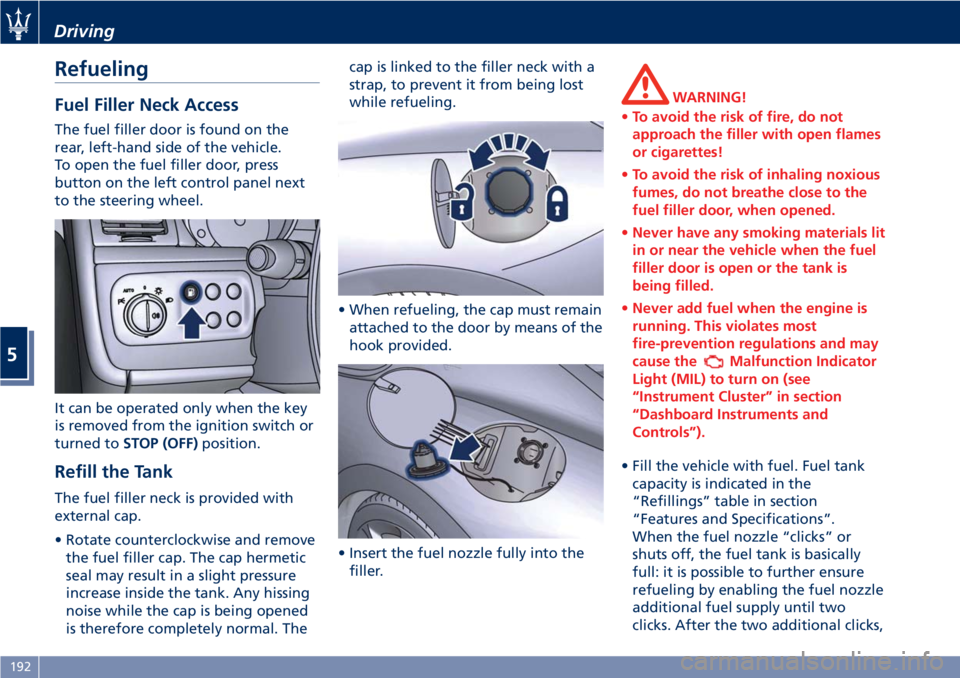
Fuel Filler Neck Access
The fuel filler door is found on the
rear, left-hand side of the vehicle.
To open the fuel filler door, press
button on the left control panel next
to the steering wheel.
It can be operated only when the key
is removed from the ignition switch or
turned toSTOP (OFF)position.
Refill the Tank
The fuel filler neck is provided with
external cap.
• Rotate counterclockwise and remove
the fuel filler cap. The cap hermetic
seal may result in a slight pressure
increase inside the tank. Any hissing
noise while the cap is being opened
is therefore completely normal. Thecap is linked to the filler neck with a
strap, to prevent it from being lost
while refueling.
• When refueling, the cap must remain
attached to the door by means of the
hook provided.
• Insert the fuel nozzle fully into the
filler.
WARNING!
•To avoid the risk of fire, do not
approach the filler with open flames
or cigarettes!
•To avoid the risk of inhaling noxious
fumes, do not breathe close to the
fuel filler door, when opened.
•Never have any smoking materials lit
in or near the vehicle when the fuel
filler door is open or the tank is
being filled.
•Never add fuel when the engine is
running. This violates most
fire-prevention regulations and may
cause the
Malfunction Indicator
Light (MIL) to turn on (see
“Instrument Cluster” in section
“Dashboard Instruments and
Controls”).
• Fill the vehicle with fuel. Fuel tank
capacity is indicated in the
“Refillings” table in section
“Features and Specifications”.
When the fuel nozzle “clicks” or
shuts off, the fuel tank is basically
full: it is possible to further ensure
refueling by enabling the fuel nozzle
additional fuel supply until two
clicks. After the two additional clicks,
Driving
5
192
Page 197 of 286
the amount of fuel allowed by the
system is very low, we recommend
therefore not to persist further.
• Wait approximately 10 seconds
before removing the fuel nozzle in
order to ensure completed supply of
residual fuel and restrict the risk of
fouling the fuel filler door area.
• Remove the fuel nozzle.
• Insert the cap on the fuel filler neck.
• Tighten the cap, turning it clockwise
until it stops.
• Close the fuel tank door.
CAUTION!
To avoid fuel spillage and overfilling,
do not “top off” the fuel tank after
filling.
Emergency Fuel Filler Door
Release
If you are unable to unlock the fuel
filler door using the dedicated button,
use the fuel filler door emergency
release located in the trunk.
• Open the trunk lid (see “Open and
Close the Trunk Lid” in section
“Before Starting”).
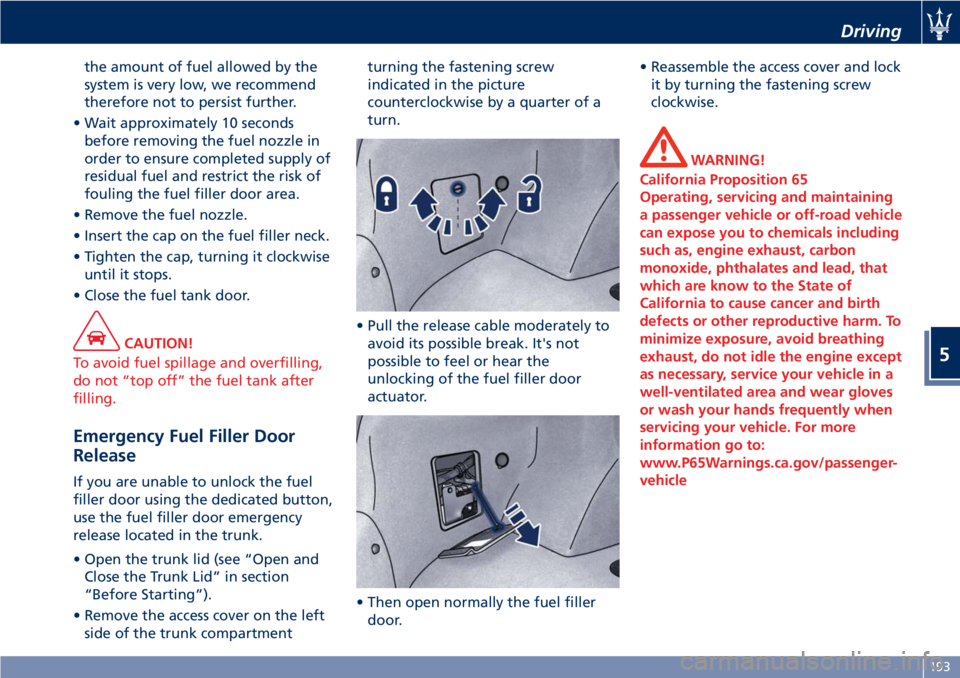
• Remove the access cover on the left
side of the trunk compartmentturning the fastening screw
indicated in the picture
counterclockwise by a quarter of a
turn.
• Pull the release cable moderately to
avoid its possible break. It's not
possible to feel or hear the
unlocking of the fuel filler door
actuator.
• Then open normally the fuel filler
door.• Reassemble the access cover and lock
it by turning the fastening screw
clockwise.
WARNING!
California Proposition 65
Operating, servicing and maintaining
a passenger vehicle or off-road vehicle
can expose you to chemicals including
such as, engine exhaust, carbon
monoxide, phthalates and lead, that
which are know to the State of
California to cause cancer and birth
defects or other reproductive harm. To
minimize exposure, avoid breathing
exhaust, do not idle the engine except
as necessary, service your vehicle in a
well-ventilated area and wear gloves
or wash your hands frequently when
servicing your vehicle. For more
information go to:
www.P65Warnings.ca.gov/passenger-
vehicle
Driving
5
193
Page 201 of 286
• Do not exceed 5 mph (8 km/h) when
driving through standing water. This
will minimize wave effects.
• Driving through standing water may
cause damage to your vehicle
drivetrain components. After driving
through standing water, do not drive
if you are not sure about drivetrain
condition. Such damage is not
covered by the New Vehicle
Warranty.
• Getting water inside your vehicle
engine can cause it to lock up and
stall out, and cause serious internal
damage to the engine. Such damage
is not covered by the New Vehicle
Warranty.
• After driving through standing
water always have the fluids (engine
oil, transmission oil, etc) checked for
contamination at anAuthorized
Maserati Dealer.
WARNING!
•Driving through standing water
limits your vehicle traction
capabilities. Do not exceed 5 mph
(8 km/h) when driving through
standing water.
•Driving through standing waterlimits your vehicle braking
capabilities, which increases
stopping distances. Therefore, after
driving through standing water,
drive slowly and lightly press on the
brake pedal several times to
progressively dry the brakes discs
and pads.
•Getting water inside your vehicle
engine can cause it to lock up and
stall out.
•Failure to follow these warnings
may result in injuries that are
serious or fatal to you, your
passengers, and others around you.
Pollution Control Devices
Even if the vehicle is fitted with
antipollution devices, the environment
deserves the greatest respect from
every one of us.
By following a few simple rules, the
driver can avoid damaging the
environment and very often can
reduce fuel consumption as well.
In this regard, some useful
information is listed here below;
please read it carefully.
• The first precaution is to follow the
Scheduled Service Plan scrupulously
(see “Scheduled Service Plan” in
section “Maintenance and Care”.
• The correct operation of the
antipollution devices not only helps
respect for the environment, but
also has an impact on vehicle
efficiency. Keeping these devices in
good working conditions is the first
rule for driving both ecologically
sound and economically.
• Always use unleaded fuel.
• If starting is difficult, do not make
prolonged attempts. In particular,
avoid push starts, towing or
downhill starts: these are all
maneuvers that can damage the
catalytic converters. For any
Driving
5
197
Page 210 of 286
(Continued)
slope or an uneven surface, place
chocks or other suitable items in
front of or behind the wheels to
stop the vehicle from moving.
•Never start or run the engine with
the vehicle on a jack.
•No person should place any portion
of their body under a vehicle that is
supported by a jack.
• Take the bag with compact spare
wheel and tools out of the trunk
compartment and remove it from the
bag.
• Remove from the compressor case
the inflation hose and the cable with
a plug for the power outlet.
• Unscrew the valve cap of the
compact spare wheel and screw the
fitting of the inflation hose onto the
valve.• Insert the plug in one of the
available power outlets fitted in the
trunk or passenger compartment.
• Turn the key in the ignition switch in
MAR (ON)position.
• Turn the compressor on by pressing
the switch.
• Stop the compressor pressing switch
again, when the pressure indicated
by the gage reaches the
recommended level (see “Tire
Inflation Pressure” in section
“Features and Specifications”) and
screw the cap on the compact spare
wheel valve.
CAUTION!
• In order to obtain a more accurate
reading, the compressor should be
switched off when checking the tirepressure of the compact spare wheel
on the pressure gage.
• Do not run the compressor for more
than 20 minutes: there is a risk it
could overheat. Also, prolonged
power absorption may discharge the
battery, subsequently preventing the
engine from starting.
• The compressor has been designed
exclusively to inflate compact spare
wheels; do not use it to inflate air
mattresses, dinghies etc.
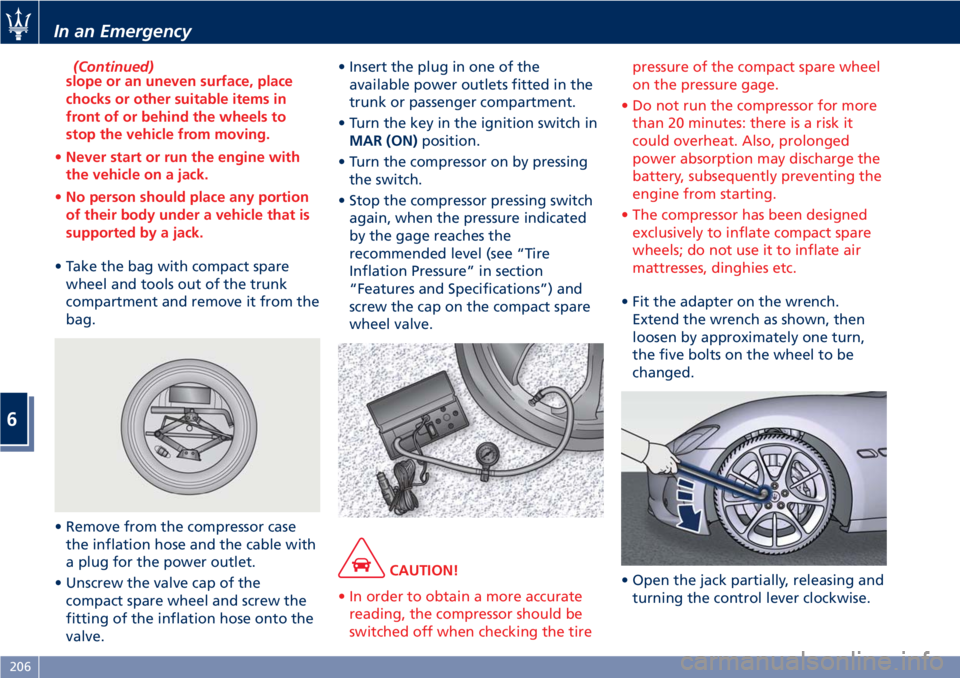
• Fit the adapter on the wrench.
Extend the wrench as shown, then
loosen by approximately one turn,
the five bolts on the wheel to be
changed.
• Open the jack partially, releasing and
turning the control lever clockwise.
In an Emergency
6
206
Page 213 of 286
7 lbf·ft / 98 ± 10 Nm). This is
equivalent to a load of
approximately 44 lb (20 kg) being
placed on the handle of the wrench
supplied when extended for use.
•After refitting the standard wheel,
check the tire pressure.
Once finished:
• completely deflate the compact
spare wheel by pressing on the valve
with the overhang of the valve cap;
• wrap the power cable and the
inflation hose inside the compressor
case;
• place the compressor, the jack, the
wrench and the adapter in the
container inside the compact spare
wheel;
• put the compact spare wheel in its
bag and put it back in the trunk
compartment.
Emergency Release of the
Parking Brake
In the event the electric parking brake
locks due to a total system failure (see
“Parking Brake” in section “Driving”),
it is not possible to move the vehicle,
since the thrust action of the brake
shoes will lock the rear wheels.
For moving the vehicle it is therefore
necessary to manually act on the
electric actuator to release the
pressure of the brake shoes on the
rear wheels by performing the
following operation.
CAUTION!
If the parking brake has been
activated in manual or automatic
mode and it is not possible to release
it by operating on the lever of the
central console, do not move the
vehicle since rear brake calipers might
be damaged. If you are not able to
perform the following operation, to
move the vehicle, load it on a rescue
vehicle, avoiding to move it. For more
information on vehicle towing, see
"Towing a Disabled Vehicle" chapter
in this section.
Manual Release Procedure
To manually release the parking brake,
you need to use the special tool
provided in the tool kit (see "Tool Kit"
in this section).
Proceed as follows:
• remove any luggage and/or the bag
containing the compact spare wheel
(if equipped) from the trunk
compartment;
• remove the floor panel from the
trunk compartment;
• remove the inside covering panel
from the battery compartment;
• remove the container in the rear
part of the trunk compartment
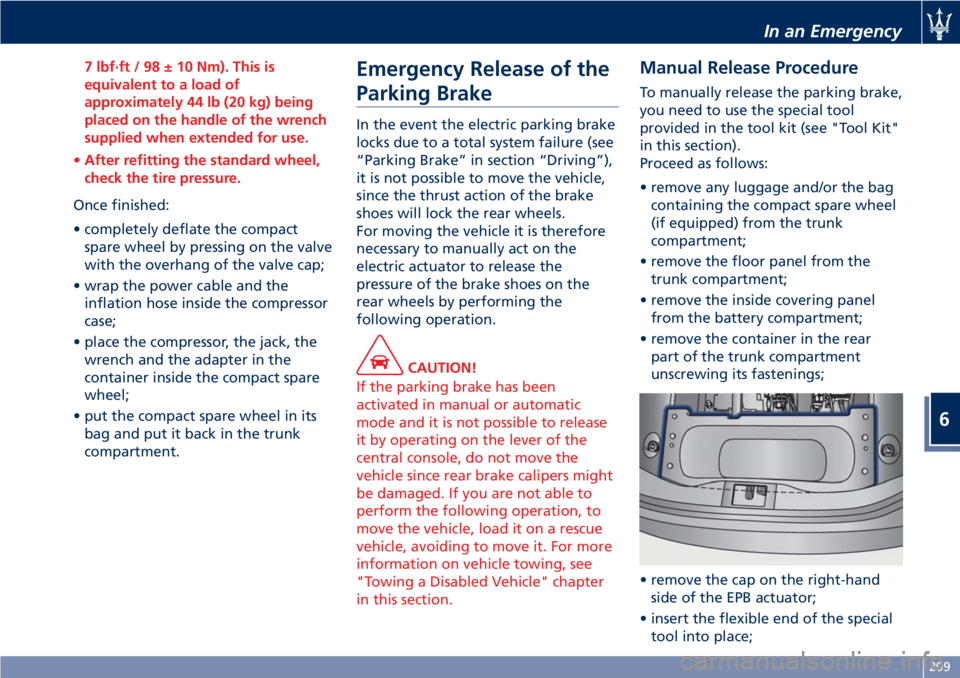
unscrewing its fastenings;
• remove the cap on the right-hand
side of the EPB actuator;
• insert the flexible end of the special
tool into place;
In an Emergency
6
209
Page 214 of 286
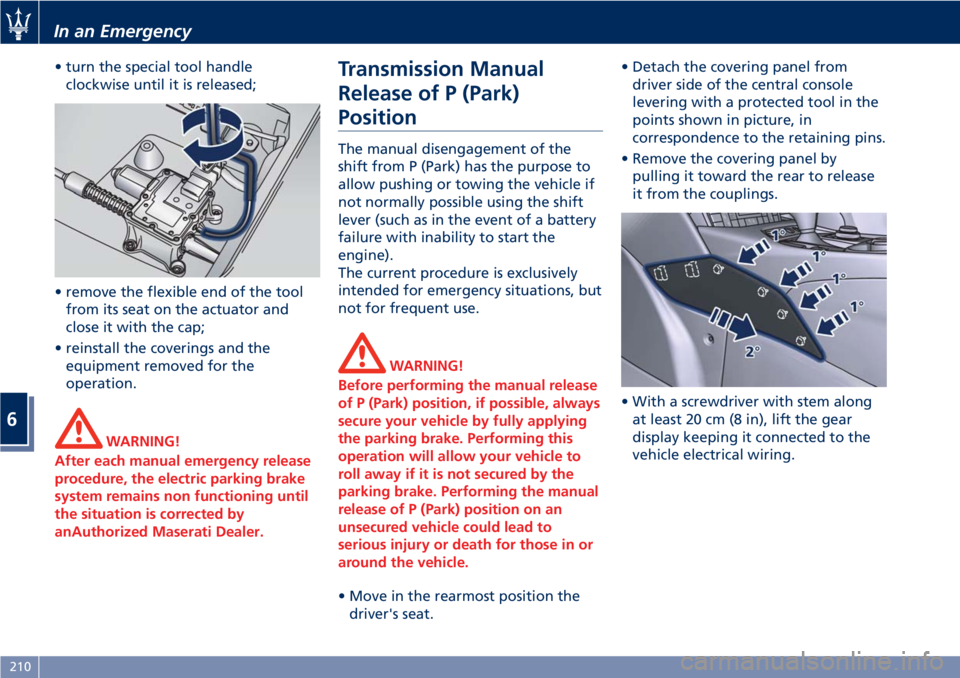
• turn the special tool handle
clockwise until it is released;
• remove the flexible end of the tool
from its seat on the actuator and
close it with the cap;
• reinstall the coverings and the
equipment removed for the
operation.
WARNING!
After each manual emergency release
procedure, the electric parking brake
system remains non functioning until
the situation is corrected by
anAuthorized Maserati Dealer.
Transmission Manual
Release of P (Park)
Position
The manual disengagement of the
shift from P (Park) has the purpose to
allow pushing or towing the vehicle if
not normally possible using the shift
lever (such as in the event of a battery
failure with inability to start the
engine).
The current procedure is exclusively
intended for emergency situations, but
not for frequent use.
WARNING!
Before performing the manual release
of P (Park) position, if possible, always
secure your vehicle by fully applying
the parking brake. Performing this
operation will allow your vehicle to
roll away if it is not secured by the
parking brake. Performing the manual
release of P (Park) position on an
unsecured vehicle could lead to
serious injury or death for those in or
around the vehicle.
• Move in the rearmost position the
driver's seat.• Detach the covering panel from
driver side of the central console
levering with a protected tool in the
points shown in picture, in
correspondence to the retaining pins.
• Remove the covering panel by
pulling it toward the rear to release
it from the couplings.
• With a screwdriver with stem along
at least 20 cm (8 in), lift the gear
display keeping it connected to the
vehicle electrical wiring.
In an Emergency
6
210