ignition MASERATI GRANTURISMO 2020 Manual PDF
[x] Cancel search | Manufacturer: MASERATI, Model Year: 2020, Model line: GRANTURISMO, Model: MASERATI GRANTURISMO 2020Pages: 286, PDF Size: 6.7 MB
Page 222 of 286
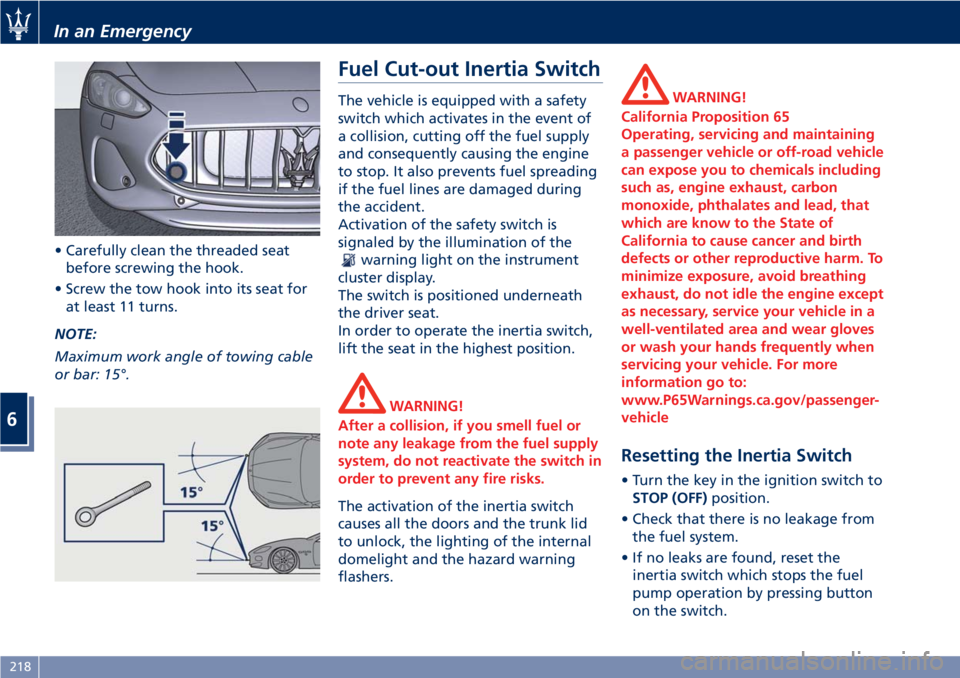
• Carefully clean the threaded seat
before screwing the hook.
• Screw the tow hook into its seat for
at least 11 turns.
NOTE:
Maximum work angle of towing cable
or bar: 15°.
Fuel Cut-out Inertia Switch
The vehicle is equipped with a safety
switch which activates in the event of
a collision, cutting off the fuel supply
and consequently causing the engine
to stop. It also prevents fuel spreading
if the fuel lines are damaged during
the accident.
Activation of the safety switch is
signaled by the illumination of the
warning light on the instrument
cluster display.
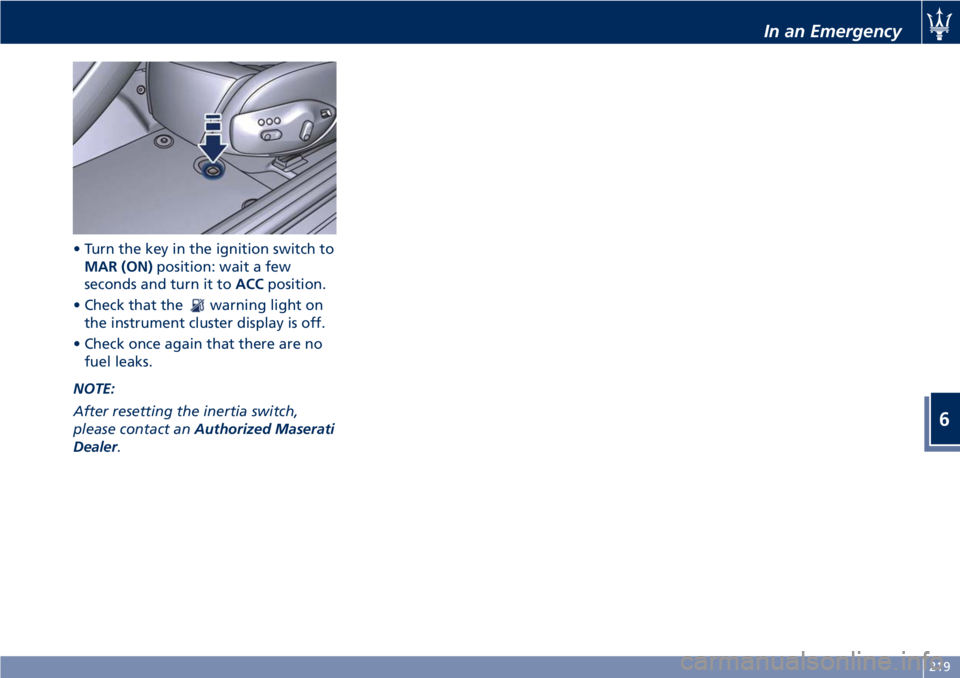
The switch is positioned underneath
the driver seat.
In order to operate the inertia switch,
lift the seat in the highest position.
WARNING!
After a collision, if you smell fuel or
note any leakage from the fuel supply
system, do not reactivate the switch in
order to prevent any fire risks.
The activation of the inertia switch
causes all the doors and the trunk lid
to unlock, the lighting of the internal
domelight and the hazard warning
flashers.
WARNING!
California Proposition 65
Operating, servicing and maintaining
a passenger vehicle or off-road vehicle
can expose you to chemicals including
such as, engine exhaust, carbon
monoxide, phthalates and lead, that
which are know to the State of
California to cause cancer and birth
defects or other reproductive harm. To
minimize exposure, avoid breathing
exhaust, do not idle the engine except
as necessary, service your vehicle in a
well-ventilated area and wear gloves
or wash your hands frequently when
servicing your vehicle. For more
information go to:
www.P65Warnings.ca.gov/passenger-
vehicle
Resetting the Inertia Switch
• Turn the key in the ignition switch to
STOP (OFF)position.
• Check that there is no leakage from
the fuel system.
• If no leaks are found, reset the
inertia switch which stops the fuel
pump operation by pressing button
on the switch.
In an Emergency
6
218
Page 223 of 286
• Turn the key in the ignition switch to
MAR (ON)position: wait a few
seconds and turn it toACCposition.
• Check that the
warning light on
the instrument cluster display is off.
• Check once again that there are no
fuel leaks.
NOTE:
After resetting the inertia switch,
please contact anAuthorized Maserati
Dealer.
In an Emergency
6
219
Page 228 of 286
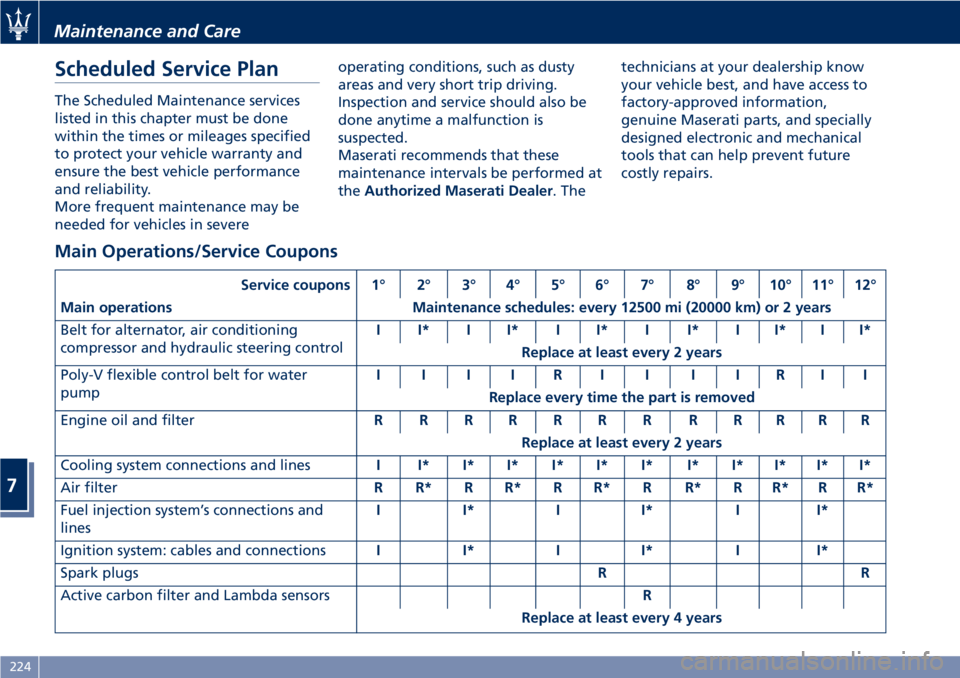
Scheduled Service Plan
The Scheduled Maintenance services
listed in this chapter must be done
within the times or mileages specified
to protect your vehicle warranty and
ensure the best vehicle performance
and reliability.
More frequent maintenance may be
needed for vehicles in severeoperating conditions, such as dusty
areas and very short trip driving.
Inspection and service should also be
done anytime a malfunction is
suspected.
Maserati recommends that these
maintenance intervals be performed at
theAuthorized Maserati Dealer. Thetechnicians at your dealership know
your vehicle best, and have access to
factory-approved information,
genuine Maserati parts, and specially
designed electronic and mechanical
tools that can help prevent future
costly repairs.
Main Operations/Service Coupons
Service coupons 1° 2° 3° 4° 5° 6° 7° 8° 9° 10° 11° 12°
Main operations Maintenance schedules: every 12500 mi (20000 km) or 2 years
Belt for alternator, air conditioning
compressor and hydraulic steering controlI I* I I* I I* I I* I I* I I*
Replace at least every 2 years
Poly-V flexible control belt for water
pumpIIIIRIIIIRII
Replace every time the part is removed
Engine oil and filterRRRRRRRRRRRR
Replace at least every 2 years
Cooling system connections and linesI I*I*I*I*I*I* I*I*I*I*I*
Air filterR R* R R* R R* R R* R R* R R*
Fuel injection system’s connections and
linesI I* I I* I I*
Ignition system: cables and connectionsI I* I I* I I*
Spark plugsRR
Active carbon filter and Lambda sensorsR
Replace at least every 4 years
Maintenance and Care
7
224
Page 239 of 286
• Return the cap and dipstick to their
position and wait for a few minutes
to allow the oil to reach the oil pan.
• Check the level again.
After topping up, the
engine oil
level warning light may not go off for
some time while the system is
performing the necessary checks. This
is normal.
Engine Oil Filter Replacement
The engine oil filter should be
replaced with a new filter at every oil
change.
Contact anAuthorized Maserati
Dealerto perform this service.
Automatic Transmission Oil Check
Contact anAuthorized Maserati
Dealerfor the oil level check.
Power Steering Fluid Level Check
With the vehicle on a level ground
and the engine cold, check the fluid
level of the power steering reservoir.
• To carry out the check, unscrew the
cap, clean the dipstick with a dry and
clean cloth.
• Retighten the cap then unscrew it
again and check the level: it should
match the “MAX” notch marked on
the dipstick. In hot oil conditions,the level may even exceed the
“MAX” notch.
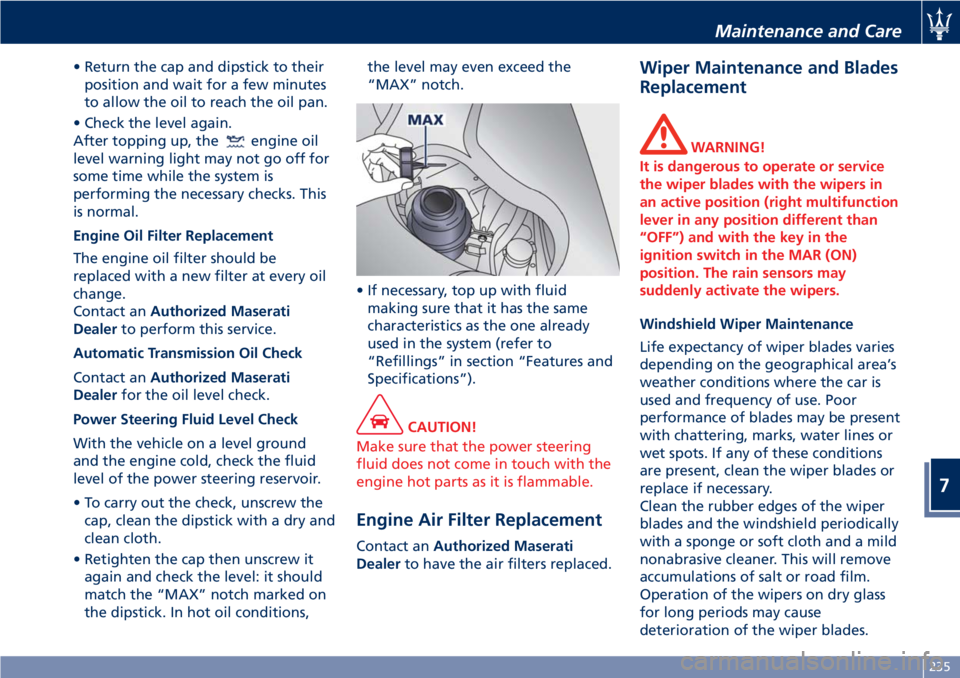
• If necessary, top up with fluid
making sure that it has the same
characteristics as the one already
used in the system (refer to
“Refillings” in section “Features and
Specifications”).
CAUTION!
Make sure that the power steering
fluid does not come in touch with the
engine hot parts as it is flammable.
Engine Air Filter Replacement
Contact anAuthorized Maserati
Dealerto have the air filters replaced.
Wiper Maintenance and Blades
Replacement
WARNING!
It is dangerous to operate or service
the wiper blades with the wipers in
an active position (right multifunction
lever in any position different than
“OFF”) and with the key in the
ignition switch in the MAR (ON)
position. The rain sensors may
suddenly activate the wipers.
Windshield Wiper Maintenance
Life expectancy of wiper blades varies
depending on the geographical area’s
weather conditions where the car is
used and frequency of use. Poor
performance of blades may be present
with chattering, marks, water lines or
wet spots. If any of these conditions
are present, clean the wiper blades or
replace if necessary.
Clean the rubber edges of the wiper
blades and the windshield periodically
with a sponge or soft cloth and a mild
nonabrasive cleaner. This will remove
accumulations of salt or road film.
Operation of the wipers on dry glass
for long periods may cause
deterioration of the wiper blades.
Maintenance and Care
7
235
Page 242 of 286
(Continued)
quick coupling from the negative
pole (–) of the battery.
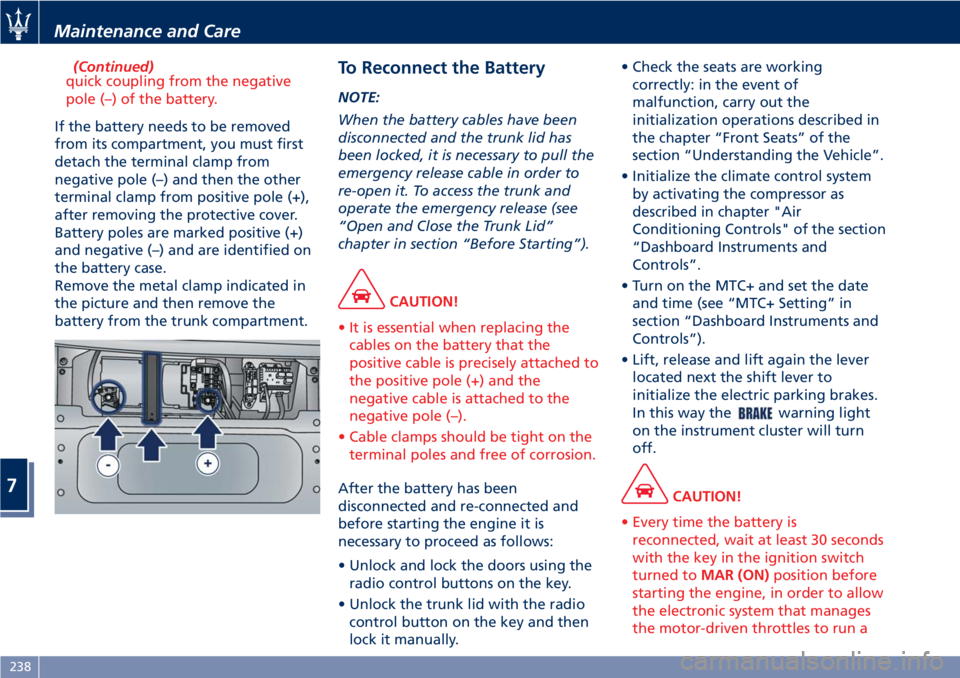
If the battery needs to be removed
from its compartment, you must first
detach the terminal clamp from
negative pole (–) and then the other
terminal clamp from positive pole (+),
after removing the protective cover.
Battery poles are marked positive (+)
and negative (–) and are identified on
the battery case.
Remove the metal clamp indicated in
the picture and then remove the
battery from the trunk compartment.
To Reconnect the Battery
NOTE:
When the battery cables have been
disconnected and the trunk lid has
been locked, it is necessary to pull the
emergency release cable in order to
re-open it. To access the trunk and
operate the emergency release (see
“Open and Close the Trunk Lid”
chapter in section “Before Starting”).
CAUTION!
• It is essential when replacing the
cables on the battery that the
positive cable is precisely attached to
the positive pole (+) and the
negative cable is attached to the
negative pole (–).
• Cable clamps should be tight on the
terminal poles and free of corrosion.
After the battery has been
disconnected and re-connected and
before starting the engine it is
necessary to proceed as follows:
• Unlock and lock the doors using the
radio control buttons on the key.
• Unlock the trunk lid with the radio
control button on the key and then
lock it manually.• Check the seats are working
correctly: in the event of
malfunction, carry out the
initialization operations described in
the chapter “Front Seats” of the
section “Understanding the Vehicle”.
• Initialize the climate control system
by activating the compressor as
described in chapter "Air
Conditioning Controls" of the section
“Dashboard Instruments and
Controls”.
• Turn on the MTC+ and set the date
and time (see “MTC+ Setting” in
section “Dashboard Instruments and
Controls”).
• Lift, release and lift again the lever
located next the shift lever to
initialize the electric parking brakes.
In this way the
warning light
on the instrument cluster will turn
off.
CAUTION!
• Every time the battery is
reconnected, wait at least 30 seconds
with the key in the ignition switch
turned toMAR (ON)position before
starting the engine, in order to allow
the electronic system that manages
the motor-driven throttles to run a
Maintenance and Care
7
238
Page 243 of 286
self-learning cycle. At the same time,
you can run the date and time set up
procedure for the MTC.
• Every time the battery is
reconnected the
and
warning lights will flash for
about 10 seconds and then go off.
WARNING!
California Proposition 65
Operating, servicing and maintaining
a passenger vehicle or off-road vehicle
can expose you to chemicals including
such as, engine exhaust, carbon
monoxide, phthalates and lead, that
which are know to the State of
California to cause cancer and birth
defects or other reproductive harm. To
minimize exposure, avoid breathing
exhaust, do not idle the engine except
as necessary, service your vehicle in a
well-ventilated area and wear gloves
or wash your hands frequently when
servicing your vehicle. For more
information go to:
www.P65Warnings.ca.gov/passenger-
vehicle
Useful Advice to Extend
Battery Life
When parking the vehicle, make sure
that the doors, front, rear lids and
flaps are properly closed. All interior
lights should be off.
When the engine is turned off, do not
keep the connected devices switched
on for a long time (such as radio,
hazard warning flashers, fan, etc.).
CAUTION!
If the battery charge remains below
50% for a long period of time, it will
be damaged due to sulfation; its
performance and starting power will
be reduced and it will be more subject
to freezing (this can happen even at
14°F/-10°C).
We recommend you to have the
battery charge condition checked,
preferably at the beginning of the
cold season, to prevent the electrolyte
from freezing.
This check should be carried out more
frequently if the vehicle is used mainly
for short trips or if it is equipped with
power absorbing devices that remain
permanently on even when the
ignition switch is off. This appliesabove all if these devices have been
retrofitted ("Aftermarket" services).
If the vehicle is not used for long
periods of time, please see “Vehicle
Stored for Long Periods” in this
section.
Battery Recharge
WARNING!
The process of charging or recharging
the battery produces hydrogen, a
flammable gas that can explode and
cause serious injuries. When charging
or recharging the battery, follow the
recommended precautions at all
times.
•Before using a charger device
always check that this tool is
suitable for the installed battery,
with constant voltage (lower than
14.8 V) and low amperage
(maximum limit 15 A).
•Recharge the battery in a
well-ventilated environment.
•Never charge or recharge a frozen
battery: it can explode due to
hydrogen trapped inside the ice
crystals.
•Ensure that any sparks or open
(Continued)
Maintenance and Care
7
239
Page 247 of 286
Pos. Amp. –
ColorSystem /
Component
F04 Maxi 40 A –
OrangeABS cylinder
F05 Maxi 40 A –
OrangeA.C. Node
F06 Maxi 60 A –
BlueFan 2 relay
F07 30 A –
GreenT07 I.E. main
relay
F08 7.5 A –
BrownT08 - Air
conditioner
compressor
relay
F09 7.5 A –
BrownT05 stop light
control relay
F10 15 A – Blue T06 horn relay
F11 10 A – Red LH high-beam
F14 - Not used
F15 15 A – Blue Alternator
sensing
F16 10 A – Red LH spot light
F17 10 A – Red RH high-beam
F18 7.5 A –
BrownI.E. bank
F19 15 A – Blue T02 DRL lights
relay
F20 - Not usedPos. Amp. –
ColorSystem /
Component
F21 - Not used
F22 - Not used
F23 10 A – Red ABS Electronics
F24 10 A – Red RH spot light
F30 30 A –
GreenT20 ignition
relay
F81 Maxi 50 A –
RedCPL2
F82 - Not used
F83 Maxi 50 A –
RedAir pump relay
F84 20 A –
YellowIgnition switch
F85 30 A –
GreenHeadlight
washers
F87 - Not used
F88 15 A – Blue Main
injector/coil
relay - cylinders
1-4
F89 15 A – Blue Main
injector/coil
relay - cylinders
5-8Pos. Amp. –
ColorSystem /
Component
F90 15 A – Blue Main I.E. relay,
secondary
connected
devices
F91 10 A – Red Main relay, I.E.
ECU
F92 15 A – Blue Main relay,
oxygen sensors
F93 7.5 A –
Brown+15 Controls on
inside roof
F94 7.5 A –
BrownNCS
F95 7.5 A –
BrownCSG
F96 7.5 A –
BrownAlternator
F97 10 A – Red I.E. ECU
F98 - Not used
F99 - Not used
F100 - Not used
F101 - Not used
F102 - Not used
F103 - Not used
F104 - Not used
F105 - Not used
Maintenance and Care
7
243
Page 251 of 286
Pos. Amp. –
ColorSystem / Component
F64 - Not used
F65 10 A –
RedKey-Lock solenoid
F66 20 A –
YellowFuel pumps
F67 - Not used
F68 - Not used
F69 - Not used
F77 - Not used
F78 20 A –
YellowPower outlet
F79 - Not used
F80 25 A –
WhiteBass boxBulb Replacement
The signal failure of an external light
(turn signal, low beam and high beam,
license plate light, reverse light, brake
light and rear fog light) is
communicated to the instrument
cluster that displays on the TFT screen
the
oramber warning light
and a text message indicating which
light is faulty.
Front Headlights
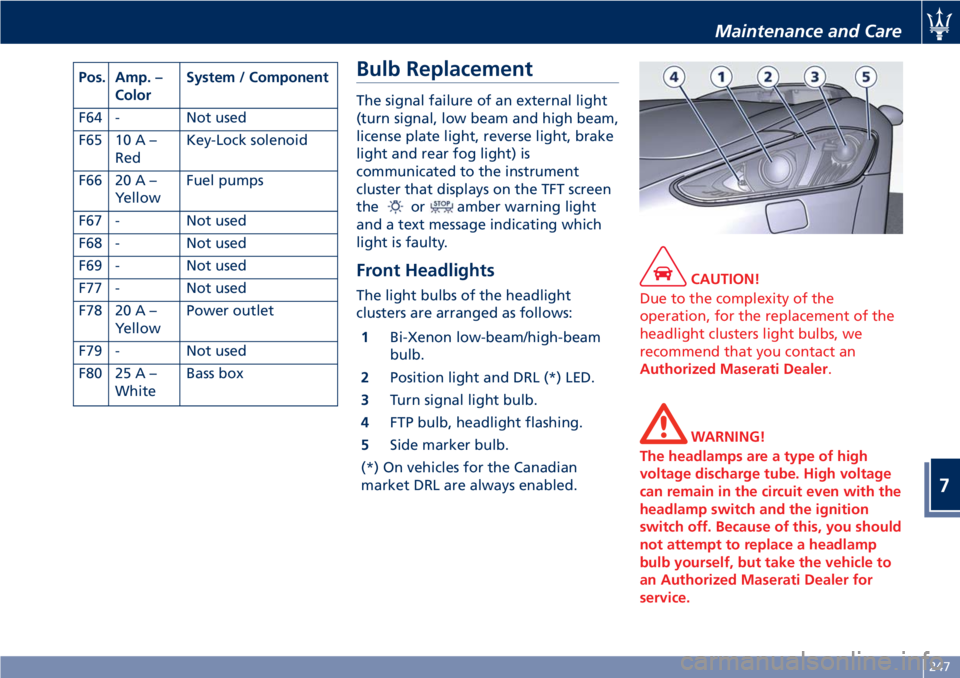
The light bulbs of the headlight
clusters are arranged as follows:
1Bi-Xenon low-beam/high-beam
bulb.
2Position light and DRL (*) LED.
3Turn signal light bulb.
4FTP bulb, headlight flashing.
5Side marker bulb.
(*) On vehicles for the Canadian
market DRL are always enabled.
CAUTION!
Due to the complexity of the
operation, for the replacement of the
headlight clusters light bulbs, we
recommend that you contact an
Authorized Maserati Dealer.
WARNING!
The headlamps are a type of high
voltage discharge tube. High voltage
can remain in the circuit even with the
headlamp switch and the ignition
switch off. Because of this, you should
not attempt to replace a headlamp
bulb yourself, but take the vehicle to
an Authorized Maserati Dealer for
service.
Maintenance and Care
7
247
Page 263 of 286
such as, engine exhaust, carbon
monoxide, phthalates and lead, that
which are know to the State of
California to cause cancer and birth
defects or other reproductive harm. To
minimize exposure, avoid breathing
exhaust, do not idle the engine except
as necessary, service your vehicle in a
well-ventilated area and wear gloves
or wash your hands frequently when
servicing your vehicle. For more
information go to:
www.P65Warnings.ca.gov/passenger-
vehicleVehicle Stored for Long
Periods
If the vehicle is going to be stored for
over a month, follow the below
precautions:
• Wash and dry the vehicle
thoroughly.
• Store the vehicle in a covered, dry
and, if possible, ventilated area.
• Select P (Park) and turn off the
engine.
• Turn the key in the ignition switch in
STOP (OFF)position.
• Disconnect the battery (refer
“Maintenance-Free Battery” in this
section) or connect a battery charger
(refer to paragraph “Maintaining
Battery Charge” of chapter “Battery
Statement” in this section).
• Check the battery charge status.
During parking, this check must be
carried out every three weeks.
Recharge the battery if the open
circuit voltage is lower than 12.2 V.
• Check that the parking brake is NOT
engaged.
• Do not empty the engine cooling
system.
• Clean and protect the painted parts
applying protective wax.• Clean and protect polished metal
parts with special products available
on the market.
• Talc the windshield wiper blades and
raise them from the windshield.
• Cover the vehicle with a long cloth
in breathable fabric (available from
theAuthorized Maserati Dealer). Do
not use thick plastic sheets, which do
not allow the humidity on the
vehicle surface to evaporate.
• Inflate the tires up to a pressure
which must be 1 bar (14.5 psi) higher
than the normally prescribed one,
and check it at regular intervals.
NOTE:
TheAuthorized Maserati Dealercan
provide you with any information
about the available “Indoor and
Outdoor Car Covers”, available in the
“Genuine Accessories” range.
WARNING!
The tire pressure must be brought
back to the prescribed value before
reusing the vehicle (see “Tire Inflation
Pressure” in section “Features and
Specifications”).
Maintenance and Care
7
259
Page 264 of 286
Restarting the Vehicle
Before restarting the vehicle after a
long period of inactivity, we
recommend that you carry out the
following operations.
• Check the tires for pressure and for
any damages, cuts or cracks. If this is
the case, have them replaced.
• Do not dry-rub the external surface
of the vehicle.
• Visually inspect if there are any fluid
leaks (oil, brake and clutch fluid,
engine coolant etc.).
• Have the engine oil and filter
replaced.
• Check the fluid levels in the brake
system, as well as the engine coolant
level.
• Check the air filter and have them
replaced if necessary.
• Reconnect the battery after checking
the charge status (refer to
“Maintenance-Free Battery” in this
section) and perform the initializing
procedure if applicable.
• With the transmission in N (Neutral),
let the engine idle for several
minutes.WARNING!
The engine idle must be performed
outdoors. Exhaust gases contain
carbon monoxide which is strongly
toxic and potentially lethal.
WARNING!
California Proposition 65
Operating, servicing and maintaining
a passenger vehicle or off-road vehicle
can expose you to chemicals including
such as, engine exhaust, carbon
monoxide, phthalates and lead, that
which are know to the State of
California to cause cancer and birth
defects or other reproductive harm. To
minimize exposure, avoid breathing
exhaust, do not idle the engine except
as necessary, service your vehicle in a
well-ventilated area and wear gloves
or wash your hands frequently when
servicing your vehicle. For more
information go to:
www.P65Warnings.ca.gov/passenger-
vehicle
Battery Statement
Battery Statement Status of
Charge
To avoid problems with ignition and/or
the electrical system in general when
you are driving, the battery charge
status is constantly maintained and
guaranteed by the vehicle's recharge
circuit; the main component of which
is the alternator. This circuit is only
able to supply voltage to the battery
when the vehicle is traveling.
The
warning light on the
instrument cluster (see “Instrument
Cluster” in section “Dashboard
Instruments and Controls”), will
indicate any malfunctions in the
recharge circuit or an insufficient
battery charge status (flashing).
The vehicle is fitted with advanced
electronic systems, such as, for
example, the alarm system and various
electronic control modules, which
consume power even when the key in
the ignition switch is in theSTOP (OFF)
position and the vehicle is not being
used.
Therefore, it is fundamental that the
battery is properly charged to ensure
that the engine starts properly and
Maintenance and Care
7
260