air condition MAZDA 232 1990 Workshop Manual Suplement
[x] Cancel search | Manufacturer: MAZDA, Model Year: 1990, Model line: 232, Model: MAZDA 232 1990Pages: 677, PDF Size: 61.19 MB
Page 13 of 677
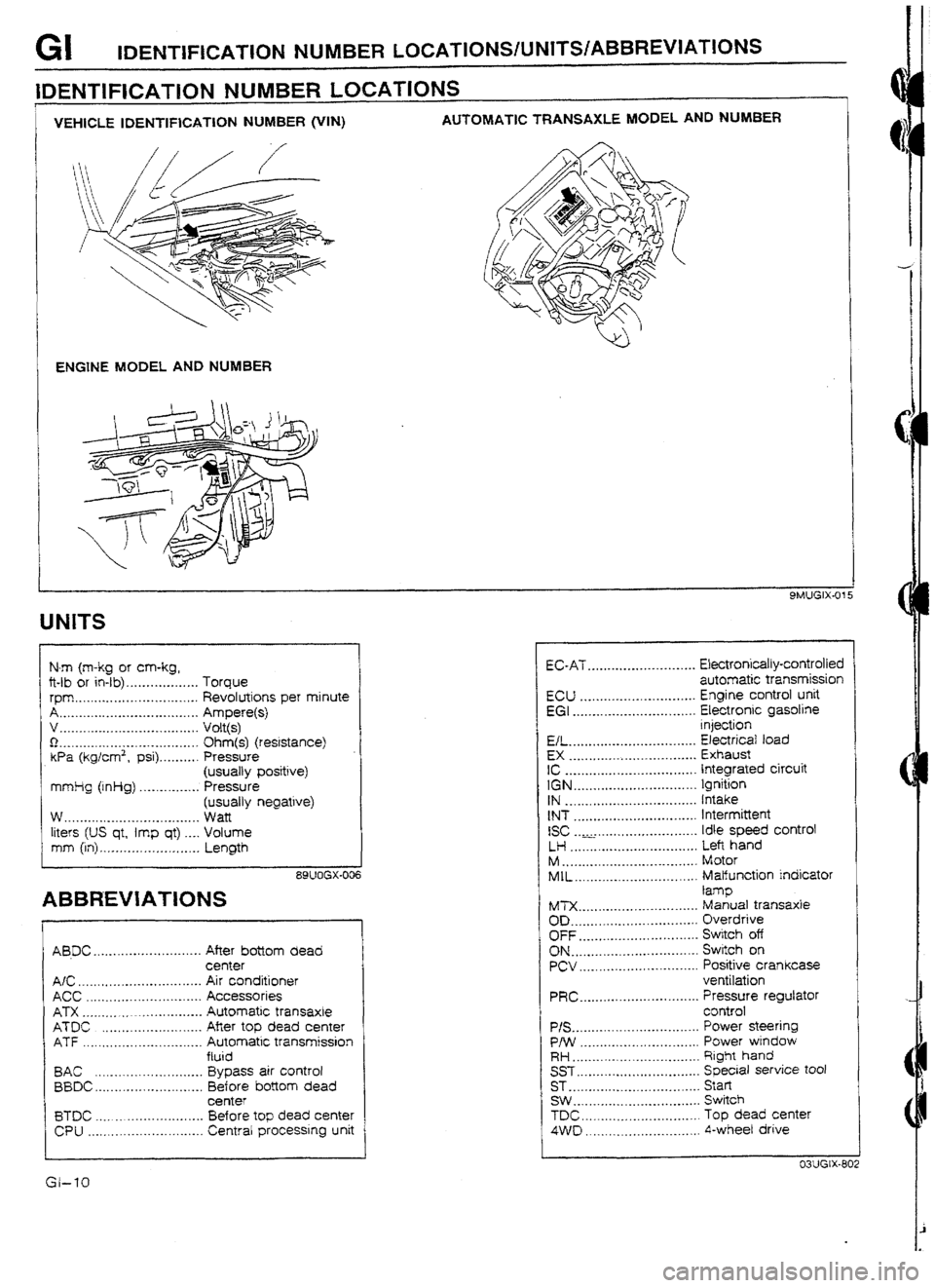
GI IDENTIFICATION NUMBER LOCATIONSIUNITSIABBREVlATlONS
IDENTIFICATCON NUMBER LOCATIONS
I
VEHKZLE IDENTIFICATION NUMBER @‘IN) AUTOMATIC TRANSAXLE MODEL AND NUM8ER
ENGINE MODEL AND NUMBER
UNlTS
N-m (m-kg or cm-kg,
ft-lb or in-lb) . . . . . .._.......... Torque
rpm ._._..._.. . . . . . . .._.._.._. . .._. Revolutions per minute
A . . .._._._...__.._.._.._. .__...._. . . Ampere(s)
v .._.... .* .*... ..__.._...*. ..*. .*. ,. Volt(s)
0 I.._._............**..-.-*..-....... Ohm(s) (resistance)
Wa (kg/cm2, psi) . . . . . . . . . . Pressure
(usually positive)
mmlig (inHg) . . . . . . .._.._... Pressure
(usually negative)
w . . . ..*.....e*.-..-..-.....*.e..... Watt
liters (US qt, imp qt) .._. Volume
mm (in) ,_._.._._..._.,_. .~. . ..__ Length
89UOGX-006
ABBREVIATIONS
AB.DC ........................... After bottom dead
center
A/C _ .............................. Air conditioner
ACC ............................. Accessories
ATX ............................. Automatic transaxte
ATDC ......................... Afier top dead center
ATF .............................. Automatic transmission
ftuid
BAC ........................... Bypass air control
BBDC.. ......................... Before bottom dead
center
BTDC ........................... Before top dead center
CPU ............................. Central processing unit t EC-AT ........................... Ekctronically-controlled
automatic transmission
ECU ............................. Engine control unit
EGI ............................... Electronic gasotine
injection
EL ................................ Electricaf toad
EX ................................ Exhaust
IC ................................. Integrated circuit
IGN ............................... Ignition
IN ................................. Intake
tNT ............................... Intermittent
ISC ............................. Idle speed control
LH ................................ Left hand
M .................................. Motor
MIL ............................... Malfunction indicator
lamp
tb4TX. ............................. Manual transaxle
OD. ............................... Overdrive
OFF .............................. Switch off
ON ................................ Switch on PCV .............................. Positive crankcase
ventilation
PRC.. ............................ Pressure regulator
control
P/S ................................ Power steering
P/W .............................. Power wtndow
RH.. .............................. Right hand
SST ............................... Special service tool
ST .................................
Start
SW . . .............................. Switch
TDC. ............................. Top dead center
4VVD ............................. 4-wheel drive
Page 21 of 677
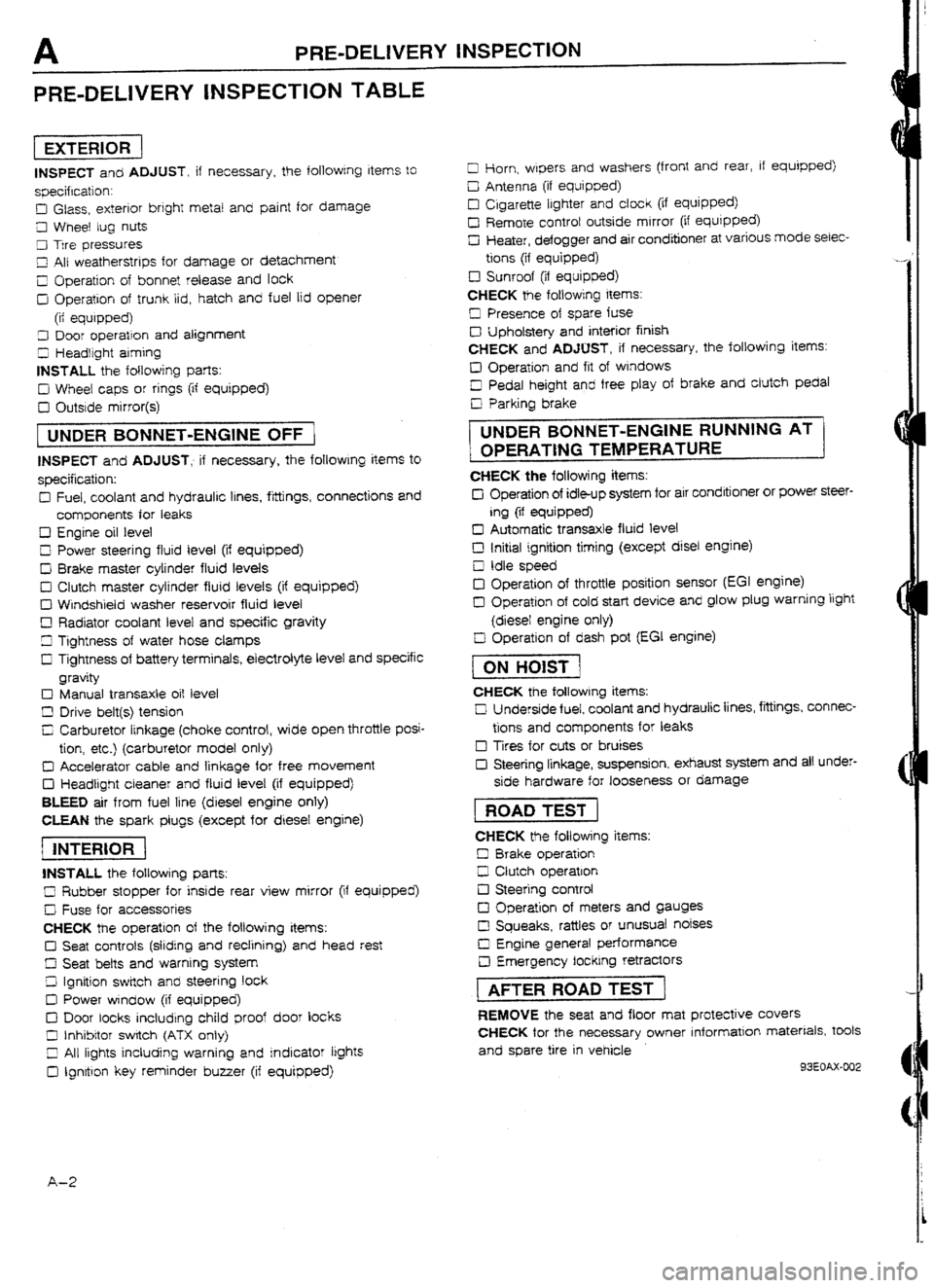
A PRE-DELIVERY INSPECTION
PRE-DELIVERY INSPECTION TABLE
pieziG-
INSPECT and ADJUST, if necessary, the following Items to
specification:
D Glass, exterior bright metal and paint for damage
Cl Wheel tug nuts
9 Trre pressures
LII All weatherstrips for damage or detachment
Z Operation of bonnet release and lock
D Operation of trunk lid, hatch and fuel lid opener
(it equipped)
3 Door operation and alignment
5 Headlight aiming
INSTALL the following parts:
D Wheel caps or rings (if equipped)
D Outside mirror(s)
[ UNDER BONNET-ENGINE OFF )
INSPECT and ADJUST, if necessary, the foIlowIng items to
specification:
Cl Fuel, coolant and hydraulrc lines, fittings, connections and
components for leaks
Cl Engine oil level
0 Power steering fluid level (if equipped)
D Brake master cylinder fluid levels
0 Clutch master cylinder fluid levels (if equipped) q
Windshield washer reservoir fluid level
D Radiator coolant level and specific gravity
Ll Tightness of water hose clamps
I3 Tightness of battery terminals, electrolyte level and specific
gravity
c) Manual transaxle oit level
D Drive belt(s) tension
C; Carburetor linkage (choke control, wide open throttle posi-
tion, etc.) (carburetor model only)
D Accelerator cable and linkage for free movement
D Headlight cleaner and fluid level (if equipped)
BLEED air from fuel line (diesel engine only)
CLEAN the spark plugs (except for diesef engine)
piicis-1
INSTALL the foflowing parts:
C Rubber stopper for inside rear view mirror (if equipped)
c! Fuse for accessories
CHECK the operation of the following items:
Cl Seat controls (sliding and redining) and head rest
ci Seat belts and warnrng system
Z! Ignition swrtch and steering lock
III Power window {if equipped)
0 Door locks including child proof door locks
0 Inhibitor switch
(ATX only)
Z All lights including warning and indicator lights
0 Ignrtron key reminder buyer (if equipped) Cl Horn, wipers and washers (front and rear, if equipped)
D Antenna (if equipped} q
Cigarette lighter and clock (if equipped)
I2 Remote controt outside mirror
(if equipped) q
Heater, defogger and air conditioner at various mode selec-
tions (if equipped)
c3 Sunroof (if equipped)
CHECK
the fotiowing items: q
Presence of spare fuse
c3 Upholstery and interior finish
CHECK and ADJUST, if necessary, the following items:
Cl Operation and fit of windows
D Pedal height and free ptay of brake and clutch pedal
Cl Parking brake
i UNDER BONNET-ENGtNE RUNNING AT ]
1 OPERATtNG TEMPERATURE
CHECK the following items:
Cl Operation of idle-up system for air conditioner or power steer-
ing (if equipped)
13 Automatic transaxle fluid level
D Initial ignition timing
(except disel engine) q
Idle speed
El Operation of throttle position sensor (EGI engine)
13 Operation of cold start device and glow plug warning light
(diesel engine only)
D Operation of dash pot [EGI engine)
t
ON HOtST 1
CHECK the following items:
U Underside fuel, coolant and hydraulic lines, fittings, connec-
tions and components for leaks q
Tires for cuts or bruises
Cl Steering linkage, suspension, exhaust system and all under-
side hardware for
looseness or damage
1 ROAD TEST 1
CHECK the foliowing items:
II Brake operation
D Clutch operation
0 Steering control
c3 Operation of meters and gauges
0 Squeaks, rattles or unusual noises q
Engine general performance
c3 Emergency Iocking retractors
rAFTER ROAD TEST 1
REMOVE the seat and floor mat protective covers
CHECK for the necessary
owner information materials, tools
and spare tire in vehicle
93EOAX-002
A-2
Page 22 of 677
SCHEDULED MAINTENANCE SERVICES (Australia) A
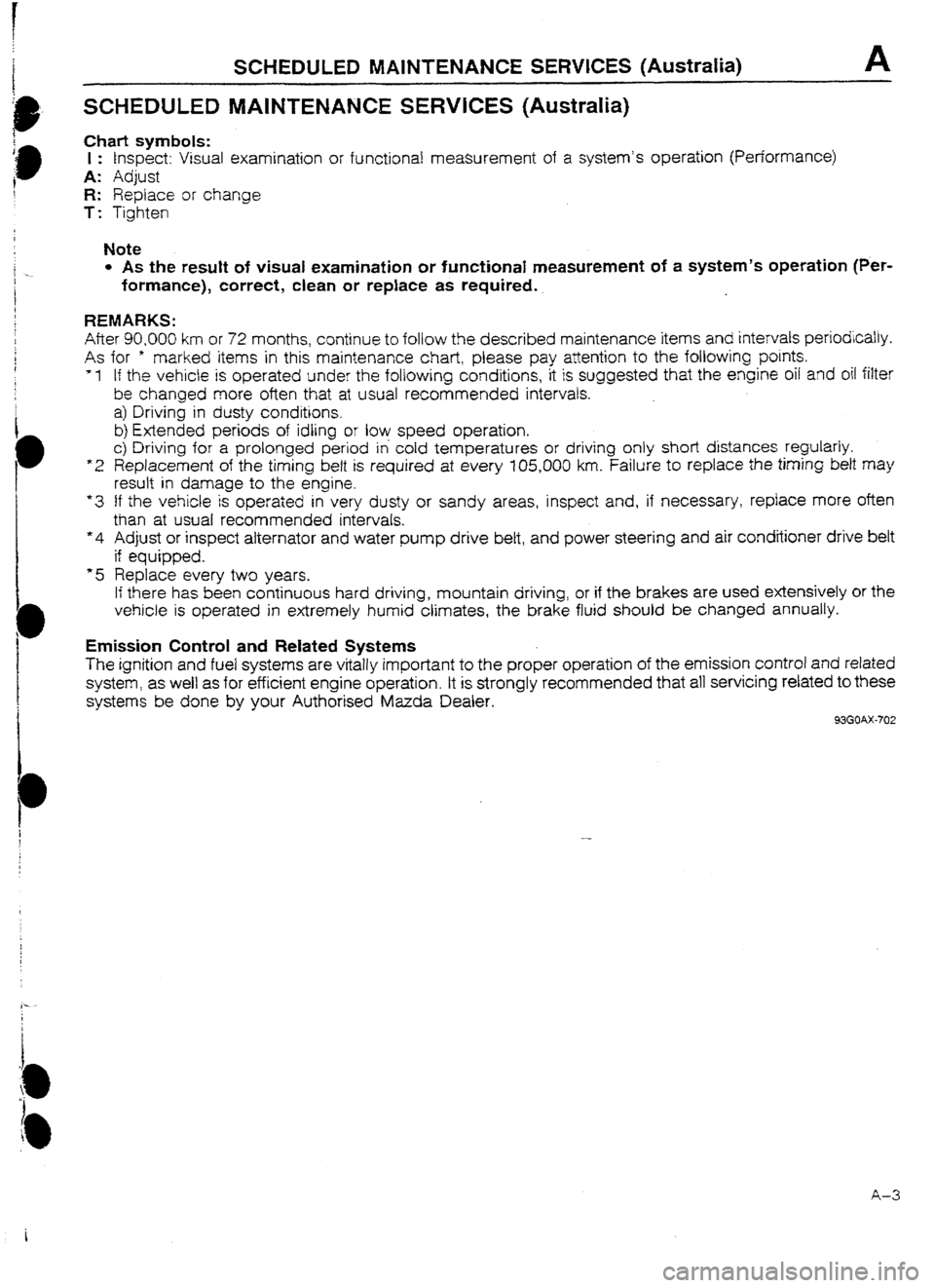
SCHEDULED MAINTENANCE SERVICES (Australia)
Chart symbols:
I : Inspect: Visual examination or functiona! measurement of a system’s operation (Performance)
A: Adjust
R: Replace or change
T : Tighten
Note
l As the result of visual examination or functional measurement of a system’s operation (Per-
formance), correct, clean or replace as required.
REMARKS:
After 90,000 km or 72 months, continue to follow
the described maintenance items and intervals periodically.
As
“I
*2
*3
“4
l 5 for *
marked items in this maintenance chart please pay attention to the following points.
If the vehicfe is operated under the foltowing conditions, it is suggested that
the engine oil and oil f&r
be changed more often that at usual recommended intervals.
a> Driving in dusty condrt,ons.
b) Extended periods of idling
or low speed operation.
c) Driving for a prolonged period iti coid temperatures or driving only short distances regularly.
Replacement of the timing belt is required at every 105,000 km. failure to replace the timing belt may
result in damage to the engine.
If the vehicle is operated in very dusty or sandy areas, inspect and, if necessary, repface more often
than at usual recommended intervals.
Adjust or inspect alternator and water pump drive belt, and power steering and air conditioner drive belt
if equipped.
Replace every two years.
If there has been continuous hard driving, mountain driving, or if the brakes are used extensively or the
vehicle is operated in extremely humid climates, the brake fluid shotlid be changed annually.
Emission Control and Related Systems
The ignition and fuel systems are vitally important to the proper operation of the emission control and related
system, as well as for efficient engine operation. It is strongly recommended that all servicing related to these
systems be done by your Authorised Mazda Dealer.
93GOAX-702
-
A-3 i
Page 24 of 677
!
i
i
I
i
t-
I
i
i
e
-1
SCHEDULED MAfNTENANCE SERVICES (Europe) A
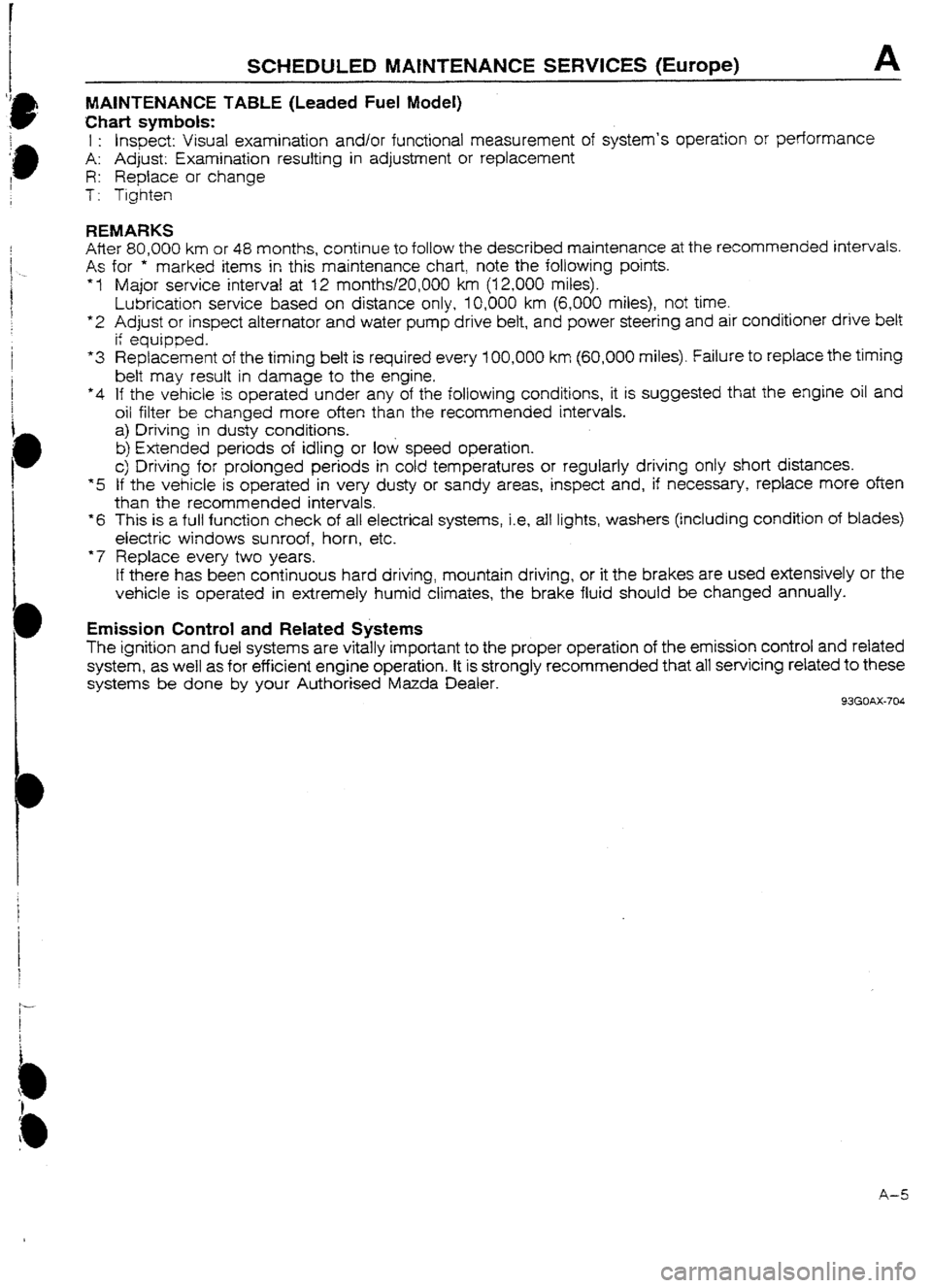
MAINTENANCE TABLE (Leaded Fuel Model)
Chart symbols:
1 : Inspect: Visual examination and/or functional measurement of system’s operation or performance
A: Adjust: Examination resulting in adjustment or replacement
R: Replace or change
T: Tighten
REMARKS
After 80.000 km or 48 months, continue to foltow the described maintenance at the recommended intervals.
As
*I
*2
“3
*4
*5
*6
*7 for *’
marked items in this’ maintenance chart, note the following points.
Major service interval at 12 months!ZO,OOO km (I 2,000 miles).
Lubrication service based on distance only, 10,000 km (6,000 miles), not time.
Adjust or inspect alternator and water pump drive belt, and power steering and air conditioner drive belt
ii equipped.
Replacement of the timing belt is required every ICQOUO km (60,000 miles). Failure to replace the timing
belt may result in damage to the engine.
If the vehicle is operated under any of the following conditions, it is suggested that the engine
oil and
oil filter be changed more often than the recommended intervals.
a) Driving in dusty conditions.
b) Extended periods of idling or low speed operation.
c) Driving for prolonged periods in cold temperatures or regularly driving only short distances.
If the vehicle is operated in very dusty or sandy areas, inspect and, if necessary, replace more often
than the recommended intervals.
This is a full function check of all electrical systems, i.e, afl lights, washers (inctuding condition of blades)
electric windows sunroof, horn, etc.
Replace every two years.
tf there has been continuous hard driving, mountain driving, or it the brakes are used extensively or the
vehicle is operated in extremely humid climates, the brake fluid should be changed annually.
Emission Control and Related Systems
The ignition and fuel systems are vitally important to the proper operation of the emission control and related
system, as well as for efficient engine operation. It is strongly recommended that all servicing related to these
systems be done by your Authorised Mazda Dealer.
93GOAX-704
A-5
Page 27 of 677
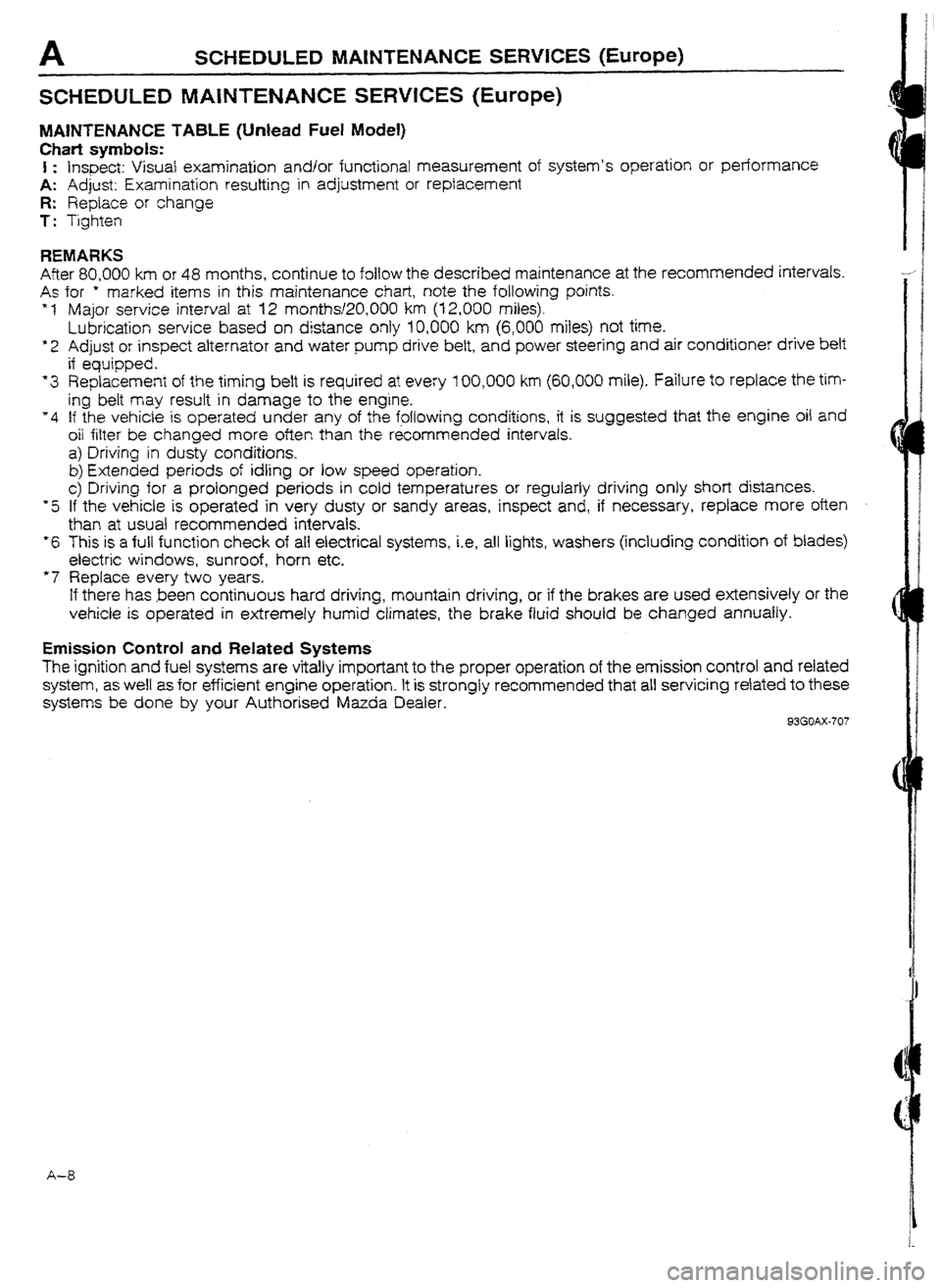
A SCHEDULED MAINTENANCE sERvw3 (Europe)
SCHEDULED MAfNTENANCE SERWCES (Europe)
MAWTENAN CE TABLE (Unlead Fuel Model)
Chati symbols:
I : Inspect: Visual examination and/or functional measurement of system’s operation or performance
A: Adjust: Examination resulting in adjustment or replacement
R: Replace or change
T: Tighten
REMARKS
After 80,000 km or 48 months, continue to follow the described maintenance at the recommended intervals.
As for * marked items in this maintenance chart, note the following points.
* 1 Major service interval at 12 months120,OOO km (12,000 miles).
Lubrication service based on distance only 10,000 km (6,000 miles) not time.
*2 Adjust or inspect alternator and water pump drive belt, and power steering and air conditioner drive belt
if equipped.
“3 Replacement of the timing belt is required at every 100,000 km (60,000 mile). failure to replace the tim-
ing belt may result in damage to the engine.
“4 If the vehicle is operated under any of the following conditions, it is suggested that the engine oil and
oil filter be changed more often than the &commended intervals.
a) Driving in dusty conditions.
b) Extended periods of idling or low speed operation.
c> Driving for a prolonged periods in cold temperatures or regularly driving only short distances.
*5 If the vehicle is operated in very dusty or sandy areas, inspect and, if necessary, replace more oten
than at usual recommended intervals.
*6 This is a full function check of all electrical systems, i.e, all lights, washers (including condition of blades)
electric windows, sunroof, horn etc.
“7 Replace every two years.
If there has been continuous hard driving, mountain driving, or if the brakes are used extensively or the
vehicle is operated in extremely humid climates, the brake fluid should be changed annually.
Emission Control and Related Systems
The ignition and fuel systems are vitally important to the proper operation of the emission control and related
system, as well as for efficient engine operation. It is strongly recommended that all servicing related to these
systems be done by your Authorised Mazda Dealer.
93GOAX-707
A-8
Page 97 of 677

E OUTLINE
ELECTRIC COCUNG FAN SYSTEM (BP DOHC TURBO)
System Circuit
I I
WITH A/C
r----‘-- -___- ---------.--------;
ADDITIONAL
FAN
MOTOR
I
II 1 A/C RELAY
RAD1ATdTHERMOSWITCH
ABOVE 105% I221 OF-): ON +IIAGNOSlS
CONNECTOR
WATER
THERMOSWlTCH
ABOVE 97% (207OF): ON
Operation 1. When the coolant temperature exceeds 97OC (207*F), the water thermoswitch turns ON to close the No.7
relay, and connects the + I and -1 terminals of the fan motor
connector. The fan motor turns at low
speed (about 1,660 rpm).
2. When the coolant temperature exceeds 105OC (221 OF), the radiator thermoswitch turns ON, to close the
No.2 and No.3 relays, and connects
the +2 and -2 terminals of the fan motor connector. The fan mo-
tor turns at high speed (about 2,200 rpm).
3. if the vehicle is equipped with air conditioning, the cooling fan motor operates whenever the
NC switch
and the blower switch are on, regardless of
the coolant temperature. Also, when the A/C switch and the blower switch are on, the A/C retay closes
to operate the additional fan
motur.
Note
l The water thermoswitch and the cooling fan reIay are normally-open switches.
Checking cooling fan operation 1. Jump across the TFA and the GND terminals
of the diagnosis connector with a jumper wire.
2. Turn the ignition switch to ON and verify that the cooling fan operates smoothly.
Note
l When the water thermoswitch connector is disconnected, the cooling fan wiif not operate.
E-8
Page 138 of 677
![MAZDA 232 1990 Workshop Manual Suplement CONTROL SYSTEM
WE~DOST WARNlNG BUZZER [BP TURBO]
To improve engine reliability, the overboost warning buzzer installed in the instrument cluster sounds during
overboost conditions as detected by en](/img/28/57056/w960_57056-137.png "MAZDA 232 1990 Workshop Manual Suplement CONTROL SYSTEM
WE~DOST WARNlNG BUZZER [BP TURBO]
To improve engine reliability, the overboost warning buzzer installed in the instrument cluster sounds during
overboost conditions as detected by en")
CONTROL SYSTEM
WE~DOST WARNlNG BUZZER [BP TURBO]
To improve engine reliability, the overboost warning buzzer installed in the instrument cluster sounds during
overboost conditions as detected by engine
speed and intake air amount caiculations within the ECU. The
driver is thus warned to reduce engine
speed.
DETECTtON
OVERBOOST
BUZZER
TURBOCHARGE INDICATOR [BP TURBO]
When the turbocharger boost pressure calcul’ated by intake air amount and engine speed reaches the predeter-
mined level and the transaxle is in gear, the turbocharge indicator illuminates to inform the driver of turbocharge
operation.
1
AIRFLOW METER
DISTRI BUTUR
rd” i
4 NEUTRAUCLUTCH
SWITCH ECU
* CALCULATION
-, OF
BOOST
PRESSURE
TURBOCHARGE
INDICATOR
Page 140 of 677
![MAZDA 232 1990 Workshop Manual Suplement CONTROL SYSTEM F2
t OXYGEN SENSOR [BP TURBO]
I
CERAMlC HEATER
93GOF2-733
Because the temperature of the exhaust gas is inherently low in turbocharged engines, the BP Turbo model
uses a rapid hea](/img/28/57056/w960_57056-139.png "MAZDA 232 1990 Workshop Manual Suplement CONTROL SYSTEM F2
t OXYGEN SENSOR [BP TURBO]
I
CERAMlC HEATER
93GOF2-733
Because the temperature of the exhaust gas is inherently low in turbocharged engines, the BP Turbo model
uses a rapid hea")
CONTROL SYSTEM F2
t OXYGEN SENSOR [BP TURBO]
I
CERAMlC HEATER
93GOF2-733
Because the temperature of the exhaust gas is inherently low in turbocharged engines, the BP Turbo model
uses a rapid heating ceramic heater to detect the air/fuel ratio,
PRESSURE REGULATOR CONTROL SYSTEM [BP TURBO]
PRESSURE
REGULATOR
I SOLENOID VALVE
(PRESSURE REGULATOR CONTROL)
FUEL
+ (FROM
DELIVERY PIPE1
II
FUEL INJ I
RELAY
(MAIN REU\Y)
I
II Ir
-__. _ - -’ VACUUM
CT0 DYNAMIC
Ill
CHAMBER)
BATTERY -
c
FUEL
(TO FUEL TANK)
nme*rn -.-a
To prevent percolation of the fuel during hot restart idle, vacuum to the pressure regulator k cut for 180
sec., and the fuel injection pressure is increased to slightly more than 284 kPa (2.90 kg/cm’, 41.2 psi).
Operating condition
l Coolant temperature: Above 90°C (194OF)
l Intake air temperature: Above 58OC (136OF)
g No-load condition
FZ-23
Page 147 of 677

F2 SELF-DIAGNOSlS FUNCTION
XIDE No. 1 42 (SOLENOID VALVE - WASTEGATE)-BP TURBO STEP
tNSPECTiON
ACTION
1
Disconnect connector from ECU and check if Yes Check ECU terminal connector for poor
battery voltage exists at connector terminal f H connection
(O/B) with Ignition switch ON
e If OK, replace ECU
4 tf not OK, repalr or replace connector
No Go to next step
2 in same condition as Step 1, check if battery Yes Repair wiring harness voltage extsts at solenoid valve connector
terminal-wire
NO Go to next step
3 Check if solenoid valve is OK
Yes Check for short or open circuit in wiring
.r3 page F2-46 from main relay (FUEL INJ relay) to
solenoid valve
NO Replace solenoid valve
Circuit Diagram
BA-iTERY
15A k
IGNITION SWITCH v /\: ./
WIG
B/w O/B
‘L a,
d
MAIN RELAY
(FUEL INJ)
WASTEGATE
SOtENOlD VALVE
ECU
WASTEGATE MAIN RELAY (FUEL INJ)
SOLENOfD VALVE
RIB 011 GIB WIG * LGIY L GM,
l v L/R
I
A WIG %fw
W/R
1u
10 1M 1K 71 B O/B
I I
i
B&Y B/L B;G UY Rh’ * I
I
IJB d/B WiB Wff W/R W/R B
F2-30
Page 149 of 677
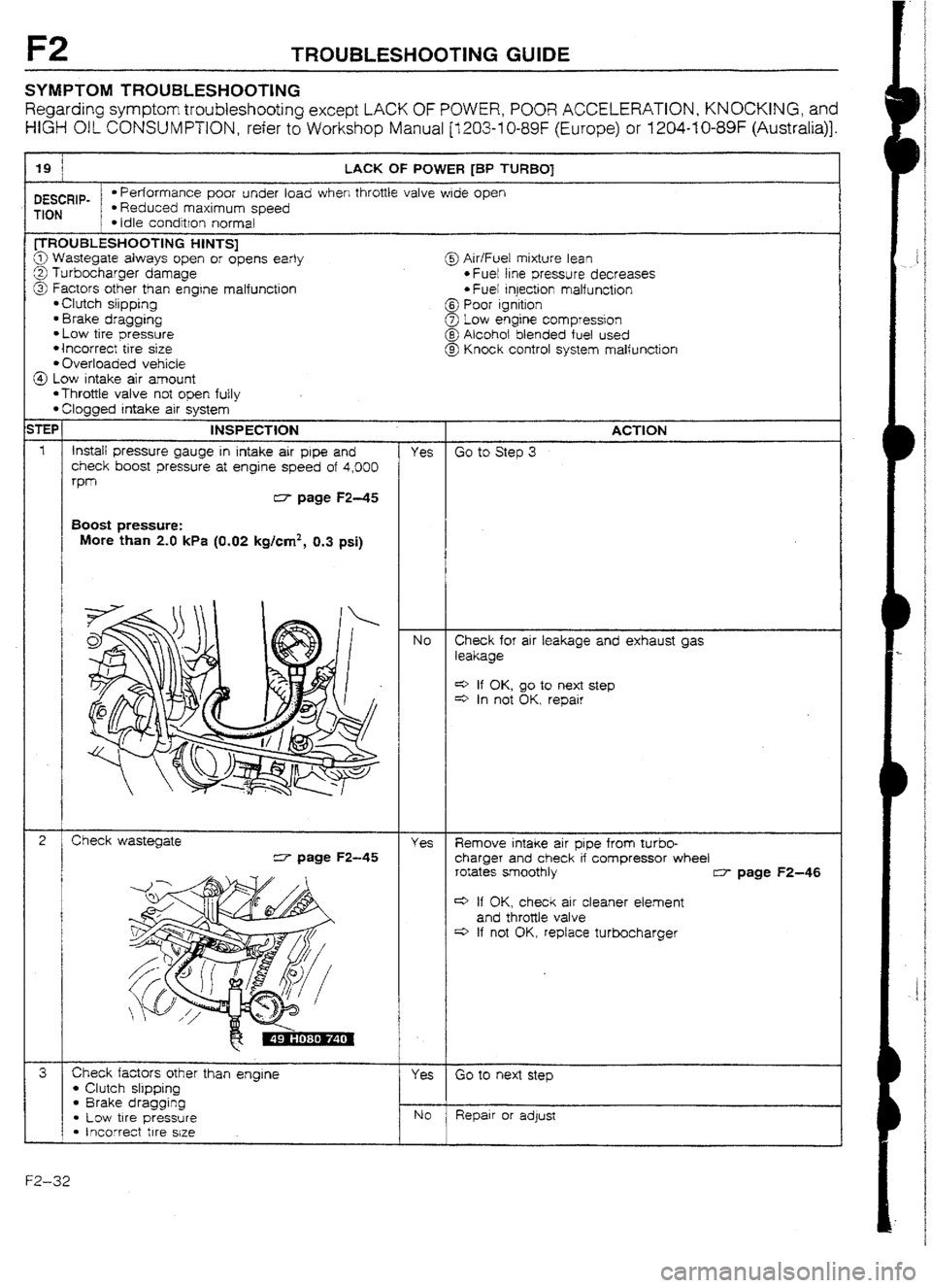
F2 TROUBLESt=iUUTlNG GUIDE
SYMPTOM TROUBLESHOOTING
Regarding symptom troubleshooting except LACK OF POWER, POOR XCELERATION, KNOCKING, and
HIGH UIL CONSUMPTION, refer to Workshop Manual [I 203-l O-89F (Europe) or 1204-l O-89F (Australia)].
19 LACK OF POWER [BP TIJR801
DESCRIP- *Performance poor under load when throttle valve wide open
TION *Reduced maximum speed
l Idle condition normal
[TROUBLESHOOTING HINTS1
3 Wastegate always open or opens early
3 Turbocharger damage
@ Factors other than engine malfunction
*Clutch sllpping
l Brake dragging
*Low tire pressure
l Incorrect tire size l Overloaded vehicle
@ Low intake air amount
*Throttle valve not open fully
*Clogged intake air system
TEP INSPECTlON
1
Install pressure gauge in intake air pipe and
check boost pressure at engine speed of
4,000
wm
CT page F2-45
Boost pressure:
More than 2.0 kPa (0.02 kglcm2, 0.3
psi)
@ Air/Fuel mixture lean
l Fuel iine pressure decreases l Fuel injection malfunction
@ Poor ignrtjon
@ Low engine compression
@ Alcohol blended fuel used
@ Knock control system malfunction
ACTION
Yes Go to Step 3
NO Check for air leakage and exhaust gas
leakage
4 If OK, go to next step
4 In not OK, repair
2 Check wastegate
Yes Remove intake air pipe from turbo-
f7 page F2-45 charger and check if compressor wheel
rotates smoothly t7 page F2-46
4 If OK, check air cleaner element
and throttle valve
+ If not OK, replace turbocharger
3 Check factors other than engrne Yes
l Clutch slipping Go to next step
1 8rake dragging
’
l Low tire pressure NO Repair or adjust
l Incorrect tire srze
FZ-32