oil MAZDA 6 2002 Workshop Manual Suplement
[x] Cancel search | Manufacturer: MAZDA, Model Year: 2002, Model line: 6, Model: MAZDA 6 2002Pages: 909, PDF Size: 17.16 MB
Page 710 of 909
M–80
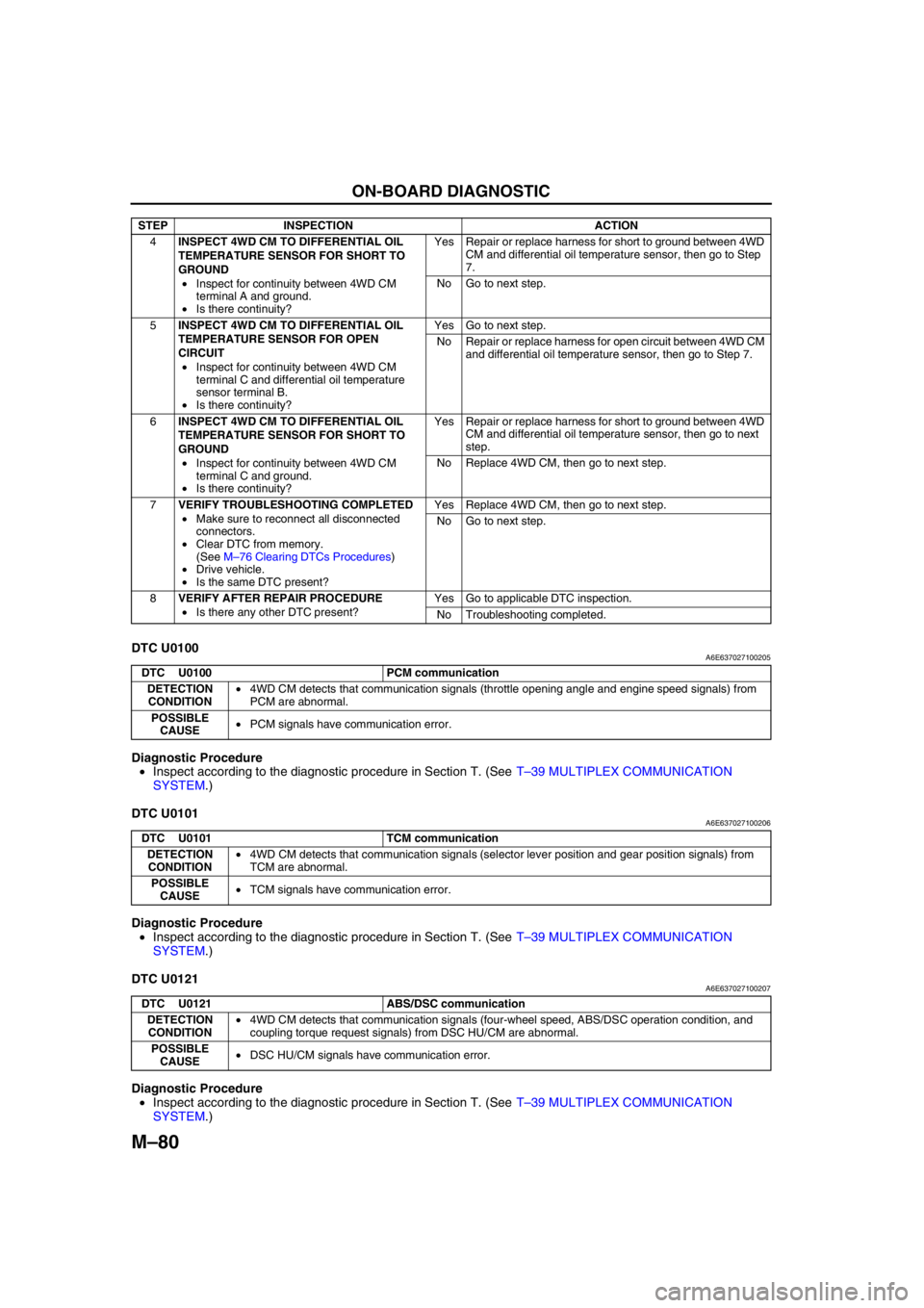
ON-BOARD DIAGNOSTIC
End Of Sie
DTC U0100A6E637027100205
Diagnostic Procedure
•Inspect according to the diagnostic procedure in Section T. (See T–39 MULTIPLEX COMMUNICATION
SYSTEM.)
End Of Sie
DTC U0101A6E637027100206
Diagnostic Procedure
•Inspect according to the diagnostic procedure in Section T. (See T–39 MULTIPLEX COMMUNICATION
SYSTEM.)
End Of Sie
DTC U0121A6E637027100207
Diagnostic Procedure
•Inspect according to the diagnostic procedure in Section T. (See T–39 MULTIPLEX COMMUNICATION
SYSTEM.)
End Of Sie
4INSPECT 4WD CM TO DIFFERENTIAL OIL
TEMPERATURE SENSOR FOR SHORT TO
GROUND
•Inspect for continuity between 4WD CM
terminal A and ground.
•Is there continuity?Yes Repair or replace harness for short to ground between 4WD
CM and differential oil temperature sensor, then go to Step
7.
No Go to next step.
5INSPECT 4WD CM TO DIFFERENTIAL OIL
TEMPERATURE SENSOR FOR OPEN
CIRCUIT
•Inspect for continuity between 4WD CM
terminal C and differential oil temperature
sensor terminal B.
•Is there continuity?Yes Go to next step.
No Repair or replace harness for open circuit between 4WD CM
and differential oil temperature sensor, then go to Step 7.
6INSPECT 4WD CM TO DIFFERENTIAL OIL
TEMPERATURE SENSOR FOR SHORT TO
GROUND
•Inspect for continuity between 4WD CM
terminal C and ground.
•Is there continuity?Yes Repair or replace harness for short to ground between 4WD
CM and differential oil temperature sensor, then go to next
step.
No Replace 4WD CM, then go to next step.
7VERIFY TROUBLESHOOTING COMPLETED
•Make sure to reconnect all disconnected
connectors.
•Clear DTC from memory.
(See M–76 Clearing DTCs Procedures)
•Drive vehicle.
•Is the same DTC present?Yes Replace 4WD CM, then go to next step.
No Go to next step.
8VERIFY AFTER REPAIR PROCEDURE
•Is there any other DTC present?Yes Go to applicable DTC inspection.
No Troubleshooting completed. STEP INSPECTION ACTION
DTC U0100 PCM communication
DETECTION
CONDITION•4WD CM detects that communication signals (throttle opening angle and engine speed signals) from
PCM are abnormal.
POSSIBLE
CAUSE•PCM signals have communication error.
DTC U0101 TCM communication
DETECTION
CONDITION•4WD CM detects that communication signals (selector lever position and gear position signals) from
TCM are abnormal.
POSSIBLE
CAUSE•TCM signals have communication error.
DTC U0121 ABS/DSC communication
DETECTION
CONDITION•4WD CM detects that communication signals (four-wheel speed, ABS/DSC operation condition, and
coupling torque request signals) from DSC HU/CM are abnormal.
POSSIBLE
CAUSE•DSC HU/CM signals have communication error.
Page 711 of 909

TROUBLESHOOTING
M–81
M
SYSTEM WIRING DIAGRAMA6E638027100201
End Of Sie
TROUBLESHOOTING
IGNITION SWITCH
BATTERY
DIFFERENTIAL OIL
TEMPERATURE
SENSOR4WD CM4WD SOLENOID ELECTRONIC CONTROL
COUPLING
CAN DRIVERINSTRUMENT CLUSTER
CAN-H
CAN-LPCM DSC HU/CM KO
P I
A
C
NH G
TCM
A6E63702002
Page 712 of 909

M–82
TROUBLESHOOTING
FOREWORDA6E638027100202
End Of Sie
SYMPTOM TROUBLESHOOTINGA6E638027100203•Verify the symptoms, and perform troubleshooting according to the appropriate number.
End Of Sie
NO.1 FREQUENT FRONT WHEEL SLIPA6E638027100204
Warning
•During simulation driving, vehicle stability may decrease extremely and cause an accident. Be
sure to perform the simulation test driving in a safe area.
Malfunction vehicle delivered
Questionnaire
Verify malfunction symptoms
Symptom troubleshooting
Verify that malfunctions have been repaired
Troubleshooting completedConfirm all customer problems using a questionnaire.
Confirm malfunction on actual vehicle.
DTC inspection
Inspect for DTCs using WDS or equivalent.
Perform applicable troubleshooting inspection according to
diagnostic index.
A6E63802001
No. Symptom Description
1 Frequent front wheel slip Front wheels slip frequently during acceleration on low-friction road.
2
Tight corner braking effectBrakes seem to be applied during tight cornering while driving very
slowly on paved road.
3 Abnormal noise and/or vibration from
coupling unitThere is abnormal noise and/or vibration from coupling unit during
driving.
1 Frequent front wheel slip
[TROUBLESHOOTING HINTS]
•Tire traction performance is extremely poor for given road friction. (4WD system is normal.)
•Improper wheel alignment (4WD system is normal.)
•Rear differential oil temperature is extremely high (Fail-safe condition)
•Differential oil temperature sensor malfunction (Fail-safe condition)
•Compare slip frequency with another vehicle of the same model (under the same road conditions and tire traction
performance).
•Replace tires with others of the same model and perform test under the same road conditions to determine if the
malfunction was caused by tire traction performance.
•Coupling component malfunction
•4WD solenoid malfunction
Page 715 of 909
N–1
N
NSTEERING SYSTEM
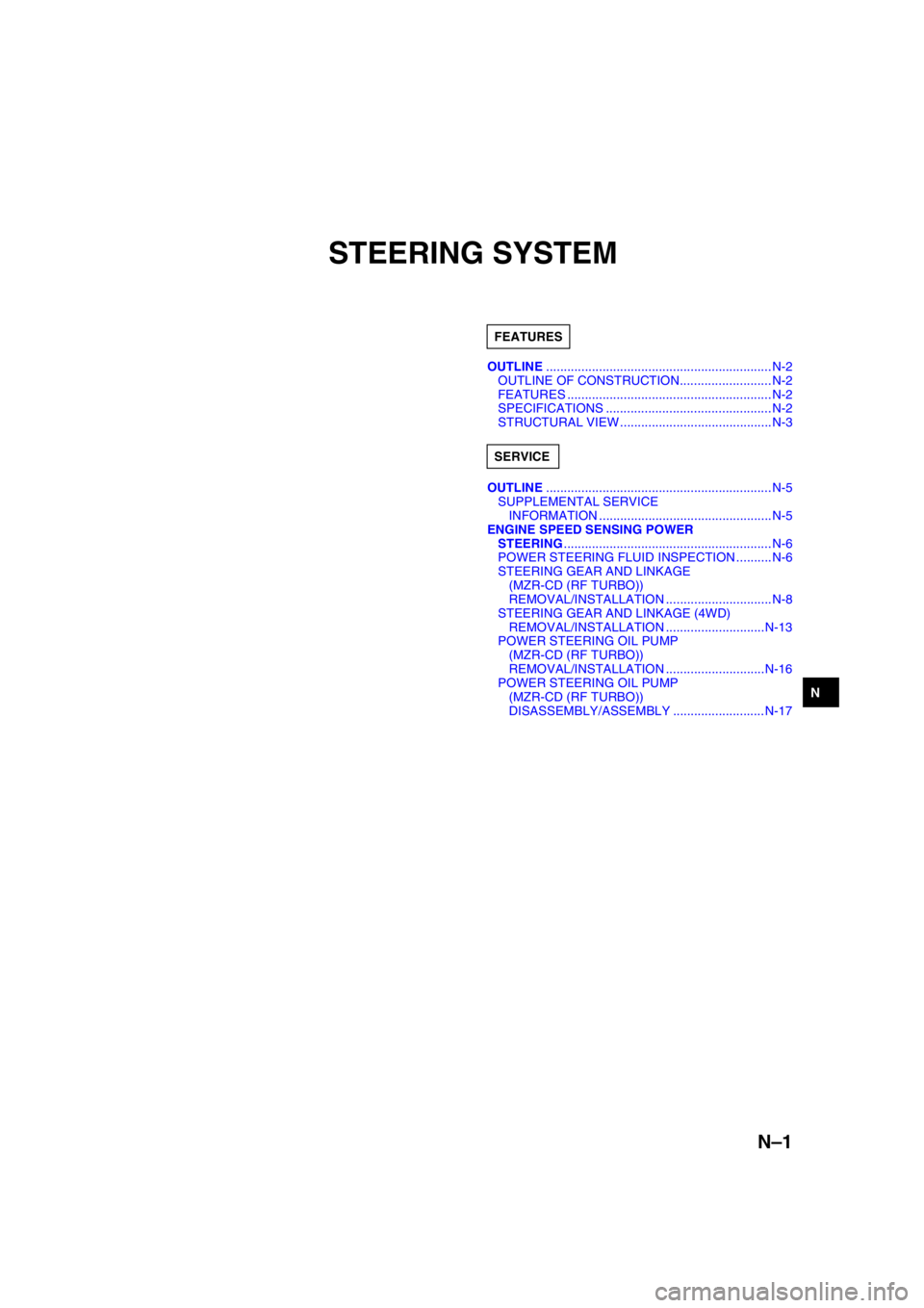
OUTLINE................................................................ N-2
OUTLINE OF CONSTRUCTION.......................... N-2
FEATURES .......................................................... N-2
SPECIFICATIONS ............................................... N-2
STRUCTURAL VIEW ...........................................N-3
OUTLINE................................................................ N-5
SUPPLEMENTAL SERVICE
INFORMATION .................................................N-5
ENGINE SPEED SENSING POWER
STEERING........................................................... N-6
POWER STEERING FLUID INSPECTION ..........N-6
STEERING GEAR AND LINKAGE
(MZR-CD (RF TURBO))
REMOVAL/INSTALLATION ..............................N-8
STEERING GEAR AND LINKAGE (4WD)
REMOVAL/INSTALLATION ............................N-13
POWER STEERING OIL PUMP
(MZR-CD (RF TURBO))
REMOVAL/INSTALLATION ............................N-16
POWER STEERING OIL PUMP
(MZR-CD (RF TURBO))
DISASSEMBLY/ASSEMBLY .......................... N-17 FEATURES
SERVICE
Page 716 of 909

N–2
OUTLINE
OUTLINE OF CONSTRUCTIONA6E660201036201•The construction and operation of the steering system is essentially carried over from that of the current
Mazda6 (GG), except for the following features. (See Mazda6 Training Manual 3359-1*-02C.)
• Due to the addition of the MZR-CD (RF Turbo) engine, a gear-driven power steering oil pump has been
adopted. The operation of the oil pump is the same as that of the current Mazda6 (GG).
• The disassembly/assembly procedures for the steering gear and linkage of the newly equipped MZR-CD (RF
Turbo) engine, wagon and 4WD models are the same as that of the current Mazda6 (GG).
End Of Sie
FEATURESA6E660201036202Improved Steering Feel
• The fluid pressure characteristics of the power steering system has been optimized (MZR-CD (RF Turbo) and
4WD models).
End Of Sie
SPECIFICATIONSA6E660201036203
* : When reservoir tank is at maximum volume
Bold frame:New specifications
End Of Sie
OUTLINE
Item New Mazda6
(GG) (4SD, 5HB) New Mazda6 (GY) (Wagon) Current Mazda6
(GG) (4SD, 5HB)
Drive train 2WD 4WD 2WD
Steering
wheel Outer diameter
370 {14.6}
(mm {in})
Lock-to-lock 18 inch wheel specification vehicles: 2.65
Except for above: 2.75 2.75
(turns)
Steering gear
and linkage Type Rack-and-pinion
Rack stroke 18 inch wheel specification vehicles:
141.6—143.6 {5.57—5.65}
Except for above:146.8—148.8
{5.78—5.85} 146.8—148.8 {5.78—5.85}
(mm {in})
Steering
column and
shaft Shaft type Collapsible
Joint type 2-cross joint
Amount of tilt
45 {1.8}
(mm {in})
Amount of telescope
(If equipped) 50 {2.0}
(mm {in})
Powe r
steering
system Power assist type Engine speed sensing
Pow er
steering
fluid
Ty p e
M-
III or equivalent (e.g. Dexron®II)
Fluid capacity
*
(approximate
quantity) MTX (except MZR-CD (RF Turbo)):
0.80 {0.85, 0.70}
ATX: 0.87 {0.92, 0.77} MZR-CD (RF Turbo):
0.86 {0.91, 0.76} 0.89 {0.94, 0.78}
MTX:
0.80 {0.85, 0.70}
AT X :
0.87 {0.92, 0.77}
(L {US qt, Imp qt})
Page 717 of 909

OUTLINE
N–3
N
STRUCTURAL VIEWA6E660201036204MZR-CD (RF Turbo)
.
7
6
7
6
5
5
3
1
2
4
A6E63162001
1L.H.D.
2 R.H.D.
3 Steering wheel
4 Steering column and shaft5 Steering gear
6 Power steering oil pump
7 Fluid reservoir
Page 718 of 909

N–4
OUTLINE
4WD
.
End Of Sie
8
7
5
4
3
1
2
6
5
6
8
7
A6E63162002
1 L.H.D.
2 R.H.D.
3 Steering wheel
4 Steering column and shaft5 Steering gear
6 Power steering oil pump
7 Fluid reservoir
8 Cooling pipe
Page 719 of 909

OUTLINE
N–5
N
SUPPLEMENTAL SERVICE INFORMATIONA6E660201034201•The following changes have been made since publication of the Mazda6 Workshop Manual (1730-1*-02C).
Power steering fluid
•Inspection procedure has been modified.
Steering gear and linkage (MZR-CD (RF Turbo))
•Removal/installation procedure has been added.
Steering gear and linkage (4WD)
•Removal/installation procedure has been added.
Power steering oil pump (MZR-CD (RF Turbo))
•Removal/installation procedure has been added.
•Disassembly/assembly procedure has been added.
End Of Sie
OUTLINE
Page 720 of 909

N–6
ENGINE SPEED SENSING POWER STEERING
POWER STEERING FLUID INSPECTIONA6E661432040201Fluid Level Inspection
1. Inspect the power steering fluid level.
•Add fluid to the specified level as necessary.
Fluid specification
ATF M-III or equivalent (e.g. Dexron
®II)
Fluid Leakage Inspection
Caution
•If the steering wheel is kept in the fully turned position for more than 5 seconds, the fluid
temperature will rise excessively and adversely affect the oil pump.
1. Start the engine and let it idle.
2. Turn the steering wheel fully to the left and right to apply fluid pressure.
Note
•The points where fluid leakage may occur are indicated in the figure.
3. Inspect for fluid leakage.
•If fluid leakage is found, replace the related pipe or hose.
ENGINE SPEED SENSING POWER STEERING
L.H.D.
ATX
MTX
R.H.D.
ATX
MTX MZR-CD (RF Turbo)
EXCEPT MZR-CD (RF Turbo)L.H.D
R.H.D
A6E66142001
Page 721 of 909
ENGINE SPEED SENSING POWER STEERING
N–7
N
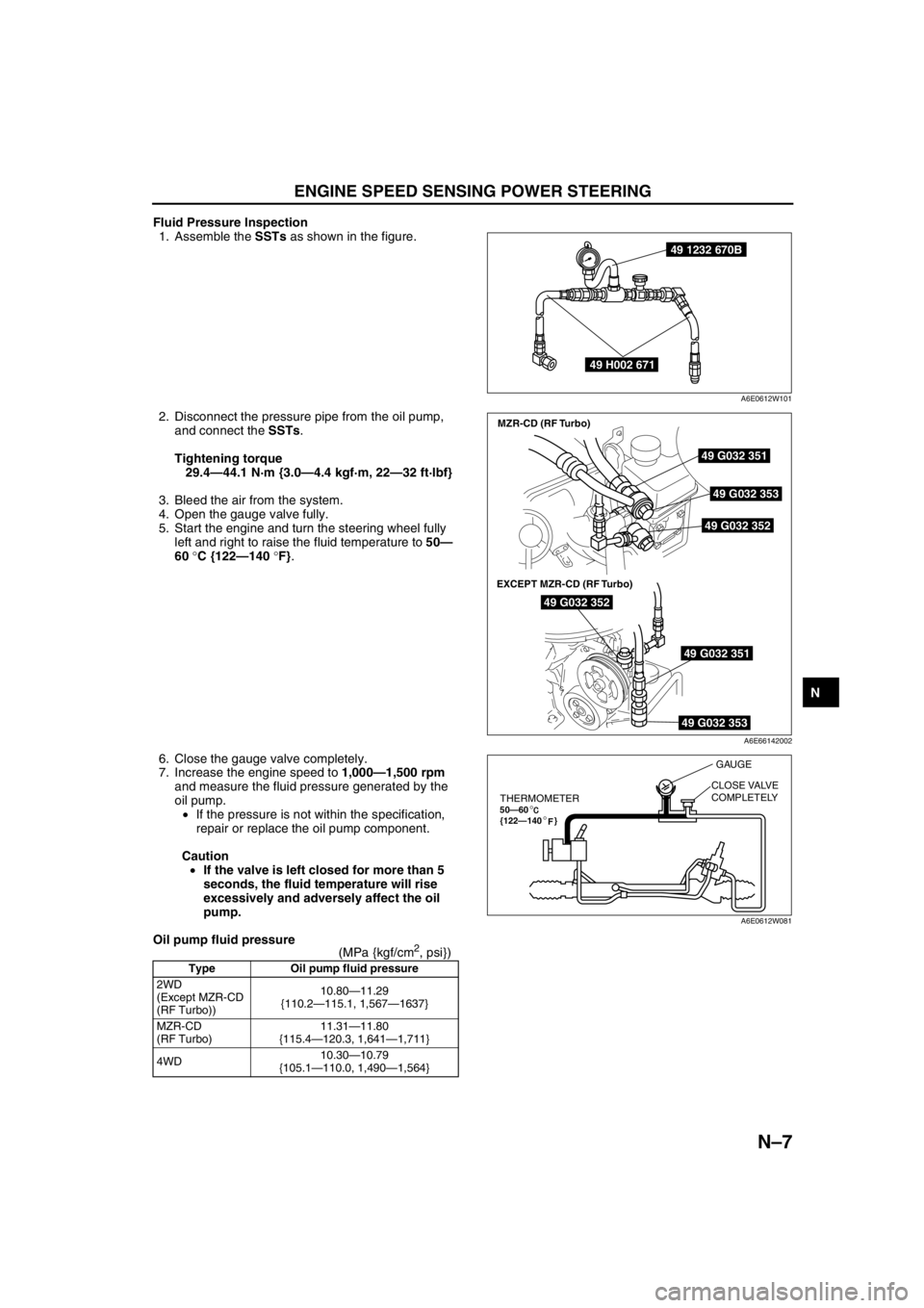
Fluid Pressure Inspection
1. Assemble the SSTs as shown in the figure.
2. Disconnect the pressure pipe from the oil pump,
and connect the SSTs.
Tightening torque
29.4—44.1 N·m {3.0—4.4 kgf·m, 22—32 ft·lbf}
3. Bleed the air from the system.
4. Open the gauge valve fully.
5. Start the engine and turn the steering wheel fully
left and right to raise the fluid temperature to 50—
60 °C {122—140 °F}.
6. Close the gauge valve completely.
7. Increase the engine speed to 1,000—1,500 rpm
and measure the fluid pressure generated by the
oil pump.
•If the pressure is not within the specification,
repair or replace the oil pump component.
Caution
•If the valve is left closed for more than 5
seconds, the fluid temperature will rise
excessively and adversely affect the oil
pump.
Oil pump fluid pressure
(MPa {kgf/cm
2, psi})
Type Oil pump fluid pressure
2WD
(Except MZR-CD
(RF Turbo))10.80—11.29
{110.2—115.1, 1,567—1637}
MZR-CD
(RF Turbo)11.31—11.80
{115.4—120.3, 1,641—1,711}
4WD10.30—10.79
{105.1—110.0, 1,490—1,564}
49 1232 670B
49 H002 671
A6E0612W101
49 G032 351
49 G032 353
49 G032 352
49 G032 352
49 G032 351
49 G032 353
MZR-CD (RF Turbo)
EXCEPT MZR-CD (RF Turbo)
A6E66142002
THERMOMETER50—60
{122—140 }°
°F
GAUGE
CLOSE VALVE
COMPLETELY
A6E0612W081