ABS MAZDA 6 2002 Suplement User Guide
[x] Cancel search | Manufacturer: MAZDA, Model Year: 2002, Model line: 6, Model: MAZDA 6 2002Pages: 909, PDF Size: 17.16 MB
Page 125 of 909

CONTROL SYSTEM
F1–37
F1
Without Using the SST
Caution
•The PCM terminal voltages vary with change in measuring conditions and vehicle conditions.
Always carry out a total inspection of the input systems, output systems, and PCM to determine
the cause of trouble. Otherwise, a wrong diagnosis will be made.
1. Measure the voltage at each terminal.
•If any incorrect voltage is detected, inspect the related system(s), wiring harnesses and connector(s)
referring to the Action column in the terminal voltage table.
Terminal voltage table (Reference)
Terminal Signal Connected to Test conditionVoltage
(V)Action
1A IGT1Ignition coil (No. 1,
4 cylinders)•Inspect using the wave profile.
(See F1–44 Inspection Using An
Oscilloscope (Reference).)•Inspect ignition coil
•Inspect related
harness
1B IGT2Ignition coil (No. 2,
3 cylinders)•Inspect using the wave profile.
(See F1–44 Inspection Using An
Oscilloscope (Reference).)•Inspect ignition coil
•Inspect related
harness
1C GND GND Under any condition Below 1.0•Inspect related
harness
1D GND GND Under any condition Below 1.0•Inspect related
harness
1E—— — ——
1F—— — ——
1G BARO BARO sensor Ignition switch ON (at sea level)Approx.
4.1 V•Inspect BARO sensor
•Inspect related
harness
1H—— — ——
1I—— — ——
1JManifold absolute
pressureMAP sensorIgnition switch ON (Engine OFF)Approx.
4.1•Inspect MAP sensor
•Inspect related
harness
IdleApprox.
1.5
1K Brake Brake switchBrake pedal depressed B+•Inspect brake switch
•Inspect related
harness Brake pedal released Below 1.0
1L—— — ——
1M ECT ECT sensorIgnition switch
ONECT 20 °C
{68 °F}3.04—
3.14•Inspect ECT sensor
•Inspect related
harness ECT 60 °C
{140 °F}1.29—
1.39
1N—— — ——
1O—— — ——
1P MAF MAF sensorIgnition switch ONApprox.
0.7•Inspect MAF sensor
•Inspect related
harness
Idle (after warm up)Approx.
1.3
1B 1A
1E 1D
1C 1H 1G 1J
1F 1I 1M
1L 1N 1K 1T 1Q1P 1S
1O 1R 1W1V
1Z 1Y
1X1AC1AB
1AA 1AD1U 2B 2A
2E 2D
2C 2H 2G 2J
2F 2I 2M
2L 2N 2K 2T 2Q2P 2S
2O 2R 2W2V
2Z 2Y
2X2AC2AB
2AA 2AD2U 3B 3A
3E 3D
3C 3H 3G 3J
3F 3I 3M
3L 3N 3K 3T 3Q3P 3S
3O 3R 3W3V
3Z 3Y
3X3AA3U 4B 4A
4E 4D
4C 4H 4G 4J
4F 4I 4M
4L 4N 4K 4T 4Q4P 4S
4O 4R 4W4V
4Z 4Y
4X4AC4AB
4AA 4AD4U
A6A3940W002
Page 127 of 909
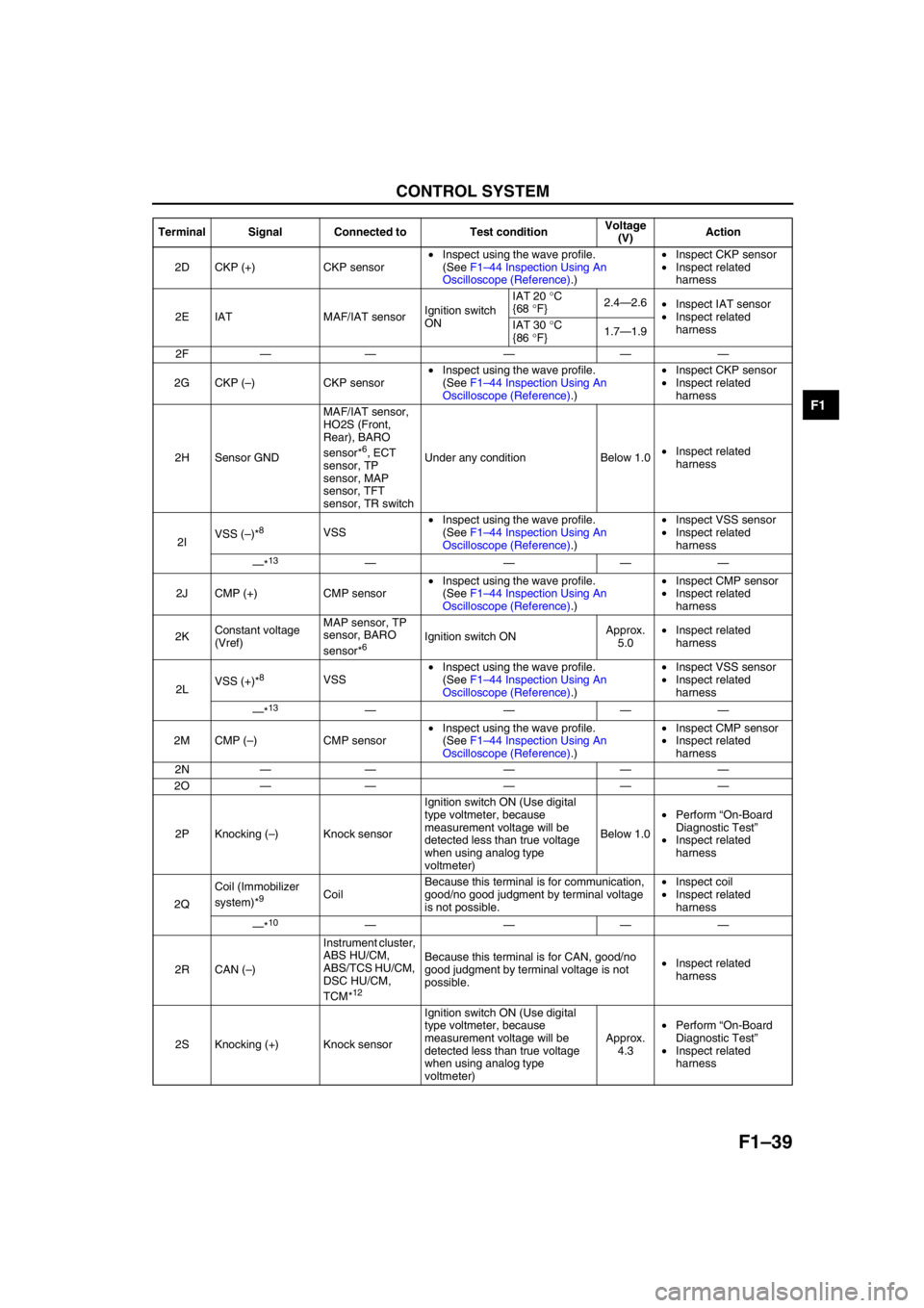
CONTROL SYSTEM
F1–39
F1
2D CKP (+) CKP sensor•Inspect using the wave profile.
(See F1–44 Inspection Using An
Oscilloscope (Reference).)•Inspect CKP sensor
•Inspect related
harness
2E IAT MAF/IAT sensorIgnition switch
ONIAT 20 °C
{68 °F}2.4—2.6
•Inspect IAT sensor
•Inspect related
harness IAT 30 °C
{86 °F}1.7—1.9
2F—— — ——
2G CKP (–) CKP sensor•Inspect using the wave profile.
(See F1–44 Inspection Using An
Oscilloscope (Reference).)•Inspect CKP sensor
•Inspect related
harness
2H Sensor GNDMAF/IAT sensor,
HO2S (Front,
Rear), BARO
sensor*
6, ECT
sensor, TP
sensor, MAP
sensor, TFT
sensor, TR switchUnder any condition Below 1.0•Inspect related
harness
2IVSS (–)*
8VSS•Inspect using the wave profile.
(See F1–44 Inspection Using An
Oscilloscope (Reference).)•Inspect VSS sensor
•Inspect related
harness
—*
13————
2J CMP (+) CMP sensor•Inspect using the wave profile.
(See F1–44 Inspection Using An
Oscilloscope (Reference).)•Inspect CMP sensor
•Inspect related
harness
2KConstant voltage
(Vref)MAP sensor, TP
sensor, BARO
sensor*
6Ignition switch ONApprox.
5.0•Inspect related
harness
2LVSS (+)*
8VSS•Inspect using the wave profile.
(See F1–44 Inspection Using An
Oscilloscope (Reference).)•Inspect VSS sensor
•Inspect related
harness
—*
13————
2M CMP (–) CMP sensor•Inspect using the wave profile.
(See F1–44 Inspection Using An
Oscilloscope (Reference).)•Inspect CMP sensor
•Inspect related
harness
2N—— — ——
2O—— — ——
2P Knocking (–) Knock sensorIgnition switch ON (Use digital
type voltmeter, because
measurement voltage will be
detected less than true voltage
when using analog type
voltmeter)Below 1.0•Perform “On-Board
Diagnostic Test”
•Inspect related
harness
2QCoil (Immobilizer
system)*
9CoilBecause this terminal is for communication,
good/no good judgment by terminal voltage
is not possible.•Inspect coil
•Inspect related
harness
—*
10————
2R CAN (–)Instrument cluster,
ABS HU/CM,
ABS/TCS HU/CM,
DSC HU/CM,
TCM*
12
Because this terminal is for CAN, good/no
good judgment by terminal voltage is not
possible.•Inspect related
harness
2S Knocking (+) Knock sensorIgnition switch ON (Use digital
type voltmeter, because
measurement voltage will be
detected less than true voltage
when using analog type
voltmeter)Approx.
4.3•Perform “On-Board
Diagnostic Test”
•Inspect related
harness Terminal Signal Connected to Test conditionVoltage
(V)Action
Page 128 of 909
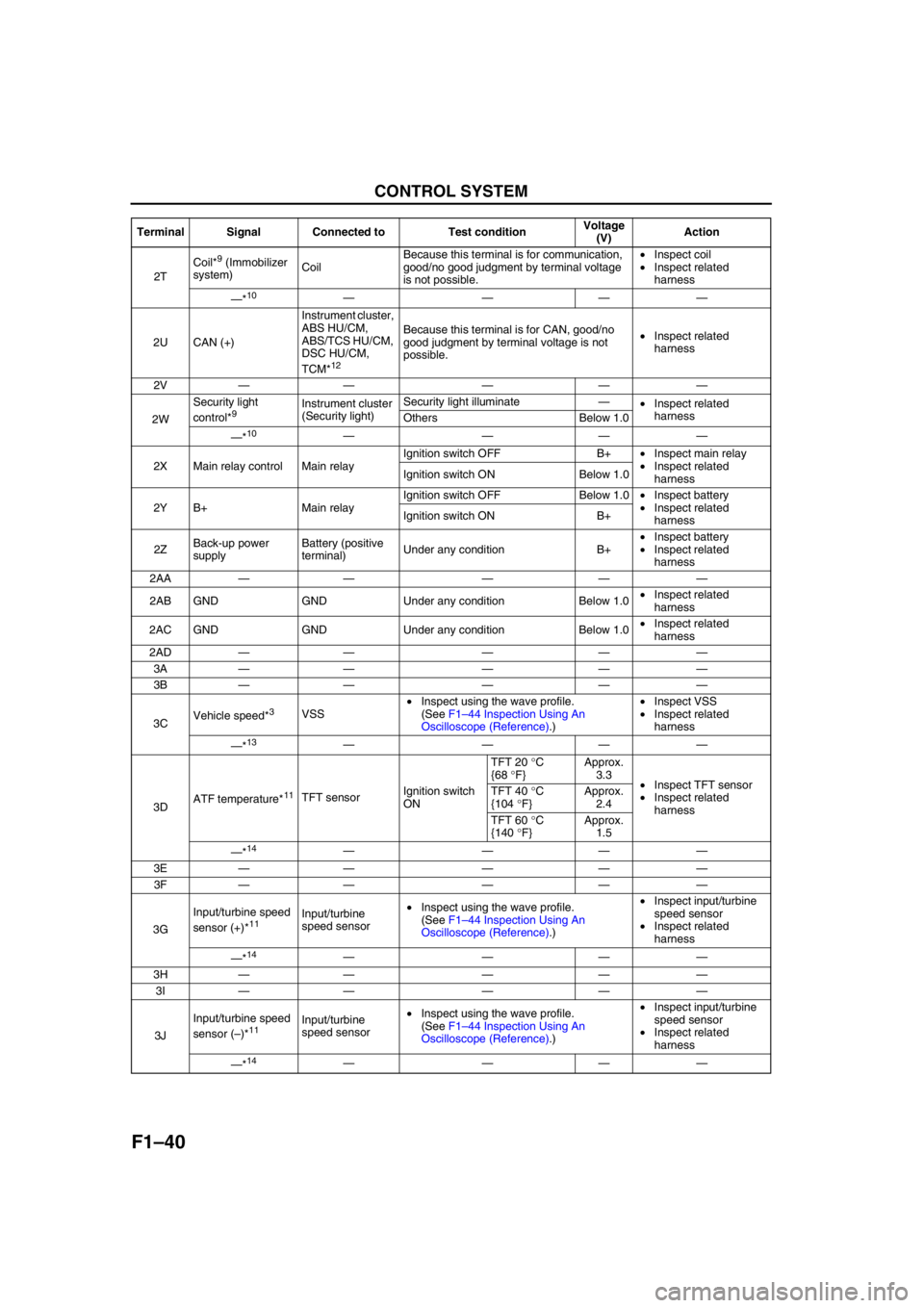
F1–40
CONTROL SYSTEM
2TCoil*
9 (Immobilizer
system)CoilBecause this terminal is for communication,
good/no good judgment by terminal voltage
is not possible.•Inspect coil
•Inspect related
harness
—*
10————
2U CAN (+)Instrument cluster,
ABS HU/CM,
ABS/TCS HU/CM,
DSC HU/CM,
TCM*
12
Because this terminal is for CAN, good/no
good judgment by terminal voltage is not
possible.•Inspect related
harness
2V—— — ——
2WSecurity light
control*
9Instrument cluster
(Security light)Security light illuminate—
•Inspect related
harness
Others Below 1.0
—*
10————
2X Main relay control Main relayIgnition switch OFF B+•Inspect main relay
•Inspect related
harness Ignition switch ON Below 1.0
2Y B+ Main relayIgnition switch OFF Below 1.0•Inspect battery
•Inspect related
harness Ignition switch ON B+
2ZBack-up power
supplyBattery (positive
terminal)Under any condition B+•Inspect battery
•Inspect related
harness
2AA—— — ——
2AB GND GND Under any condition Below 1.0•Inspect related
harness
2AC GND GND Under any condition Below 1.0•Inspect related
harness
2AD—— — ——
3A—— — ——
3B—— — ——
3CVehicle speed*
3VSS•Inspect using the wave profile.
(See F1–44 Inspection Using An
Oscilloscope (Reference).)•Inspect VSS
•Inspect related
harness
—*
13————
3DATF temperature*
11TFT sensorIgnition switch
ONTFT 20 °C
{68 °F}Approx.
3.3
•Inspect TFT sensor
•Inspect related
harness TFT 40 °C
{104 °F}Approx.
2.4
TFT 60 °C
{140 °F}Approx.
1.5
—*
14————
3E—— — ——
3F—— — ——
3GInput/turbine speed
sensor (+)*
11Input/turbine
speed sensor•Inspect using the wave profile.
(See F1–44 Inspection Using An
Oscilloscope (Reference).)•Inspect input/turbine
speed sensor
•Inspect related
harness
—*
14————
3H—— — ——
3I—— — ——
3JInput/turbine speed
sensor (–)*
11Input/turbine
speed sensor•Inspect using the wave profile.
(See F1–44 Inspection Using An
Oscilloscope (Reference).)•Inspect input/turbine
speed sensor
•Inspect related
harness
—*
14———— Terminal Signal Connected to Test conditionVoltage
(V)Action
Page 131 of 909

CONTROL SYSTEM
F1–43
F1
*1: Calculated value; differs from terminal voltage
*2: MTX models
*3: ATX models
*4: LF engine models
*5: L3 engine models
4QFuel pump control*
9Fuel pump relayIgnition switch ON B+•Inspect fuel pump
relay
•Inspect related
harness Cranking Below 1.0
Idle Below 1.0
—*
10————
4RVIC control*
5VIC control
solenoid valveEngine speed: above 4,500 rpm B+•Inspect VIC solenoid
valve
•Inspect related
harness Engine speed: below 4,500 rpm Below 1.0
—*
7————
4S—— — ——
4TVariable tumble
controlVariable tumble
control solenoid
valveECT above 63 °C { 145 °F} while
idling.B+•Inspect variable
tumble control
solenoid valve
•Inspect related
harness ECT below 63 °C {145 °F} and
engine speed below 3,750 rpmBelow 1.0
4U Purge controlPurge solenoid
valve•Inspect using the wave profile.
(See F1–44 Inspection Using An
Oscilloscope (Reference).)•Inspect purge
solenoid valve
•Inspect related
harness
4VB+*
3Main relayIgnition switch OFF Below 1.0•Inspect battery
•Inspect related
harness Ignition switch ON B+
—— — ——
4W Fuel injection (#2) Fuel injector No.2•Inspect using the wave profile.
(See F1–44 Inspection Using An
Oscilloscope (Reference).)•Inspect fuel injector
No.2
•Inspect related
harness
4X GND GND Under any condition Below 1.0•Inspect related
harness
4YShift solenoid C
control*
11Shift solenoid C•Inspect using the wave profile.
(See F1–44 Inspection Using An
Oscilloscope (Reference).)•Inspect shift solenoid
C
•Inspect related
harness
—*
14————
4Z Fuel injection (#1) Fuel injector No.1•Inspect using the wave profile.
(See F1–44 Inspection Using An
Oscilloscope (Reference).)•Inspect fuel injector
No.1
•Inspect related
harness
4AA Fuel injection (#4) Fuel injector No.4•Inspect using the wave profile.
(See F1–44 Inspection Using An
Oscilloscope (Reference).)•Inspect fuel injector
No.4
•Inspect related
harness
4ABShift solenoid A
control*
11Shift solenoid A•Inspect using the wave profile.
(See F1–44 Inspection Using An
Oscilloscope (Reference).)•Inspect shift solenoid
A
•Inspect related
harness
—*
14————
4ACShift solenoid B
control*
11Shift solenoid B•Inspect using the wave profile.
(See F1–44 Inspection Using An
Oscilloscope (Reference).)•Inspect shift solenoid
B
•Inspect related
harness
—*
14————
4AD Fuel injection (#3) Fuel injector No.3•Inspect using the wave profile.
(See F1–44 Inspection Using An
Oscilloscope (Reference).)•Inspect fuel injector
No.3
•Inspect related
harness Terminal Signal Connected to Test conditionVoltage
(V)Action
Page 132 of 909

F1–44
CONTROL SYSTEM
*6: Unleaded fuel (RON 90 or above) models
*7: Exclude L3 engine models
*8: MTX, without ABS models
*9: Immobilizer system equipped
*10: Immobilizer system not equipped
*11: 2WD ATX models
*12: 4WD ATX models
*13: Exclude MTX models without ABS
*14: Exclude 2WD ATX models
Inspection Using An Oscilloscope (Reference)
IGT1, IGT2 control signals
PCM terminals
•IGT1(No.1 and No.4): 1A(+)—1D(–)
•IGT2(No.2 and No.3): 1B(+)—1C(–)
Oscilloscope setting
•4 V/DIV (Y), 0.01 ms/DIV (X), DC range
Vehicle condition
•Idle after warm up (engine speed approx. 650
rpm [MTX] or 700 rpm [ATX], no load, P/S off, A/C
off)
Generator output voltage signal
PCM terminals
•1AA(+)—2AC(–)
Oscilloscope setting
•2 V/DIV (Y), 2 ms/DIV (X), DC range
Vehicle condition
•Idle after warm up (engine speed approx. 650
rpm [MTX] or 700 rpm [ATX], no load, P/S off, A/C
off)
HO2S (front) signal
PCM terminals
•1AB(+)—2H(–)
Oscilloscope setting
•0.1 V/DIV (Y), 400 ms/DIV (X), DC range
Vehicle condition
•Idle after warm up (engine speed approx. 650
rpm [MTX], 700 rpm [ATX], no load, P/S off, A/C
off)
0 V
A6A3940W003
0 V
A6A3940W004
0 V
A6A3940W005
Page 140 of 909

F1–52
ON-BOARD DIAGNOSTIC
End Of Sie
DTC (4WD)A6E397018881204•Detection logics and conditions are as shown below.
Controller Area Network (CAN)
PCM cannot receive any signals from TCM (U0101)
•PCM cannot receive any signals from TCM.
End Of Sie
OBD DRIVE MODEA6E397018881205•Performing the Drive Mode inspects the OBD system for proper operation. The Drive Mode must be performed
to ensure that no additional DTCs are present.
•During Drive Mode, the following systems are inspected:
—Oxygen sensor (HO2S)
—Oxygen sensor heater
—Catalytic converter (TWC)
Caution
•While performing the Drive Mode, always operate the vehicle in a safe and lawful manner.
•When the WDS or equivalent is used to observe monitor system condition while driving, be sure to
have another technician with you, or record the data in the WDS or equivalent using the PID/DATA
MONITOR AND RECORD function and inspect later.
Note
•Vehicle speed and engine speed detected by the PCM may differ from that indicated by the speedometer
and tachometer. Use the WDS or equivalent to monitor vehicle speed.
•If the OBD system inspection is not completed during the Drive Mode, the following causes are
considered:
1. The OBD system detects the malfunction.
2. The Drive Mode procedure is not completed correctly.
•Disconnecting the battery will reset the memory. Do not disconnect the battery during and after Drive
Mode.
PCM Adaptive Memory Procedure Drive Mode
Note
•The PCM adaptive memory condition can be confirmed with RFCFLAG PID.
•If RFCFLAG PID is “Learnt”, PCM Adaptive Memory Procedure Drive Mode is not necessary, because
PCM already has adaptive memory.
•If RFCFLAG PID is “Not Learnt”, PCM Adaptive Memory Procedure Drive should be performed before
HO2S Heater, HO2S, and TWC Repair Verification Drive Mode.
1. Start the engine and warm it up completely.
2. Verify all accessory loads (A/C, headlights, blower fan, rear window defroster) are off.
U0101 PCM cannot receive any signals from TCM ON 1 Other×
U0121PCM cannot receive any signals from ABS, ABS/TCS
or DSC HU/CMON 1 Other×
U0155PCM cannot receive any signals from instrument
clusterON 1 Other× DTC No. Condition MIL DC Monitor itemMemory
function
Page 144 of 909

F1–56
ON-BOARD DIAGNOSTIC
End Of Sie
P2504Generator terminal B circuit
openOFF 1 Other——
U0073 CAN bus off OFF 1 Other——
U0101PCM cannot receive any
signals from TCMON 1 Other×(See T–39 MULTIPLEX
COMMUNICATION
SYSTEM)
U0121PCM cannot receive any
signals from ABS, ABS/TCS or
DSC HU/CMON 1 Other×—
U0155PCM cannot receive any
signals from combination meterON 1 Other×— DTC No. Condition MIL DC Monitor itemMemory
functionPage
Page 148 of 909
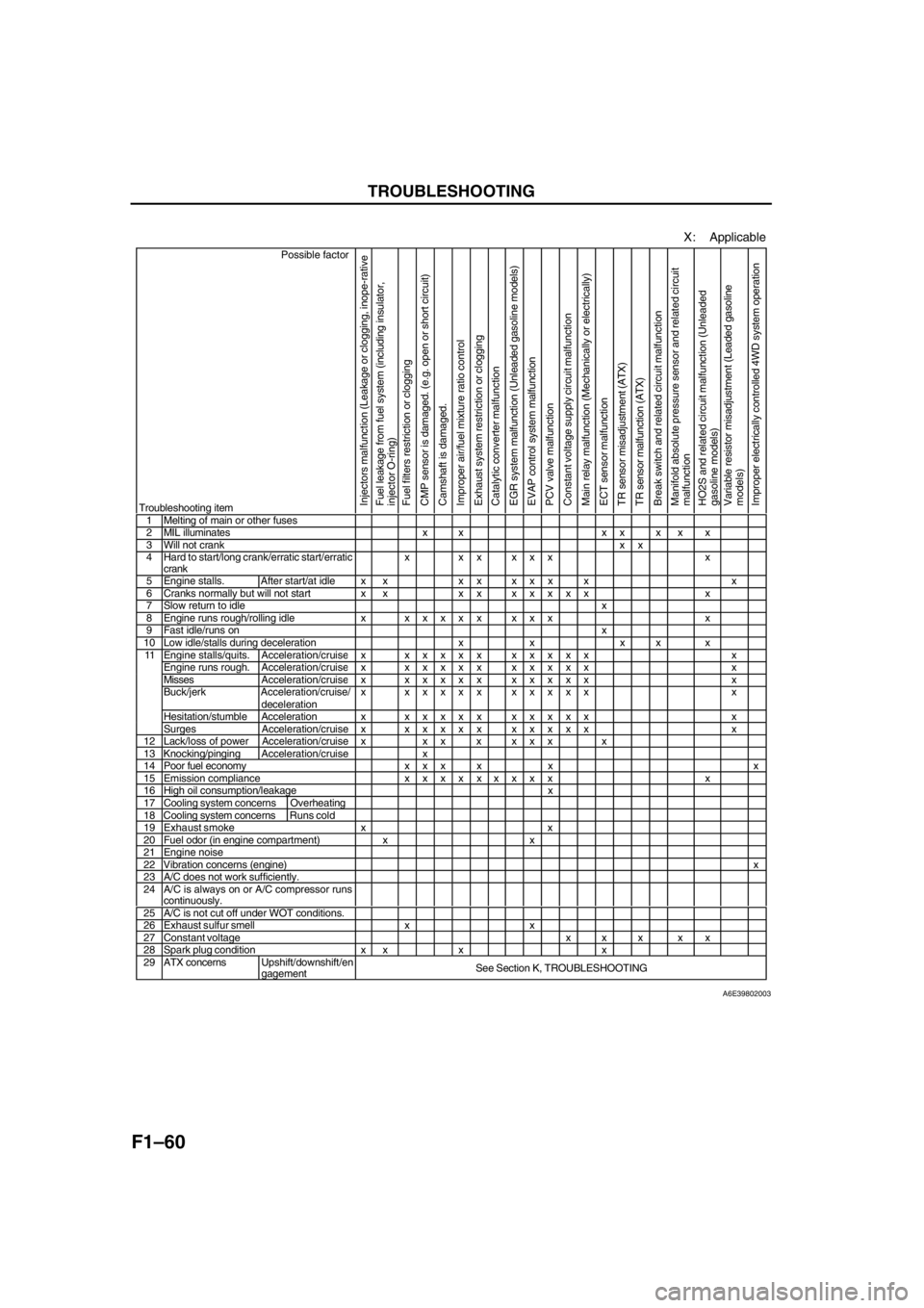
F1–60
TROUBLESHOOTING
X: Applicable
Possible factor
Troubleshooting item
Injectors malfunction (Leakage or clogging, inope-rative
Fuel leakage from fuel system (including insulator,
injector O-ring)
Fuel filters restriction or clogging
CMP sensor is damaged. (e.g. open or short circuit)
Camshaft is damaged.
Improper air/fuel mixture ratio control
Exhaust system restriction or clogging
Catalytic converter malfunction
EGR system malfunction (Unleaded gasoline models)
EVAP control system malfunction
PCV valve malfunction
Constant voltage supply circuit malfunction
Main relay malfunction (Mechanically or electrically)
ECT sensor malfunction
TR sensor misadjustment (ATX)
TR sensor malfunction (ATX)
Break switch and related circuit malfunction
Manifold absolute pressure sensor and related circuit
malfunction
HO2S and related circuit malfunction (Unleaded
gasoline models)
Variable resistor misadjustment (Leaded gasoline
models)
Improper electrically controlled 4WD system operation
1 Melting of main or other fuses2 MIL illuminates x x x x x x x3 Will not crankxx4 Hard to start/long crank/erratic start/erratic
crankx xx xxx x
5 Engine stalls. After start/at idle x x x x x x x x x6 Cranks normally but will not start x x x xxxxxx x7 Slow return to idlex8 Engine runs rough/rolling idle xxxxxx xxx x9 Fast idle/runs onx10 Low idle/stalls during deceleration x x x x xEngine stalls/quits.Acceleration/cruisex xxxxx xxxxx xEngine runs rough. Acceleration/cruisex xxxxx xxxxx xMissesAcceleration/cruisex xxxxx xxxxx xBuck/jerk Acceleration/cruise/
decelerationx xxxxx xxxxx x
Hesitation/stumble Acceleration xxxxxx xxxxx x
11
Surges Acceleration/cruise xxxxxx xxxxx x
12 Lack/loss of power Acceleration/cruise x x x x x x x x13 Knocking/pingingAcceleration/cruise x14 Poor fuel economy x x x x x x15 Emission compliancexxxxxxxxx x16 High oil consumption/leakage x17 Cooling system concerns Overheating18 Cooling system concernsRuns cold19 Exhaust smoke x x20 Fuel odor (in engine compartment) x x21 Engine noise22 Vibration concerns (engine)x23 A/C does not work sufficiently.24 A/C is always on or A/C compressor runs
continuously.
25 A/C is not cut off under WOT conditions.26 Exhaust sulfur smell x x27 Constant voltage x x x x x28 Spark plug condition x x x x29 ATX concernsUpshift/downshift/en
gagementSee Section K, TROUBLESHOOTING
A6E39802003
Page 176 of 909

F2–24
CONTROL SYSTEM, ON-BOARD DIAGNOSTIC
CONTROLLER AREA NETWORK (CAN)A6E404018881206Outline
•The PCM transmit/received the information other units using CAN to simplify the system.
Transmit Information
•Engine speed
•Vehicle speed
•Accelerator pedal position
•Fuel injection information
•Torque reduction inhibit
•Intake air temperature
•Engine coolant temperature
•Travelled distance
•Glow indicator light conditions
•Engine displacement
•Number of cylinders
•Air induction type
•Fuel type and delivery
•Country
•Transmission/axle type
•Tire circumference (front/rear)
•Cruise main indicator light conditions
•Cruise set indicator light conditions
Received Information
•Torque reduction request from DSC HU/CM
•Wheel speed from ABS HU/CM or DSC HU/CM
—Front left
—Front right
•Travelled distance from ABS HU/CM or DSC HU/CM
End Of Sie
OUTLINEA6E407018881201•The on-board diagnostic system is essentially carried over from that of the current MPV (LW) MZR-CD (RF
Turbo) engine models, except for the following. (See MPV Workshop Manual Supplement 1737-1*-02C.)
—DTCs, PID monitoring items, and simulation items have been changed.
—KOEO/KOER self-test items have been changed.
End Of Sie
DTCA6E407018881202
×: Applicable –: Not applicable
ON-BOARD DIAGNOSTIC
DTC Condition Detection condition MILMemory
function
P0016Crankshaft position-camshaft position
correlation malfunctionInput signals from CKP sensor and CMP sensor
are misaligned.××
P0088 Fuel pressure system too highFuel pressure is higher than preprogrammed
criteria.–×
P0091 Suction control valve circuit low inputInput voltage from suction control valve does not
change from off to on.××
P0092 Suction control valve circuit high inputInput voltage from suction control valve does not
change from on to off.××
P0093 Fuel system leak detectionFuel pressure after fuel injection is lower than
preprogrammed criteria.××
P0097 IAT sensor No.1 circuit low input Input voltage from IAT sensor No.1 is below 0.1 V.××
P0098 IAT sensor No.1 circuit high input Input voltage from IAT sensor No.1 is above 5.0 V.××
P0102 MAF sensor circuit low input Input voltage from MAF sensor is below 0.2 V.××
P0103 MAF sensor circuit high input Input voltage from MAF sensor is above 4.9 V.××
P0107 Boost sensor circuit low inputInput voltage from boost sensor is below 1.9 V
when engine speed is 2,400 rpm or above and
accelerator opening angle is 50% or above.××
P0108 Boost sensor circuit high input Input voltage from boost sensor is above 4.9 V.××
Page 178 of 909

F2–26
ON-BOARD DIAGNOSTIC
End Of Sie
KOEO/KOER SELF-TESTA6E407018881203KOEO/KOER self-test function table
×: Applicable –: Not applicable
End Of Sie
P0610 Control module vehicle options error PCM data configuration error.××
P0661 VSC solenoid valve circuit low inputInput voltage from VSC solenoid valve is below 0.1
V.–×
P0662 VSC solenoid valve circuit high input Input voltage from VSC solenoid valve is above B+.–×
P0850 Neutral switch circuit malfunctionInput voltage from neutral switch does not change
when vehicle stops after accelerating to above 60
km/h {37 mph} and decelerating to 0 km/h {0 mph}
2 times.××
P1190 Calibration resistor circuit malfunctionInput voltage from calibration resistor is below 0.2 V
or above 4.8 V.××
P2228 BARO sensor circuit low input Input voltage from BARO sensor is below 0.7 V.××
P2229 BARO sensor circuit high input Input voltage from BARO sensor is above 4.5 V.××
U0073 CAN bus off CAN controller is damaged.–×
U0121PCM cannot receive any signals from
ABS, ABS/TCS or DSC HU/CMPCM cannot receive any signals from ABS, ABS/
TCS or DSC HU/CM.××
U0155PCM cannot receive any signals from
instrument clusterPCM cannot receive any signals from instrument
cluster.×× DTC Condition Detection condition MILMemory
function
DTC Condition KOEO KOER
P0097 IAT sensor No.1 circuit low input××
P0098 IAT sensor No.1 circuit high input××
P0102 MAF sensor circuit low input××
P0103 MAF sensor circuit high input××
P0107 Boost sensor circuit low input××
P0108 Boost sensor circuit high input××
P0112 IAT sensor No.2 circuit low input××
P0113 IAT sensor No.2 circuit high input××
P0117 ECT sensor circuit low input××
P0118 ECT sensor circuit high input××
P0122 Accelerator position sensor No.1 circuit low input××
P0123 Accelerator position sensor No.1 circuit high input××
P0222 Accelerator position sensor No.2 circuit low input××
P0223 Accelerator position sensor No.2 circuit high input××
P0602 PCM programming error××
P0610 Control module vehicle options error××
P0661 VSC solenoid valve circuit low input××
P0662 VSC solenoid valve circuit high input××
P2228 BARO sensor circuit low input××
P2229 BARO sensor circuit high input××
U0073 CAN bus off××
U0121 PCM cannot receive any signals from ABS, ABS/TCS or DSC HU/CM××
U0155 PCM cannot receive any signals from instrument cluster××