fuel pressure MAZDA 6 2002 Suplement User Guide
[x] Cancel search | Manufacturer: MAZDA, Model Year: 2002, Model line: 6, Model: MAZDA 6 2002Pages: 909, PDF Size: 17.16 MB
Page 99 of 909

FUEL SYSTEM
F1–11
F1
Operation
•The fuel jet pump (venturi) is installed in the return passage from the pressure regulator, and fuel in the fuel
tank is pumped to the left side from the right side using the vacuum generated in the passage.
•When the return fuel pressure exceeds a specified value, the relief valve is opened. The relief valve delivers the
return fuel directly to the fuel tank. In this way, pressure of the return fuel passing through the fuel jet pump is
kept constantly below the specified value.
.
End Of Sie
9
8
7
54
3
10
14
13
11
12
6
1
2
:
:
2
15
A6E39122003
1 Fuel pump unit
2 Fuel pump (transfer)
3 Fuel injector
4 Fuel tank (left side)
5 Fuel tank (right side)
6 Relief valve
7 Discharge outlet
8 From pressure regulator9 From fuel tank (right side)
10 Fuel jet pump
11 To fuel tank (left side)
12 Fuel jet pump
13 From fuel tank (left side)
14 Fuel flow
15 Pumped fuel flow
Page 102 of 909

F1–14
CONTROL SYSTEM
OUTLINEA6E394018880201•The control system is essentially carried over from the current Mazda6 (GG), except for the following. (See
Mazda6 Training Manual 3359-1*-02C.)
Vehicle Adoption
4WD ATX model
•TCM has been adopted. Due to this the PCM terminal of ATX device has been replaced to TCM. The ATX
device information which is needed by the fuel and emission control systems is communicated to the PCM by
the controller area network (CAN).
Unleaded (RON 90 or above) model
•BARO sensor has been eliminated. Due to this the BARO factor for purge control has been eliminated.
Input Device
×:Applicable
—: Not applicable
*
1: For MTX model
*2: With Immobilizer system
CONTROL SYSTEM
Item SignalMazda6 (GG, GY)
Remark for new model
4WD ATX Unleaded
(RON 90 or
above)Current
model
MAF/IAT sensor MAF and IAT×Same as current model
TP sensor TP×Same as current model
MAP sensor MAP×Same as current model
ECT sensor ECT×Same as current model
CMP sensorCylinder
identification×Same as current model
CKP sensor Engine revolution×Same as current model
Knock sensor Knocking×Same as current model
HO2S (Front, Rear)Oxygen
concentration×Same as current model
BARO sensor BARO×—×Same as current model
Neutral switch*
1Load/no load
distinction×Same as current model
Clutch switch*
1Load/no load
distinction×Same as current model
Brake switchBrake pedal
condition×Same as current model
PSP switchP/S oil pump load
condition×Same as current model
VSS Vehicle speed—×—
A/C switch, refrigerant
pressure switch (high,
low pressure)A/C operational×Same as current model
Refrigerant pressure
switch (middle
pressure)A/C compressor load×—×Same as current model
Battery Battery voltage×Same as current model
Generation voltage
(Generator terminal P)Generation voltage×Same as current model
Immobilizer unit*
2Immobilizer system
communication×—×Same as current model
Page 106 of 909

F1–18
CONTROL SYSTEM
*1: For MTX model
*2: For 2WD ATX model
*3: For L3 engine
End Of Sie
1 MAF/IAT sensor
2 TP sensor
3 MAP sensor
4 CMP sensor
5 CKP sensor
6 ECT sensor
7 Knock sensor
8 HO2S (front, rear)
9 PSP switch
10 Vehicle speedometer sensor
11
Clutch switch*
1
12
Neutral switch*1
13
TR switch*2
14 Brake switch
15 A/C switch
16 Refrigerant pressure switch
17 Generator (terminal P: generation voltage)
18 Battery
19
VAD control solenoid valve*
3
20 IAC valve
21
VIC solenoid valve*
3
22 Variable tumble control solenoid valve
23
OCV*
3
24 Fuel injector
25 Fuel pump relay
26 Ignition coil
27 Purge solenoid valve
28 EGR valve
29 Oxygen sensor heater (front, rear)
30 A/C relay
31 Cooling fan relay
32 Generator (terminal D: field coil)
33
VAD control*
3
34 IAC
35
VIC*
3
36 VTCS
37
Variable valve timing control*
3
38 Fuel injection control
39 Fuel pump control
40 Electronic spark advance (ESA) control
41 Purge control
42 EGR control
43 Oxygen sensor heater control
44 A/C cut-off control
45 Electrical fan control
46 Generator control
Page 107 of 909
CONTROL SYSTEM
F1–19
F1
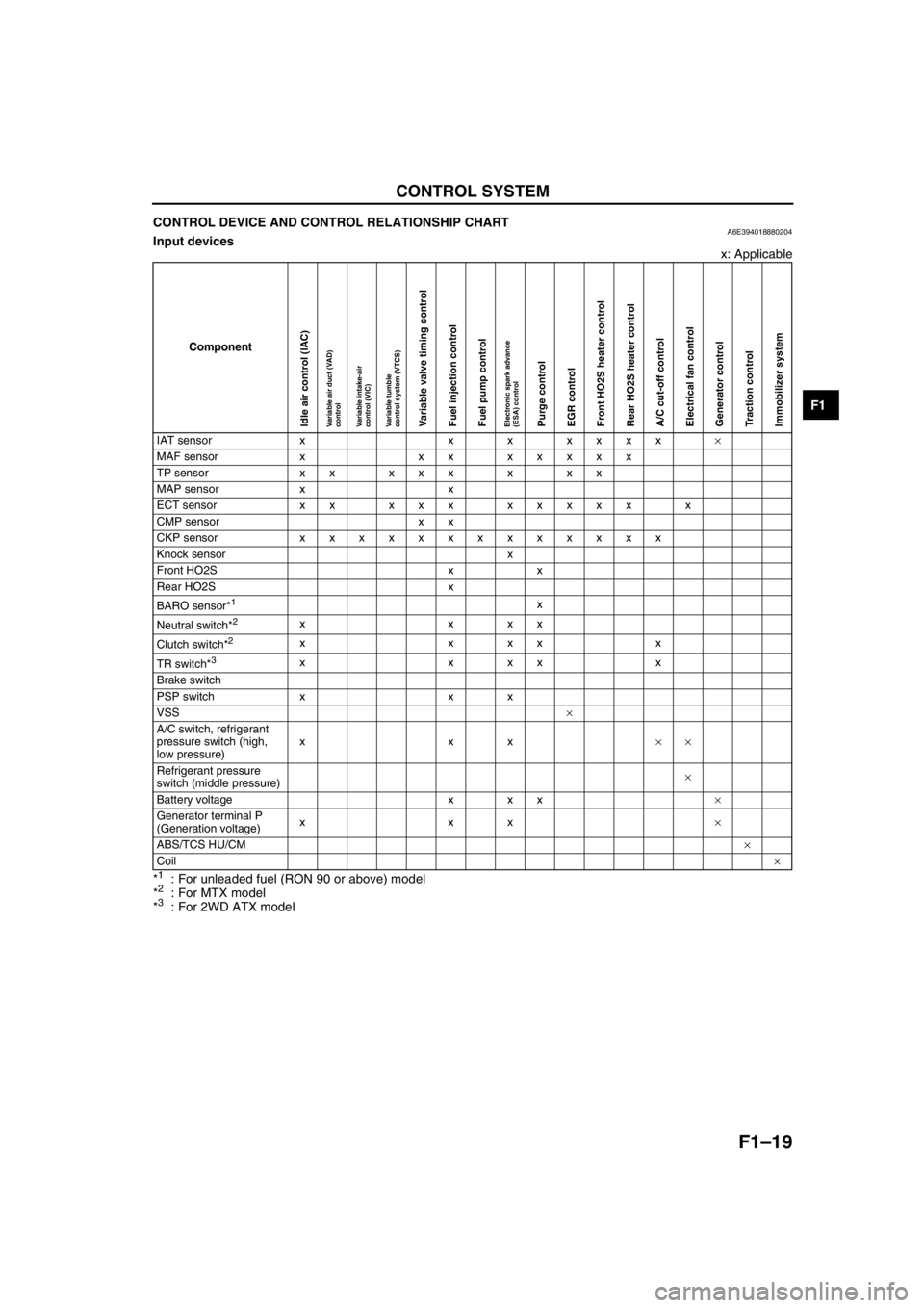
CONTROL DEVICE AND CONTROL RELATIONSHIP CHARTA6E394018880204Input devices
x: Applicable
*
1: For unleaded fuel (RON 90 or above) model
*2: For MTX model
*3: For 2WD ATX model
Component
IAT sensor x x x xxxx×
MAF sensor x xx xxxxx
TP sensor x x x x x x x x
MAP sensor x x
ECT sensor xx xxx xxxxx x
CMP sensor x x
CKP sensor xxxxxxxxxxxxx
Knock sensor x
Front HO2S x x
Rear HO2S x
BARO sensor*
1x
Neutral switch*
2xxxx
Clutch switch*
2xxxxx
TR switch*
3xxxxx
Brake switch
PSP switch x x x
VSS×
A/C switch, refrigerant
pressure switch (high,
low pressure)xxx××
Refrigerant pressure
switch (middle pressure)×
Battery voltage x x x×
Generator terminal P
(Generation voltage)xxx×
ABS/TCS HU/CM×
Coil×
Idle air control (IAC)Variable air duct (VAD)
controlVariable intake-air
control (VIC)Variable tumble
control system (VTCS)Variable valve timing controlFuel injection controlFuel pump controlElectronic spark advance
(ESA) controlPurge controlEGR controlFront HO2S heater controlRear HO2S heater controlA/C cut-off controlElectrical fan controlGenerator controlTraction controlImmobilizer system
Page 110 of 909

F1–22
OUTLINE, ENGINE TUNE-UP
SUPPLEMENTAL SERVICE INFORMATIONA6E390218881206•The following changes and/or additions have been made since publication of the Mazda6 Workshop Manual
(1621-10-98E).
Idle speed
•Adjustment procedure has been modified.
Fuel tank
•Removal/installation procedure has been modified.
Fuel pump unit
•Removal/installation procedure has been modified.
Quick release connector (fuel tank side, transfer hose part)
•Removal/installation procedure has been added.
Exhaust system
•Removal/installation procedure has been modified.
PCM
•Inspection procedure has been modified.
On-board diagnostic
•Inspection procedure has been modified.
Troubleshooting
•Inspection procedure has been modified.
End Of Sie
IDLE SPEED INSPECTION (4WD)A6E390802000201
Note
•Ignition timing is not adjustable.
•Ignition timing verification requires WDS or equivalent.
1. Turn off the electrical loads.
2. Warm up the engine as follows.
(1) Start the engine.
(2) Maintain the engine speed at approx. 3,000 rpm until the cooling fans start to operate.
(3) Release the accelerator pedal.
(4) Wait until the cooling fans stop.
3. Verify that the idle speed (WDS: RPM PID) is within the specification using WDS or equivalent.
Idle speed
*1 : Excludes temporary idle speed drop just after the electrical loads are turned on.
*2 : Blower motor is operating at high speed. Headlight switch is turned on. Rear window defroster switch is turned
on. Cooling fans are operating.
End Of Sie
OUTLINE
ENGINE TUNE-UP
Condition
Engine speed (rpm)*1
No load 650—750
Electrical loads*
2 ON650—750
P/S ON 650—750
A/C ON and refrigerant
pressure switch (middle) OFF650—750
A/C ON and refrigerant
pressure switch (middle) ON700—800
Page 122 of 909

F1–34
CONTROL SYSTEM
BARO*7
(Barometric pressure)kPa, inHgIgnition switch ON (at sea level):
approx. 101 kPa {29.8 inHg}
Inspect BARO sensor. 1G
VIgnition switch ON (at sea level):
approx. 4.1 V
BOO
(Brake switch)ON/OFFBrake pedal depressed: ON
Brake pedal released: OFFInspect brake switch. 1K
CHRGLP (Generator
warning light)ON/OFFIgnition switch ON: ON
Idle: OFFPerform applicable DTC
troubleshooting.
(See F1–54 DTC TABLE)—
COLP*
4 (Refrigerant
pressure switch
(middle))ON/OFFRefrigerant pressure switch (middle)
ON *2 at idle: ON
Refrigerant pressure switch (middle)
OFF
*3 at idle: OFFInspect refrigerant pressure switch. 1Q
CPP*
8
(Clutch pedal position)ON/OFFClutch pedal depressed: ON
Clutch pedal released: OFFInspect clutch switch. 1R
CPP/PNP*
8 (Shift
lever position)Drive/
NeutralNeutral position: Neutral
Others: DriveInspect neutral switch. 1W
DTCCNT (Number of
DTC detected)——Perform applicable DTC
troubleshooting.
(See F1–54 DTC TABLE)—
ECT (Engine coolant
temperature)°C°FECT 20 °C {68 °F}: 20 °C {68 °F}
ECT 60 °C {140 °F}: 60 °C {140 °F}
Inspect ECT sensor. 1M
VECT 20 °C {68 °F}: 3.04—3.14 V
ECT 60 °C {140 °F}: 1.29—1.39 V
EVAPCP (Purge
solenoid valve duty
value)%Ignition switch ON: 0%
Idle: 0%Inspect following PIDs: IAT, RPM,
ECT, MAF, O2S11,BARO, INGEAR,
TR, VPWR.4U
FAN1
(Cooling fan control)ON/OFFECT below 100 °C {212 °F}: OFF
Others: ONInspect following PIDs: RPM, TP,
ECT, ACSW, COLP, TEST.
Inspect cooling fan relay.4L
FAN2
(Cooling fan control)ON/OFFECT below 108 °C {226 °F}: OFF
A/C operating, refrigerant pressure
switch (middle) is OFF, and ECT
below 108 °C {226 °F}: OFF
Others: ONInspect following PIDs: RPM, TP,
ECT, ACSW, COLP, TEST.
Inspect cooling fan relay.4F
FAN3
(Cooling fan control)ON/OFFECT below 100 °C {212 °F}: OFF
A/C operating, refrigerant pressure
switch (middle) is ON, and ECT
below 108 °C {226 °F}: OFF
Other: ONInspect following PIDs: RPM, TP,
ECT, ACSW, COLP, TEST.
Inspect cooling fan relay.4B
FDPDTC
(Pending code caused
FFD storage)——Perform applicable DTC
troubleshooting.
(See F1–54 DTC TABLE)—
FP (Fuel pump relay) ON/OFFIgnition switch ON: OFF
Idle: ON
Cranking: ONInspect following PIDs: RPM.
Inspect fuel pump relay.4P
*5
4Q*6
FUELPW (Fuel
injector duration)msIgnition switch ON: 0 ms
Idle (after warm up): approx. 2.5 msInspect following PIDs: IAT, MAF, TP,
MAP, ECT, RPM, O2S11, O2S12,
INGEAR, TR, PSP, ACSW, VPWR,
ALTT V.
Inspect fuel injector.4W, 4Z,
4AA,
4AD
FUELSYS
(Fuel system status)OL_Drive/
OL/
CL_Fault/
OL_Fault/CLIgnition switch ON: OL
Idle (after warm up): CLInspect following PIDs: IAT, MAF, TP,
MAP, ECT, RPM, O2S11, O2S12,
INGEAR, TR, PSP, ACSW, VPWR,
ALTT V.
Inspect fuel injector.—
GENVDSD
(Generator voltage
desired)VIgnition switch ON: 0 V
Idle: Approx. 14.9 V
*1 (E/L not
operating)Perform applicable DTC
troubleshooting.
(See F1–54 DTC TABLE)—
HTR11
(HO2S heater (front))ON/OFF Idle (after warm up): ON⇔OFFInspect following PIDs: IAT, MAF, TP,
ECT, RPM, ACSW.4A Monitor item
(Definition)Unit/
ConditionCondition/Specification
(Reference)ActionPCM
terminal
Page 123 of 909

CONTROL SYSTEM
F1–35
F1
HTR12
(HO2S heater (rear))ON/OFFIgnition switch ON: ON (HO2S
heater operated)
Idle: ON (HO2S heater operated)Inspect following PIDs: IAT, MAF,
ECT, RPM, ACSW.4D
IAC (IAC valve) %Ignition switch ON: 0%
Idle: Approx. 60% (ECT 90°C {194
°F} and E/L not operating) Inspect following PIDs: IAT, RPM,
MAP, ECT, MAF, TP, INGEAR, TR,
PSP, ACSW.
Inspect IAC valve.4G, 4J
IASV (Variable air duct
control solenoid valve)ON/OFFECT is above 70 °C {158 °F}, engine
speed is above 5,800 rpm, and TP
opening angle is above 50%: ON
Others: OFFInspect following PIDs: ECT, RPM,
TP.
Inspect VAD control solenoid valve.4C
IAT
(Intake air temperature)°C°FIAT 20 °C {68 °F}: 20 °C {68 °F}
IAT 30 °C {86 °F}: 30 °C {86 °F}
Inspect IAT sensor. 2E
VIAT 20 °C {68 °F}: 2.4—2.6 V
IAT 30 °C {86 °F}: 1.7—1.9 V
IMRC (Variable tumble
control solenoid valve)ON/OFFEngine speed is below approx.
3,500 rpm: ON
Others: OFFInspect following PIDs: TP, ECT,
RPM.
Inspect variable tumble control
solenoid valve.4T
IMTV*
7 (Variable
Intake-air control
solenoid valve)ON/OFFEngine speed is below approx.
4,350 rpm: ON
Others: OFFInspect following PIDs: RPM.
Inspect VIC control solenoid valve.4R
INGEAR*
8 (Load/no
load condition)ON/OFFCPP or CPP/PNP is ON: OFF
Others: ONPerform applicable DTC
troubleshooting.1R, 1W
IVS (CTP condition)IDLE/ OFF
IDLECTP: IDLE
Others: OFF IDLEPerform applicable DTC
troubleshooting.2A
KNOCKR (Knocking
retard)°Ignition switch ON: 0°
Idle: 0°Inspect knock sensor. 2P, 2S
LOAD (Engine load) %Ignition switch ON: 0%
Idle (after warm up): approx.19%Inspect MAF sensor.—
LONGFT1 (long term
fuel trim)%Idle (after warm up): approx. –14—
14%Perform applicable DTC
troubleshooting.
(See F1–54 DTC TABLE)—
MAF (Mass airflow)g/sIgnition switch ON: approx. 0 g/s
Idle (after warm up): approx. 1.5 g/s
Inspect MAF sensor. 1P
VIgnition switch ON: approx. 0.7 V
Idle (after warm up): approx. 1.3 V
MAP (Manifold
absolute pressure)kPa, inHgIgnition switch ON (at sea level):
approx 101 kPa {29.8 inHg}
Inspect MAP sensor. 1J
VIgnition switch ON (at sea level):
approx 4.1 V
MIL (Malfunction
indicator lamp)ON/OFFIgnition switch ON: ON
Idle: OFFPerform applicable DTC
troubleshooting.
(See F1–54 DTC TABLE)—
MIL_DIS (Trabelled
distance since the MIL
illuminated)km, mileNo DTC: 0 km {0 mile}
DTC detected: Not 0 km {0 mile}Perform applicable DTC
troubleshooting.
(See F1–54 DTC TABLE)—
O2S11 (Front oxygen
sensor)VIgnition switch ON: 0—1.0 V
Idle (After warm up): 0—1.0 V
Inspect HO2S (front). 1AB
Rich/LeanAcceleration (After warm up): Rich
Deceleration (After warm up): Lean
O2S12 (Rear oxygen
sensor)V Idle (After warm up): approx 0.6 V
Inspect HO2S (rear). 1Y
Rich/Lean Idle (After warm up): Rich
PSP (Power steering
pressure switch)Low/HighSteering wheel in straight ahead
position: Low
Others: HighInspect PSP switch. 1Z
RFCFLAG (Readness
function code)Learnt/Not
LearntBefore running PCM adaptive
memory procedure drive mode: Not
Learnt
After running PCM adaptive memory
procedure drive mode: LearntRun PCM adaptive memory
procedure drive mode.— Monitor item
(Definition)Unit/
ConditionCondition/Specification
(Reference)ActionPCM
terminal
Page 124 of 909

F1–36
CONTROL SYSTEM
*1: Calculated value; differs from terminal voltage
*2: Refrigerant pressure switch (middle) turns on when the refrigerant pressure is 1.69—1.84 MPa {17.3—18.7
kgf/cm2, 247—265 psi}
*3: Refrigerant pressure switch (middle) turns off when the refrigerant pressure is 1.26—1.49 MPa {12.9—15.1
kgf/cm2, 184—214 psi}
*4: L3 and L8, LF (Intensely hot area) engine models
*5: Immobilizer system equipped model
*6: Immobilizer system not equipped
*7: L3 engine model only
*8: MTX model only
•Following PIDs are for the ATX models. If inspects for following PIDs, see K2–180 PID/DATA MONITOR
INSPECTION.
PIDs for the ATX models
—GEAR, LINEDES, LPS, OP_SW_B, SSA/SS1, SSB/SS2, SSC/SS3, TCS, TFT, TFTV, THOP, TR,
TR_SENS, TSS
RO2FT1 (Rear oxygen
sensor fuel trim)—Idle (after warm up): approx. –
0.03—0.03Perform applicable DTC
troubleshooting.—
RPM (Engine speed) rpm
LF Unleaded fuel (RON 90 or
above) model
No load: 600—700 rpm
E/L operating: 650—750 rpm
P/S operating: 650—750 rpm
A/C ON: 700—800 rpm
L3 4WD ATX model
No load: 650—750 rpm
E/L operating: 650—750 rpm
P/S operating: 650—750 rpm
A/C ON: 650—750 rpm*
2, 700—
800 rpm*3
Inspect CKP sensor. 2D, 2G
SEGRP (EGR valve
(stepping motor)
position)StepIgnition switch ON: 0 step
Idle: 0 step
Cranking: 0—60 stepsInspect following PIDs: MAF, TP,
ECT, RPM, VSS.
Inspect EGR valve.4E, 4H,
4K, 4N
SHRTFT1 (Short term
fuel trim)%Idle (after warm up): approx.–30—
25%Perform applicable DTC
troubleshooting.
(See F1–54 DTC TABLE)—
SPARKADV (Ignition
timing)°Ignition switch ON: BTDC 0°
Idle: BTDC approx. 10°Inspect following PIDs: MAF, TP,
ECT, RPM, INGEAR, TR, PSP,
ACSW, VPWR.
Inspect ignition timing.2J, 2M
TEST (Test mode) ON/OFF———
TP (TP)%CTP: 13—23%
WOT: 86—96%
Inspect TP sensor. 2A
VCTP: 0.65—1.15 V
WOT: 4.3—4.8 V
TPCT
(TP sensor voltage at
CTP )V0.65—1.15 V Inspect TP sensor. 2A
VPWR (Battery positive
voltage)V Ignition switch ON: B+Inspect main relay.
Inspect battery.2Y, 2Z
VSS (Vehicle speed) kph, mphVehicle speed 20 kph {12 mph}:
20 kph {12 mph}
Vehicle speed 40 kph {25 mph}:
20 kph {12 mph}Perform applicable DTC
troubleshooting.
(See F1–54 DTC TABLE)—
VT DUTY1*
7% Idle: 0%Inspect following PIDs: TP, ECT,
RPM.
Inspect OCV.2I, 2L Monitor item
(Definition)Unit/
ConditionCondition/Specification
(Reference)ActionPCM
terminal
Page 130 of 909
F1–42
CONTROL SYSTEM
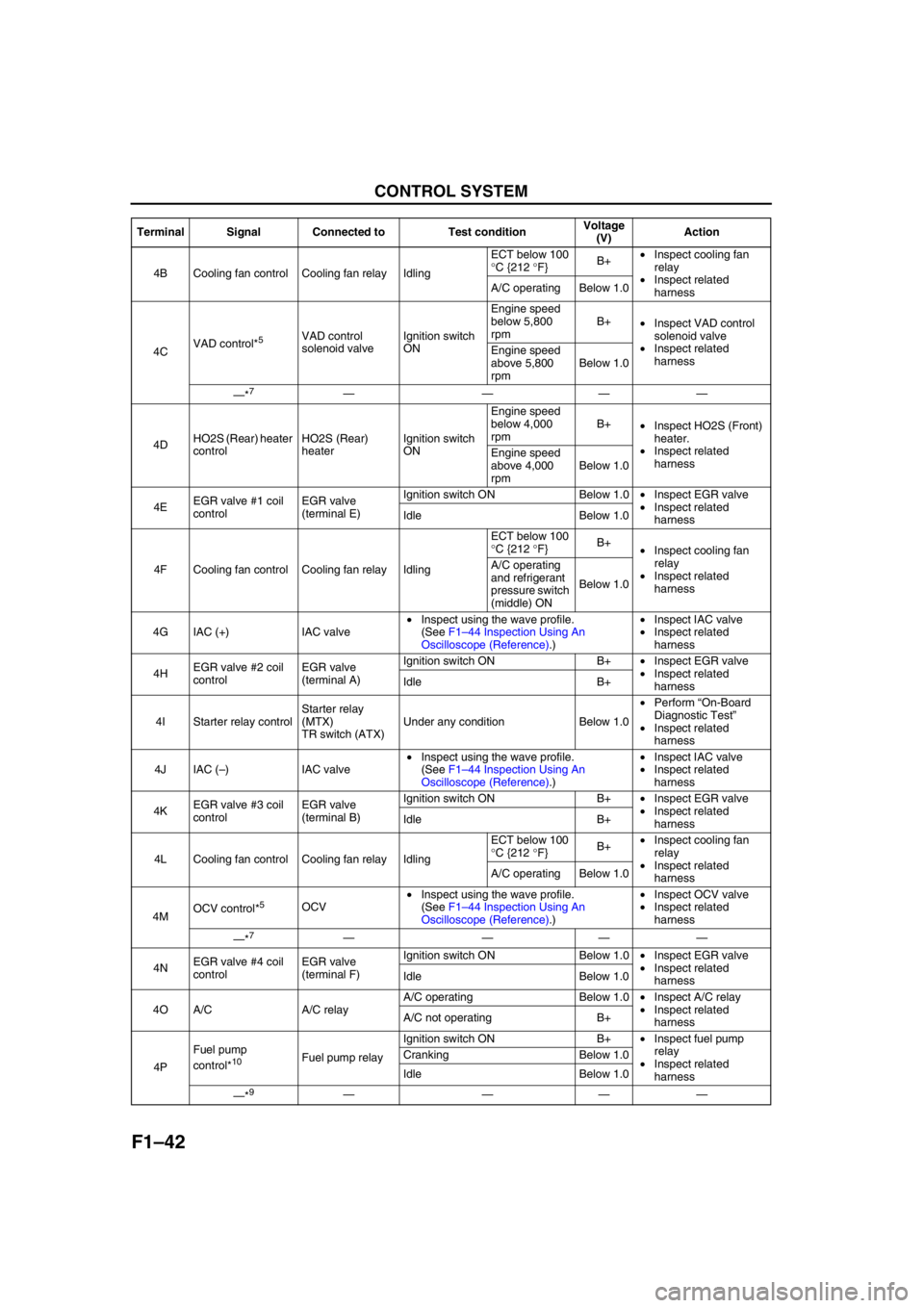
4B Cooling fan control Cooling fan relay IdlingECT below 100
°C {212 °F}B+•Inspect cooling fan
relay
•Inspect related
harness A/C operating Below 1.0
4CVAD control*
5VAD control
solenoid valveIgnition switch
ONEngine speed
below 5,800
rpmB+
•Inspect VAD control
solenoid valve
•Inspect related
harness Engine speed
above 5,800
rpmBelow 1.0
—*
7————
4DHO2S (Rear) heater
controlHO2S (Rear)
heaterIgnition switch
ONEngine speed
below 4,000
rpmB+
•Inspect HO2S (Front)
heater.
•Inspect related
harness Engine speed
above 4,000
rpmBelow 1.0
4EEGR valve #1 coil
controlEGR valve
(terminal E)Ignition switch ON Below 1.0•Inspect EGR valve
•Inspect related
harness Idle Below 1.0
4F Cooling fan control Cooling fan relay IdlingECT below 100
°C {212 °F}B+
•Inspect cooling fan
relay
•Inspect related
harness A/C operating
and refrigerant
pressure switch
(middle) ONBelow 1.0
4G IAC (+) IAC valve•Inspect using the wave profile.
(See F1–44 Inspection Using An
Oscilloscope (Reference).)•Inspect IAC valve
•Inspect related
harness
4HEGR valve #2 coil
controlEGR valve
(terminal A)Ignition switch ON B+•Inspect EGR valve
•Inspect related
harness Idle B+
4I Starter relay controlStarter relay
(MTX)
TR switch (ATX)Under any condition Below 1.0•Perform “On-Board
Diagnostic Test”
•Inspect related
harness
4J IAC (–)IAC valve•Inspect using the wave profile.
(See F1–44 Inspection Using An
Oscilloscope (Reference).)•Inspect IAC valve
•Inspect related
harness
4KEGR valve #3 coil
controlEGR valve
(terminal B)Ignition switch ON B+•Inspect EGR valve
•Inspect related
harness Idle B+
4L Cooling fan control Cooling fan relay IdlingECT below 100
°C {212 °F}B+•Inspect cooling fan
relay
•Inspect related
harness A/C operating Below 1.0
4MOCV control*
5OCV•Inspect using the wave profile.
(See F1–44 Inspection Using An
Oscilloscope (Reference).)•Inspect OCV valve
•Inspect related
harness
—*
7————
4NEGR valve #4 coil
controlEGR valve
(terminal F)Ignition switch ON Below 1.0•Inspect EGR valve
•Inspect related
harness Idle Below 1.0
4O A/C A/C relayA/C operating Below 1.0•Inspect A/C relay
•Inspect related
harness A/C not operating B+
4PFuel pump
control*
10Fuel pump relayIgnition switch ON B+•Inspect fuel pump
relay
•Inspect related
harness Cranking Below 1.0
Idle Below 1.0
—*
9———— Terminal Signal Connected to Test conditionVoltage
(V)Action
Page 147 of 909
TROUBLESHOOTING
F1–59
F1
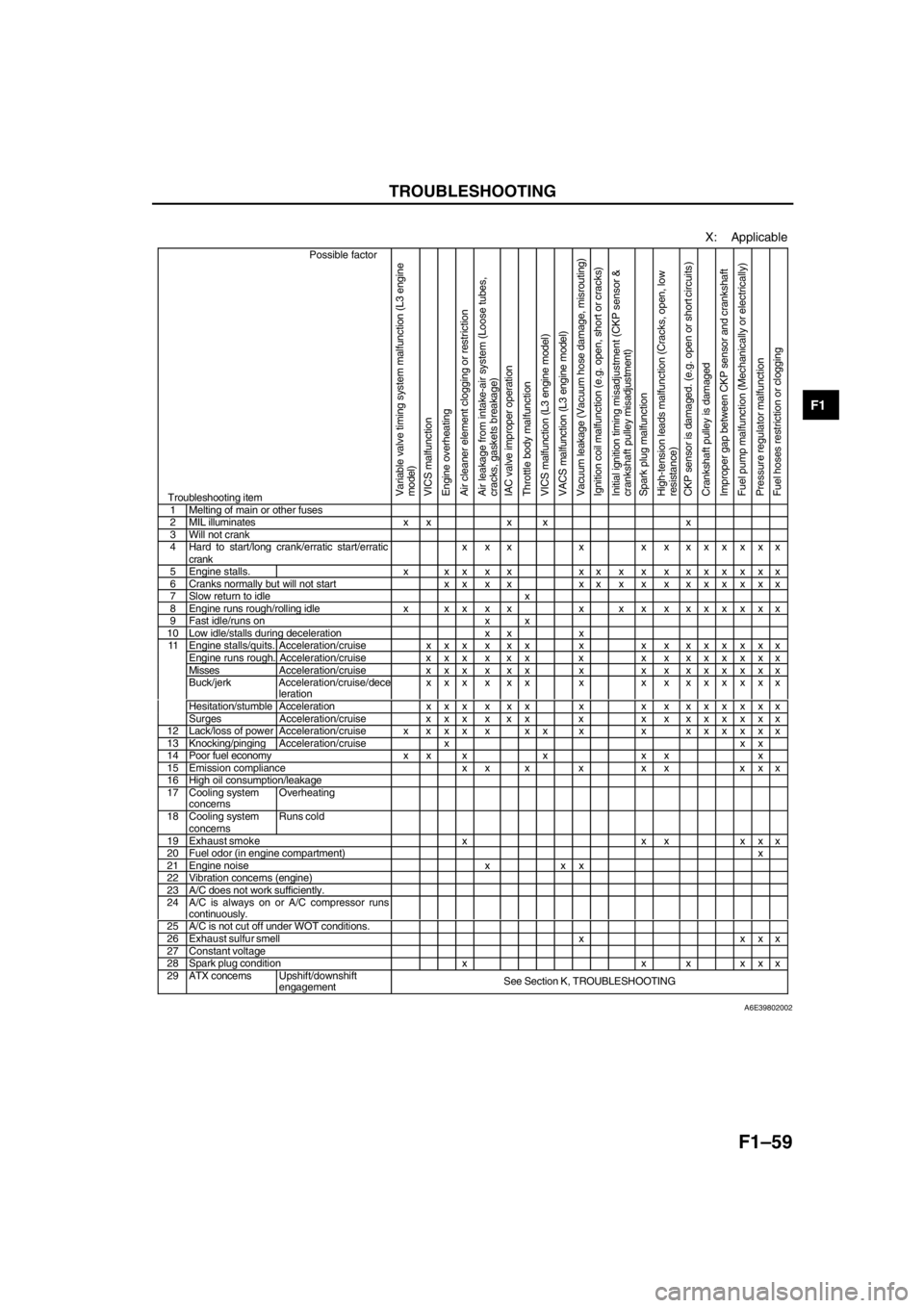
X: Applicable
Possible factor
Troubleshooting itemVariable valve timing system malfunction (L3 engine
model)
VICS malfunction
Engine overheating
Air cleaner element clogging or restriction
Air leakage from intake-air system (Loose tubes,
cracks, gaskets breakage)
IAC valve improper operation
Throttle body malfunction
VICS malfunction (L3 engine model)
VACS malfunction (L3 engine model)
Vacuum leakage (Vacuum hose damage, misrouting)
Ignition coil malfunction (e.g. open, short or cracks)
Initial ignition timing misadjustment (CKP sensor &
crankshaft pulley misadjustment)
Spark plug malfunction
High-tension leads malfunction (Cracks, open, low
resistance)
CKP sensor is damaged. (e.g. open or short circuits )
Crankshaft pulley is damaged
Improper gap between CKP sensor and crankshaft
Fuel pump malfunction (Mechanically or electrically)
Pressure regulator malfunction
Fuel hoses restriction or clogging
1 Melting of main or other fuses2 MIL illuminates x x x x x3 Will not crank4 Hard to start/long crank/erratic start/erratic
crankx x x x x x xxxxxx
5 Engine stalls. x x x x x xxxxxxxxxxx6 Cranks normally but will not start x x x x xxxxxxxxxxx7 Slow return to idle x8 Engine runs rough/rolling idle x x x x x x x x xxxxxxx9 Fast idle/runs on x x10 Low idle/stalls during deceleration x x xEngine stalls/quits. Acceleration/cruise x x x x x x x x xxxxxxxEngine runs rough. Acceleration/cruise x x x x x x x x xxxxxxxMissesAcceleration/cruise x x x x x x x x xxxxxxxBuck/jerk Acceleration/cruise/dece
lerationxxx x xx x x x xxxxxx
Hesitation/stumble Acceleration x x x x x x x x xxxxxxx
11
Surges Acceleration/cruise x x x x x x x x xxxxxxx
12 Lack/loss of powerAcceleration/cruise x x x x x x x x xxxxxxx13 Knocking/pingingAcceleration/cruise x x x14 Poor fuel economy x x x x x x x15 Emission compliance x x x x x x x x x16 High oil consumption/leakage17 Cooling system
concernsOverheating
18 Cooling system
concernsRuns cold
19 Exhaust smoke x x x x x x20 Fuel odor (in engine compartment)x21 Engine noise x x x22 Vibration concerns (engine)23 A/C does not work sufficiently.24 A/C is always on or A/C compressor runs
continuously.
25 A/C is not cut off under WOT conditions.26 Exhaust sulfur smell x x x x27 Constant voltage28 Spark plug condition x x x x x x29 ATX concernsUpshift/downshift
engagementSee Section K, TROUBLESHOOTING
A6E39802002