wheel MAZDA 6 2002 Suplement Repair Manual
[x] Cancel search | Manufacturer: MAZDA, Model Year: 2002, Model line: 6, Model: MAZDA 6 2002Pages: 909, PDF Size: 17.16 MB
Page 639 of 909

ELECTRONIC 4WD CONTROL SYSTEM
M–9
M
End Of SieELECTRONIC CONTROL COUPLINGA6E632227100202Outline
Features
•An electromagnetic clutch, which operates smoothly due to the lack influence from the front and rear wheel
traction force, has been adopted for the electronic control coupling system.
•The construction of the coupling enables the torque formed by the pilot clutch to be amplified by the cam
mechanism, thus allowing the main clutch to obtain a high degree of torque. Due to this, size and weight
reduction of the component parts has been achieved.
Construction
•The electronic control coupling basically consists of an electromagnetic clutch, a cam mechanism and a torque
transmission system.
•The electromagnetic clutch consists of a 4WD solenoid (electromagnetic coil), rear-housing that forms a
magnetic path, pilot clutch, and armature. The cam mechanism consists of a pilot cam, balls, and main cam.
The torque transmission system consists of a main clutch and hydraulic oil (ATF).
.
9
8
7
5
43
10
13
1112
6
12
A6E63222003
1 Front wheel side
2 Rear wheel side
3 Torque transmission system
4 Electromagnetic clutch
5 Rear housing
6 4WD solenoid (Electromagnetic coil)
7 Cam mechanism8Ball
9 Main clutch
10 Main cam
11 Armature
12 Pilot clutch
13 Pilot cam
Page 640 of 909

M–10
ELECTRONIC 4WD CONTROL SYSTEM
Operation
4WD solenoid control current is OFF
•When the 4WD solenoid control current is OFF, no torque is generated in the pilot clutch because there is no
current flowing to the 4WD solenoid. At the same time, the pilot cam and the main cam rotate in the same
direction via the balls, and the main cam does not exert any push force on the main clutch side. Therefore, the
traction from the front wheels is not transmitted to the rear wheels.
.
8
7
5
4
3
6
12
56
7
A6E63222004
1 Main clutch
2 Pilot clutch
3 4WD solenoid (Electromagnetic coil)
4 4WD control modure (4WD CM)5Main cam
6Pilot cam
7Ball
8 Armature
Page 641 of 909

ELECTRONIC 4WD CONTROL SYSTEM
M–11
M
4WD solenoid control current is ON
•When the 4WD solenoid control current is ON, current flows from the 4WD CM to the 4WD solenoid, and the
coupling operates in the following manner.
1. Magnetic flux forms at the electromagnetic coil of the 4WD solenoid.
2. Due to the magnetic flux in the armature, the pilot clutch is suctioned towards the magnetic coil side and
made to engage. This causes frictional torque to generate in the pilot clutch.
3. The torque is transmitted to the pilot cam, which is engaged with the pilot clutch.
4. A rotational difference is created between the pilot cam and the main cam. Due to this relative torsion, the
cam mechanism operates, transmitting torque from the pilot cam to the ball and then to the main cam. In
this way, the push force exerted on the main clutch is amplified.
5. As the main clutch engages, the drive torque from the front wheels is transmitted to the rear wheels.
•The amount of push force exerted on the main clutch by the main cam (that is, the strength of the drive torque
transmitted to the rear wheels) changes in accordance with the proportion of the force acting upon the pilot
cam, engaged with the pilot clutch. Therefore, by changing the periodicity of the electric current from the 4WD
CM to the 4WD solenoid (ON/OFF rate of the 4WD solenoid = force acting on the pilot cam), the module
controls the transmission of drive torque to the rear wheels.
.
End Of Sie
98
75
4
3
10
11
6
12
56
7
12
A6E63222005
1 Main clutch
2Pilot clutch
3 4WD solenoid (Electromagnetic coil)
4 4WD control modure (4WD CM)
5Main cam
6Pilot cam7Ball
8Armature
9 Drive torque
10 Magnetic flux
11 Input
12 Output
Page 643 of 909
ELECTRONIC 4WD CONTROL SYSTEM
M–13
M
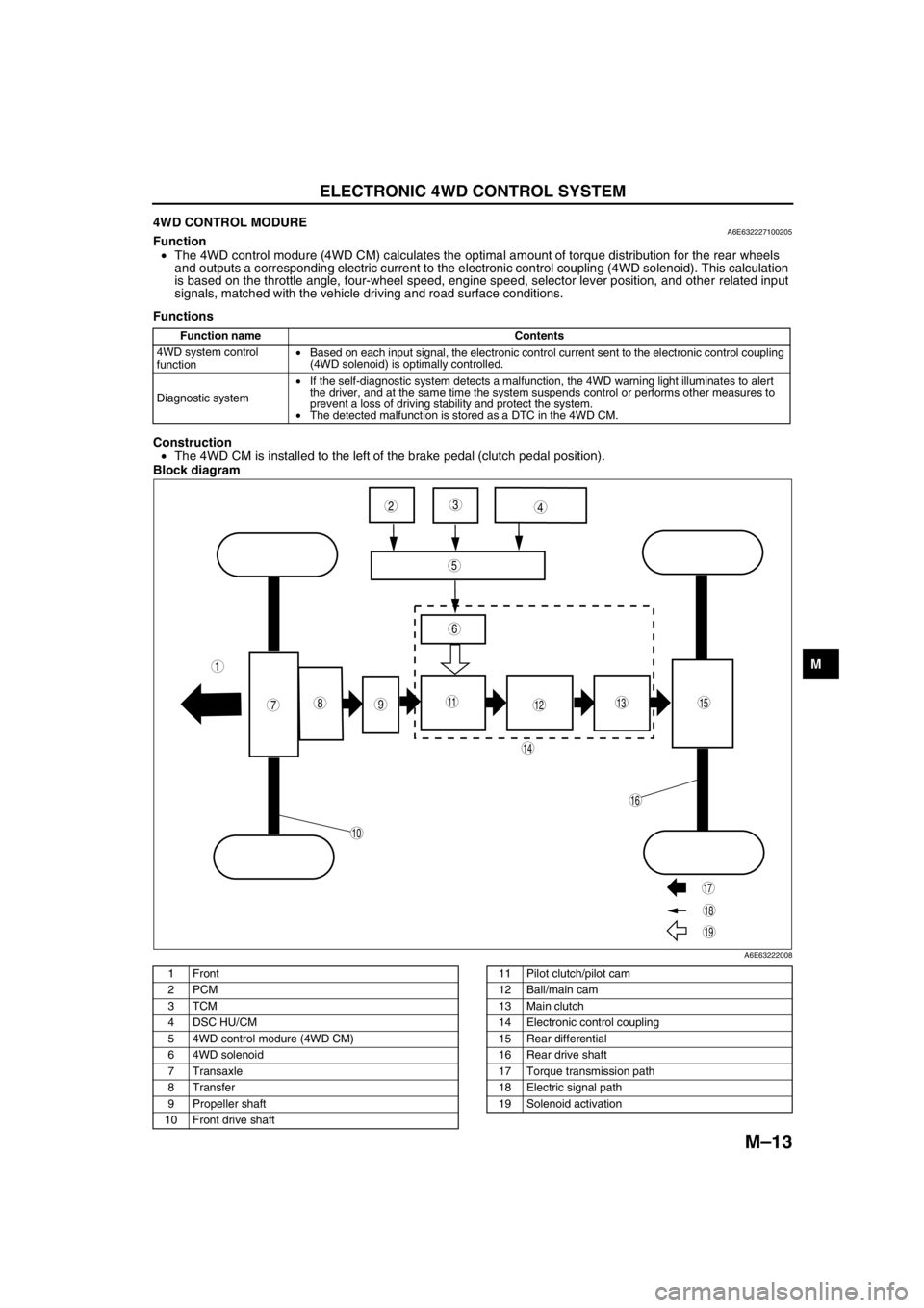
4WD CONTROL MODUREA6E632227100205Function
•The 4WD control modure (4WD CM) calculates the optimal amount of torque distribution for the rear wheels
and outputs a corresponding electric current to the electronic control coupling (4WD solenoid). This calculation
is based on the throttle angle, four-wheel speed, engine speed, selector lever position, and other related input
signals, matched with the vehicle driving and road surface conditions.
Functions
Construction
•The 4WD CM is installed to the left of the brake pedal (clutch pedal position).
Block diagram
.
Function name Contents
4WD system control
function•Based on each input signal, the electronic control current sent to the electronic control coupling
(4WD solenoid) is optimally controlled.
Diagnostic system•If the self-diagnostic system detects a malfunction, the 4WD warning light illuminates to alert
the driver, and at the same time the system suspends control or performs other measures to
prevent a loss of driving stability and protect the system.
•The detected malfunction is stored as a DTC in the 4WD CM.
987
5
43
10
19
18
17
15
16
14
131112
6
1
2
A6E63222008
1Front
2PCM
3TCM
4 DSC HU/CM
5 4WD control modure (4WD CM)
6 4WD solenoid
7Transaxle
8Transfer
9 Propeller shaft
10 Front drive shaft11 Pilot clutch/pilot cam
12 Ball/main cam
13 Main clutch
14 Electronic control coupling
15 Rear differential
16 Rear drive shaft
17 Torque transmission path
18 Electric signal path
19 Solenoid activation
Page 644 of 909
M–14
ELECTRONIC 4WD CONTROL SYSTEM
End Of Sie4WD SYSTEM CONTROLA6E632227100206Outline
Features
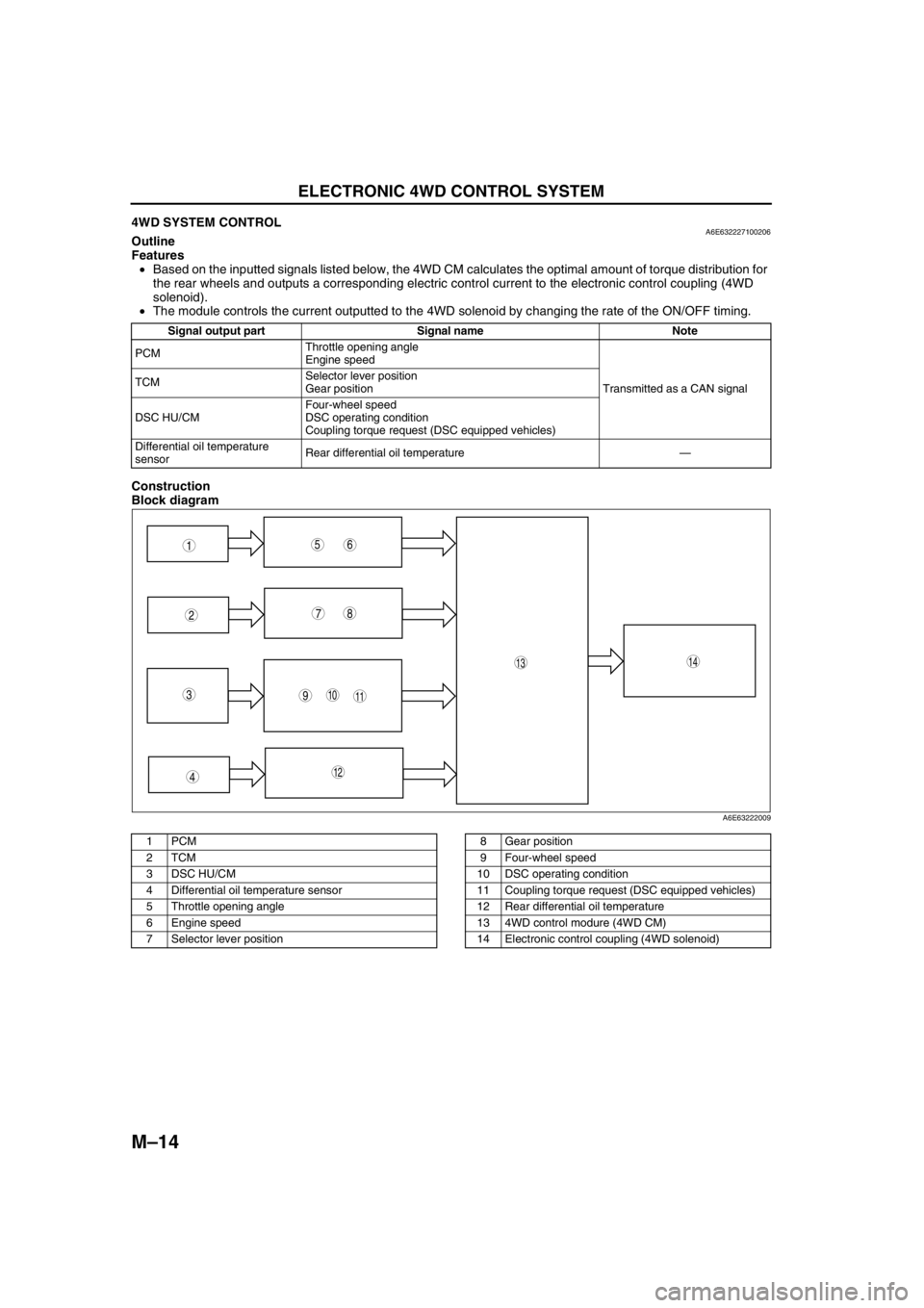
•Based on the inputted signals listed below, the 4WD CM calculates the optimal amount of torque distribution for
the rear wheels and outputs a corresponding electric control current to the electronic control coupling (4WD
solenoid).
•The module controls the current outputted to the 4WD solenoid by changing the rate of the ON/OFF timing.
Construction
Block diagram
.
Signal output part Signal name Note
PCMThrottle opening angle
Engine speed
Transmitted as a CAN signal TCMSelector lever position
Gear position
DSC HU/CMFour-wheel speed
DSC operating condition
Coupling torque request (DSC equipped vehicles)
Differential oil temperature
sensorRear differential oil temperature—
9
87
5
4
310
1413
11
12
61
2
A6E63222009
1PCM
2TCM
3 DSC HU/CM
4 Differential oil temperature sensor
5 Throttle opening angle
6 Engine speed
7 Selector lever position8 Gear position
9 Four-wheel speed
10 DSC operating condition
11 Coupling torque request (DSC equipped vehicles)
12 Rear differential oil temperature
13 4WD control modure (4WD CM)
14 Electronic control coupling (4WD solenoid)
Page 645 of 909
ELECTRONIC 4WD CONTROL SYSTEM
M–15
M
Operation
Normal control
•When starting off or accelerating during straight-ahead driving, torque transmitted to the rear wheels is
optimally controlled to ensure sufficient acceleration performance. Due to this, standing-start and acceleration
performance is improved.
•Also, in order to improve fuel economy when driving at a stable, consistent speed, torque transmitted to the
rear wheels is damped, and rear-wheel drive is controlled to maintain it close to that of the front wheels.
Tight cornering control
•When the 4WD CM determines, based on the four-wheel speed signal, that the vehicle is in tight cornering, it
reduces the torque transmitted to the rear wheels to avoid tight corner braking characteristics.
Integrated DSC control
•If a signal from the DSC HU/CM input to the 4WD CM indicates that ABS control is activated, the module
controls the torque transmitted to the rear wheels to prevent undue influence on ABS control.
•Also, when a coupling torque request signal is received from the DSC HU/CM, the module controls the torque
transmitted to the rear wheels to match the amount of requested torque.
Other control
•In case the rear differential oil temperature exceeds the specified amount, or when there is an unusually large
variation in the rotation speed of the front and rear wheels (ex. when trying to get unstuck), control is
temporarily suspended in order to protect the 4WD system. When this occurs the 4WD warning light flashes to
indicate the situation to the driver.
End Of Sie
CONTROLLER AREA NETWORK (CAN)A6E632227100207Outline
•The 4WD CM transmits/receives information using the CAN system. See Section T for detailed information
regarding the CAN system.
Operation
Transmitted information
•Coupling torque
•4WD system operating condition (warning light information)
Received information
•Four-wheel speed
•Throttle opening angle
•Engine speed
•ABS/DSC operating condition
•Gear position
•Selector lever position
•Coupling torque request
End Of Sie
Page 648 of 909

M–18
OUTLINE
SUPPLEMENTAL SERVICE INFORMATIONA6E630201018204•The following additions have been made since publication of the Mazda6 Workshop Manual (1730-1*-02C).
Rear wheel hub bolt
•Replacement procedure has been added.
Wheel hub, knuckle
•Removal/installation procedure has been added.
Joint shaft (MZR-CD (RF Turbo))
•Disassembly/assembly procedure has been added.
Joint shaft (4WD)
•Disassembly/assembly procedure has been added.
Front drive shaft (MZR-CD (RF Turbo))
•Disassembly/assembly procedure has been added.
Front drive shaft (4WD)
•Disassembly/assembly procedure has been added.
Rear drive shaft
•Inspection procedure has been added.
•Removal/installation procedure has been added.
•Disassembly/assembly procedure has been added.
Differential oil
•Inspection procedure has been added.
•Replacement procedure has been added.
Oil seal (side gear)
•Replacement procedure has been added.
Oil seal (companion flange)
•Replacement procedure has been added.
Rear differential
•Removal/installation procedure has been added.
•Disassembly procedure has been added.
•Assembly procedure has been added.
Differential oil temperature sensor
•Inspection procedure has been added.
•Removal/installation procedure has been added.
4WD solenoid
•Inspection procedure has been added.
Coupling component
•Removal/installation procedure has been added.
•Disassembly procedure has been added.
•Assembly procedure has been added.
On-board diagnostic
•Electronic 4WD control system have been added.
Troubleshooting
•Electronic 4WD control system have been added.
End Of Sie
OUTLINE
Page 649 of 909

LOCATION INDEX
M–19
M
AXLE/DRIVE SHAFT LOCATION INDEXA6E630025500201
.
End Of Sie
LOCATION INDEX
5
4
3
1
2
A6J63002001
1 Wheel hub bolt
(See M–22 WHEEL HUB BOLT REPLACEMENT)
2 Wheel hub, knuckle
(See M–22 WHEEL HUB, KNUCKLE REMOVAL/
INSTALLATION)
3 Joint shaft
(See M–29 JOINT SHAFT (MZR-CD (RF Turbo))
DISASSEMBLY/ASSEMBLY)
(See M–31 JOINT SHAFT (4WD) DISASSEMBLY/
ASSEMBLY)4 Front drive shaft
(See M–34 FRONT DRIVE SHAFT (MZR-CD (RF
Turbo)) DISASSEMBLY/ASSEMBLY)
(See M–39 FRONT DRIVE SHAFT (4WD)
DISASSEMBLY/ASSEMBLY)
5 Rear drive shaft
(See M–42 REAR DRIVE SHAFT
PRE-INSPECTION)
(See M–43 REAR DRIVE SHAFT REMOVAL/
INSTALLATION)
(See M–45 REAR DRIVE SHAFT DISASSEMBLY/
ASSEMBLY)
Page 651 of 909
GENERAL PROCEDURES
M–21
M
PRECAUTION (FRONT AND REAR AXLE)A6E631001018201Wheel and Tire Removal/Installation
1. The removal and installation procedures for the wheels and tires are not mentioned in this section. When a
wheel is removed, tighten it to 88—118 N·m {9.0—12.0 kgf·m, 65.0—87.0 ft·lbf}
Brake Line Disconnection/Connection
Caution
•Brake fluid will damage painted surfaces. If brake fluid gets on a painted surface, wipe it off
immediately.
1. Tighten the brake pipe flare nut using the SST (49 0259 770B). Be sure to modify the brake pipe flare nut
tightening torque to allow for use of a torque wrench-SST combination.
2. If any brake line has been disconnected any time during the procedure, add brake fluid, bleed the brakes, and
inspect for leakage after the procedure has been completed.
Suspension Arm Removal/Installation
1. Tighten any part of the suspension that uses rubber bushings only after vehicle has been lowered and
unloaded.
Note
•Unloaded: Fuel tank is full. Engine coolant and engine oil are at specified level. Spare tire, jack, and tools
are in designated position.
Connector Disconnection
1. Disconnect the negative (-) battery cable before disconnecting connectors.
Electronic Control 4WD System Parts
1. After servicing the electronic control 4WD system parts, verify that no DTC has been stored. Clear any DTCs
remaining in the memory.
End Of Sie
GENERAL PROCEDURES
Page 652 of 909
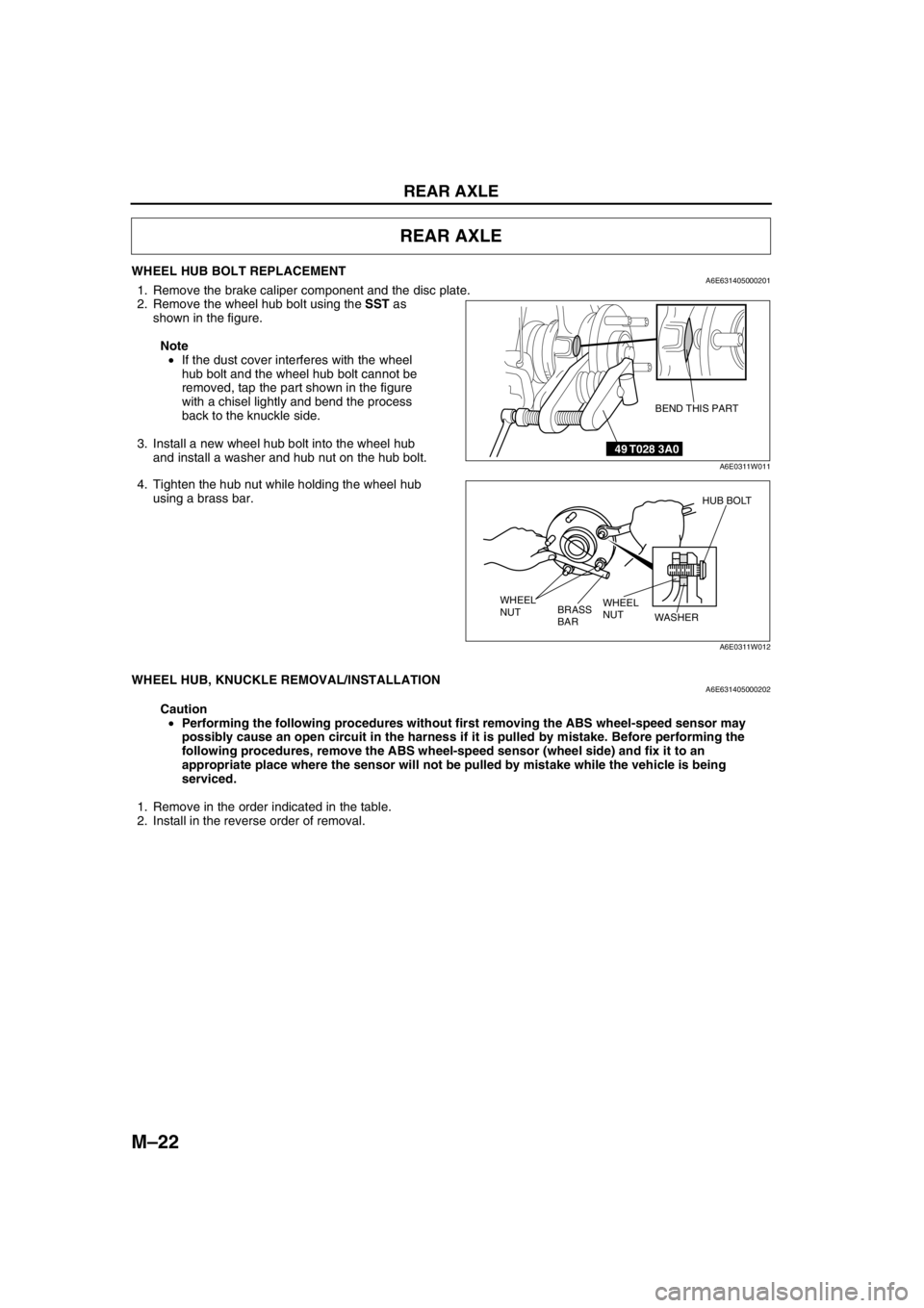
M–22
REAR AXLE
WHEEL HUB BOLT REPLACEMENTA6E6314050002011. Remove the brake caliper component and the disc plate.
2. Remove the wheel hub bolt using the SST as
shown in the figure.
Note
•If the dust cover interferes with the wheel
hub bolt and the wheel hub bolt cannot be
removed, tap the part shown in the figure
with a chisel lightly and bend the process
back to the knuckle side.
3. Install a new wheel hub bolt into the wheel hub
and install a washer and hub nut on the hub bolt.
4. Tighten the hub nut while holding the wheel hub
using a brass bar.
End Of Sie
WHEEL HUB, KNUCKLE REMOVAL/INSTALLATIONA6E631405000202
Caution
•Performing the following procedures without first removing the ABS wheel-speed sensor may
possibly cause an open circuit in the harness if it is pulled by mistake. Before performing the
following procedures, remove the ABS wheel-speed sensor (wheel side) and fix it to an
appropriate place where the sensor will not be pulled by mistake while the vehicle is being
serviced.
1. Remove in the order indicated in the table.
2. Install in the reverse order of removal.
REAR AXLE
49 T028 3A0
BEND THIS PART
A6E0311W011
HUB BOLT
WHEEL
NUT WHEEL
NUT
WASHER
BRASS
BAR
A6E0311W012