spare wheel MAZDA CX3 2023 User Guide
[x] Cancel search | Manufacturer: MAZDA, Model Year: 2023, Model line: CX3, Model: MAZDA CX3 2023Pages: 595, PDF Size: 32.7 MB
Page 466 of 595

3. Tread wear indicator
You should replace the tire before the
band crosses the entire tread.
NOTE
Tires degrade over time, even when
they are not being used on the road. It
is recommended that tires generally be
replaced when they are 6 years or
older. Heat caused by hot climates or
frequent high loading conditions can
accelerate the aging process. You
should replace the spare tire when you
replace the other road tires due to the
aging of the spare tire. The period in
which the tire was manufactured (both
week and year) is indicated by a 4-digit
number.
Refer to Tire Labeling on page 8-23.
▼Temporary Spare Tire
Inspect the temporary spare tire at
least monthly to make sure it is
properly
inflated and stored.
NOTE
The temporary spare tire condition
gradually deteriorates even if it has not
been used.
The temporary spare tire is easier to
handle because of its construction
which is lighter and smaller than a
conventional tire. This tire should be
used only for an emergency and only
for a short distance.
Use the temporary spare tire only until
the conventional tire is repaired, which
should be as soon as possible.
Refer to Tires on page 9-8.
CAUTION
Do not use your temporary spare tire
rim with a snow tire or a
conventional tire. Neither will
properly
fit and could damage both
tire and rim.
The temporary spare tire has a tread
life of less than 5,000 km (3,000
miles). The tread life may be shorter
depending on driving conditions.
The temporary spare tire is for
limited use, however, if the tread
wear solid-band indicator appears,
replace the tire with the same type of
temporary spare (page 6-32).
NOTE
Tires degrade over time, even when
they are not being used on the road. It
is recommended that tires generally be
replaced when they are 6 years or
older. Heat caused by hot climates or
frequent high load ing conditions can
accelerate the aging process. You
should replace the spare tire when you
replace the other road tires due to the
aging of the spare tire. The period in
which the tire was manufactured (both
week and year) is indicated by a 4-digit
number.
Refer to Tire Labeling on page 8-23.
▼ Replacing a Wheel
WARNING
Always use wheels of the correct size
on your vehicle:
Using a wrong-sized wheel is
dangerous. Braking and handling could
be
affected, leading to loss of control
and an accident.
Maintenance and Care
Owner Maintenance
6-33
CX-30_8KN2-EA-21L_Edition1_new 2021-9-15 19:39:56
Page 489 of 595

WARNING
Do not install the temporary spare tire
on the front wheels (driving wheels):
Driving with the temporary spare tire
on one of the front driving wheels is
dangerous. Handling will be affected.
You could lose control of the vehicle,
especially on ice or snow bound roads,
and have an accident. Move a regular
tire to the front wheel and install the
temporary spare tire to the rear.
CAUTION
When using the temporary spare tire,
driving stability may decrease
compared to when using only the
conventional tire. Drive carefully.
To avoid damage to the temporary
spare tire or to the vehicle, observe
the following precautions:
Do not exceed 80 km/h (50 mph).
Avoid driving over obstacles. Also,
do not drive through an automatic
car wash. This tire's diameter is
smaller than a conventional tire, so
the ground clearance is reduced.
Do not use a tire chain on this tire
because it will not fit properly.
Do not use your temporary spare
tire on any other vehicle, it has
been designed only for your
Mazda.
Use only one temporary spare tire
on your vehicle at the same time.
To remove the spare tire
1. Remove the luggage mat.
2.(Vehicles with sub-woofer)
Uncouple the sub-woofer
connector.
NOTE
Extra strength may be required to
uncouple the connector. Be sure to
squeeze the tab firmly.
3. (Vehicles with sub-woofer)
Turn the spare tire hold-down bolt
counterclockwise and remove the
sub-woofer and the spare tire.
If Trouble Arises
Flat Tire
7-4
CX-30_8KN2-EA-21L_Edition1_new 2021-9-15 19:39:56
Page 491 of 595

2. Shift into Park (P) and turn off theengine.
3. Turn on the hazard warning flasher.
4. Have passengers get out of the vehicle and away from the vehicle
and traffic.
5. Remove any luggage, the jack, tools, and spare tire (page 7-3).
6. Block the wheel diagonally opposite the flat tire. When
blocking a wheel, place a tire block
both in front and behind the tire.
NOTE
When blocking a tire, use rocks or
wood blocks of sufficient size if
possible to hold the tire in place.
▼Removing a Flat Tire
WARNING
When jacking-up a vehicle, always
shift the selector lever to P position,
apply the parking brake, and place
wheel blocks in the position
diagonally opposed to the jack:
Changing a flat tire without using
wheel blocks is dangerous because the
vehicle may move and fall off the jack
even with the selector lever is in P
position, which could result in an
accident.
1. If your vehicle is equipped with a
wheel cover, pry off the wheel
cover with the beveled end of the
jack lever.
NOTE
Force the end of the jack lever
firmly between wheel and cover, or
removal will be difficult.
If Trouble Arises
Flat Tire
7-6
CX-30_8KN2-EA-21L_Edition1_new 2021-9-15 19:39:56
Page 494 of 595

7. Insert the jack lever and attach thelug wrench to tire jack.
8. Turn the jack handle clockwise andraise the vehicle high enough so
that the spare tire can be installed.
Before removing the lug nuts, make
sure your Mazda is firmly in
position and that it cannot slip or
move.
WARNING
Do not jack up the vehicle higher
than is necessary:
Jacking up the vehicle higher than is
necessary is dangerous as it could
destabilize the vehicle resulting in
an accident.
Do not start the engine or shake
the vehicle while it is jacked up:
Starting the engine or shaking the
vehicle while it is jacked up is
dangerous as it could cause the
vehicle to fall off the jack resulting
in an accident.
Never go under the vehicle while it
is jacked up:
Going under the vehicle while it is
jacked up is dangerous as it could
result in death or serious injury if
the vehicle were to fall off the jack.
9. Remove the lug nuts by turning them counterclockwise; then
remove the wheel and center cap.
If Trouble Arises
Flat Tire
7-9
CX-30_8KN2-EA-21L_Edition1_new 2021-9-15 19:39:56
Page 495 of 595

▼Locking Lug Nuts
If your Mazda is equipped with the
optional antitheft wheel lug nuts, a
special key must be
used to unlock the
locking lug nut for each wheel. The key
is stored in the glove compartment,
center console storage, storage box, or
trunk. Register the key and lug nuts
with the lock manufacturer by filling
out the registration card and mailing it
in using the accompanying envelope. If
the key is lost, consult an Authorized
Mazda Dealer or use the lock
manufacturer’s order form to order a
new key.
Antitheft wheel lug nuts cannot be
installed on a steel wheel spare tire.
When installing a temporary spare tire,
use one of the original lug nuts in place
of the locking lug nut. The original lug
nuts are stored inside your Mazda.
1. Antitheft lug nut
2. Special key
To remove an antitheft lug nut
1. Obtain the special key for the antitheft lug nut.
2. Place the special key on top of the antitheft lug nut, and be sure to
hold the key square to it. If you
hold the key at an angle, you may
damage both key and nut. Do not
use a power impact wrench.
3. Place the lug wrench on top of the key and apply pressure. Turn the
wrench counterclockwise.
To install the antitheft lug nut
1. Place the special key on top of the
nut, and be sure to hold the key
square to it. If you hold the key at
an angle, you may damage both key
and nut. Do not use a power
impact wrench.
2. Place the lug wrench on top of the special key, apply pressure, and
turn it clockwise.
Nut tightening torque
N·m (kgf·m, ft·lbf) 108
―147 (12 ―14,
80 ―108)
▼ Mounting the Spare Tire
1. Remove dirt and grime from the
mounting surfaces of the wheel and
hub, including the hub bolts, with a
cloth.
WARNING
Make sure the mounting surfaces
of the wheel, hub and lug nuts are
clean before changing or replacing
tires:
When changing or replacing a tire,
not removing dirt and grime from
the mounting surfaces of the wheel,
hub and hub bolts is dangerous.
The lug nuts could loosen while
driving and cause the tire to come
off, resulting in an accident.
2. Mount the spare tire.
If Trouble Arises
Flat Tire
7-10
CX-30_8KN2-EA-21L_Edition1_new 2021-9-15 19:39:56
Page 497 of 595
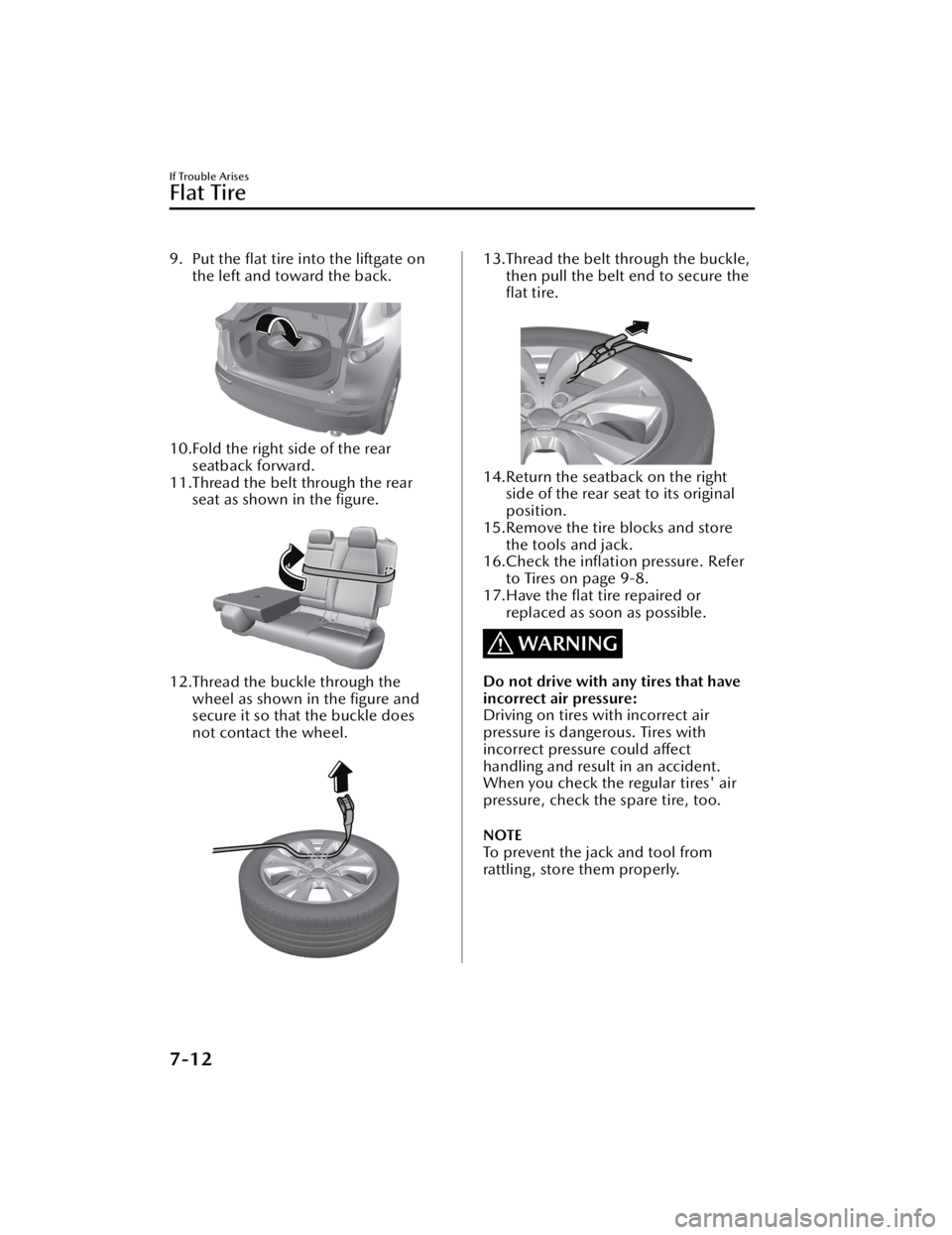
9. Put the flat tire into the liftgate onthe left and toward the back.
10.Fold the right side of the rearseatback forward.
11.Thread the belt through the rear seat as shown in the figure.
12.Thread the buckle through thewheel as shown in the figure and
secure it so that the buckle does
not contact the wheel.
13.Thread the belt through the buckle,then pull the belt end to secure the
flat tire.
14.Return the seatback on the rightside of the rear seat to its original
position.
15.Remove the tire blocks and store the tools and jack.
16.Check the inflation pressure. Refer to Tires on page 9-8.
17.Have the flat tire repaired or replaced as soon as possible.
WARNING
Do not drive with any tires that have
incorrect air pressure:
Driving on tires with incorrect air
pressure is dangerous. Tires with
incorrect pressure could affect
handling and result in an accident.
When you check the regular tires' air
pressure, check the spare tire, too.
NOTE
To prevent the jack and tool from
rattling, store them properly.
If Trouble Arises
Flat Tire
7-12
CX-30_8KN2-EA-21L_Edition1_new 2021-9-15 19:39:56
Page 559 of 595

NOTE
Some spare tires require higher
inflation pressure.
8. Visually inspect the tires to make sure there are no nails or other
objects embedded that could poke
a hole in the tire and cause an air
leak.
9. Check the sidewalls to make sure there are no gouges, cuts, bulges,
cracks or other irregularities.
▼Glossary of Terms
Tire Placard:
A label indicating the OE
tire sizes, recommended inflation
pressure, and the maximum weight the
vehicle can carry.
Tire Identification Number (TIN): A
number on the sidewall of each tire
providing information about the tire
brand and manufacturing plant, tire
size, and date of manufacture.
Inflation Pressure: A measure of the
amount of air in a tire.
kPa: Kilopascal, the metric unit for air
pressure.
psi: Pounds per square inch, the
English unit for air pressure.
B-pillar: The structural member at the
side of the vehicle behind the front
door.
Original Equipment (OE): Describes
components originally equipped on
the vehicle.
Vehicle Load Limit: The maximum
value of the combination weight of
occupants and cargo.
Bead Area of the Tire: Area of the tire
next to the rim.
Sidewall Area of the Tire: Area
between the bead area and the tread.
Trea d A rea o f t h e Ti re : Area on the
perimeter of the tire that contacts the
road when it's mounted on the
vehicle.
Seating capacity means the total
allowable number of vehicle
occupants. Seating capacity is
described on the tire label.
Production options weight is the
combination weight of installed regular
production options weighing over 2.3
kilograms in excess of the standard
items which they replace, and not
previously considered in the curb
weight or accessory weight, including
heavy duty brakes, ride levelers, roof
rack, heavy duty battery, and special
trim.
Rim is the metal support (wheel) for a
tire or a tire and tube assembly upon
which the tire beads are seated.
Customer Information and Reporting Safety Defects
Tire Information (U.S.A.)
8-28
CX-30_8KN2-EA-21L_Edition1_new 2021-9-15 19:39:56
Page 560 of 595

Tire Maintenance
▼Tire Maintenance
Improper or inadequate vehicle
maintenance can cause tires to wear
abnormally. Here are some important
maintenance points:
▼Tire
Inflation Pressure
Inspect all tire pressure monthly
(including the spare) when the tires are
cold. Maintain recommended
pressures for the best ride, top
handling, and minimum tire wear. Use
the pressures specified on the vehicle
tire information placard or tire label for
optimum service.
▼Tire Rotation
To equalize tread wear, rotate the tires
every 16,000 km (10,000 miles) at the
latest or sooner if irregular wear
develops. Mazda recommends to
rotate every 8,000 km (5,000 miles) to
help increase tire life and distribute
wear more evenly.
1. Forward
Do not include (TEMPORARY USE
ONLY) spare tire in rotation.
Inspect the tires for uneven wear and
damage. Abnormal wear is usually
caused by one or a combination of the
following:
Incorrect tire pressure
Improper wheel alignmentOut-of-balance wheelSevere braking
After rotation, inflate all tire pressures
to specification on page 9-8 and
inspect the lug nuts for tightness.
CAUTION
Rotate unidirectional tires and radial
tires that have an asymmetrical tread
pattern or studs only from front to rear,
not from side to side. Tire performance
will be weakened if rotated from side
to side.
▼ Replacing a Tire
WARNING
Always use tires that are in good
condition:
Driving with worn tires is dangerous.
Reduced braking , steering , and
traction could result in an accident.
If a tire wears evenly, a wear indicator
will appear as a solid band across the
tread.
Replace the tire when this happens.
1. New tread
2. Worn tread
3. Tread wear indicator
You should replace the tire before the
band crosses the entire tread.
Customer Information and Reporting Safety Defects
Tire Information (U.S.A.)
8-29
CX-30_8KN2-EA-21L_Edition1_new
2021-9-15 19:39:56
Page 593 of 595

Index
Rocking the Vehicle................... 3-53
S
Safety Defects, Reporting
(Canada).................................. 8-14
Safety Defects, Reporting
(U.S.A.).................................... 8-13
Saving Fuel and Protection of the
Environment............................. 3-50
Scheduled MaintenanceCanada.................................. 6-6
Mexico.................................. 6-8
U.S.A. and Puerto Rico........... 6-4
Seats Driver's seat........................... 2-4
Front passenger's seat........... 2-12
Front seat............................... 2-4
Head restraint...................... 2-16
Rear seat.............................. 2-13
Seat warmer......................... 2-18
Seat Belt System Automatic locking................ 2-23
Emergency locking................ 2-23
Extender.............................. 2-28
Pregnant women.................. 2-23
Seat belt precautions............ 2-21
Seat Belt Warning Beep............. 7-38
Security System Immobilizer system............... 3-46
Theft-deterrent system.......... 3-48
Selector Lever Not In P or N
Reminder Warning Beep............ 7-41
Shift Position Warning Beep....... 7-41
Smart Brake Support (SBS)....... 4-156 Stopping the Smart Brake Support
(SBS) system operation........4-163
Spare Tire................................... 7-3
Spare Tire and Tool Storage.......... 7-3
Specifications Capacities.............................. 9-5
Dimensions............................ 9-6
Electrical system..................... 9-4
Engine................................... 9-4
Light bulbs............................. 9-7
Lubricant quality..................... 9-4
Tires.......................................9-8
Weights................................. 9-6
SRS Air Bags Driver and front passenger
occupant classification
system................................. 2-66
How the SRS air bags work.... 2-60
Limitations to SRS air bag...... 2-65
Monitoring........................... 2-71
SRS air bag deployment
criteria................................. 2-63
Supplemental restraint system
components......................... 2-58
Supplemental restraint system
(SRS) precautions................. 2-52
Starting the Engine...................... 4-5
Steering Wheel Heated steering wheel.......... 2-19
Horn.................................... 4-65
Storage Compartments.............. 5-46 Center console..................... 5-47
Glove compartment..............5-46
Luggage compartment.......... 5-47
Overhead console................ 5-46
Storage pocket..................... 5-46
Storage Pocket.......................... 5-46
Sunshade.................................. 3-45
Sunvisors.................................. 5-39
T
Theft-Deterrent System.............. 3-48
Three-flash Turn Signal...............4-59
Tiedown Hook.......................... 7-20
Tires......................................... 6-31 Replacing a tire.................... 6-32
10-8
CX-30_8KN2-EA-21L_Edition1_new 2021-9-15 19:39:56
Page 594 of 595

Index
Replacing a wheel................ 6-33
Snow tires............................ 3-54
Specifications......................... 9-8
Temporary spare tire............. 6-33
Tire chains............................3-54
Tire inflation pressure............6-31
Tire rotation......................... 6-32
Uniform tire quality grading
system (UTQGS)................... 8-21
Tire Information Location of the tire label
(placard).............................. 8-27
Steps for determining the correct
load limit............................. 8-34
Tire labeling......................... 8-23
Tire maintenance.................. 8-29
Vehicle loading.....................8-30
Tire Pressure Monitoring
System.................................... 4-212
Touch Sensor Inoperable Warning
Beep (With the advanced keyless
function)...................................7-40
To w i n g Recreational towing.............. 3-58
Trailer towing....................... 3-58
Towing Description................... 7-19
Traction Control System (TCS).... 4-85 TCS OFF Indicator Light......... 4-86
TCS OFF switch.................... 4-86
TCS/DSC indicator light........4-85
Tra ffi c Jam Assist (TJA).............. 4-138
Close proximity warning...... 4-143
Display indication............... 4-141
Setting the system...............4-144
Stop hold control............... 4-151
Traffic Sign Recognition System
(TSR)...................................... 4-110
Trouble Battery runs out.................... 7-13
Emergency starting................7-16
Flat tire.................................. 7-5Overheating......................... 7-17
Parking in an emergency......... 7-2
When liftgate cannot be
opened................................ 7-44
Turn and Lane-Change Signals.... 4-58
Turn Signals.............................. 4-58
U
Ultrasonic Sensor.................... 4-206
V
Vehicle Information Labels Chassis number...................... 9-2
Engine number....................... 9-3
Motor vehicle safety standard
label...................................... 9-2
Tire pressure label.................. 9-2
Vehicle emission control
information label.................... 9-2
Ve h i c l e identification
number..................................9-2
Vehicle Problem Warning Beep...7-42
W
Warning Sound is Activated........7-43 AUTOHOLD warning beep.... 7-42
Battery Saving Mode Warning
Sound.................................. 7-43
Blind Spot Monitoring (BSM)
warning beep....................... 7-42
Brake override warning
beep.................................... 7-41
Brake system warning beep....7-41
Collision warning..................7-43
Door-ajar warning beep........ 7-43
Electric Parking Brake (EPB)
warning beep....................... 7-42
Excessive speed warning........7-43
Front Cross Traffic Alert (FCTA)
Warning Beep...................... 7-42
10-9
CX-30_8KN2-EA-21L_Edition1_new 2021-9-15 19:39:56