oil temperature MAZDA CX30 2023 Owners Manual
[x] Cancel search | Manufacturer: MAZDA, Model Year: 2023, Model line: CX30, Model: MAZDA CX30 2023Pages: 595, PDF Size: 21.06 MB
Page 142 of 595

Rocking the Vehicle
▼Rocking the Vehicle
WARNING
Do not spin the wheels at more than
56 km/h (35 mph), and do not allow
anyone to stand behind a wheel when
pushing the vehicle:
When the vehicle is stuck, spinning the
wheels at high speed is dangerous. The
spinning tire could overheat and
explode. This could cause serious
injuries.
CAUTION
Too much rocking may cause engine
overheating , transmission failure, and
tire damage.
If you must rock the vehicle to free it
from snow, sand or mud, depress the
accelerator slightly and slowly move
the selector lever from D to R position.
Winter Driving
▼Winter Driving
Carry emergency gear, including tire
chains, window scraper,
flares, a small
shovel, jumper cables, and a small bag
of sand or salt.
Ask an Authorized Mazda Dealer to
check the following:
Have the proper ratio of antifreeze in
the radiator.
Refer to Engine Coolant on page
6-18.
Inspect the battery and its cables.
Cold reduces battery capacity.
Use an engine oil appropriate for the
lowest ambient temperatures that
the vehicle will be driven in (page
6-16).
Inspect the ignition system for
damage and loose connections.
Use washer fluid made with
antifreeze ―but do not use engine
coolant antifreeze for washer fluid
(page 6-20).
NOTE
Remove snow before driving. Snow
left on the windshield is dangerous
as it could obstruct vision.
Do not apply excessive force to a
window scraper when removing ice
or frozen snow on the mirror glass
and windshield.
Never use warm or hot water for
removing snow or ice from windows
and mirrors as it could result in the
glass cracking.
Before Driving
Driving Tips
3-53
CX-30_8LD3-EA-22J_Edition1_new 2022-6-7 13:06:59
Page 164 of 595

When the light is turned on
The light turns on while engine idling is
stopped and turns off when the engine
is restarted.Cylinder Deactivation*
▼Cylinder Deact ivat ion
The cylinder deactivation is a function
designed to reduce fuel consumption
and improve fuel economy by
deactivating 2 out of the 4 cylinders
while driving. The function constantly
determines which is better for driving;
4 cylinders or 2 cylinders, regardless of
the driver's operations, and it performs
the switching automatically.
When the cylinder deactivation
function does not operate
The cylinder deactivation function
does not operate under the following
conditions.
The selector lever is in the P, N, or R
position.
The gear is in 1st gear.The engine oil temperature or engine
coolant temperature is low.
After disconnecting the battery
terminals for some reason, such as
for battery replacement.
When Driving
Start/Stop Engine
*Some models.4-17
CX-30_8LD3-EA-22J_Edition1_new
2022-6-7 13:06:59
Page 176 of 595

▼Warning Indication/Warning Lights
These lights turn on or flash to notify th
e user of the system operation status or a
system malfunction.
Signal Warning Refer to
Brake System Warning Indication/Warning Light*17-22
ABS Warning Indication/Warning Light*1
Electronic
Brake Force
Distribution
System Warn- ing
7-23
ABS warning 7-25
Charging System Warning Indication/Warning Light*17-24
Engine Oil Warning Indication/Warning Light*17-24
High Engine Coolant Temperature Warning Indication 7-24
Power Steering Malfunction Indication/Indicator Light*17-25
Master Warning Indication7-25
Brake Control System Warning Indication/Warning Light*17-26
Brake Override Warning Indication7-26
Check Engine Indication/Light*17-26
(Amber)
*i-stop Warning Indication/Warning Light*17-27
Automatic Transmission Warning Indication/Warning Light*17-27
When Driving
Instrument Cluster and Display
*Some models.4-29
CX-30_8LD3-EA-22J_Edition1_new 2022-6-7 13:06:59
Page 437 of 595

Scheduled Maintenance
▼Scheduled Maintenance (U.S.A. and Puerto Rico)
Vehicles utilizing the vehicle status monitor feature:
The vehicle status monitor feature alerts you of maintenance needs by turning on the
wrench indicator light or displaying a message in the instrument panel, or both.
Every maintenance must be done when the display/wrench indication comes on.
The display/wrench indication will come
on before reaching the maximum interval
of 16,000 km (10,000 miles), or 12 mont hs (after the previous maintenance).
If you drive your vehicle under any of th e following conditions, follow the Severe
Driving Scheduled Maintenance and replace the engine oil and filter every 8,000 km
(5,000 miles) or 6 months, whichever comes first.
Otherwise, follow the Normal Driv ing Scheduled Maintenance intervals.
1. The vehicle is idled for long periods or driven at low speeds, such as with police cars, taxis, or driver's education school car.
2. Driving under dusty conditions.
3. Driving for long periods in cold temperatures or driving regularly for short distan- ces only.
4. Driving under extremely high temperature conditions.
5. Driving continuously in mountainous regions.
If you are following the Severe Driving Scheduled Maintenance (8,000 km (5,000
miles) or 6 months oil replacement interval), set the vehicle status monitor manually.
Refer to the Information section in the Mazda Connect Owner's Manual. Please
contact an Authorized Mazda Dealer if necessary.
USA and Puerto Rico Residents (Nor mal Driving Scheduled Maintenance):
Maintenance ItemNumber of times, maintenance was performed.
12345678
Engine oil & filter
*1RRRRRRRR
Spark plugs SKYACTIV-G
2.5T
Replace every 64,000 km (40,000 miles).
Except SKY-
ACTIV-G
2.5T Replace every 120,000 km (75,000 miles).
Air filter RR
Fuel lines & hoses
*2IIII
Hoses and tubes for emission
*2II
Drive belts IIIIIIII
Vacuum brake booster and hose III I
Exhaust system and heat shields II
Coolant level IIIIIIII
Maintenance and Care
Scheduled Maintenance
6-4
CX-30_8LD3-EA-22J_Edition1_new 2022-6-7 13:06:59
Page 441 of 595

R: Replace
C: Clean
L: Lubricate
T: Tighten
Remarks:
*1 Reset the engine oil data whenever replacing the engine oil regardless of the message/wrench indicator light display.
*2 If you drive your vehicle under any of the following conditions, replace the engine oil & filter every8,000 km (5,000 miles) or 6 months, whichever comes first.
1. The vehicle is idled for long periods or driven at low speeds, such as with police cars, taxis, or driver's education school vehicles.
2. Driving under dusty conditions.
3. Driving for long periods in cold temperatures or driving regularly for short distances only.
4. Driving under extremely high temperature conditions.
5. Driving continuously in mountainous regions.
*3 Also inspect the air conditioner drive belts, if equipped. If the vehicle is operated primarily under any of the following conditions, inspect the drive belts more
often than the recommended intervals.
a) Driving under dusty conditions.
b) The vehicle is idled for long periods or driven at low speeds.
c) Driving for long periods in cold temperatures or driving regularly for short distances only.
d) Driving under extremely high temperature conditions.
e) Driving continuously in mountainous regions.
f) Driving for long period in extremely wet or heavy rain condition.
*4 Use of FL-22 is recommended when replacing c oolant. Using coolant other than FL-22 may cause
serious damage to the engine and cooling system.
*5 According to state/provincial and federal regulati ons, failure to perform maintenance on these items
will not void your emissions warranties. However, Mazda recommends that all maintenance services
be performed at the recommended time or mileage/kilometer period to ensure long-term reliability.
*6 Inspect a spare tire if equipped.
▼ Scheduled Maintenance (Mexico)
Vehicles utilizing the vehicle status monitor feature:
The vehicle status monitor feature alerts you of maintenance needs by turning on the
wrench indicator light or displaying a message in the instrument panel, or both.
Every maintenance must be done when the display/wrench indication comes on.
The display/wrench indication will come
on before reaching the maximum interval
of 10,000 km, or 6 months (after the previous maintenance).
If you drive your vehicle under any of th e following conditions, follow the Severe
Driving Scheduled Maintenance and replace the engine oil and filter every 5,000 km
or 3 months, whichever comes first.
Otherwise, follow the Normal Driv ing Scheduled Maintenance intervals.
1. The vehicle is idled for long periods or driven at low speeds, such as with police cars, taxis, or driver's education school car.
Maintenance and Care
Scheduled Maintenance
6-8
CX-30_8LD3-EA-22J_Edition1_new 2022-6-7 13:06:59
Page 442 of 595

2. Driving under dusty conditions.
3. Driving for long periods in cold temperatures or driving regularly for short distan-
ces only.
4. Driving under extremely high temperature conditions.
5. Driving continuously in mountainous regions.
If you are following the Severe Driving Scheduled Maintenance (5,000 km or 3
months oil replacement interval), set the vehicle status monitor manually.
Refer to the Information section in th e Mazda Connect Owner's Manual. Please
contact an Authorized Mazda Dealer if necessary.
Mexico Residents (Normal Driv ing Scheduled Maintenance):
Maintenance Item Number of times, maintenance was performed.
12345678
Engine oil & filter
*1RRRRRRRR
Spark plugs SKYACTIV-G
2.5T
IIIIIIII
Replace every 64,000 km
Except SKY-
ACTIV-G
2.5T IIIIIIII
Replace every 120,000 km.
Air filter RR RR
Drive belts IIIIIIII
Coolant level IIIIIIII
Coolant
*2Replace at first 192,000 km or 120 months; after that, every 96,000 km or 60 months.
Fuel lines & hoses
*3II
Hoses and tubes for emission
*3II
Fuel filter Replace every 60,000 km.
Brake lines, hoses and connections II II
Vacuum brake booster and
hose With vacuum
booster
IIII
Brake and clutch fluid level III III
Brake fluid RR
Disc brakes IIIIIIII
Tire rotation Rotate every 10,000 km.
Tire inflation pressure and tire wear
*4IIIIIIII
Steering operation and linkages IIIIIIII
Front and rear suspension, ball joints and
wheel bearing axial play IIII
Maintenance and Care
Scheduled Maintenance
6-9
CX-30_8LD3-EA-22J_Edition1_new
2022-6-7 13:06:59
Page 450 of 595

Only use SAE 5W-30 oil “Certified For
Gasoline Engines” by the American
Petroleum Institute (API).
Oil with this trademark symbol
conforms to the current engine and
emission system protection standards
and fuel economy requirements of the
International Lubricant Standardization
and Approval Committee (ILSAC),
comprised of U.S. and Japanese
automobile manufacturers.
Except U.S.A., Canada
Use SAE 5W-30 engine oil.
Oil container labels provide important
information.
A chief contribution this type of oil
makes to fuel economy is reducing the
amount of fuel necessary to overcome
engine friction.
For maintenance service, Mazda
recommends Mazda Genuine Parts.
(Mexico)
SKYACTIV-G 2.0 and
SKYACTIV-G
2.5
Use API SM or higher, SAE 5W-30
engine oil. If SAE 5W-30 engine oil is
not available, use SAE 5W-20, SAE
0W-30 or SAE
10W-30 engine oil.
The quality designation SM, SN or SP
must be on the label.
SKYACTIV-G 2.5T
Use API SM or higher, SAE 5W-30
engine oil. If SAE 5W-30 engine oil is
not available, use SAE 0W-30 or SAE
10W-30 engine oil.
The quality designation SM, SN or SP
must be on the label.
▼ Inspecting Engine Oil Level
NOTE
If the engine oil level warning
indication/warning light turns on,
add 1 L (0.26 US gal, 0.22 Imp gal)
of engine oil.
1. Be sure the vehicle is on a level surface.
2. Warm up the engine to normal
operating temperature.
3. Turn it off and wait at least 5 minutes for the oil to return to the
oil pan.
Maintenance and Care
Owner Maintenance
6-17
CX-30_8LD3-EA-22J_Edition1_new 2022-6-7 13:06:59
Page 451 of 595
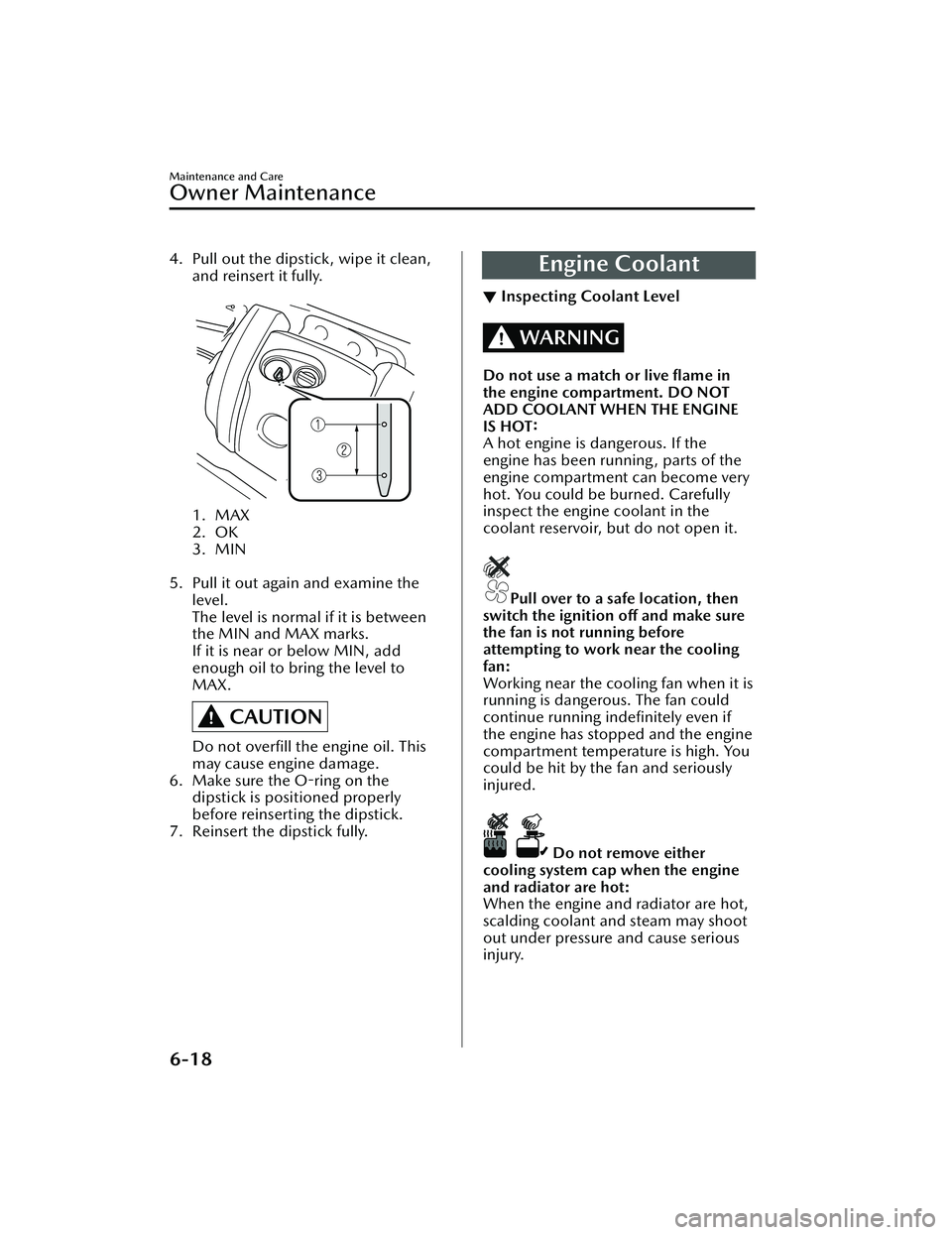
4. Pull out the dipstick, wipe it clean,and reinsert it fully.
1. MAX
2. OK
3. MIN
5. Pull it out again and examine the level.
The level is normal if it is between
the MIN and MAX marks.
If it is near or below MIN, add
enough oil to bring the level to
MAX.
CAUTION
Do not overfill the engine oil. This
may cause engine damage.
6. Make sure the O-ring on the dipstick is positioned properly
before reinserting the dipstick.
7. Reinsert the dipstick fully.
Engine Coolant
▼ Inspecting Coolant Level
WARNING
Do not use a match or live flame in
the engine compartment. DO NOT
ADD COOLANT WHEN THE ENGINE
IS HOT:
A hot engine is dangerous. If the
engine has been running, parts of the
engine compartment can become very
hot. You could be burned. Carefully
inspect the engine coolant in the
coolant reservoir, but do not open it.
Pull over to a safe location, then
switch the ignition off and make sure
the fan is not running before
attempting to work near the cooling
fan:
Working near the cooling fan when it is
running is dangerous. The fan could
continue running indefinitely even if
the engine has stopped and the engine
compartment temperature is high. You
could be hit by the fan and seriously
injured.
Do not remove either
cooling system cap when the engine
and radiator are hot:
When the engine and radiator are hot,
scalding coolant and steam may shoot
out under pressure and cause serious
injury.
Maintenance and Care
Owner Maintenance
6-18
CX-30_8LD3-EA-22J_Edition1_new 2022-6-7 13:06:59
Page 479 of 595

edges of the doors and rocker panels
are clean.
Insects, tar, tree sap, bird droppings,
industrial fallout, and similar deposits
can damage the finish if not removed
immediately. When prompt washing
with plain water is ineffective, use a
mild soap made for use on vehicles.
Thoroughly rinse off all soap with
lukewarm or cold water. Do not allow
soap to dry on the finish.
After washing the vehicle, dry it with a
clean chamois to prevent water spots
from forming.
WARNING
Dry off brakes that have become wet
by driving slowly, releasing the
accelerator pedal and lightly applying
the brakes several times until the
brake performance returns to normal:
Driving with wet brakes is dangerous.
Increased stopping distance or the
vehicle pulling to one side when
braking could result in a serious
accident. Light braking will indicate
whether the brakes have been
affected.
When using an automatic car wash
Retract the door mirrors.The automatic car wash brushes
could reduce the paint luster or
hasten paint deterioration.
When using a high water pressure car
wash
High water temperature and high
water pressure car washers are
available depending on the type of car
wash machine. If the car washer nozzle
is put too close to the vehicle, the
force of the spray could damage or
deform the molding, affect the
sealability of parts, and allow water to
penetrate the interior. Keep a sufficient
space (30 cm (12 in) or more)
between the nozzle and the vehicle. In
addition, do not spend too much time
spraying the same area of the vehicle,
and be very careful when spraying
between gaps in doors and around
windows.
Waxing
Your vehicle needs to be waxed when
water no longer beads on the finish.
Always wash and dry the vehicle before
waxing it. In addition to the vehicle
body, wax the metal trim to maintain
its luster.
1. Use wax which contains no
abrasives.
Wax containing abrasives will
remove paints and could damage
bright metal parts.
2. Use a good grade of natural wax for metallic, mica, and solid colors.
3. When waxing, coat evenly with the sponge supplied or a soft cloth.
4. Wipe off the wax with a soft cloth.
NOTE
A spot remover to remove oil, tar, and
similar materials will usually also take
off the wax. Rewax these areas even if
the rest of the vehicle does not need it.
▼ Repairing Damage to the Finish
Deep scratches or chips on the finish
should be repaired promptly. Exposed
metal quickly rusts and can lead to
major repairs.
Maintenance and Care
Appearance Care
6-46
CX-30_8LD3-EA-22J_Edition1_new
2022-6-7 13:06:59
Page 481 of 595

NOTE
Do not use a wire brush or any
abrasive cleaner, polishing
compound, or solvent on aluminum
wheels. They may damage the
coating.
Always use a sponge or soft cloth to
clean the wheels.
Rinse the wheels thoroughly with
lukewarm or cold water. Also, be
sure to clean the wheels after driving
on dusty or salted roads to help
prevent corrosion.
Avoid washing your vehicle in an
automatic car wash that uses
high-speed or hard brushes.
▼Plastic Part Maintenance
When cleaning the plastic lenses of
the lights, do not use gasoline,
kerosene,
rectified spirit, paint,
thinner, highly acidic detergents, or
strongly alkaline detergents.
Otherwise, these chemical agents
can discolor or damage the surfaces
resulting in a significant loss in
functionality. If plastic parts become
inadvertently exposed to any of these
chemical agents, flush with water
immediately.
If plastic parts such as the bumpers
become inadvertently exposed to
chemical agents or fluids such as
gasoline, oil, engine coolant, or
battery fluid, it could cause
discoloration, staining , or paint
peeling. Wipe off any such chemical
agents or fluids using a soft cloth
immediately.
High water temperature and high
water pressure car washers are
available depending on the type of
high pressure car washer device. If
the car washer nozzle is put too
close to the vehicle or aimed at one
area for an extended period of time,
it could deform plastic parts or
damage the paint.
Do not use wax containing
compounds (polish). Otherwise, it
could result in paint damage.
In addition, do not use an electrical
or air tool to apply wax. Otherwise,
the frictional heat generated could
result in deformation of plastic parts
or paint damage.
Maintenance and Care
Appearance Care
6-48
CX-30_8LD3-EA-22J_Edition1_new 2022-6-7 13:06:59