warning MAZDA MAZDA 2023 Owners Manual
[x] Cancel search | Manufacturer: MAZDA, Model Year: 2023, Model line: MAZDA, Model: MAZDA MAZDA 2023Pages: 623, PDF Size: 15.08 MB
Page 576 of 623
Uniform Tire Quality
Grading System (UTQGS)
▼ Uniform Tire Quality Grading
System (UTQGS)
This information relates to the tire
grading system developed by the U.S.
National Highway
Tra ffi c Safety
Administration for grading tires by
tread wear, traction, and temperature
performance.
▼ Trea d Wea r
The tread wear grade is a comparative
rating based on the wear rate of the
tire when tested under controlled
conditions on a specified government
test course.
For example, a tire graded 150 would
wear one-and-a-half times as well on
the government course as a tire graded
100.
The relative performance of tires
depends upon the actual conditions of
their use, however, and may depart
significantly from the norm because of
variations in driving habits, service
practices and differences in road
characteristics and climate.
▼
Traction-AA, A, B, C
The traction grades, from highest to
lowest, are AA, A, B, and C. These
grades represent the tire's ability to
stop on wet pavement as measured
under controlled conditions on
specified government test surfaces of
asphalt and concrete. A tire marked C
may have poor traction performance.
WARNING
The traction grade assigned to this tire
is based on braking (straight ahead)
traction tests and does not include
acceleration cornering (turning),
hydroplaning , or peak traction
characteristics.
▼Temperature-A, B, C
The temperature grades A (the
highest), B, and C, represent the tire's
resistance to the generation of heat
and its ability to dissipate heat when
tested under controlled conditions on
a specified indoor laboratory test
wheel.
Sustained high temperature can cause
the material of the tire to degenerate
and reduce tire life, and excessive
temperatures can lead to sudden tire
failure.
Grade C corresponds to a level of
performance which all passenger
vehicle tires must meet under the
Federal Motor Vehicle Safety Standard
No. 109. Grades B and A represent
higher levels of performance on the
laboratory test wheel than the
minimum required by law.
Customer Information and Reporting Safety Defects
Uniform Tire Quality Grading System (UTQGS)
8-21
Mazda3_8LC2-EA-22G_Edition1_new
2022-5-20 11:26:10
Page 577 of 623
WARNING
Keep your vehicle's tires properly
inflated and not overloaded:
Driving with improperly inflated or
overloaded tires is dangerous.
Excessive speed, underinflation, or
excessive loading, either separately or
in combination, can cause heat
buildup and possible tire failure. The
temperature grade for this tire is
established for a tire that is properly
inflated and not overloaded.
These grades will be added to the
sidewalls of passenger vehicle tires
over the next several years according to
a schedule established by the NHTSA
and the tire manufacturers.
The grade of tires available as standard
or optional equipment on Mazda
vehicles may vary with respect to
grade.
ALL PASSENGER VEHICLE TIRES MUST
CONFORM TO THESE GRADES AND
TO ALL OTHER FEDERAL TIRE-SAFETY
REQUIREMENTS.
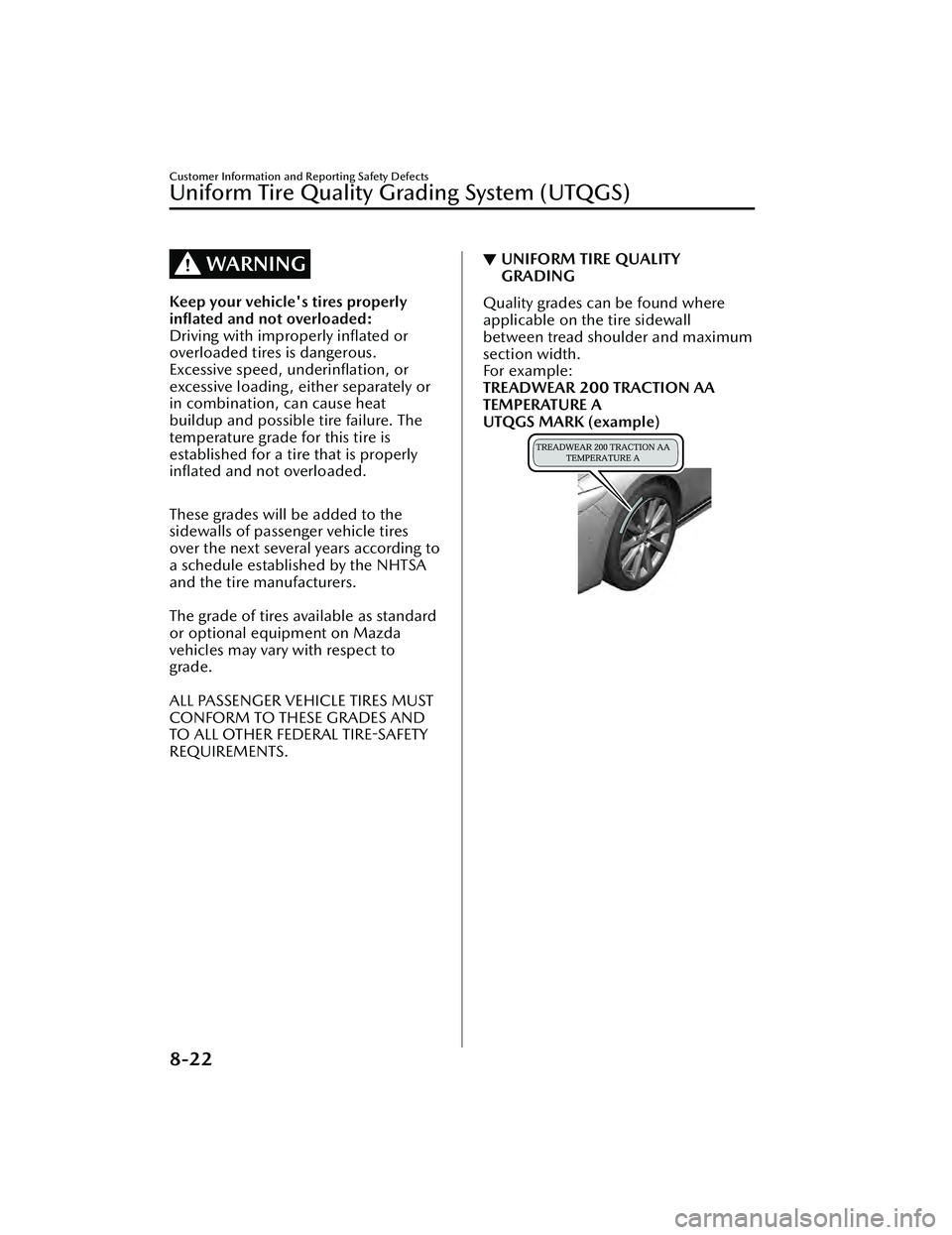
▼ UNIFORM TIRE QUALITY
GRADING
Quality grades can be found where
applicable on the tire sidewall
between tread shoulder and maximum
section width.
For example:
TREADWEAR 200 TRACTION AA
TEMPERATURE A
UTQGS MARK (example)
Customer Information and Reporting Safety Defects
Uniform Tire Quality Grading System (UTQGS)
8-22
Mazda3_8LC2-EA-22G_Edition1_new
2022-5-20 11:26:10
Page 578 of 623
Tire Labeling
▼Tire Labeling
Federal law requires tire manufacturers
to place standardized information on
the sidewall of all tires. This
information identifies and describes
the fundamental characteristics of the
tire and also provides a tire
identification
number for safety
standard certification and in case of a
recall.
▼ Information on Passenger Vehicle
Tires
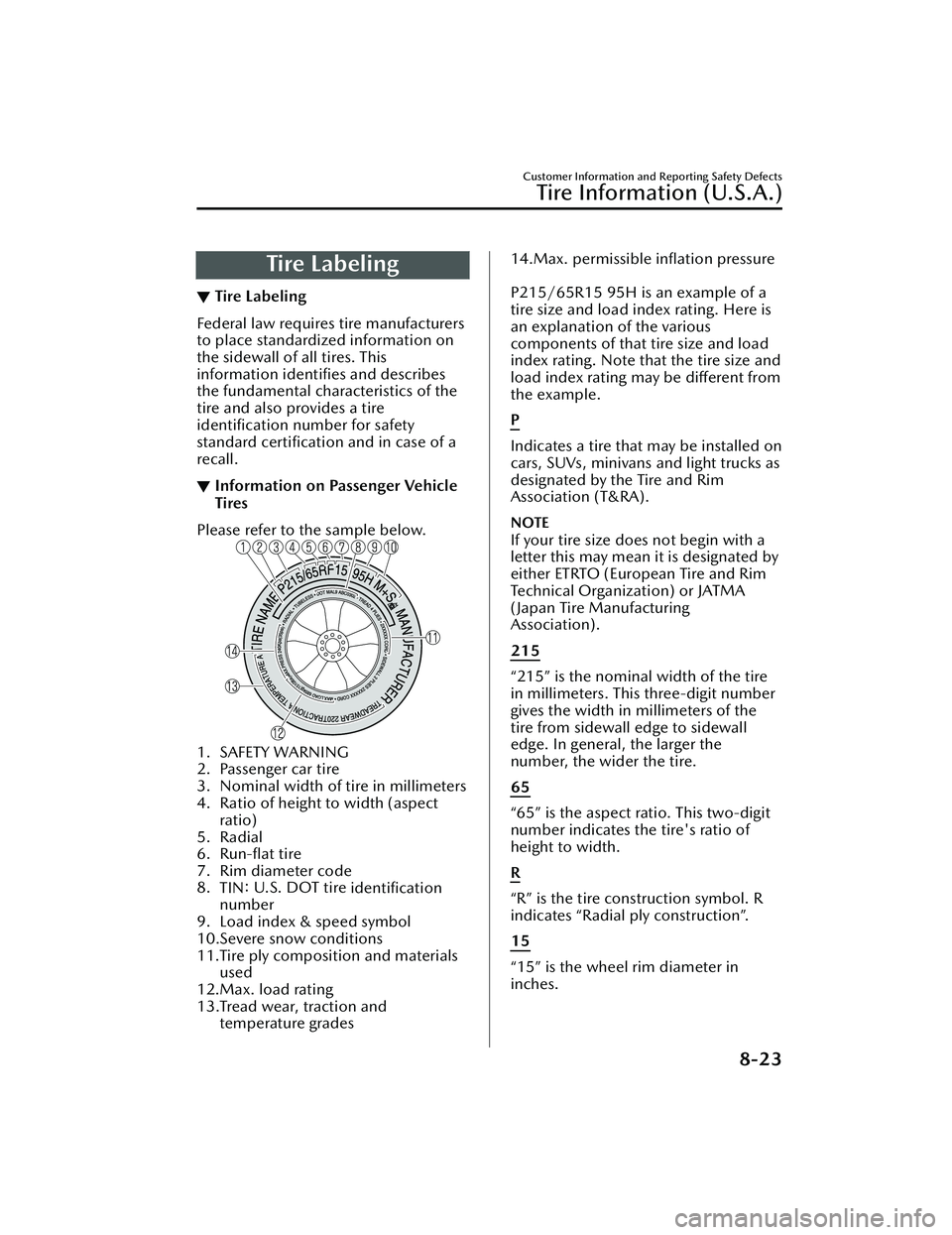
Please refer to the sample below.
1. SAFETY WARNING
2. Passenger car tire
3. Nominal width of tire in millimeters
4. Ratio of height to width (aspect
rat io)
5. Radial
6. Run-flat tire
7. Rim diameter code
8. TIN: U.S. DOT tire
identification
number
9. Load index & speed symbol
10.Severe snow conditions
11.Tire ply composition and materials used
12.Max. load rating
13.Tread wear, traction and temperature grades
14.Max. permissible inflation pressure
P215/65R15 95H is an example of a
tire size and load index rating. Here is
an explanation of the various
components of that tire size and load
index rating. Note that the tire size and
load index rating may be different from
the example.
P
Indicates a tire that may be installed on
cars, SUVs, minivans and light trucks as
designated by the Tire and Rim
Association (T&RA).
NOTE
If your tire size does not begin with a
letter this may mean it is designated by
either ETRTO (European Tire and Rim
Technical Organization) or JATMA
(Japan Tire Manufacturing
Association).
215
“215” is the nominal width of the tire
in millimeters. This three-digit number
gives the width in millimeters of the
tire from sidewall edge to sidewall
edge. In general, the larger the
number, the wider the tire.
65
“65” is the aspect ratio. This two-digit
number indicates the tire's ratio of
height to width.
R
“R” is the tire construction symbol. R
indicates “Radial ply construction”.
15
“15” is the wheel rim diameter in
inches.
Customer Information and Reporting Safety Defects
Tire Information (U.S.A.)
8-23
Mazda3_8LC2-EA-22G_Edition1_new 2022-5-20 11:26:10
Page 580 of 623
Tread Wear, Traction and Temperature
Grades
Tr ea d w ea r : The tread wear grade is a
comparative rating based on the wear
rate of the tire when tested under
controlled conditions on a specified
government test course. For example,
a tire graded 150 would wear one and
one-half (1 1/2) times as well on the
government course as a tire graded
100.
Traction: The traction grades, from
highest to lowest are AA, A, B, and C.
The grades represent the tire's ability
to stop on wet pavement as measured
under controlled conditions on
specified government test surfaces of
asphalt and concrete. A tire marked C
may have poor traction performance.
Temperature: The temperature grades
are A (the highest), B and C,
representing the tire's resistance to the
generation of heat and its ability to
dissipate heat when tested under
controlled conditions on a specified
indoor laboratory test wheel.
Snow Tires
In some heavy snow areas, local
governments may require true snow
tires, those with very deeply cut tread.
These tires should only be used in pairs
or placed on all four wheels. Make
sure you purchase snow tires that are
the same size and construction type as
the other tires on your vehicle.
SAFETY WARNING
The following safety warning appears
on the tire's sidewall.
SERIOUS INJURY MAY RESULT FROM:
EXPLOSION OF TIRE/RIM ASSEMBLY
DUE TO IMPROPER
MOUNTING-MATCH TIRE
DIAMETER TO RIM DIAMETER;
NEVER EXCEED 40 psi (275 kPa) TO
SEAT BEADS-ONLY SPECIALLY
TRAINED PERSONS SHOULD
MOUNT TIRES.
TIRE FAILURE DUE TO UNDER-INFLATION/
OVERLOADING/DAMAGE-FOLLOW
OWNER'S MANUAL AND PLACARD
IN VEHICLE-FREQUENTLY CHECK
INFLATION PRESSURE AND INSPECT
FOR DAMAGE.
▼ Information on Temporary Tires
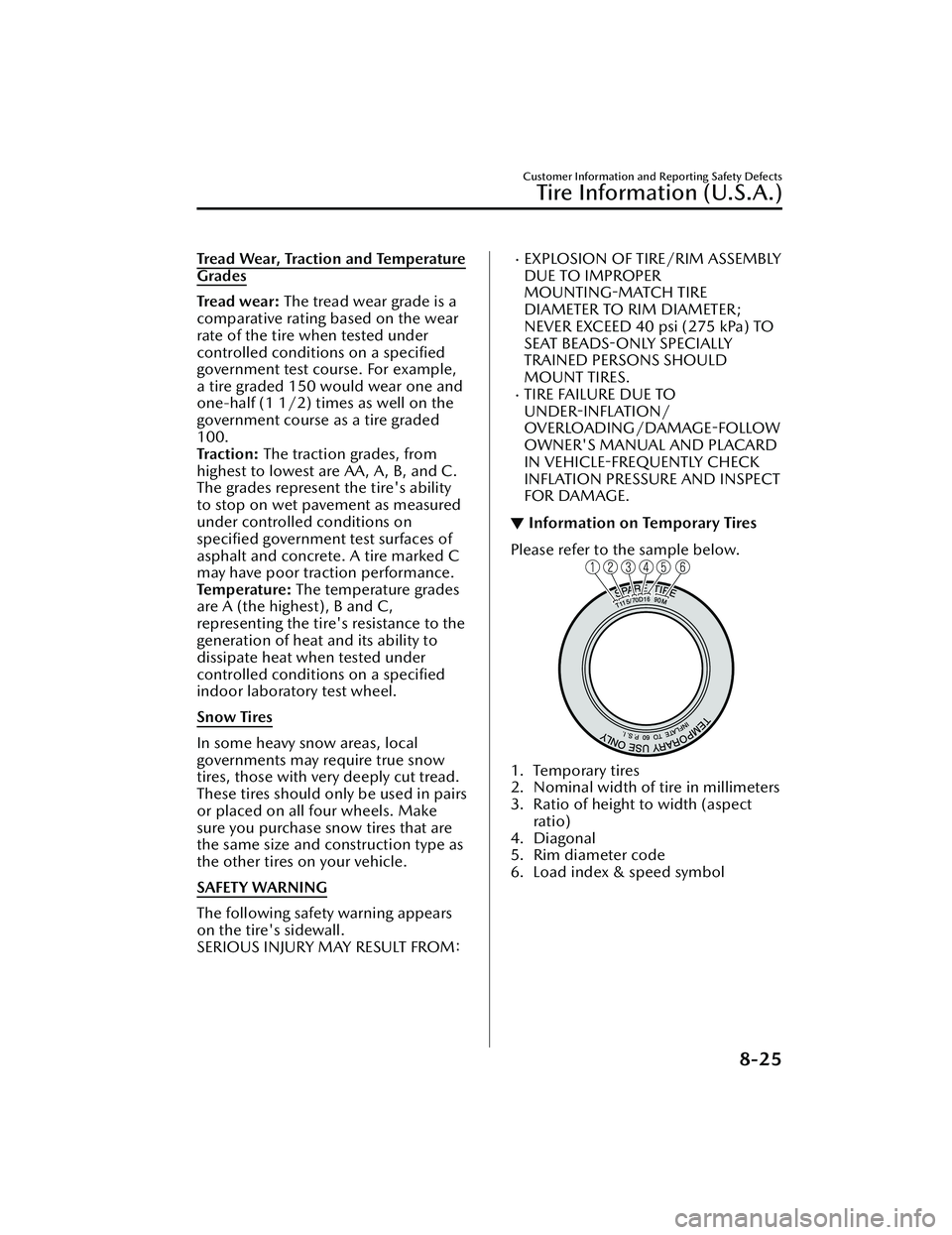
Please refer to the sample below.
1. Temporary tires
2. Nominal width of tire in millimeters
3. Ratio of height to width (aspect
ratio)
4. Diagonal
5. Rim diameter code
6. Load index & speed symbol
Customer Information and Reporting Safety Defects
Tire Information (U.S.A.)
8-25
Mazda3_8LC2-EA-22G_Edition1_new 2022-5-20 11:26:10
Page 582 of 623
Location of the Tire Label(Placard)
▼Location of the Tire Label (Placard)
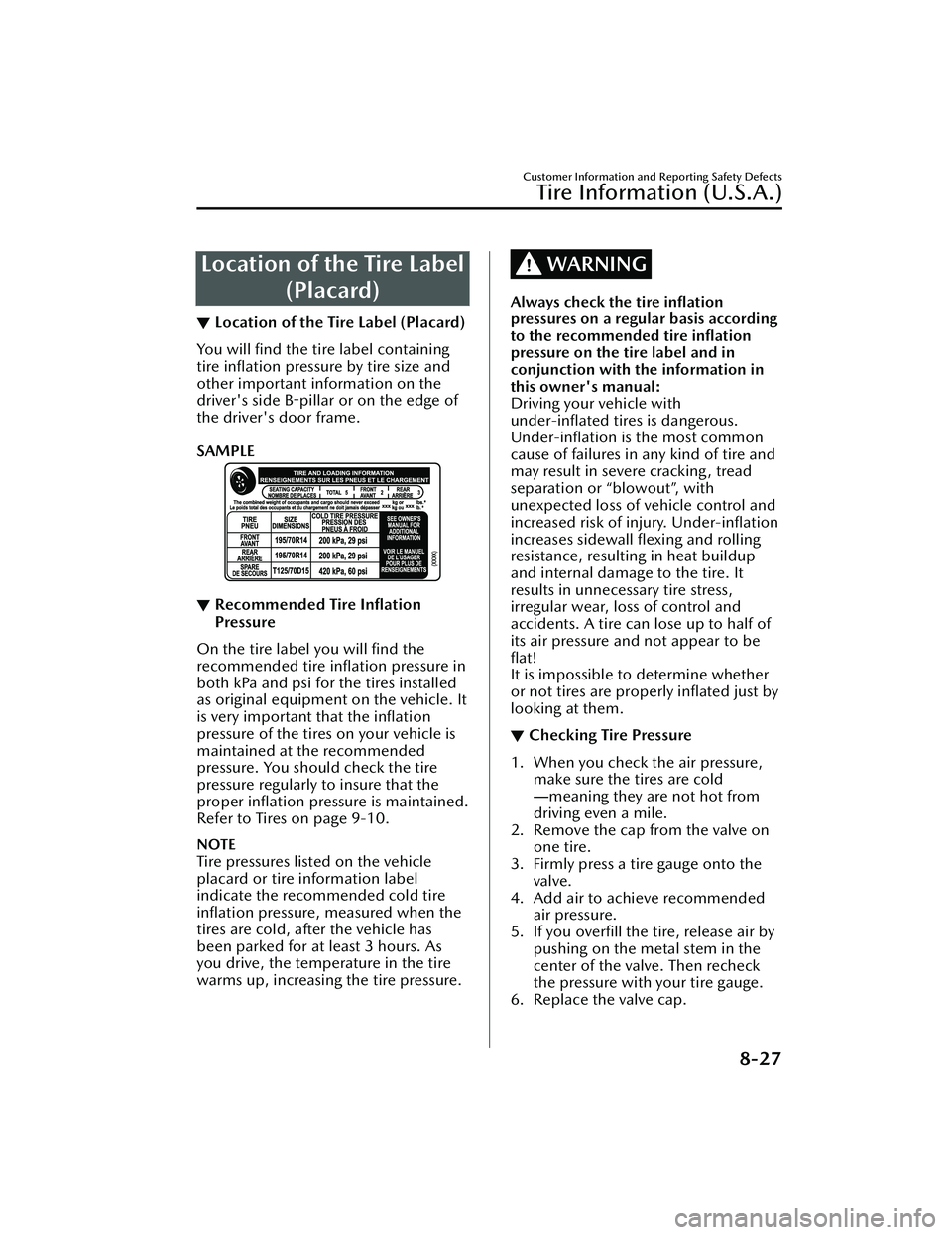
You will find the tire label containing
tire
inflation pressure by tire size and
other important information on the
driver's side B-pillar or on the edge of
the driver's door frame.
SAMPLE
▼ Recommended Tire Inflation
Pressure
On the tire label you will find the
recommended tire
inflation pressure in
both kPa and psi for the tires installed
as original equipment on the vehicle. It
is very important that the inflation
pressure of the tires on your vehicle is
maintained at the recommended
pressure. You should check the tire
pressure regularly to insure that the
proper inflation pressure is maintained.
Refer to Tires on page 9-10.
NOTE
Tire pressures listed on the vehicle
placard or tire information label
indicate the recommended cold tire
inflation pressure, measured when the
tires are cold, after the vehicle has
been parked for at least 3 hours. As
you drive, the temperature in the tire
warms up, increasing the tire pressure.
WARNING
Always check the tire inflation
pressures on a regular basis according
to the recommended tire inflation
pressure on the tire label and in
conjunction with the information in
this owner's manual:
Driving your vehicle with
under-inflated tires is dangerous.
Under-inflation is the most common
cause of failures in any kind of tire and
may result in severe cracking , tread
separation or “blowout”, with
unexpected loss of vehicle control and
increased risk of injury. Under-inflation
increases sidewall flexing and rolling
resistance, resulting in heat buildup
and internal damage to the tire. It
results in unnecessary tire stress,
irregular wear, loss of control and
accidents. A tire can lose up to half of
its air pressure and not appear to be
flat!
It is impossible to determine whether
or not tires are properly inflated just by
looking at them.
▼ Checking Tire Pressure
1. When you check the air pressure,
make sure the tires are cold
―meaning they are not hot from
driving even a mile.
2. Remove the cap from the valve on one tire.
3. Firmly press a tire gauge onto the valve.
4. Add air to achieve recommended air pressure.
5. If you overfill the tire, release air by pushing on the metal stem in the
center of the valve. Then recheck
the pressure with your tire gauge.
6. Replace the valve cap.
Customer Information and Reporting Safety Defects
Tire Information (U.S.A.)
8-27
Mazda3_8LC2-EA-22G_Edition1_new 2022-5-20 11:26:10
Page 584 of 623
Tire Maintenance
▼Tire Maintenance
Improper or inadequate vehicle
maintenance can cause tires to wear
abnormally. Here are some important
maintenance points:
▼Tire
Inflation Pressure
Inspect all tire pressure monthly
(including the spare) when the tires are
cold. Maintain recommended
pressures for the best ride, top
handling, and minimum tire wear. Use
the pressures specified on the vehicle
tire information placard or tire label for
optimum service.
▼Tire Rotation
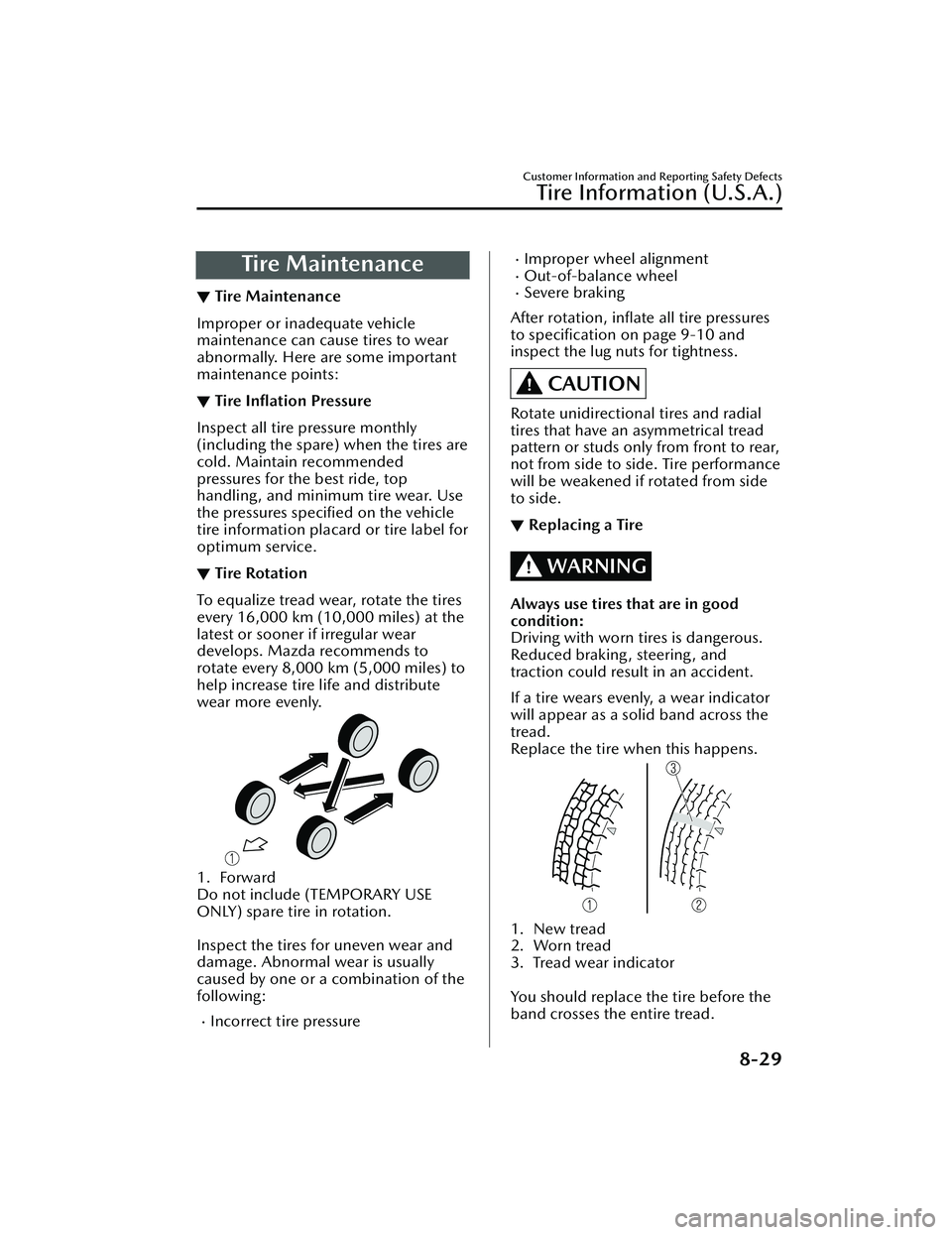
To equalize tread wear, rotate the tires
every 16,000 km (10,000 miles) at the
latest or sooner if irregular wear
develops. Mazda recommends to
rotate every 8,000 km (5,000 miles) to
help increase tire life and distribute
wear more evenly.
1. Forward
Do not include (TEMPORARY USE
ONLY) spare tire in rotation.
Inspect the tires for uneven wear and
damage. Abnormal wear is usually
caused by one or a combination of the
following:
Incorrect tire pressure
Improper wheel alignmentOut-of-balance wheelSevere braking
After rotation, inflate all tire pressures
to specification on page 9-10 and
inspect the lug nuts for tightness.
CAUTION
Rotate unidirectional tires and radial
tires that have an asymmetrical tread
pattern or studs only from front to rear,
not from side to side. Tire performance
will be weakened if rotated from side
to side.
▼ Replacing a Tire
WARNING
Always use tires that are in good
condition:
Driving with worn tires is dangerous.
Reduced braking , steering , and
traction could result in an accident.
If a tire wears evenly, a wear indicator
will appear as a solid band across the
tread.
Replace the tire when this happens.
1. New tread
2. Worn tread
3. Tread wear indicator
You should replace the tire before the
band crosses the entire tread.
Customer Information and Reporting Safety Defects
Tire Information (U.S.A.)
8-29
Mazda3_8LC2-EA-22G_Edition1_new
2022-5-20 11:26:10
Page 586 of 623
Ve h i c l e L o a d i n g
▼Ve h i c l e L o a d i n g
WARNING
Do not tow a trailer with this vehicle:
Towing a trailer with this vehicle is
dangerous because it has not been
designed to tow a trailer and doing so
will
affect the drive system which could
result in vehicle damage.
This section will guide you in the
proper loading of your vehicle, to keep
your loaded vehicle weight within its
design rating capability. Properly
loading your vehicle will provide
maximum return of vehicle design
performance. Before loading your
vehicle, familiarize yourself with the
following terms for determining your
vehicle's weight ratings, from the
vehicle's Safety Certification Label and
Tire and Load Information Label:
WARNING
Overloaded Vehicle:
Overloading a vehicle is dangerous.
The results of overloading can have
serious consequences in terms of
passenger safety. Too much weight on
a vehicle's suspension system can
cause spring or shock absorber failure,
brake failure, handling or steering
problems, irregular tire wear, tire
failure or other damage.
Overloading makes a vehicle harder to
drive and control. It also increases the
distance required for stopping. In cases
of serious overloading, brakes can fail
completely, particularly on steep
grades. The load a tire will carry safely
is a combination of the size of the tire,
its load range, and corresponding
inflation pressure.
Never overload the vehicle and always
observe the vehicle's weight ratings
from the vehicle's Safety Certification
and Tire and Load Information labels.
Base Curb Weight is the weight of the
vehicle including a full tank of fuel
and all standard equipment. It does
not include passengers, cargo, or
optional equipment.
Vehicle Curb Weight is the weight of
your new vehicle when you picked it
up from your dealer plus any
aftermarket equipment.
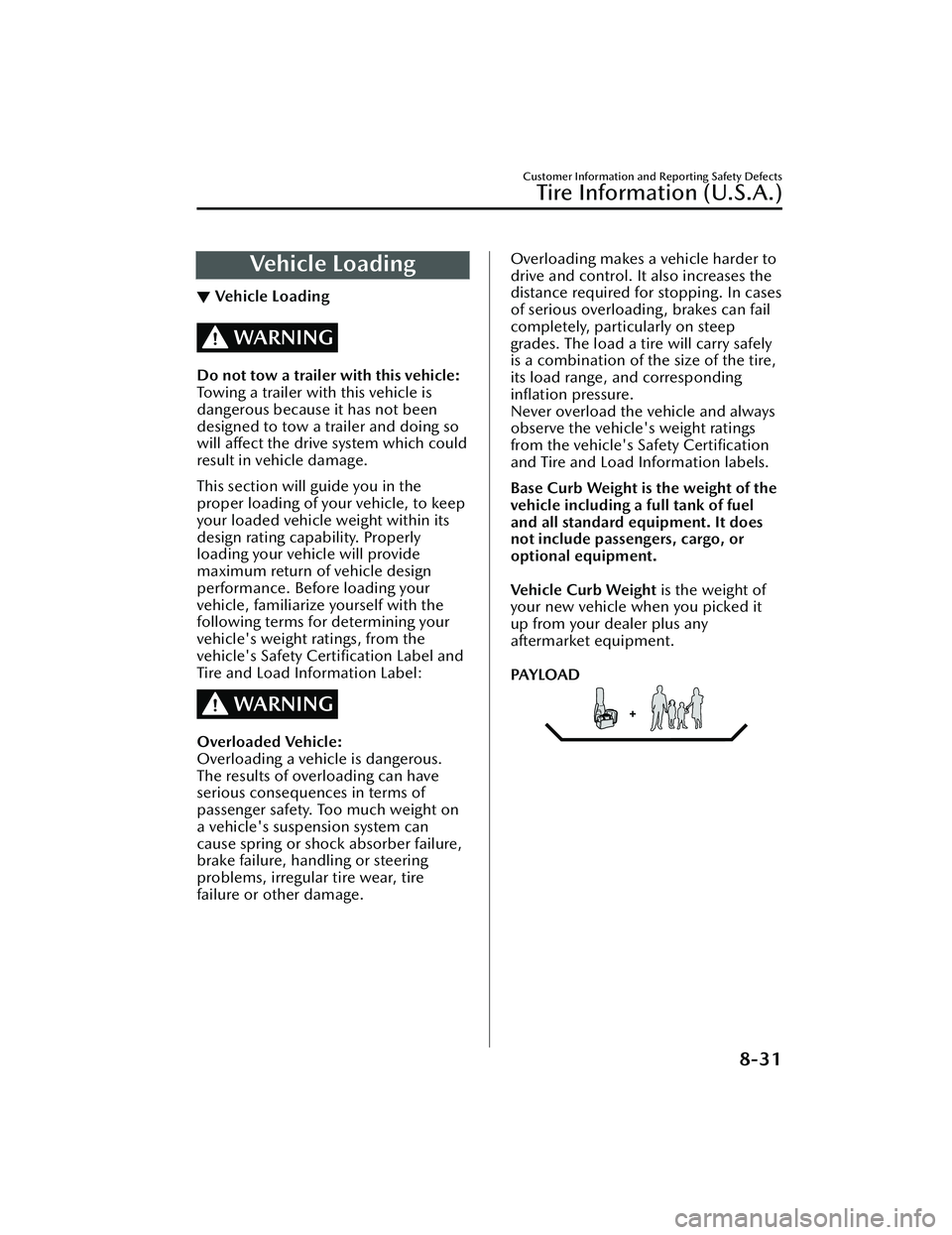
PAY LOA D
Customer Information and Reporting Safety Defects
Tire Information (U.S.A.)
8-31
Mazda3_8LC2-EA-22G_Edition1_new 2022-5-20 11:26:10
Page 588 of 623
GVW (Gross Vehicle Weight) is the
Vehicle Curb Weight + cargo +
passengers.
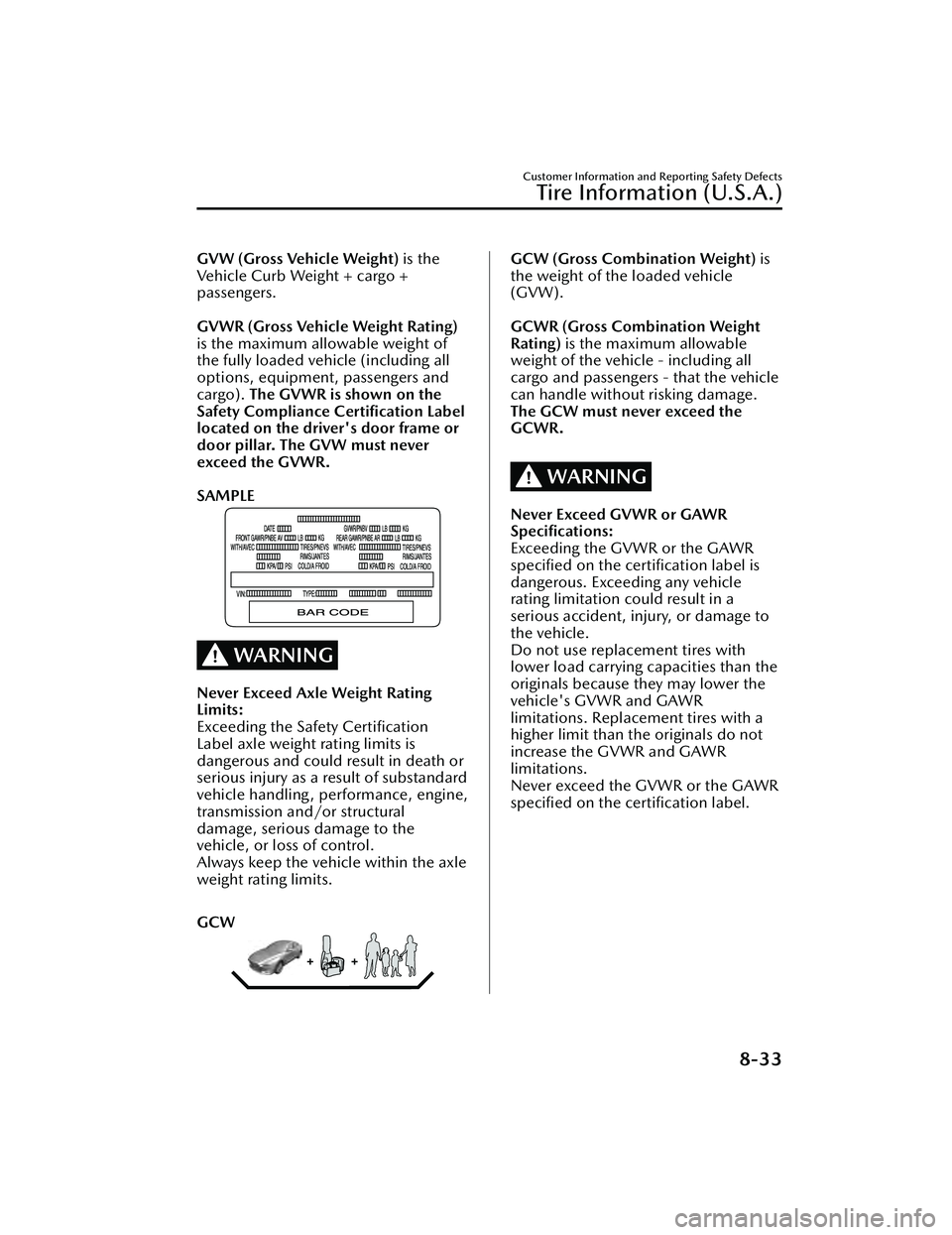
GVWR (Gross Vehicle Weight Rating)
is the maximum allowable weight of
the fully loaded vehicle (including all
options, equipment, passengers and
cargo). The GVWR is shown on the
Safety Compliance Certification Label
located on the driver's door frame or
door pillar. The GVW must never
exceed the GVWR.
SAMPLE
WARNING
Never Exceed Axle Weight Rating
Limits:
Exceeding the Safety Certification
Label axle weight rating limits is
dangerous and could result in death or
serious injury as a result of substandard
vehicle handling, performance, engine,
transmission and/or structural
damage, serious damage to the
vehicle, or loss of control.
Always keep the vehicle within the axle
weight rating limits.
GCW
GCW (Gross Combination Weight) is
the weight of the loaded vehicle
(GVW).
GCWR (Gross Combination Weight
Rating) is the maximum allowable
weight of the vehicle - including all
cargo and passengers - that the vehicle
can handle without risking damage.
The GCW must never exceed the
GCWR.
WARNING
Never Exceed GVWR or GAWR
Specifications:
Exceeding the GVWR or the GAWR
specified on the certification label is
dangerous. Exceeding any vehicle
rating limitation could result in a
serious accident, injury, or damage to
the vehicle.
Do not use replacement tires with
lower load carrying capacities than the
originals because they may lower the
vehicle's GVWR and GAWR
limitations. Replacement tires with a
higher limit than th e originals do not
increase the GVWR and GAWR
limitations.
Never exceed the GVWR or the GAWR
specified on the certification label.
Customer Information and Reporting Safety Defects
Tire Information (U.S.A.)
8-33
Mazda3_8LC2-EA-22G_Edition1_new 2022-5-20 11:26:10
Page 615 of 623
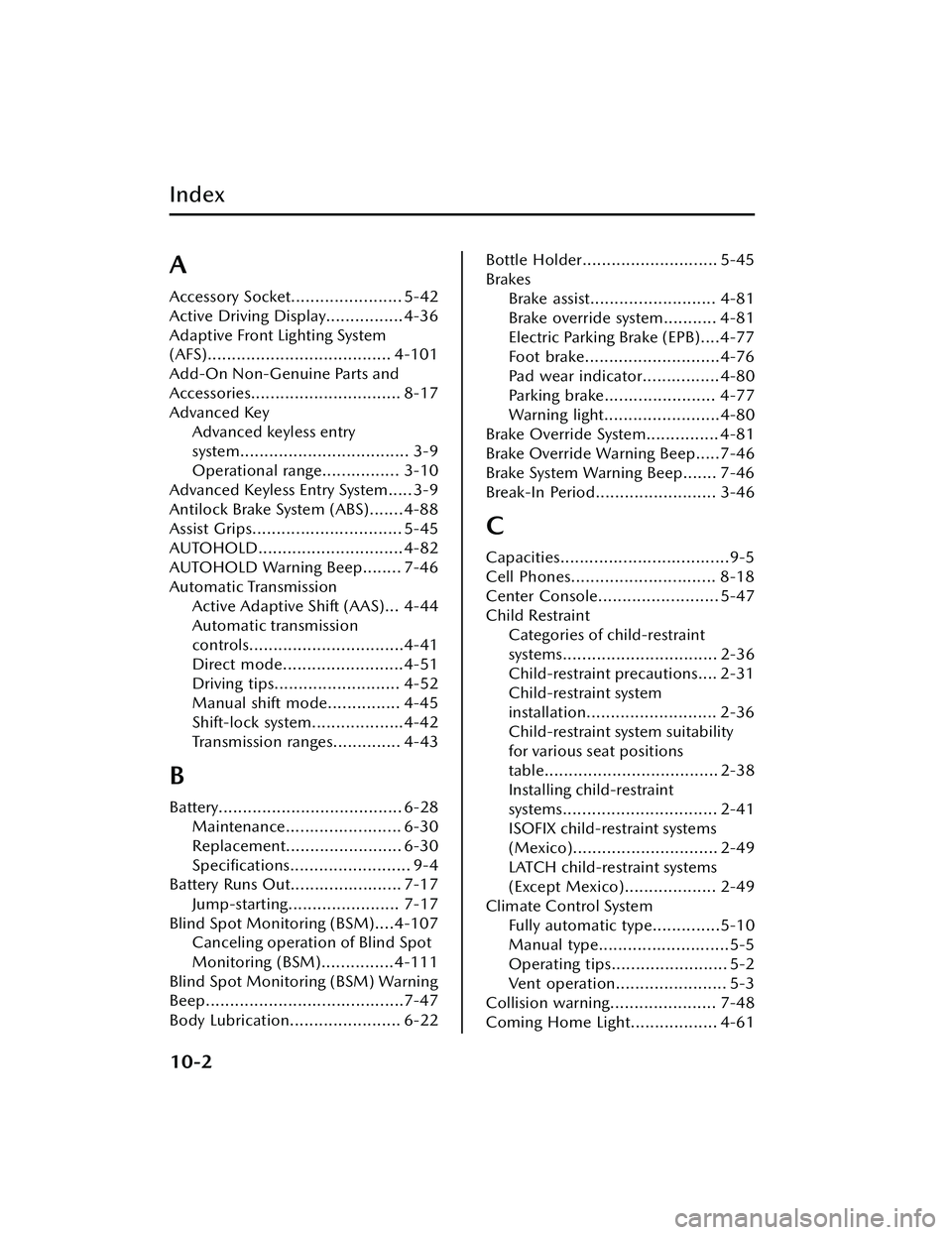
Index
A
Accessory Socket....................... 5-42
Active Driving Display................4-36
Adaptive Front Lighting System
(AFS)...................................... 4-101
Add-On Non-Genuine Parts and
Accessories............................... 8-17
Advanced KeyAdvanced keyless entry
system................................... 3-9
Operational range................ 3-10
Advanced Keyless Entry System..... 3-9
Antilock Brake System (ABS).......4-88
Assist Grips............................... 5-45
AUTOHOLD.............................. 4-82
AUTOHOLD Warning Beep........ 7-46
Automatic Transmission Active Adaptive Shift (AAS)... 4-44
Automatic transmission
controls................................4-41
Direct mode.........................4-51
Driving tips.......................... 4-52
Manual shift mode............... 4-45
Shift-lock system...................4-42
Transmission ranges.............. 4-43
B
Battery...................................... 6-28Maintenance........................ 6-30
Replacement........................ 6-30
Specifications......................... 9-4
Battery Runs Out....................... 7-17
Jump-starting....................... 7-17
Blind Spot Monitoring (BSM)....4-107 Canceling operation of Blind Spot
Monitoring (BSM)...............4-111
Blind Spot Monitoring (BSM) Warning
Beep.........................................7-47
Body Lubrication....................... 6-22
Bottle Holder............................ 5-45
Brakes Brake assist.......................... 4-81
Brake override system........... 4-81
Electric Parking Brake (EPB)....4-77
Foot brake............................4-76
Pad wear indicator................4-80
Parking brake....................... 4-77
Warning light........................4-80
Brake Override System............... 4-81
Brake Override Warning Beep.....7-46
Brake System Warning Beep....... 7-46
Break-In Period......................... 3-46
C
Capacities...................................9-5
Cell Phones.............................. 8-18
Center Console......................... 5-47
Child Restraint Categories of child-restraint
systems................................ 2-36
Child-restraint precautions.... 2-31
Child-restraint system
installation........................... 2-36
Child-restraint system suitability
for various seat positions
table.................................... 2-38
Installing child-restraint
systems................................ 2-41
ISOFIX child-restraint systems
(Mexico).............................. 2-49
LATCH child-restraint systems
(Except Mexico)................... 2-49
Climate Control System Fully automatic type..............5-10
Manual type...........................5-5
Operating tips........................ 5-2
Vent operation....................... 5-3
Collision warning...................... 7-48
Coming Home Light.................. 4-61
10-2
Mazda3_8LC2-EA-22G_Edition1_new 2022-5-20 11:26:10
Page 616 of 623
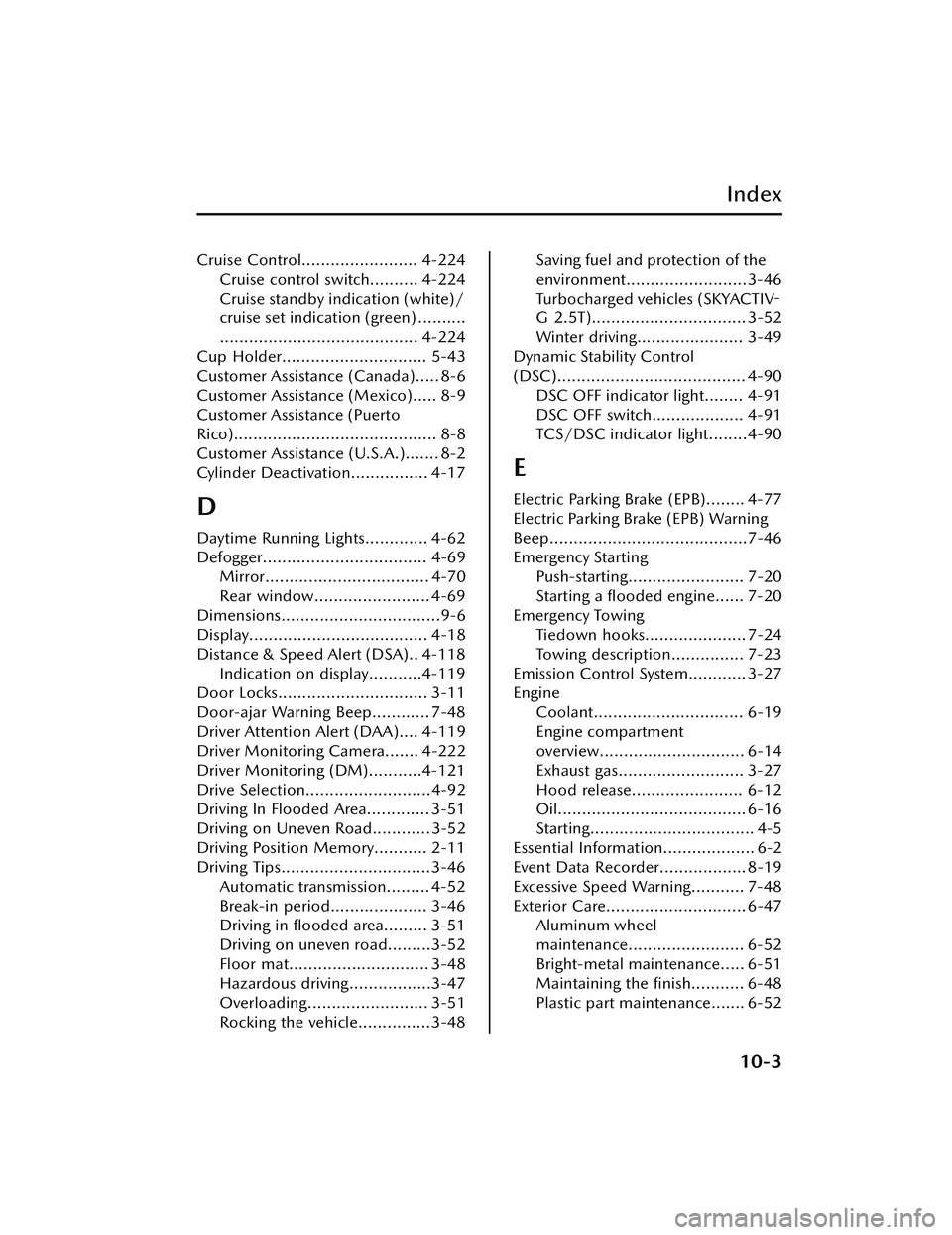
Index
Cruise Control........................ 4-224Cruise control switch.......... 4-224
Cruise standby indication (white)/
cruise set indication (green) ..........
......................................... 4-224
Cup Holder.............................. 5-43
Customer Assistance (Canada)..... 8-6
Customer Assistance (Mexico)..... 8-9
Customer Assistance (Puerto
Rico).......................................... 8-8
Customer Assistance (U.S.A.)....... 8-2
Cylinder Deactivation................ 4-17
D
Daytime Running Lights............. 4-62
Defogger.................................. 4-69 Mirror.................................. 4-70
Rear window........................ 4-69
Dimensions.................................9-6
Display..................................... 4-18
Distance & Speed Alert (DSA).. 4-118 Indication on display...........4-119
Door Locks............................... 3-11
Door-ajar Warning Beep............ 7-48
Driver Attention Alert (DAA).... 4-119
Driver Monitoring Camera....... 4-222
Driver Monitoring (DM)...........4-121
Drive Selection..........................4-92
Driving In Flooded Area............. 3-51
Driving on Uneven Road............ 3-52
Driving Position Memory........... 2-11
Driving Tips...............................3-46 Automatic transmission......... 4-52
Break-in period.................... 3-46
Driving in flooded area......... 3-51
Driving on uneven road.........3-52
Floor mat............................. 3-48
Hazardous driving.................3-47
Overloading......................... 3-51
Rocking the vehicle...............3-48
Saving fuel and protection of the
environment.........................3-46
Turbocharged vehicles (SKYACTIV-
G 2.5T)................................ 3-52
Winter driving...................... 3-49
Dynamic Stability Control
(DSC)....................................... 4-90 DSC OFF indicator light........ 4-91
DSC OFF switch................... 4-91
TCS/DSC indicator light........4-90
E
Electric Parking Brake (EPB)........ 4-77
Electric Parking Brake (EPB) Warning
Beep.........................................7-46
Emergency StartingPush-starting........................ 7-20
Starting a flooded engine...... 7-20
Emergency Towing Tiedown hooks..................... 7-24
Towing description............... 7-23
Emission Control System............ 3-27
Engine Coolant............................... 6-19
Engine compartment
overview.............................. 6-14
Exhaust gas.......................... 3-27
Hood release....................... 6-12
Oil....................................... 6-16
Starting.................................. 4-5
Essential Information................... 6-2
Event Data Recorder.................. 8-19
Excessive Speed Warning........... 7-48
Exterior Care............................. 6-47 Aluminum wheel
maintenance........................ 6-52
Bright-metal maintenance..... 6-51
Maintaining the finish........... 6-48
Plastic part maintenance....... 6-52
10-3
Mazda3_8LC2-EA-22G_Edition1_new 2022-5-20 11:26:10