steering wheel MAZDA MODEL 2 2012 User Guide
[x] Cancel search | Manufacturer: MAZDA, Model Year: 2012, Model line: MODEL 2, Model: MAZDA MODEL 2 2012Pages: 346, PDF Size: 3.93 MB
Page 102 of 346

Black plate (102,1)
Break-In Period
No special break-in is necessary, but a few
precautions in the first 1,000 km (600
miles) may add to the performance,
economy, and life of your Mazda.
lDo not race the engine.lDo not maintain one constant speed,
either slow or fast, for a long period of
time.
lDo not drive constantly at full-throttle
or high engine rpm for extended
periods of time.
lAvoid unnecessary hard stops.lAvoid full-throttle starts.
Money-Saving Suggestions
How you operate your Mazda determines
how far it will travel on a tank of fuel. Use
these suggestions to help save money on
fuel and repairs.
lAvoid long warm-ups. Once the engine
runs smoothly, begin driving.
lAvoid fast starts.lKeep the engine tuned. Follow the
maintenance schedule (page 8-3) and
have an Authorized Mazda Dealer
perform inspections and servicing.
lUse the air conditioner only when
necessary.
lSlow down on rough roads.lKeep the tires properly inflated.lDo not carry unnecessary weight.lDo not rest your foot on the brake
pedal while driving.
lKeep the wheels in correct alignment.lKeep windows closed at high speeds.lSlow down when driving in crosswinds
and headwinds.
WARNING
Never stop the engine when going
down a hill:Stopping the engine when going
down a hill is dangerous. This causes
the loss of power steering and power
brake control, and may cause
damage to the drivetrain. Any loss of
steering or braking control could
cause an accident.
4-6
Before Driving Your Mazda
Driving Tips
Mazda2_8CC7-EA-11H_Edition2 Page102
Monday, September 26 2011 1:54 PM
Form No.8CC7-EA-11H
Page 110 of 346

Black plate (110,1)
Ignition Switch
qIgnition Switch Positions
OFF/LOCK
The engraved mark on the actual vehicle
may read OFF or LOCK depending on the
type of ignition system.
OFF/LOCK
The power supply to electrical devices is
turned off. Only in this position can the
key be removed.
WARNING
Remove the key only when the vehicle
is parked (with steering lock
mechanism):
Removing the key from the ignition
switch while the vehicle is moving is
dangerous. Removing the key allows
the steering wheel to lock. You will
lose steering control and a serious
accident could occur.
Before leaving the driver's seat, always
switch the ignition to OFF/LOCK, set the
parking brake and make sure the shift
lever is in P (automatic transaxle) or in
1st gear or R (manual transaxle): It is important to switch the ignition
to OFF/LOCK even if you are not
removing the key from the ignition or
leaving the vehicle. Leaving the key
in other positions will disable some of
the vehicle security systems and run
the battery down.
Leaving the driver's seat without
switching the ignition to OFF/LOCK,
setting the parking brake and
shifting the shift lever to P
(automatic transaxle) or to 1st gear
or R (manual transaxle) is dangerous.
Unexpected vehicle movement could
occur. This could cause an accident.
NOTE
If turning the key is difficult, move the steering
wheel left and right.
Leaving the key in any position but the OFF/
LOCK position also disables some of the
security features and may run the battery
down.
ACC (Accessory)
In this position, some electrical
accessories will operate.
5-2
Driving Your Mazda
Starting and Driving
Mazda2_8CC7-EA-11H_Edition2 Page110
Monday, September 26 2011 1:54 PM
Form No.8CC7-EA-11H
Page 124 of 346

Black plate (124,1)
NOTElThe power steering system is inoperable
when the power steering malfunction
indicator light illuminates or flashes.
Steering is possible, but requires more
physical effort.
lRepeatedly jerking the steering wheel left
and right while the vehicle is stopped or
moving at slow speeds will cause the power
steering system to go into protective mode
which will make the steering feel heavy, but
this does not indicate a malfunction. If this
occurs, park the vehicle safely and wait a
few minutes for the system to return to
normal.
Cruise Controlí
With cruise control, you can set and
automatically maintain any speed of more
than about 30 km/h (19 mph).
WARNING
Do not use the cruise control under the
following conditions:Using the cruise control under the
following conditions is dangerous
and could result in loss of vehicle
control.
ØHilly terrain
Ø Steep inclines
Ø Heavy or unsteady traffic
Ø Slippery or winding roads
Ø Similar restrictions that require
inconsistent speed
qCruise Main Indicator Light
(Amber)/Cruise Set Indicator
Light (Green)
The indicator light has two colors.
Cruise Main Indicator Light (Amber)
The indicator light illuminates amber
when the ON switch is pressed and the
cruise control system is activated.
Cruise Set Indicator Light (Green)
The indicator light illuminates green when
a cruising speed has been set.
5-16
Driving Your Mazda
íSome models.
Starting and Driving
Mazda2_8CC7-EA-11H_Edition2 Page124
Monday, September 26 2011 1:54 PM
Form No.8CC7-EA-11H
Page 155 of 346

Black plate (155,1)
If the light stays on when the TCS/DSC is
not switched off, take your vehicle to an
Authorized Mazda Dealer. The dynamic
stability control may have a malfunction.
qCruise Main Indicator Light
(Amber)/Cruise Set Indicator
Light (Green)
í
The indicator light has two colors.
Cruise Main Indicator Light (Amber)
The indicator light illuminates amber
when the ON switch is pressed and the
cruise control system is activated.
Cruise Set Indicator Light (Green)
The indicator light illuminates green when
a cruising speed has been set.
qPower Steering Malfunction
Indicator Light
This indicator light illuminates or flashes
when the ignition is switched ON, and
turns off when the engine is started. If the light remains illuminated or flashing
after the engine is started, or illuminates
while driving, turn off the engine after
parking in a safe place, and then start the
engine again.
If the light does not illuminate after
restarting the engine, this indicates that
the power steering is restored and normal
steering is possible.
If the light remains illuminated, the power
steering is still inoperable. Consult an
Authorized Mazda Dealer.
NOTE
lThe power steering system is inoperable
when the power steering malfunction
indicator light illuminates or flashes.
Steering is possible, but requires more
physical effort.
lRepeatedly jerking the steering wheel left
and right while the vehicle is stopped or
moving at slow speeds will cause the power
steering system to go into protective mode
which will make the steering feel heavy, but
this does not indicate a malfunction. If this
occurs, park the vehicle safely and wait a
few minutes for the system to return to
normal.
q
Turn Signal/Hazard Warning
Indicator Lights
When operating the turn signal lights, the
left or right turn signal indicator light
flashes to indicate which turn signal light
is operating (page 5-53).
Driving Your Mazda
Warning/Indicator Lights and Beep Sounds
5-47íSome models.
Mazda2_8CC7-EA-11H_Edition2 Page155
Monday, September 26 2011 1:54 PM
Form No.8CC7-EA-11H
Page 167 of 346

Black plate (167,1)
Horn
To sound the horn, press themark on
the steering wheel.
Hazard Warning Flasher
The hazard warning lights should always
be used when you stop on or near a
roadway in an emergency.
The hazard warning lights warn other
drivers that your vehicle is a traffic hazard
and that they must take extreme caution
when near it.
Depress the hazard warning flasher and all
the turn signals will flash.
NOTE
lThe turn signals do not work when the
hazard warning lights are on.
lCheck local regulations about the use of
hazard warning lights while the vehicle is
being towed to verify that it is not in
violation of the law.
Driving Your Mazda
Switches and Controls
5-59
Mazda2_8CC7-EA-11H_Edition2 Page167
Monday, September 26 2011 1:55 PM
Form No.8CC7-EA-11H
Page 178 of 346

Black plate (178,1)
Operating Tips for Audio
System
WARNING
Do not adjust the audio control
switches while driving the vehicle:Adjusting the audio while driving the
vehicle is dangerous as it could
distract your attention from the
vehicle operation which could lead to
a serious accident. Always adjust the
audio while the vehicle is stopped.
Even if the audio control switches are
equipped on the steering wheel, learn
to use the switches without looking
down at them so that you can keep
your maximum attention on the road
while driving the vehicle.
CAUTION
For the purposes of safe driving,
adjust the audio volume to a level
that allows you to hear sounds
outside of the vehicle including car
horns and particularly emergency
vehicle sirens.
NOTE
lTo prevent the battery from being
discharged, do not leave the audio system
on for a long period of time when the
engine is not running.
lIf a cellular phone or CB radio is used in
or near the vehicle, it could cause noise to
occur from the audio system, however, this
does not indicate that the system has been
damaged.
q Radio Reception
AM characteristics
AM signals bend around such things as
buildings or mountains and bounce off the
ionosphere. Therefore, they can reach
longer distances than FM signals. Because
of this, two stations may sometimes be
picked up on the same frequency at the
same time.
Station 2
Station 1 Ionosphere
FM characteristics
An FM broadcast range is usually about
40
―50 km (25 ―30 miles) from the
source. Because of extra coding needed to
break the sound into two channels, stereo
FM has even less range than monaural
(non-stereo) FM.
FM Station
40—50km
(25—30 miles)
6-10
Interior Comfort
Audio System
Mazda2_8CC7-EA-11H_Edition2 Page178
Monday, September 26 2011 1:55 PM
Form No.8CC7-EA-11H
Page 201 of 346

Black plate (201,1)
Audio Control Switch
Operation
í
When the audio unit is turned on,
operation of the audio unit from the
steering wheel is possible.
NOTE
Because the audio unit will be turned off under
the following conditions, the switches will be
inoperable.
lWhen the ignition is switched off.lWhen the power button on the audio unit is
pressed and the audio unit is turned off.
lWhen the CD being played is ejected and
the audio unit is turned off.
qAdjusting the Volume
To increase the volume, press up the
volume switch.
To decrease the volume, press down the
volume switch.
qChanging the Source
Press the mode switch () to change
the audio source (FM1 radio →FM2
radio →AM radio →CD player →AUX
→ cyclical).
Interior Comfort
Audio System
6-33íSome models.
Mazda2_8CC7-EA-11H_Edition2 Page201
Monday, September 26 2011 1:55 PM
Form No.8CC7-EA-11H
Page 204 of 346
Black plate (204,1)
NOTElBefore using the auxiliary jack, read the
manufacturer's instructions for the product
being connected.
lUse a commercially-available, non-
impedance (3.5
) stereo mini plug for
connecting the portable audio unit to the
auxiliary jack. Before using the auxiliary
jack, read the manufacturer's instructions
for connecting a portable audio unit to the
auxiliary jack.
lTo prevent discharging of the battery, do
not use the auxiliary input for long periods
with the engine off or idling.
lNoise may occur depending on the product
connected to the auxiliary jack.
lWith regard to connecting a portable audio
or similar device to a power source, use the
battery for the device, not the accessory
socket.
lInsert the plug to the auxiliary jack
securely.
lInsert or remove the plug with the plug
perpendicular to the auxiliary jack hole.
lInsert or remove the plug by holding its
base.
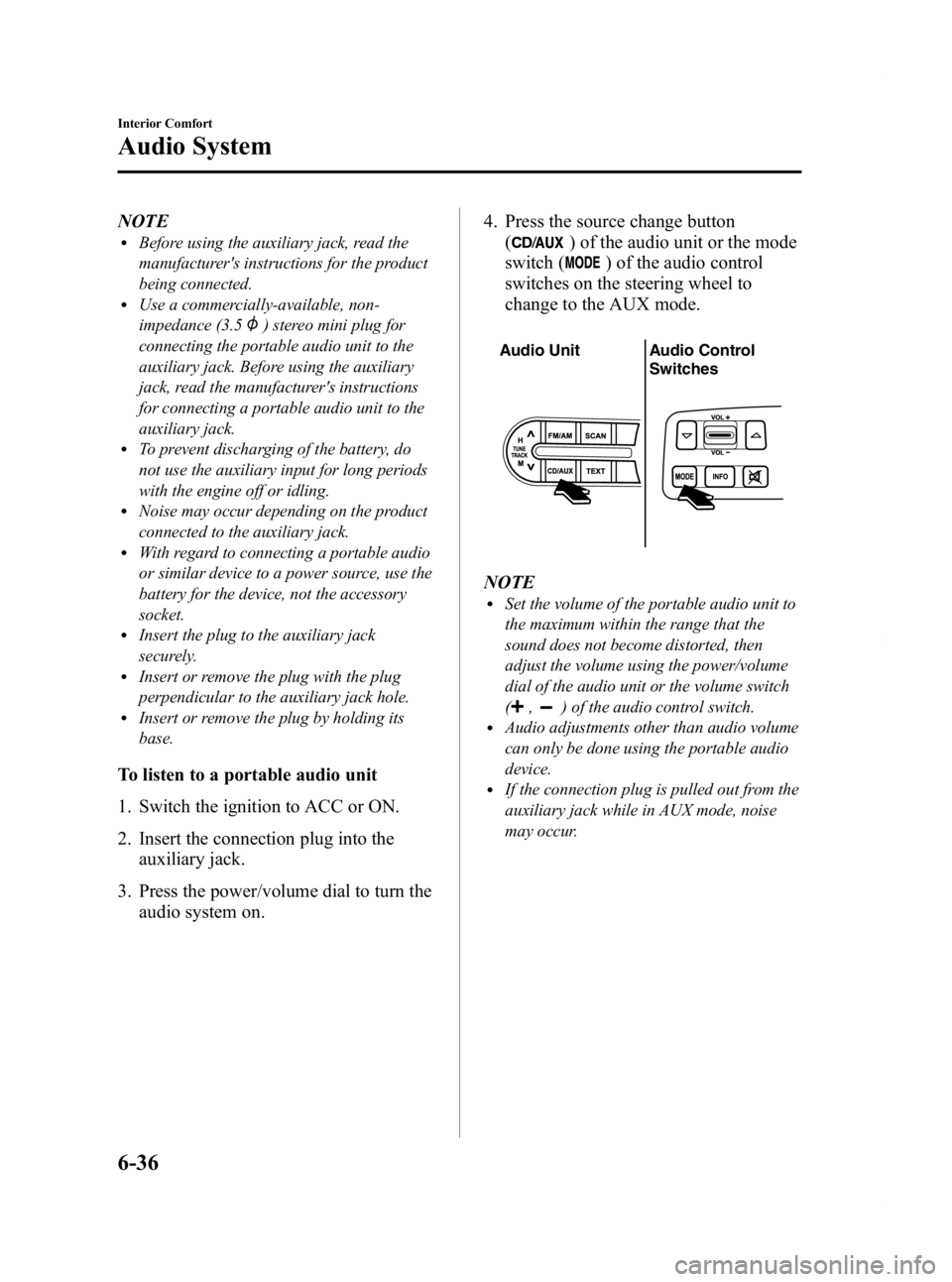
To listen to a portable audio unit
1. Switch the ignition to ACC or ON.
2. Insert the connection plug into the auxiliary jack.
3. Press the power/volume dial to turn the audio system on. 4. Press the source change button
(
) of the audio unit or the mode
switch (
) of the audio control
switches on the steering wheel to
change to the AUX mode.
Audio Unit Audio Control
Switches
NOTElSet the volume of the portable audio unit to
the maximum within the range that the
sound does not become distorted, then
adjust the volume using the power/volume
dial of the audio unit or the volume switch
(
,) of the audio control switch.lAudio adjustments other than audio volume
can only be done using the portable audio
device.
lIf the connection plug is pulled out from the
auxiliary jack while in AUX mode, noise
may occur.
6-36
Interior Comfort
Audio System
Mazda2_8CC7-EA-11H_Edition2 Page204
Monday, September 26 2011 1:55 PM
Form No.8CC7-EA-11H
Page 216 of 346

Black plate (216,1)
To remove the spare tire
1. Remove the trunk mat.
Trunk mat
2. Turn the tire hold-down boltcounterclockwise using the lug wrench.
To secure the spare tire
Perform the removal procedure in reverse.
Changing a Flat Tire
NOTE
If the following occurs while driving, it could
indicate a flat tire.
lSteering becomes difficult.lThe vehicle begins to vibrate excessively.lThe vehicle pulls in one direction.
If you have a flat tire, drive slowly to a
level spot that is well off the road and out
of the way of traffic to change the tire.
Stopping in traffic or on the shoulder of a
busy road is dangerous.
WARNING
Be sure to follow the directions for
changing a tire: Changing a tire is dangerous if not
done properly. The vehicle can slip off
the jack and seriously injure
someone. No person should place
any portion of their body under a
vehicle that is supported by a jack.
Never allow anyone inside a vehicle
supported by a jack: Allowing someone to remain in a
vehicle supported by a jack is
dangerous. The occupant could cause
the vehicle to fall resulting in serious
injury.
CAUTION
(With Tire Pressure Monitoring
System)
The wheels equipped on your Mazda
are specially designed for installation
of the tire pressure sensors. Do not
use non-genuine wheels, otherwise it
may not be possible to install the tire
pressure sensors.
7-6
In Case of an Emergency
Flat Tire
Mazda2_8CC7-EA-11H_Edition2 Page216
Monday, September 26 2011 1:55 PM
Form No.8CC7-EA-11H
Page 238 of 346

Black plate (238,1)
qSchedule 1
Maintenance Interval Number of months or kilometers (miles), whichever comes first
Months 6 12 18 24 30 36 42 48
×1000 km 12 24 36 48 60 72 84 96
×1000 miles 7.5 15 22.5 30 37.5 45 52.5 60
ENGINE
Engine valve clearance Audibly inspect every 120,000 km (75,000 miles), if noisy,
adjust
Drive belts I
Engine oil RRRRRRRR
Engine oil filter RRRRRRRR
COOLING SYSTEM
Engine coolant FL22 type
*1Replace at first 192,000 km (120,000 miles) or 10 years; after
that, every 96,000 km (60,000 miles) or 5 years
Others Replace at first 96,000 km (60,000 miles) or 4 years; after that,
every 2 years
FUEL SYSTEM
Air filter CC R C
Fuel lines and hoses
*2II
Hoses and tubes for emission*2I
IGNITION SYSTEM
Spark plugs Replace every 120,000 km (75,000 miles)
CHASSIS and BODY
Brake lines, hoses and connections I I
Disc brakes IIII
Drum brakes I I
Tire (Rotation) Rotate every 12,000 km (7,500 miles)
Steering operation and linkages I I
Front and rear suspension, ball joints and wheel
bearing axial play II
Driveshaft dust boots I I
Bolts and nuts on chassis and body T T
Exhaust system and heat shields Inspect every 72,000 km (45,000 miles) or 5 years
All locks and hinges LLLLLLLL
8-4
Maintenance and Care
Scheduled Maintenance
Mazda2_8CC7-EA-11H_Edition2 Page238
Monday, September 26 2011 1:55 PM
Form No.8CC7-EA-11H