mount MAZDA MODEL 3 4-DOOR 2006 Owner's Manual
[x] Cancel search | Manufacturer: MAZDA, Model Year: 2006, Model line: MODEL 3 4-DOOR, Model: MAZDA MODEL 3 4-DOOR 2006Pages: 372, PDF Size: 4.12 MB
Page 337 of 372

Black plate (337,1)
H
“H ”is the speed rating. The speed rating denotes the maximum speed for which the use of
the tire is rated.
Letter Rating Speed Rating
Q 99 mph
R 106 mph
S 112 mph
T 118 mph
U 124 mph
H 130 mph
V 149 mph
W 168
*mph
Y 186*mph
* For tires with a maximum speed capability over 149 mph, tire manufacturers sometimes use the letters ZR. For tires with a maximum speed capability over 186 mph, tire manufacturers always use the letters ZR.
M+S or M/S: Mud and Snow
AT: All Terrain.
AS: All Season. The “M+S ”or “M/S ”indicates that the tire has some functional use in
mud and snow.
U.S. DOT Tire Identification Number (TIN)
This begins with the letters “DOT ”which indicates the tire meets all federal standards. The
next two numbers or letters are the plant code where it was manufactured, and the last four
numbers represent the week and year the tire was manufactured. For example, the numbers
457 means the 45st week of 1997. After 2000 the numbers go to four digits. For example,
the number 2102 means the 21th week of 2002. The other numbers are marketing codes
used at the manufacturer's discretion. This information is used to contact consumers if a tire
defect requires a recall.
Tire Ply Composition and Materials Used
The number of plies indicates the number of layers of rubber-coated fabric in the tire. In
general, the greater the number of plies, the more weight a tire can support. Tire
manufacturers also must indicate the tire materials, which include steel, nylon, polyester,
and other.
Maximum Load Rating
This number indicates the maximum load in kilograms and pounds that can be carried by
the tire.
Maximum Permissible Inflation Pressure
This number is the greatest amount of air pressure that should ever be put in the tire under
normal driving conditions.
Customer Information and Reporting Safety Defects
Tire Information (U.S.A.)
9-23
Mazda3_8U55-EA-05G_Edition3 Page337
Tuesday, September 13 2005 10:45 AM
Form No.8U55-EA-05G
Page 338 of 372

Black plate (338,1)
Tread Wear, Traction and Temperature Grades
Tread wear:The tread wear grade is a comparative rating based on the wear rate of the tire
when tested under controlled conditions on a specified government test course. For
example, a tire graded 150 would wear one and one-half (1 1/2) times as well on the
government course as a tire graded 100.
Traction: The traction grades, from highest to lowest are AA, A, B, and C. The grades
represent the tire's ability to stop on wet pavement as measured under controlled conditions
on specified government test surfaces of asphalt and concrete. A tire marked C may have
poor traction performance.
Temperature: The temperature grades are A (the highest), B and C, representing the tire's
resistance to the generation of heat and its ability to dissipate heat when tested under
controlled conditions on a specified indoor laboratory test wheel.
Snow Tires
In some heavy snow areas, local governments may require true snow tires, those with very
deeply cut tread. These tires should only be used in pairs or placed on all four wheels.
Make sure you purchase snow tires that are the same size and construction type as the other
tires on your vehicle.
SAFETY WARNING
The following safety warning appears on the tire's sidewall.
SERIOUS INJURY MAY RESULT FROM:
lEXPLOSION OF TIRE/RIM ASSEMBLY DUE TO IMPROPER MOUNTING-
MATCH TIRE DIAMETER TO RIM DIAMETER; NEVER EXCEED 40 psi (275 kPa)
TO SEAT BEADS-ONLY SPECIALLY TRAINED PERSONS SHOULD MOUNT
TIRES.
lTIRE FAILURE DUE TO UNDER-INFLATION/OVERLOADING/DAMAGE-
FOLLOW OWNER'S MANUAL AND PLACARD IN VEHICLE-FREQUENTLY
CHECK INFLATION PRESSURE AND INSPECT FOR DAMAGE.
9-24
Customer Information and Reporting Safety Defects
Tire Information (U.S.A.)
Mazda3_8U55-EA-05G_Edition3 Page338
Tuesday, September 13 2005 10:45 AM
Form No.8U55-EA-05G
Page 343 of 372

Black plate (343,1)
NOTE
Warm tires normally exceed recommended pressures. Don't release air from warm tires
to adjust the pressure.
Under-inflation can cause serious failures and accidents.
Over-inflation can produce a harsh ride and the greater possibility of damage from road
hazards.
qGlossary of Terms
Tire Placard: A label indicating the OE tire sizes, recommended inflation pressure, and
the maximum weight the vehicle can carry.
Tire Identification Number (TIN): A number on the sidewall of each tire providing
information about the tire brand and manufacturing plant, tire size, and date of
manufacture.
Inflation Pressure: A measure of the amount of air in a tire.
kPa: Kilopascal, the metric unit for air pressure.
psi: Pounds per square inch, the English unit for air pressure.
B-pillar: The structural member at the side of the vehicle behind the front door.
Original Equipment (OE): Describes components originally equipped on the vehicle.
Vehicle Load Limit: The maximum value of the combined weight of occupants and cargo.
Bead Area of the Tire: Area of the tire next to the rim.
Sidewall Area of the Tire: Area between the bead area and the tread.
Tread Area of the Tire: Area on the perimeter of the tire that contacts the road when it's
mounted on the vehicle.
Seating capacity means the total allowable number of vehicle occupants. Seating capacity
is described on the tire label.
Production options weight is the combined weight of installed regular production options
weighing over 2.3 kilograms in excess of the standard items which they replace, and not
previously considered in the curb weight or accessory weight, including heavy duty brakes,
ride levelers, roof rack, heavy duty battery, and special trim.
Rim is the metal support (wheel) for a tire or a tire and tube assembly upon which the tire
beads are seated.
Customer Information and Reporting Safety Defects
Tire Information (U.S.A.)
9-29
Mazda3_8U55-EA-05G_Edition3 Page343
Tuesday, September 13 2005 10:45 AM
Form No.8U55-EA-05G
Page 352 of 372
Black plate (352,1)
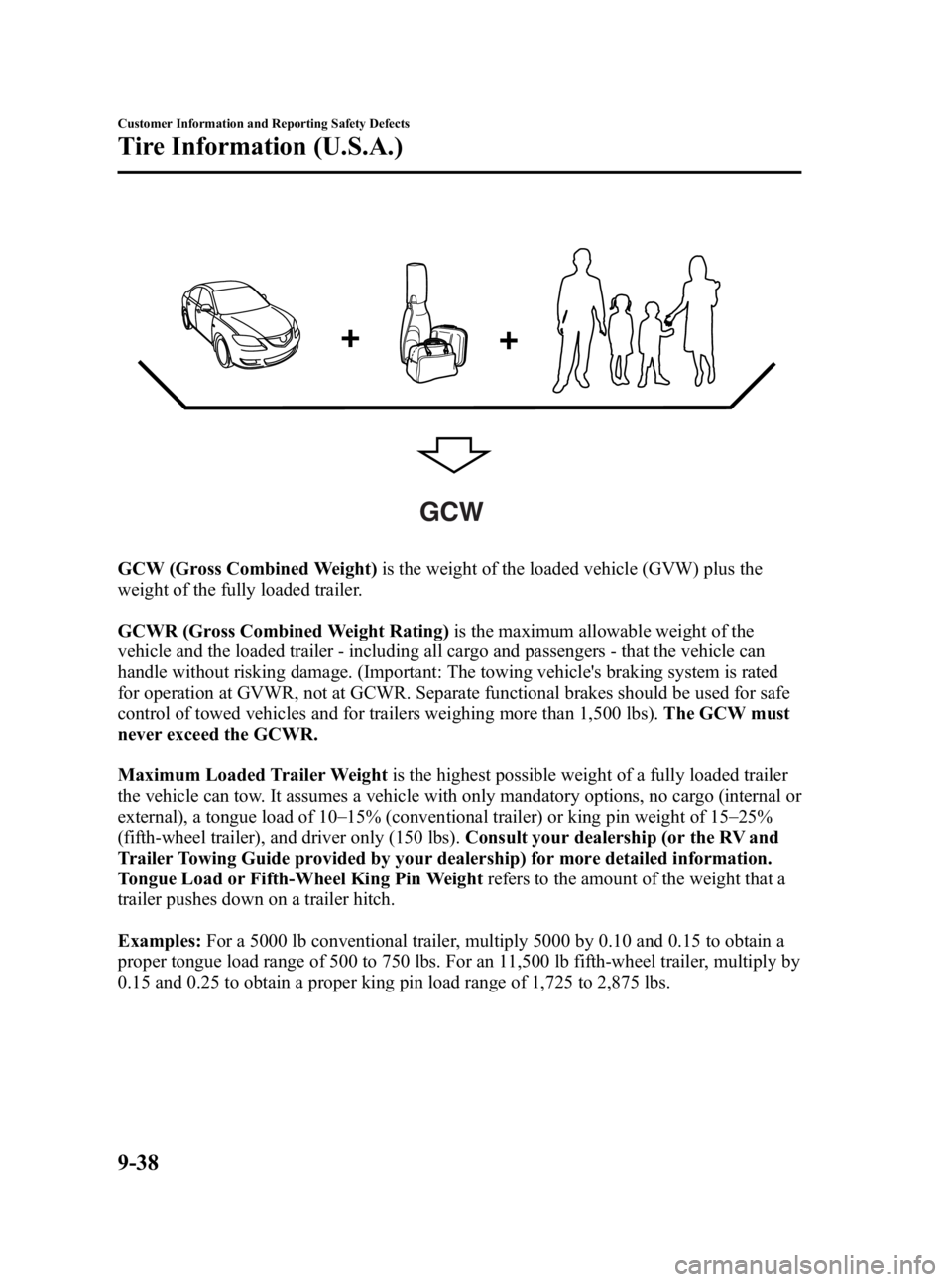
GCW
GCW (Gross Combined Weight)is the weight of the loaded vehicle (GVW) plus the
weight of the fully loaded trailer.
GCWR (Gross Combined Weight Rating) is the maximum allowable weight of the
vehicle and the loaded trailer - including all cargo and passengers - that the vehicle can
handle without risking damage. (Important: The towing vehicle's braking system is rated
for operation at GVWR, not at GCWR. Separate functional brakes should be used for safe
control of towed vehicles and for trailers weighing more than 1,500 lbs). The GCW must
never exceed the GCWR.
Maximum Loaded Trailer Weight is the highest possible weight of a fully loaded trailer
the vehicle can tow. It assumes a vehicle with only mandatory options, no cargo (internal or
external), a tongue load of 10 _
15% (conventional trailer) or king pin weight of 15 _
25%
(fifth-wheel trailer), and driver only (150 lbs). Consult your dealership (or the RV and
Trailer Towing Guide provided by your dealership) for more detailed information.
Tongue Load or Fifth-Wheel King Pin Weight refers to the amount of the weight that a
trailer pushes down on a trailer hitch.
Examples: For a 5000 lb conventional trailer, multiply 5000 by 0.10 and 0.15 to obtain a
proper tongue load range of 500 to 750 lbs. For an 11,500 lb fifth-wheel trailer, multiply by
0.15 and 0.25 to obtain a proper king pin load range of 1,725 to 2,875 lbs.
9-38
Customer Information and Reporting Safety Defects
Tire Information (U.S.A.)
Mazda3_8U55-EA-05G_Edition3 Page352
Tuesday, September 13 2005 10:45 AM
Form No.8U55-EA-05G
Page 354 of 372
Black plate (354,1)
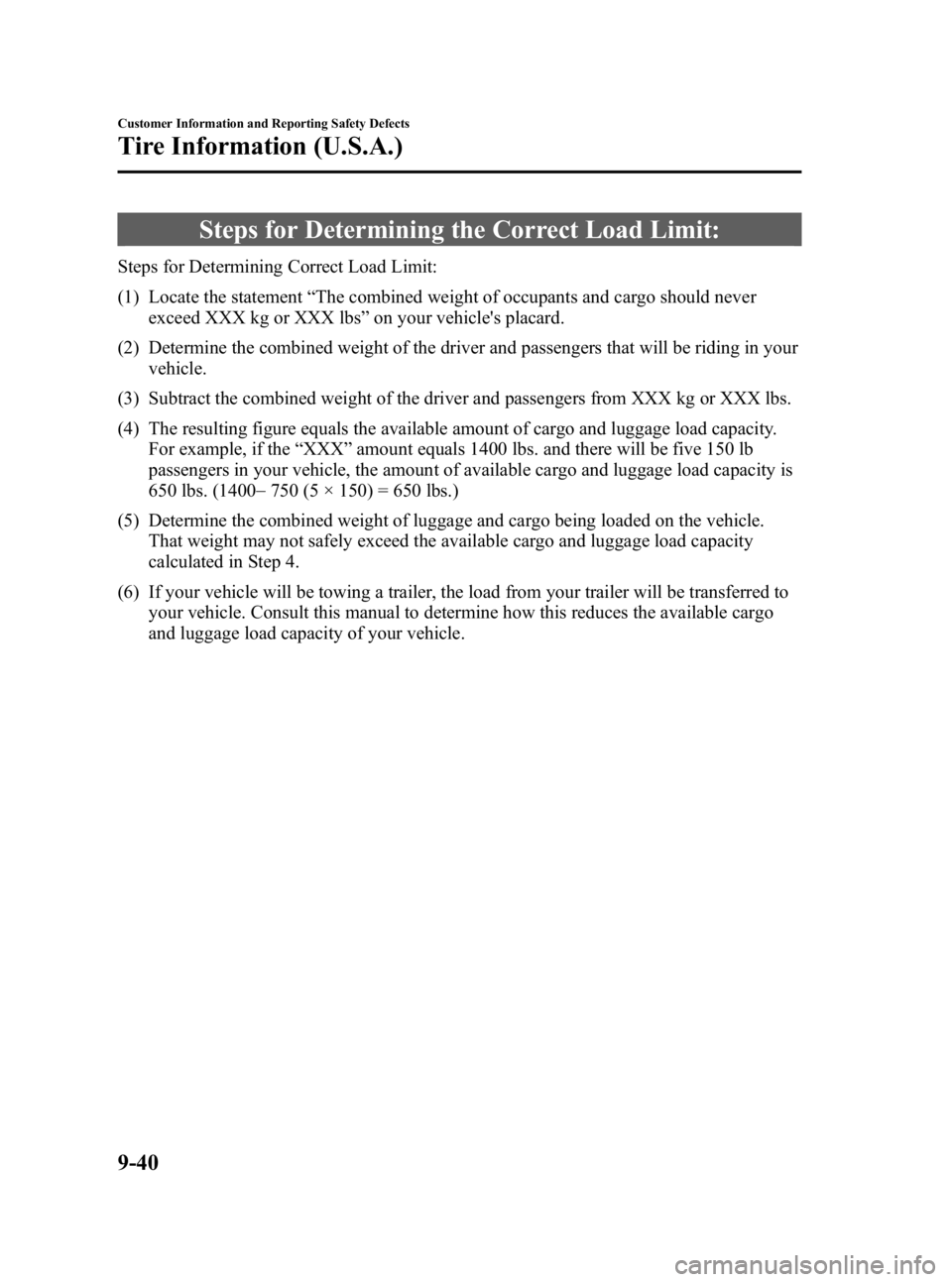
Steps for Determining the Correct Load Limit:
Steps for Determining Correct Load Limit:
(1) Locate the statement“The combined weight of occupants and cargo should never
exceed XXX kg or XXX lbs” on your vehicle's placard.
(2) Determine the combined weight of the driver and passengers that will be riding in your vehicle.
(3) Subtract the combined weight of the driver and passengers from XXX kg or XXX lbs.
(4) The resulting figure equals the available amount of cargo and luggage load capacity. For example, if the “XXX ”amount equals 1400 lbs. and there will be five 150 lb
passengers in your vehicle, the amount of available cargo and luggage load capacity is
650 lbs. (1400 _
750 (5 × 150) = 650 lbs.)
(5) Determine the combined weight of luggage and cargo being loaded on the vehicle. That weight may not safely exceed the available cargo and luggage load capacity
calculated in Step 4.
(6) If your vehicle will be towing a trailer, the load from your trailer will be transferred to your vehicle. Consult this manual to determine how this reduces the available cargo
and luggage load capacity of your vehicle.
9-40
Customer Information and Reporting Safety Defects
Tire Information (U.S.A.)
Mazda3_8U55-EA-05G_Edition3 Page354
Tuesday, September 13 2005 10:45 AM
Form No.8U55-EA-05G
Page 364 of 372
Black plate (364,1)
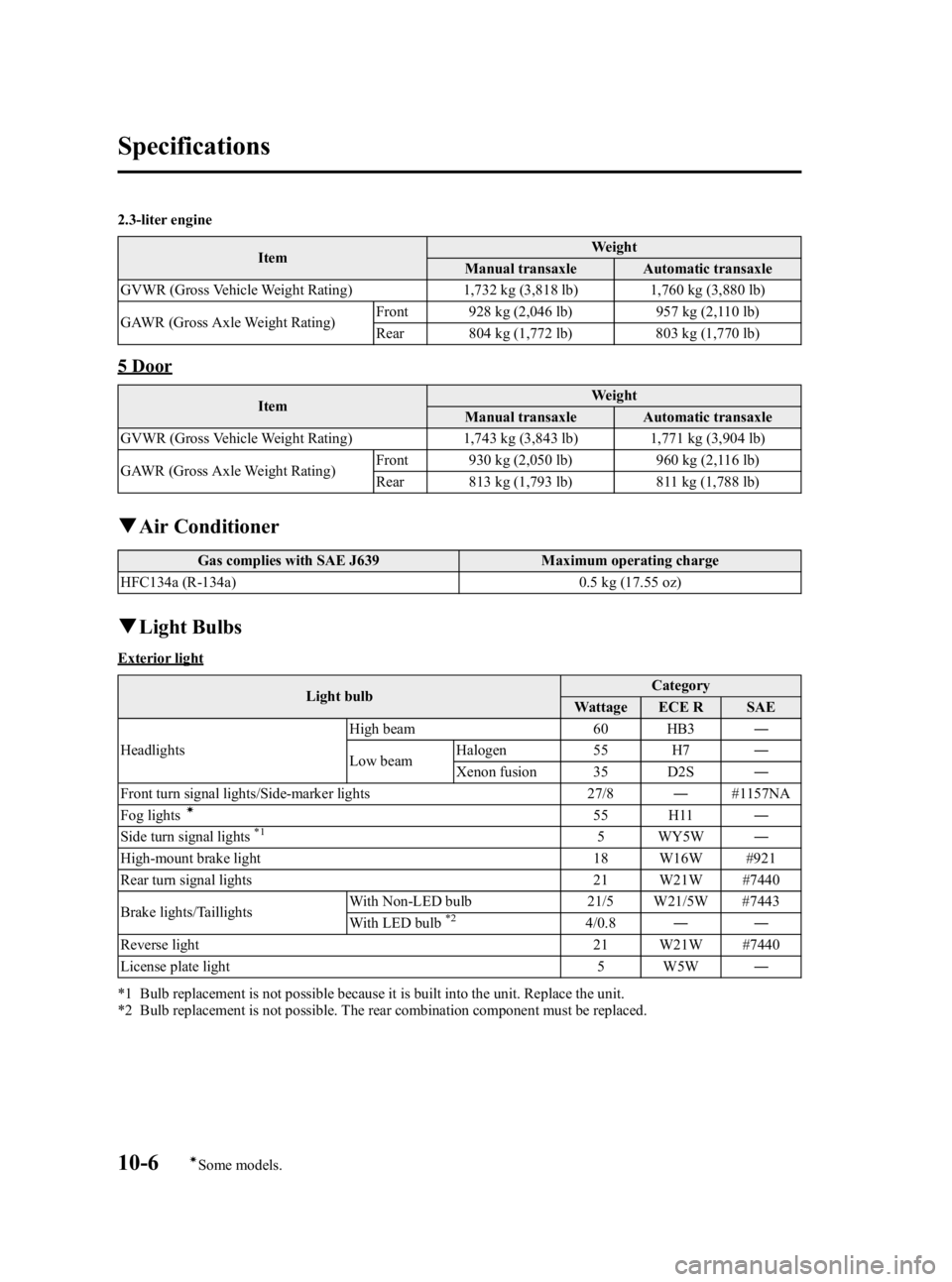
2.3-liter engineItem Weight
Manual transaxle Automatic transaxle
GVWR (Gross Vehicle Weight Rating) 1,732 kg (3,818 lb) 1,760 kg (3,880 lb)
GAWR (Gross Axle Weight Rating) Front 928 kg (2,046 lb) 957 kg (2,110 lb)
Rear 804 kg (1,772 lb) 803 kg (1,770 lb)
5 Door
Item Weight
Manual transaxle Automatic transaxle
GVWR (Gross Vehicle Weight Rating) 1,743 kg (3,843 lb) 1,771 kg (3,904 lb)
GAWR (Gross Axle Weight Rating) Front 930 kg (2,050 lb) 960 kg (2,116 lb)
Rear 813 kg (1,793 lb) 811 kg (1,788 lb)
q
Air Conditioner
Gas complies with SAE J639 Maximum operating charge
HFC134a (R-134a) 0.5 kg (17.55 oz)
qLight Bulbs
Exterior light
Light bulb Category
Wattage ECE R SAE
Headlights High beam 60 HB3
―
Low beam Halogen 55 H7
―
Xenon fusion 35 D2S ―
Front turn signal lights/Side-marker lights 27/8 ―#1157NA
Fog lights
í55 H11 ―
Side turn signal lights*15 WY5W ―
High-mount brake light 18 W16W #921
Rear turn signal lights 21 W21W #7440
Brake lights/Taillights With Non-LED bulb 21/5 W21/5W #7443
With LED bulb
*24/0.8
――
Reverse light 21 W21W #7440
License plate light 5 W5W ―
*1 Bulb replacement is not possible because it is built into the unit. Replace the unit.
*2 Bulb replacement is not possible. The rear combination component must be replaced.
10-6íSome models.
Specifications
Mazda3_8U55-EA-05G_Edition3 Page364
Tuesday, September 13 2005 10:46 AM
Form No.8U55-EA-05G