remove seats MAZDA MODEL 3 4-DOOR 2017 Owners Manual
[x] Cancel search | Manufacturer: MAZDA, Model Year: 2017, Model line: MODEL 3 4-DOOR, Model: MAZDA MODEL 3 4-DOOR 2017Pages: 612
Page 16 of 612
2–2
Essential Safety Equipment
Seats
Seat Precautions
WARNING
Make sure the adjustable components of a seat are locked in place:
Adjustable seats and seatbacks that are not securely locked are dangerous. In a
sudden stop or collision, the seat or seatback could move, causing injury. Make sure the
adjustable components of the seat are locked in place by attempting to slide the seat
forward and backward and rocking the seatback.
Never allow children to adjust a seat: Allowing children to adjust a seat is dangerous as it could result in serious injury if a
child's hands or feet become caught in the seat.
Do not drive with the seatback unlocked: All of the seatbacks play an important role in your protection in a vehicle. Leaving the
seatback unlocked is dangerous as it can allow passengers to be ejected or thrown
around and baggage to strike occupants in a sudden stop or collision, resulting in severe
injury. After adjusting the seatback at any time, even when there are no other passengers,
rock the seatback to make sure it is locked in place.
Adjust the driver's seat only when the vehicle is stopped: Adjusting the driver's seat while the vehicle is moving is dangerous. The driver could lose
control of the vehicle and have an accident.
Do not modify or replace the front seats: Modifying or replacing the front seats such as replacing the upholstery or loosening
any bolts is dangerous. The front seats contain air bag components essential to the
supplemental restraint system. Such modifications could damage the supplemental
restraint system and result in serious injury. Consult an Authorized Mazda Dealer if there
is any need to remove or reinstall the front seats.
Do not drive with damaged front seats: Driving with damaged front seats, such as seat cushions torn or damaged down to the
urethane, is dangerous. A collision, even one not strong enough to inflate the air bags,
could damage the front seats which contain essential air bag components. If there was a
subsequent collision, an air bag may not deploy which could lead to injuries. Always have
an Authorized Mazda Dealer inspect the front seats, front seat belt pretensioners and air
bags after a collision.
Mazda3_8FL6-EA-16F_Edition2.indb 22016/08/10 17:34:50
Page 23 of 612
2–9
Essential Safety Equipment
Seats
WARNING
Do not drive the vehicle with occupants
on folded down seatback(s) or in the
luggage compartment.Putting occupants in the luggage
compartment is dangerous because
seat belts cannot be fastened which
could lead to serious injury or death
during sudden braking or a collision.
Do not allow children to play inside the
vehicle with the seatback(s) lowered. Allowing children to play in the
vehicle with the seatback(s) folded
down is dangerous. If a child enters
the luggage compartment and the
seatback(s) were raised back up, the
child may become trapped in the
luggage compartment which could
lead to an accident.
Tightly secure cargo in the luggage
compartment when it is transported
with the seatback(s) folded down. Driving without tightly securing cargo
and luggage is dangerous as it could
move and become an obstruction to
driving during emergency braking or
a collision resulting in an unexpected
accident.
When transporting cargo, do not allow
the cargo to exceed the height of the
seatback(s). Transporting cargo stacked higher
than the seatback(s) is dangerous as
visibility to the rear and sides of the
vehicle is reduced which could interfere
with driving operations and lead to an
accident.
Lowering the seatback(s)
CAUTION
Check the position of a front seat
before folding a rear seatback.
Depending on the position of a front
seat, it may not be possible to fold
a rear seatback all the way down
because it may hit the seatback of
the front seat which could scratch or
damage the front seat or its pocket.
Lower or remove the head restraint on
the rear outboard seat if necessary.
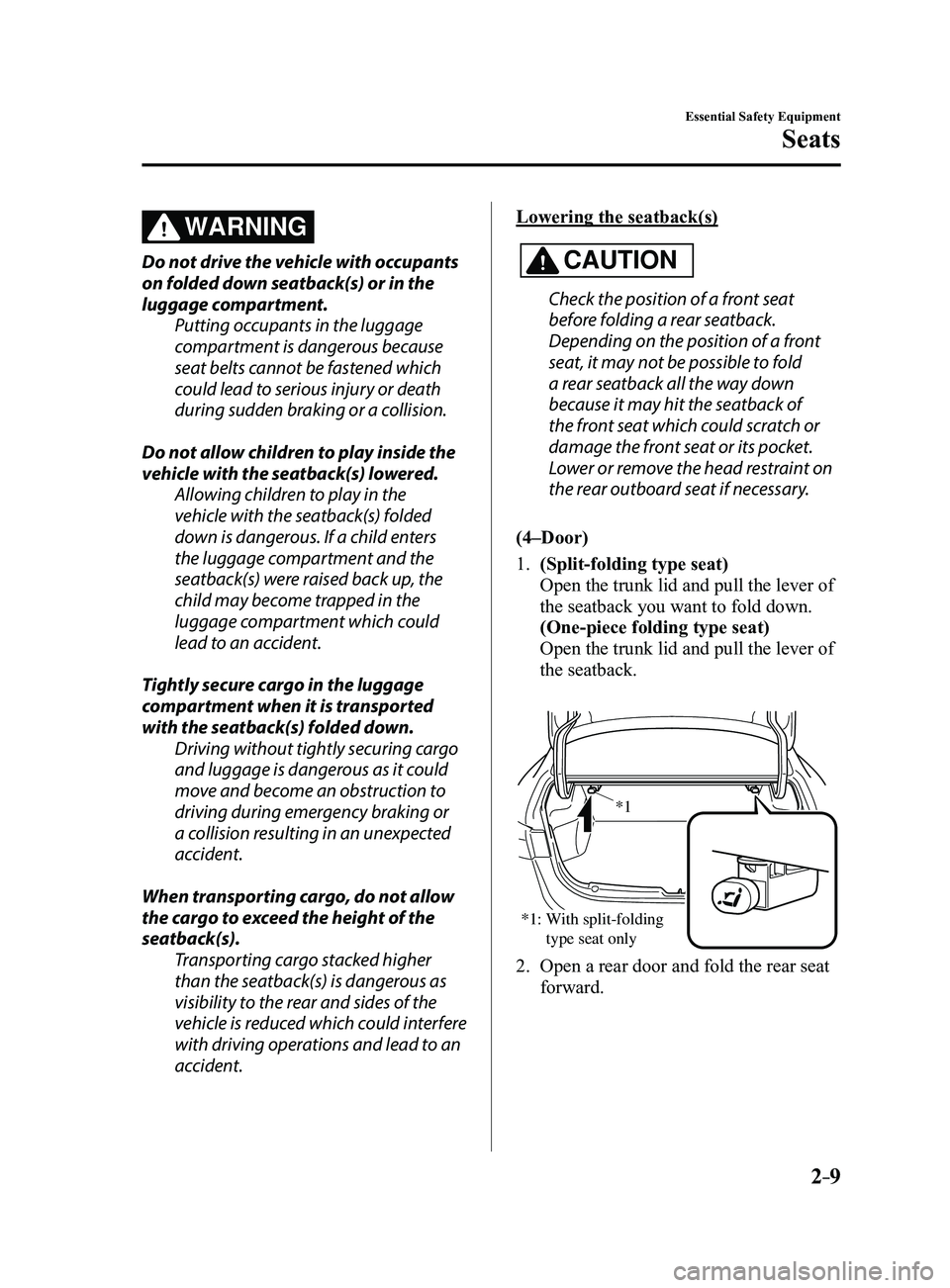
(4–Door)
1. (Split-folding type seat)
Open the trunk lid and pull the lever of
the seatback you want to fold down.
(One-piece folding type seat)
Open the trunk lid and pull the lever of
the seatback.
*1: With split-folding type seat only *1
2. Open a rear door and fold the rear seat
forward.
Mazda3_8FL6-EA-16F_Edition2.indb 92016/08/10 17:34:53
Page 26 of 612
2–12
Essential Safety Equipment
Seats
Head Restraints
Your vehicle is equipped with head
restraints on all outboard seats and the
rear center seat. The head restraints are
intended to help protect you and the
passengers from neck injury.
WARNING
Always drive with the head restraints
installed when seats are being used and
make sure they are properly adjusted:Driving with the head restraints
adjusted too low or removed is
dangerous. With no support behind
your head, your neck could be seriously
injured in a collision.
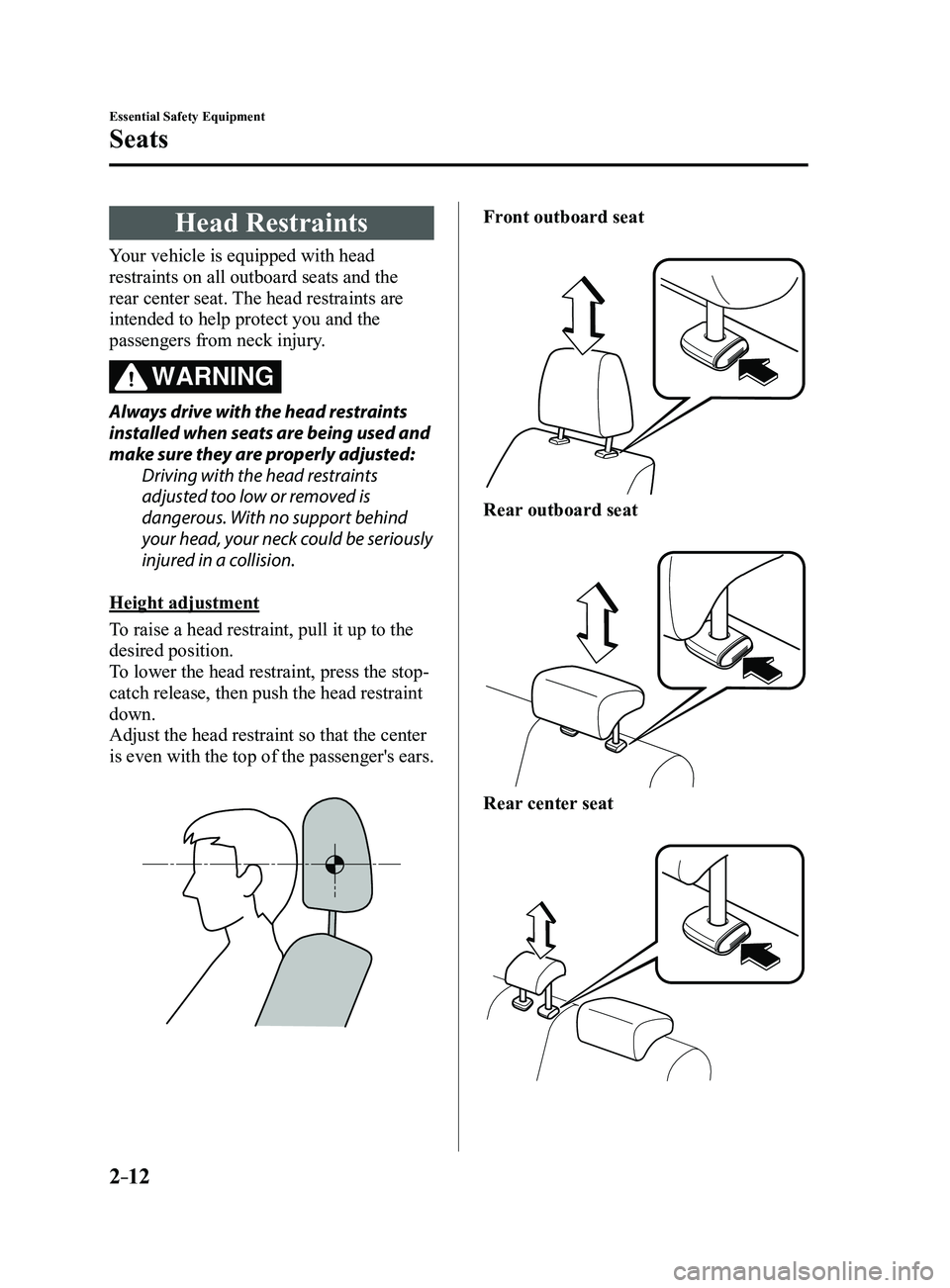
Height adjustment
To raise a head restraint, pull it up to the
desired position.
To lower the head restraint, press the stop-
catch release, then push the head restraint
down.
Adjust the head restraint so that the center
is even with the top of the passenger's ears.
Front outboard seat
Rear outboard seat
Rear center seat
Mazda3_8FL6-EA-16F_Edition2.indb 122016/08/10 17:34:55
Page 27 of 612
2–13
Essential Safety Equipment
Seats
Removal/Installation
To remove the head restraint, pull it up
while pressing the stop-catch.
To install the head restraint, insert the legs
into the holes while pressing the stop-
catch.
WARNING
Always drive with the head restraints
installed when seats are being used and
make sure they are properly installed:Driving with the head restraints not
installed is dangerous. With no support
behind your head, your neck could be
seriously injured in a collision.
Mazda3_8FL6-EA-16F_Edition2.indb 132016/08/10 17:34:55
Page 28 of 612

2–14
Essential Safety Equipment
Seat Belt Systems
Seat Belt Precautions
Seat belts help to decrease the possibility of severe injury during acci\
dents and sudden
stops. Mazda recommends that the driver and all passengers always wear s\
eat belts.
(Except Mexico)
All of the seat belt retractors are designed to keep the lap/shoulder be\
lts out of the way when
not in use.
The driver's seat belt has no provisions for child-restraint systems and\
has only an
emergency locking mode. The driver may wear it comfortably, and it will lock during a
collision.
However, the front passenger's seat and all rear lap/shoulder belt retractors o\
perate in
two modes: emergency locking mode, and for child-restraint systems, automatic locking
mode. While we recommend you put all children in the rear seats, if you must u\
se the front
passenger seat for a child, slide the front passenger seat as far back a\
s possible and make
sure any child-restraint system is secured properly.
(Mexico)
All the seats have lap/shoulder belts. These belts have retractors with inertia locks that keep
them out of the way when not in use. The locks allow the belts to remain comfortable on
users, but they will lock in position during a collision.
WARNING
Always wear your seat belt and make sure all occupants are properly restrained:
Not wearing a seat belt is extremely dangerous. During a collision, occupants not
wearing seat belts could hit someone or things inside the vehicle or even be thrown out of
the vehicle. They could be seriously injured or even killed. In the same collision, occupants
wearing seat belts would be much safer.
Do not wear twisted seat belts: Twisted seat belts are dangerous. In a collision, the full width of the belt is not available to
absorb the impact. This puts more force on the bones beneath the belt, which could cause
serious injury or death. So, if your seat belt is twisted, you must straighten the seat belt to
remove any twists and to allow the full width of the belt to be used.
Never use one seat belt on more than one person at a time: Using one seat belt for more than one person at a time is dangerous. A seat belt used
in this way cannot spread the impact forces properly and the two passengers could
be crushed together and seriously injured or even killed. Never use one belt for more
than one person at a time and always operate the vehicle with each occupant properly
restrained.
Mazda3_8FL6-EA-16F_Edition2.indb 142016/08/10 17:34:56
Page 47 of 612
2–33
Essential Safety Equipment
Child-Restraint
Always install the head restraint and
adjust it to the appropriate position
after removing the child-restraint
system:Driving with the head restraint
removed is dangerous as impact to the
occupant's head cannot be prevented
during emergency braking or in a
collision, which could result in a serious
accident, injury or death.
Refer to Head Restraints on page
2-12.
If You Must Use the Front Seat for
Children
If you cannot put all children in the rear
seat, at least put the smallest children
in the rear and be sure the largest child
up front uses the shoulder belt over the
shoulder.
NEVER put a rear-facing child-restraint
system on the front passenger seat whether
your vehicle is equipped with a occupant
classification sensor or not.
This seat is also not set up for tethered
child-restraint systems, put them in one of
the rear seat positions set up with tether
anchors.
Likewise the LATCH child-restraint
system cannot be secured in the front
passenger's seat and should be used in the
rear seat.
Do not allow anyone to sleep against the
side window since your vehicle has side
and curtain air bags, it could cause serious
injuries to an out of position occupant.
As children more often sleep in cars,
it is better to put them in the rear seat.
If installing the child-restraint system
on the front seat is unavoidable, follow
these instructions when using a front-
facing child-restraint system in the front
passenger's seat.
NOTE
To check if your front seats have side air
bags:
Mazda vehicles equipped with side air
bag will have a "SRS AIRBAG" tag on
the outboard shoulder of the front seats.
To check if your vehicle has curtain air
bags:
Mazda vehicles equipped with curtain
air bag will have an "SRS AIRBAG"
marking on the window pillars along
the roof edge.
WARNING
Always move the front passenger seat
as far back as possible if installing a
front-facing child-restraint system on it
is unavoidable:As your vehicle has front air bags and
doubly so because your vehicle has
side air bags, a front-facing child-
restraint system should be put on the
front passenger seat only when it is
unavoidable.
Even if the front passenger air
bag deactivation indicator light
illuminates, always move the seat as
far back as possible, because the force
of a deploying air bag could cause
serious injury or death to the child.
Mazda3_8FL6-EA-16F_Edition2.indb 332016/08/10 17:35:03
Page 51 of 612
2–37
Essential Safety Equipment
Child-Restraint
Using LATCH Lower Anchor
Your Mazda is equipped with LATCH lower anchors for attachment of specially designed
LATCH child-restraint systems in the rear seats. Both anchors must be used, otherwise the
seat will bounce around and put the child in danger. Most LATCH child-restraint systems
must also be used in conjunction with a tether to be effective. If they have a tether you must
use it to better assure your child's safety.
WARNING
Follow the manufacturer's instructions for the use of the child-restraint system:
An unsecured child-restraint system is dangerous. In a sudden stop or a collision it could
move causing serious injury or death to the child or other occupants. Make sure the
child-restraint system is properly secured in place according to the child-restraint system
manufacturer's instructions.
Never attach two child-restraint systems to the same LATCH lower anchor: Attaching two child-restraint systems to the same LATCH lower anchor is dangerous.
In a collision, one anchor may not be strong enough to hold two child-restraint system
attachments, and it may break, causing serious injury or death. If you use the seat
position for another child-restraint system when an outboard LATCH position is occupied,
use the center seat belts instead, and the tether if tether-equipped.
Make sure the child-restraint system is properly secured: An unsecured child-restraint system is dangerous. In a sudden stop or a collision it could
move causing serious injury or death to the child or other occupants. Follow the child-
restraint system manufacturer's instructions on belt routing to secure the seat just as you
would with a child in it so that nobody is tempted to put a child in an improperly secured
seat later on. When not in use, remove it from the vehicle or fasten it with a seat belt, or
latch it down to BOTH LATCH lower anchors for LATCH child-restraint systems.
Make sure there are no seat belts or foreign objects near or around the LATCH child-
restraint system: Not following the child-restraint system manufacturer's instructions when installing
the child-restraint system is dangerous. If seat belts or a foreign object prevent the
child-restraint system from being securely attached to the LATCH lower anchors and the
child-restraint system is installed improperly, the child-restraint system could move in a
sudden stop or collision causing serious injury or death to the child or other occupants.
When installing the child-restraint system, make sure there are no seat belts or foreign
objects near or around the LATCH lower anchors. Always follow the child-restraint system
manufacturer's instructions.
Mazda3_8FL6-EA-16F_Edition2.indb 372016/08/10 17:35:04
Page 52 of 612
2–38
Essential Safety Equipment
Child-Restraint
Installation on rear outboard seats
1. First, adjust the front seat to allow
clearance between the child-restraint
system and the front seat (page
2-5).
2. Make sure the seatback is securely
latched by pushing it back until it is
fully locked.
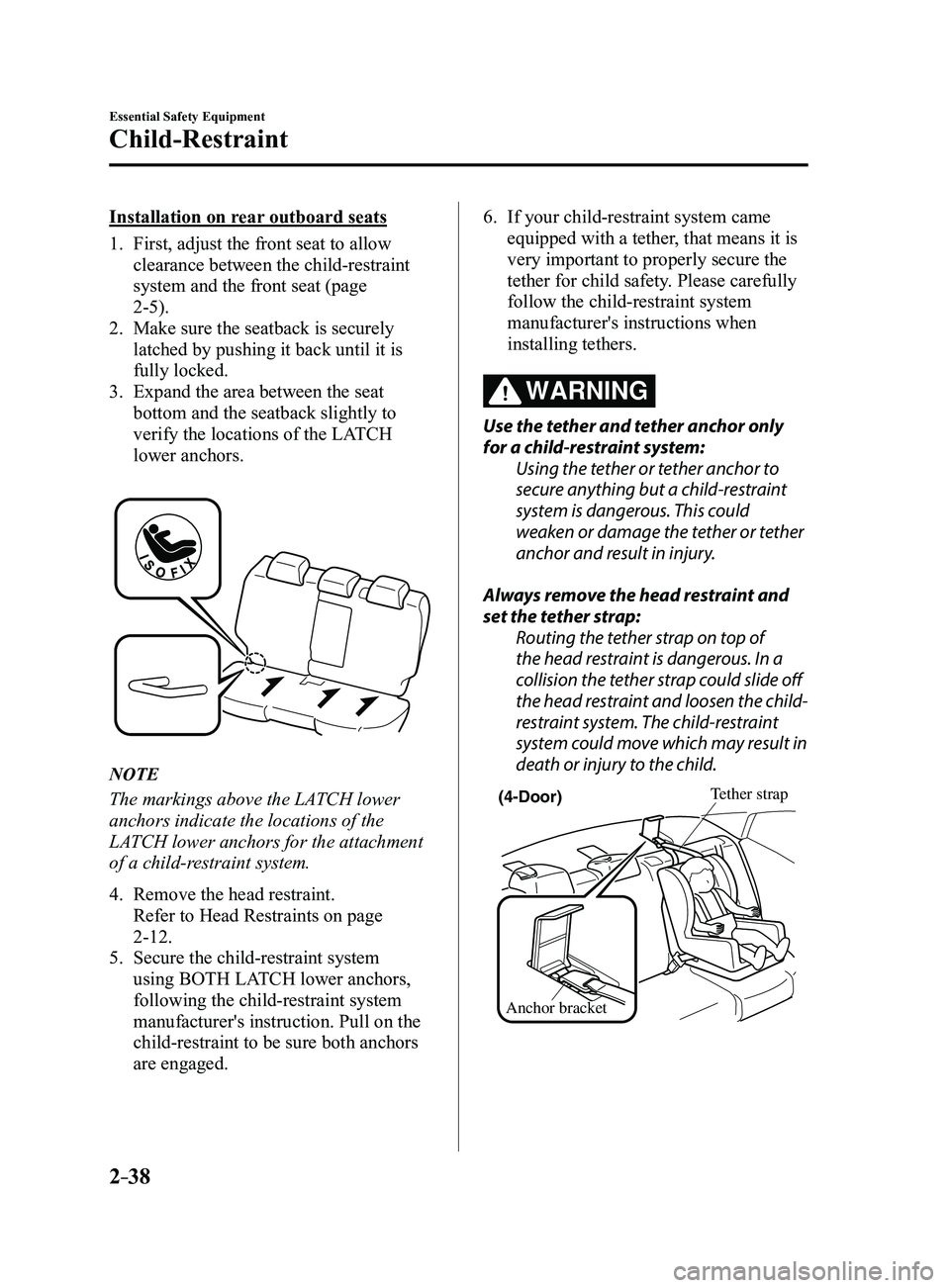
3. Expand the area between the seat
bottom and the seatback slightly to
verify the locations of the LATCH
lower anchors.
NOTE
The markings above the LATCH lower
anchors indicate the locations of the
LATCH lower anchors for the attachment
of a child-restraint system.
4. Remove the head restraint.
Refer to Head Restraints on page
2-12.
5. Secure the child-restraint system
using BOTH LATCH lower anchors,
following the child-restraint system
manufacturer's instruction. Pull on the
child-restraint to be sure both anchors
are engaged.
6. If your child-restraint system came
equipped with a tether, that means it is
very important to properly secure the
tether for child safety. Please carefully
follow the child-restraint system
manufacturer's instructions when
installing tethers.
WARNING
Use the tether and tether anchor only
for a child-restraint system:Using the tether or tether anchor to
secure anything but a child-restraint
system is dangerous. This could
weaken or damage the tether or tether
anchor and result in injury.
Always remove the head restraint and
set the tether strap: Routing the tether strap on top of
the head restraint is dangerous. In a
collision the tether strap could slide off
the head restraint and loosen the child-
restraint system. The child-restraint
system could move which may result in
death or injury to the child.
Anchor bracket
Tether strap(4-Door)
Mazda3_8FL6-EA-16F_Edition2.indb 382016/08/10 17:35:04
Page 53 of 612
2–39
Essential Safety Equipment
Child-Restraint
Tether strapForward(5-Door)
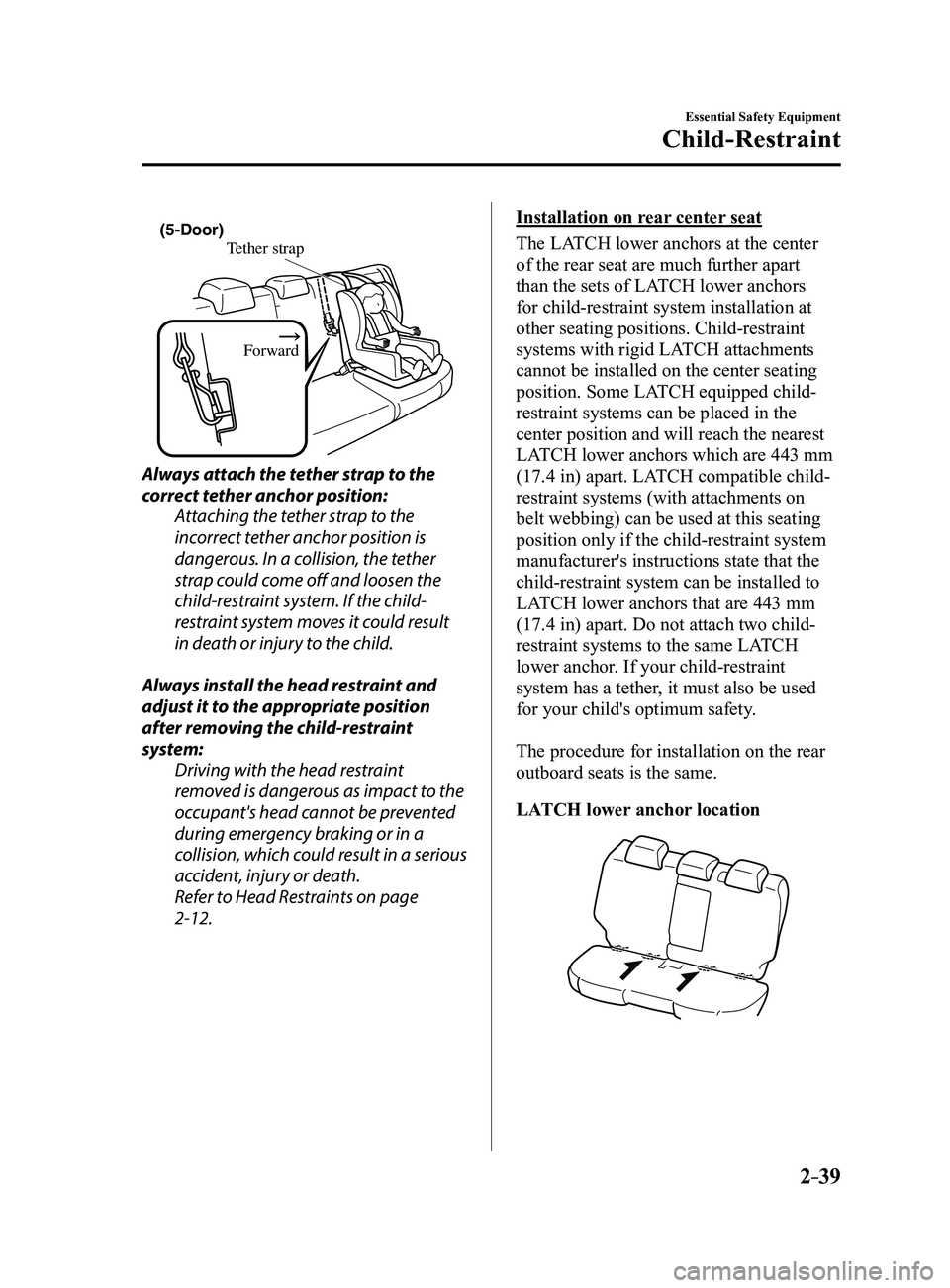
Always attach the tether strap to the
correct tether anchor position: Attaching the tether strap to the
incorrect tether anchor position is
dangerous. In a collision, the tether
strap could come off and loosen the
child-restraint system. If the child-
restraint system moves it could result
in death or injury to the child.
Always install the head restraint and
adjust it to the appropriate position
after removing the child-restraint
system: Driving with the head restraint
removed is dangerous as impact to the
occupant's head cannot be prevented
during emergency braking or in a
collision, which could result in a serious
accident, injury or death.
Refer to Head Restraints on page
2-12.
Installation on rear center seat
The LATCH lower anchors at the center
of the rear seat are much further apart
than the sets of LATCH lower anchors
for child-restraint system installation at
other seating positions. Child-restraint
systems with rigid LATCH attachments
cannot be installed on the center seating
position. Some LATCH equipped child-
restraint systems can be placed in the
center position and will reach the nearest
LATCH lower anchors which are 443 mm
(17.4 in) apart. LATCH compatible child-
restraint systems (with attachments on
belt webbing) can be used at this seating
position only if the child-restraint system
manufacturer's instructions state that the
child-restraint system can be installed to
LATCH lower anchors that are 443 mm
(17.4 in) apart. Do not attach two child-
restraint systems to the same LATCH
lower anchor. If your child-restraint
system has a tether, it must also be used
for your child's optimum safety.
The procedure for installation on the rear
outboard seats is the same.
LATCH lower anchor location
Mazda3_8FL6-EA-16F_Edition2.indb 392016/08/10 17:35:05
Page 59 of 612
2–45
Essential Safety Equipment
SRS Air Bags
To prevent false detection by the air bag sensor system, heed the following:
Do not use tires or wheels other than those specified for your Mazda:
Use of any tire or wheel other than those specified for your Mazda (page 9-10) is
dangerous. Use of such wheels will prevent the vehicle's accident detections system
from accurately detecting a collision or roll-over accident resulting in incorrect or
unexpected air bag deployment and the possibility of serious injuries.
Do not overload your vehicle:
Overloading your vehicle is dangerous as it could prevent the air bag crash sensor
system from accurately detecting a collision or roll-over accident resulting in incorrect
or unexpected air bag deployment and the possibility of serious injuries. The gross axle
weight rating (GAWR) and the gross vehicle weight rating (GVWR) for your vehicle are
on the Motor Vehicle Safety Standard Label on the driver's door frame. Do not exceed
these ratings.
Do not drive the vehicle off-road:
Driving your Mazda off-road is dangerous because the vehicle has not been designed
to do so. Driving the vehicle off-road could prevent the air bag crash sensor system
from accurately detecting a collision or roll-over accident resulting in incorrect or
unexpected air bag deployment and the possibility of serious injuries.
Do not modify a front door or leave any damage unrepaired. Always have an
Authorized Mazda Dealer inspect a damaged front door: Modifying a front door or leaving any damage unrepaired is dangerous. Each front
door has a side crash sensor as a component of the supplemental restraint system. If
holes are drilled in a front door, a door speaker is left removed, or a damaged door is left
unrepaired, the sensor could be adversely affected causing it to not detect the pressure
of an impact correctly during a side collision. If a sensor does not detect a side impact
correctly, the side and curtain air bags and the front seat belt pretensioner may not
operate normally which could result in serious injury to occupants.
Do not modify the supplemental restraint system: Modifying the components or wiring of the supplemental restraint system is dangerous.
You could accidentally activate it or make it inoperable. Do not make any modifications
to the supplemental restraint system. This includes installing trim, badges, or anything
else over the air bag modules. It also includes installing extra electrical equipment on or
near system components or wiring. An Authorized Mazda Dealer can provide the special
care needed in the removal and installation of front seats. It is important to protect the air
bag wiring and connections to assure that the bags do not accidentally deploy, and that
the front passenger occupant classification system and the seats retain an undamaged
air bag connection.
Mazda3_8FL6-EA-16F_Edition2.indb 452016/08/10 17:35:06