tires MAZDA MODEL 3 4-DOOR 2017 Owners Manual
[x] Cancel search | Manufacturer: MAZDA, Model Year: 2017, Model line: MODEL 3 4-DOOR, Model: MAZDA MODEL 3 4-DOOR 2017Pages: 612
Page 12 of 612

Hood ........................................................................\
.............")
1–6
Pictorial Index
Exterior Overview
The equipment and installation position varies by vehicle
(4-Door)
Hood ........................................................................\
..............................................page 6-22
Windshield wiper blades ........................................................................\
...............page 6-32
Moonroof ........................................................................\
......................................page 3-40
Doors and keys ........................................................................\
..............................page 3-14
Fuel-filler lid ........................................................................\
.................................page 3-31
Wheels and Tires ........................................................................\
...........................page 6-41
Exterior lights ........................................................................\
................................page 6-45
Trunk lid ........................................................................\
........................................page 3-22
Child safety locks ........................................................................\
..........................page 3-21
Outside mirror ........................................................................\
...............................page 3-34
Mazda3_8FL6-EA-16F_Edition2.indb 62016/08/10 17:34:49
Page 13 of 612

Hood ........................................................................\
.............")
1–7
Pictorial Index
Exterior Overview
The equipment and installation position varies by vehicle
(5-Door)
Hood ........................................................................\
..............................................page 6-22
Windshield wiper blades ........................................................................\
...............page 6-32
Moonroof ........................................................................\
......................................page 3-40
Doors and keys ........................................................................\
..............................page 3-14
Fuel-filler lid ........................................................................\
.................................page 3-31
Wheels and Tires ........................................................................\
...........................page 6-41
Exterior lights ........................................................................\
................................page 6-45
Rear window wiper blade ........................................................................\
.............page 6-33
Liftgate ........................................................................\
..........................................page 3-22
Child safety locks ........................................................................\
..........................page 3-21
Outside mirror ........................................................................\
...............................page 3-34
Mazda3_8FL6-EA-16F_Edition2.indb 72016/08/10 17:34:50
Page 59 of 612
2–45
Essential Safety Equipment
SRS Air Bags
To prevent false detection by the air bag sensor system, heed the following:
Do not use tires or wheels other than those specified for your Mazda:
Use of any tire or wheel other than those specified for your Mazda (page 9-10) is
dangerous. Use of such wheels will prevent the vehicle's accident detections system
from accurately detecting a collision or roll-over accident resulting in incorrect or
unexpected air bag deployment and the possibility of serious injuries.
Do not overload your vehicle:
Overloading your vehicle is dangerous as it could prevent the air bag crash sensor
system from accurately detecting a collision or roll-over accident resulting in incorrect
or unexpected air bag deployment and the possibility of serious injuries. The gross axle
weight rating (GAWR) and the gross vehicle weight rating (GVWR) for your vehicle are
on the Motor Vehicle Safety Standard Label on the driver's door frame. Do not exceed
these ratings.
Do not drive the vehicle off-road:
Driving your Mazda off-road is dangerous because the vehicle has not been designed
to do so. Driving the vehicle off-road could prevent the air bag crash sensor system
from accurately detecting a collision or roll-over accident resulting in incorrect or
unexpected air bag deployment and the possibility of serious injuries.
Do not modify a front door or leave any damage unrepaired. Always have an
Authorized Mazda Dealer inspect a damaged front door: Modifying a front door or leaving any damage unrepaired is dangerous. Each front
door has a side crash sensor as a component of the supplemental restraint system. If
holes are drilled in a front door, a door speaker is left removed, or a damaged door is left
unrepaired, the sensor could be adversely affected causing it to not detect the pressure
of an impact correctly during a side collision. If a sensor does not detect a side impact
correctly, the side and curtain air bags and the front seat belt pretensioner may not
operate normally which could result in serious injury to occupants.
Do not modify the supplemental restraint system: Modifying the components or wiring of the supplemental restraint system is dangerous.
You could accidentally activate it or make it inoperable. Do not make any modifications
to the supplemental restraint system. This includes installing trim, badges, or anything
else over the air bag modules. It also includes installing extra electrical equipment on or
near system components or wiring. An Authorized Mazda Dealer can provide the special
care needed in the removal and installation of front seats. It is important to protect the air
bag wiring and connections to assure that the bags do not accidentally deploy, and that
the front passenger occupant classification system and the seats retain an undamaged
air bag connection.
Mazda3_8FL6-EA-16F_Edition2.indb 452016/08/10 17:35:06
Page 122 of 612
3–46
Before Driving
Driving Tips
Break-In Period
No special break-in is necessary, but a
few precautions in the first 1,000 km
(600 miles) may add to the performance,
economy, and life of the vehicle.
Do not race the engine. Do not maintain one constant speed,
either slow or fast, for a long period of
time.
Do not drive constantly at full-throttle or
high engine rpm for extended periods of
time.
Avoid unnecessary hard stops. Avoid full-throttle starts.
Saving Fuel and
Protection of the
Environment
How you operate your Mazda determines
how far it will travel on a tank of fuel. Use
these suggestions to help save fuel and
reduce CO2.
Avoid long warm-ups. Once the engine
runs smoothly, begin driving. Avoid fast starts. Drive at lower speeds. Anticipate when to apply the brakes
(avoid sudden braking). Follow the maintenance schedule
(page 6-4) and have an Authorized
Mazda Dealer perform inspections and
servicing.
Use the air conditioner only when
necessary. Slow down on rough roads. Keep the tires properly inflated. Do not carry unnecessary weight. Do not rest your foot on the brake pedal
while driving. Keep the wheels in correct alignment. Keep windows closed at high speeds. Slow down when driving in crosswinds
and headwinds.
WARNING
Never stop the engine when going down
a hill: Stopping the engine when going
down a hill is dangerous. This causes
the loss of power steering and power
brake control, and may cause damage
to the drivetrain. Any loss of steering
or braking control could cause an
accident.
Mazda3_8FL6-EA-16F_Edition2.indb 462016/08/10 17:35:38
Page 123 of 612
3–47
Before Driving
Driving Tips
Hazardous Driving
WARNING
Be extremely careful if it is necessary to
downshift on slippery surfaces:Downshifting into lower gear
while driving on slippery surfaces is
dangerous. The sudden change in tire
speed could cause the tires to skid. This
could lead to loss of vehicle control
and an accident.
When driving on ice or in water, snow,
mud, sand, or similar hazards:
Be cautious and allow extra distance for
braking. Avoid sudden braking and sudden
maneuvering. Do not pump the brakes. Continue to
press down on the brake pedal.
Refer to Antilock Brake System (ABS)
on page 4-68. If you get stuck, select a lower gear and
accelerate slowly. Do not spin the front
wheels.
For more traction in starting on slippery
surfaces such as ice or packed snow,
use sand, rock salt, chains, carpeting, or
other nonslip material under the front
wheels.
NOTE
Use snow chains only on the front wheels.
Floor Mat
We recommend the use of Genuine
Mazda floor mats.
WARNING
Make sure the floor mats are secured
with the grommets or the retainers to
prevent them from bunching up under
the foot pedals (Driver's side): Using a floor mat that is not secured is
dangerous as it will interfere with the
accelerator and brake pedal operation
(driver's side), which could result in an
accident.
Only use a floor mat which conforms
to the shape of the floor on the driver's
side and make sure it is oriented
correctly.
Secure the floor mat using the
grommets or retainers.
There are various ways to secure floor
mats depending on the type used,
therefore secure the mat according to
the type.
After installing the floor mat, make
sure that it does not slide from side
to side or back and forth, and that
there is sufficient clearance with the
accelerator and brake pedals on the
driver's side.
After removing the floor mat for
cleaning or some other reason, always
securely reinstall it while paying
attention to the precautions just
mentioned.
Mazda3_8FL6-EA-16F_Edition2.indb 472016/08/10 17:35:38
Page 125 of 612
3–49
Before Driving
Driving Tips
Winter Driving
Carry emergency gear, including tire
chains, window scraper, flares, a small
shovel, jumper cables, and a small bag of
sand or salt.
Ask an Authorized Mazda Dealer to check
the following:
Have the proper ratio of antifreeze in the
radiator.
Refer to Engine Coolant on page
6-28. Inspect the battery and its cables. Cold
reduces battery capacity. Use an engine oil appropriate for the
lowest ambient temperatures that the
vehicle will be driven in (page
6-25). Inspect the ignition system for damage
and loose connections. Use washer fluid made with antifreeze—
but do not use engine coolant antifreeze
for washer fluid (page
6-30).
NOTE
(Without electric parking brake)
Do not use the parking brake in freezing
weather as it may freeze. Instead, shift
to P with an automatic transaxle and to
1 or R with a manual transaxle. Block
the rear wheels.
Remove snow before driving. Snow left
on the windshield is dangerous as it
could obstruct vision.
Do not apply excessive for ce to a
window scraper when removing ice or
frozen snow on the mirror glass and
windshield.
Never use warm or hot water for
removing snow or ice from windows and
mirrors as it could result in the glass
cracking.
Drive slowly. Braking performance
can be adversely affected if snow or
ice adheres to the brake components. If
this situation occurs, drive the vehicle
slowly, releasing the accelerator pedal
and lightly applying the brakes several
times until the brake performance
returns to normal.
Snow Tires
Use snow tires on all four wheels
Do not go faster than 120 km/h (75 mph)
while driving with snow tires. Inflate snow
tires 30 kPa (0.3 kgf/cm
2, 4.3 psi) more
than recommended on the tire pressure
label (driver's door frame), but never
more than the maximum cold-tire pressure
shown on the tires.
Mazda3_8FL6-EA-16F_Edition2.indb 492016/08/10 17:35:38
Page 126 of 612
3–50
Before Driving
Driving Tips
Except Mexico (18–inch wheel vehicle)
The vehicle is originally equipped with
all season radials designed to be used all
year around. In some extreme climates you
may find it necessary to replace them with
snow tires during the winter months to
further improve traction on snow and ice
covered roads.
Mexico (18–inch wheel vehicle)
The vehicle is originally equipped with
summer tires designed for optimum
traction on wet and dry roads. If your
vehicle is to be used on snow and ice
covered roads, Mazda recommends that
you replace the tires originally equipped
on your vehicle with snow tires during the
winter months.
WARNING
Use only the same size and type tires
(snow, radial, or non-radial) on all four
wheels:Using tires different in size or type is
dangerous. Your vehicle's handling
could be greatly affected and result in
an accident.
CAUTION
Check local regulations before using
studded tires.
Tire Chains
Check local regulations before using tire
chains.
CAUTION
Chains may a ffect handling. Do not go faster than 50 km/h (30 mph)
or the chain manufacturer's
recommended limit, whichever is lower.
Drive carefully and avoid bumps, holes,
and sharp turns. Avoid locked-wheel braking. Do not use chains on a temporary spare
tire; it may result in damage to the
vehicle and to the tire.
Do not use chains on roads that are free
of snow or ice. The tires and chains could
be damaged.
Chains may scr atch or chip aluminum
wheels.
NOTE
The tire pressure monitoring system may
not function correctly when using tire
chains.
Install the chains on the front tires only.
Do not use chains on the rear tires.
Please consult an Authorized Mazda
Dealer.
Installing the chains
1. If your vehicle is equipped with wheel
covers remove them, otherwise the
chain bands will scratch them.
2. Secure the chains on the front tires as
tightly as possible.
Always follow the chain manufacturer's
instructions.
3. Retighten the chains after driving
1/2—1 km (1/4—1/2 mile).
Mazda3_8FL6-EA-16F_Edition2.indb 502016/08/10 17:35:39
Page 128 of 612

3–52
Before Driving
Driving Tips
Driving on Uneven Road
Your vehicle's suspension and underbody can be damaged if driven on rough\
/uneven roads
or over speed bumps at excessive speeds. Use care and reduce speed when \
traveling on
rough/uneven roads or over speed bumps.
Use care not to damage the vehicle's underbody, bumpers or muffler(s) when driving under
the following conditions:
Ascending or descending a slope with a sharp transition angle Ascending or descending a driveway or trailer ramp with a sharp transiti\
on angle
This vehicle is equipped with low profile tires allowing class-leading performance and
handling. As a result, the sidewall of the tires are very thin and the tires and w\
heels can be
damaged if driven through potholes or on rough/uneven roads at excessive\
speeds. Use care
and reduce speed when traveling on rough/uneven roads or through pothole\
s.
Mazda3_8FL6-EA-16F_Edition2.indb 522016/08/10 17:35:39
Page 159 of 612
4–29
When Driving
Manual Transaxle Operation
Manual Transaxle Shift
Pattern
Neutral position
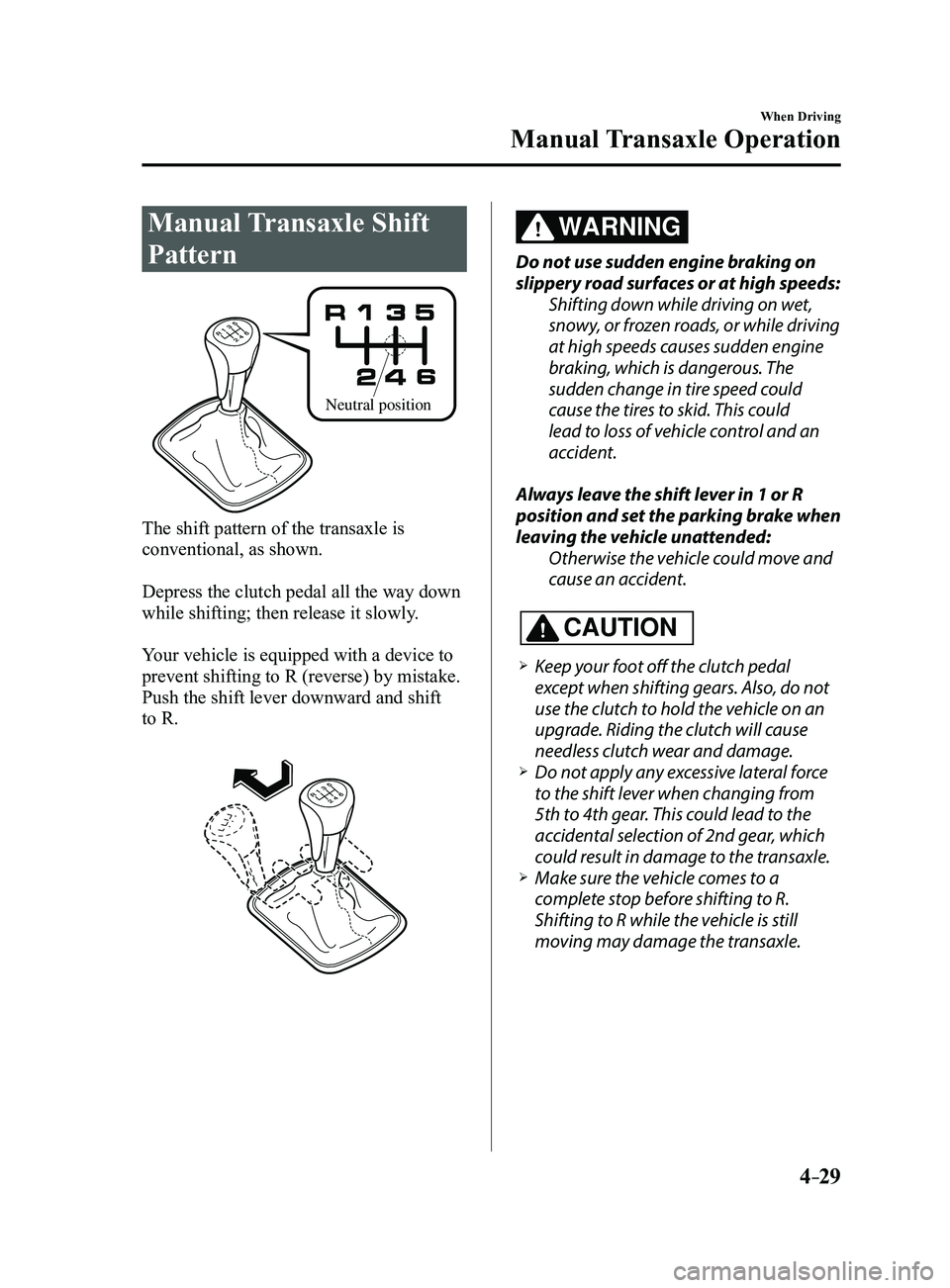
The shift pattern of the transaxle is
conventional, as shown.
Depress the clutch pedal all the way down
while shifting; then release it slowly.
Your vehicle is equipped with a device to
prevent shifting to R (reverse) by mistake.
Push the shift lever downward and shift
to R.
WARNING
Do not use sudden engine braking on
slippery road surfaces or at high speeds:Shifting down while driving on wet,
snowy, or frozen roads, or while driving
at high speeds causes sudden engine
braking, which is dangerous. The
sudden change in tire speed could
cause the tires to skid. This could
lead to loss of vehicle control and an
accident.
Always leave the shift lever in 1 or R
position and set the parking brake when
leaving the vehicle unattended: Otherwise the vehicle could move and
cause an accident.
CAUTION
Keep your foot off the clutch pedal
except when shifting gears. Also, do not
use the clutch to hold the vehicle on an
upgrade. Riding the clutch will cause
needless clutch wear and damage.
Do not apply any excessive lateral force
to the shift lever when changing from
5th to 4th gear. This could lead to the
accidental selection of 2nd gear, which
could result in damage to the transaxle.
Make sure the vehicle comes to a
complete stop before shifting to R.
Shifting to R while the vehicle is still
moving may damage the transaxle.
Mazda3_8FL6-EA-16F_Edition2.indb 292016/08/10 17:36:06
Page 168 of 612
4–38
When Driving
Automatic Transaxle
*Some models.
Manually Shifting Down
You can shift gears down by operating
the selector lever or the steering shift
switches
*.
M6 → M5 → M4 → M3 → M2→ M1
Using selector lever
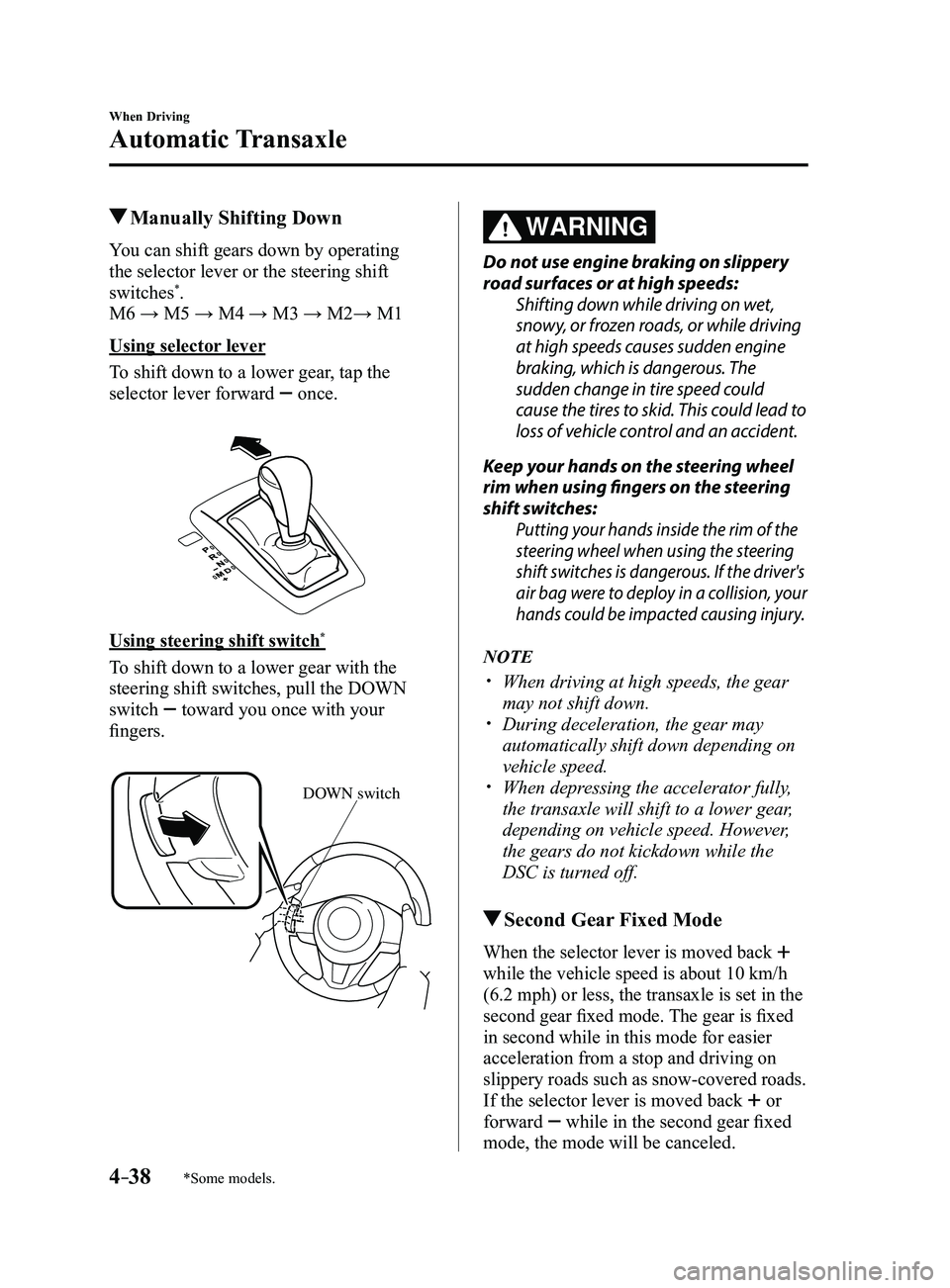
To shift down to a lower gear, tap the
selector lever forward
once.
Using steering shift switch*
To shift down to a lower gear with the
steering shift switches, pull the DOWN
switch
toward you once with your
fingers.
DOWN switch
WARNING
Do not use engine braking on slippery
road surfaces or at high speeds:
Shifting down while driving on wet,
snowy, or frozen roads, or while driving
at high speeds causes sudden engine
braking, which is dangerous. The
sudden change in tire speed could
cause the tires to skid. This could lead to
loss of vehicle control and an accident.
Keep your hands on the steering wheel
rim when using fingers on the steering
shift switches:
Putting your hands inside the rim of the
steering wheel when using the steering
shift switches is dangerous. If the driver's
air bag were to deploy in a collision, your
hands could be impacted causing injury.
NOTE
When driving at high speeds, the gear
may not shift down. During deceleration, the gear may
automatically shift down depending on
vehicle speed.
When depressing the accelerator fully,
the transaxle will shift to a lower gear,
depending on vehicle speed. However,
the gears do not kickdown while the
DSC is turned off.
Second Gear Fixed Mode
When the selector lever is moved back
while the vehicle speed is about 10 km/h
(6.2 mph) or less, the transaxle is set in the
second gear fixed mode. The gear is fixed
in second while in this mode for easier
acceleration from a stop and driving on
slippery roads such as snow-covered roads.
If the selector lever is moved back or
forward
while in the second gear fixed
mode, the mode will be canceled.
Mazda3_8FL6-EA-16F_Edition2.indb 382016/08/10 17:36:12