traction control MAZDA MODEL 3 4-DOOR 2017 Owners Manual
[x] Cancel search | Manufacturer: MAZDA, Model Year: 2017, Model line: MODEL 3 4-DOOR, Model: MAZDA MODEL 3 4-DOOR 2017Pages: 612
Page 123 of 612
3–47
Before Driving
Driving Tips
Hazardous Driving
WARNING
Be extremely careful if it is necessary to
downshift on slippery surfaces:Downshifting into lower gear
while driving on slippery surfaces is
dangerous. The sudden change in tire
speed could cause the tires to skid. This
could lead to loss of vehicle control
and an accident.
When driving on ice or in water, snow,
mud, sand, or similar hazards:
Be cautious and allow extra distance for
braking. Avoid sudden braking and sudden
maneuvering. Do not pump the brakes. Continue to
press down on the brake pedal.
Refer to Antilock Brake System (ABS)
on page 4-68. If you get stuck, select a lower gear and
accelerate slowly. Do not spin the front
wheels.
For more traction in starting on slippery
surfaces such as ice or packed snow,
use sand, rock salt, chains, carpeting, or
other nonslip material under the front
wheels.
NOTE
Use snow chains only on the front wheels.
Floor Mat
We recommend the use of Genuine
Mazda floor mats.
WARNING
Make sure the floor mats are secured
with the grommets or the retainers to
prevent them from bunching up under
the foot pedals (Driver's side): Using a floor mat that is not secured is
dangerous as it will interfere with the
accelerator and brake pedal operation
(driver's side), which could result in an
accident.
Only use a floor mat which conforms
to the shape of the floor on the driver's
side and make sure it is oriented
correctly.
Secure the floor mat using the
grommets or retainers.
There are various ways to secure floor
mats depending on the type used,
therefore secure the mat according to
the type.
After installing the floor mat, make
sure that it does not slide from side
to side or back and forth, and that
there is sufficient clearance with the
accelerator and brake pedals on the
driver's side.
After removing the floor mat for
cleaning or some other reason, always
securely reinstall it while paying
attention to the precautions just
mentioned.
Mazda3_8FL6-EA-16F_Edition2.indb 472016/08/10 17:35:38
Page 131 of 612
4–1
*Some models.
4When Driving
Information concerning safe driving and stopping.
Start/Stop Engine ................................4-4
Ignition Switch ...............................4-4
Starting the Engine .........................4-5
Turning the Engine Off ................4-10
Instrument Cluster and Display ......4-12
Meters and Gauges .......................4-12
Active Driving Display* ...............4-21
Warning/Indicator Lights .............4-23
Manual Transaxle Operation ...........4-29
Manual Transaxle Shift Pattern ....4-29
Automatic Transaxle .........................4-32
Automatic Transaxle Controls .....4-32
Shift-Lock System .......................4-33
Transaxle Ranges .........................4-34
Manual Shift Mode ......................4-35
Direct Mode* ................................4-41
Driving Tips .................................4-42
Switches and Controls ......................4-43
Lighting Control ...........................4-43
Fog Lights* ...................................4-48
Turn and Lane-Change Signals ....4-49
Windshield Wipers and Washer ...4-50
Rear Window Wiper and
Washer*.........................................4-53
Rear Window Defogger ...............4-54
Horn .............................................4-56
Hazard Warning Flasher ...............4-56
HomeLink Wireless Control
System* .........................................4-57
Brake ..................................................4-61
Brake System ...............................4-61
Hill Launch Assist (HLA) ............4-67
ABS/TCS/DSC ...................................4-68
Antilock Brake System (ABS) .....4-68
Traction Control System (TCS) ...4-69
Dynamic Stability Control
(DSC)
...........................................4-70
i-ELOOP ............................................4-72
i-ELOOP* .....................................4-72
Fuel Economy Monitor .....................4-75
Fuel Economy Monitor* ...............4-75
Drive Selection ...................................4-78
Drive Selection* ...........................4-78
Power Steering ...................................4-80
Power Steering .............................4-80
Mazda3_8FL6-EA-16F_Edition2.indb 12016/08/10 17:35:40
Page 199 of 612
4–69
When Driving
ABS/TCS/DSC
Traction Control System
(TCS)
The Traction Control System (TCS)
enhances traction and safety by controlling
engine torque and braking. When the TCS
detects driving wheel slippage, it lowers
engine torque and operates the brakes to
prevent loss of traction.
This means that on a slick surface, the
engine adjusts automatically to provide
optimum power to the drive wheels,
limiting wheel spin and loss of traction.
The warning light turns on when the
system has a malfunction.
Refer to Warning Lights on page
4-24.
WARNING
Do not rely on the Traction Control
System (TCS) as a substitute for safe
driving:The Traction Control System (TCS)
cannot compensate for unsafe and
reckless driving, excessive speed,
tailgating (following another vehicle
too closely), and hydroplaning
(reduced tire friction and road contact
because of water on the road surface).
You can still have an accident.
Use snow tires or tire chains and drive at
reduced speeds when roads are covered
with ice and/or snow: Driving without proper traction devices
on snow and/or ice-covered roads
is dangerous. The Traction Control
System (TCS) alone cannot provide
adequate traction and you could still
have an accident.
NOTE
To turn off the TCS, press the DSC OFF
switch (page
4-71).
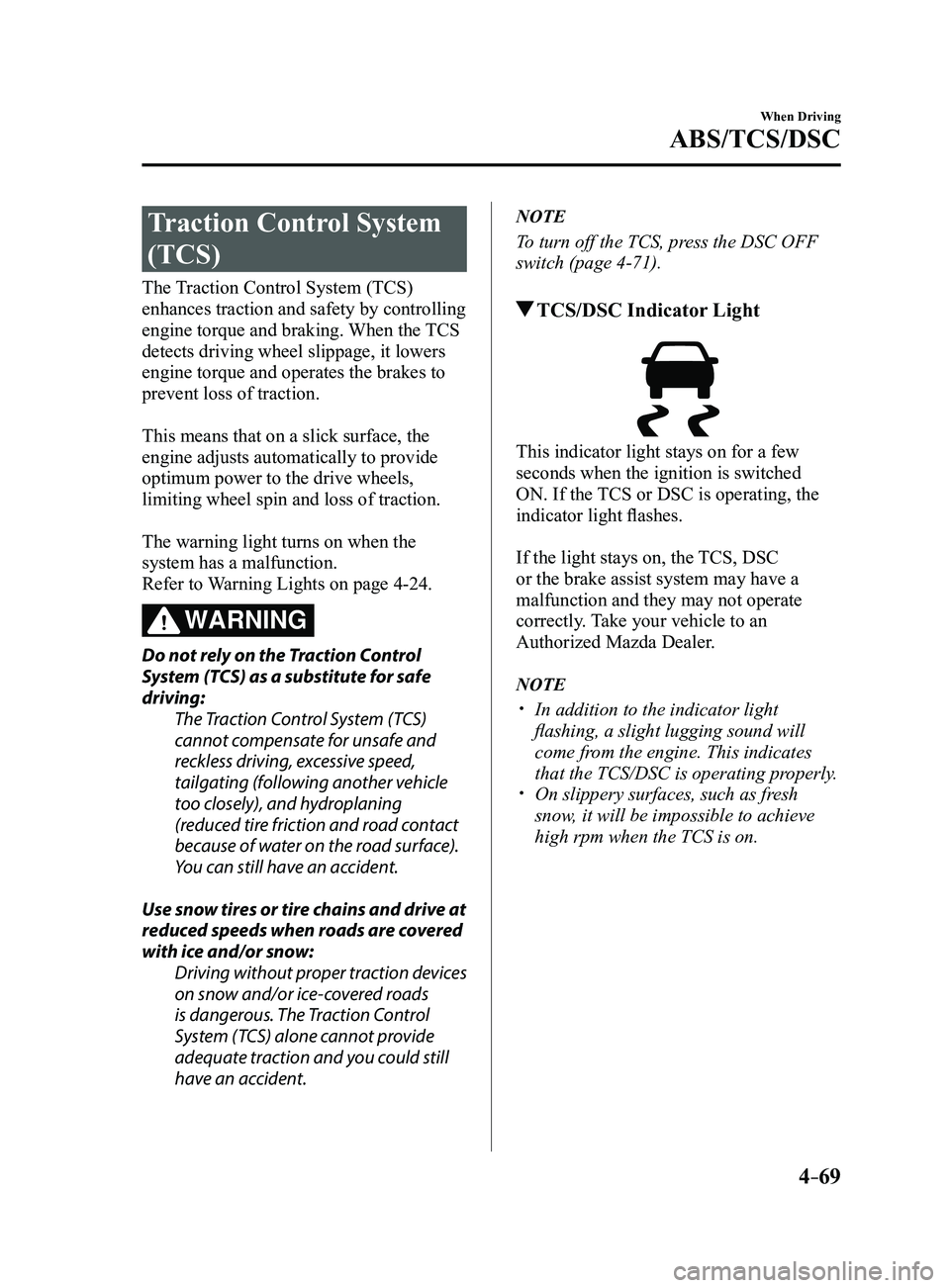
TCS/DSC Indicator Light
This indicator light stays on for a few
seconds when the ignition is switched
ON. If the TCS or DSC is operating, the
indicator light flashes.
If the light stays on, the TCS, DSC
or the brake assist system may have a
malfunction and they may not operate
correctly. Take your vehicle to an
Authorized Mazda Dealer.
NOTE
In addition to the indicator light
flashing, a slight lugging sound will
come from the engine. This indicates
that the TCS/DSC is operating properly.
On slippery surfaces, such as fr esh
snow, it will be impossible to achieve
high rpm when the TCS is on.
Mazda3_8FL6-EA-16F_Edition2.indb 692016/08/10 17:36:29
Page 455 of 612
6–43
Maintenance and Care
Owner Maintenance
Replacing a Tire
WARNING
Always use tires that are in good
condition:Driving with worn tires is dangerous.
Reduced braking, steering, and
traction could result in an accident.
Replace all four tires at the same time: Replacing just one tire is dangerous. It
could cause poor handling and poor
braking resulting in loss of vehicle
control. Mazda strongly recommends
that you replace all four tires at the
same time.
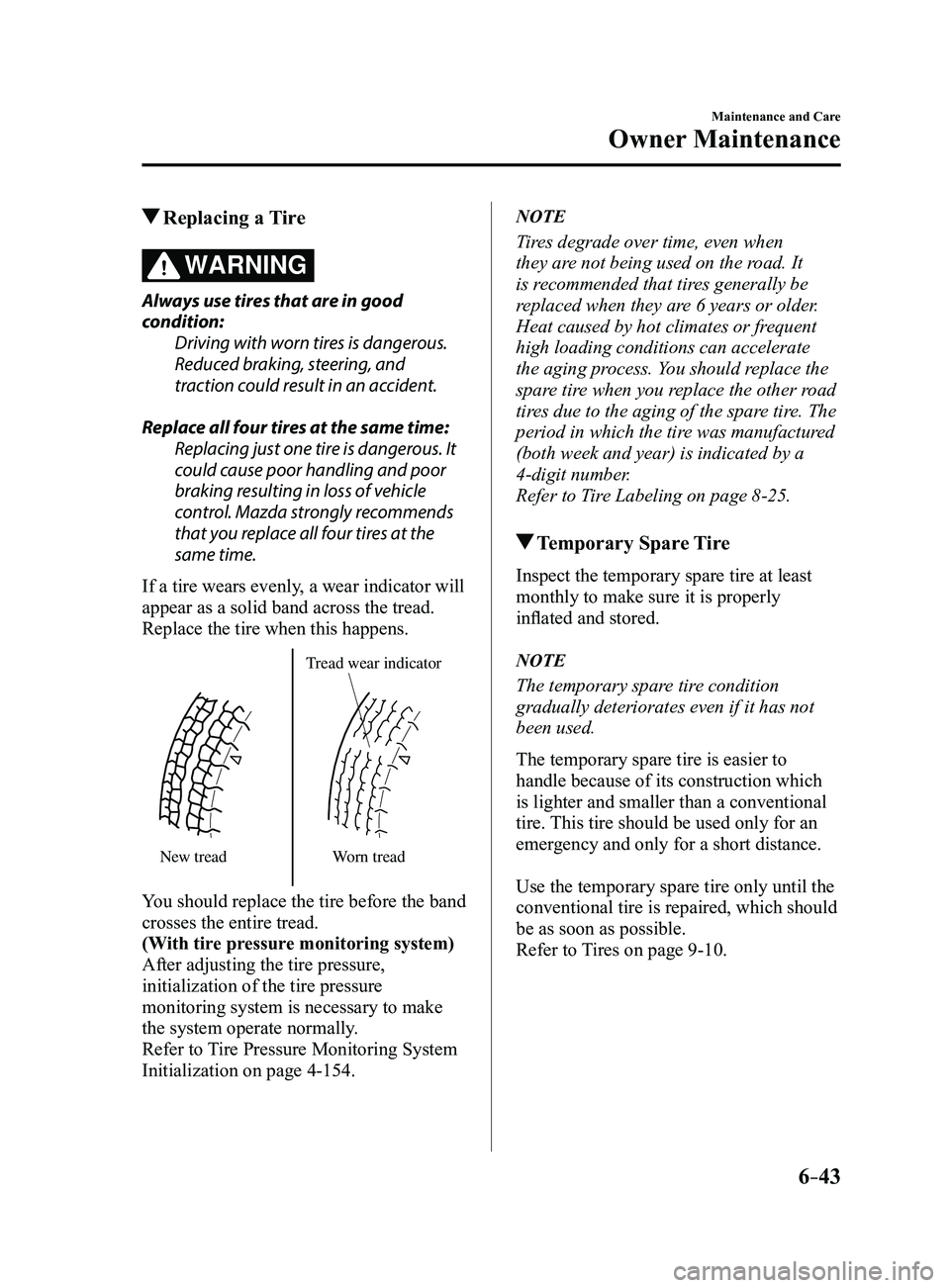
If a tire wears evenly, a wear indicator will
appear as a solid band across the tread.
Replace the tire when this happens.
New tread Tread wear indicator
Worn tread
You should replace the tire before the band
crosses the entire tread.
(With tire pressure monitoring system)
After adjusting the tire pressure,
initialization of the tire pressure
monitoring system is necessary to make
the system operate normally.
Refer to Tire Pressure Monitoring System
Initialization on page
4-154.
NOTE
Tires degrade over time, even when
they are not being used on the road. It
is recommended that tires generally be
replaced when they are 6 years or older.
Heat caused by hot climates or frequent
high loading conditions can accelerate
the aging process. You should replace the
spare tire when you replace the other road
tires due to the aging of the spare tire. The
period in which the tire was manufactured
(both week and year) is indicated by a
4-digit number.
Refer to Tire Labeling on page
8-25.
Temporary Spare Tire
Inspect the temporary spare tire at least
monthly to make sure it is properly
inflated and stored.
NOTE
The temporary spare tire condition
gradually deteriorates even if it has not
been used.
The temporary spare tire is easier to
handle because of its construction which
is lighter and smaller than a conventional
tire. This tire should be used only for an
emergency and only for a short distance.
Use the temporary spare tire only until the
conventional tire is repaired, which should
be as soon as possible.
Refer to Tires on page
9-10.
Mazda3_8FL6-EA-16F_Edition2.indb 432016/08/10 17:38:49
Page 557 of 612
8–23
Customer Information and Reporting Safety Defects
Uniform Tire Quality Grading System (UTQGS)
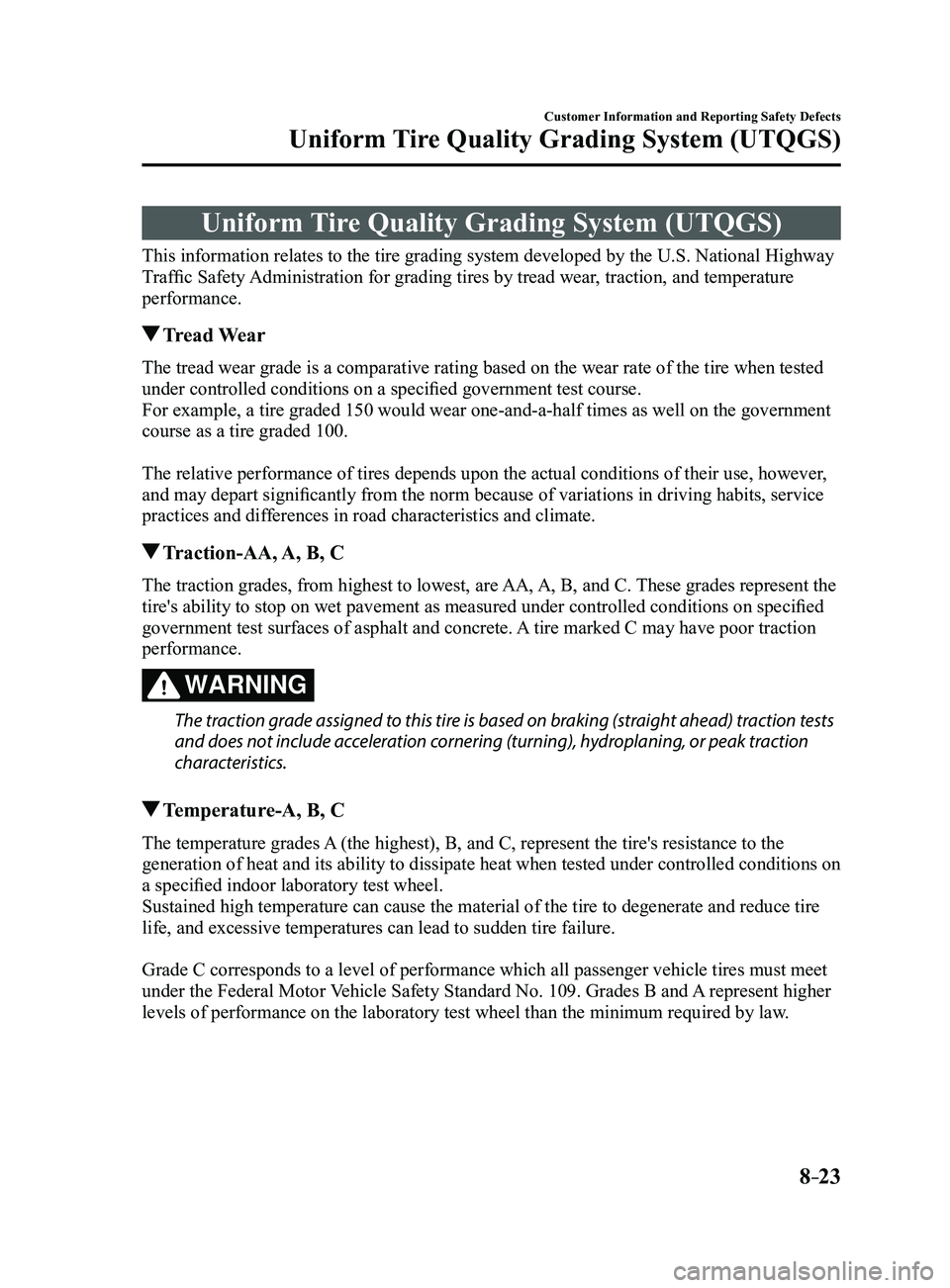
Uniform Tire Quality Grading System (UTQGS)
This information relates to the tire grading system developed by the U.S. National Highway
Traffic Safety Administration for grading tires by tread wear, traction, and temperature
performance.
Tread Wear
The tread wear grade is a comparative rating based on the wear rate of t\
he tire when tested
under controlled conditions on a specified government test course.
For example, a tire graded 150 would wear one-and-a-half times as well o\
n the government
course as a tire graded 100.
The relative performance of tires depends upon the actual conditions of \
their use, however,
and may depart significantly from the norm because of variations in driving habits, service
practices and differences in road characteristics and climate.
Traction-AA, A, B, C
The traction grades, from highest to lowest, are AA, A, B, and C. These grades represent the
tire's ability to stop on wet pavement as measured under controlled conditions on specified
government test surfaces of asphalt and concrete. A tire marked C may have poor traction
performance.
WARNING
The traction grade assigned to this tire is based on braking (straight ahead) traction tests
and does not include acceleration cornering (turning), hydroplaning, or peak traction
characteristics.
Temperature-A, B, C
The temperature grades A (the highest), B, and C, represent the tire's resistance to the
generation of heat and its ability to dissipate heat when tested under c\
ontrolled conditions on
a specified indoor laboratory test wheel.
Sustained high temperature can cause the material of the tire to degener\
ate and reduce tire
life, and excessive temperatures can lead to sudden tire failure.
Grade C corresponds to a level of performance which all passenger vehicle tires must meet
under the Federal Motor Vehicle Safety Standard No. 109. Grades B and A represent higher
levels of performance on the laboratory test wheel than the minimum required by law.
Mazda3_8FL6-EA-16F_Edition2.indb 232016/08/10 17:39:40
Page 561 of 612
8–27
Customer Information and Reporting Safety Defects
Tire Information (U.S.A.)
MS or M/S: Mud and Snow
AT: All Terrain.
AS: All Season. The “M
S” or “M/S” indicates that the tire has some functional use in mud
and snow.
U.S. DOT Tire Identification Number (TIN)
This begins with the letters “DOT” which indicates the tire meets all federal standards. The
next two numbers or letters are the plant code where it was manufactured\
, and the last four
numbers represent the week and year the tire was manufactured. For examp\
le, the numbers
457 means the 45st week of 1997. After 2000 the numbers go to four digits. For example,
the number 2102 means the 21th week of 2002. The other numbers are marketing codes
used at the manufacturer's discretion. This information is used to contact consumers if a tire
defect requires a recall.
Tire Ply Composition and Materials Used
The number of plies indicates the number of layers of rubber-coated fabric in the tire.
In general, the greater the number of plies, the more weight a tire can \
support. Tire
manufacturers also must indicate the tire materials, which include steel\
, nylon, polyester,
and other.
Maximum Load Rating
This number indicates the maximum load in kilograms and pounds that can \
be carried by the
tire.
Maximum Permissible Inflation Pressure
This number is the greatest amount of air pressure that should ever be p\
ut in the tire under
normal driving conditions.
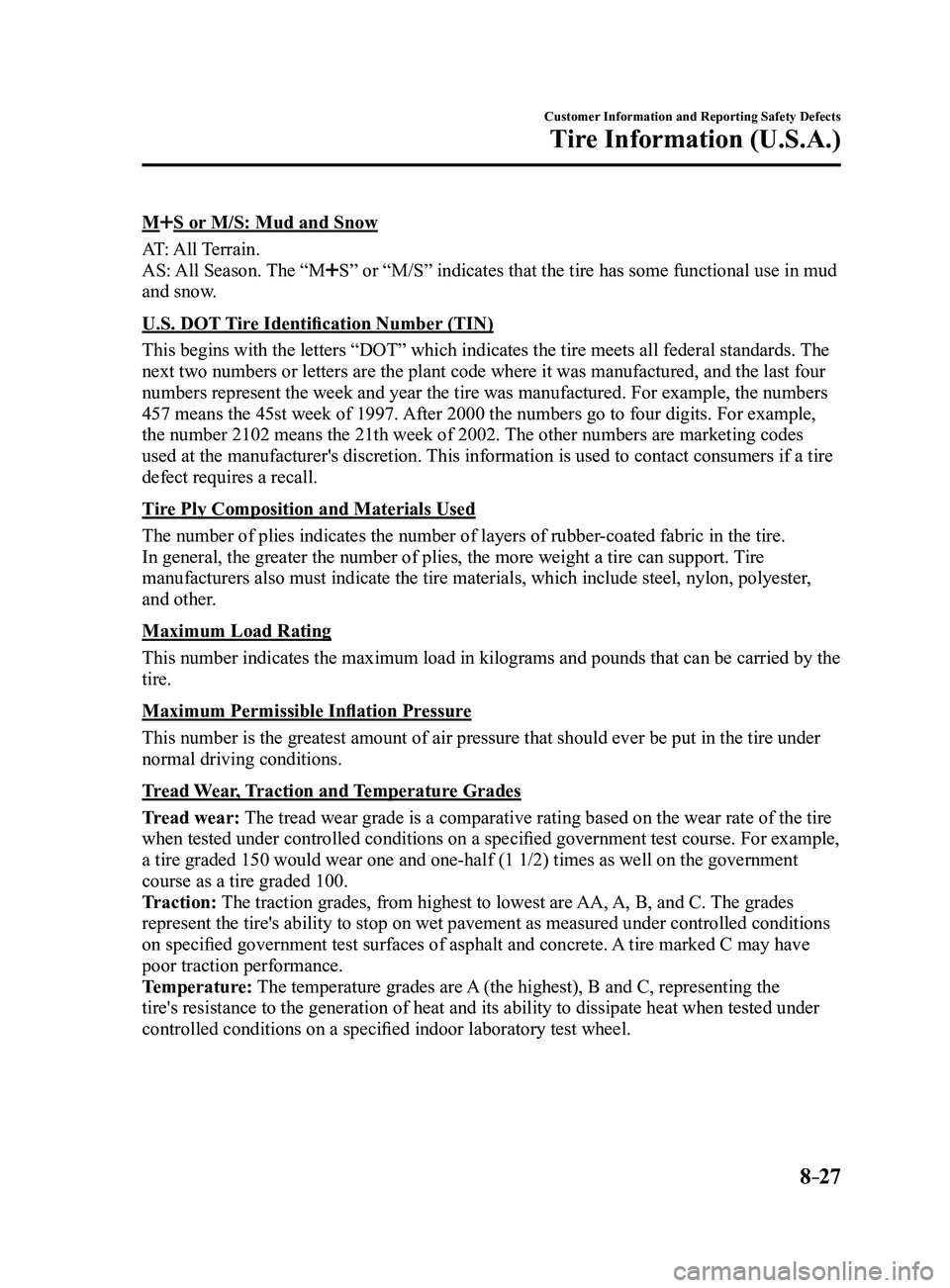
Tread Wear, Traction and Temperature Grades
Tread wear: The tread wear grade is a comparative rating based on the wear rate of t\
he tire
when tested under controlled conditions on a specified government test course. For example,
a tire graded 150 would wear one and one-half (1 1/2) times as well on\
the government
course as a tire graded 100.
Traction: The traction grades, from highest to lowest are AA, A, B, and C. The grades
represent the tire's ability to stop on wet pavement as measured under c\
ontrolled conditions
on specified government test surfaces of asphalt and concrete. A tire marked C may have
poor traction performance.
Temperature: The temperature grades are A (the highest), B and C, representing the
tire's resistance to the generation of heat and its ability to dissipate\
heat when tested under
controlled conditions on a specified indoor laboratory test wheel.
Mazda3_8FL6-EA-16F_Edition2.indb 272016/08/10 17:39:41
Page 610 of 612
10–8
Spare Tire ..............................................7-5
Specifications
........................................9-4
Speed Unit Selector
.............................4-14
Speedometer
........................................4-14
Starting the Engine
................................4-5
Steering Wheel
....................................3-33
Horn ............................................... 4-56
Storage Compartments
......................5-117
Center console
.............................5-118
Glove compartment
.....................5-117
Overhead console
........................5-117
Rear coat hooks
...........................5-119
Sunshade
.............................................3-41
Sunvisors
...........................................5-110
T
Tachometer ..........................................4-16
Theft-Deterrent System
.......................3-44
Tiedown Hook
..............................................7-23
Tire Information
..................................8-25
Tire Pressure Monitoring System
.....4-151
Tire inflation pressure warning beep
...7-41
Tires
....................................................6-41
Flat Tire
...........................................7-3
Replacing a Tire
............................6-43
Replacing a Wheel
........................6-44
Snow tires
......................................3-49
Specifications
................................9-10
Temporary Spare Tire
....................6-43
Tire Inflation Pressure
...................6-41
Tire Rotation
.................................6-42
Tire chains
.....................................3-50
Uniform tire quality grading system
(UTQGS)
.......................................8-23
Towing Recreational towing
......................3-53
Trailer Towing
...............................3-53
Towing Description
.............................7-22
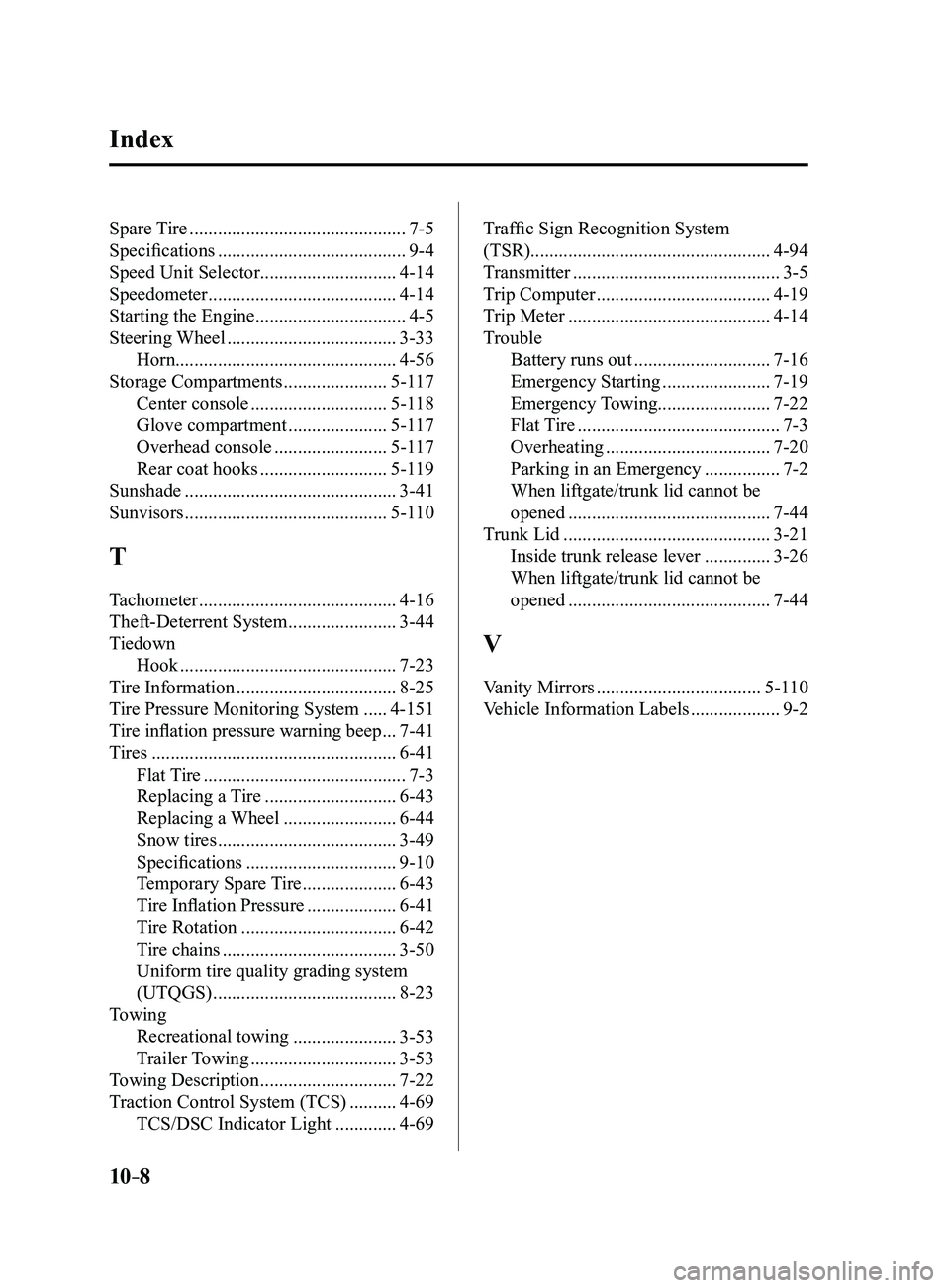
Traction Control System (TCS)
..........4-69
TCS/DSC Indicator Light
.............4-69 Traffic Sign Recognition System
(TSR)................................................... 4-94
Transmitter
............................................3-5
Trip Computer
.....................................4-19
Trip Meter
...........................................4-14
Trouble Battery runs out
.............................7-16
Emergency Starting
.......................7-19
Emergency Towing ........................7-22
Flat Tire
...........................................7-3
Overheating
...................................7-20
Parking in an Emergency
................7-2
When liftgate/trunk lid cannot be
opened
...........................................7-44
Trunk Lid
............................................3-21
Inside trunk release lever
..............3-26
When liftgate/trunk lid cannot be
opened
...........................................7-44
V
Vanity Mirrors ...................................5-110
Vehicle Information Labels
...................9-2
Index
Mazda3_8FL6-EA-16F_Edition2.indb 82016/08/10 17:39:58