belt MAZDA MODEL 3 4-DOOR 2018 Owner's Manual
[x] Cancel search | Manufacturer: MAZDA, Model Year: 2018, Model line: MODEL 3 4-DOOR, Model: MAZDA MODEL 3 4-DOOR 2018Pages: 624, PDF Size: 59.23 MB
Page 37 of 624

Seating a child in a child-restraint system on the front passenger seat is dangerous under
certain conditions (With Front Passenger Occupant Classification System):
Your vehicle is equipped with front passenger occupant classification sensor. Even with the
front passenger occupant classification sensor, if you must use the front passenger seat to
seat a child, using a child-restraint system on the front passenger seat under the following
conditions increases the danger of the front passenger air bag deploying and could result in
serious injury or death to the child.
The front passenger air bag deactivation indicato r light does not illuminate when seating a
child in the child-restraint system.
Luggage or other items are placed on the seat with the child in the child-restraint system.
A rear passenger or luggage pushing or pulling down on the front passenger seatback.
Luggage or other items are placed on the seatback or hung on the head restraint.
The seat is washed.
Liquids are spilled on the seat.
The front passenger seat is moved backward, pushing into luggage or other items placed
behind it.
The front passenger seatback contacts the rear seat.
Luggage or other items are placed between the front passenger seat and driver seat.
An electric device is put on the front passenger's seat.
An additional electrical device, such as a seat warmer is installed to the surface of the front
passenger seat.
The designated positions with seat belts on th e rear seats are the safest places for children.
Always use seat belts and child restraints.
Do not allow a child or anyone to lean over or against the side window of a vehicle with side
and curtain air bags:
It is dangerous to allow anyone to lean over or against the side window, the area of the front
passenger seat, the front and rear window pillars and the roof edge along both sides from
which the side and curtain air bags deploy, even if a child-restraint system is used. The impact
of inflation from a side or curtain air bag could cause serious injury or death to an out of
position child. Furthermore, leaning over or ag ainst the front door could block the side and
curtain air bags and eliminate the advantages of supplemental protection. With the front air
bag and the additional side air bag that comes ou t of the front seat, the rear seat is always a
better location for children. Take special care no t to allow a child to lean over or against the
side window, even if the child is seated in a child-restraint system.
Essential Safety Equipment
Child-Restraint
2-23
Mazda3_8GE4-EA-17F_Edition1 2017-4-7 11:59:21
Page 38 of 624
Never use one seat belt on more than one person at a time:
Using one seat belt for more than one person at a time is dangerous. A seat belt used in this
way cannot spread the impact forces properly and the two passengers could be crushed
together and seriously injured or even killed. Never use one belt for more than one person at a
time and always operate the vehicle with each occupant properly restrained.
CAUTION
A seat belt or child-restraint system can become very hot in a closed vehicle during warm
weather. To avoid burning yourself or a child, check them before you or your child touches
them.
NOTE
Your Mazda is equipped with LATCH lower an chors for attachment of specially designed
LATCH child-restraint systems in the rear seats. When using these anchors to secure a
child-restraint system, refer to "U sing LATCH Lower Anchor" (page 2-40).
Essential Safety Equipment
Child-Restraint
2-24
Mazda3_8GE4-EA-17F_Edition1 2017-4-7 11:59:21
Page 40 of 624
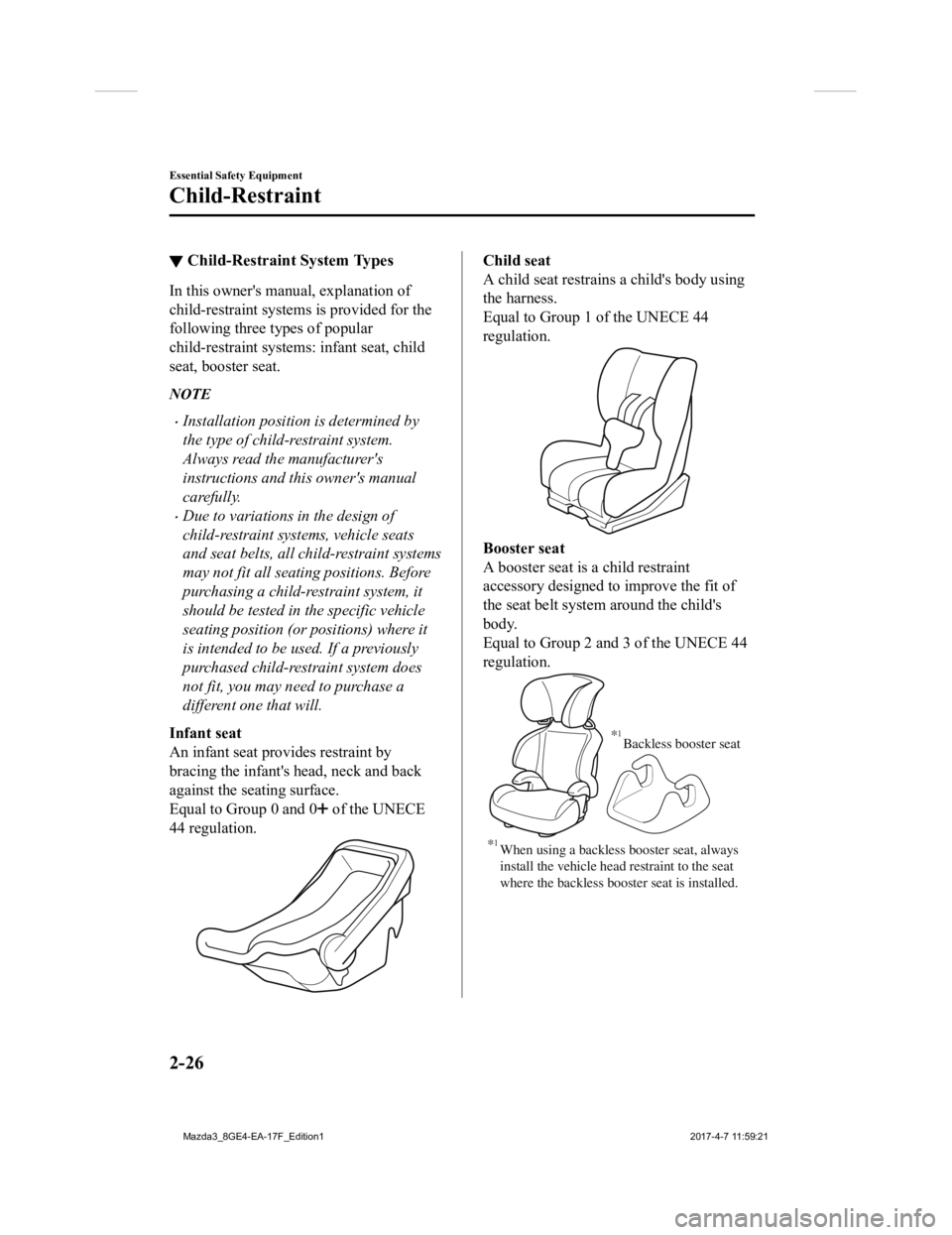
▼Child-Restraint System Types
In this owner's manual, explanation of
child-restraint system
s is provided for the
following three types of popular
child-restraint system s: infant seat, child
seat, booster seat.
NOTE
Installation position is determined by
the type of child-restraint system.
Always read the manufacturer's
instructions and this owner's manual
carefully.
Due to variations in the design of
child-restraint systems, vehicle seats
and seat belts, all child-restraint systems
may not fit all seating positions. Before
purchasing a child-restraint system, it
should be tested in the specific vehicle
seating position (or positions) where it
is intended to be used. If a previously
purchased child-restraint system does
not fit, you may need to purchase a
different one that will.
Infant seat
An infant seat provides restraint by
bracing the infant's head, neck and back
against the seating surface.
Equal to Group 0 and 0
of the UNECE
44 regulation.
Child seat
A child seat restrains a child's body using
the harness.
Equal to Group 1 of the UNECE 44
regulation.
Booster seat
A booster seat is a child restraint
accessory designed to improve the fit of
the seat belt system around the child's
body.
Equal to Group 2 and 3 of the UNECE 44
regulation.
When using a backless booster seat, always
install the vehicle head restraint to the seat
where the backless booster seat is installed.
Backless booster seat
*1
*1
Essential Safety Equipment
Child-Restraint
2-26
Mazda3_8GE4-EA-17F_Edition1
2017-4-7 11:59:21
Page 44 of 624
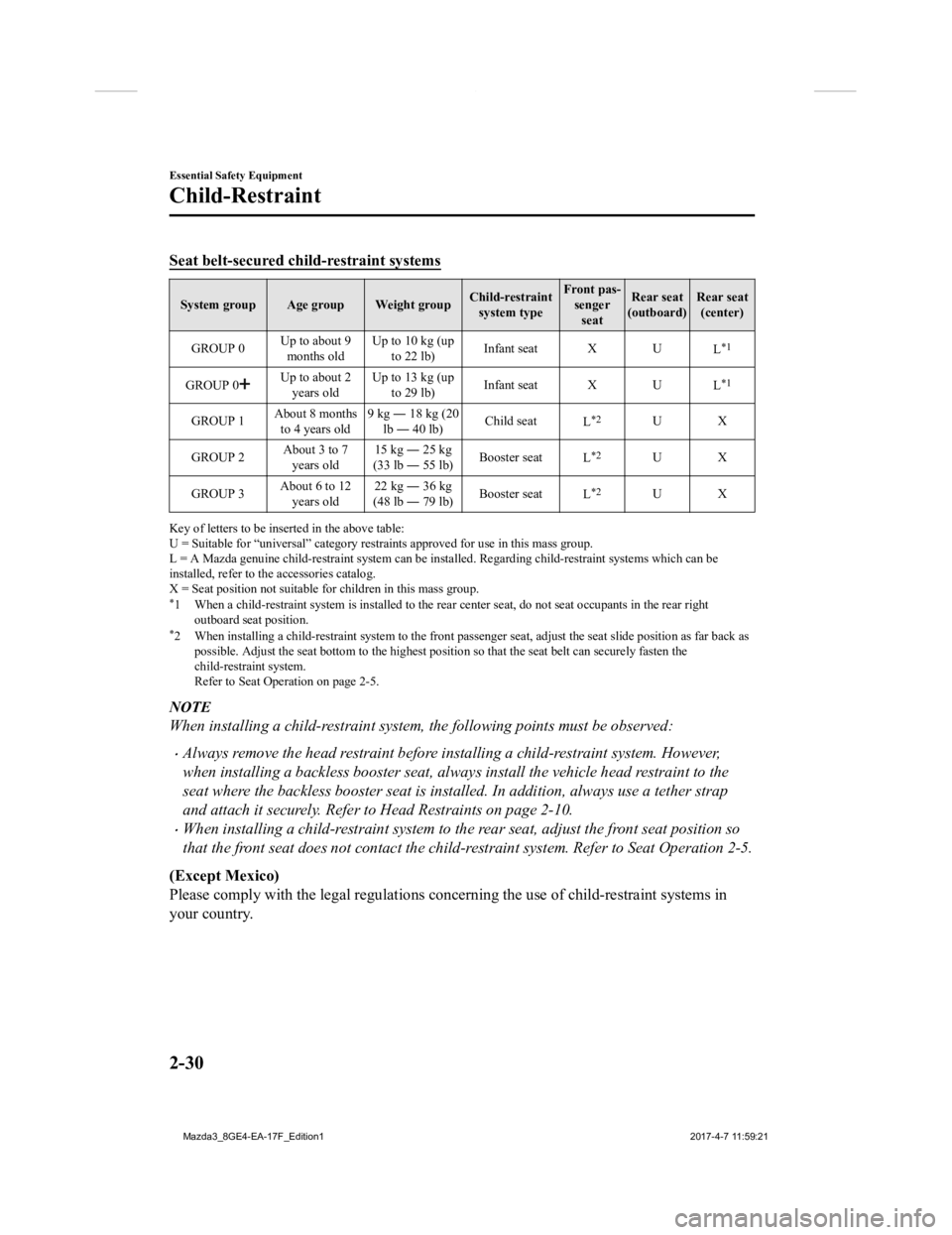
Seat belt-secured child-restraint systems
System group Age group Weight groupChild-restraint
system type Front pas-
sengerseat Rear seat
(outboard) Rear seat
(center)
GROUP 0 Up to about 9
months old Up to 10 kg (up
to 22 lb) Infant seat X U
L
*1
GROUP 0Up to about 2
years old Up to 13 kg (up
to 29 lb) Infant seat X U
L*1
GROUP 1About 8 months
to 4 years old 9 kg ― 18 kg (20
lb ― 40 lb) Child seat
L*2UX
GROUP 2 About 3 to 7
years old 15 kg ― 25 kg
(33 lb ― 55 lb) Booster seat
L
*2UX
GROUP 3 About 6 to 12
years old 22 kg ― 36 kg
(48 lb ― 79 lb) Booster seat
L
*2UX
Key of letters to be inserted in the above table:
U = Suitable for “univ ersal” category restraints approved for u se in this mass group.
L = A Mazda genuine child-restrai nt system can be installed. Regarding child-restraint systems which can be
installed, refer to the accessories catalog.
X = Seat position not suitable for children in this mass group.
*1 When a child-restraint system is installed to the rear center seat, do not seat occupants in the rear right
outboard seat position.
*2 When installing a child-restraint system to the front passenge r seat, adjust the seat slide position as far back as
possible. Adjust the se at bottom to the highest position so tha t the seat belt can securely fasten the
child-restraint system.
Refer to Seat Operation on page 2-5.
NOTE
When installing a child-restraint system, the following points must be observed:
Always remove the head restraint before installing a child-restraint system. However,
when installing a backless booster seat, always install the vehicle head restraint to the
seat where the backless booster seat is instal led. In addition, always use a tether strap
and attach it securely. Refer to Head Restraints on page 2-10.
When installing a child-restraint system to the rear seat, adjust the front seat position so
that the front seat does not contact the child-restraint system. Refer to Seat Operation 2-5.
(Except Mexico)
Please comply with the legal regulations concerning the use of child-restraint systems in
your country.
Essential Safety Equipment
Child-Restraint
2-30
Mazda3_8GE4-EA-17F_Edition1 2017-4-7 11:59:21
Page 47 of 624
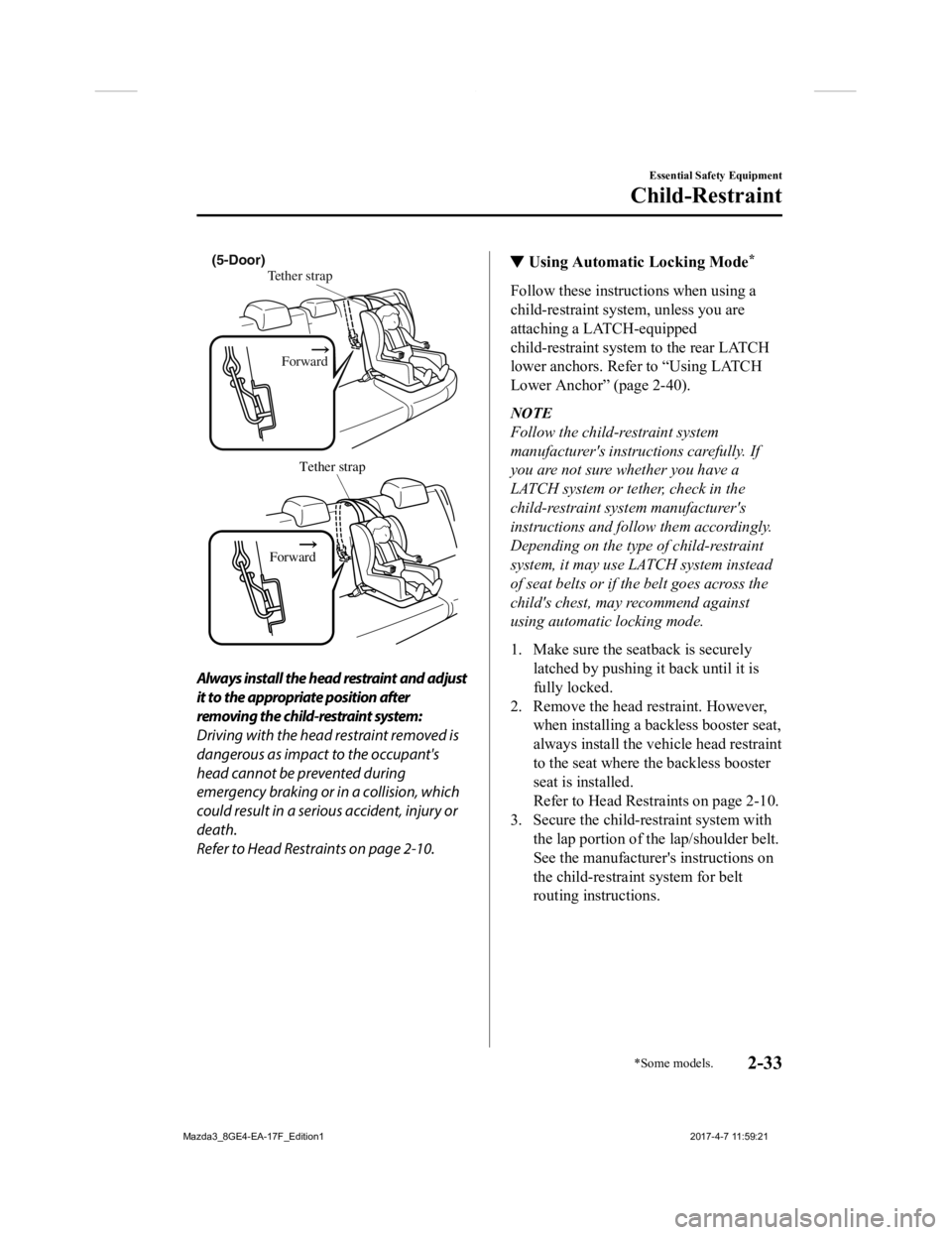
Tether strapForward
(5-Door)
Tether strap
Forward
Always install the head restraint and adjust
it to the appropriate position after
removing the child-restraint system:
Driving with the head restraint removed is
dangerous as impact to the occupant's
head cannot be prevented during
emergency braking or in a collision, which
could result in a serious accident, injury or
death.
Refer to Head Restraints on page 2-10.
▼ Using Automatic Locking Mode*
Follow these instructions when using a
child-restraint system, unless you are
attaching a LATCH-equipped
child-restraint syst
em to the rear LATCH
lower anchors. Refer to “Using LATCH
Lower Anchor” (page 2-40).
NOTE
Follow the child-restraint system
manufacturer's instru ctions carefully. If
you are not sure whether you have a
LATCH system or tether, check in the
child-restraint system manufacturer's
instructions and follow them accordingly.
Depending on the type of child-restraint
system, it may use LATCH system instead
of seat belts or if the belt goes across the
child's chest, may recommend against
using automatic locking mode.
1. Make sure the seatback is securely latched by pushing it back until it is
fully locked.
2. Remove the head restraint. However,
when installing a backless booster seat,
always install the vehicle head restraint
to the seat where the backless booster
seat is installed.
Refer to Head Restra ints on page 2-10.
3. Secure the child-restraint system with the lap portion of the lap/shoulder belt.
See the manufacturer's instructions on
the child-restraint system for belt
routing instructions.
Essential Safety Equipment
Child-Restraint
*Some models.2-33
Mazda3_8GE4-EA-17F_Edition1 2017-4-7 11:59:21
Page 48 of 624
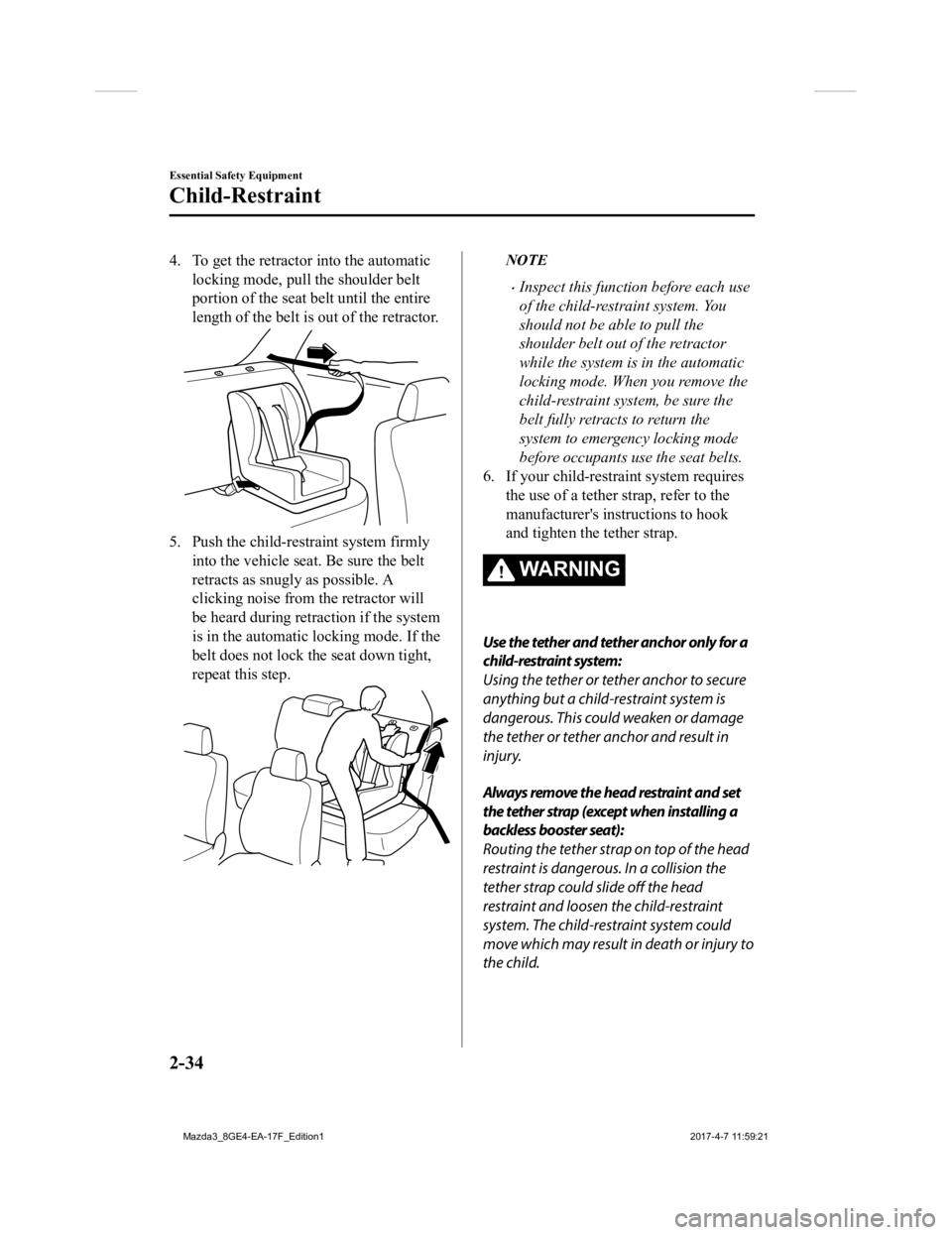
4. To get the retractor into the automatic
locking mode, pull the shoulder belt
portion of the seat belt until the entire
length of the belt is out of the retractor.
5. Push the child-restraint system firmly into the vehicle sea t. Be sure the belt
retracts as snugly as possible. A
clicking noise from the retractor will
be heard during retraction if the system
is in the automatic locking mode. If the
belt does not lock the seat down tight,
repeat this step.
NOTE
Inspect this function before each use
of the child-restraint system. You
should not be able to pull the
shoulder belt out of the retractor
while the system is in the automatic
locking mode. When you remove the
child-restraint system, be sure the
belt fully retracts to return the
system to emergency locking mode
before occupants use the seat belts.
6. If your child-restraint system requires the use of a tether strap, refer to the
manufacturer's instructions to hook
and tighten the tether strap.
WA R N I N G
Use the tether and tether anchor only for a
child-restraint system:
Using the tether or tether anchor to secure
anything but a child-restraint system is
dangerous. This could weaken or damage
the tether or tether anchor and result in
injury.
Always remove the head restraint and set
the tether strap (except when installing a
backless booster seat):
Routing the tether strap on top of the head
restraint is dangerous. In a collision the
tether strap could slide off the head
restraint and loosen the child-restraint
system. The child-restraint system could
move which may result in death or injury to
the child.
Essential Safety Equipment
Child-Restraint
2-34
Mazda3_8GE4-EA-17F_Edition1 2017-4-7 11:59:21
Page 50 of 624

▼If You Must Use the Front Seat for
Children
If you cannot put all children in the rear
seat, at least put the
smallest children in
the rear and be sure the largest child up
front uses the shoulder belt over the
shoulder.
NEVER put a rear-facing child-restraint
system on the front passenger seat whether
your vehicle is equipped with an occupant
classification sensor or not.
This seat is also not set up for tethered
child-restraint system s, put them in one of
the rear seat positions set up with tether
anchors.
Likewise the LATCH child-restraint
system cannot be secured in the front
passenger's seat and should be used in the
rear seat.
Do not allow anyone to sleep against the
side window since your vehicle has side
and curtain air bags, it could cause serious
injuries to an out of position occupant. As
children more often sleep in cars, it is
better to put them in the rear seat. If
installing the child-re straint system on the
front seat is unavoidable, follow these
instructions when using a front-facing
child-restraint sy stem in the front
passenger's seat.
NOTE
To check if your front seats have side air
bags:
Mazda vehicles equipped with side air
bag will have a "SRS AIRBAG" tag on
the outboard shoulder of the front seats.
To check if your vehicle has curtain air
bags:
Mazda vehicles equipped with curtain
air bag will have an "SRS AIRBAG"
marking on the window pillars along the
roof edge.
WA R N I N G
Always move the front passenger seat as
far back as possible if installing a
front-facing child-restraint system on it is
unavoidable:
As your vehicle has front air bags and
doubly so because your vehicle has side air
bags, a front-facing child-restraint system
should be put on th e front passenger seat
only when it is unavoidable.
Even if the front passenger air bag
deactivation indicator light illuminates,
always move the seat as far back as
possible, because the force of a deploying
air bag could cause serious injury or death
to the child.
Never use a rear-facing child-restraint
system in the front seat with an air bag
that could deploy:
Rear-facing child-restraint systems on the
front seat are part icularly dangerous.
Even in a moderate collision, the
child-restraint system can be hit by a
deploying air bag and moved violently
backward resulting in serious injury or
death to the child. Even though you may
feel assured that the front passenger air
bag will not deploy based on the fact that
the front passenger air bag deactivation
indicator light illuminates, you should not
use a rear-facing child-restraint system in
the front seat.
Essential Safety Equipment
Child-Restraint
2-36
Mazda3_8GE4-EA-17F_Edition1 2017-4-7 11:59:21
Page 51 of 624

Do not allow a child or anyone to lean over
or against the side window of a vehicle
with side and curtain air bags:
It is dangerous to allow anyone to lean over
or against the side window, the area of the
front passenger seat, the front and rear
window pillars and the roof edge along
both sides from which the side and curtain
air bags deploy, even if a child-restraint
system is used. The impact of inflation from
a side or curtain air bag could cause serious
injury or death to an out of position child.
Furthermore, leaning over or against the
front door could block the side and curtain
air bags and eliminate the advantages of
supplemental protection. With the front air
bag and the additional side air bag that
comes out of the front seat, the rear seat is
always a better location for children. Take
special care not to allow a child to lean
over or against the side window, even if the
child is seated in a child-restraint system.
Always remove the head restraint and
install child-restraint system (except when
installing a backless booster seat):
Installing a child-restraint system without
removing the head restraint is dangerous.
The child-restraint system cannot be
installed correctly which may result in
death or injury to the child in a collision.
Always install the head restraint and adjust
it to the appropriate position after
removing the child-restraint system:
Driving with the head restraint removed is
dangerous as impact to the occupant's
head cannot be prevented during
emergency braking or in a collision, which
could result in a serious accident, injury or
death.
Refer to Head Restraints on page 2-10.Front Passenger's S eat Child-Restraint
System Installation (With Front
Passenger Occupant Classification
System)
1. Make sure the ignition is switched off.
2. Slide the seat as far back as possible.
3. Remove the head restraint. However,
when installing a backless booster seat,
always install the vehicle head restraint
to the seat where the backless booster
seat is installed.
4. Place the child-restraint system on the seat without putting your weight on the
seat and fasten the seat belt. See the
manufacturer's instructions on the
child-restraint system for belt routing
instructions.
5. To get the retractor into the automatic
locking mode, pull the shoulder belt
portion of the seat belt until the entire
length of the belt is out of the retractor.
6. Push the child-restraint system firmly into the vehicle seat. Be sure the belt
retracts as snugly as possible. A
clicking noise from the retractor will
be heard during retraction if the system
is in automatic lo cking mode. If the
belt does not lock the seat down tight,
repeat the previous step and also this
one.
Essential Safety Equipment
Child-Restraint
2-37
Mazda3_8GE4-EA-17F_Edition1 2017-4-7 11:59:21
Page 52 of 624
NOTE
Inspect this function before each use
of the child-restraint system. You
should not be able to pull the
shoulder belt out of the retractor
while the system is in the automatic
locking mode. When you remove the
child-restraint system, be sure the
belt fully retracts to return the
system to emergency locking mode
before occupants use the seat belts.
Follow the child-restraint system
manufacturer's instructions
carefully.
Depending on the type of
child-restraint system, it may not
employ seat belts which are in
automatic locking mode.
7. Seat your child safely in the
child-restraint system and secure the
child according to the instructions
from the child-restraint system
manufacturer.
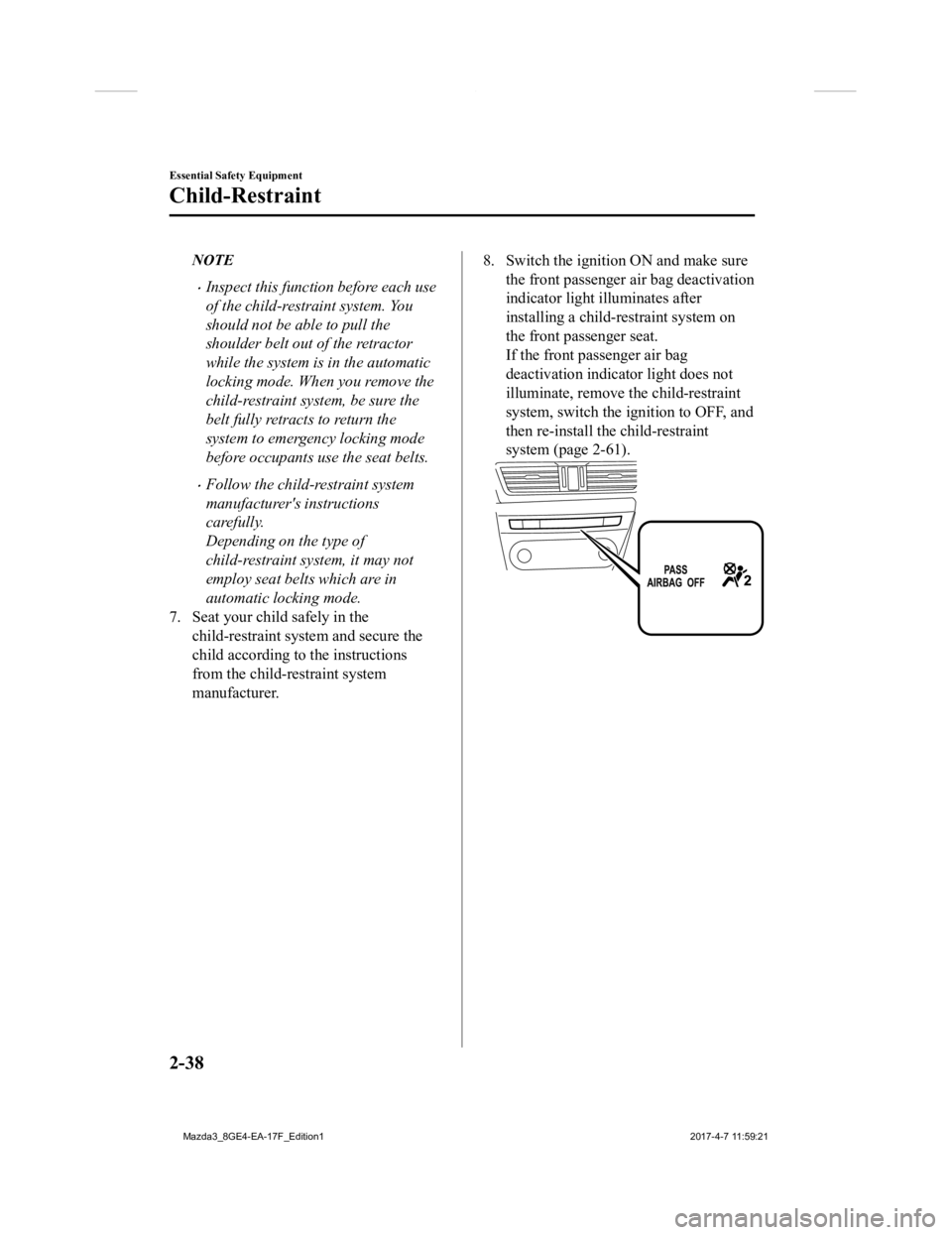
8. Switch the ignition ON and make surethe front passenger air bag deactivation
indicator light illuminates after
installing a child-restraint system on
the front passenger seat.
If the front passenger air bag
deactivation indicator light does not
illuminate, remove the child-restraint
system, switch the ignition to OFF, and
then re-install th e child-restraint
system (page 2-61).
Essential Safety Equipment
Child-Restraint
2-38
Mazda3_8GE4-EA-17F_Edition1 2017-4-7 11:59:21
Page 53 of 624
WA R N I N G
Do not seat a child in a child-restraint
system on the front passenger seat if the
front passenger air bag deactivation
indicator light does not illuminate:
While it is always better to install any
child-restraint system on the rear seat, it is
imperative that a child-restraint system
ONLY be used on the front passenger seat if
the deactivation indica tor light illuminates
when the child is seated in the
child-restraint system (page 2-61). Seating
a child in a child-restraint system installed
on the front passenger seat with the front
passenger air bag deactivation indicator
light not illuminated is dangerous. If this
indicator light does not illuminate, this
means that the front passenger front and
side air bags, and seat belt pretensioner are
ready for deployment. If an accident were
to deploy an air bag, a child in a
child-restraint system sitting in the front
passenger seat could be seriously injured or
killed. If the indicator light does not
illuminate after seating a child in a
child-restraint system on the front
passenger seat, seat a child in a
child-restraint system on the rear seat and
consult an Authorized Mazda Dealer as
soon as possible.
Essential Safety Equipment
Child-Restraint
2-39
Mazda3_8GE4-EA-17F_Edition1 2017-4-7 11:59:21