belt MAZDA MODEL 3 4-DOOR 2018 Service Manual
[x] Cancel search | Manufacturer: MAZDA, Model Year: 2018, Model line: MODEL 3 4-DOOR, Model: MAZDA MODEL 3 4-DOOR 2018Pages: 624, PDF Size: 59.23 MB
Page 74 of 624
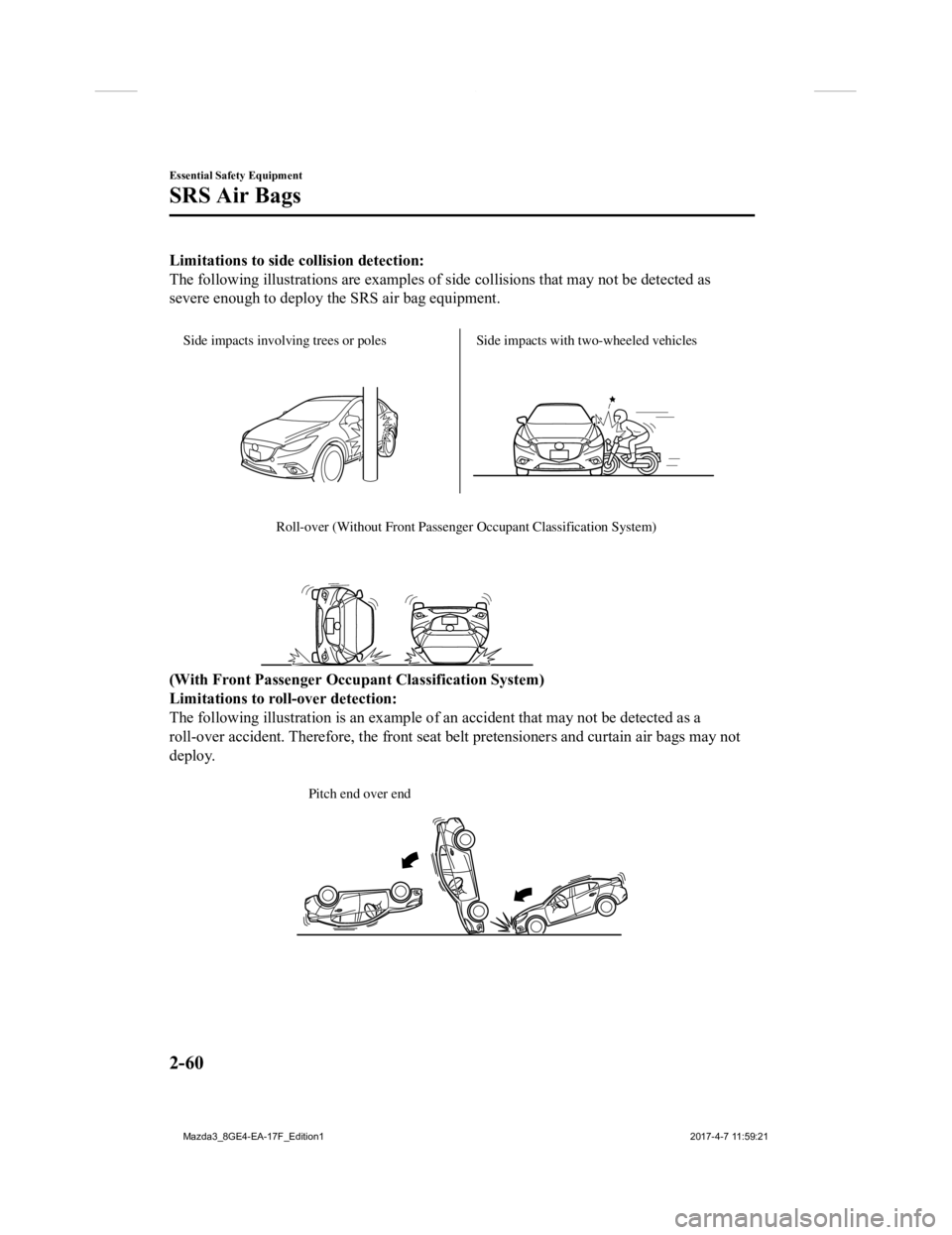
Limitations to side collision detection:
The following illustrations are e xamples of side collisions that may not be detected as
severe enough to deploy the SRS air bag equipment.
Side impacts involving trees or poles Side impacts with two-wheeled vehicles
Roll-over (Without Front Passenger Occupant Classification System)
(With Front Passenger Occupa
nt Classification System)
Limitations to roll-over detection:
The following illustration is an example of an accident that may not be detected as a
roll-over accident. Therefore, the front seat belt pretensioner s and curtain air bags may not
deploy.
Pitch end over end
Essential Safety Equipment
SRS Air Bags
2-60
Mazda3_8GE4-EA-17F_Edition1 2017-4-7 11:59:21
Page 75 of 624

Front Passenger Occupant Classification System*
First, please read "Supplemental Restraint System (SRS) Precautions" (page 2-44) carefully.
▼Front Passenger Occupant Classification Sensor
Your vehicle is equipped with a front passenger occupant classi
fication sensor as a part of
the supplemental restraint system. This sensor is equipped in t he front passenger's seat
cushion. This sensor measures th e electrostatic capacity of the front passenger's seat. The
SAS unit is designed to prevent the front passenger front and s ide air bags and seat belt
pretensioner system from deployi ng if the front passenger air bag deactivation indicator
light turns on.
To reduce the chance of injuries caused by deployment of the front passenger air bag, the
system deactivates the front passenger front and side air bags and also the seat belt
pretensioner system when the front passenger air bag deactivati on indicator light turns on.
Refer to the following table for the front passenger air bag deactivation indicator light
illumination conditions.
This system shuts off the front passenger front and side air ba gs and seat belt pretensioner
system, so make sure the front passenger air bag deactivation indicator light turns on
according to the following table.
The air bag/front seat belt pretensioner system warning light f lashes and the front passenger
air bag deactivation indicator light illuminates if the sensors have a possible malfunction. If
this happens, the front passenger front and side air bags and s eat belt pretensioner system
will not deploy.
Front passenger air bag deactivation indicator light
This indicator light turns on to r emind you that the front passenger front and side air bags
and seat belt pretensioner will not deploy during a collision.
If the front passenger occupant classification sensor is normal, the indicator light turns on
when the ignition is switched ON. The light turns off after a f ew seconds. Then, the
indicator light turns on or is off under the following conditio ns:
Essential Safety Equipment
SRS Air Bags
*Some models.2-61
Mazda3_8GE4-EA-17F_Edition1 2017-4-7 11:59:21
Page 76 of 624

Front passenger air bag deactivation indicator light on/off condition chart
Condition detected by the front
passenger occupant classifica- tion system Front passenger air
bag deactivation indi- cator light Front passenger front
and side air bags Front passenger seat
belt pretensioner sys- tem
Empty (Not occupied) On Deactivated Deactivated
A child less than 1 year old is
seated in a child-restraint system On Deactivated Deactivated
Child
*1On or off Deactivated or ready Deactivated or ready
Adult
*2Off Ready Ready
*1 The occupant classification sens or may not detect a child seated on the seat, in a child-restraint system, or a
junior seat depending on the ch ild's physical size and seated posture.
*2 If a smaller adult sits on the front passenger seat, the sensors might detect the person as being a child
depending on the person's physique.
The curtain air bag is ready for inflating regardless of what the front passenger air bag
deactivation indicator light on/off condition chart indicates.
If the front passenger air bag deactivation indicator light doe s not turn on when the ignition
is switched ON and does not turn on as indicated in the front p assenger air bag deactivation
indicator light on/off condition chart, do not allow an occupan t to sit in the front passenger
seat and consult an Authorized M azda Dealer as soon as possible. The system may not work
properly in an accident.
WA R N I N G
Do not allow an occupant in the front passenger's seat to sit with a posture which makes it
difficult for the front passenger occupant classification sensor to detect the occupant
correctly:
Sitting in the front passenger's seat with a posture which makes it difficult for the front
passenger occupant classification sensor to detect the occupant correctly is dangerous. If the
front passenger occupant classification sensor cann ot detect the occupant sitting on the front
passenger's seat correctly, the front passenger front and side air bags and pretensioner system
may not operate (non-deploy) or they may oper ate (deploy) accidentally. The front passenger
will not have the supplementary protection of the air bags or the accidental operation
(deployment) of the air bags could result in serious injury or death.
Under the following conditions, the front passe nger occupant classification sensor cannot
detect a passenger sitting on the front pa ssenger's seat correctly and the deployment/
non-deployment of the air bags cannot be controlled as indicated in the front passenger air
bag deactivation indicator light on/off condition chart. For example:
Essential Safety Equipment
SRS Air Bags
2-62
Mazda3_8GE4-EA-17F_Edition1 2017-4-7 11:59:21
Page 78 of 624

The front passenger front and side air bags and seat belt pretensioner systems will deactivate
if the front passenger air bag deactivation indicator light turns on.
CAUTION
To assure proper deployment of the front air bag and to prevent damage to the sensor in
the front seat cushion:
Do not place sharp objects on the front seat cushion or leave heavy luggage on them.
Do not spill any liquids on the front seats or under the front seats.
To allow the sensors to function pr operly, always perform the following:
Adjust the front seats as far back as possibl e and always sit upright against the seatbacks
with seat belts worn properly.
If you place your child on the front passenger seat, secure the child-restraint system
properly and slide the fron t passenger seat as far back as possible (page 2-33).
NOTE
The system requires about 10 seconds to alte rnate between turning the front passenger
front and side air bags and seat belt pretensioner system on or off.
The front passenger air bag deactivation indicato r light may turn on repeatedly if luggage
or other items are put on the front passenger seat, or if the temperature of the vehicle's
interior changes suddenly.
The front passenger air bag deactivation indicato r light may turn on for 10 seconds if the
electrostatic capacity on the front passenger seat changes.
The air bag/front seat belt pretensioner system warning light might turn on if the front
passenger seat receives a severe impact.
If the front passenger air bag deactivation indicator light does not turn on after installing
a child-restraint system on the front passenger seat, first, re-install your child-restraint
system according to the procedure in this owner's manual. Then, if the front passenger air
bag deactivation indicator light still does not tu rn on, install the child-restraint system on
the rear seat and consult an Authorized Mazda Dealer as soon as possible.
If the front passenger air bag deactivation i ndicator light turns on when an occupant is
seated directly in the front passenger seat, have the passenger re-adjust their posture by
sitting with their feet on the floor, and th en re-fastening the seat belt. If the front
passenger air bag deactivation i ndicator light remains turned on, move the passenger to
the rear seat. If sitting in the rear seat is no t possible, slide the front passenger seat as far
back as possible. Consult an Authorized Mazda Dealer as soon as possible.
Essential Safety Equipment
SRS Air Bags
2-64
Mazda3_8GE4-EA-17F_Edition1 2017-4-7 11:59:21
Page 79 of 624

Constant Monitoring
The following components of the air bag systems are monitored by a diagnostic system:
Front air bag sensors
Crash sensors, and diagnostic module (SAS unit)
Side crash sensors
Air bag modules
Front seat belt pretensioners
Air bag/Front seat belt pretensioner system warning light
Related wiring
(With Front Passenger Occupa nt Classification System)
Front passenger occupant classification sensor
Front passenger occupant classification module
Front passenger air bag deactivation indicator light
The diagnostic module continuously monitors the system's readin ess. This begins when the
ignition is switched ON and contin ues while the vehicle is being driven.
Essential Safety Equipment
SRS Air Bags
2-65
Mazda3_8GE4-EA-17F_Edition1 2017-4-7 11:59:21
Page 138 of 624
After starting a cold engine, the engine
speed increases and a whining sound
from the engine compartment can be
heard.
This is for improved exhaust gas
purification and does not indicate any
parts defect.
Engine-starting is controlled by the
spark ignition system.
This system meets all Canadian
Interference-Causing Equipment
Standard requirements regulating the
impulse electrical field strength of radio
noise.
1. Make sure you are carrying the key.
2. Occupants should fasten their seat belts.
3. Make sure the parking brake is on.
4. Continue to press the brake pedal firmly until the engine has completely
started.
5. (Manual transaxle)
Continue to press the clutch pedal
firmly until the engine has completely
started.
(Automatic transaxle)
Put the vehicle in park (P). If you must
restart the engine while the vehicle is
moving, shift into neutral (N).
NOTE
(Manual transaxle)
The starter will not operate if the
clutch pedal is not depressed
sufficiently.
(Automatic transaxle)
The starter will not operate if the
selector lever is not in P or N and
the brake pedal is not depressed
sufficiently.
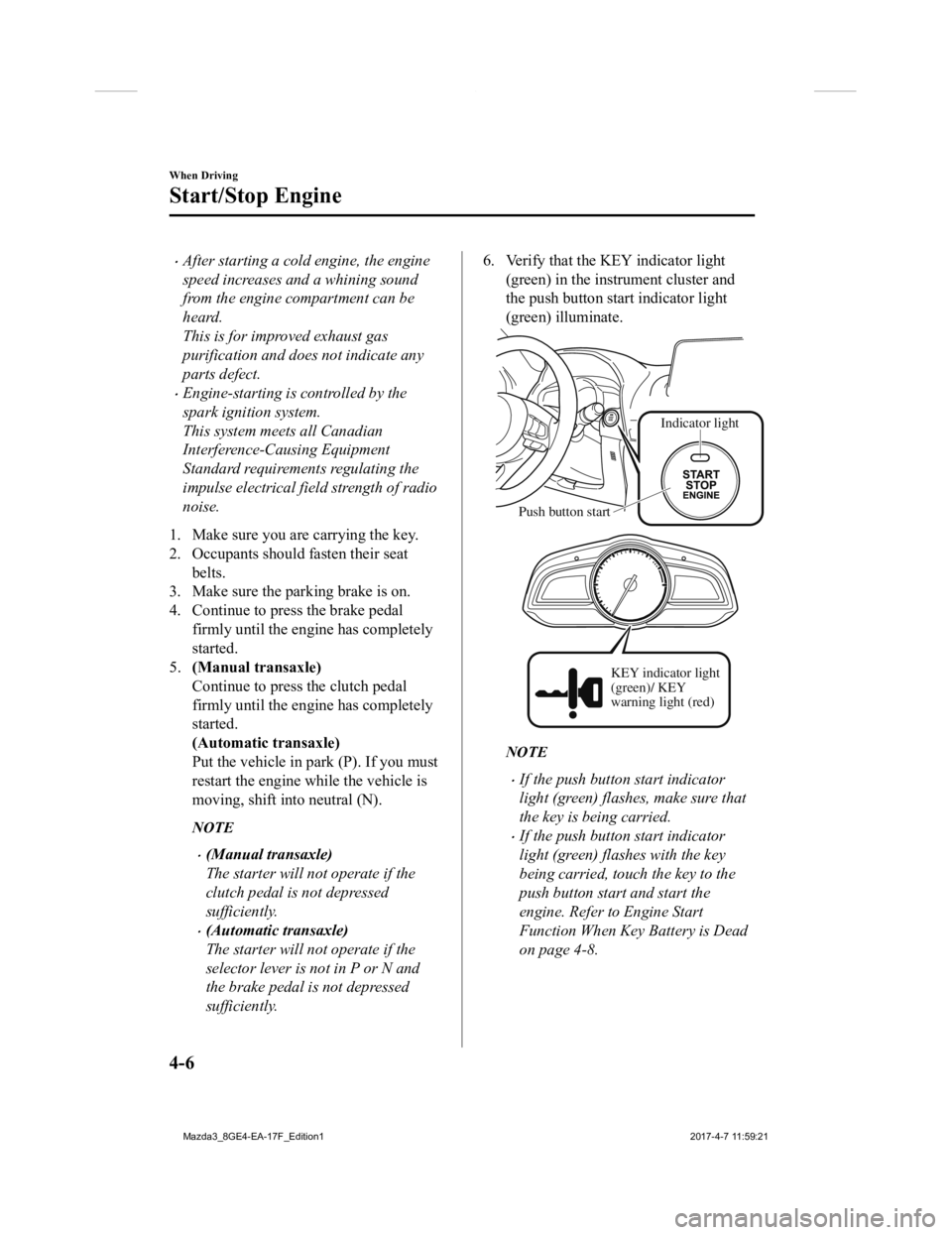
6. Verify that the KEY indicator light
(green) in the instr ument cluster and
the push button start indicator light
(green) illuminate.
Indicator light
Push b utton start
KEY indicator light
(green)/ KEY
warning light (red)
NOTE
If the push button start indicator
light (green) flashes, make sure that
the key is being carried.
If the push button start indicator
light (green) flashes with the key
being carried, touch the key to the
push button start and start the
engine. Refer to Engine Start
Function When Key Battery is Dead
on page 4-8.
When Driving
Start/Stop Engine
4-6
Mazda3_8GE4-EA-17F_Edition1 2017-4-7 11:59:21
Page 156 of 624
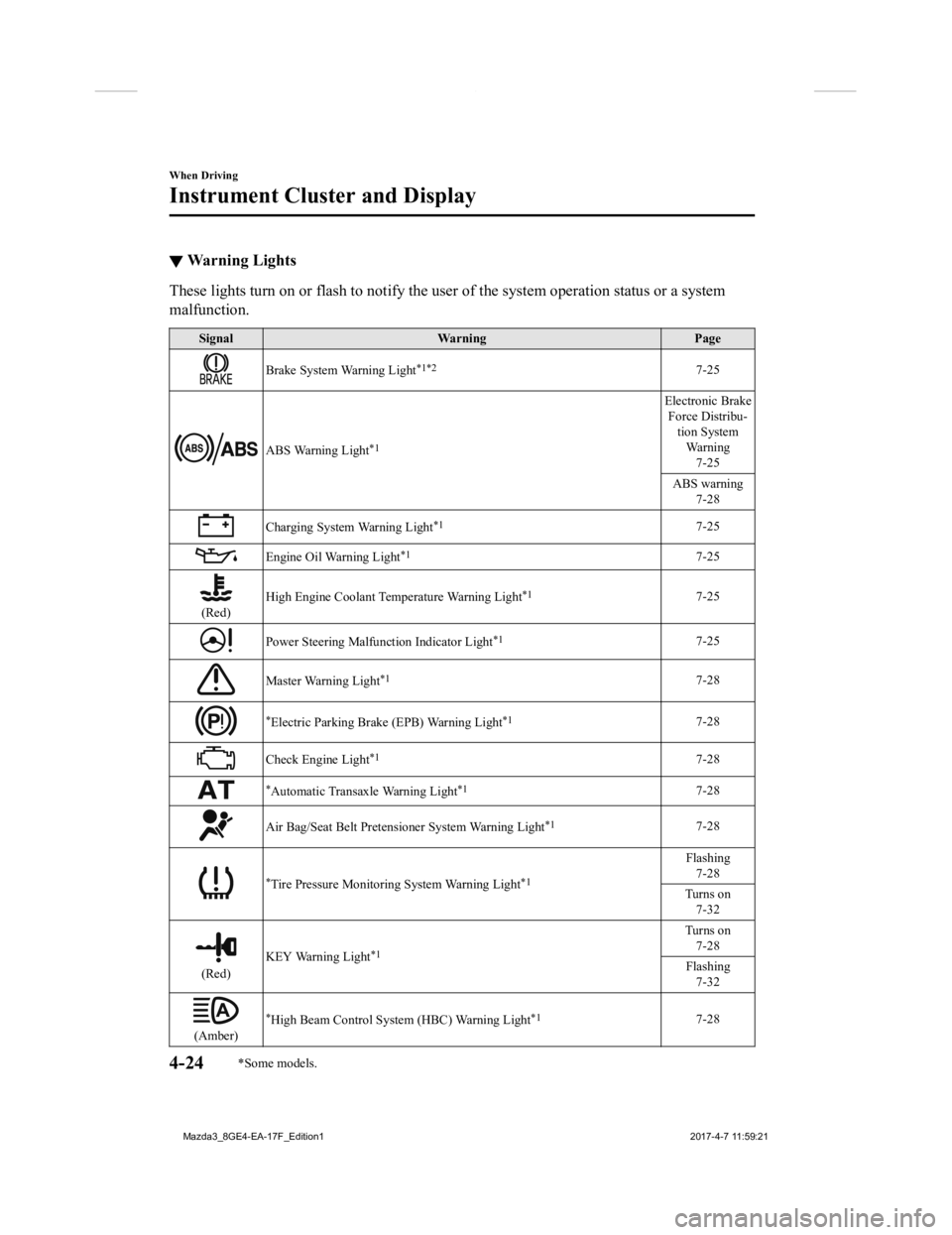
▼Warning Lights
These lights turn on or flash to notify the user of the system
operation status or a system
malfunction.
Signal Warning Page
Brake System Warning Light*1*27-25
ABS Warning Light*1
Electronic Brake
Force Distribu- tion SystemWa r n i n g 7-25
ABS warning 7-28
Charging System Warning Light*17-25
Engine Oil Warning Light*17-25
(Red) High Engine Coolant Temperature Warning Light
*17-25
Power Steering Malfunction Indicator Light*17-25
Master Warning Light*17-28
*Electric Parking Brake (EPB) Warning Light*17-28
Check Engine Light*17-28
*Automatic Transaxle Warning Light*17-28
Air Bag/Seat Belt Pretensioner System Warning Light*17-28
*Tire Pressure Monitoring System Warning Light*1
Flashing
7-28
Turns on 7-32
(Red) KEY Warning Light
*1
Turns on
7-28
Flashing 7-32
(Amber)
*High Beam Control System (HBC) Warning Light*17-28
When Driving
Instrument Cluster and Display
4-24*Some models.
Mazda3_8GE4-EA-17F_Edition1 2017-4-7 11:59:21
Page 157 of 624
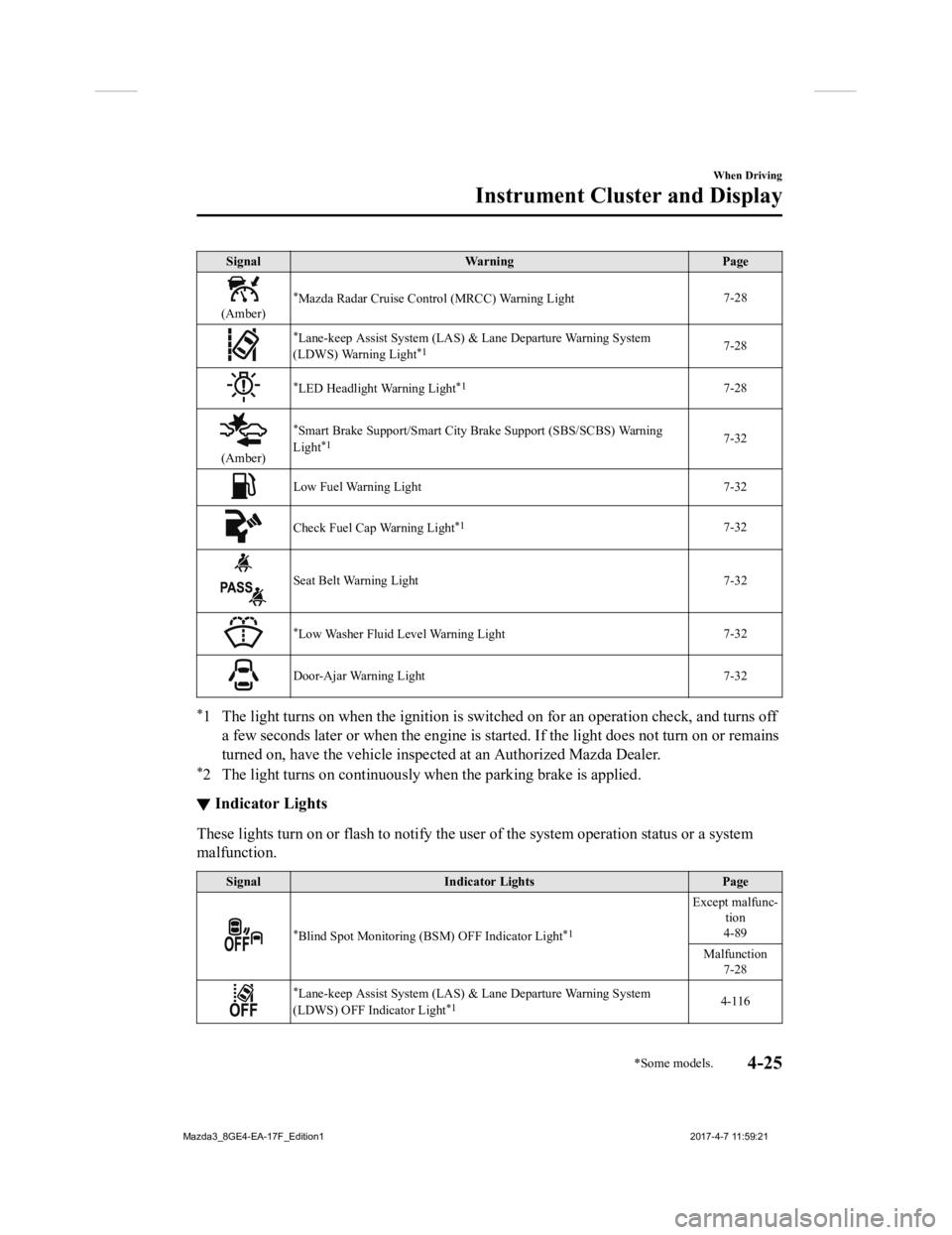
SignalWarning Page
(Amber)
*Mazda Radar Cruise Control (MRCC) Warning Light 7-28
*Lane-keep Assist System (LAS) & Lane Departure Warning System
(LDWS) Warning Light*17-28
*LED Headlight Warning Light*17-28
(Amber)
*Smart Brake Support/Smart City B rake Support (SBS/SCBS) Warning
Light*17-32
Low Fuel Warning Light 7-32
Check Fuel Cap Warning Light*17-32
Seat Belt Warning Light 7-32
*Low Washer Fluid Level Warning Light7-32
Door-Ajar Warning Light
7-32
*1 The light turns on when the ignition is switched on for an operation check, and turns off
a few seconds later or when the engine is started. If the light does not turn on or remains
turned on, have the vehicle inspected at an Authorized Mazda De aler.
*2 The light turns on continuously when the parking brake is appl ied.
▼Indicator Lights
These lights turn on or flash to
notify the user of the system operation status or a system
malfunction.
Signal Indicator Lights Page
*Blind Spot Monitoring (BSM) OFF Indicator Light*1
Except malfunc-
tion
4-89
Malfunction 7-28
*Lane-keep Assist System (LAS) & Lane Departure Warning System
(LDWS) OFF Indicator Light*14-116
When Driving
Instrument Cluster and Display
*Some models.4-25
Mazda3_8GE4-EA-17F_Edition1 2017-4-7 11:59:21
Page 195 of 624

EPB manual release
Firmly depress the brake pedal and press
the EPB switch.
If the EPB switch is pressed without
depressing the brake pedal, the indicator
light in the instrument cluster notifies the
driver that the brake is not depressed.
The brake pedal operation demand
indicator light in the instrument cluster
turns on.
EPB automatic release
If the accelerator pe dal is depressed with
the EPB applied and all of the following
conditions met, the parking brake is
released automatically.
The engine is running.
The driver's door is closed.
The driver's seat belt is fastened.
(Manual transaxle)
The change lever is in a position other
than neutral.
The clutch pedal is depressed halfway
(Automatic transaxle)
Selector lever is in the D, M, or R
position
NOTE
If something such as the driver's foot
contacts the accelerator pedal with the
engine running and the EPB applied, the
parking brake may be released
automatically. If you do not intend to drive
immediately, shift the change lever
(manual transaxle) to the neutral position,
or shift the selector lever (automatic
transaxle) to the P or N position.
▼ War ni ng L i gh t
The warning light
turns on when the
system has a malfunction.
Refer to Warning Lights on page 4-24.
▼ Brake Pad Wear Indicator
When the disc brake pads become worn,
the built-in wear indicators contact the
disc plates. This caus
es a screeching noise
to warn that the pads should be replaced.
When you hear this noise, consult an
Authorized Mazda Dealer as soon as
possible.
When Driving
Brake
4-63
Mazda3_8GE4-EA-17F_Edition1 2017-4-7 11:59:21
Page 236 of 624
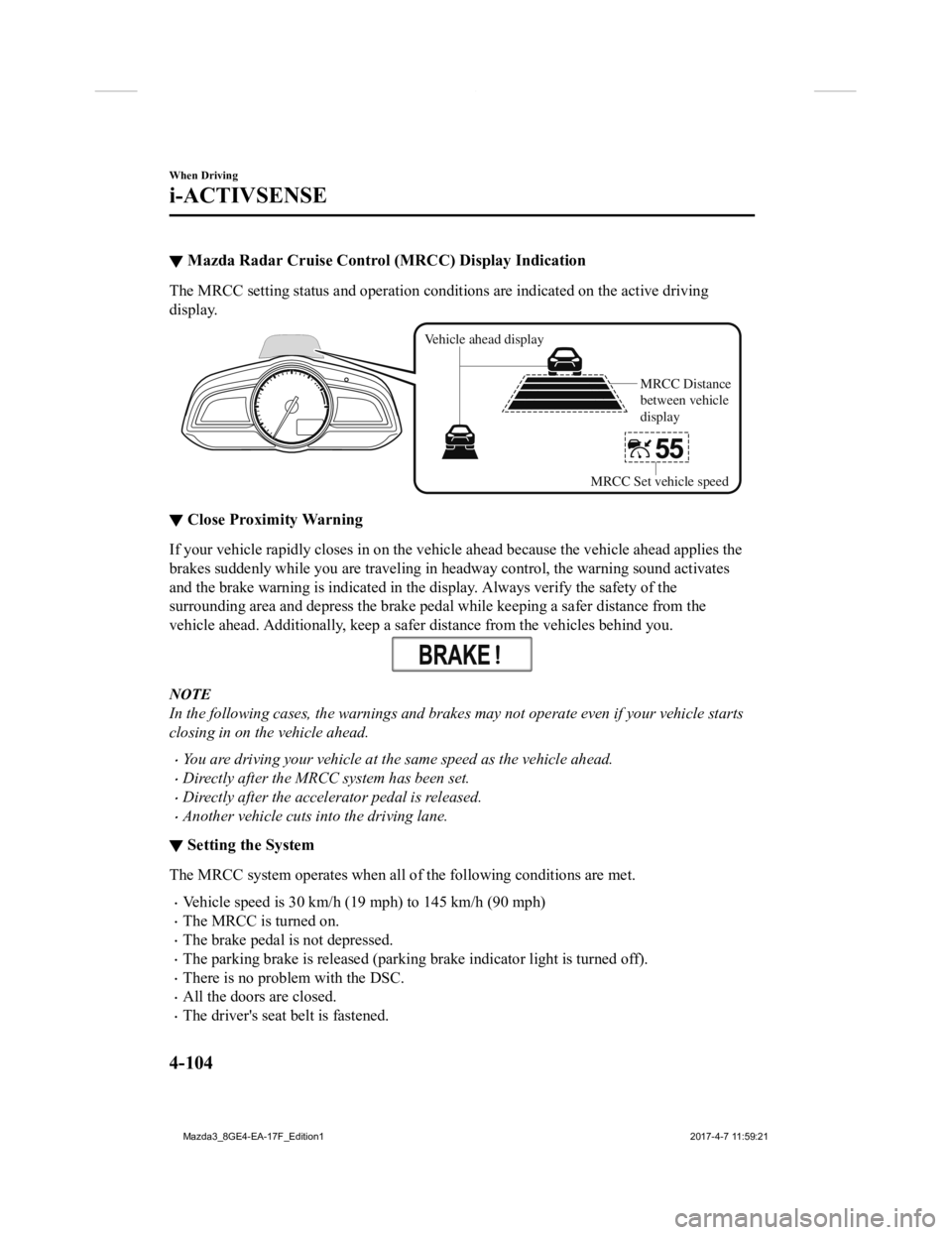
▼Mazda Radar Cruise Control (MRCC) Display Indication
The MRCC setting status and operation conditions are indicated
on the active driving
display.
Vehicle ahead display
MRCC Distance
between vehicle
display
MRCC Set vehicle speed
▼ Close Proximity Warning
If your vehicle rapidly closes in
on the vehicle ahead because the vehicle ahead applies the
brakes suddenly while you are traveling in headway control, the warning sound activates
and the brake warning is indicated in the display. Always verif y the safety of the
surrounding area and depress the brake pedal while keeping a sa fer distance from the
vehicle ahead. Additionally, keep a safer distance from the veh icles behind you.
NOTE
In the following cases, the warnings and brakes may not operate even if your vehicle starts
closing in on the vehicle ahead.
You are driving your vehicle at the same speed as the vehicle ahead.
Directly after the MRCC system has been set.
Directly after the accelerator pedal is released.
Another vehicle cuts into the driving lane.
▼Setting the System
The MRCC system operates when all of the following conditions a
re met.
Vehicle speed is 30 km/h (19 mph) to 145 km/h (90 mph)
The MRCC is turned on.
The brake pedal is not depressed.
The parking brake is released (parking brake indicator light is turned off).
There is no problem with the DSC.
All the doors are closed.
The driver's seat belt is fastened.
When Driving
i-ACTIVSENSE
4-104
Mazda3_8GE4-EA-17F_Edition1 2017-4-7 11:59:21