warning light MAZDA MODEL 3 5-DOOR 2017 Manual PDF
[x] Cancel search | Manufacturer: MAZDA, Model Year: 2017, Model line: MODEL 3 5-DOOR, Model: MAZDA MODEL 3 5-DOOR 2017Pages: 612
Page 218 of 612
4–88
When Driving
i-ACTIVSENSE
*Some models.
Blind Spot Monitoring (BSM)*
The Blind Spot Monitoring (BSM) is designed to assist the driver in checking the area to the
rear of the vehicle on both sides during lane changes by notifying the d\
river of the presence
of vehicles approaching from the rear in an adjacent lane.
The Blind Spot Monitoring (BSM) detects vehicles approaching from the rear while
traveling in the forward direction at a speed of 10 km/h (6.3 mph) or faster and notifies
the driver by turning on the Blind Spot Monitoring (BSM) warning indicator light and
displaying the vehicle detection screen (vehicles with active driving d\
isplay).
If the turn signal lever is operated to signal a turn in the direction in which the Blind Spot
Monitoring (BSM) warning indicator light is illuminated while the approaching vehicle is
detected, the Blind Spot Monitoring (BSM) notifies the driver of possible danger by turning
on the Blind Spot Monitoring (BSM) warning indicator light, and by activating the warning
sound and the warning screen indicator display (vehicles with active dr\
iving display).
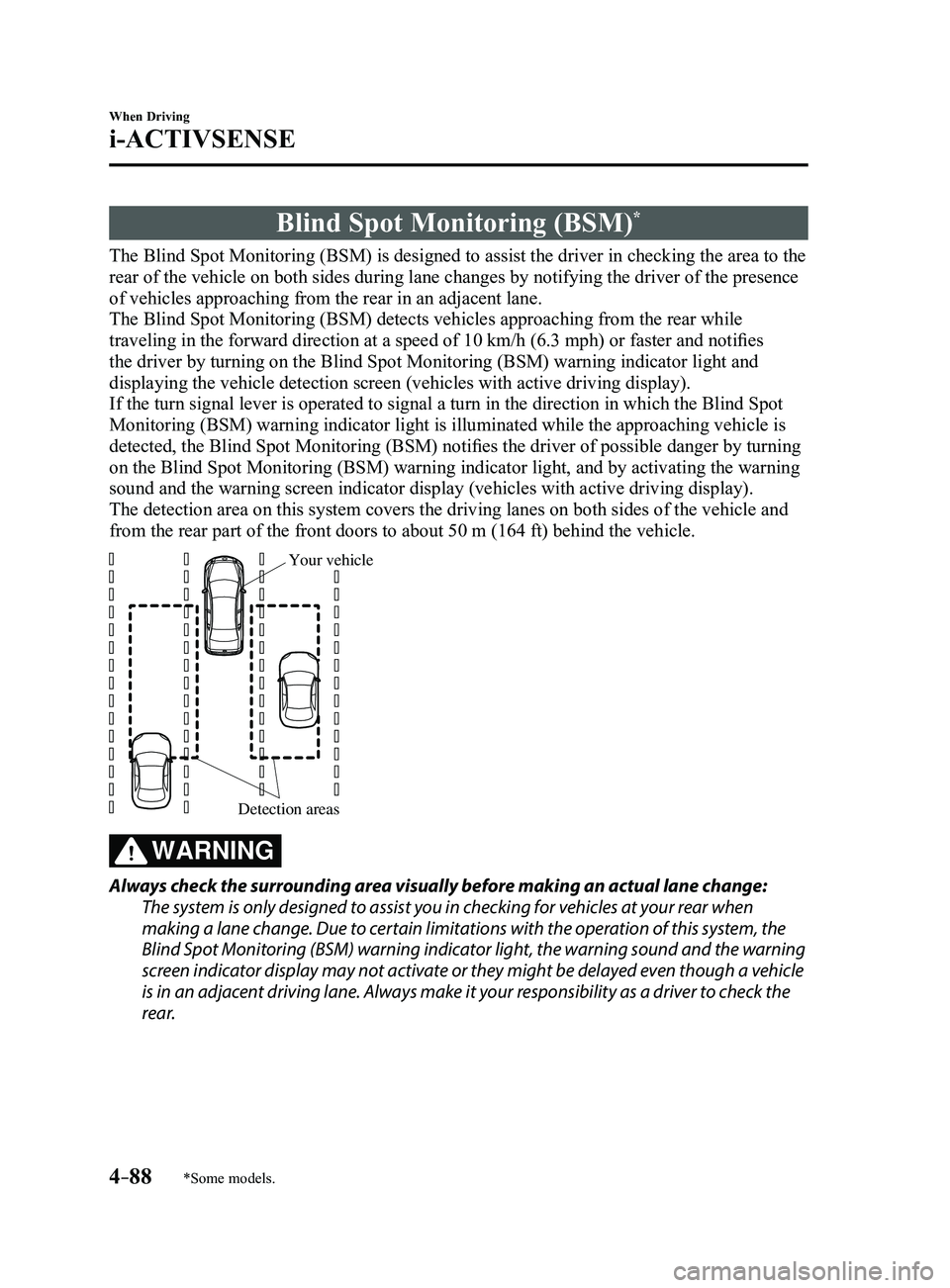
The detection area on this system covers the driving lanes on both sides\
of the vehicle and
from the rear part of the front doors to about 50 m (164 ft) behind th\
e vehicle.
Detection areas
Your vehicle
WARNING
Always check the surrounding area visually before making an actual lane change:
The system is only designed to assist you in checking for vehicles at your rear when
making a lane change. Due to certain limitations with the operation of this system, the
Blind Spot Monitoring (BSM) warning indicator light, the warning sound and the warning
screen indicator display may not activate or they might be delayed even though a vehicle
is in an adjacent driving lane. Always make it your responsibility as a driver to check the
rear.
Mazda3_8FL6-EA-16F_Edition2.indb 882016/08/10 17:36:37
Page 219 of 612
 will operate when all of the following\
conditions are
met:
The ignition is switched ON. The Blind Spot Monitoring (B")
4–89
When Driving
i-ACTIVSENSE
NOTE
The Blind Spot Monitoring (BSM) will operate when all of the following\
conditions are
met:
The ignition is switched ON. The Blind Spot Monitoring (BSM) OFF indicator light in the instrument \
cluster is
turned off. The vehicle speed is about 10 km/h (6.3 mph) or faster.
The Blind Spot Monitoring (BSM) will not operate under the following c\
ir cumstances.
The vehicle speed falls below about 10 km/h (6.3 mph) even though the \
Blind Spot
Monitoring (BSM) OFF switch indicator light is turned off. The shift lever (manual transaxle)/selector lever (automatic transaxl\
e) is shifted to
reverse (R) and the vehicle is reversing.
In the following cases, the Blind Spot Monitoring (BSM) warning indica\
tion/warning
light turns on and operation of the system is stopped. If the Blind Spot\
Monitoring (BSM)
warning indication/warning light remains illuminated, have the vehicle inspected at an
Authorized Mazda Dealer as soon as possible.
Some problem with the system including the Blind Spot Monitoring (BSM) warnin\
g
indicator lights is detected. A large deviation in the installation position of a radar sensor (rear) on the vehicle has
occurred. There is a large accumulation of snow or ice on the rear bumper near a radar sensor
(rear). Remove any snow, ice or mud on the rear bumper. Driving on snow-covered roads for long periods. The temperature near the radar sensors (rear) becomes extremely hot due to driving
for long periods on slopes during the summer. The battery voltage has decr eased.
Under the following conditions, the radar sensors (r ear) cannot detect target objects or it
may be difficult to detect them.
A vehicle is in the detection area at the rear in an adjacent driving lane but it does not
approach. The Blind Spot Monitoring (BSM) determines the condition based o\
n radar
detection data.
A vehicle is traveling alongside your vehicle at nearly the same speed fo\
r an extended
period of time. Vehicles approaching in the opposite direction. A vehicle in an adjacent driving lane is attempting to pass your vehicle.\
A vehicle is in an adjacent lane on a road with extremely wide driving lanes. The
detection area of the radar sensors (rear) is set at the road width of expressways.
Mazda3_8FL6-EA-16F_Edition2.indb 892016/08/10 17:36:37
Page 220 of 612
4–90
When Driving
i-ACTIVSENSE
In the following case, the flashing of the Blind Spot Monitoring (BSM) warning indicator
light, and the activation of the warning sound and the warning screen indicator display
may not occur or they may be delayed.
A vehicle makes a lane change from a driving lane two lanes over to an adjacent lane. Driving on steep slopes. Crossing the summit of a hill or mountain pass. The turning radius is small (making a sharp turn, turning at intersecti\
ons). When there is a difference in the height between your driving lane and the adjacent
lane. Directly after pressing the Blind Spot Monitoring (BSM) OFF switch and the system
becomes operable.
If the road width is extremely narrow, vehicles two lanes over may be detected.
The detection area of the radar sensors (rear) is set according to the road width of
expressways.
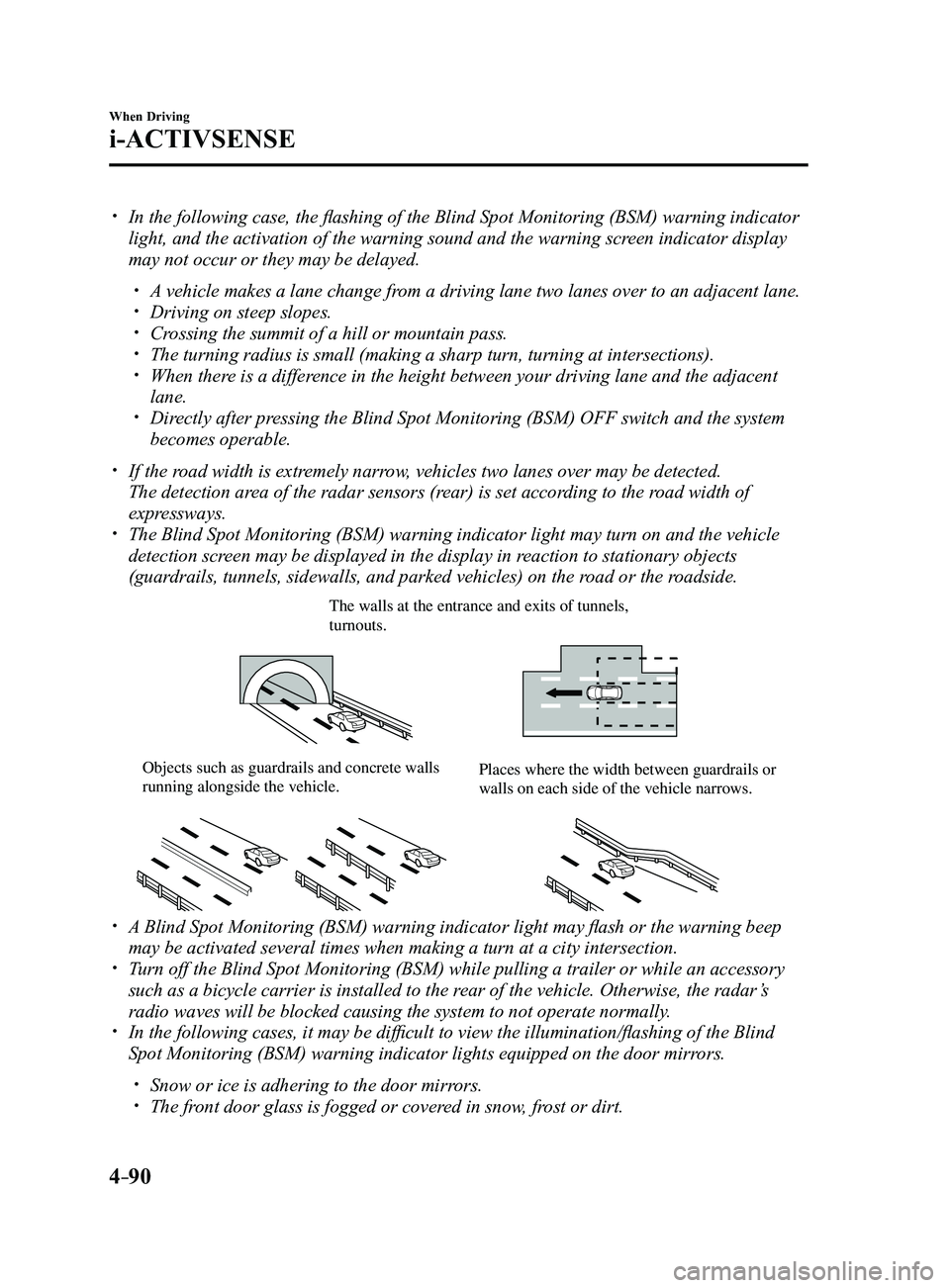
The Blind Spot Monitoring (BSM) warning indicator light may turn on an\
d the vehicle
detection screen may be displayed in the display in reaction to stationary objects
(guardrails, tunnels, sidewalls, and parked vehicles) on the road or the roadside.
The walls at the entrance and exits of tunnels, turnouts.
Objects such as guardrails and concrete walls running alongside the vehicle.Places where the width between guardrails or walls on each side of the vehicle narrows.
A Blind Spot Monitoring (BSM) warning indicator light may flash or the warning beep
may be activated several times when making a turn at a city intersection\
. Turn off the Blind Spot Monitoring (BSM) while pulling a trailer or whi\
le an accessory
such as a bicycle carrier is installed to the rear of the vehicle. Otherwise, the radar’s
radio waves will be blocked causing the system to not operate normally.
In the following cases, it may be difficult to view the illumination/flashing of the Blind
Spot Monitoring (BSM) warning indicator lights equipped on the door mi\
rrors.
Snow or ice is adhering to the door mirrors. The front door glass is fogged or covered in snow, frost or dirt.
Mazda3_8FL6-EA-16F_Edition2.indb 902016/08/10 17:36:38
Page 221 of 612
4–91
When Driving
i-ACTIVSENSE
The radar sensors (rear) of the Blind Spot Monitoring (BSM) may be regulated under
the radio wave related laws of the country where the vehicle is driven. The sensors
in this system are approved for use in the U.S.A. (including territories), Canada, and
Mexico. If a vehicle with a Blind Spot Monitoring (BSM) is driven in a\
country other
than the U.S.A., Canada, or Mexico, the system has to be turned off usin\
g the Blind Spot
Monitoring (BSM) OFF switch.
The system switches to the Rear Cr oss Traffic Alert function when the shift lever (manual
transaxle) or the selector lever (automatic transaxle) is shifted to \
the reverse (R) position.
Refer to Rear Cross Traffic Alert (RCTA) on page 4-103.
Blind Spot Monitoring (BSM) Warning Indicator Lights/Blind Spot
Monitoring (BSM) Warning Beep
The Blind Spot Monitoring (BSM) or Rear Cross Traffic Alert (RCTA) system notifies the
driver of the presence of vehicles in adjacent lanes or at the rear of t\
he vehicle using the
Blind Spot Monitoring (BSM) warning indicator light, the warning sound and the display
indicator (vehicles with active driving display) while the systems are\
operational.
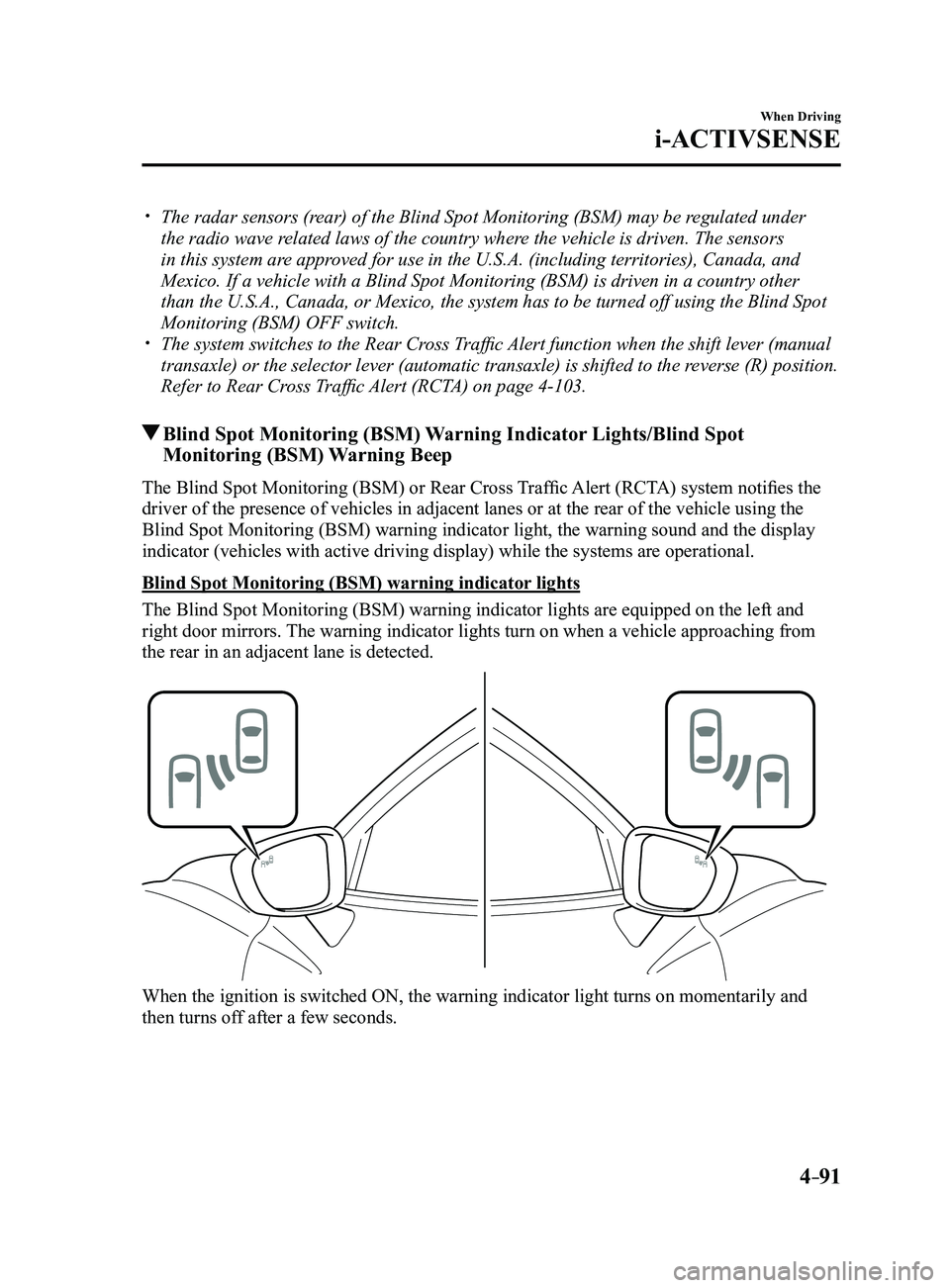
Blind Spot Monitoring (BSM) warning indicator lights
The Blind Spot Monitoring (BSM) warning indicator lights are equipped on the left and
right door mirrors. The warning indicator lights turn on when a vehicle approaching from
the rear in an adjacent lane is detected.
When the ignition is switched ON, the warning indicator light turns on momentarily and
then turns off after a few seconds.
Mazda3_8FL6-EA-16F_Edition2.indb 912016/08/10 17:36:38
Page 222 of 612
4–92
When Driving
i-ACTIVSENSE
Forward driving (Blind Spot Monitoring (BSM) operation)
The Blind Spot Monitoring (BSM) detects vehicles approaching from the rear and turns on
the Blind Spot Monitoring (BSM) warning indicator lights equipped on the door mirrors
according to the conditions. Additionally, while a Blind Spot Monitoring (BSM) warning
indicator light is illuminated, if the turn signal lever is operated to \
signal a turn in the
direction in which the Blind Spot Monitoring (BSM) warning indicator light is illuminated,
the Blind Spot Monitoring (BSM) warning indicator light flashes.
Reverse driving (Rear Cross Traffic Alert (RCTA) system operation)
The Rear Cross Traffic Alert (RCTA) system detects vehicles approaching from the left and
right of your vehicle and flashes the Blind Spot Monitoring (BSM) warning indicator lights.
Function for cancelling illumination dimmer
If the Blind Spot Monitoring (BSM) warning indicator lights turn on when the parking lights
are turned on, the brightness of the Blind Spot Monitoring (BSM) warning indicator lights is
dimmed.
If the Blind Spot Monitoring (BSM) warning indicator lights are difficult to see due to
glare from surrounding brightness when traveling on snow-covered roads o\
r under foggy
conditions, press the dimmer cancellation button to cancel the dimmer an\
d increase the
brightness of Blind Spot Monitoring (BSM) warning indicator lights when they turn on.
Refer to Dashboard Illumination on page
4-18.
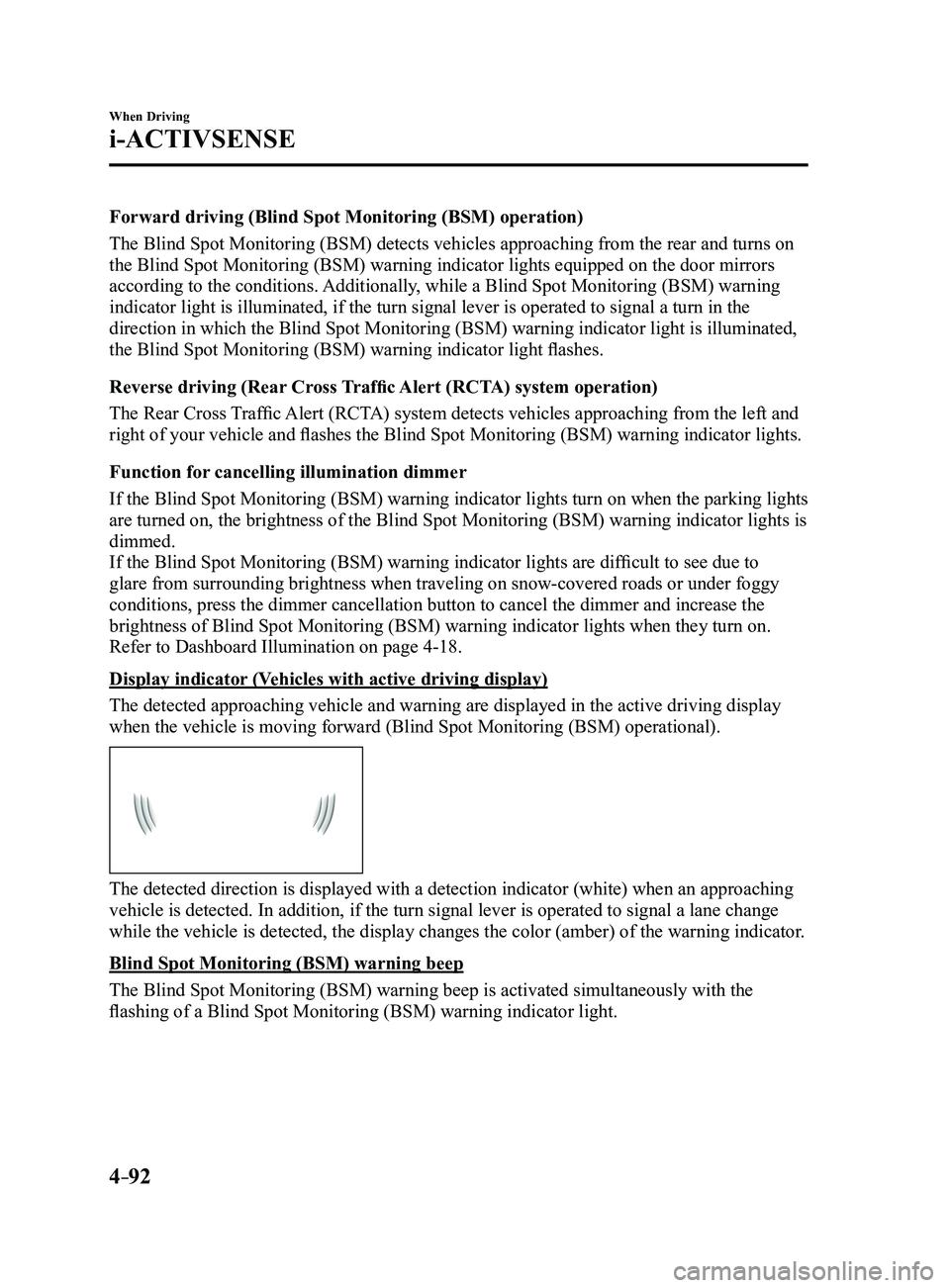
Display indicator (Vehicles with active driving display)
The detected approaching vehicle and warning are displayed in the active\
driving display
when the vehicle is moving forward (Blind Spot Monitoring (BSM) operational).
The detected direction is displayed with a detection indicator (white)\
when an approaching
vehicle is detected. In addition, if the turn signal lever is operated t\
o signal a lane change
while the vehicle is detected, the display changes the color (amber) o\
f the warning indicator.
Blind Spot Monitoring (BSM) warning beep
The Blind Spot Monitoring (BSM) warning beep is activated simultaneously with the
flashing of a Blind Spot Monitoring (BSM) warning indicator light.
Mazda3_8FL6-EA-16F_Edition2.indb 922016/08/10 17:36:39
Page 232 of 612
4–102
When Driving
i-ACTIVSENSE
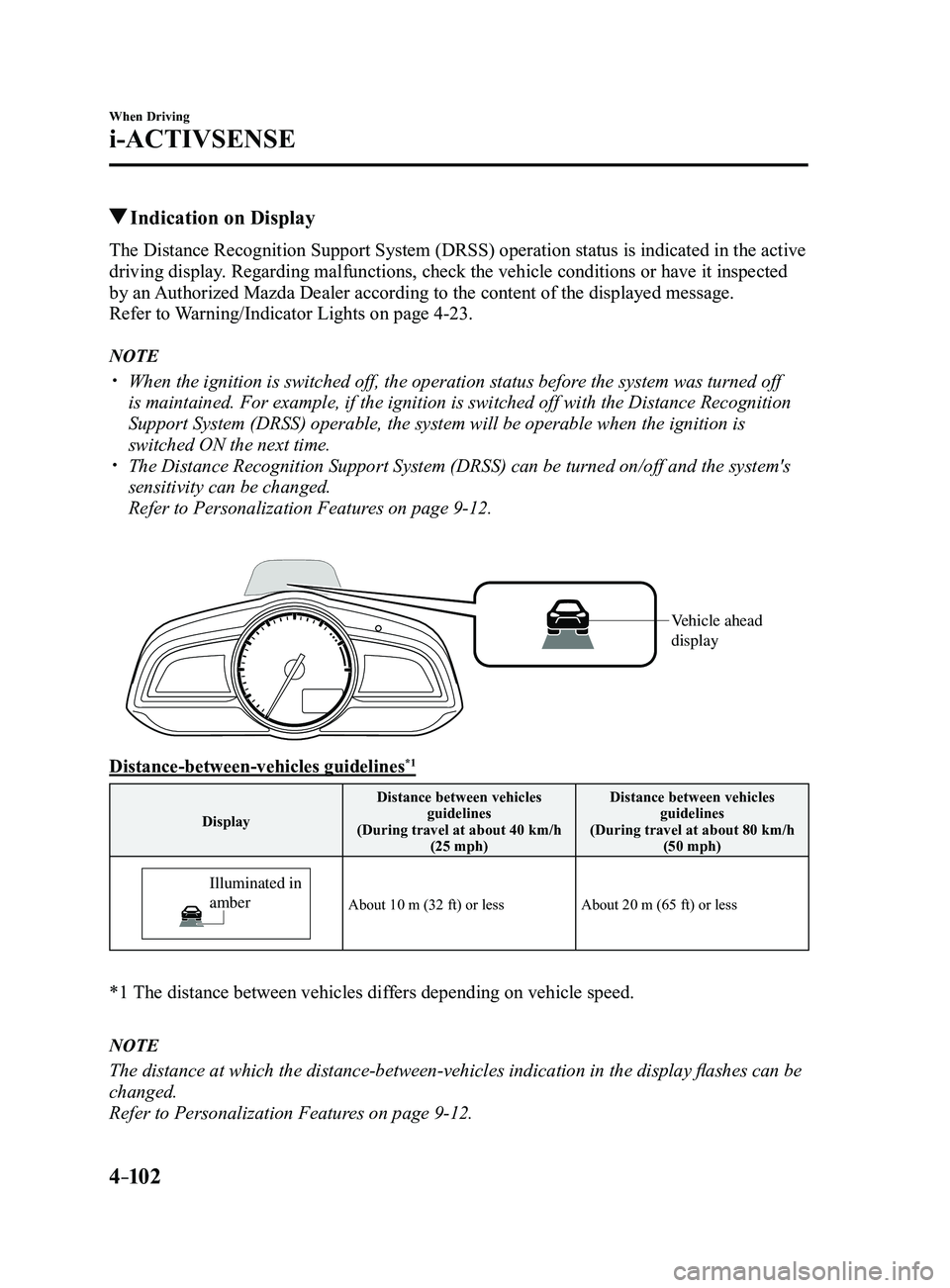
Indication on Display
The Distance Recognition Support System (DRSS) operation status is indicated in the active
driving display. Regarding malfunctions, check the vehicle conditions or have it inspected
by an Authorized Mazda Dealer according to the content of the displayed messag\
e.
Refer to Warning/Indicator Lights on page
4-23.
NOTE
When the ignition is switched off, the operation status before the system was turned off
is maintained. For example, if the ignition is switched off with the Dis\
tance Recognition
Support System (DRSS) operable, the system will be operable when the i\
gnition is
switched ON the next time.
The Distance Recognition Support System (DRSS) can be turned on/off an\
d the system's
sensitivity can be changed.
Refer to Personalization Features on page 9-12.
Vehicle ahead
display
Distance-between-vehicles guidelines*1
DisplayDistance between vehicles
guidelines
(During travel at about 40 km/h (25 mph) Distance between vehicles
guidelines
(During travel at about 80 km/h (50 mph)
Illuminated in
amber
About 10 m (32 ft) or lessAbout 20 m (65 ft) or less
*1 The distance between vehicles dif fers depending on vehicle speed.
NOTE
The distance at which the distance-between-vehicles indication in the display flashes can be
changed.
Refer to Personalization Features on page
9-12.
Mazda3_8FL6-EA-16F_Edition2.indb 1022016/08/10 17:36:44
Page 233 of 612
4–103
When Driving
i-ACTIVSENSE
*Some models.
Rear Cross Traffic Alert (RCTA)*
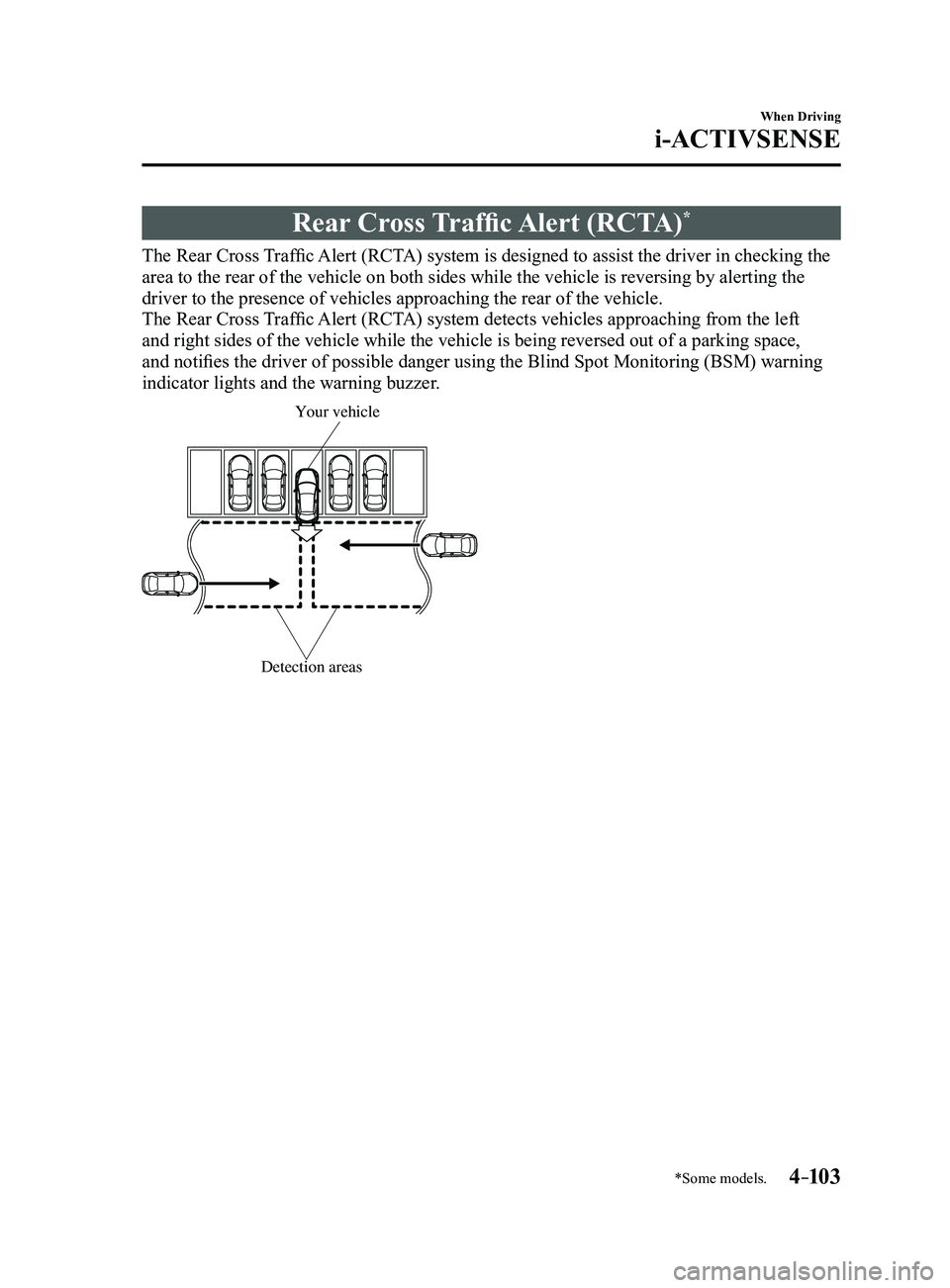
The Rear Cross Traffic Alert (RCTA) system is designed to assist the driver in checking the
area to the rear of the vehicle on both sides while the vehicle is rever\
sing by alerting the
driver to the presence of vehicles approaching the rear of the vehicle.
The Rear Cross Traffic Alert (RCTA) system detects vehicles approaching from the left
and right sides of the vehicle while the vehicle is being reversed out o\
f a parking space,
and notifies the driver of possible danger using the Blind Spot Monitoring (BSM) warning
indicator lights and the warning buzzer.
Detection areas
Your vehicle
Mazda3_8FL6-EA-16F_Edition2.indb 1032016/08/10 17:36:44
Page 234 of 612
4–104
When Driving
i-ACTIVSENSE
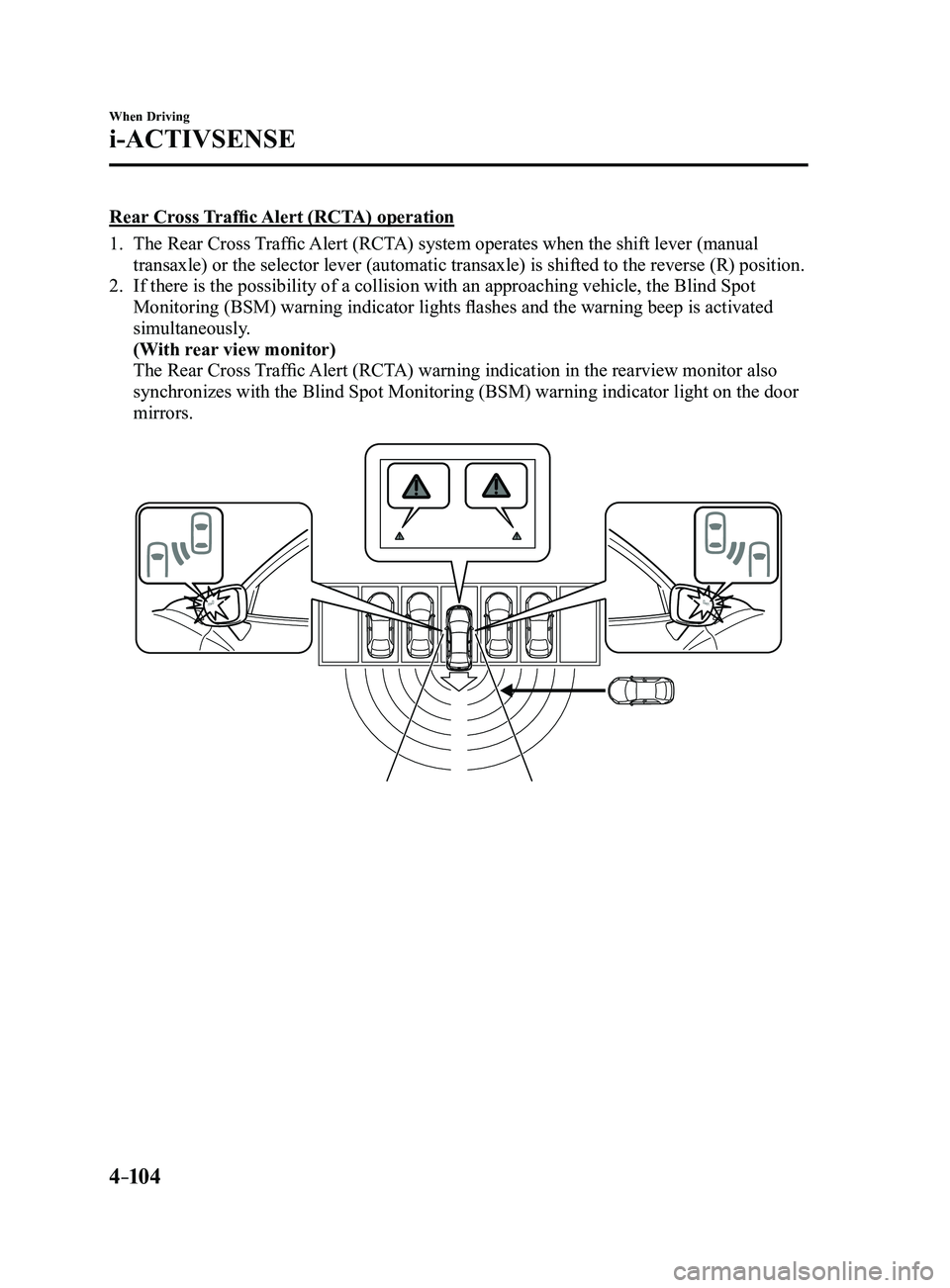
Rear Cross Traffic Alert (RCTA) operation
1. The Rear Cross Traffic Alert (RCTA) system operates when the shift lever (manual
transaxle) or the selector lever (automatic transaxle) is shifted to the reverse (R) position.
2. If there is the possibility of a collision with an approaching vehicle, the Blind Spot
Monitoring (BSM) warning indicator lights flashes and the warning beep is activated
simultaneously.
(With rear view monitor)
The Rear Cross Traffic Alert (RCTA) warning indication in the rearview monitor also
synchronizes with the Blind Spot Monitoring (BSM) warning indicator light on the door
mirrors.
Mazda3_8FL6-EA-16F_Edition2.indb 1042016/08/10 17:36:44
Page 235 of 612
4–105
When Driving
i-ACTIVSENSE
WARNING
Always check the surrounding area visually before actually putting the vehicle in
reverse:The system is only designed to assist you in checking for vehicles at the rear when putting
the vehicle in reverse. Due to certain limitations with the operation of this system, the
Blind Spot Monitoring (BSM) warning indicator lights may not flash or it might be delayed
even though a vehicle is behind your vehicle. Always make it your responsibility as a
driver to check the rear.
NOTE
In the following cases, the Blind Spot Monitoring (BSM) warning indica\
tion/warning
light turns on and operation of the system is stopped. If the Blind Spot\
Monitoring (BSM)
warning indication/warning light remains illuminated, have the vehicle inspected at an
Authorized Mazda Dealer as soon as possible.
Some problem with the system including the Blind Spot Monitoring (BSM) warnin\
g
indicator lights has occurred. A large deviation in the installation position of a radar sensor (rear) on the vehicle has
occurred. There is a large accumulation of snow or ice on the rear bumper near a radar sensor
(rear). Driving on snow-cover ed roads for long periods. The temperature near the radar sensors becomes extremely hot due to driving for long
periods on slopes during the summer. The battery voltage has decr eased.
Mazda3_8FL6-EA-16F_Edition2.indb 1052016/08/10 17:36:45
Page 236 of 612
4–106
When Driving
i-ACTIVSENSE
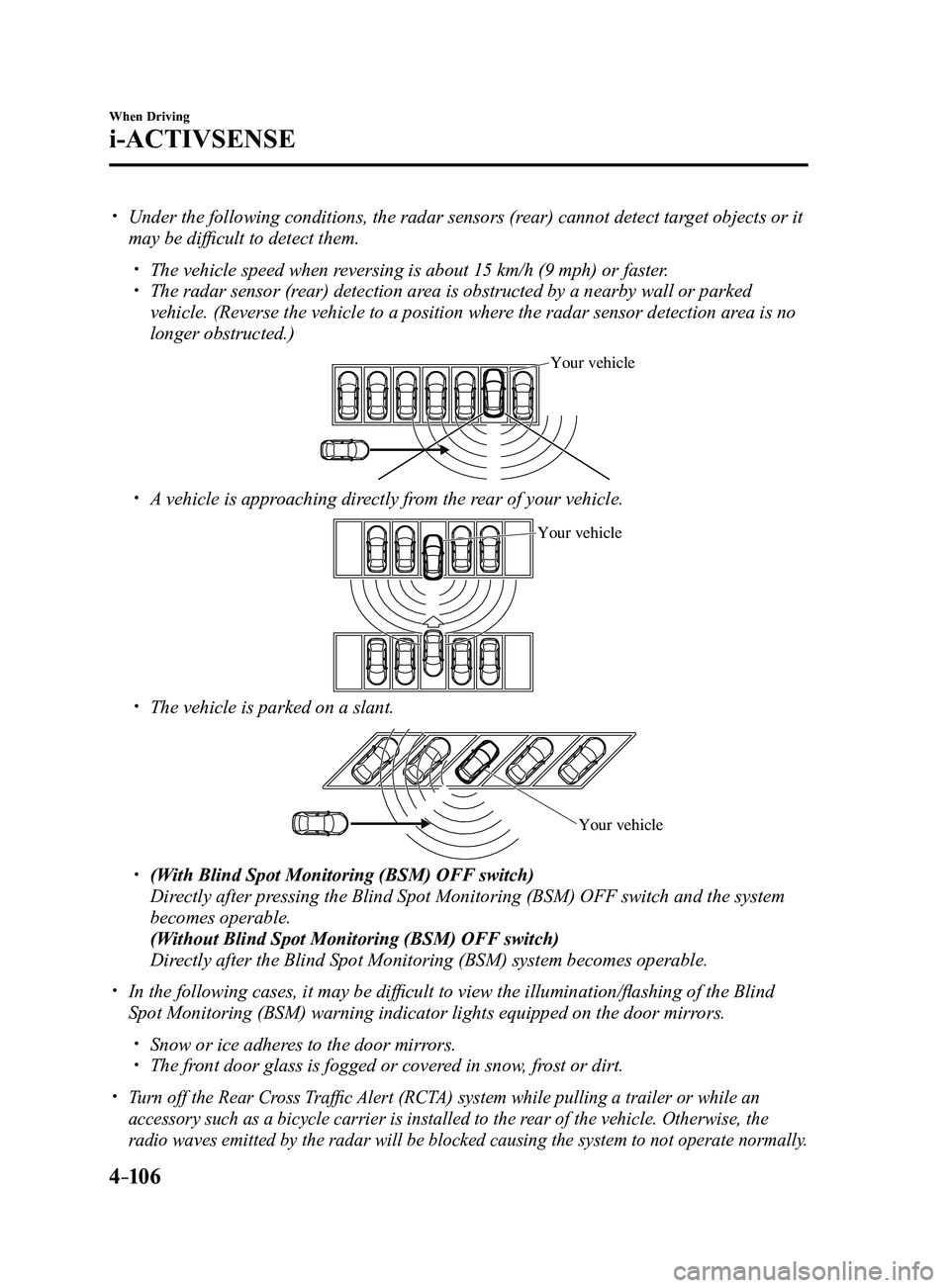
Under the following conditions, the radar sensors (rear) cannot detect target objects or it
may be difficult to detect them.
The vehicle speed when reversing is about 15 km/h (9 mph) or faster. The radar sensor (rear) detection area is obstructed by a nearby wall or parked
vehicle. (Reverse the vehicle to a position where the radar sensor detection area is no
longer obstructed.)
Your vehicle
A vehicle is approaching directly from the rear of your vehicle.
Your vehicle
The vehicle is parked on a slant.
Your vehicle
(With Blind Spot Monitoring (BSM) OFF switch)
Directly after pressing the Blind Spot Monitoring (BSM) OFF switch and the system
becomes operable.
(Without Blind Spot Monitoring (BSM) OFF switch)
Directly after the Blind Spot Monitoring (BSM) system becomes operable.
In the following cases, it may be difficult to view the illumina tion/flashing of the Blind
Spot Monitoring (BSM) warning indicator lights equipped on the door mi\
rrors.
Snow or ice adheres to the door mirrors. The front door glass is fogged or covered in snow, frost or dirt.
Turn off the Rear Cross Traffic Alert (RCTA) system while pulling a trailer or while an
accessory such as a bicycle carrier is installed to the rear of the vehicle. Otherwise, the
radio waves emitted by the radar will be blocked causing the system to n\
ot operate normally.
Mazda3_8FL6-EA-16F_Edition2.indb 1062016/08/10 17:36:45