seats MAZDA MODEL 3 HATCHBACK 2012 (in English) User Guide
[x] Cancel search | Manufacturer: MAZDA, Model Year: 2012, Model line: MODEL 3 HATCHBACK, Model: MAZDA MODEL 3 HATCHBACK 2012Pages: 525, PDF Size: 5.95 MB
Page 24 of 525
Black plate (23,1)
WARNING
Always make sure the seat belts are
fully pulled out from under the
seatbacks:A seat belt caught under a seatback
after the seatback is returned to its
upright position is dangerous. In a
collision or sudden stop, the seat belt
cannot provide adequate protection.
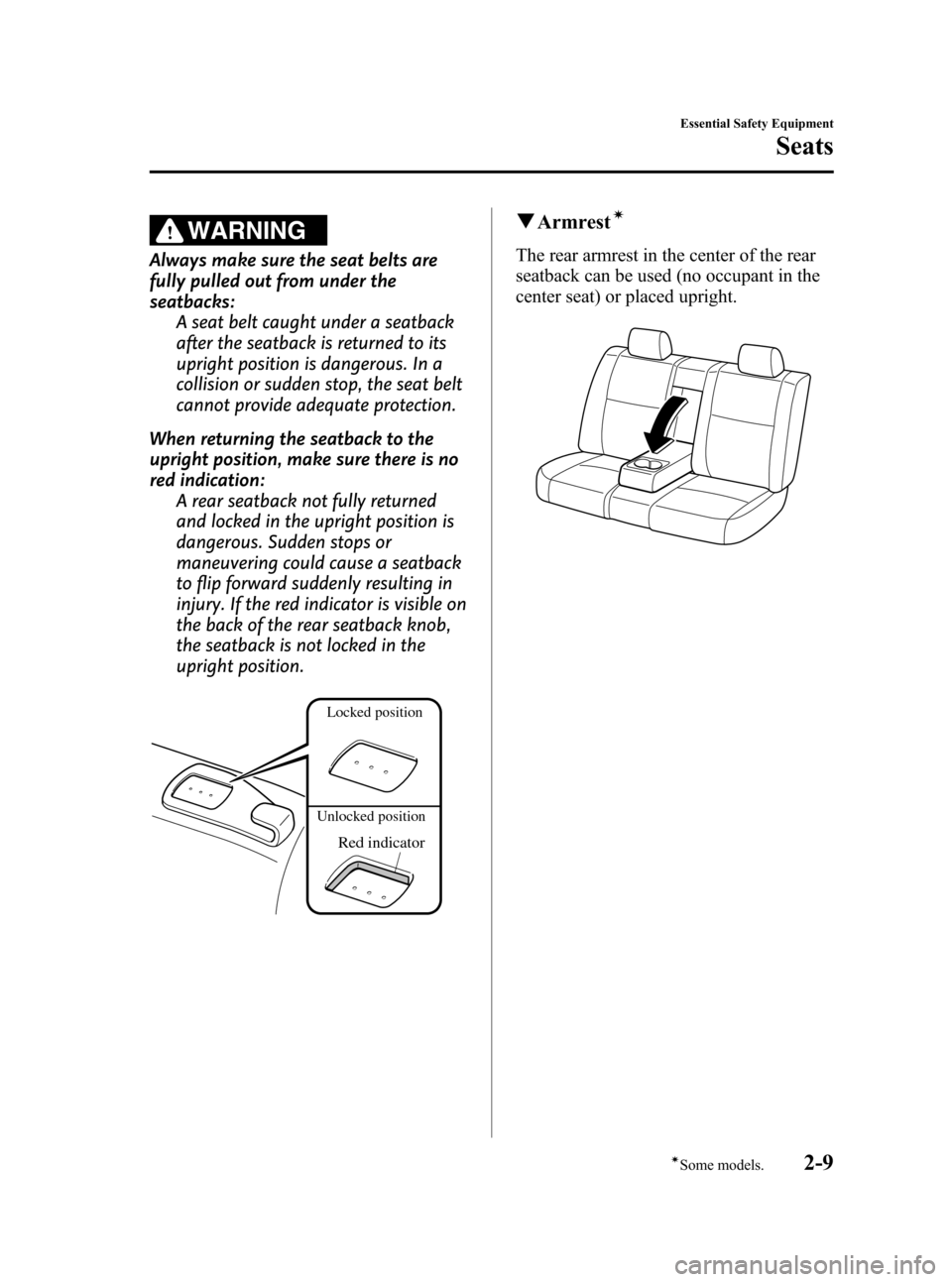
When returning the seatback to the
upright position, make sure there is no
red indication: A rear seatback not fully returned
and locked in the upright position is
dangerous. Sudden stops or
maneuvering could cause a seatback
to flip forward suddenly resulting in
injury. If the red indicator is visible on
the back of the rear seatback knob,
the seatback is not locked in the
upright position.
Locked position
Unlocked position
Red indicator
q Armrestí
The rear armrest in the center of the rear
seatback can be used (no occupant in the
center seat) or placed upright.
Essential Safety Equipment
Seats
2-9íSome models.
Mazda3_8BY7-EC-11F_Edition1 Page23
Friday, June 17 2011 2:54 PM
Form No.8BY7-EC-11F
Page 25 of 525
Black plate (24,1)
Head Restraints
Your vehicle is equipped with head
restraints on all outboard seats. The head
restraints are intended to help protect you
and the passengers from neck injury.
WARNING
Always drive with the head restraints
installed when seats are being used
and make sure they are properly
adjusted:Driving with the head restraints
adjusted too low or removed is
dangerous. With no support behind
your head, your neck could be
seriously injured in a collision.
qNormal Head Restraints
Height adjustment
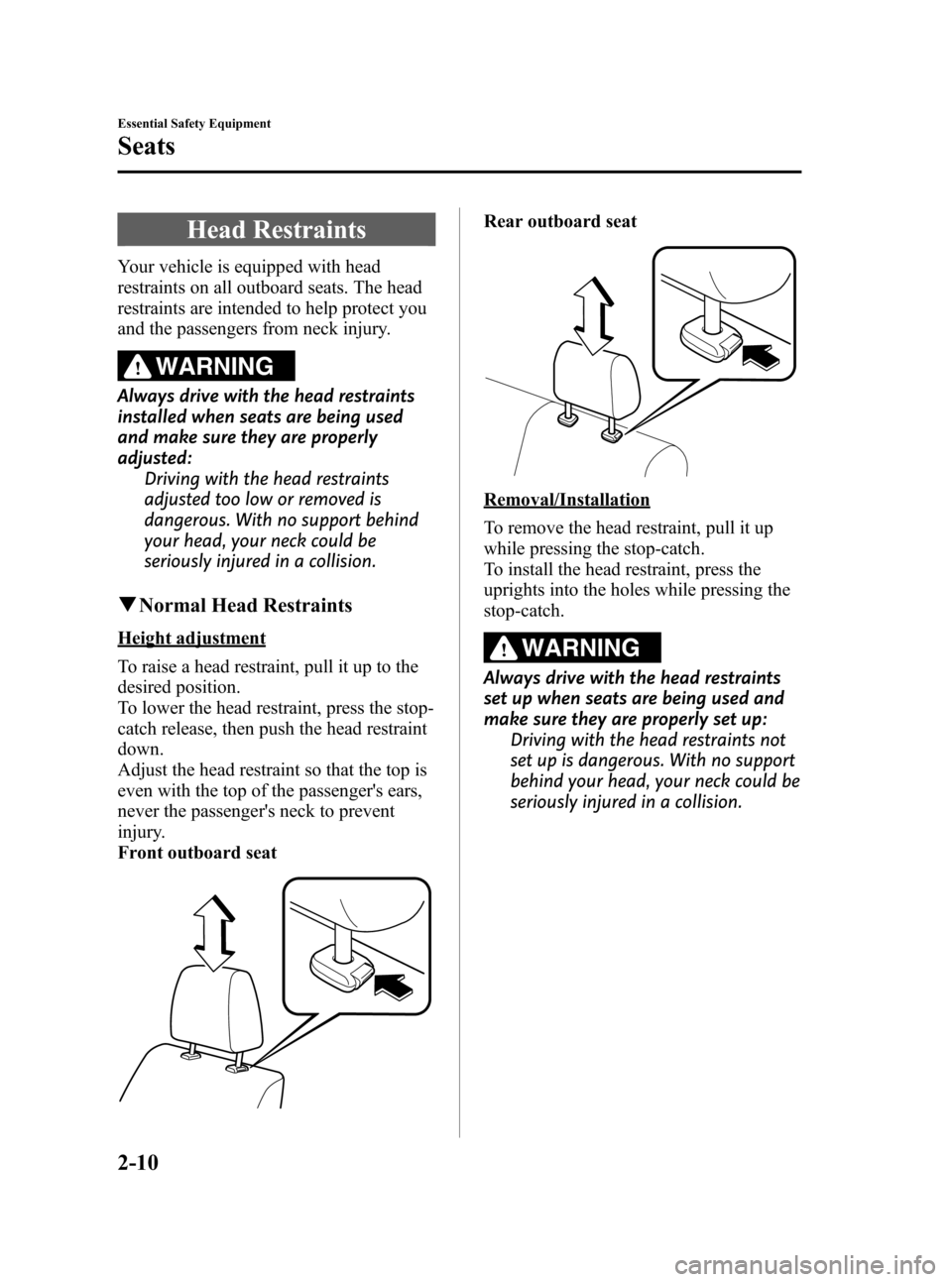
To raise a head restraint, pull it up to the
desired position.
To lower the head restraint, press the stop-
catch release, then push the head restraint
down.
Adjust the head restraint so that the top is
even with the top of the passenger's ears,
never the passenger's neck to prevent
injury.
Front outboard seat
Rear outboard seat
Removal/Installation
To remove the head restraint, pull it up
while pressing the stop-catch.
To install the head restraint, press the
uprights into the holes while pressing the
stop-catch.
WARNING
Always drive with the head restraints
set up when seats are being used and
make sure they are properly set up:
Driving with the head restraints not
set up is dangerous. With no support
behind your head, your neck could be
seriously injured in a collision.
2-10
Essential Safety Equipment
Seats
Mazda3_8BY7-EC-11F_Edition1 Page24
Friday, June 17 2011 2:54 PM
Form No.8BY7-EC-11F
Page 26 of 525
Black plate (25,1)
Active Head Restraintsí
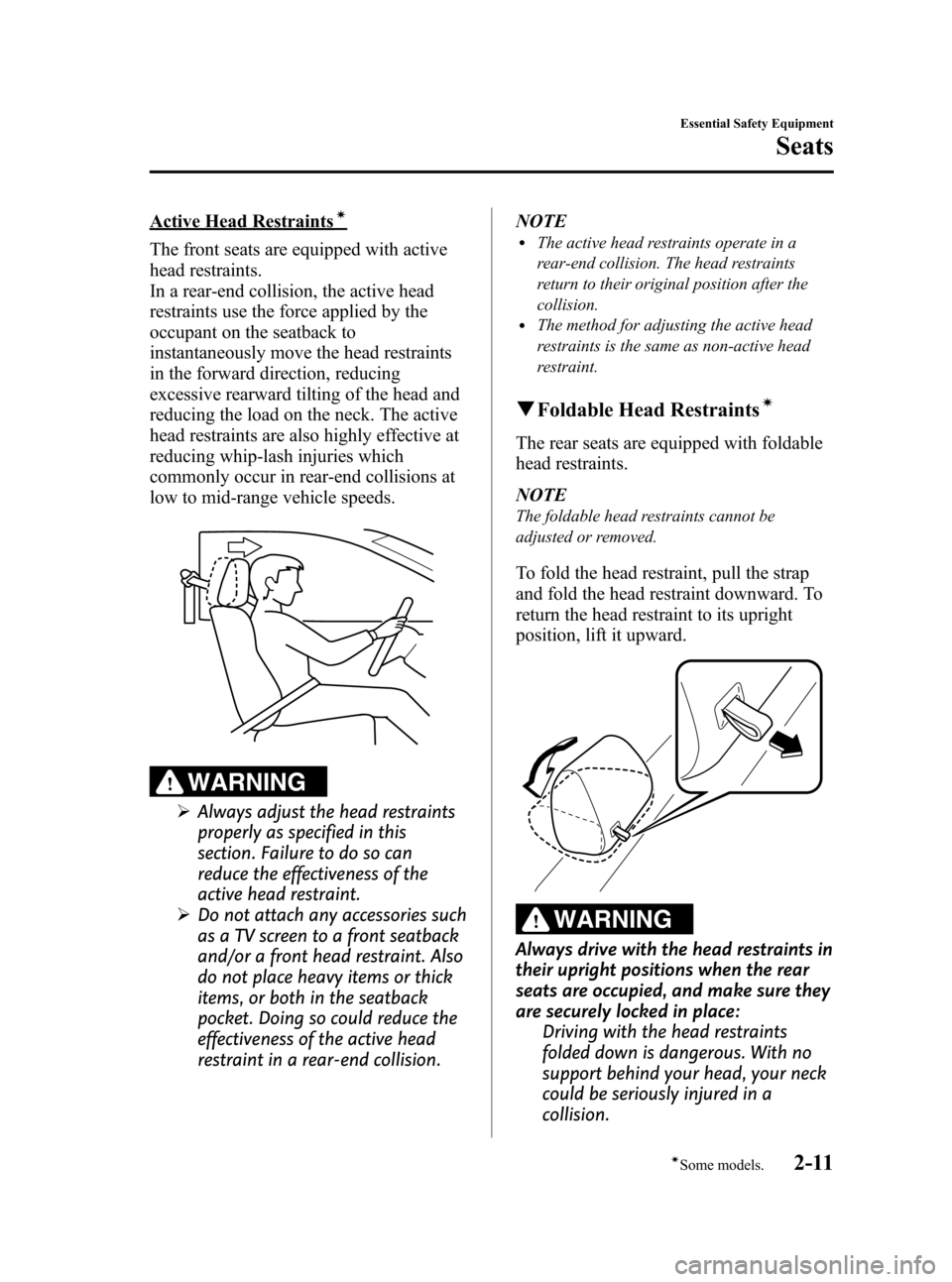
The front seats are equipped with active
head restraints.
In a rear-end collision, the active head
restraints use the force applied by the
occupant on the seatback to
instantaneously move the head restraints
in the forward direction, reducing
excessive rearward tilting of the head and
reducing the load on the neck. The active
head restraints are also highly effective at
reducing whip-lash injuries which
commonly occur in rear-end collisions at
low to mid-range vehicle speeds.
WARNING
ØAlways adjust the head restraints
properly as specified in this
section. Failure to do so can
reduce the effectiveness of the
active head restraint.
Ø Do not attach any accessories such
as a TV screen to a front seatback
and/or a front head restraint. Also
do not place heavy items or thick
items, or both in the seatback
pocket. Doing so could reduce the
effectiveness of the active head
restraint in a rear-end collision. NOTE
lThe active head restraints operate in a
rear-end collision. The head restraints
return to their original position after the
collision.
lThe method for adjusting the active head
restraints is the same as non-active head
restraint.
q
Foldable Head Restraintsí
The rear seats are equipped with foldable
head restraints.
NOTE
The foldable head restraints cannot be
adjusted or removed.
To fold the head restraint, pull the strap
and fold the head restraint downward. To
return the head restraint to its upright
position, lift it upward.
WARNING
Always drive with the head restraints in
their upright positions when the rear
seats are occupied, and make sure they
are securely locked in place:
Driving with the head restraints
folded down is dangerous. With no
support behind your head, your neck
could be seriously injured in a
collision.
Essential Safety Equipment
Seats
2-11íSome models.
Mazda3_8BY7-EC-11F_Edition1 Page25
Friday, June 17 2011 2:54 PM
Form No.8BY7-EC-11F
Page 27 of 525
Black plate (26,1)
Seat Warmerí
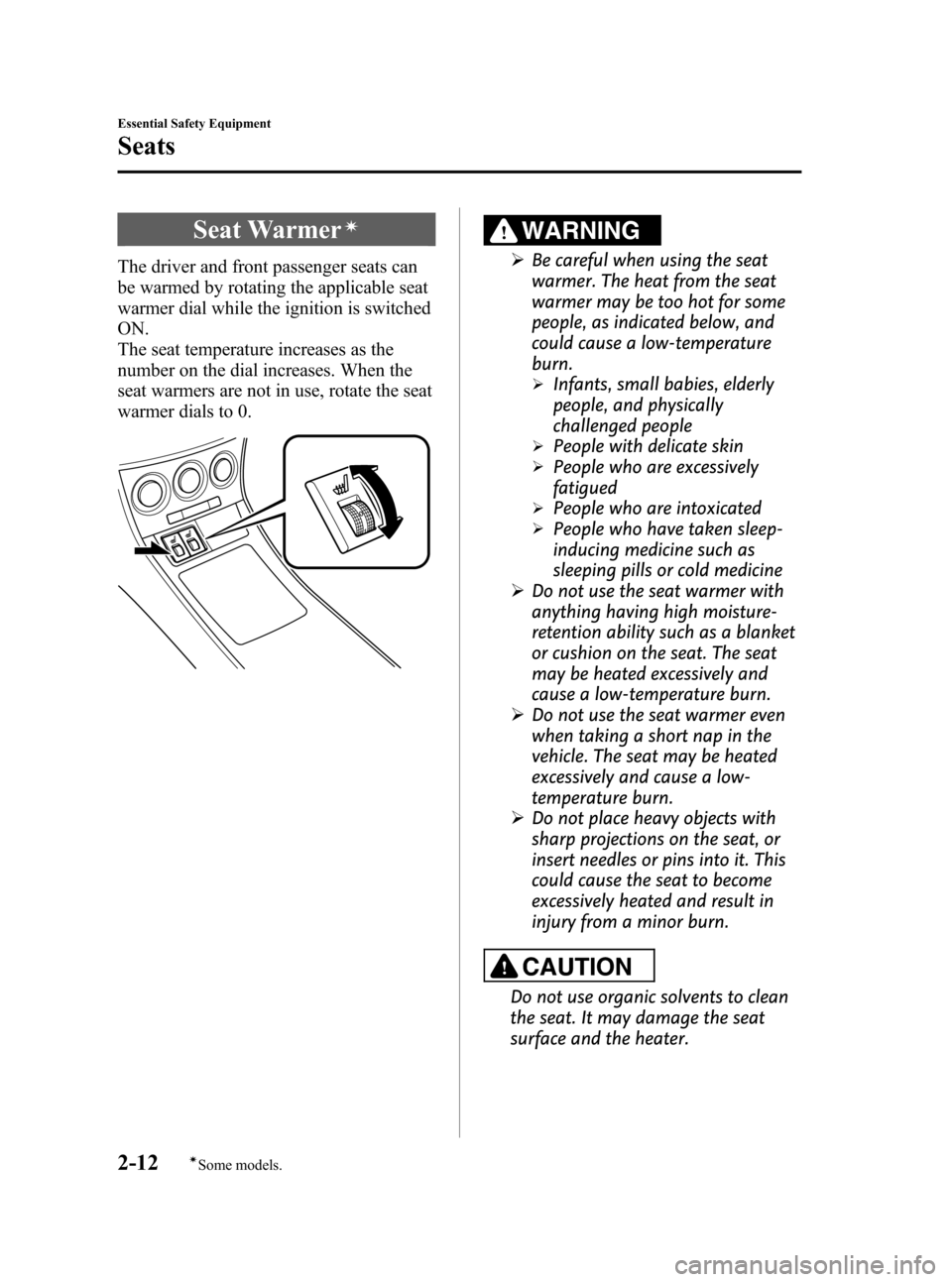
The driver and front passenger seats can
be warmed by rotating the applicable seat
warmer dial while the ignition is switched
ON.
The seat temperature increases as the
number on the dial increases. When the
seat warmers are not in use, rotate the seat
warmer dials to 0.
WARNING
ØBe careful when using the seat
warmer. The heat from the seat
warmer may be too hot for some
people, as indicated below, and
could cause a low-temperature
burn.
ØInfants, small babies, elderly
people, and physically
challenged people
ØPeople with delicate skin
ØPeople who are excessively
fatigued
ØPeople who are intoxicated
ØPeople who have taken sleep-
inducing medicine such as
sleeping pills or cold medicine
Ø Do not use the seat warmer with
anything having high moisture-
retention ability such as a blanket
or cushion on the seat. The seat
may be heated excessively and
cause a low-temperature burn.
Ø Do not use the seat warmer even
when taking a short nap in the
vehicle. The seat may be heated
excessively and cause a low-
temperature burn.
Ø Do not place heavy objects with
sharp projections on the seat, or
insert needles or pins into it. This
could cause the seat to become
excessively heated and result in
injury from a minor burn.
CAUTION
Do not use organic solvents to clean
the seat. It may damage the seat
surface and the heater.
2-12
Essential Safety Equipment
íSome models.
Seats
Mazda3_8BY7-EC-11F_Edition1 Page26
Friday, June 17 2011 2:54 PM
Form No.8BY7-EC-11F
Page 28 of 525
Black plate (27,1)
NOTE
Use the seat warmer when the engine is
running, and do not continue to use it for a
long period of time.
Essential Safety Equipment
Seats
2-13
Mazda3_8BY7-EC-11F_Edition1 Page27
Friday, June 17 2011 2:54 PM
Form No.8BY7-EC-11F
Page 29 of 525
Black plate (28,1)
Seat Belt Precautions
Seat belts help to decrease the possibility of severe injury during accidents and sudden
stops. Mazda recommends that the driver and all passengers always wear seat belts.
All of the seat belt retractors are designed to keep the lap/shoulder belts out of the way
when not in use.
The driver's seat belt has no provisions for child-restraint systems and has only an
emergency locking mode. The driver may wear it comfortably, and it will lock during a
collision.
However, the front passenger's seat and all rear lap/shoulder belt retractors operate in two
modes: emergency locking mode, and for child-restraint systems, automatic locking mode.
While we recommend you put all children in the rear seats, if you must use the front
passenger seat for a child, slide the front passenger seat as far back as possible and make
sure any child-restraint system is secured properly.
2-14
Essential Safety Equipment
Seat Belt Systems
Mazda3_8BY7-EC-11F_Edition1 Page28
Friday, June 17 2011 2:54 PM
Form No.8BY7-EC-11F
Page 41 of 525
Black plate (40,1)
Child Restraint Precautions
Mazda strongly urges the use of child-restraint systems for children small enough to use
them.
You are required by law to use a child-restraint system for children in the U.S. and Canada.
Check your local and state or provincial laws for specific requirements regarding the safety
of children riding in your vehicle.
Whatever child-restraint system you consider, please pick the appropriate one for the age
and size of the child, obey the law and follow the instructions that come with the individual
child-restraint system.
A child who has outgrown child-restraint systems should sit in the rear and use seat belts,
both lap and shoulder. If the shoulder belt crosses the neck or face, move the child closer to
the center of the vehicle in the outboard seats, and towards the buckle on the right if the
child is seated on the center seat.
Statistics confirm that the rear seat is the best place for all children up to 12 years of age,
and more so with a supplemental restraint system (air bags).
A rear-facing child-restraint system shouldNEVERbe used on the front seat with the air
bag system activated. The front passenger's seat is also the least preferred seat for other
child-restraint systems.
(With Driver and Front Passenger Occupant Classification System)
To reduce the chance of injuries caused by deployment of the front passenger air bag, the
front passenger seat weight sensors work as a part of the supplemental restraint system.
This system deactivates the front passenger front and side air bags and also the front
passenger seat belt pretensioner system when the front passenger air bag deactivation
indicator light illuminates.
When an infant or small child sits on the front passenger seat, the system shuts off the front
passenger front and side air bags and seat belt pretensioner system, so make sure the front
passenger air bag deactivation indicator light illuminates.
Even if the front passenger air bag is shut off, Mazda strongly recommends that children be
properly restrained and child-restraint systems of all kinds are properly secured on the rear
seats which are the best place for children.
For more details, refer to “Front passenger seat weight sensors ”(page 2-57).
2-26
Essential Safety Equipment
Child Restraint
Mazda3_8BY7-EC-11F_Edition1 Page40
Friday, June 17 2011 2:54 PM
Form No.8BY7-EC-11F
Page 44 of 525
Black plate (43,1)
Seating a child in a child-restraint system on the front passenger seat is dangerous
under certain conditions (With Driver and Front Passenger Occupant Classification
System):Your vehicle is equipped with front passenger seat weight sensors. Even with the
front passenger seat weight sensors, if you must use the front passenger seat to seat
a child, using a child-restraint system on the front passenger seat under the
following conditions increases the danger of the front passenger air bag deploying
and could result in serious injury or death to the child.
ØThe front passenger air bag deactivation indicator light does not illuminate when
seating a child in the child-restraint system.
Ø Luggage or other items are placed on the seat with the child in the child-restraint
system.
Ø A rear passenger or luggage pushing or pulling down on the front passenger
seatback.
Ø A rear passenger puts their feet on the front seat rails.
Ø Luggage or other items are placed on the seatback or hung on the head restraint.
Ø Heavy items are placed in the seatback map pocket.
Ø The seat is washed.
Ø Liquids are spilled on the seat.
Ø The front passenger seat is moved backward, pushing into luggage or other items
placed behind it.
Ø The front passenger seatback contacts the rear seat.
Ø Luggage or other items are placed between the front passenger seat and driver
seat.
Ø Any accessories, which might increase the total seated weight on the front
passenger seat, are attached to the front passenger seat.
The designated positions with seat belts on the rear seats are the safest places for
children. Always use seat belts and child restraints.
Do not allow a child or anyone to lean over or against the side window of a vehicle
with side and curtain air bags: It is dangerous to allow anyone to lean over or against the side window, the area of
the front passenger seat, the front and rear window pillars and the roof edge along
both sides from which the side and curtain air bags deploy, even if a child-restraint
system is used. The impact of inflation from a side or curtain air bag could cause
serious injury or death to an out of position child. Furthermore, leaning over or
against the front door could block the side and curtain air bags and eliminate the
advantages of supplemental protection. With the front air bag and the additional
side air bag that comes out of the front seat, the rear seat is always a better location
for children. Take special care not to allow a child to lean over or against the side
window, even if the child is seated in a child-restraint system.
Essential Safety Equipment
Child Restraint
2-29
Mazda3_8BY7-EC-11F_Edition1 Page43
Friday, June 17 2011 2:54 PM
Form No.8BY7-EC-11F
Page 46 of 525
Black plate (45,1)
Child-Restraint System
Installation Position
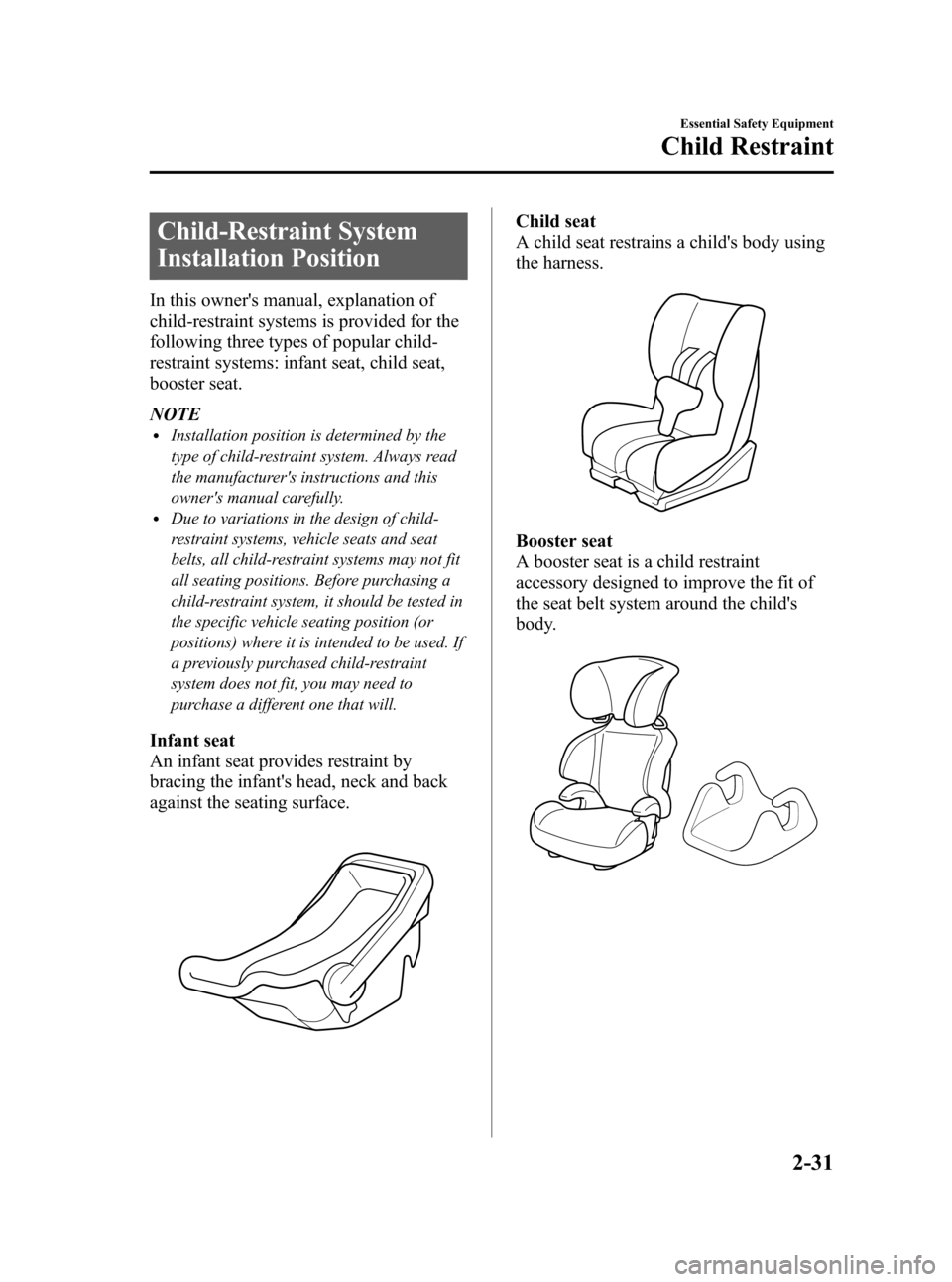
In this owner's manual, explanation of
child-restraint systems is provided for the
following three types of popular child-
restraint systems: infant seat, child seat,
booster seat.
NOTE
lInstallation position is determined by the
type of child-restraint system. Always read
the manufacturer's instructions and this
owner's manual carefully.
lDue to variations in the design of child-
restraint systems, vehicle seats and seat
belts, all child-restraint systems may not fit
all seating positions. Before purchasing a
child-restraint system, it should be tested in
the specific vehicle seating position (or
positions) where it is intended to be used. If
a previously purchased child-restraint
system does not fit, you may need to
purchase a different one that will.
Infant seat
An infant seat provides restraint by
bracing the infant's head, neck and back
against the seating surface.
Child seat
A child seat restrains a child's body using
the harness.
Booster seat
A booster seat is a child restraint
accessory designed to improve the fit of
the seat belt system around the child's
body.
Essential Safety Equipment
Child Restraint
2-31
Mazda3_8BY7-EC-11F_Edition1 Page45
Friday, June 17 2011 2:54 PM
Form No.8BY7-EC-11F
Page 47 of 525
Black plate (46,1)
Installing Child-Restraint
Systems
Accident statistics reveal that a child is
safer in the rear seat. The front passenger's
seat is clearly the worst choice for any
child under 12, and with rear-facing child-
restraint systems it is clearly unsafe due to
air bags.
NOTE
Even if your vehicle is equipped with front
passenger seat weight sensors (page 2-57),
which automatically deactivates the front
passenger air bag, a rear seat is the safest
place for a child of any age or size.
Some child-restraint systems now come
with tethers and therefore must be
installed on the seats that take tethers to
be effective. In your Mazda, tethered
child-restraint systems can only be
accommodated in the three positions on
the rear seat.
Some child-restraint systems also employ
specially designed LATCH attachments;
refer to“LATCH Child-Restraint
Systems ”(page 2-39).
WARNING
Tethered Child-Restraint Systems Work
Only on Tether-Equipped Rear Seats:
Installation of a tether equipped
child-restraint system in the front
passenger's seat defeats the safety
design of the system and will result in
an increased chance of serious injury
if the child-restraint system goes
forward without benefit of being
tethered.
Place tether equipped child-restraint
systems where there are tether
anchors.
qRear Seat Child-Restraint System
Installation
Follow these instructions when using a
child-restraint system, unless you are
attaching a LATCH-equipped child-
restraint system to the rear LATCH lower
anchors. Refer to “LATCH Child-
Restraint Systems ”(page 2-39).
NOTE
Follow the child-restraint system
manufacturer's instructions carefully. If you
are not sure whether you have a LATCH
system or tether, check in the child-restraint
system manufacturer's instructions and follow
them accordingly. Depending on the type of
child-restraint system, it may use LATCH
system instead of seat belts or if the belt goes
across the child's chest, may recommend
against using automatic locking mode.
1. Make sure the seatback is securely latched by pushing it back until it is
fully locked.
2-32
Essential Safety Equipment
Child Restraint
Mazda3_8BY7-EC-11F_Edition1 Page46
Friday, June 17 2011 2:54 PM
Form No.8BY7-EC-11F