warning light MAZDA MODEL 3 SEDAN 2019 Repair Manual
[x] Cancel search | Manufacturer: MAZDA, Model Year: 2019, Model line: MODEL 3 SEDAN, Model: MAZDA MODEL 3 SEDAN 2019Pages: 592, PDF Size: 75.35 MB
Page 254 of 592

A vehicle approaching from the rear
left and right side of your vehicle
slows down.
A vehicle approaching from the rear
left and right side of your vehicle
makes a right or left turn directly in
front of your vehicle.
A vehicle overtakes your vehicle while
it is stopped.
Your vehicle is in an area where
strong radio waves or electrical noise
may occur such as near a television
tower or power plant.
In the following cases, the
i-ACTIVSENSE warning indication/
warning light turns on and operation of
the system is stopped. If the
i-ACTIVSENSE warning indication/
warning light remains illuminated, have
the vehicle inspected at an Authorized
Mazda Dealer as soon as possible.
Some problem with the system
including the Blind Spot Monitoring
(BSM) warning indicator lights has
occurred.
A large deviation in the installation
position of a rear side radar sensor on
the vehicle has occurred.
There is a large accumulation of snow
or ice on the rear bumper near a rear
side radar sensor.
Driving on snow-covered roads for
long periods.
The temperature near the radar
sensors becomes extremely hot due to
driving for long periods on slopes
during the summer.
The battery voltage has decreased.
Under the following conditions, the rear
side radar sensor cannot detect
approaching vehicles or it might be
difficult to detect them, and the system
may not operate normally.
The vehicle speed when reversing is
about 15 km/h (9 mph) or faster.
The rear side radar sensor detection
area is obstructed by a nearby wall or
parked vehicle. (Reverse the vehicle to
a position where the radar sensor
detection area is no longer
obstructed.)
1. Your vehicle
A vehicle is approaching directly from
the rear of your vehicle.
1. Your vehicle
The vehicle is parked on a slant.
1. Your vehicle
When Driving
i-ACTIVSENSE
4-114
Mazda3_8HE9-EA-18K_Edition3 2018-11-21 14:31:58
Page 255 of 592

Directly after the RCTA system
becomes operable using the
personalization feature.
Radio wave interference from a radar
sensor equipped on a nearby parked
vehicle.
In the following cases, it may be difficult
to view the illumination/flashing of the
Blind Spot Monitoring (BSM) warning
indicator lights equipped on the door
mirrors.
Snow or ice adheres to the door
mirrors.
The front door glass is fogged or
covered in snow, frost or dirt.
Turn off the RCTA system while pulling
a trailer or while an accessory such as a
bicycle carrier is installed to the rear of
the vehicle. Otherwise, the radio waves
emitted by the radar will be blocked
causing the system to not operate
normally.
The rear side radar sensor of the RCTA
may be regulated under the radio wave
related laws of the country where the
vehicle is driven. If this system is used
abroad, it may be necessary to turn off
the system.
Refer to Rear Side Radar Sensor on
page 4-206.
▼Canceling Operation of Rear Cross
Traffic Alert (RCTA)
The RCTA can be set to inoperable.
(If only the RCT
A is turned off)
Refer to the Settings section in the
Mazda Connect Owner's Manual.
(If the RCTA is turned off by
operating the i-ACTIVSENSE switch)
Refer to i-ACTIV SENSE Switch on
page 4-85.
NOTE
When the ignition is switched OFF, the
system status before it was turned off is
maintained. For exampl e, if the ignition is
switched OFF with the RCTA operable,
the system will be operable when the
ignition is switched ON the next time.
When Driving
i-ACTIVSENSE
4-115
Mazda3_8HE9-EA-18K_Edition3 2018-11-21 14:31:58
Page 257 of 592

Slippery roads such as ice or snow-bound
roads (Tires could spin causing you to
lose vehicle control, or the stop hold
control may not operate.)
Long, descending slopes (to maintain
distance between vehicles, the system
automatically and continuously applies
the brakes which could result in the loss
of brake power.)
Two-wheeled vehicles such as
motorcycles or bicycles are ahead.
Slopes with a steep gradient (The vehicle
ahead may not be detected correctly,
your vehicle may slide while stopped by
the stop hold control, and it may
accelerate suddenly after it starts
moving.)
For safety purposes, switch the MRCC
system off when it is not being used.
CAUTION
If your vehicle is towed or you are towing
something, switch the MRCC system off to
prevent an unexpected operation.
NOTE
The MRCC system does not detect the
following as physical objects.
Vehicles approaching in the opposite
direction
Pedestrians
Stationary objects (stopped vehicles,
obstructions)
If a vehicle ahead is traveling at an
extremely low speed, the system may
not detect it correctly.
If there is a structure on the road or an
object (such as a monorail) at a low
height off the ground in front of the
vehicle, the system may operate.
Therefore, do not use the MRCC.
Do not use the MRCC system under
conditions in which close proximity
warnings are frequently activated.
During headway control travel, the
system accelerates and decelerates your
vehicle in conjunction with the speed of
the vehicle ahead. However, if it is
necessary to accelerate for a lane
change or if the vehicle ahead brakes
suddenly causing you to close in on the
vehicle rapidly, accelerate using the
accelerator pedal or decelerate using
the brake pedal depending on the
conditions.
While the MRCC system is in use, it
does not cancel even if the shift lever is
operated and any intended engine
braking will not occur. If deceleration is
required, lower the vehicle speed setting
or depress the brake pedal.
The sound of the automatic brakes
operating may be heard, however, it
does not indicate a problem.
The brake lights tu
rn on while the
MRCC automatic braking is operating.
When Driving
i-ACTIVSENSE
4-117
Mazda3_8HE9-EA-18K_Edition3 2018-11-21 14:31:58
Page 258 of 592
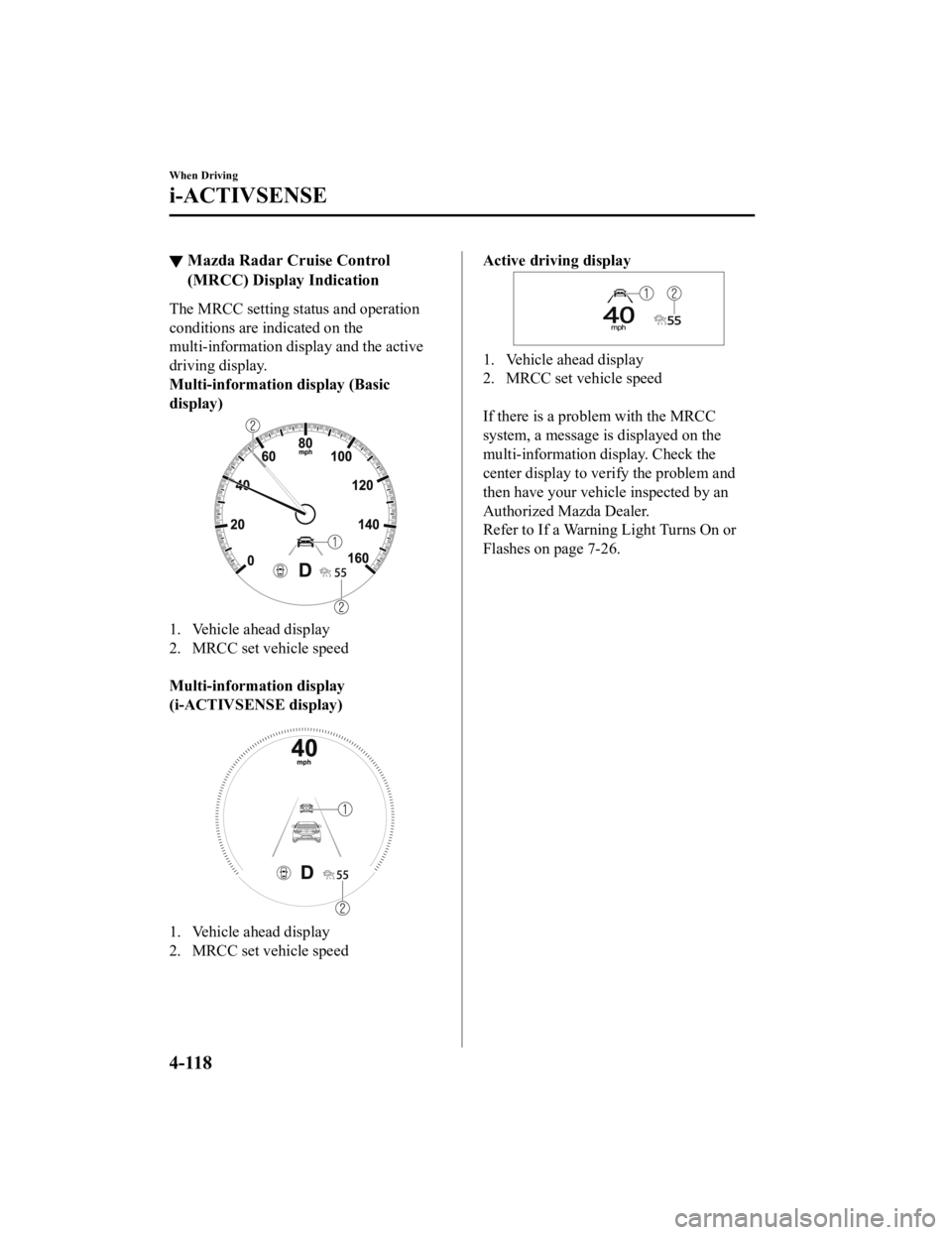
▼Mazda Radar Cruise Control
(MRCC) Display Indication
The MRCC setting status and operation
conditions are indicated on the
multi-information di
splay and the active
driving display.
Multi-information display (Basic
display)
1. Vehicle ahead display
2. MRCC set vehicle speed
Multi-information display
(i-ACTIVSENSE display)
1. Vehicle ahead display
2. MRCC set vehicle speed
Active drivin g display
1. Vehicle ahead display
2. MRCC set vehicle speed
If there is a probl em with the MRCC
system, a message is displayed on the
multi-information display. Check the
center display to ve rify the problem and
then have your vehicle inspected by an
Authorized Mazda Dealer.
Refer to If a Warning Light Turns On or
Flashes on page 7-26.
When Driving
i-ACTIVSENSE
4-118
Mazda3_8HE9-EA-18K_Edition3 2018-11-21 14:31:58
Page 266 of 592

For safety purposes, switch the MRCC with
Stop & Go function system off when it is not
being used.
Do not get out of the vehicle while the stop
hold control is operating:
Getting out of the vehicle while the stop
hold control is operating is dangerous as
the vehicle may move unexpectedly and
result in an accident. Before getting out of
the vehicle, switch the MRCC with Stop &
Go function system off, shift the selector
lever to the P position, and apply the
parking brake.
CAUTION
If your vehicle is towed or you are towing
something, switch the MRCC with Stop &
Go function system off to prevent an
unexpected operation.
NOTE
The MRCC with Stop & Go function
system does not detect the following as
physical objects.
Vehicles approaching in the opposite
direction
Pedestrians
Stationary objects (stopped vehicles,
obstructions)
If a vehicle ahead is traveling at an
extremely low speed, the system may
not detect it correctly.
If there is a structure on the road or an
object (such as a monorail) at a low
height off the ground in front of the
vehicle, the system may operate.
Therefore, do not use the MRCC with
Stop & Go function.
Do not use the MRCC with Stop & Go
function system under conditions in
which close proximity warnings are
frequently activated.
During headway control travel, the
system accelerates and decelerates your
vehicle in conjunction with the speed of
the vehicle ahead. However, if it is
necessary to accelerate for a lane
change or if the vehicle ahead brakes
suddenly causing you to close in on the
vehicle rapidly, accelerate using the
accelerator pedal or decelerate using
the brake pedal depending on the
conditions.
While the MRCC with Stop & Go
function system is in use, it does not
cancel even if the selector lever is
operated and any intended engine
braking does not occur. If deceleration
is required, lower the set speed or
depress the brake pedal.
The sound of the automatic brakes
operating may be heard, however, it
does not indicate a problem.
The brake lights turn on while the
MRCC with Stop & Go function
automatic braking is operating.
When Driving
i-ACTIVSENSE
4-126
Mazda3_8HE9-EA-18K_Edition3 2018-11-21 14:31:58
Page 277 of 592

If a vehicle ahead is traveling at an
extremely low speed, the system may
not detect it correctly.
If there is a structure on the road or an
object (such as a monorail) at a low
height off the ground in front of the
vehicle, the system may operate.
Therefore, do not use the TJA.
Do not use the TJA under conditions in
which close proximity warnings are
frequently activated.
If it is necessary to accelerate for a lane
change or the vehicle ahead brakes
suddenly causing you to close in on the
vehicle rapidly, accelerate using the
accelerator pedal or decelerate using
the brake pedal depending on the
conditions.
While the TJA is in use, it does not
cancel even if the selector lever is
operated and any intended engine
braking does not occur. If deceleration
is required, lower the set speed or
depress the brake pedal.
You might hear the sound of the
automatic brakes operating; however, it
does not indicate a problem.
The brake lights turn on while the TJA
automatic braking is operating.
Under the following conditions, the TJA
may not be able to detect white (yellow)
lines correctly and the TJA may not
operate normally.
The forward sensing camera (FSC)
cannot recognize the area in front of
the vehicle due to soiling or fog.
The white (yellow) lane lines are less
visible because of dirt or paint
flaking.
White (yellow) lane lines are less
visible because of bad weather (rain,
fog, or snow).
The vehicle is driven on a temporary
lane or section with a closed lane
resulting from construction where
there might be multiple white (yellow)
lane lines, or they are interrupted.
The camera picks up an obscure line,
such as a temporary line being used
for construction, or because of shade,
unmelted snow, or grooves filled with
water.
The road surface is wet and shiny
after rain, or there are puddles on the
road.
Heavy luggage is loaded in the
luggage compartment or on the rear
seat causing the vehicle to tilt.
A vehicle in front of your vehicle is
running near a white (yellow) lane
line making it less visible.
The windshield is dirty or foggy.
The tire pressures are not adjusted to
the specified pressure.
Tires other than standard tires are
equipped.
The vehicle is driven through an
intersection, a junction, or a fork in
the road.
While white (yellow) lane lines cannot
be detected due to road or weather
conditions.
The surrounding brightness suddenly
changes such as when entering or
exiting a tunnel.
The illumination of the headlights is
weakened because of dirt or the
optical axis is deviated at night.
Back-light is reflected off the road
surface or the road surface is wet and
shiny after rain.
When Driving
i-ACTIVSENSE
4-137
Mazda3_8HE9-EA-18K_Edition3 2018-11-21 14:31:58
Page 280 of 592
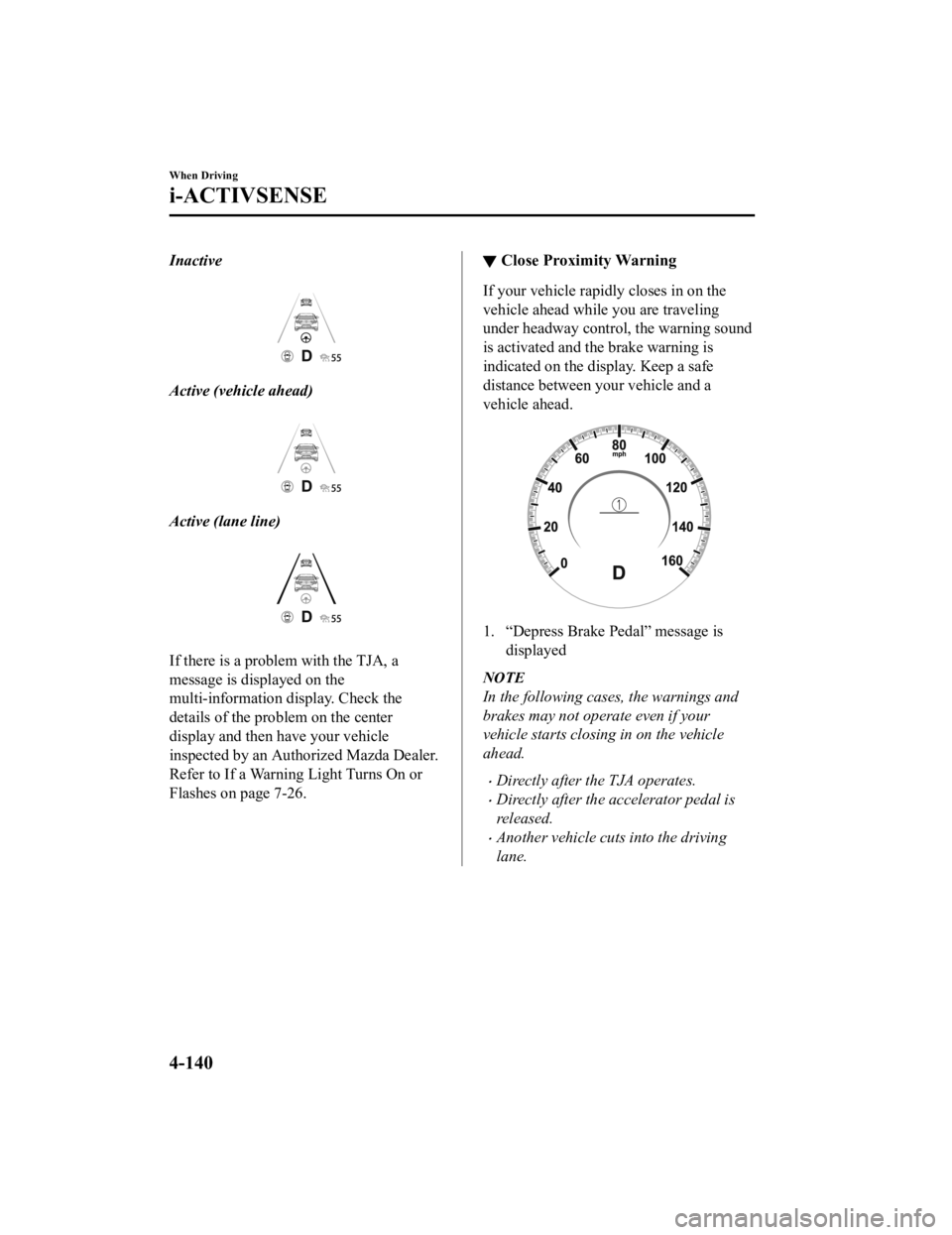
Inactive
Active (vehicle ahead)
Active (lane line)
If there is a problem with the TJA, a
message is displayed on the
multi-information display. Check the
details of the prob lem on the center
display and then have your vehicle
inspected by an Authorized Mazda Dealer.
Refer to If a Warnin g Light Turns On or
Flashes on page 7-26.
▼ Close Proximity Warning
If your vehicle rapidly closes in on the
vehicle ahead while you are traveling
under headway control, the warning sound
is activated and the brake warning is
indicated on the display. Keep a safe
distance between your vehicle and a
vehicle ahead.
1. “Depress Brake Pedal” message is
displayed
NOTE
In the following cases, the warnings and
brakes may not operate even if your
vehicle starts closin g in on the vehicle
ahead.
Directly after the TJA operates.
Directly after the accelerator pedal is
released.
Another vehicle cuts into the driving
lane.
When Driving
i-ACTIVSENSE
4-140
Mazda3_8HE9-EA-18K_Edition3 2018-11-21 14:31:58
Page 291 of 592

The vehicle is driven on a temporary
lane or section with a closed lane
resulting from construction where there
might be multiple white (yellow) lane
lines, or they are interrupted.
The camera picks up an obscure line,
such as a temporary line being used for
construction, or because of shade,
unmelted snow, or grooves filled with
water.
The surrounding brightness suddenly
changes such as when entering or
exiting a tunnel.
Back-light is reflected off the road
surface.
The road surface is wet and shiny after
rain, or there are puddles on the road.
The width of a lane is excessively
narrow.
The vehicle is driven on roads with tight
curves.
Heavy luggage is loaded in the luggage
compartment or on the rear seat causing
the vehicle to tilt.
The vehicle is driven through a fork in
the road or a junction.
The shade of a guardrail parallel to a
white (yellow) lane line is cast on the
road.
The illumination of the headlights is
weakened because of dirt or the optical
axis is deviated at night.
The road is excessively uneven.
The vehicle is shaken after hitting a
road bump.
A vehicle in front of your vehicle is
running near a white (yellow) lane line
making it less visible.
The windshield is dirty or foggy.
Strong light is directed from the front of
the vehicle (such as sunlight, or
headlights (high-beam) of on-coming
vehicles).
▼System Operation
When the ignition is switched ON, the
i-ACTIVSENSE status symbol (warning/
risk avoidance suppor
t system) (white)
turns on and the system goes on standby.
NOTE
If the i-ACTIVSENSE status symbol
(warning/risk avoidance support system)
(white) does not turn on, the system is
canceled using the i-ACTIVSENSE switch
or the personalization feature.
Operation conditions
When all of the foll owing conditions are
met, the i-ACTIVSENSE status symbol
(warning/risk avoidance support system)
on the multi-information display changes
from white to green and the system
becomes operational.
The ignition is switched ON.
The vehicle speed is about 64 km/h (40
mph) or faster.
The system detects white (yellow) lane
lines.
When Driving
i-ACTIVSENSE
4-151
Mazda3_8HE9-EA-18K_Edition3 2018-11-21 14:31:58
Page 292 of 592
NOTE
When the system does not detect a white
(yellow) lane line on one side only, the
system does not operate on the side that is
not being detected.
When temporarily canceling the system
The LAS goes on standby in the following
cases: The LAS opera tion is automatically
restored when the system's operation
conditions are met.
The system cannot detect white (yellow)
lane lines.
The vehicle speed is less than about 56
km/h (35 mph).
The turn signal lever is operated.
The accelerator pedal is depressed
abruptly.
The TCS/DSC is operating.
The DSC is turned off.
The steering wheel is operated.
The brake pedal is operated.
The function is temporarily stopped.
The LAS stops functioning in the
following cases:
The temperature in the forward sensing
camera (FSC) is high or low.
The windshield around the forward
sensing camera (FSC) is foggy.
The windshield around the forward
sensing camera (FSC) is blocked by an
obstruction, causing poor forward
visibility.
Strong light (such as sunlight, or
headlights (high-beam) of on-coming
vehicles) is directed at the forward
sensing camera (FSC).
System malfunction
If there is a problem w ith the system, the
i-ACTIVSENSE status symbol (warning/
risk avoidance suppo rt system) (white)
and the i-ACTIVSENSE warning
indication/warning light on the
multi-information di splay turns on and a
message is indicated.
Refer to i-ACTIVSENSE Status Symbol
(Warning/Risk Avoidance Support
System) on page 4-84.
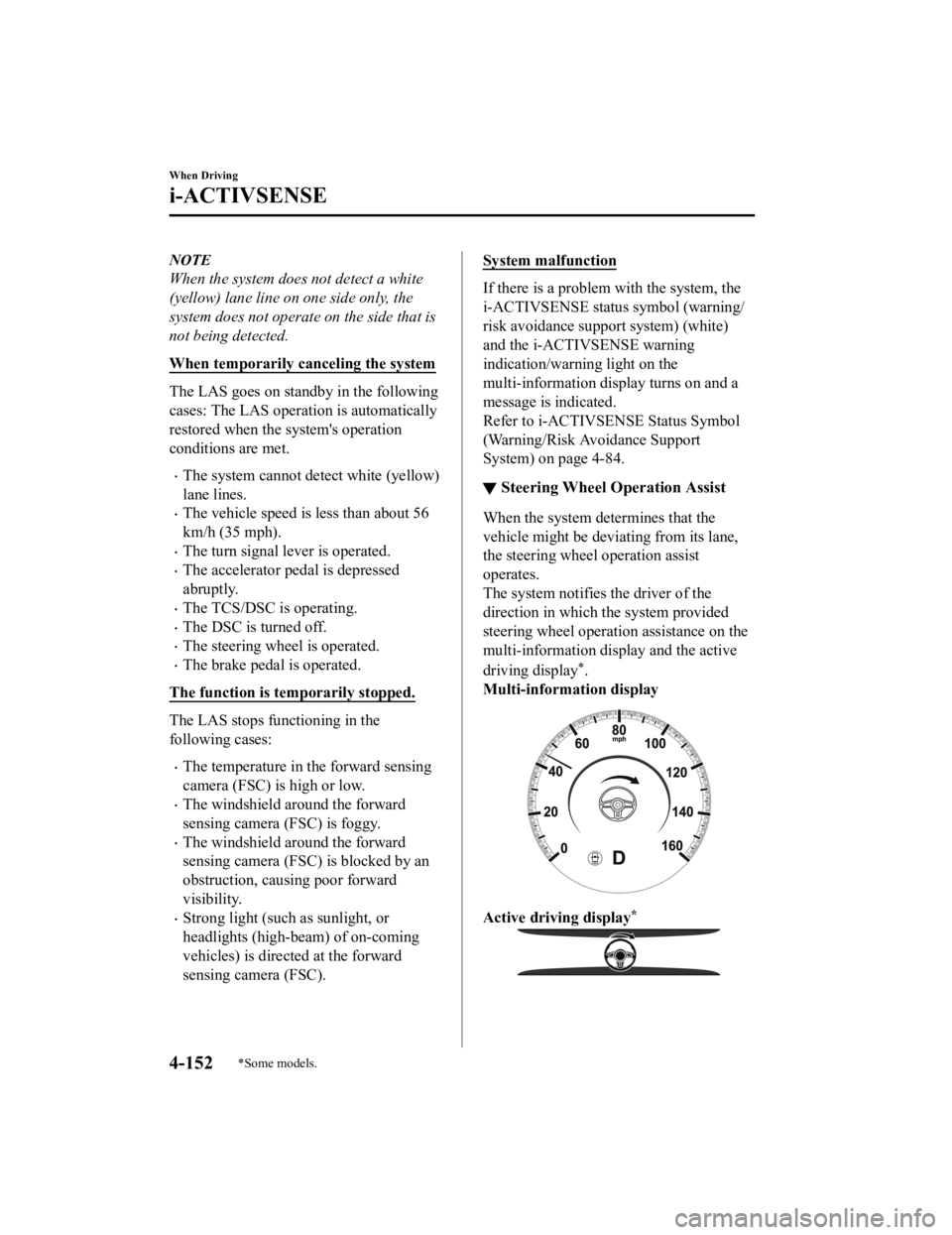
▼ Steering Wheel Operation Assist
When the system determines that the
vehicle might be deviating from its lane,
the steering wheel operation assist
operates.
The system notifies
the driver of the
direction in which t he system provided
steering wheel operation assistance on the
multi-information di splay and the active
driving display
*.
Multi-information display
Active drivin g display*
When Driving
i-ACTIVSENSE
4-152*Some models.
Mazda3_8HE9-EA-18K_Edition3 2018-11-21 14:31:58
Page 294 of 592

CAUTION
In the following cases, turn the system off
to prevent an unexpected operation.
The vehicle is being towed or when
towing another vehicle.
The vehicle is on a chassis roller.
When driving on rough roads such as in
areas of dense grass or off-road.
See the next page on how to turn off the
system.
Refer to Stopping the Smart Brake
Support (SBS) System Operation on page
4-155.
Operation conditions
The SBS operates when all of the
following conditions are met.
The ignition i s switched ON.
The SBS is on.
The i-ACTIVSENSE warning
indication/warning light is not turned
on.
(Object is vehicle ahead)
The vehicle speed is about 4 km/h (2
mph) or higher.
(Object is a pedestrian or bicycle)
The vehicle speed is between about 10
to 80 km/h (6.2 to 50 mph).
The DSC does not operate.
NOTE
Under the following conditions, the SBS
may not operate.
If there is the possib ility of hitting only
a part of a vehicle or obstruction
ahead.
You are driving your vehicle at the
same speed as the vehicle ahead.
When the driver deliberately performs
driving operations (accelerator
operation, steering wheel operation).
The accelerator pedal is depressed
abruptly.
The brake pedal is being depressed.
The steering wheel is being operated.
The selector lever is being shifted.
The turn signal lever is being
operated.
When warnings and messages, such
as a dirty windshield, related to the
Forward Sensing Camera (FSC) or
front radar sensor are being displayed
on the multi-information display.
The SBS may operate under the
following conditions.
There is an object in the road at the
entrance to a curve (including
guardrails and snow banks).
Passing an approaching vehicle while
rounding a curve.
When crossing a narrow bridge, and
passing through low gates, narrow
gates, car washing machines, or
tunnels.
When passing through a toll gate.
When entering an underground
parking area.
There is a metal object, bump, or a
protruding object on the road.
If you suddenly come close to a
vehicle ahead.
There is an animal, wall, or tree.
Notifies the driver with a warning
indication on the multi-information
display and the active driving display
(vehicles with active driving display)
while the system is operating.
When Driving
i-ACTIVSENSE
4-154
Mazda3_8HE9-EA-18K_Edition3 2018-11-21 14:31:58