Sound MAZDA MODEL 5 2012 User Guide
[x] Cancel search | Manufacturer: MAZDA, Model Year: 2012, Model line: MODEL 5, Model: MAZDA MODEL 5 2012Pages: 440, PDF Size: 5.51 MB
Page 107 of 440

Black plate (107,1)
Theft-Deterrent Systemí
If the theft deterrent system detects an
inappropriate entry into the vehicle, which
could result in the vehicle or its contents
being stolen, the alarm alerts the
surrounding area of an abnormality by
sounding the horn and flashing the hazard
warning lights.
Refer to Operation on page 3-29.
NOTE
lThe theft-deterrent system operates with the
key or the keyless entry system transmitter.
lThe system will not function unless it is
properly armed. To properly secure the
vehicle, always make sure all windows are
completely closed and all doors and the
liftgate are locked before leaving the
vehicle. Remember to take your key and
transmitter.
qOperation
System triggering conditions
The horn sounds intermittently and the
hazard warning lights flash for about 30
seconds when the system is triggered by
any one of the following:
lForcing open a door, the hood or the
liftgate.
lUnlocking a door with the inside door-
lock knob.
lUnlocking a door with the door lock
switch.
lOpening the hood by operating the
hood release handle.
lSwitching the ignition ON without the
key.
If the system is triggered again, the lights
and horn will activate until a door or the
liftgate is unlocked with the key or with
the transmitter. NOTE
If the battery goes dead while the theft-
deterrent system is armed, the horn will
activate and the hazard warning lights will
flash when the battery is charged or replaced.
q
How to Arm the System
1. Close the windows and the moonroofí
securely.
2. Remove the key from the ignition switch.
3. Make sure all the windows, the moonroof
í, and the hood are closed.
Close and lock all doors and the
liftgate from the outside using the key
or press the lock button on your
keyless entry system transmitter.
The hazard warning lights will flash
once.
The following method will also arm the
theft-deterrent system:
Close the hood and the liftgate. Press
the area on the door-lock switch
marked “LOCK ”once. Close all doors.
The security indicator light in the
instrument panel flashes twice per
second for 20 seconds.
The theft deterrent system can also be
armed by activating the auto re-lock
function with all the doors, the liftgate and
the hood closed.
NOTE
Locking the doors with the inside door-lock
knob will not arm the system.
Knowing Your Mazda
Security System
3-29íSome models.
Mazda5_8BR9-EA-10J_Edition3 Page107
Monday, February 21 2011 1:44 PM
Form No.8BR9-EA-10J
Page 115 of 440

Black plate (115,1)
Emission Control System
Your vehicle is equipped with an emission control system (the catalytic converter is part of
this system) that enables your vehicle to comply with existing exhaust emissions
requirements.
WARNING
Never park over or near anything flammable:Parking over or near anything flammable, such as dry grass, is dangerous. Even with
the engine turned off, the exhaust system remains very hot after normal use and
could ignite anything flammable. A resulting fire could cause serious injury or death.
CAUTION
Ignoring the following precautions could cause lead to accumulate on the catalyst
inside the converter or cause the converter to get very hot. Either condition will
damage the converter and cause poor performance.
ØUSE ONLY UNLEADED FUEL.
Ø Do not drive your Mazda with any sign of engine malfunction.
Ø Do not coast with the ignition switched off.
Ø Do not descend steep grades in gear with the ignition switched off.
Ø Do not operate the engine at high idle for more than 5 minutes.
Ø Do not tamper with the emission control system. All inspections and adjustments
must be made by a qualified technician.
Ø Do not push-start or pull-start your vehicle.
NOTE
Under U.S. federal law, any modification to the original-equipment emission control system before
the first sale and registration of a vehicle is subject to penalties. In some states, such modification
made on a used vehicle is also subject to penalties.
NOTE
While the engine is off, the sound of a valve opening and closing can be heard at the middle rear of
the vehicle, however this does not indicate an abnormality. Your vehicle has a self-checking device
and it operates while the engine is off.
Before Driving Your Mazda
Fuel and Engine Exhaust Precautions
4-3
Mazda5_8BR9-EA-10J_Edition3 Page115
Monday, February 21 2011 1:44 PM
Form No.8BR9-EA-10J
Page 125 of 440

Black plate (125,1)
5Driving Your Mazda
Explanation of instruments and controls.
Starting and Driving ..................................................................... 5-2Ignition Switch .......................................................................... 5-2
Starting the Engine .................................................................... 5-3
Turning the Engine Off ............................................................. 5-4
Brake System ............................................................................ 5-5
Manual Transaxle Operation ................................................... 5-10
Automatic Transaxle Controls ................................................ 5-12
Power Steering ........................................................................ 5-18
Cruise Control
í...................................................................... 5-19
Traction Control System (TCS) .............................................. 5-23
Dynamic Stability Control (DSC) ........................................... 5-24
Tire Pressure Monitoring System
í......................................... 5-26
Instrument Cluster and Indicators ............................................ 5-32 Meters and Gauges .................................................................. 5-32
Warning/Indicator Lights and Beep Sounds ............................ 5-36 Warning/Indicator Lights ........................................................ 5-36
Beep Sounds ........................................................................... 5-49
Switches and Controls ................................................................ 5-51 Lighting Control ..................................................................... 5-51
Turn and Lane-Change Signals ............................................... 5-55
Fog Lights
í............................................................................ 5-56
Windshield Wipers and Washer .............................................. 5-56
Rear Window Wiper and Washer ............................................ 5-60
Rear Window Defroster ........................................................... 5-61
Horn ........................................................................................ 5-62
Hazard Warning Flasher .......................................................... 5-62
5-1íSome models.
Mazda5_8BR9-EA-10J_Edition3 Page125
Monday, February 21 2011 1:44 PM
Form No.8BR9-EA-10J
Page 127 of 440

Black plate (127,1)
ON
This is the normal running position after
the engine is started. Some indicator
lights/warning lights should be inspected
before the engine is started (page 5-36).
NOTE
When the ignition is switched ON, the sound of
the fuel pump motor operating near the fuel
tank can be heard. This does not indicate an
abnormality.
START
The engine is started in this position. It
will crank until you release the key. It
then returns to the ON position.
qIgnition Key Reminder
If the ignition is switched off or the
ignition is switched to ACC with the key
inserted, a continuous beep sound will be
heard when the driver's door is opened.
NOTE
A personalized function is available to change
the sound volume for the ignition key reminder.
Refer to Personalization Features on page
10-8.
Starting the Engine
NOTE
Engine-starting is controlled by the spark
ignition system.
This system meets all Canadian Interference-
Causing Equipment Standard requirements
regulating the impulse electrical field strength
of radio noise.
1. Occupants should fasten their seat
belts.
2. Make sure the parking brake is on.
3. Depress the brake pedal.
4. (Manual transaxle)
Depress the clutch pedal all the way
and shift into neutral.
Keep the clutch pedal depressed while
cranking the engine.
(Automatic transaxle)
Put the vehicle in park (P). If you must
restart the engine while the vehicle is
moving, shift into neutral (N).
NOTE
(Manual transaxle)
The starter will not operate unless the clutch is
depressed sufficiently.
(Automatic transaxle)
The starter will not operate if the shift lever is
not in P or N.
5. Switch the ignition to START and hold
(up to 10 seconds at a time) until the
engine starts.
CAUTION
Do not try the starter for more than
10 seconds at a time. If the engine
stalls or fails to start, wait 10 seconds
before trying again. Otherwise, you
may damage the starter and drain
the battery.
Driving Your Mazda
Starting and Driving
5-3
Mazda5_8BR9-EA-10J_Edition3 Page127
Monday, February 21 2011 1:44 PM
Form No.8BR9-EA-10J
Page 132 of 440
Black plate (132,1)
Even if the light turns off have your brake
system inspected as soon as possible by
an Authorized Mazda Dealer.
NOTE
Having to add brake fluid is sometimes an
indicator of leakage. Consult an Authorized
Mazda Dealer as soon as possible even if the
brake light is no longer illuminated.
WARNING
Do not drive with the brake system
warning light illuminated. Contact an
Authorized Mazda Dealer to have the
brakes inspected as soon as possible:Driving with the brake system
warning light illuminated is
dangerous. It indicates that your
brakes may not work at all or that
they could completely fail at any
time. If this light remains
illuminated, after checking that the
parking brake is fully released, have
the brakes inspected immediately.
qAnti-Lock Brake System (ABS)
The ABS control unit continuously
monitors the speed of each wheel. If one
is about to lock up, the ABS responds by
automatically releasing and reapplying
that wheel's brake.
The driver will feel a slight vibration in
the brake pedal and may hear a chattering
noise from the brake system. This is
normal when the ABS operates. Continue
to depress the brake pedal without
pumping the brakes.
WARNING
Do not rely on ABS as a substitute for
safe driving:
The ABS cannot compensate for
unsafe and reckless driving, excessive
speed, tailgating (following another
vehicle too closely), driving on ice and
snow, and hydroplaning (reduced tire
friction and road contact because of
water on the road surface). You can
still have an accident.
NOTE
lBraking distances may be longer on loose
surfaces (snow or gravel, for example)
which usually have a hard foundation. A
vehicle with a normal braking system may
require less distance to stop under these
conditions because the tires will build up a
wedge of surface layer when the wheels
skid.
lThe sound of the ABS operating may be
heard when starting the engine or
immediately after starting the vehicle.
However, it does not indicate a malfunction.
q ABS Warning Light
The warning light stays on for a few
seconds when the ignition is switched
ON.
5-8
Driving Your Mazda
Starting and Driving
Mazda5_8BR9-EA-10J_Edition3 Page132
Monday, February 21 2011 1:44 PM
Form No.8BR9-EA-10J
Page 147 of 440
Black plate (147,1)
Traction Control System
(TCS)
The Traction Control System (TCS)
enhances traction and safety by
controlling engine torque and braking.
When the TCS detects driving wheel
slippage, it lowers engine torque and
operates the brakes to prevent loss of
traction.
This means that on a slick surface, the
engine adjusts automatically to provide
optimum power to the drive wheels,
limiting wheel spin and loss of traction.
WARNING
Do not rely on the traction control
system as a substitute for safe driving:The traction control system (TCS)
cannot compensate for unsafe and
reckless driving, excessive speed,
tailgating (following another vehicle
too closely), and hydroplaning
(reduced tire friction and road
contact because of water on the road
surface). You can still have an
accident.
Use snow tires or tire chains and drive
at reduced speeds when roads are
covered with ice and/or snow: Driving without proper traction
devices on snow and/or ice-covered
roads is dangerous. The traction
control system (TCS) alone cannot
provide adequate traction and you
could still have an accident.
NOTE
To turn off the TCS, press the DSC OFF switch
(page 5-25).
q TCS/DSC Indicator Light
This indicator light stays on for a few
seconds when the ignition is switched
ON. If the TCS or DSC is operating, the
indicator light flashes.
If the light stays on, the TCS or DSC may
have a malfunction and they may not
operate correctly. Take your vehicle to an
Authorized Mazda Dealer.
NOTE
lIn addition to the indicator light flashing, a
slight lugging sound will come from the
engine. This indicates that the TCS is
operating properly.
lOn slippery surfaces, such as fresh snow, it
will be impossible to achieve high rpm
when the TCS is on.
Driving Your Mazda
Starting and Driving
5-23
Mazda5_8BR9-EA-10J_Edition3 Page147
Monday, February 21 2011 1:44 PM
Form No.8BR9-EA-10J
Page 148 of 440

Black plate (148,1)
Dynamic Stability Control
(DSC)
The Dynamic Stability Control (DSC)
automatically controls braking and engine
torque in conjunction with systems such
as ABS and TCS to help control side slip
when driving on slippery surfaces, or
during sudden or evasive maneuvering,
enhancing vehicle safety.
Refer to ABS (page 5-8) and TCS (page
5-23).
DSC operation is possible at speeds
greater than 20 km/h (12 mph).
WARNING
Do not rely on the dynamic stability
control as a substitute for safe driving:The dynamic stability control (DSC)
cannot compensate for unsafe and
reckless driving, excessive speed,
tailgating (following another vehicle
too closely), and hydroplaning
(reduced tire friction and road
contact because of water on the road
surface). You can still have an
accident.
CAUTION
ØThe DSC may not operate correctly
unless the following are observed:
ØUse tires of the correct size
specified for your Mazda on all
four wheels.
ØUse tires of the same
manufacturer, brand and tread
pattern on all four wheels.
ØDo not mix worn tires.
Ø The DSC may not operate correctly
when tire chains are used or a
temporary spare tire is installed
because the tire diameter changes.
NOTE
After switching the ignition ON, a clicking
sound may be heard behind the dashboard.
This sound is the result of the DSC system self-
check operation and does not indicate an
abnormality.
q TCS/DSC Indicator Light
This indicator light stays on for a few
seconds when the ignition is switched
ON. If the TCS or DSC is operating, the
indicator light flashes.
If the light stays on, the TCS or DSC may
have a malfunction and they may not
operate correctly. Take your vehicle to an
Authorized Mazda Dealer.
5-24
Driving Your Mazda
Starting and Driving
Mazda5_8BR9-EA-10J_Edition3 Page148
Monday, February 21 2011 1:44 PM
Form No.8BR9-EA-10J
Page 150 of 440

Black plate (150,1)
Tire Pressure Monitoring Systemí
The tire pressure monitoring system (TPMS) monitors the pressure for each tire.
If tire pressure is too low in one or more tires, the system will inform the driver via the
warning light in the instrument panel and by the warning beep sound.
The tire pressure sensors installed on each wheel send tire pressure data by radio signal to
the receiver unit in the vehicle.
Tire pressure sensors
NOTE
When the ambient temperature is low due to seasonal changes, tire temperatures are also lower.
When the tire temperature decreases, the air pressure decreases as well. The TPMS warning light
may illuminate more frequently. Visually inspect the tires daily before driving, and check tire
pressures monthly with a tire pressure gauge. When checking tire pressures, use of a digital tire
pressure gauge is recommended.
TPMS does not alleviate your need to check the pressure and condition of all four tires
regularly.
5-26
Driving Your Mazda
íSome models.
Starting and Driving
Mazda5_8BR9-EA-10J_Edition3 Page150
Monday, February 21 2011 1:44 PM
Form No.8BR9-EA-10J
Page 152 of 440

Black plate (152,1)
qTire Pressure Monitoring System
Warning Light
This warning light illuminates for a few
seconds when the ignition is switched
ON.
Thereafter, the warning light illuminates
and a beep is heard when tire pressure is
too low in one or more tires, and flashes
when there is a system malfunction.
WARNING
If the tire pressure monitoring system
warning light illuminates or flashes, or
the tire pressure warning beep sound is
heard, decrease vehicle speed
immediately and avoid sudden
maneuvering and braking:
If the tire pressure monitoring system
warning light illuminates or flashes,
or the tire pressure warning beep
sound is heard, it is dangerous to
drive the vehicle at high speeds, or
perform sudden maneuvering or
braking. Vehicle drivability could
worsen and result in an accident.
To determine if you have a slow leak
or a flat, pull over to a safe position
where you can check the visual
condition of the tire and determine if
you have enough air to proceed to a
place where air may be added and
the system monitored again by an
Authorized Mazda Dealer or a tire
repair station.
Do not ignore the TPMS Warning Light: Ignoring the TPMS warning light is
dangerous, even if you know why it is
illuminated. Have the problem taken
care of as soon as possible before it
develops into a more serious
situation that could lead to tire
failure and a dangerous accident.
Warning light illuminates/Warning
beep sounds
When the warning light illuminates, and
the warning beep sound is heard (about 3
seconds), tire pressure is too low in one or
more tires.
5-28
Driving Your Mazda
Starting and Driving
Mazda5_8BR9-EA-10J_Edition3 Page152
Monday, February 21 2011 1:44 PM
Form No.8BR9-EA-10J
Page 159 of 440
Black plate (159,1)
If the gauge indicates that the fuel level is
near E, refuel as soon as possible.
NOTE
lAfter refueling, it may require some time for
the indicator to stabilize. In addition, the
indicator may deviate while driving on a
slope or curve since the fuel moves in the
tank.
lThe direction of the arrow () indicates
that the fuel-filler lid is on the right side of
the vehicle.
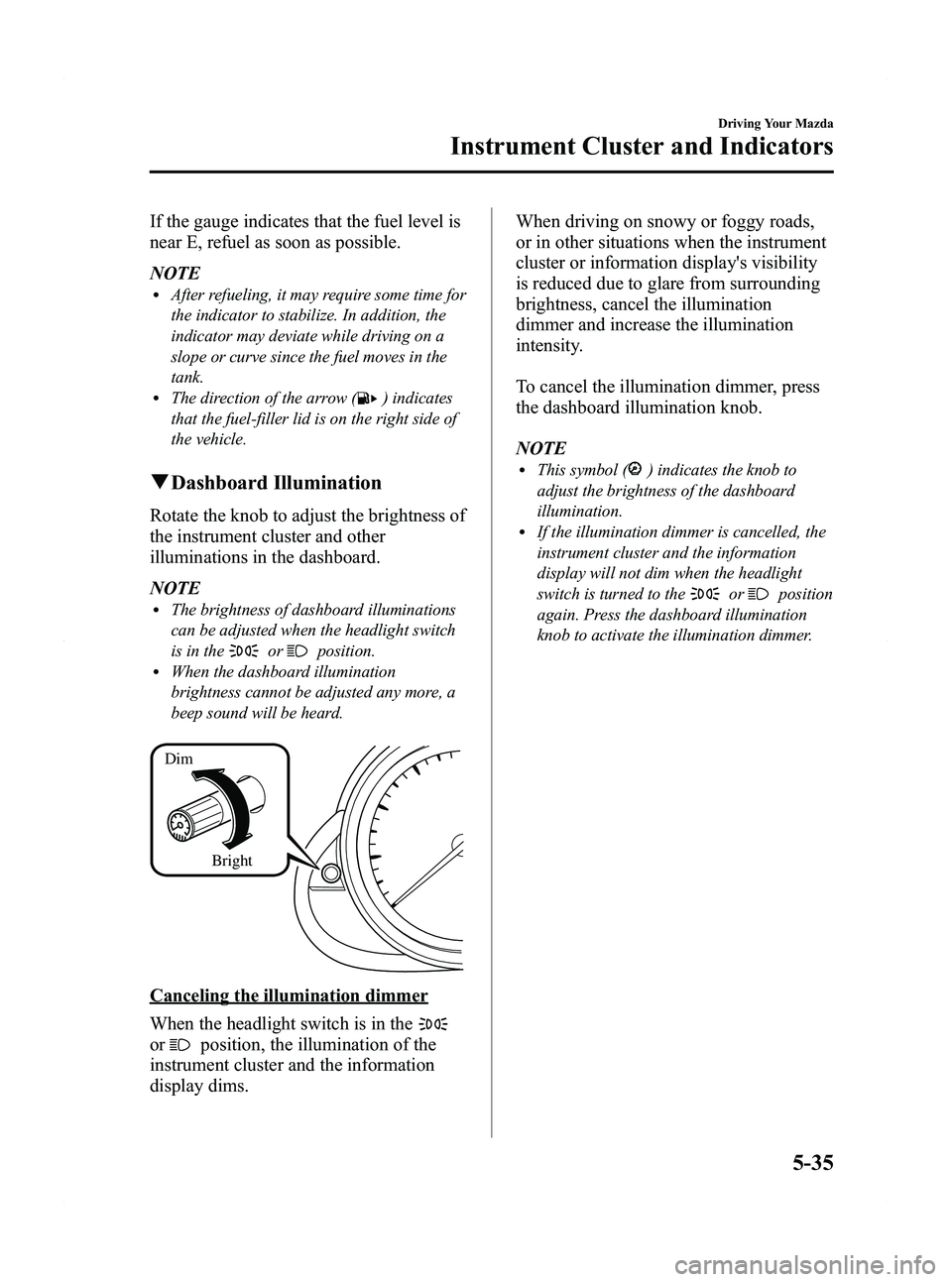
q Dashboard Illumination
Rotate the knob to adjust the brightness of
the instrument cluster and other
illuminations in the dashboard.
NOTE
lThe brightness of dashboard illuminations
can be adjusted when the headlight switch
is in the
orposition.lWhen the dashboard illumination
brightness cannot be adjusted any more, a
beep sound will be heard.
Bright
Dim
Canceling the illumination dimmer
When the headlight switch is in the
orposition, the illumination of the
instrument cluster and the information
display dims. When driving on snowy or foggy roads,
or in other situations when the instrument
cluster or information display's visibility
is reduced due to glare from surrounding
brightness, cancel the illumination
dimmer and increase the illumination
intensity.
To cancel the illumination dimmer, press
the dashboard illumination knob.
NOTE
lThis symbol () indicates the knob to
adjust the brightness of the dashboard
illumination.
lIf the illumination dimmer is cancelled, the
instrument cluster and the information
display will not dim when the headlight
switch is turned to the
orposition
again. Press the dashboard illumination
knob to activate the illumination dimmer.
Driving Your Mazda
Instrument Cluster and Indicators
5-35
Mazda5_8BR9-EA-10J_Edition3 Page159
Monday, February 21 2011 1:44 PM
Form No.8BR9-EA-10J