warning MAZDA MODEL 6 2017 Owners Manual (in English)
[x] Cancel search | Manufacturer: MAZDA, Model Year: 2017, Model line: MODEL 6, Model: MAZDA MODEL 6 2017Pages: 578, PDF Size: 54.72 MB
Page 525 of 578
8–23
Customer Information and Reporting Safety Defects
Uniform Tire Quality Grading System (UTQGS)
Uniform Tire Quality Grading System (UTQGS)
This information relates to the tire grading system developed by the U.S. National Highway
Traffic Safety Administration for grading tires by tread wear, traction, and temperature
performance.
Tread Wear
The tread wear grade is a comparative rating based on the wear rate of t\
he tire when tested
under controlled conditions on a specified government test course.
For example, a tire graded 150 would wear one-and-a-half times as well o\
n the government
course as a tire graded 100.
The relative performance of tires depends upon the actual conditions of \
their use, however,
and may depart significantly from the norm because of variations in driving habits, service
practices and differences in road characteristics and climate.
Traction-AA, A, B, C
The traction grades, from highest to lowest, are AA, A, B, and C. These grades represent the
tire's ability to stop on wet pavement as measured under controlled conditions on specified
government test surfaces of asphalt and concrete. A tire marked C may have poor traction
performance.
WARNING
The traction grade assigned to this tire is based on braking (straight ahead) traction tests
and does not include acceleration cornering (turning), hydroplaning, or peak traction
characteristics.
Mazda6_8FH2-EA-16F_Edition2.indb 232016/07/07 13:46:39
Page 526 of 578
8–24
Customer Information and Reporting Safety Defects
Uniform Tire Quality Grading System (UTQGS)
Temperature-A, B, C
The temperature grades A (the highest), B, and C, represent the tire's resistance to the
generation of heat and its ability to dissipate heat when tested under c\
ontrolled conditions on
a specified indoor laboratory test wheel.
Sustained high temperature can cause the material of the tire to degener\
ate and reduce tire
life, and excessive temperatures can lead to sudden tire failure.
Grade C corresponds to a level of performance which all passenger vehicle tires must meet
under the Federal Motor Vehicle Safety Standard No. 109. Grades B and A represent higher
levels of performance on the laboratory test wheel than the minimum required by law.
WARNING
Keep your vehicle's tires properly inflated and not overloaded:
Driving with improperly inflated or overloaded tires is dangerous. Excessive speed,
underinflation, or excessive loading, either separately or in combination, can cause heat
buildup and possible tire failure. The temperature grade for this tire is established for a
tire that is properly inflated and not overloaded.
These grades will be added to the sidewalls of passenger vehicle tires o\
ver the next several
years according to a schedule established by the NHTSA and the tire manufacturers.
The grade of tires available as standard or optional equipment on Mazda vehicles may vary
with respect to grade.
ALL PASSENGER VEHICLE TIRES MUST CONFORM TO THESE GRADES AND TO
ALL OTHER FEDERAL TIRE-SAFETY REQUIREMENTS.
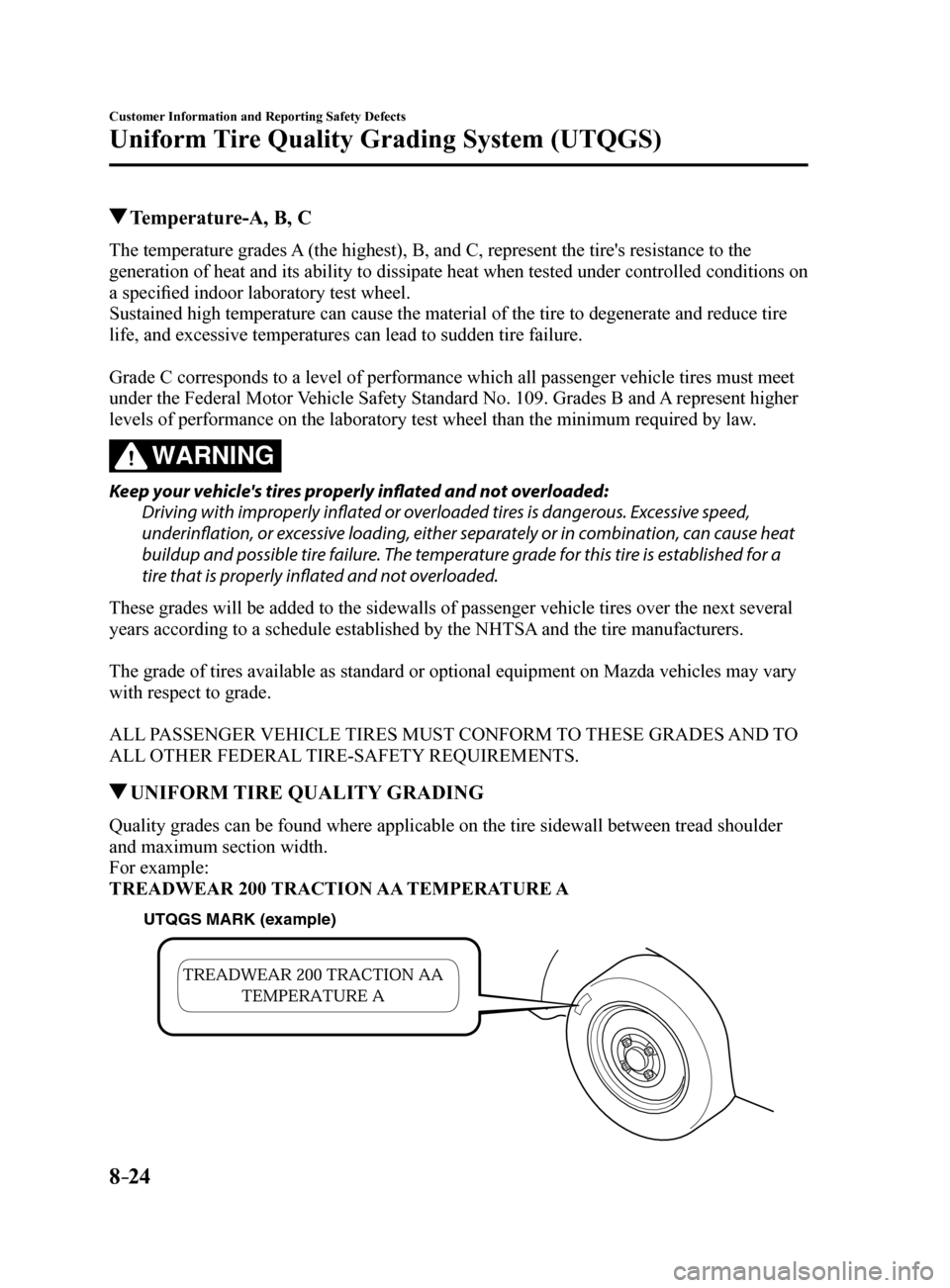
UNIFORM TIRE QUALITY GRADING
Quality grades can be found where applicable on the tire sidewall between tread shoulder
and maximum section width.
For example:
TREADWEAR 200 TRACTION AA TEMPERATURE A
UTQGS MARK (e xample)
Mazda6_8FH2-EA-16F_Edition2.indb 242016/07/07 13:46:39
Page 527 of 578
8–25
Customer Information and Reporting Safety Defects
Tire Information (U.S.A.)
Tire Labeling
Federal law requires tire manufacturers to place standardized information on the sidewall of
all tires. This information identifies and describes the fundamental characteristics of the tire
and also provides a tire identification number for safety standard certification and in case of
a recall.
Information on Passenger Vehicle Tires
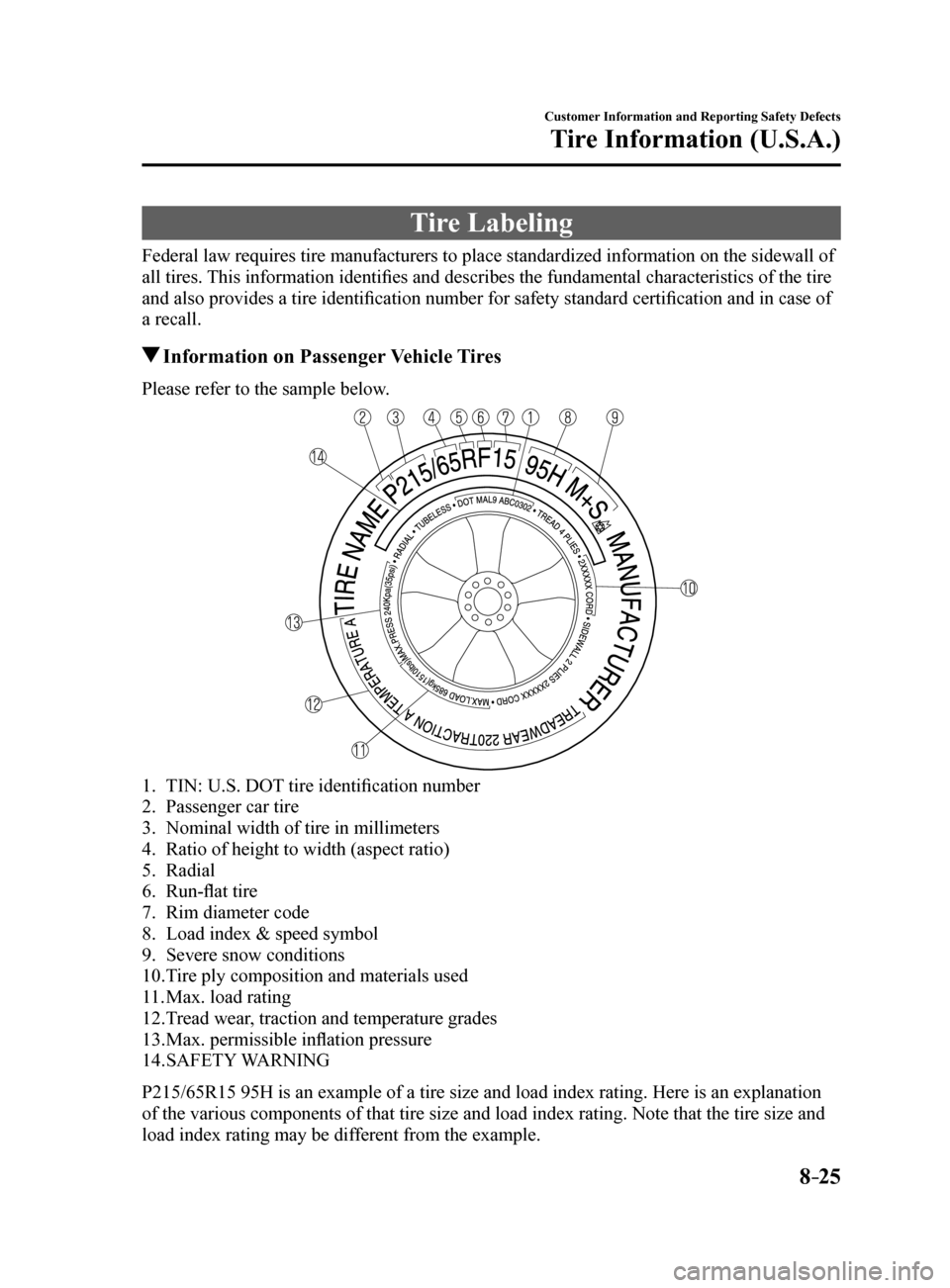
Please refer to the sample below.
1. TIN: U.S. DOT tire identification number
2. Passenger car tire
3. Nominal width of tire in millimeters
4. Ratio of height to width (aspect ratio)
5. Radial
6. Run-flat tire
7. Rim diameter code
8. Load index & speed symbol
9. Severe snow conditions
10. Tire ply composition and materials used
11. Max. load rating
12. Tread wear, traction and temperature grades
13. Max. permissible inflation pressure
14. SAFETY WARNING
P215/65R15 95H is an example of a tire size and load index rating. Here is an explanation
of the various components of that tire size and load index rating. Note that the tire size and
load index rating may be different from the example.
Mazda6_8FH2-EA-16F_Edition2.indb 252016/07/07 13:46:39
Page 530 of 578
8–28
Customer Information and Reporting Safety Defects
Tire Information (U.S.A.)
SAFETY WARNING
The following safety warning appears on the tire's sidewall.
SERIOUS INJURY MAY RESULT FROM:
EXPLOSION OF TIRE/RIM ASSEMBLY DUE TO IMPROPER MOUNTING-MATCH
TIRE DIAMETER TO RIM DIAMETER; NEVER EXCEED 40 psi (275 kPa) TO SEAT
BEADS-ONLY SPECIALLY TRAINED PERSONS SHOULD MOUNT TIRES.
TIRE FAILURE DUE TO UNDER-INFLATION/OVERLOADING/DAMAGE-
FOLLOW OWNER'S MANUAL AND PLACARD IN VEHICLE-FREQUENTLY
CHECK INFLATION PRESSURE AND INSPECT FOR DAMAGE.
Information on Temporary Tires
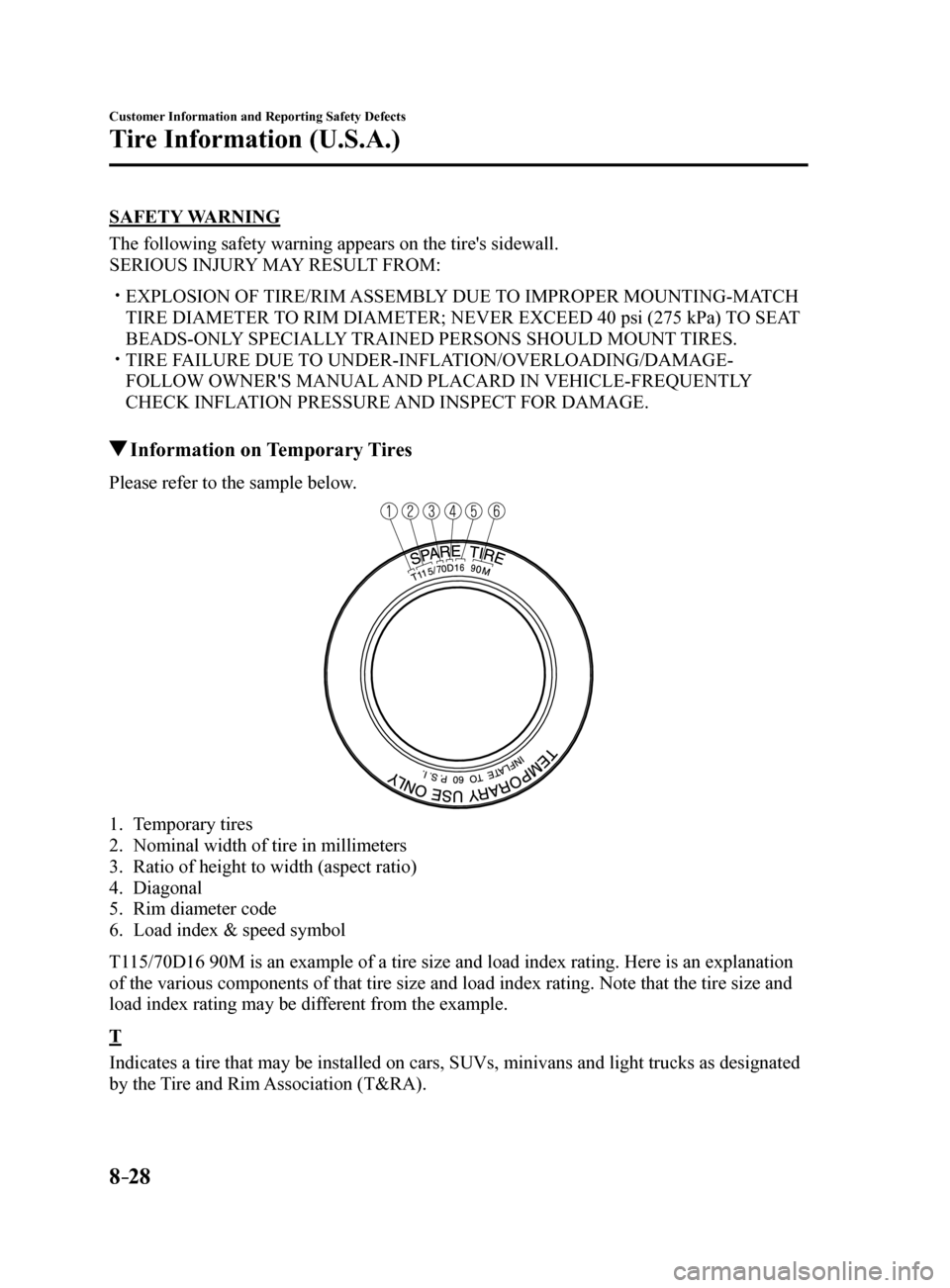
Please refer to the sample below.
1. Temporary tires
2. Nominal width of tire in millimeters
3. Ratio of height to width (aspect ratio)
4. Diagonal
5. Rim diameter code
6. Load index & speed symbol
T115/70D16 90M is an example of a tire size and load index rating. Here is\
an explanation
of the various components of that tire size and load index rating. Note that the tire size and
load index rating may be different from the example.
T
Indicates a tire that may be installed on cars, SUVs, minivans and light trucks as designated
by the Tire and Rim Association (T&RA).
Mazda6_8FH2-EA-16F_Edition2.indb 282016/07/07 13:46:40
Page 533 of 578
8–31
Customer Information and Reporting Safety Defects
Tire Information (U.S.A.)
WARNING
Always check the tire inflation pressures on a regular basis according to the
recommended tire inflation pressure on the tire label and in conjunction with the
information in this owner's manual:Driving your vehicle with under-inflated tires is dangerous.
Under-inflation is the most common cause of failures in any kind of tire and may result
in severe cracking, tread separation or “blowout”, with unexpected loss of vehicle
control and increased risk of injury. Under-inflation increases sidewall flexing and
rolling resistance, resulting in heat buildup and internal damage to the tire. It results in
unnecessary tire stress, irregular wear, loss of control and accidents. A tire can lose up to
half of its air pressure and not appear to be flat!
It is impossible to determine whether or not tires are properly inflated just by looking at
them.
Checking Tire Pressure
1. When you check the air pressure, make sure the tires are cold —meaning they are not hot
from driving even a mile.
2. Remove the cap from the valve on one tire.
3. Firmly press a tire gauge onto the valve.
4. Add air to achieve recommended air pressure.
5. If you overfill the tire, release air by pushing on the metal stem in the center of the valve.
Then recheck the pressure with your tire gauge.
6. Replace the valve cap.
7. Repeat with each tire, including the spare.
NOTE
Some spare tires require higher inflation pressure.
8. Visually inspect the tires to make sure there are no nails or other objects embedded that
could poke a hole in the tire and cause an air leak.
9. Check the sidewalls to make sure there are no gouges, cuts, bulges, crac\
ks or other
irregularities.
Mazda6_8FH2-EA-16F_Edition2.indb 312016/07/07 13:46:40
Page 536 of 578
8–34
Customer Information and Reporting Safety Defects
Tire Information (U.S.A.)
Replacing a Tire
WARNING
Always use tires that are in good condition:Driving with worn tires is dangerous. Reduced braking, steering, and traction could result
in an accident.
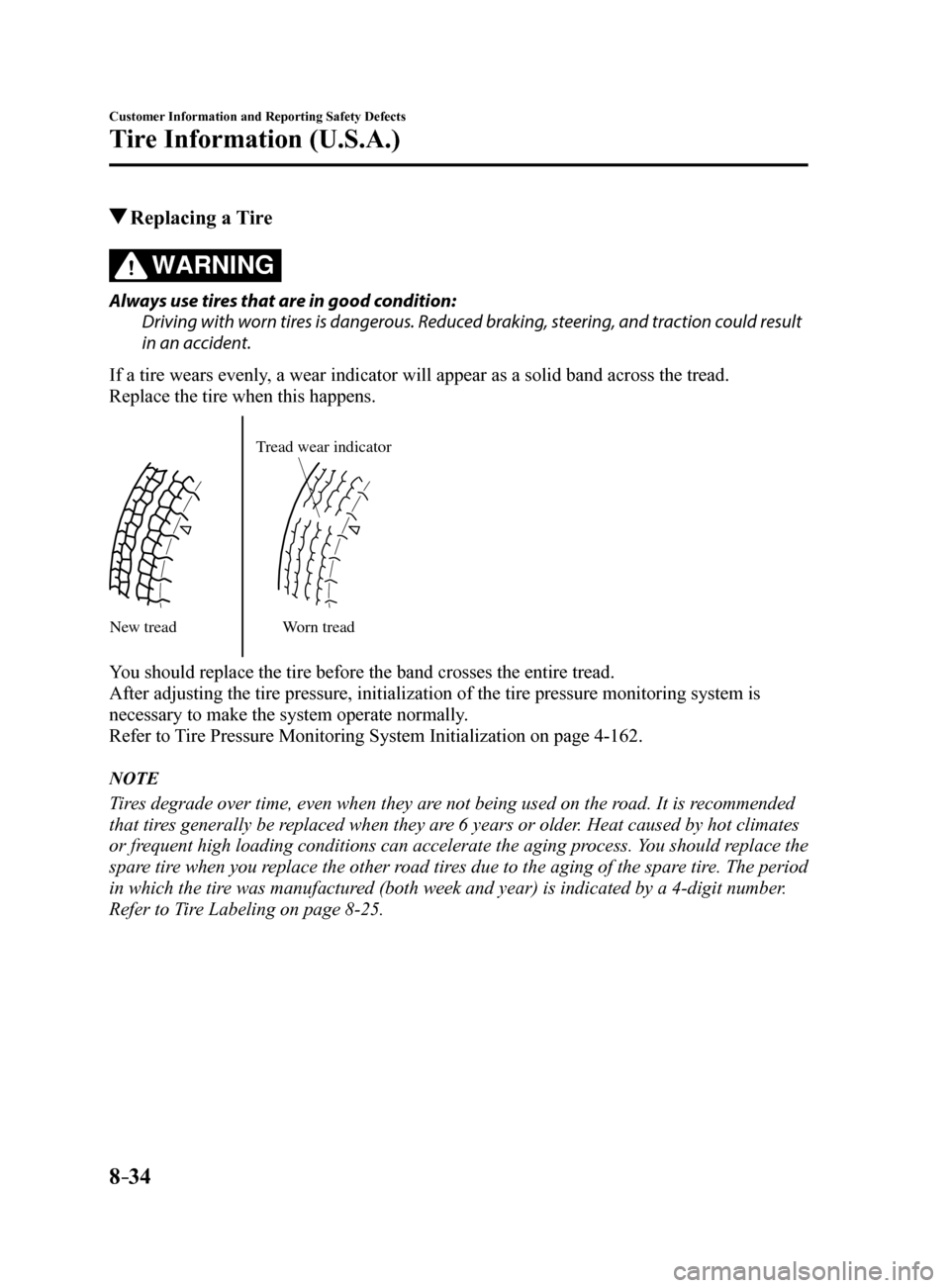
If a tire wears evenly, a wear indicator will appear as a solid band across the tread.
Replace the tire when this happens.
New tread T
read wear indicator
Worn tread
You should replace the tire before the band crosses the entire tread.
After adjusting the tire pressure, initialization of the tire pressure m\
onitoring system is
necessary to make the system operate normally.
Refer to Tire Pressure Monitoring System Initialization on page 4-162.
NOTE
Tires degrade over time, even when they are not being used on the road. It is recommended
that tires generally be replaced when they are 6 years or older. Heat caused by hot climates
or frequent high loading conditions can accelerate the aging process. You should replace the
spare tire when you replace the other road tires due to the aging of the spare tire. The period
in which the tire was manufactured (both week and year) is indicated by a 4-digit number.
Refer to Tire Labeling on page 8-25.
Mazda6_8FH2-EA-16F_Edition2.indb 342016/07/07 13:46:41
Page 538 of 578
8–36
Customer Information and Reporting Safety Defects
Tire Information (U.S.A.)
Vehicle Loading
WARNING
Do not tow a trailer with this vehicle:Towing a trailer with this vehicle is dangerous because it has not been designed to tow a
trailer and doing so will affect the drive system which could result in vehicle damage.
This section will guide you in the proper loading of your vehicle, to ke\
ep your loaded
vehicle weight within its design rating capability. Properly loading your vehicle will provide
maximum return of vehicle design performance. Before loading your vehicle, familiarize
yourself with the following terms for determining your vehicle's weight \
ratings, from the
vehicle's Safety Certification Label and Tire and Load Information Label:
WARNING
Overloaded Vehicle: Overloading a vehicle is dangerous. The results of overloading can have serious
consequences in terms of passenger safety. Too much weight on a vehicle's suspension
system can cause spring or shock absorber failure, brake failure, handling or steering
problems, irregular tire wear, tire failure or other damage.
Overloading makes a vehicle harder to drive and control. It also increases the distance
required for stopping. In cases of serious overloading, brakes can fail completely,
particularly on steep grades. The load a tire will carry safely is a combination of the size of
the tire, its load range, and corresponding inflation pressure.
Never overload the vehicle and always observe the vehicle's weight ratings from the
vehicle's Safety Certification and Tire and Load Information labels.
Mazda6_8FH2-EA-16F_Edition2.indb 362016/07/07 13:46:41
Page 542 of 578
8–40
Customer Information and Reporting Safety Defects
Tire Information (U.S.A.)
GVW (Gross Vehicle Weight) is the Vehicle Curb Weight cargo passengers.
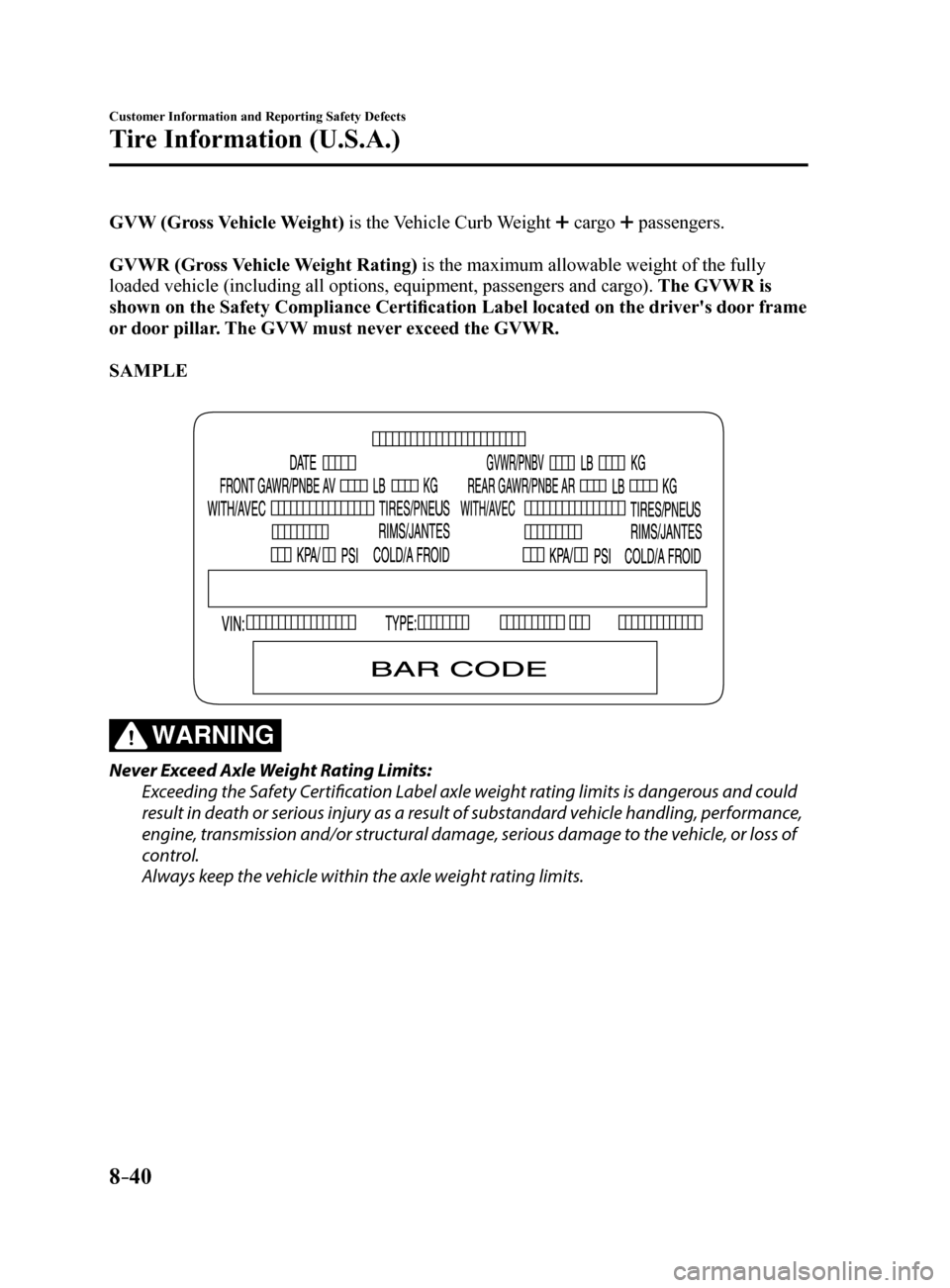
GVWR (Gross Vehicle Weight Rating) is the maximum allowable weight of the fully
loaded vehicle (including all options, equipment, passengers and cargo). The GVWR is
shown on the Safety Compliance Certification Label located on the driver's door frame
or door pillar. The GVW must never exceed the GVWR.
SAMPLE
WARNING
Never Exceed Axle Weight Rating Limits: Exceeding the Safety Certification Label axle weight rating limits is dangerous and could
result in death or serious injury as a result of substandard vehicle handling, performance,
engine, transmission and/or structural damage, serious damage to the vehicle, or loss of
control.
Always keep the vehicle within the axle weight rating limits.
Mazda6_8FH2-EA-16F_Edition2.indb 402016/07/07 13:46:42
Page 543 of 578

8–41
Customer Information and Reporting Safety Defects
Tire Information (U.S.A.)
GCW
GCW (Gross Combination Weight) is the weight of the loaded vehicle (GVW).
GCWR (Gross Combination Weight Rating) is the maximum allowable weight of the
vehicle - including all cargo and passengers - that the vehicle can handle without risking
damage. The GCW must never exceed the GCWR.
WARNING
Never Exceed GVWR or GAWR Specifications:Exceeding the GVWR or the GAWR specified on the certification label is dangerous.
Exceeding any vehicle rating limitation could result in a serious accident, injury, or
damage to the vehicle.
Do not use replacement tires with lower load carrying capacities than the originals
because they may lower the vehicle's GVWR and GAWR limitations. Replacement tires
with a higher limit than the originals do not increase the GVWR and GAWR limitations.
Never exceed the GVWR or the GAWR specified on the certification label.
Mazda6_8FH2-EA-16F_Edition2.indb 412016/07/07 13:46:42
Page 547 of 578
8–45
Customer Information and Reporting Safety Defects
Declaration of Conformity
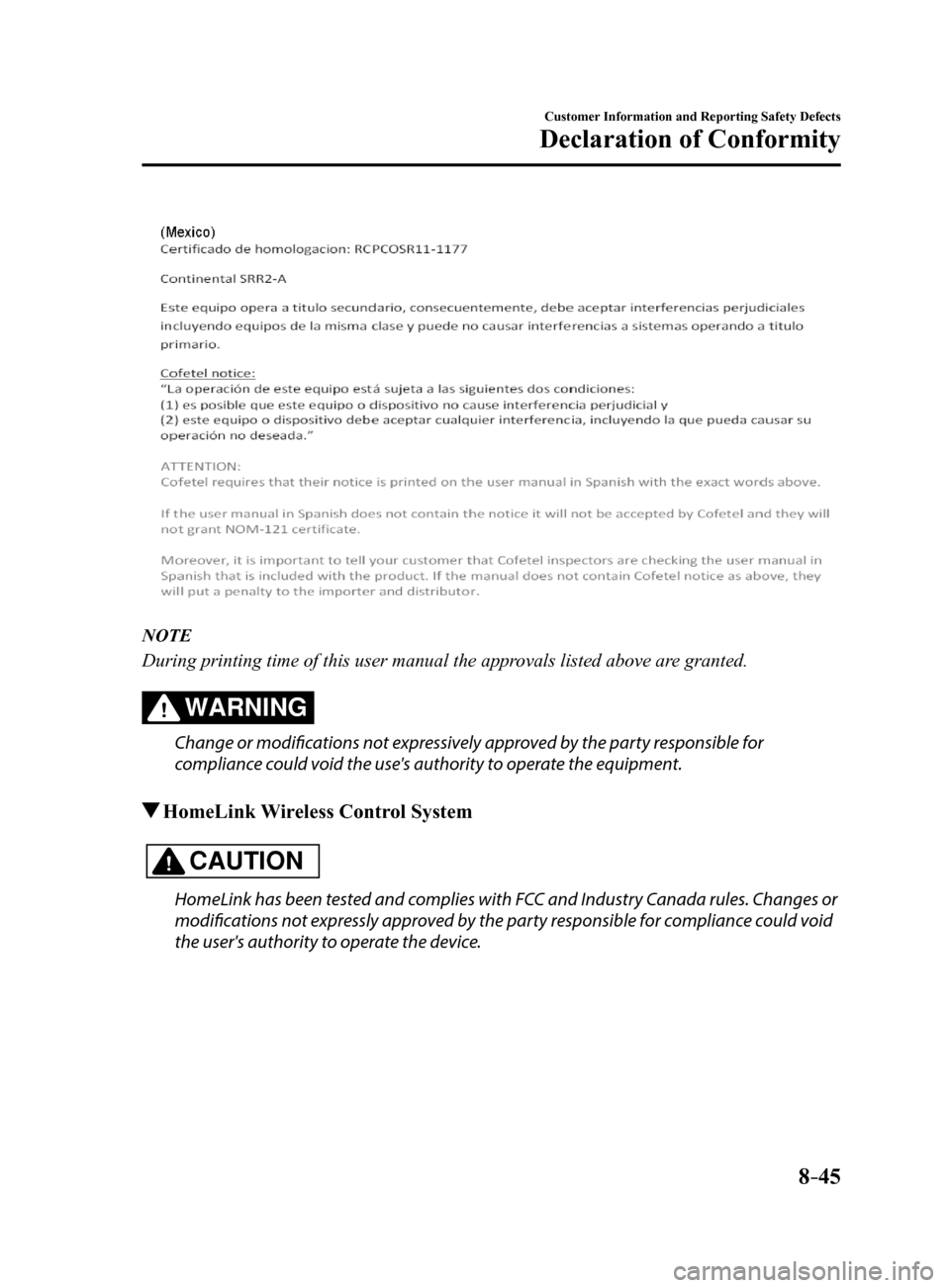
NOTE
During printing time of this user manual the approvals listed above are granted.
WARNING
Change or modifications not expressively approved by the party responsible for
compliance could void the use's authority to operate the equipment.
HomeLink Wireless Control System
CAUTION
HomeLink has been tested and complies with FCC and Industry Canada rules. Changes or
modifications not expressly approved by the party responsible for compliance could void
the user's authority to operate the device.
Mazda6_8FH2-EA-16F_Edition2.indb 452016/07/07 13:46:44