warning MAZDA MODEL 6 2017 (in English) Owner's Manual
[x] Cancel search | Manufacturer: MAZDA, Model Year: 2017, Model line: MODEL 6, Model: MAZDA MODEL 6 2017Pages: 578, PDF Size: 54.72 MB
Page 45 of 578
2–33
Essential Safety Equipment
Child Restraint
NOTE
To check if your front seats have side air
bags:
Mazda vehicles equipped with side air
bag will have a "SRS AIRBAG" tag on
the outboard shoulder of the front seats.
To check if your vehicle has curtain air
bags:
Mazda vehicles equipped with curtain
air bag will have an "SRS AIRBAG"
marking on the window pillars along
the roof edge.
WARNING
Always move the front passenger seat
as far back as possible if installing a
front-facing child-restraint system on it
is unavoidable:
As your vehicle has front air bags and
doubly so because your vehicle has
side air bags, a front-facing child-
restraint system should be put on the
front passenger seat only when it is
unavoidable.
Even if the front passenger air
bag deactivation indicator light
illuminates, always move the seat as
far back as possible, because the force
of a deploying air bag could cause
serious injury or death to the child. Never use a rear-facing child-restraint
system in the front seat with an air bag
that could deploy:
Rear-facing child-restraint systems
on the front seat are particularly
dangerous.
Even in a moderate collision, the
child-restraint system can be hit
by a deploying air bag and moved
violently backward resulting in
serious injury or death to the child.
Even though you may feel assured
that the front passenger air bag will
not deploy based on the fact that the
front passenger air bag deactivation
indicator light illuminates, you should
not use a rear-facing child-restraint
system in the front seat.
Do not allow a child or anyone to lean
over or against the side window of a
vehicle with side and curtain air bags: It is dangerous to allow anyone to lean
over or against the side window, the
area of the front passenger seat, the
front and rear window pillars and the
roof edge along both sides from which
the side and curtain air bags deploy,
even if a child-restraint system is used.
The impact of inflation from a side or
curtain air bag could cause serious
injury or death to an out of position
child. Furthermore, leaning over or
against the front door could block the
side and curtain air bags and eliminate
the advantages of supplemental
protection. With the front air bag and
the additional side air bag that comes
out of the front seat, the rear seat is
always a better location for children.
Take special care not to allow a child to
lean over or against the side window,
even if the child is seated in a child-
restraint system.
Mazda6_8FH2-EA-16F_Edition2.indb 332016/07/07 13:44:16
Page 47 of 578
2–35
Essential Safety Equipment
Child Restraint
NOTE
Inspect this function before each use of
the child-restraint system. You should
not be able to pull the shoulder belt
out of the retractor while the system is
in the automatic locking mode. When
you remove the child-restraint system,
be sure the belt fully retracts to return
the system to emergency locking mode
before occupants use the seat belts.
Follow the child-restraint system
manufacturer's instructions carefully.
Depending on the type of child-restraint
system, it may not employ seat belts
which are in automatic locking mode.
7. Seat your child safely in the child-
restraint system and secure the child
according to the instructions from the
child-restraint system manufacturer.
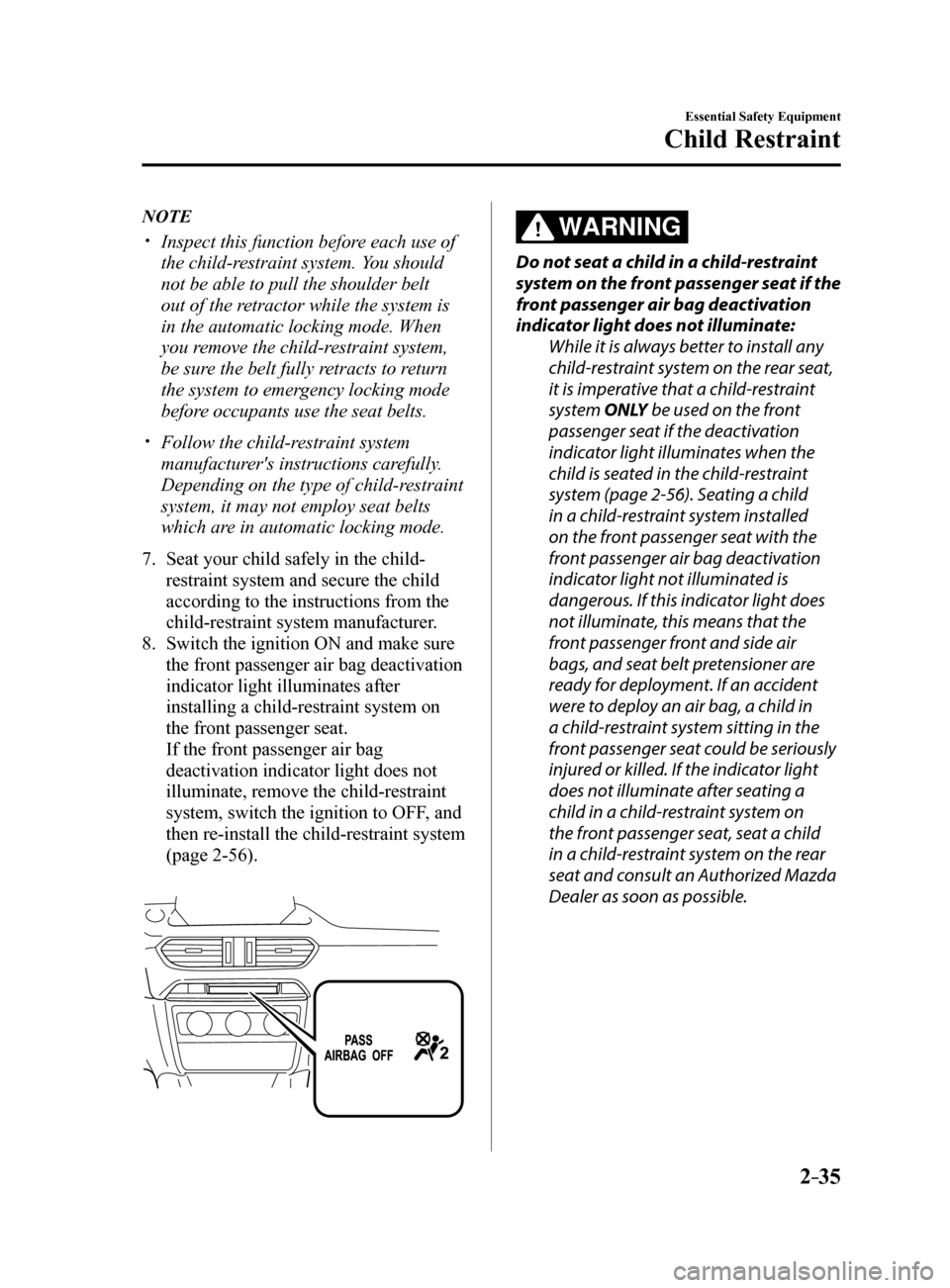
8. Switch the ignition ON and make sure
the front passenger air bag deactivation
indicator light illuminates after
installing a child-restraint system on
the front passenger seat.
If the front passenger air bag
deactivation indicator light does not
illuminate, remove the child-restraint
system, switch the ignition to OFF, and
then re-install the child-restraint system
(page 2-56).
WARNING
Do not seat a child in a child-restraint
system on the front passenger seat if the
front passenger air bag deactivation
indicator light does not illuminate: While it is always better to install any
child-restraint system on the rear seat,
it is imperative that a child-restraint
system ONLY be used on the front
passenger seat if the deactivation
indicator light illuminates when the
child is seated in the child-restraint
system (page 2-56). Seating a child
in a child-restraint system installed
on the front passenger seat with the
front passenger air bag deactivation
indicator light not illuminated is
dangerous. If this indicator light does
not illuminate, this means that the
front passenger front and side air
bags, and seat belt pretensioner are
ready for deployment. If an accident
were to deploy an air bag, a child in
a child-restraint system sitting in the
front passenger seat could be seriously
injured or killed. If the indicator light
does not illuminate after seating a
child in a child-restraint system on
the front passenger seat, seat a child
in a child-restraint system on the rear
seat and consult an Authorized Mazda
Dealer as soon as possible.
Mazda6_8FH2-EA-16F_Edition2.indb 352016/07/07 13:44:16
Page 48 of 578
2–36
Essential Safety Equipment
Child Restraint
Using LATCH Lower Anchor
Your Mazda is equipped with LATCH lower anchors for attachment of specially designed
LATCH child-restraint systems in the rear seats. Both anchors must be used, otherwise the
seat will bounce around and put the child in danger. Most LATCH child-restraint systems
must also be used in conjunction with a tether to be effective. If they have a tether you must
use it to better assure your child's safety.
WARNING
Follow the manufacturer's instructions for the use of the child-restraint system:
An unsecured child-restraint system is dangerous. In a sudden stop or a collision it could
move causing serious injury or death to the child or other occupants. Make sure the
child-restraint system is properly secured in place according to the child-restraint system
manufacturer's instructions.
Never attach two child-restraint systems to the same LATCH lower anchor: Attaching two child-restraint systems to the same LATCH lower anchor is dangerous.
In a collision, one anchor may not be strong enough to hold two child-restraint system
attachments, and it may break, causing serious injury or death. If you use the seat
position for another child-restraint system when an outboard LATCH position is occupied,
use the center seat belts instead, and the tether if tether-equipped.
Make sure the child-restraint system is properly secured: An unsecured child-restraint system is dangerous. In a sudden stop or a collision it could
move causing serious injury or death to the child or other occupants. Follow the child-
restraint system manufacturer's instructions on belt routing to secure the seat just as you
would with a child in it so that nobody is tempted to put a child in an improperly secured
seat later on. When not in use, remove it from the vehicle or fasten it with a seat belt, or
latch it down to BOTH LATCH lower anchors for LATCH child-restraint systems.
Make sure there are no seat belts or foreign objects near or around the LATCH child-
restraint system: Not following the child-restraint system manufacturer's instructions when installing
the child-restraint system is dangerous. If seat belts or a foreign object prevent the
child-restraint system from being securely attached to the LATCH lower anchors and the
child-restraint system is installed improperly, the child-restraint system could move in a
sudden stop or collision causing serious injury or death to the child or other occupants.
When installing the child-restraint system, make sure there are no seat belts or foreign
objects near or around the LATCH lower anchors. Always follow the child-restraint system
manufacturer's instructions.
Mazda6_8FH2-EA-16F_Edition2.indb 362016/07/07 13:44:16
Page 49 of 578
2–37
Essential Safety Equipment
Child Restraint
Installation on rear outboard seats
1. First, adjust the front seat to allow
clearance between the child-restraint
system and the front seat (page
2-5).
2. Make sure the seatback is securely
latched by pushing it back until it is
fully locked.
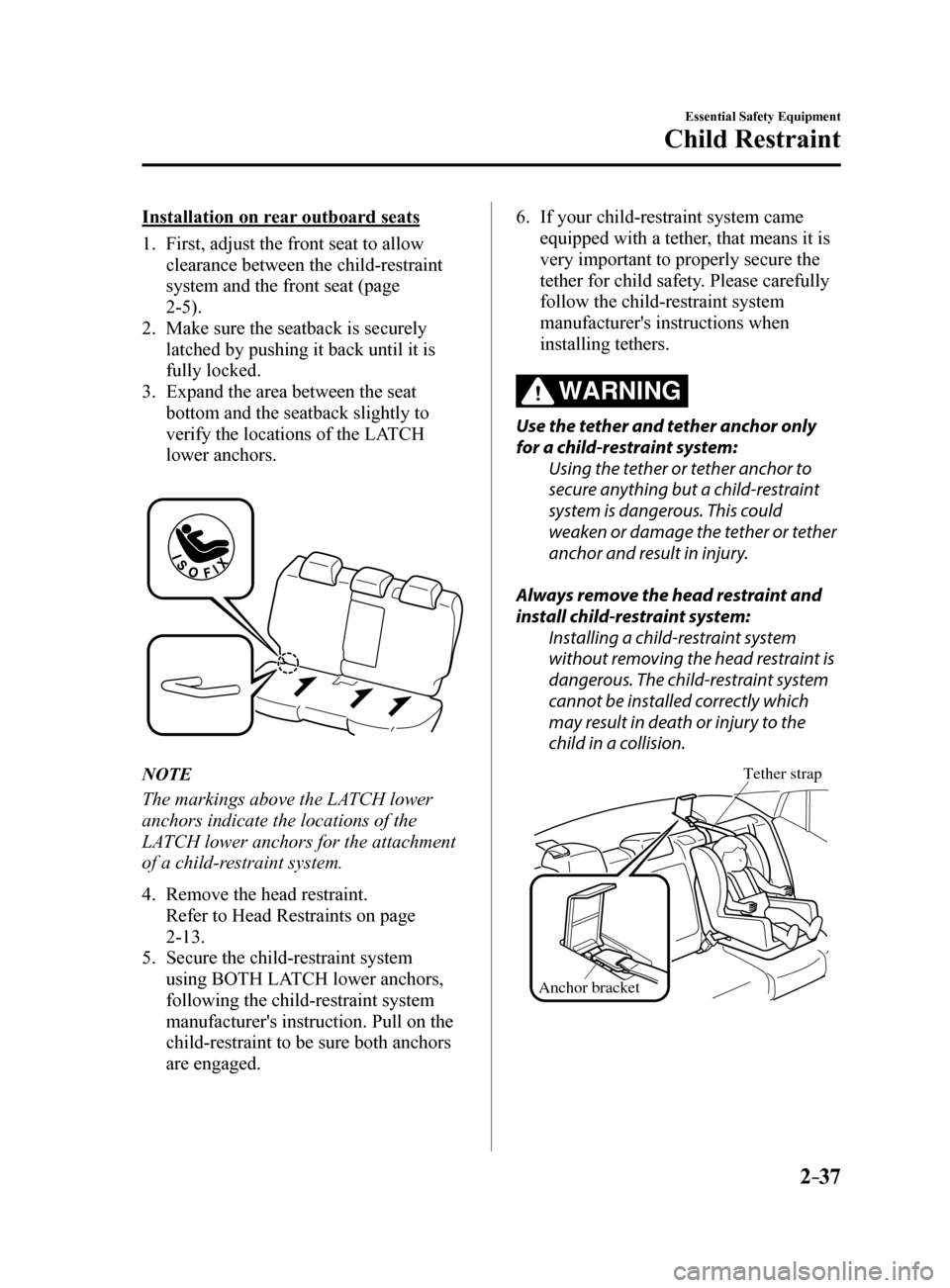
3. Expand the area between the seat
bottom and the seatback slightly to
verify the locations of the LATCH
lower anchors.
NOTE
The markings above the LATCH lower
anchors indicate the locations of the
LATCH lower anchors for the attachment
of a child-restraint system.
4. Remove the head restraint.
Refer to Head Restraints on page
2-13.
5. Secure the child-restraint system
using BOTH LATCH lower anchors,
following the child-restraint system
manufacturer's instruction. Pull on the
child-restraint to be sure both anchors
are engaged. 6.
If your child-restraint system came
equipped with a tether, that means it is
very important to properly secure the
tether for child safety. Please carefully
follow the child-restraint system
manufacturer's instructions when
installing tethers.
WARNING
Use the tether and tether anchor only
for a child-restraint system:
Using the tether or tether anchor to
secure anything but a child-restraint
system is dangerous. This could
weaken or damage the tether or tether
anchor and result in injury.
Always remove the head restraint and
install child-restraint system: Installing a child-restraint system
without removing the head restraint is
dangerous. The child-restraint system
cannot be installed correctly which
may result in death or injury to the
child in a collision.
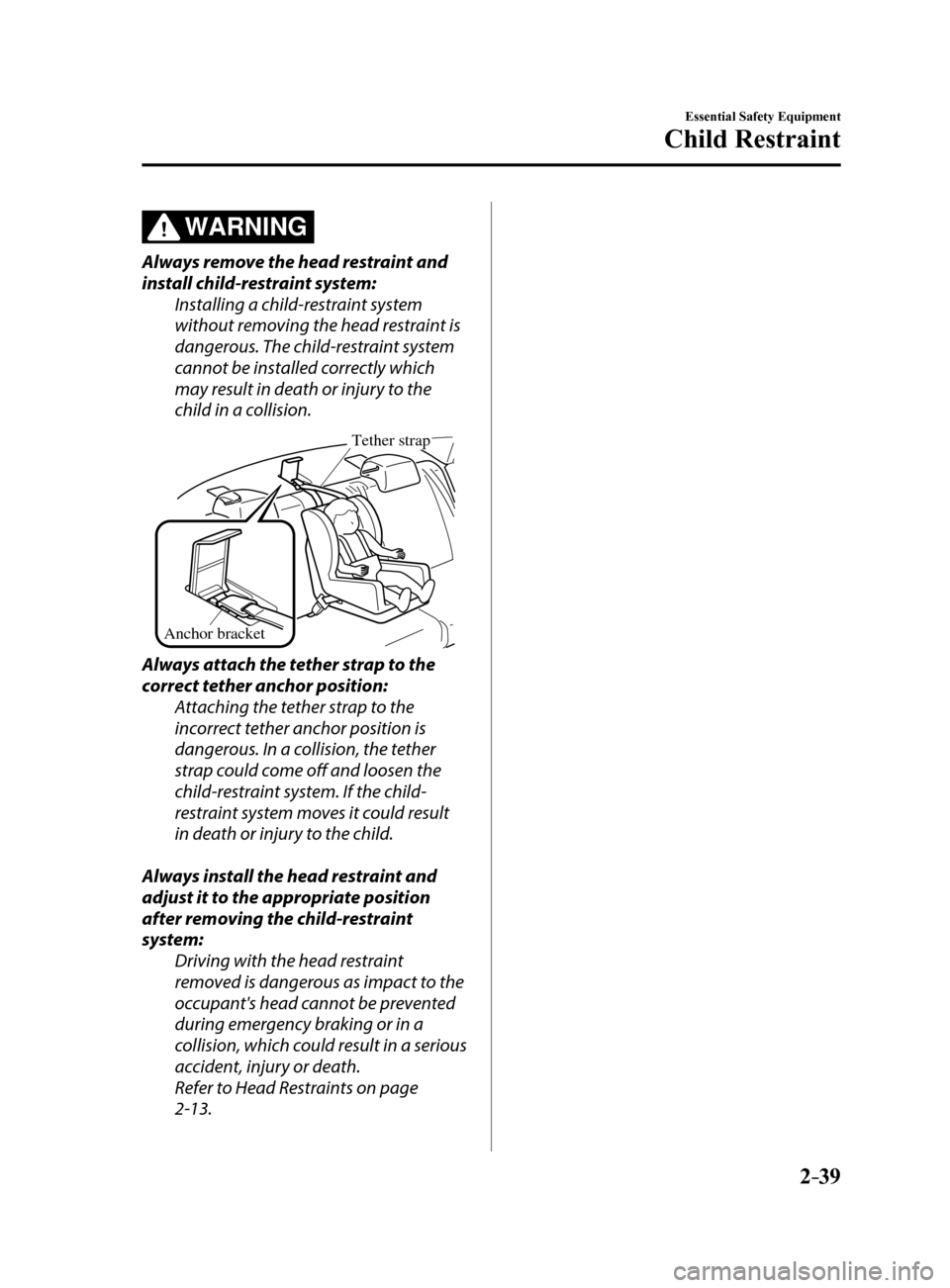
Anchor bracket
Tether strap
Mazda6_8FH2-EA-16F_Edition2.indb 372016/07/07 13:44:16
Page 51 of 578
2–39
Essential Safety Equipment
Child Restraint
WARNING
Always remove the head restraint and
install child-restraint system:Installing a child-restraint system
without removing the head restraint is
dangerous. The child-restraint system
cannot be installed correctly which
may result in death or injury to the
child in a collision.
Anchor bracket
Tether strap
Always attach the tether strap to the
correct tether anchor position:Attaching the tether strap to the
incorrect tether anchor position is
dangerous. In a collision, the tether
strap could come off and loosen the
child-restraint system. If the child-
restraint system moves it could result
in death or injury to the child.
Always install the head restraint and
adjust it to the appropriate position
after removing the child-restraint
system: Driving with the head restraint
removed is dangerous as impact to the
occupant's head cannot be prevented
during emergency braking or in a
collision, which could result in a serious
accident, injury or death.
Refer to Head Restraints on page
2-13.
Mazda6_8FH2-EA-16F_Edition2.indb 392016/07/07 13:44:17
Page 53 of 578
2–41
Essential Safety Equipment
SRS Air Bags
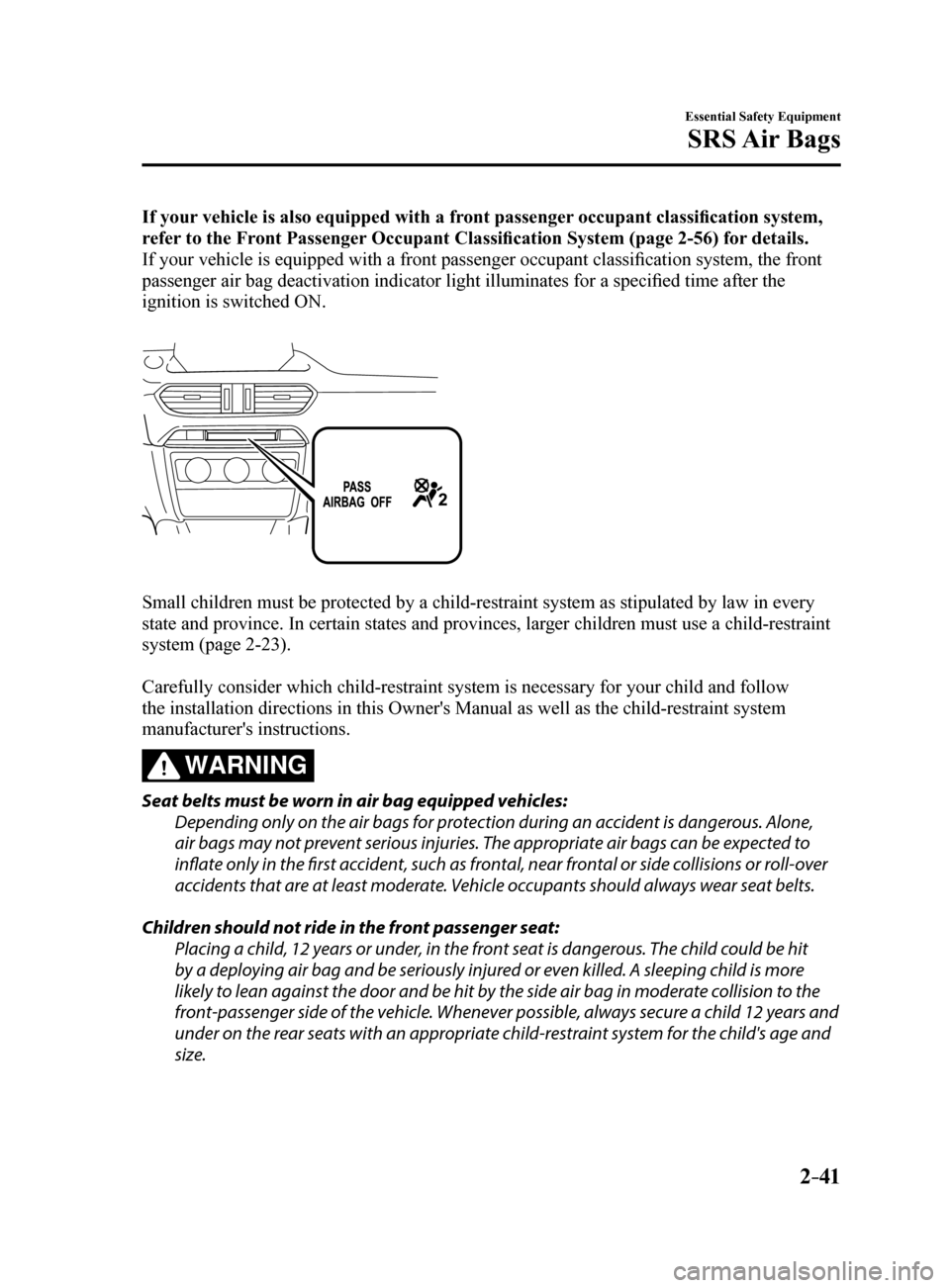
If your vehicle is also equipped with a front passenger occupant classification system,
refer to the Front Passenger Occupant Classification System (page 2‑56) for details.
If your vehicle is equipped with a front passenger occupant classification system, the front
passenger air bag deactivation indicator light illuminates for a specified time after the
ignition is switched ON.
Small children must be protected by a child-restraint system as stipulat\
ed by law in every
state and province. In certain states and provinces, larger children must use a child-restraint
system (page 2-23).
Carefully consider which child-restraint system is necessary for your ch\
ild and follow
the installation directions in this Owner's Manual as well as the child-\
restraint system
manufacturer's instructions.
WARNING
Seat belts must be worn in air bag equipped vehicles:Depending only on the air bags for protection during an accident is dangerous. Alone,
air bags may not prevent serious injuries. The appropriate air bags can be expected to
inflate only in the first accident, such as frontal, near frontal or side collisions or roll-over
accidents that are at least moderate. Vehicle occupants should always wear seat belts.
Children should not ride in the front passenger seat: Placing a child, 12 years or under, in the front seat is dangerous. The child could be hit
by a deploying air bag and be seriously injured or even killed. A sleeping child is more
likely to lean against the door and be hit by the side air bag in moderate collision to the
front-passenger side of the vehicle. Whenever possible, always secure a child 12 years and
under on the rear seats with an appropriate child-restraint system for the child's age and
size.
Mazda6_8FH2-EA-16F_Edition2.indb 412016/07/07 13:44:17
Page 60 of 578
2–48
Essential Safety Equipment
SRS Air Bags
*Some models.
Driver/Front passenger inflators and air bags
Roll-over sensor*, crash sensors, and diagnostic module (SAS unit)
Seat belt pretensioners (page 2-19)
Front air bag sensors
Side crash sensors
Air bag/seat belt pretensioner system warning light (page 4-33)
Side and curtain inflators and air bags
Front passenger air bag deactivation indicator light* (page 2-56)
Front passenger occupant classification sensor* (page 2-56)
Front passenger occupant classification module*
Mazda6_8FH2-EA-16F_Edition2.indb 482016/07/07 13:44:18
Page 64 of 578
 Owners Manual 2–52
Essential Safety Equipment
SRS Air Bags
Curtain Air Bags
The curtain air bags are mounted in the front and rear window pillars, a\
nd the roof edge
along both sides.
When the air bag crash")
2–52
Essential Safety Equipment
SRS Air Bags
Curtain Air Bags
The curtain air bags are mounted in the front and rear window pillars, a\
nd the roof edge
along both sides.
When the air bag crash sensors detect a side impact of greater than mode\
rate force, the
curtain air bag inflates quickly and helps to reduce injury mainly to the rear outboard
passenger's head caused by directly hitting interior parts such as a doo\
r or window.
For more details about air bag deployment, refer to "SRS Air Bag Deployment Criteria"
(page 2-53).
In a side impact:
Greater than moderate impact to one side of the vehicle will cause the curtain air bag on that
side only to inflate.
Only one side curtain air bag will deploy on the side of the vehicle that receives the force of an
impact.
(With Front Passenger Occupant Classification System)
In a roll-over:
In response to a vehicle roll-over, both curtain air bags inflate.
Both curtain air bags will deploy after the roll-over accident is detected.
Warning Light/Beep
A system malfunction or operation conditions are indicated by a warning.
Refer to Warning/Indicator Lights on page 4-32.
Refer to Warning Sound is Activated on page 7-36.
Mazda6_8FH2-EA-16F_Edition2.indb 522016/07/07 13:44:19
Page 68 of 578
2–56
Essential Safety Equipment
SRS Air Bags
*Some models.
Front Passenger Occupant Classification System*
First, please read "Supplemental Restraint System (SRS) Precautions" (page 2-40)
carefully.
Front Passenger Occupant Classification Sensor
Your vehicle is equipped with a front passenger occupant classification sensor as a part
of the supplemental restraint system. This sensor is equipped in the front passenger's seat
cushion. This sensor measures the electrostatic capacity of the front passenger's\
seat. The
SAS unit is designed to prevent the front passenger front and side air b\
ags and seat belt
pretensioner system from deploying if the front passenger air bag deacti\
vation indicator
light turns on.
To reduce the chance of injuries caused by deployment of the front passen\
ger air bag,
the system deactivates the front passenger front and side air bags and a\
lso the seat belt
pretensioner system when the front passenger air bag deactivation indica\
tor light turns
on. Refer to the following table for the front passenger air bag deactivation indicator light
illumination conditions.
This system shuts off the front passenger front and side air bags and seat belt pretensioner\
system, so make sure the front passenger air bag deactivation indicator \
light turns on
according to the following table.
The air bag/front seat belt pretensioner system warning light flashes and the front passenger
air bag deactivation indicator light illuminates if the sensors have a p\
ossible malfunction.
If this happens, the front passenger front and side air bags and seat be\
lt pretensioner system
will not deploy.
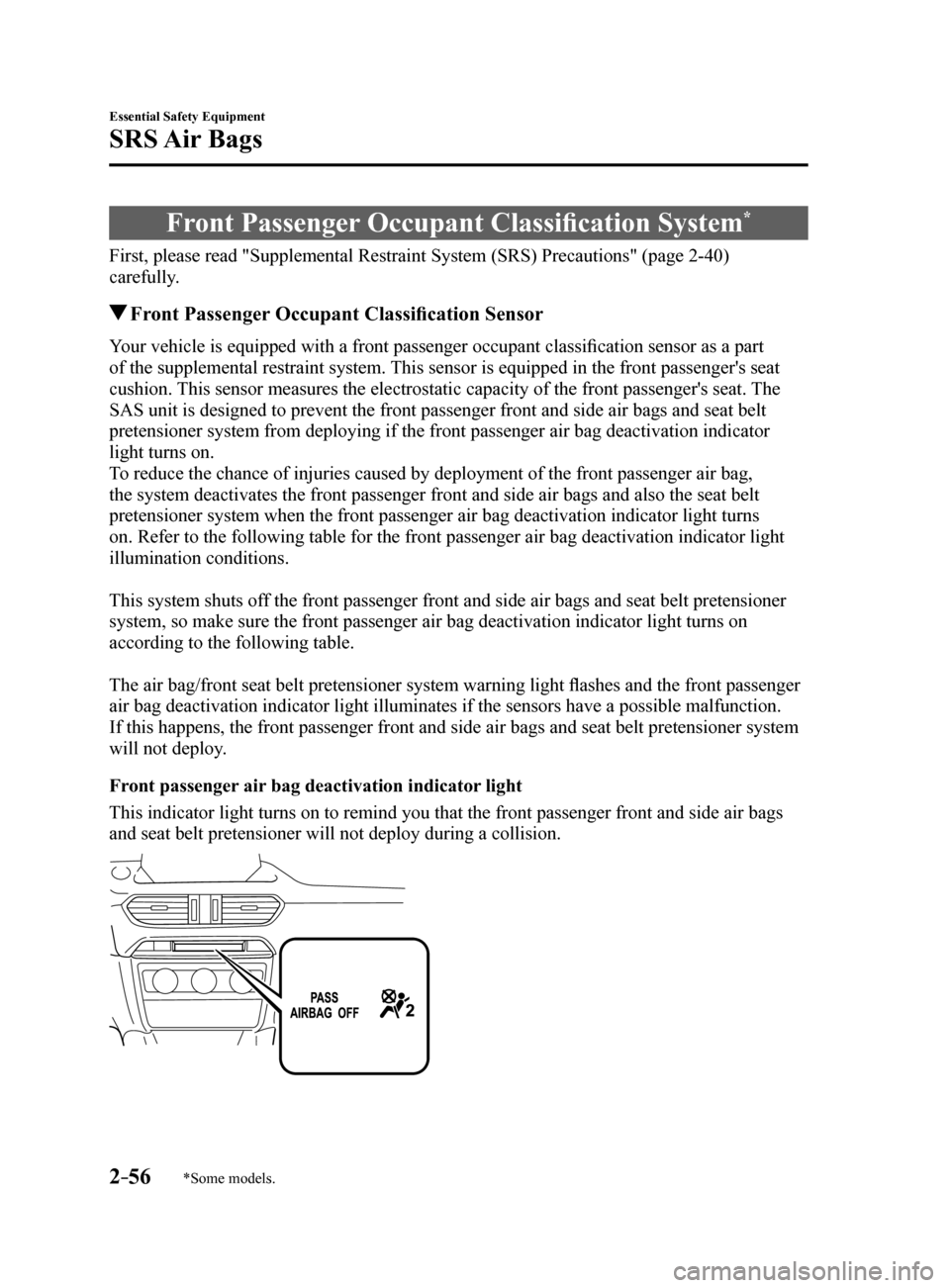
Front passenger air bag deactivation indicator light
This indicator light turns on to remind you that the front passenger fro\
nt and side air bags
and seat belt pretensioner will not deploy during a collision.
Mazda6_8FH2-EA-16F_Edition2.indb 562016/07/07 13:44:21
Page 70 of 578
2–58
Essential Safety Equipment
SRS Air Bags
WARNING
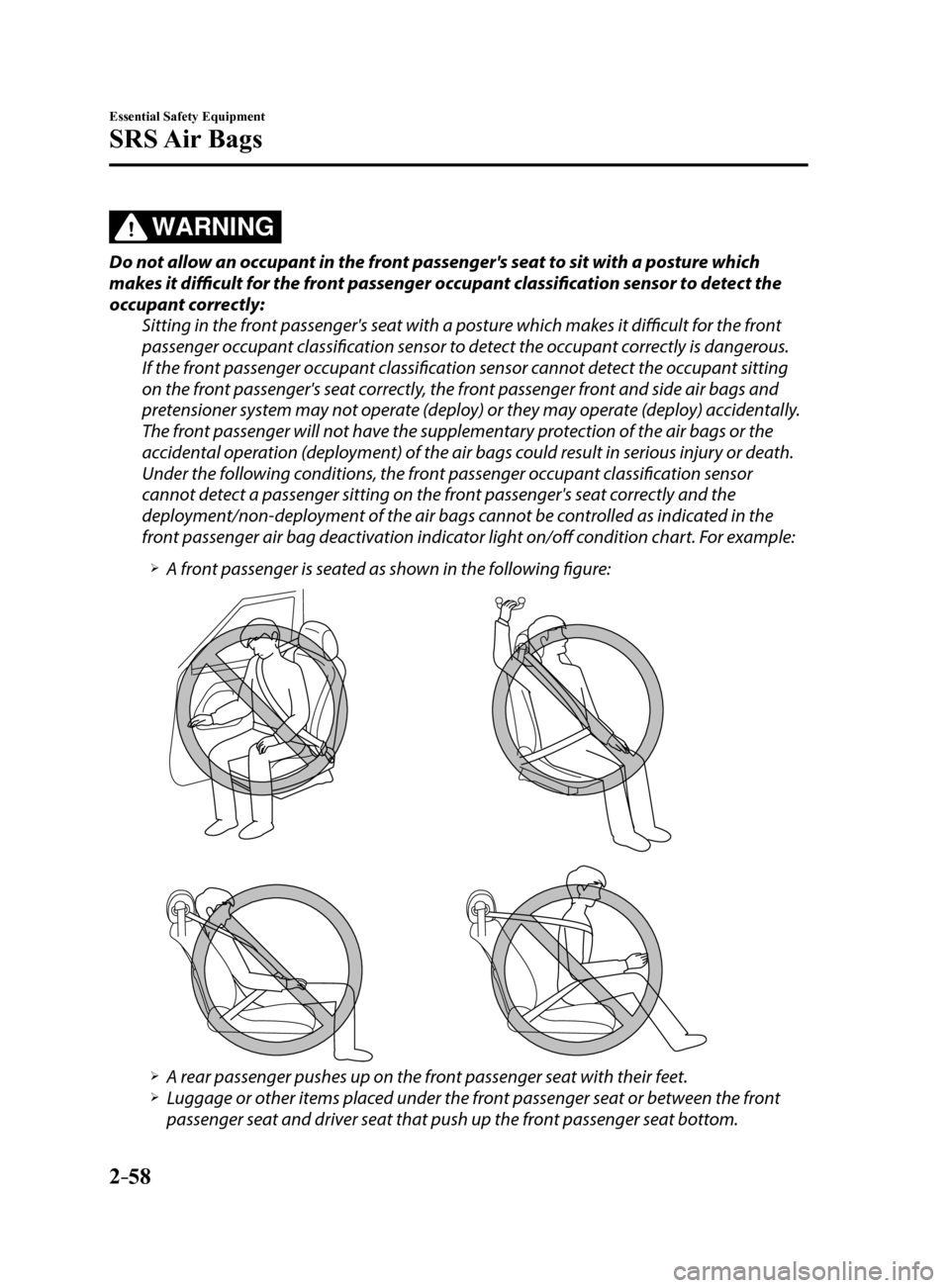
Do not allow an occupant in the front passenger's seat to sit with a posture which
makes it difficult for the front passenger occupant classification sensor to detect the
occupant correctly:Sitting in the front passenger's seat with a posture which makes it difficult for the front
passenger occupant classification sensor to detect the occupant correctly is dangerous.
If the front passenger occupant classification sensor cannot detect the occupant sitting
on the front passenger's seat correctly, the front passenger front and side air bags and
pretensioner system may not operate (deploy) or they may operate (deploy) accidentally.
The front passenger will not have the supplementary protection of the air bags or the
accidental operation (deployment) of the air bags could result in serious injury or death.
Under the following conditions, the front passenger occupant classification sensor
cannot detect a passenger sitting on the front passenger's seat correctly and the
deployment/non-deployment of the air bags cannot be controlled as indicated in the
front passenger air bag deactivation indicator light on/off condition chart. For example:
A front passenger is seated as shown in the following figure:
A rear passenger pushes up on the front passenger seat with their feet. Luggage or other items placed under the front passenger seat or between the front
passenger seat and driver seat that push up the front passenger seat bottom.
Mazda6_8FH2-EA-16F_Edition2.indb 582016/07/07 13:44:21