tire pressure MAZDA MODEL 6 2017 (in English) Owner's Guide
[x] Cancel search | Manufacturer: MAZDA, Model Year: 2017, Model line: MODEL 6, Model: MAZDA MODEL 6 2017Pages: 578, PDF Size: 54.72 MB
Page 470 of 578
7–10
If Trouble Arises
Flat Tire
To install the antitheft lug nut
1. Place the special key on top of the nut,
and be sure to hold the key square to
it. If you hold the key at an angle, you
may damage both key and nut. Do not
use a power impact wrench.
2. Place the lug wrench on top of the
special key, apply pressure, and turn it
clockwise.
Nut tightening torque
N·m (kgf·m, ft·lbf) 108—147 (12—14, 80—108)
Mounting the Spare Tire
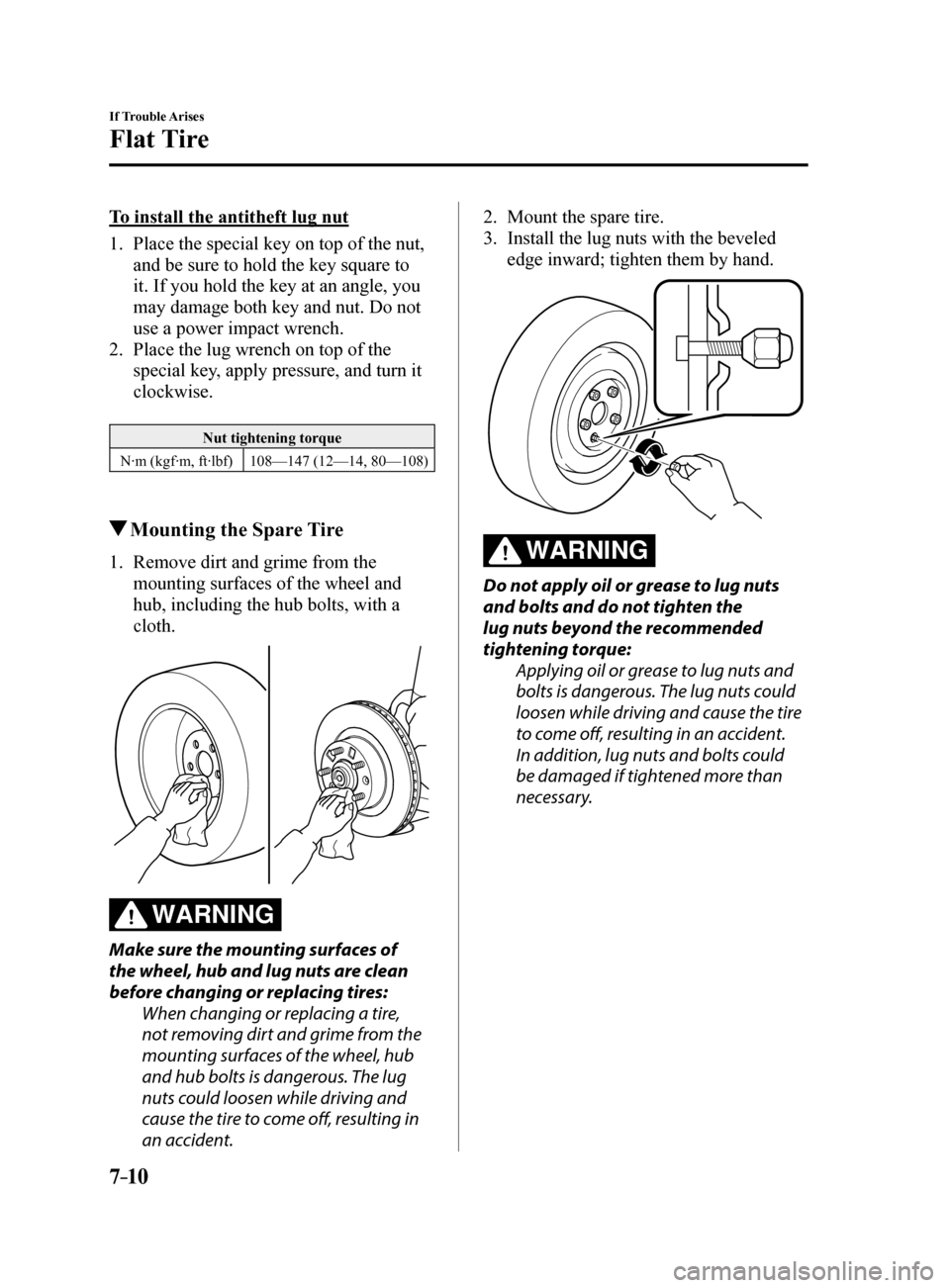
1. Remove dirt and grime from the
mounting surfaces of the wheel and
hub, including the hub bolts, with a
cloth.
WARNING
Make sure the mounting surfaces of
the wheel, hub and lug nuts are clean
before changing or replacing tires:
When changing or replacing a tire,
not removing dirt and grime from the
mounting surfaces of the wheel, hub
and hub bolts is dangerous. The lug
nuts could loosen while driving and
cause the tire to come off, resulting in
an accident. 2.
Mount the spare tire.
3. Install the lug nuts with the beveled
edge inward; tighten them by hand.
WARNING
Do not apply oil or grease to lug nuts
and bolts and do not tighten the
lug nuts beyond the recommended
tightening torque:
Applying oil or grease to lug nuts and
bolts is dangerous. The lug nuts could
loosen while driving and cause the tire
to come off, resulting in an accident.
In addition, lug nuts and bolts could
be damaged if tightened more than
necessary.
Mazda6_8FH2-EA-16F_Edition2.indb 102016/07/07 13:46:27
Page 472 of 578
7–12
If Trouble Arises
Flat Tire
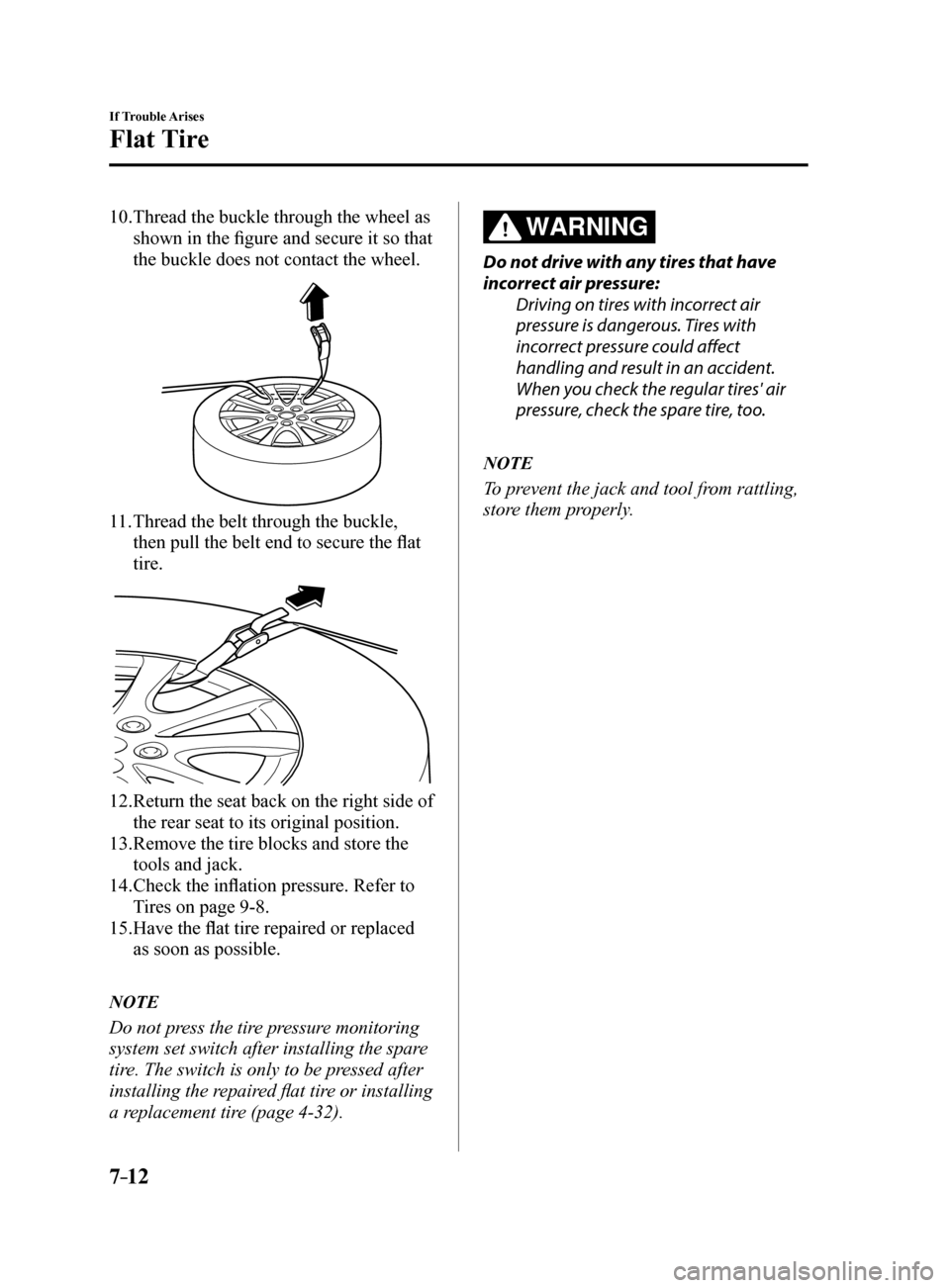
10. Thread the buckle through the wheel as
shown in the figure and secure it so that
the buckle does not contact the wheel.
11. Thread the belt through the buckle,
then pull the belt end to secure the flat
tire.
12. Return the seat back on the right side of
the rear seat to its original position.
13. Remove the tire blocks and store the
tools and jack.
14. Check the inflation pressure. Refer to
Tires on page 9-8.
15. Have the flat tire repaired or replaced
as soon as possible.
NOTE
Do not press the tire pressure monitoring
system set switch after installing the spare
tire. The switch is only to be pressed after
installing the repaired flat tire or installing
a replacement tire (page 4-32).
WARNING
Do not drive with any tires that have
incorrect air pressure:
Driving on tires with incorrect air
pressure is dangerous. Tires with
incorrect pressure could affect
handling and result in an accident.
When you check the regular tires' air
pressure, check the spare tire, too.
NOTE
To prevent the jack and tool from rattling,
store them properly.
Mazda6_8FH2-EA-16F_Edition2.indb 122016/07/07 13:46:27
Page 486 of 578
7–26
If Trouble Arises
Warning/Indicator Lights and Warning Sounds
SignalWarning
Automatic
Transaxle Warning
Indication/Warning Light The indication/light illuminates when the transaxle has a problem.CAUTION
If the automatic transaxle warning indication/light illuminates, the transaxle has
an electrical problem. Continuing to drive your Mazda in this condition could cause
damage to your transaxle. Consult an Authorized Mazda Dealer as soon as possible.
(Illuminate)
TCS/DSC Indicator Light If the light stays on, the TCS, DSC or the brake assist system may have a malfunction and
they may not operate correctly. Take your vehicle to an Authorized Mazda Dealer.
Air Bag/Front Seat
Belt Pretensioner System Warning Light A system malfunction is indicated if the warning light constantly flashes, constantly
illuminates or does not illuminate at all when the ignition is switched ON. If any of these
occur, consult an Authorized Mazda Dealer as soon as possible. The system may not operate
in an accident.WARNING
Never tamper with the air bag/pretensioner systems and always have an Authorized
Mazda Dealer perform all servicing and repairs:
Self-servicing or tampering with the systems is dangerous. An air bag/pretensioner
could accidentally activate or become disabled causing serious injury or death.
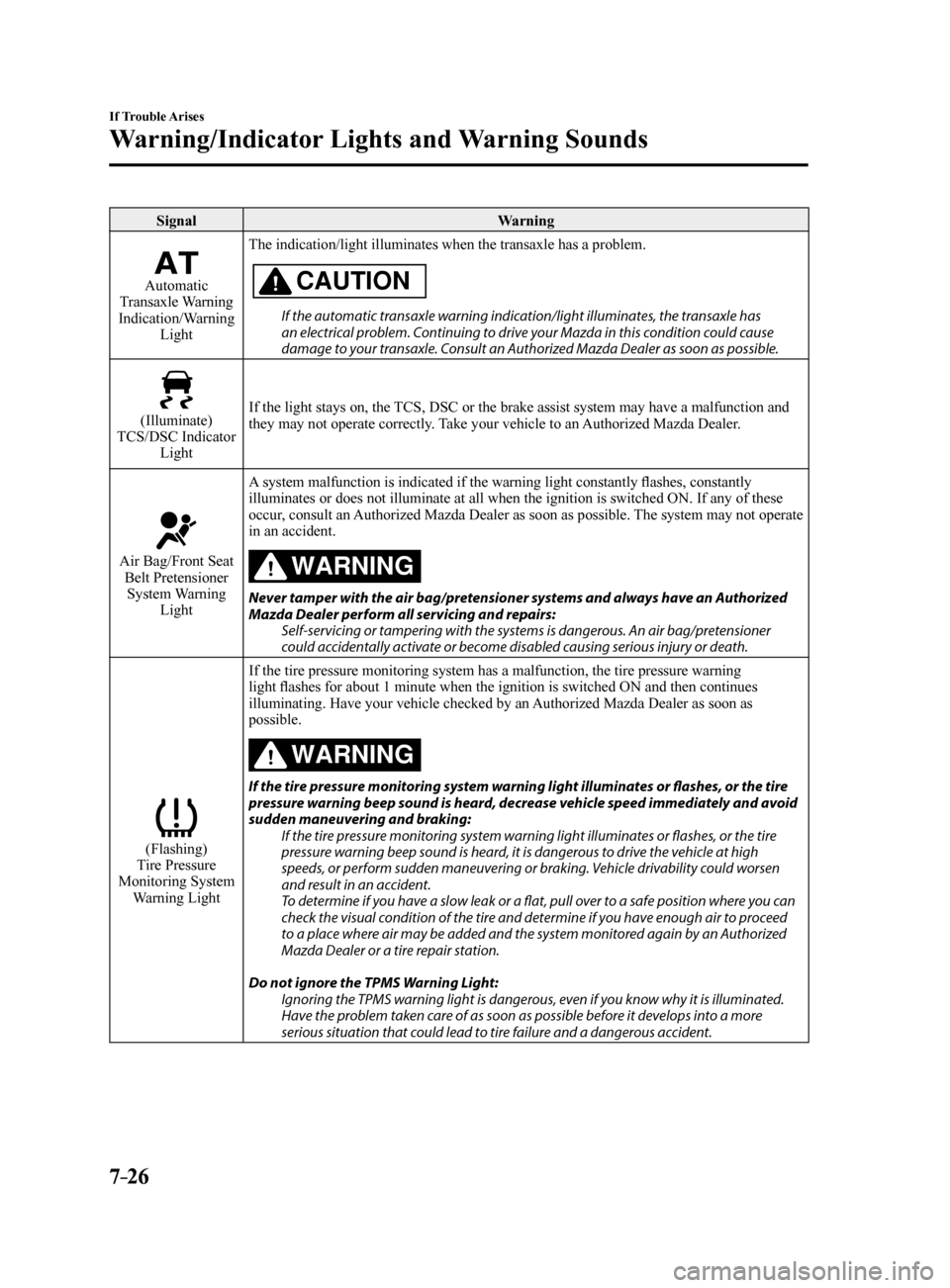
(Flashing)
Tire Pressure
Monitoring System Warning Light If the tire pressure monitoring system has a malfunction, the tire press\
ure warning
light flashes for about 1 minute when the ignition is switched ON and then continues
illuminating. Have your vehicle checked by an Authorized Mazda Dealer as soon as
possible.
WARNING
If the tire pressure monitoring system warning light illuminates or flashes, or the tire
pressure warning beep sound is heard, decrease vehicle speed immediately and avoid
sudden maneuvering and braking:
If the tire pressure monitoring system warning light illuminates or flashes, or the tire
pressure warning beep sound is heard, it is dangerous to drive the vehicle at high
speeds, or perform sudden maneuvering or braking. Vehicle drivability could worsen
and result in an accident.
To determine if you have a slow leak or a flat, pull over to a safe position where you can
check the visual condition of the tire and determine if you have enough air to proceed
to a place where air may be added and the system monitored again by an Authorized
Mazda Dealer or a tire repair station.
Do not ignore the TPMS Warning Light: Ignoring the TPMS warning light is dangerous, even if you know why it is illuminated.
Have the problem taken care of as soon as possible before it develops into a more
serious situation that could lead to tire failure and a dangerous accident.
Mazda6_8FH2-EA-16F_Edition2.indb 262016/07/07 13:46:32
Page 489 of 578
7–29
If Trouble Arises
Warning/Indicator Lights and Warning Sounds
Taking Action
Take the appropriate action and verify that the warning light turns off.
SignalWarning Action to be taken
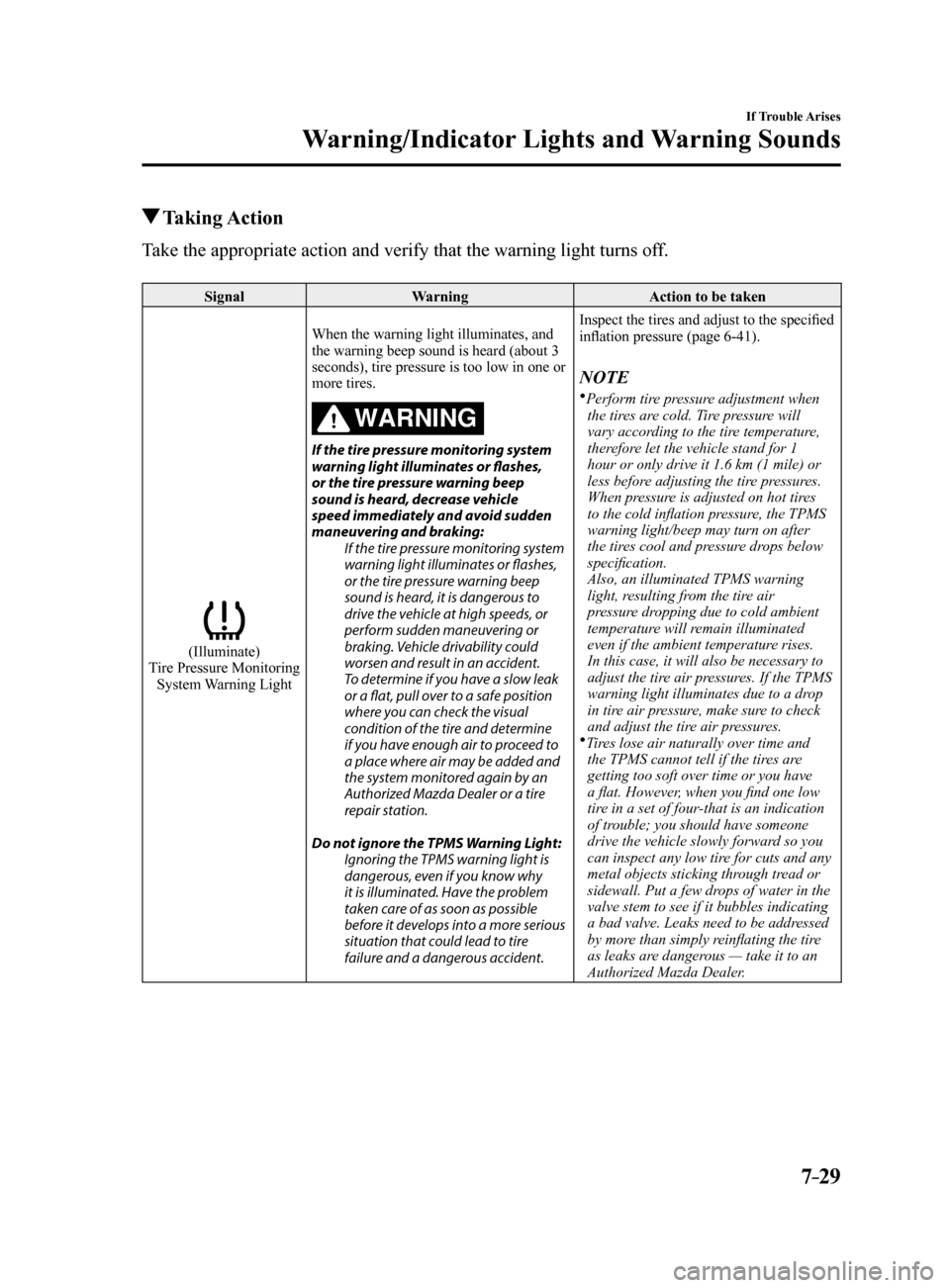
(Illuminate)
Tire Pressure Monitoring System Warning Light When the warning light illuminates, and
the warning beep sound is heard (about 3
seconds), tire pressure is too low in one or
more tires.
WARNING
If the tire pressure monitoring system
warning light illuminates or flashes,
or the tire pressure warning beep
sound is heard, decrease vehicle
speed immediately and avoid sudden
maneuvering and braking:
If the tire pressure monitoring system
warning light illuminates or flashes,
or the tire pressure warning beep
sound is heard, it is dangerous to
drive the vehicle at high speeds, or
perform sudden maneuvering or
braking. Vehicle drivability could
worsen and result in an accident.
To determine if you have a slow leak
or a flat, pull over to a safe position
where you can check the visual
condition of the tire and determine
if you have enough air to proceed to
a place where air may be added and
the system monitored again by an
Authorized Mazda Dealer or a tire
repair station.
Do not ignore the TPMS Warning Light: Ignoring the TPMS warning light is
dangerous, even if you know why
it is illuminated. Have the problem
taken care of as soon as possible
before it develops into a more serious
situation that could lead to tire
failure and a dangerous accident. Inspect the tires and adjust to the specified
inflation pressure (page 6-41).
NOTE
Perform tire pressure adjustment when
the tires are cold. Tire pressure will
vary according to the tire temperature,
therefore let the vehicle stand for 1
hour or only drive it 1.6 km (1 mile) or
less before adjusting the tire pressures.
When pressure is adjusted on hot tires
to the cold inflation pressure, the TPMS
warning light/beep may turn on after
the tires cool and pressure drops below
specification.
Also, an illuminated TPMS warning
light, resulting from the tire air
pressure dropping due to cold ambient
temperature will remain illuminated
even if the ambient temperature rises.
In this case, it will also be necessary to
adjust the tire air pressures. If the TPMS
warning light illuminates due to a drop
in tire air pressure, make sure to check
and adjust the tire air pressures.
Tires lose air naturally over time and
the TPMS cannot tell if the tires are
getting too soft over time or you have
a flat. However, when you find one low
tire in a set of four-that is an indication
of trouble; you should have someone
drive the vehicle slowly forward so you
can inspect any low tire for cuts and any
metal objects sticking through tread or
sidewall. Put a few drops of water in the
valve stem to see if it bubbles indicating
a bad valve. Leaks need to be addressed
by more than simply reinflating the tire
as leaks are dangerous — take it to an
Authorized Mazda Dealer.
Mazda6_8FH2-EA-16F_Edition2.indb 292016/07/07 13:46:34
Page 498 of 578
7–38
If Trouble Arises
Warning/Indicator Lights and Warning Sounds
*Some models.
Request Switch Inoperable
Warning Beep (With the advanced
keyless function)
If the request switch is pressed with the
door open or ajar, or the ignition is not
switched OFF with a key being carried,
a beep will be heard outside for about 2
seconds to notify the driver that the door
or trunk lid cannot be locked.
Key Left-in-trunk Compartment
Warning Beep (With the advanced
keyless function)
If the key is left in the trunk with all the
doors locked and the trunk lid closed, a
beep will be heard outside for about 10
seconds to notify the driver that the key is
in the trunk. In this case, take out the key
by pressing the electric trunk lid opener
and opening the trunk lid. The key taken
out of the trunk may not operate because
its functions have been temporarily
stopped. To restore the key's functions,
perform the applicable procedure (page
3-9).
Key Left-in-vehicle Warning Beep
(With the advanced keyless
function)
If all the doors and trunk are locked using
another key while the key is left in the
cabin, the beep which sounds outside of
the vehicle will be heard for about 10
seconds to notify the driver that the key
is in the cabin. In this case, take out the
key by opening the door. A key taken
out of the vehicle using this method may
not operate because its functions have
been temporarily stopped. To restore the
key's functions, perform the applicable
procedure (page 3-9).
i-ELOOP Warning Beep*
If the vehicle is driven while “i-ELOOP
Charging Please don't Drive” is displayed,
a beep sound is heard. Make sure the
message is no longer displayed before
driving.
Tire Inflation Pressure Warning
Beep
The warning beep sound will be heard
for about 3 seconds when there is any
abnormality in tire inflation pressures
(page 4-159).
Blind Spot Monitoring (BSM)
System Warning Beep*
Driving forward
The warning beep operates when the turn
signal lever is operated to the side where
the Blind Spot Monitoring (BSM) warning
light is illuminated.
NOTE
A personalized function is available to
change the Blind Spot Monitoring (BSM)
warning beep sound volume.
Refer to Personalization Features on page
9-10.
Reversing
If a moving object such as a vehicle or
two-wheeled vehicle approaches on the
left or right from behind your vehicle, the
Blind Spot Monitoring (BSM) warning
sound is activated.
Mazda6_8FH2-EA-16F_Edition2.indb 382016/07/07 13:46:37
Page 527 of 578
8–25
Customer Information and Reporting Safety Defects
Tire Information (U.S.A.)
Tire Labeling
Federal law requires tire manufacturers to place standardized information on the sidewall of
all tires. This information identifies and describes the fundamental characteristics of the tire
and also provides a tire identification number for safety standard certification and in case of
a recall.
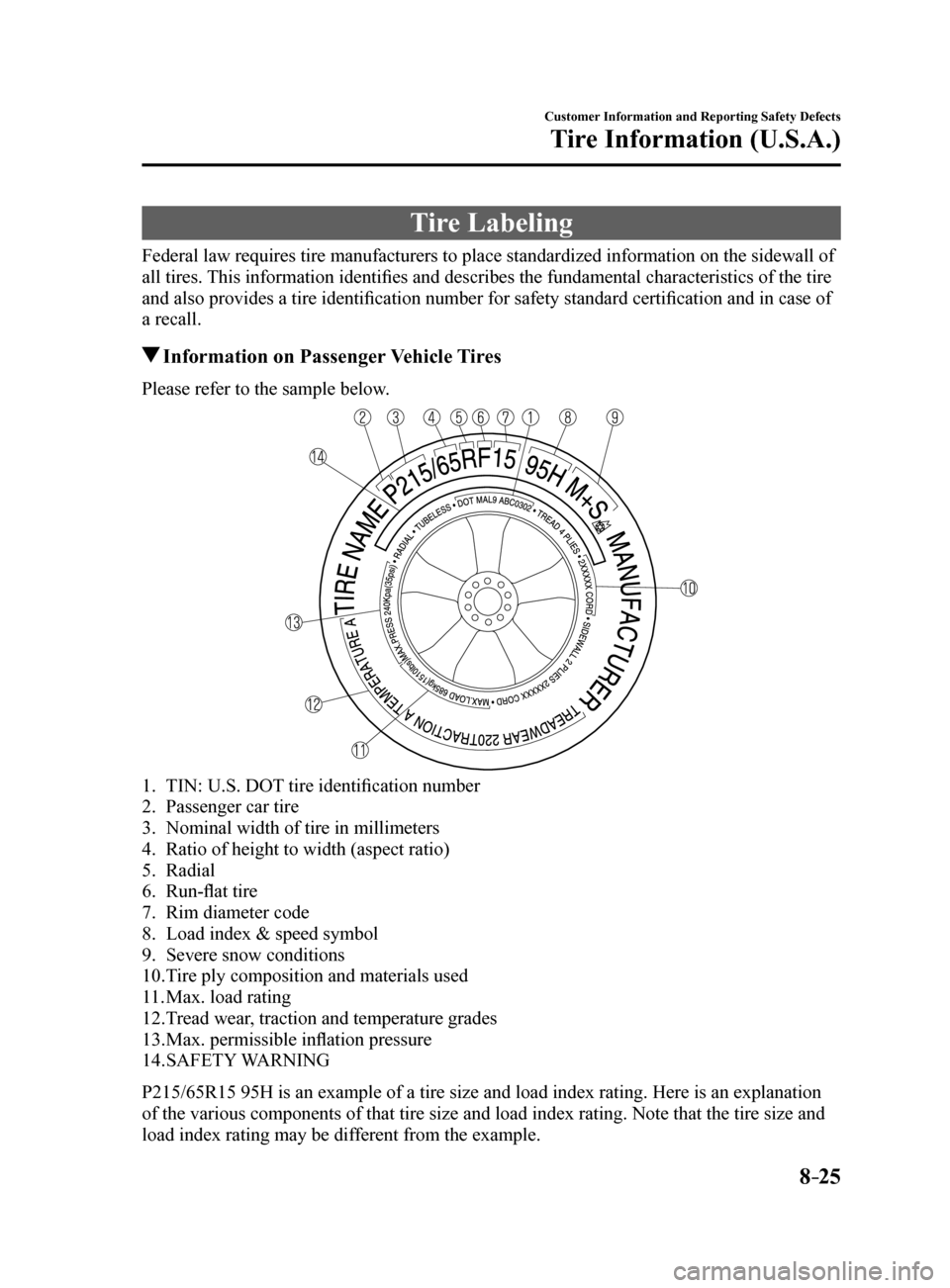
Information on Passenger Vehicle Tires
Please refer to the sample below.
1. TIN: U.S. DOT tire identification number
2. Passenger car tire
3. Nominal width of tire in millimeters
4. Ratio of height to width (aspect ratio)
5. Radial
6. Run-flat tire
7. Rim diameter code
8. Load index & speed symbol
9. Severe snow conditions
10. Tire ply composition and materials used
11. Max. load rating
12. Tread wear, traction and temperature grades
13. Max. permissible inflation pressure
14. SAFETY WARNING
P215/65R15 95H is an example of a tire size and load index rating. Here is an explanation
of the various components of that tire size and load index rating. Note that the tire size and
load index rating may be different from the example.
Mazda6_8FH2-EA-16F_Edition2.indb 252016/07/07 13:46:39
Page 529 of 578
8–27
Customer Information and Reporting Safety Defects
Tire Information (U.S.A.)
M S or M/S: Mud and Snow
AT: All Terrain.
AS: All Season. The “M
S” or “M/S” indicates that the tire has some functional use in mud
and snow.
U.S. DOT Tire Identification Number (TIN)
This begins with the letters “DOT” which indicates the tire meets all federal standards. The
next two numbers or letters are the plant code where it was manufactured\
, and the last four
numbers represent the week and year the tire was manufactured. For examp\
le, the numbers
457 means the 45st week of 1997. After 2000 the numbers go to four digits. For example,
the number 2102 means the 21th week of 2002. The other numbers are marketing codes
used at the manufacturer's discretion. This information is used to contact consumers if a tire
defect requires a recall.
Tire Ply Composition and Materials Used
The number of plies indicates the number of layers of rubber-coated fabric in the tire.
In general, the greater the number of plies, the more weight a tire can \
support. Tire
manufacturers also must indicate the tire materials, which include steel\
, nylon, polyester,
and other.
Maximum Load Rating
This number indicates the maximum load in kilograms and pounds that can \
be carried by the
tire.
Maximum Permissible Inflation Pressure
This number is the greatest amount of air pressure that should ever be p\
ut in the tire under
normal driving conditions.
Tread Wear, Traction and Temperature Grades
Tread wear: The tread wear grade is a comparative rating based on the wear rate of t\
he tire
when tested under controlled conditions on a specified government test course. For example,
a tire graded 150 would wear one and one-half (1 1/2) times as well on\
the government
course as a tire graded 100.
Traction: The traction grades, from highest to lowest are AA, A, B, and C. The grades
represent the tire's ability to stop on wet pavement as measured under c\
ontrolled conditions
on specified government test surfaces of asphalt and concrete. A tire marked C may have
poor traction performance.
Temperature: The temperature grades are A (the highest), B and C, representing the
tire's resistance to the generation of heat and its ability to dissipate\
heat when tested under
controlled conditions on a specified indoor laboratory test wheel.
Snow Tires
In some heavy snow areas, local governments may require true snow tires, those with very
deeply cut tread. These tires should only be used in pairs or placed on all four wheels. M\
ake
sure you purchase snow tires that are the same size and construction typ\
e as the other tires
on your vehicle.
Mazda6_8FH2-EA-16F_Edition2.indb 272016/07/07 13:46:40
Page 530 of 578
8–28
Customer Information and Reporting Safety Defects
Tire Information (U.S.A.)
SAFETY WARNING
The following safety warning appears on the tire's sidewall.
SERIOUS INJURY MAY RESULT FROM:
EXPLOSION OF TIRE/RIM ASSEMBLY DUE TO IMPROPER MOUNTING-MATCH
TIRE DIAMETER TO RIM DIAMETER; NEVER EXCEED 40 psi (275 kPa) TO SEAT
BEADS-ONLY SPECIALLY TRAINED PERSONS SHOULD MOUNT TIRES.
TIRE FAILURE DUE TO UNDER-INFLATION/OVERLOADING/DAMAGE-
FOLLOW OWNER'S MANUAL AND PLACARD IN VEHICLE-FREQUENTLY
CHECK INFLATION PRESSURE AND INSPECT FOR DAMAGE.
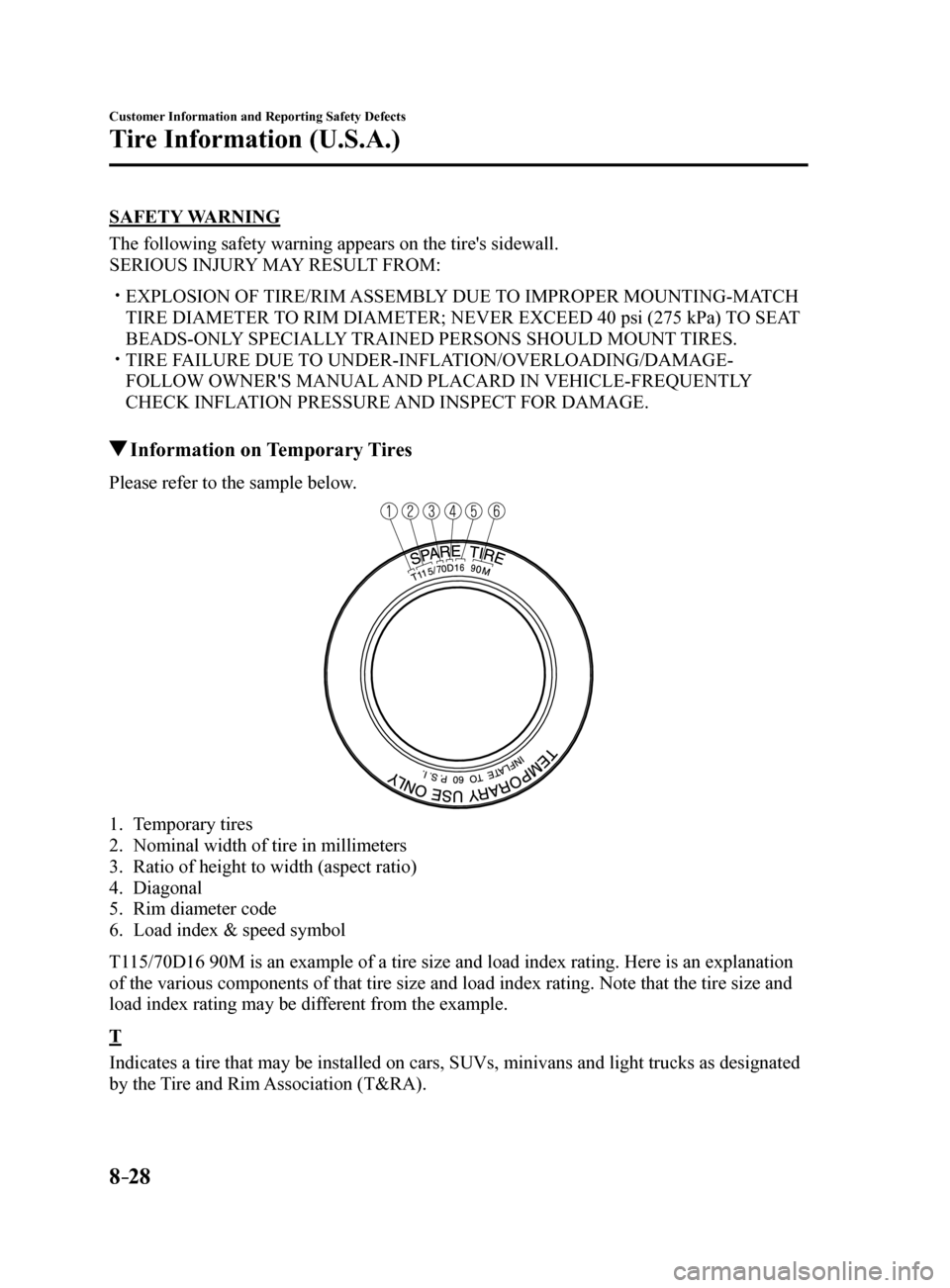
Information on Temporary Tires
Please refer to the sample below.
1. Temporary tires
2. Nominal width of tire in millimeters
3. Ratio of height to width (aspect ratio)
4. Diagonal
5. Rim diameter code
6. Load index & speed symbol
T115/70D16 90M is an example of a tire size and load index rating. Here is\
an explanation
of the various components of that tire size and load index rating. Note that the tire size and
load index rating may be different from the example.
T
Indicates a tire that may be installed on cars, SUVs, minivans and light trucks as designated
by the Tire and Rim Association (T&RA).
Mazda6_8FH2-EA-16F_Edition2.indb 282016/07/07 13:46:40
Page 532 of 578
8–30
Customer Information and Reporting Safety Defects
Tire Information (U.S.A.)
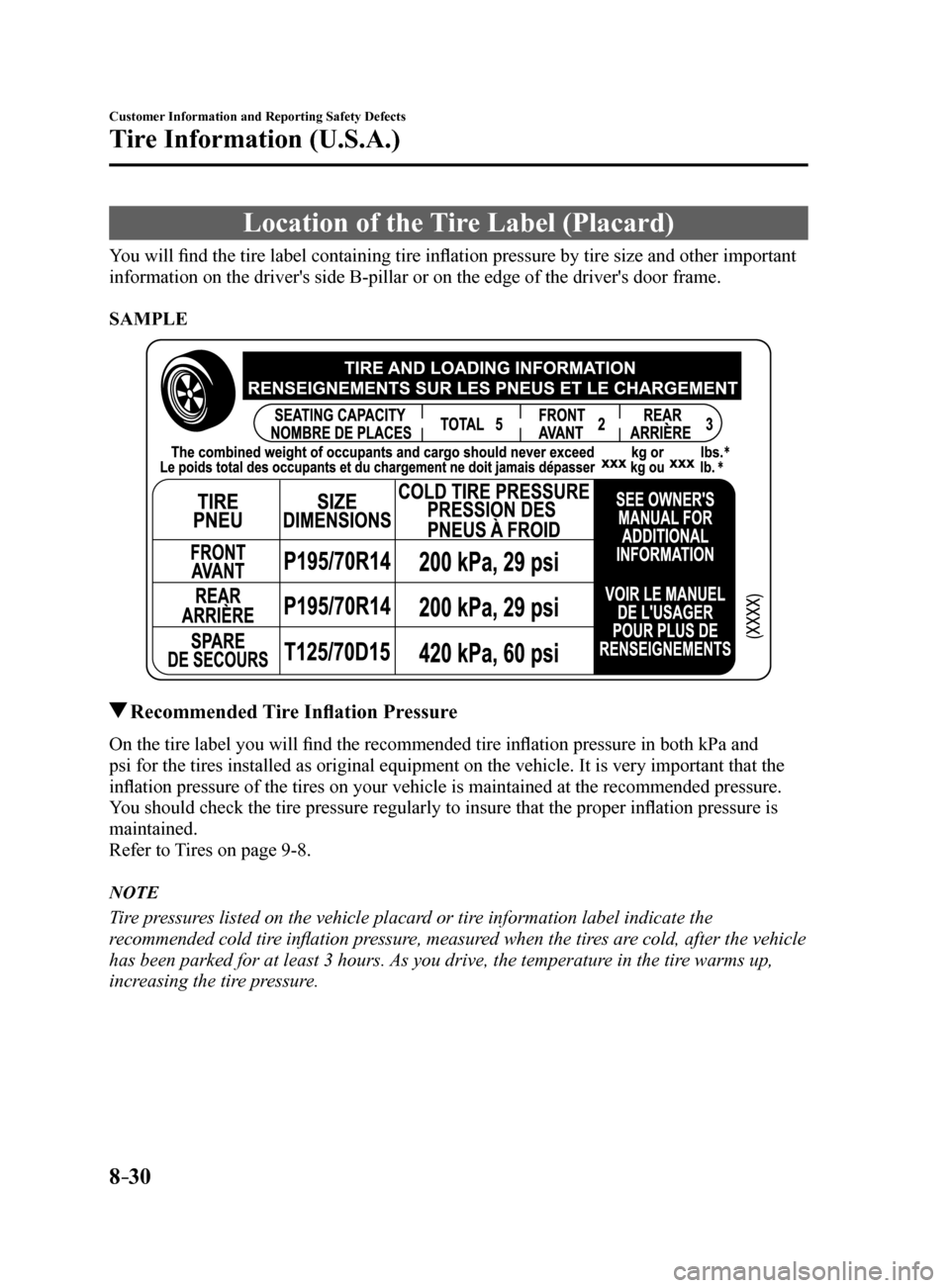
Location of the Tire Label (Placard)
You will find the tire label containing tire inflation pressure by tire size and other important
information on the driver's side B-pillar or on the edge of the driver's door frame.
SAMPLE
Recommended Tire Inflation Pressure
On the tire label you will find the recommended tire inflation pressure in both kPa and
psi for the tires installed as original equipment on the vehicle. It is very important that the
inflation pressure of the tires on your vehicle is maintained at the recommended pressure.
You should check the tire pressure regularly to insure that the proper inflation pressure is
maintained.
Refer to Tires on page 9-8.
NOTE
Tire pressures listed on the vehicle placard or tire information label indicate the
recommended cold tire inflation pressure, measured when the tires are cold, after the vehicle
has been parked for at least 3 hours. As you drive, the temperature in the tire warms up,
increasing the tire pressure.
Mazda6_8FH2-EA-16F_Edition2.indb 302016/07/07 13:46:40
Page 533 of 578
8–31
Customer Information and Reporting Safety Defects
Tire Information (U.S.A.)
WARNING
Always check the tire inflation pressures on a regular basis according to the
recommended tire inflation pressure on the tire label and in conjunction with the
information in this owner's manual:Driving your vehicle with under-inflated tires is dangerous.
Under-inflation is the most common cause of failures in any kind of tire and may result
in severe cracking, tread separation or “blowout”, with unexpected loss of vehicle
control and increased risk of injury. Under-inflation increases sidewall flexing and
rolling resistance, resulting in heat buildup and internal damage to the tire. It results in
unnecessary tire stress, irregular wear, loss of control and accidents. A tire can lose up to
half of its air pressure and not appear to be flat!
It is impossible to determine whether or not tires are properly inflated just by looking at
them.
Checking Tire Pressure
1. When you check the air pressure, make sure the tires are cold —meaning they are not hot
from driving even a mile.
2. Remove the cap from the valve on one tire.
3. Firmly press a tire gauge onto the valve.
4. Add air to achieve recommended air pressure.
5. If you overfill the tire, release air by pushing on the metal stem in the center of the valve.
Then recheck the pressure with your tire gauge.
6. Replace the valve cap.
7. Repeat with each tire, including the spare.
NOTE
Some spare tires require higher inflation pressure.
8. Visually inspect the tires to make sure there are no nails or other objects embedded that
could poke a hole in the tire and cause an air leak.
9. Check the sidewalls to make sure there are no gouges, cuts, bulges, crac\
ks or other
irregularities.
Mazda6_8FH2-EA-16F_Edition2.indb 312016/07/07 13:46:40