belt MAZDA MODEL 6 2017 (in English) Service Manual
[x] Cancel search | Manufacturer: MAZDA, Model Year: 2017, Model line: MODEL 6, Model: MAZDA MODEL 6 2017Pages: 578, PDF Size: 54.72 MB
Page 71 of 578
2–59
Essential Safety Equipment
SRS Air Bags
An object, such as a seat cushion, is put on the front passenger's seat or between the
passenger's back and the seatback.
A seat cover is put on the front passenger's seat. Luggage or other items are placed on the seat with the child in the child-restraint
system.
A rear passenger or luggage push or pull down on the front passenger seatback. Luggage or other items are placed on the seatback or hung on the head restraint. The seat is washed. Liquids are spilled on the seat. The front passenger seat is moved backward, pushing into luggage or other items
placed behind it.
The front passenger seatback contacts the rear seat. Luggage or other items are placed between the front passenger seat and driver seat. An electric device is put on the front passenger's seat. An additional electrical device, such as a seat warmer is installed to the surface of the
front passenger seat.
The front passenger front and side air bags and seat belt pretensioner systems will
deactivate if the front passenger air bag deactivation indicator light turns on.
CAUTION
To assure proper deployment of the front air bag and to prevent damage to the sensor in
the front seat cushion:
Do not place sharp objects on the front seat cushion or leave heavy luggage on them. Do not spill any liquids on the front seats or under the front seats.
To allow the sensors to function properly, always perform the following:
Adjust the front seats as far back as possible and always sit upright against the
seatbacks with seat belts worn properly.
If you place your child on the front passenger seat, secure the child-restraint system
properly and slide the front passenger seat as far back as possible (page 2-30).
Mazda6_8FH2-EA-16F_Edition2.indb 592016/07/07 13:44:21
Page 72 of 578
2–60
Essential Safety Equipment
SRS Air Bags
NOTE
The system requires about 10 seconds to alternate between turning the front passenger
front and side air bags and seat belt pretensioner system on or off.
The front passenger air bag deactivation indicator light may turn on repeatedly if luggage
or other items are put on the front passenger seat, or if the temperature of the vehicle's
interior changes suddenly.
The front passenger air bag deactivation indicator light may turn on for 10 se\
conds if the
electrostatic capacity on the front passenger seat changes.
The air bag/front seat belt pretensioner system warning light might turn on if the front
passenger seat receives a severe impact.
If the front passenger air bag deactivation indicator light does not turn on afte\
r installing
a child-restraint system on the front passenger seat, first, re-install your child-restraint
system according to the procedure in this owner's manual. Then, if the front passenger air
bag deactivation indicator light still does not turn on, install the chi\
ld-restraint system on
the rear seat and consult an Authorized Mazda Dealer as soon as possible.
If the front passenger air bag deactivation indicator light turns on when an occu\
pant
is seated directly in the front passenger seat, have the passenger re-adjust their posture
by sitting with their feet on the floor, and then re-fastening the seat belt. If the front
passenger air bag deactivation indicator light remains turned on, move the passenger to
the rear seat. If sitting in the rear seat is not possible, slide the front passenger seat as far
back as possible. Consult an Authorized Mazda Dealer as soon as possible.
Mazda6_8FH2-EA-16F_Edition2.indb 602016/07/07 13:44:21
Page 73 of 578
 Service Manual 2–61
Essential Safety Equipment
SRS Air Bags
Constant Monitoring
The following components of the air bag systems are monitored by a diagn\
ostic system:
Crash sensors, and diagnostic module (SA")
2–61
Essential Safety Equipment
SRS Air Bags
Constant Monitoring
The following components of the air bag systems are monitored by a diagn\
ostic system:
Crash sensors, and diagnostic module (SAS unit) Front air bag sensors Air bag modules Side crash sensors Air bag/Front seat belt pretensioner system warning light Front seat belt pretensioners Related wiring
(With Front Passenger Occupant Classification System)
Front passenger air bag deactivation indicator light Front passenger occupant classification sensor Front passenger occupant classification module
The diagnostic module continuously monitors the system's readiness. This begins when the
ignition is switched ON and continues while the vehicle is being driven.
Mazda6_8FH2-EA-16F_Edition2.indb 612016/07/07 13:44:21
Page 130 of 578
4–6
When Driving
Start/Stop Engine
Engine-starting is controlled by the
spark ignition system.
This system meets all Canadian
Interference-Causing Equipment
Standard requirements regulating the
impulse electrical field strength of radio
noise.
1. Make sure you are carrying the key.
2. Occupants should fasten their seat
belts.
3. Make sure the parking brake is on.
4. Continue to press the brake pedal
firmly until the engine has completely
started.
5. (Manual transaxle)
Continue to press the clutch pedal
firmly until the engine has completely
started.
(Automatic transaxle)
Put the vehicle in park (P). If you must
restart the engine while the vehicle is
moving, shift into neutral (N).
NOTE
(Manual transaxle)
The starter will not operate if the clutch
pedal is not depressed sufficiently.
(Automatic transaxle)
The starter will not operate if the selector
lever is not in P or N and the brake pedal
is not depressed sufficiently. 6.
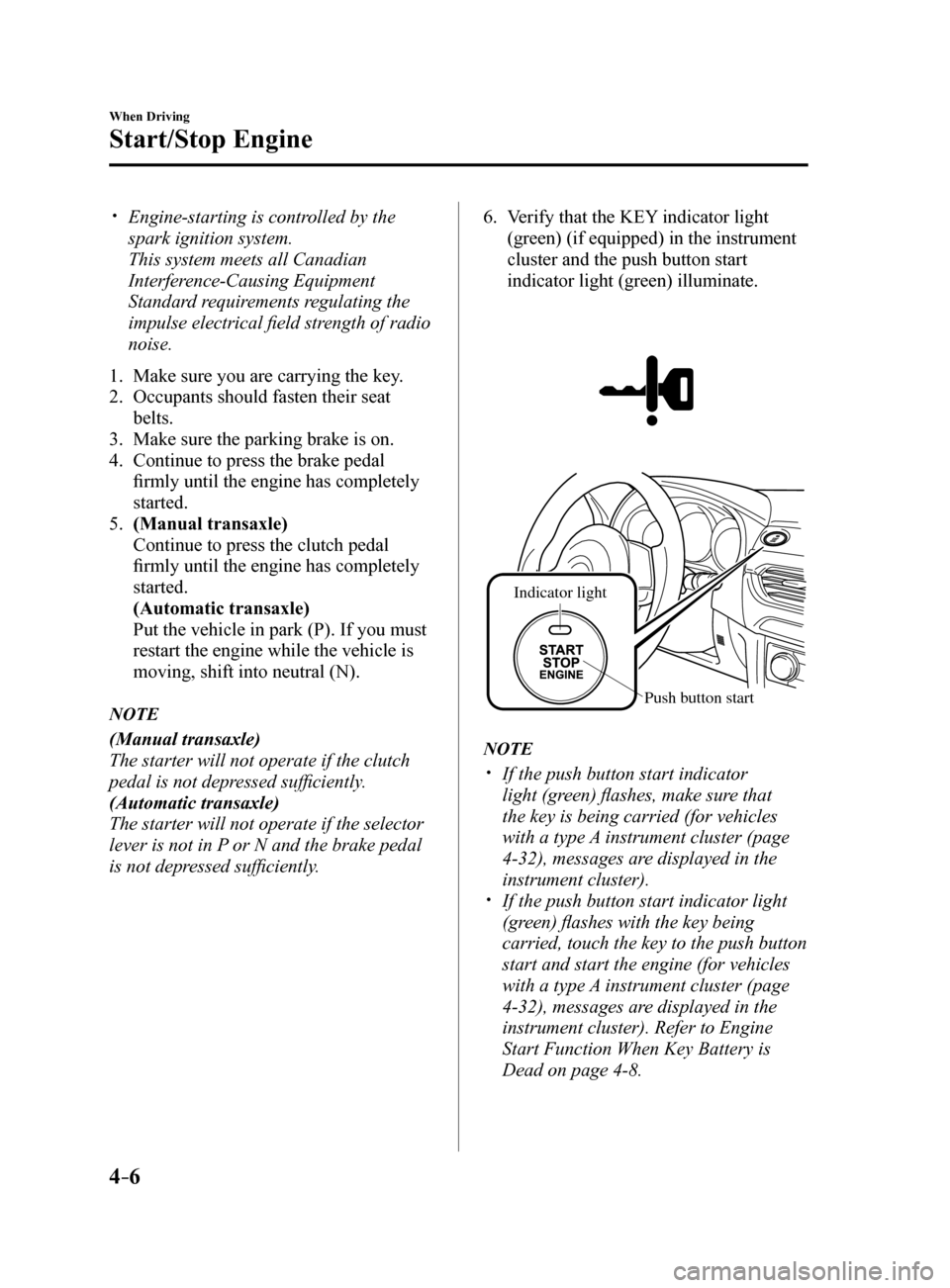
Verify that the KEY indicator light
(green) (if equipped) in the instrument
cluster and the push button start
indicator light (green) illuminate.
Indicator light
Push b utton start
NOTE
If the push button start indicator
light (green) flashes, make sure that
the key is being carried (for vehicles
with a type A instrument cluster (page
4-32), messages are displayed in the
instrument cluster).
If the push button start indicator light
(green) flashes with the key being
carried, touch the key to the push button
start and start the engine (for vehicles
with a type A instrument cluster (page
4-32), messages are displayed in the
instrument cluster). Refer to Engine
Start Function When Key Battery is
Dead on page 4-8.
Mazda6_8FH2-EA-16F_Edition2.indb 62016/07/07 13:44:33
Page 157 of 578
4–33
When Driving
Instrument Cluster and Display
*Some models.
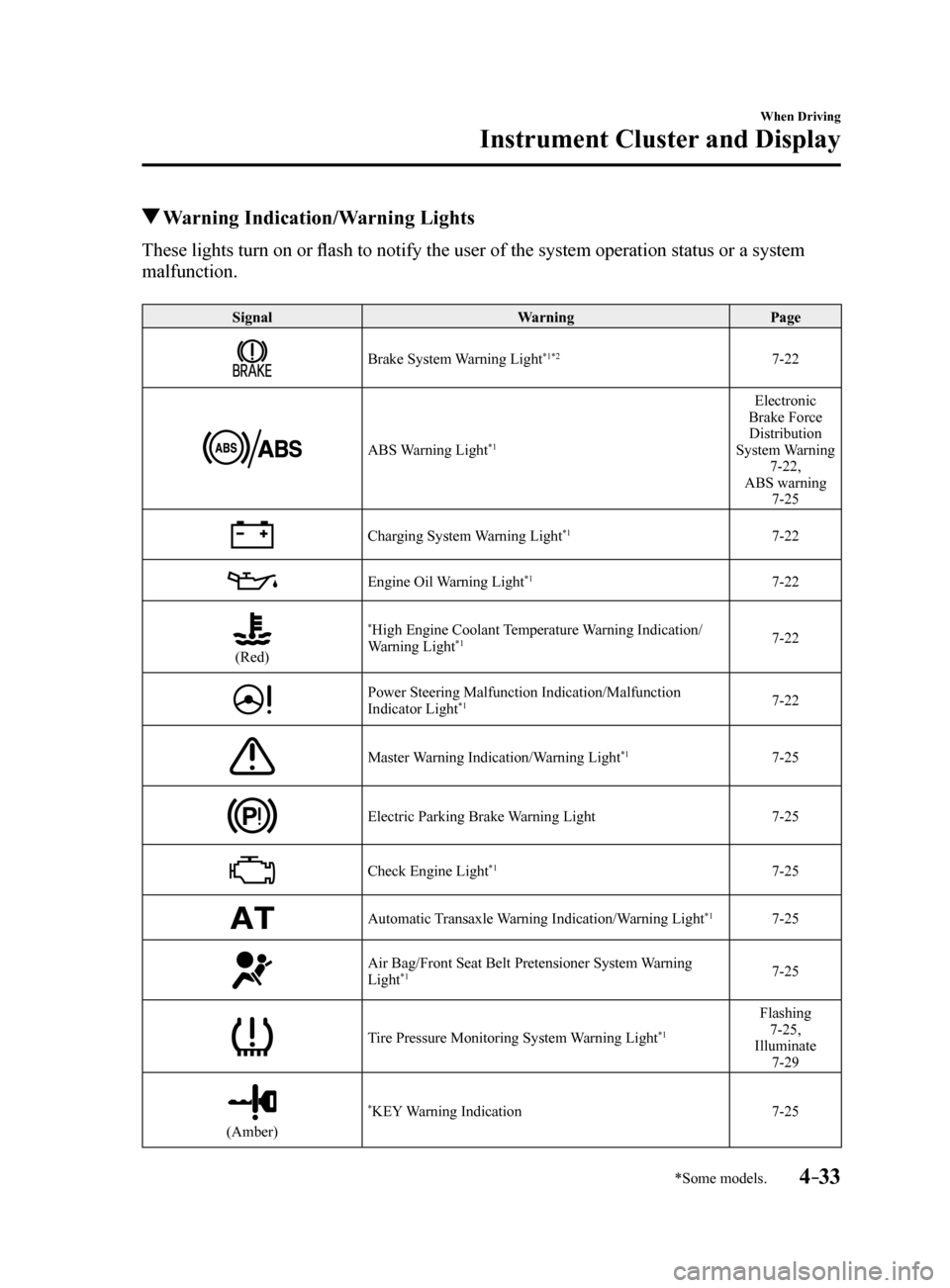
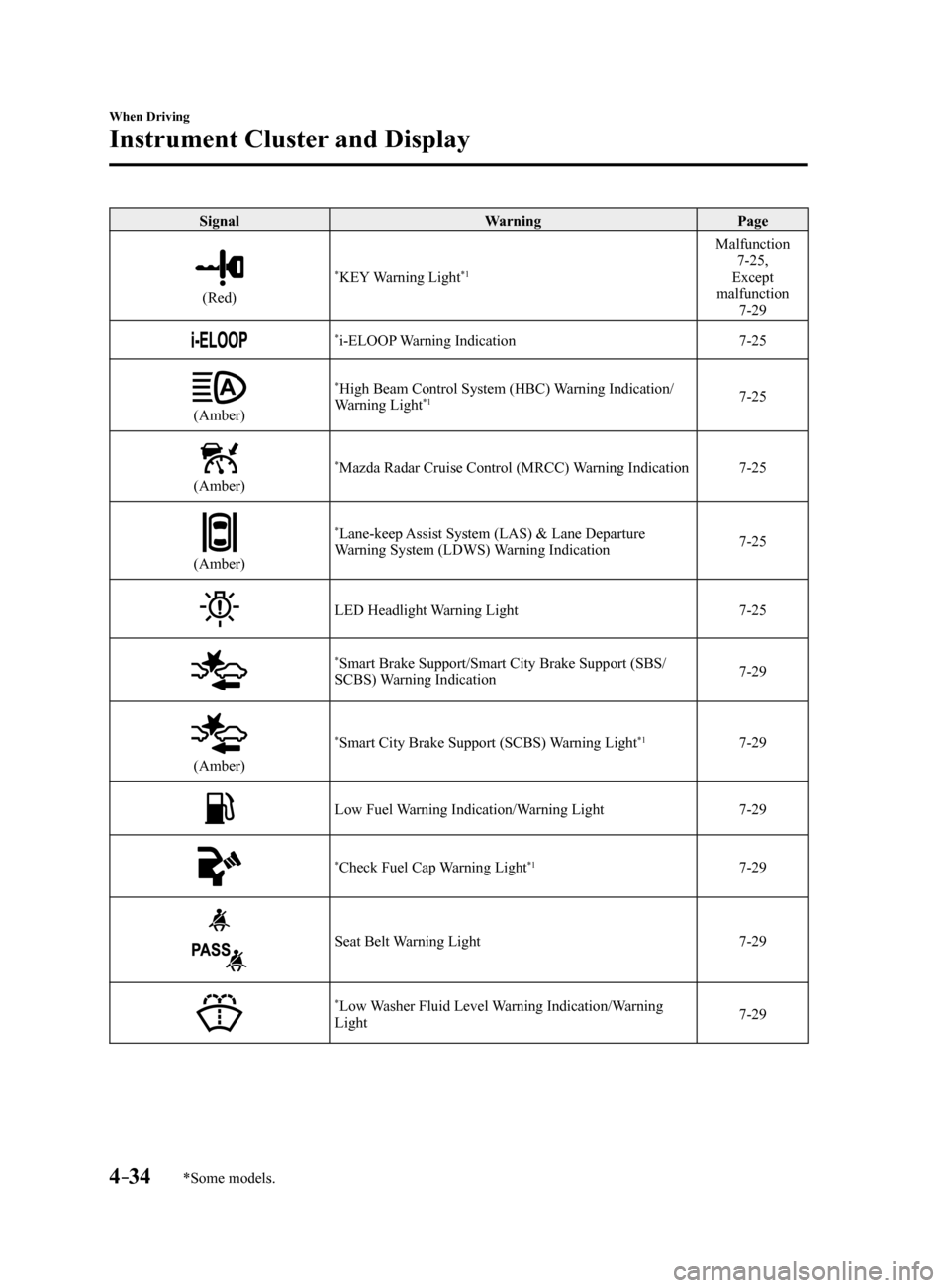
Warning Indication/Warning Lights
These lights turn on or flash to notify the user of the system operation status or a system
malfunction.
Signal WarningPage
Brake System Warning Light*1*27-22
ABS Warning Light*1
Electronic
Brake Force Distribution
System Warning 7-22,
ABS warning 7-25
Charging System Warning Light*17-22
Engine Oil Warning Light*17-22
(Red)
*High Engine Coolant Temperature Warning Indication/
Warning Light*17-22
Power Steering Malfunction Indication/Malfunction
Indicator Light*17-22
Master Warning Indication/Warning Light*17-25
Electric Parking Brake Warning Light 7-25
Check Engine Light*17-25
Automatic Transaxle Warning Indication/Warning Light*17-25
Air Bag/Front Seat Belt Pretensioner System Warning
Light*17-25
Tire Pressure Monitoring System Warning Light*1
Flashing
7-25,
Illuminate 7-29
(Amber)
*KEY Warning Indication 7-25
Mazda6_8FH2-EA-16F_Edition2.indb 332016/07/07 13:44:44
Page 158 of 578
4–34
When Driving
Instrument Cluster and Display
*Some models.
SignalWarningPage
(Red)
*KEY Warning Light*1
Malfunction
7-25,
Except
malfunction 7-29
*i-ELOOP Warning Indication 7-25
(Amber)
*High Beam Control System (HBC) Warning Indication/
Warning Light*17-25
(Amber)
*Mazda Radar Cruise Control (MRCC) Warning Indication 7-25
(Amber)
*Lane-keep Assist System (LAS) & Lane Departure
Warning System (LDWS) Warning Indication 7-25
LED Headlight Warning Light
7-25
*Smart Brake Support/Smart City Brake Support (SBS/
SCBS) Warning Indication 7-29
(Amber)
*Smart City Brake Support (SCBS) Warning Light*17-29
Low Fuel Warning Indication/Warning Light
7-29
*Check Fuel Cap Warning Light*17-29
Seat Belt Warning Light7-29
*Low Washer Fluid Level Warning Indication/Warning
Light 7-29
Mazda6_8FH2-EA-16F_Edition2.indb 342016/07/07 13:44:45
Page 197 of 578
4–73
When Driving
Brake
Electric parking brake automatic
release
If the accelerator pedal is depressed with
the electric parking brake applied and
all of the following conditions met, the
parking brake is released automatically.
The engine is running. The driver's door is closed. The driver's seat belt is fastened.
(Manual transaxle)
The change lever is in a position other
than neutral.
The clutch pedal is depressed halfway
(Automatic transaxle)
Selector lever is in the D, M, or R
position
NOTE
If something such as the driver's foot
contacts the accelerator pedal with the
engine running and the electric parking
brake applied, the parking brake may
be released automatically. If you do not
intend to drive immediately, shift the
change lever (manual transaxle) to the
neutral position, or shift the selector
lever (automatic transaxle) to the P or N
position.
Warning Light
The warning light turns on when the
system has a malfunction.
Refer to Warning Indication/Warning
Lights on page 4-33.
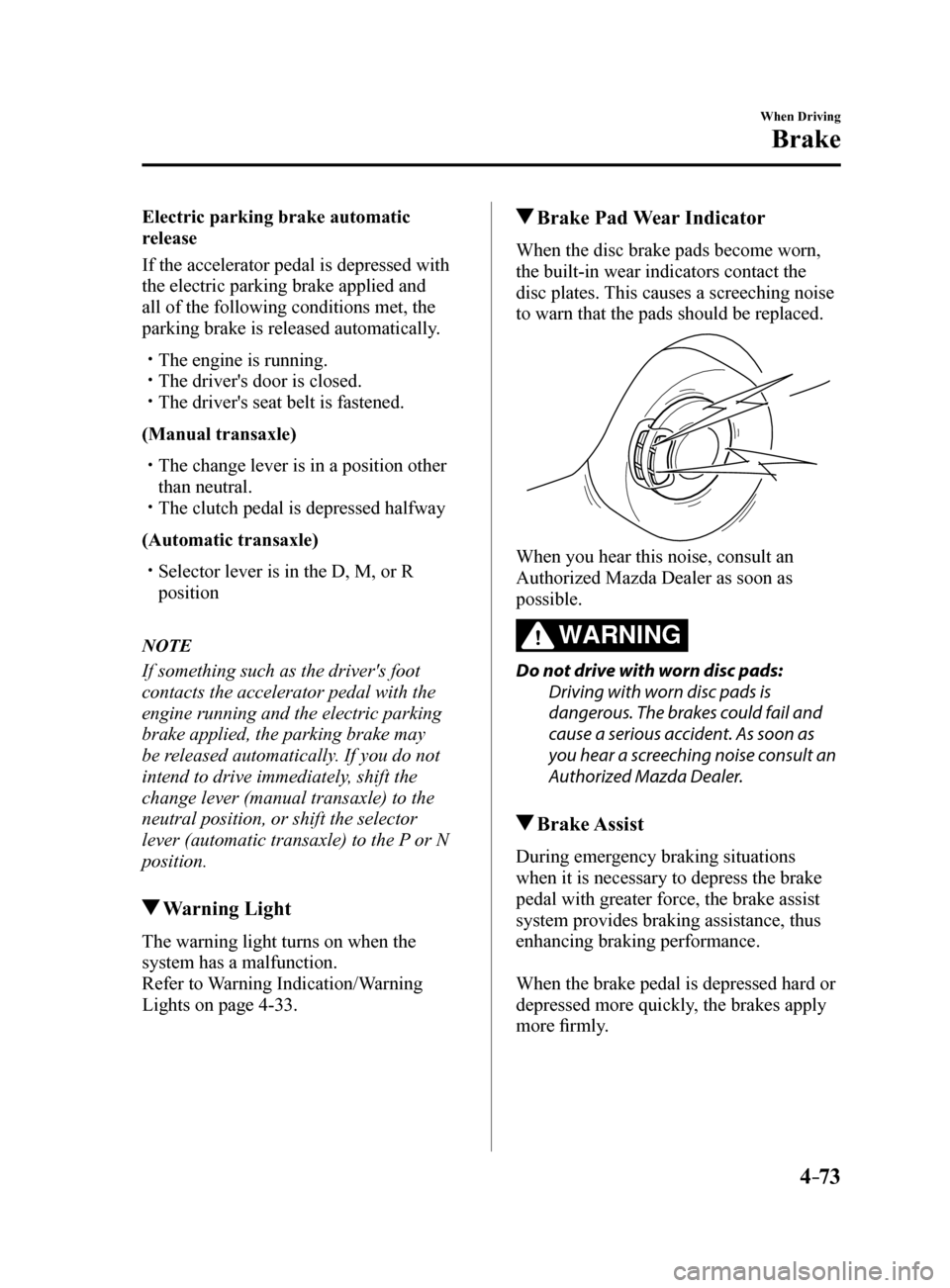
Brake Pad Wear Indicator
When the disc brake pads become worn,
the built-in wear indicators contact the
disc plates. This causes a screeching noise
to warn that the pads should be replaced.
When you hear this noise, consult an
Authorized Mazda Dealer as soon as
possible.
WARNING
Do not drive with worn disc pads:
Driving with worn disc pads is
dangerous. The brakes could fail and
cause a serious accident. As soon as
you hear a screeching noise consult an
Authorized Mazda Dealer.
Brake Assist
During emergency braking situations
when it is necessary to depress the brake
pedal with greater force, the brake assist
system provides braking assistance, thus
enhancing braking performance.
When the brake pedal is depressed hard or
depressed more quickly, the brakes apply
more firmly.
Mazda6_8FH2-EA-16F_Edition2.indb 732016/07/07 13:45:00
Page 240 of 578
4–116
When Driving
i-ACTIVSENSE
CAUTION
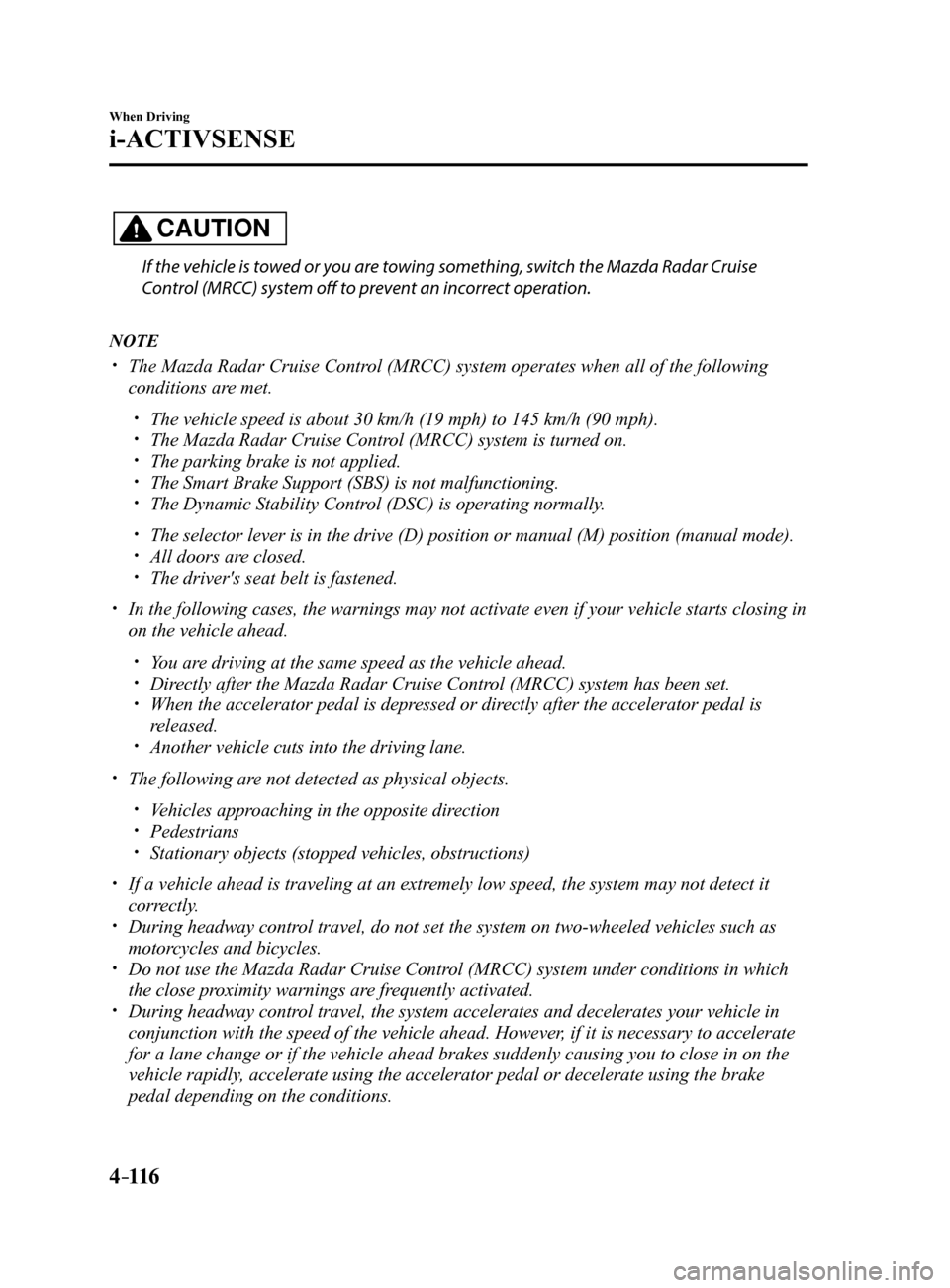
If the vehicle is towed or you are towing something, switch the Mazda Radar Cruise
Control (MRCC) system off to prevent an incorrect operation.
NOTE
The Mazda Radar Cruise Control (MRCC) system operates when all of the following
conditions are met.
The vehicle speed is about 30 km/h (19 mph) to 145 km/h (90 mph). The Mazda Radar Cruise Control (MRCC) system is turned on. The parking brake is not applied. The Smart Brake Support (SBS) is not malfunctioning. The Dynamic Stability Control (DSC) is operating normally.
The selector lever is in the drive (D) position or manual (M) positi\
on (manual mode). All doors are closed. The driver's seat belt is fastened.
In the following cases, the warnings may not activate even if your vehic\
le starts closing in
on the vehicle ahead.
You are driving at the same speed as the vehicle ahead. Directly after the Mazda Radar Cruise Control (MRCC) system has been set. When the accelerator pedal is depressed or directly after the accelerator pedal is
released.
Another vehicle cuts into the driving lane.
The following are not detected as physical objects.
Vehicles approaching in the opposite direction Pedestrians Stationary objects (stopped vehicles, obstructions)
If a vehicle ahead is traveling at an extremely low speed, the system may not detect it
correctly.
During headway control travel, do not set the system on two-wheeled vehicles such as
motorcycles and bicycles.
Do not use the Mazda Radar Cruise Control (MRCC) system under conditions in which
the close proximity warnings are frequently activated.
During headway control travel, the system accelerates and decelerates your vehicle in
conjunction with the speed of the vehicle ahead. However, if it is necessary to accelerate
for a lane change or if the vehicle ahead brakes suddenly causing you to\
close in on the
vehicle rapidly, accelerate using the accelerator pedal or decelerate using the brake
pedal depending on the conditions.
Mazda6_8FH2-EA-16F_Edition2.indb 1162016/07/07 13:45:12
Page 246 of 578

4–122
When Driving
i-ACTIVSENSE
When the system is temporarily
canceled
In the following cases, the Mazda Radar
Cruise Control (MRCC) is temporarily
canceled, the Mazda Radar Cruise Control
(MRCC) set indication (green) is turned
off, and the Mazda Radar Cruise Control
(MRCC) main indication (white) is turned
on.
The OFF/CAN switch is pressed once. The brake pedal is depressed. The parking brake is applied. The selector lever is shifted to park (P),
neutral (N) or reverse (R).
In the following cases, the “Mazda
Radar Cruise Control Canceled”
indication is displayed and the beep
sounds one time.
The vehicle speed decreases to less
than 25 km (16 mph).
The DSC has operated. The TCS has operated for a certain
period of time.
The Smart City Brake Support (SCBS)
has operated.
The Smart Brake Support (SBS) has
operated.
When traveling on a down slope for a
long period of time.
Any door is opened. The driver's seat belt is unfastened. There is a problem with the system.
NOTE
The Mazda Radar Cruise Control
(MRCC) system may be canceled during
rain, fog, snow or other inclement
weather conditions, or the front surface
of the radiator grille is dirty.
If you have temporarily canceled the
Mazda Radar Cruise Control (MRCC),
you can return to your previously set
speed by pressing the RES switch and
after all of the operation conditions
have been met.
If the Mazda Radar Cruise Control
(MRCC) system is deactivated, the
system does not return to the previously
set speed even if the RES switch is
pressed.
Mazda6_8FH2-EA-16F_Edition2.indb 1222016/07/07 13:45:16
Page 391 of 578
6–5
Maintenance and Care
Scheduled Maintenance
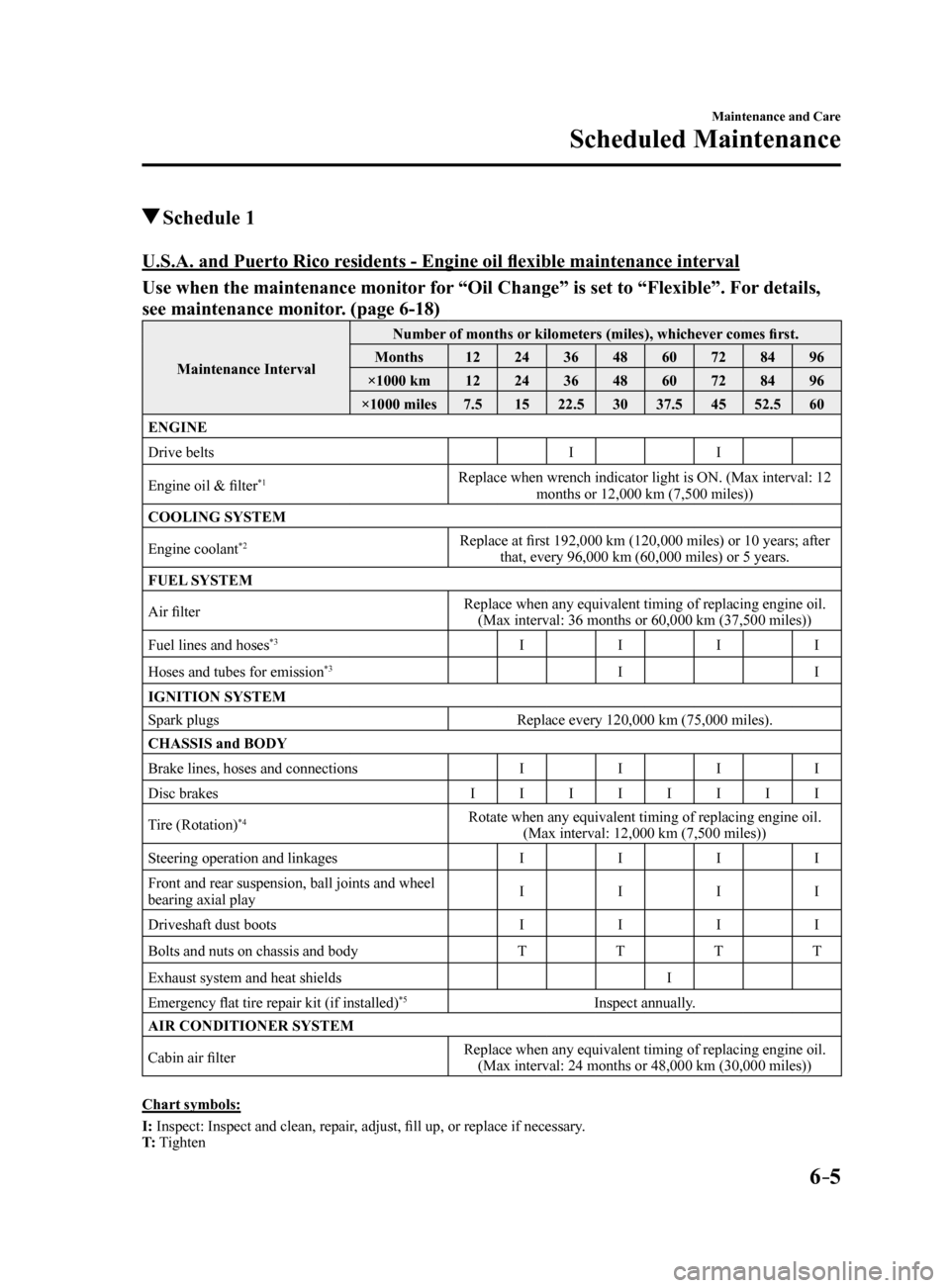
Schedule 1
U.S.A. and Puerto Rico residents ‑ Engine oil flexible maintenance interval
Use when the maintenance monitor for “Oil Change” is set to “Flexible”. For details,
see maintenance monitor. (page 6-18)
Maintenance IntervalNumber of months or kilometers (miles), whichever comes first.
Months 1224364860728496
×1000 km 1224364860728496
×1000 miles 7.51522.5 3037.5 4552.5 60
ENGINE
Drive belts II
Engine oil & filter
*1Replace when wrench indicator light is ON. (Max interval: 12 months or 12,000 km (7,500 miles))
COOLING SYSTEM
Engine coolant
*2Replace at first 192,000 km (120,000 miles) or 10 years; after that, every 96,000 km (60,000 miles) or 5 years.
FUEL SYSTEM
Air filter Replace when any equivalent timing of replacing engine oil.
(Max interval: 36 months or 60,000 km (37,500 miles))
Fuel lines and hoses
*3I III
Hoses and tubes for emission
*3I I
IGNITION SYSTEM
Spark plugs Replace every 120,000 km (75,000 miles).
CHASSIS and BODY
Brake lines, hoses and connections IIII
Disc brakes IIIIIIII
Tire (Rotation)
*4Rotate when any equivalent timing of replacing engine oil. (Max interval: 12,000 km (7,500 miles))
Steering operation and linkages IIII
Front and rear suspension, ball joints and wheel
bearing axial play I
III
Driveshaft dust boots IIII
Bolts and nuts on chassis and body TTTT
Exhaust system and heat shields I
Emergency flat tire repair kit (if installed)
*5Inspect annually.
AIR CONDITIONER SYSTEM
Cabin air filter Replace when any equivalent timing of replacing engine oil.
(Max interval: 24 months or 48,000 km (30,000 miles))
Chart symbols:
I: Inspect: Inspect and clean, repair, adjust, fill up, or replace if necessary.
T: Tighten
Mazda6_8FH2-EA-16F_Edition2.indb 52016/07/07 13:46:06