fuel pump MAZDA MODEL B2300 2003 Owners Manual (in English)
[x] Cancel search | Manufacturer: MAZDA, Model Year: 2003, Model line: MODEL B2300, Model: MAZDA MODEL B2300 2003Pages: 248, PDF Size: 2.71 MB
Page 2 of 248
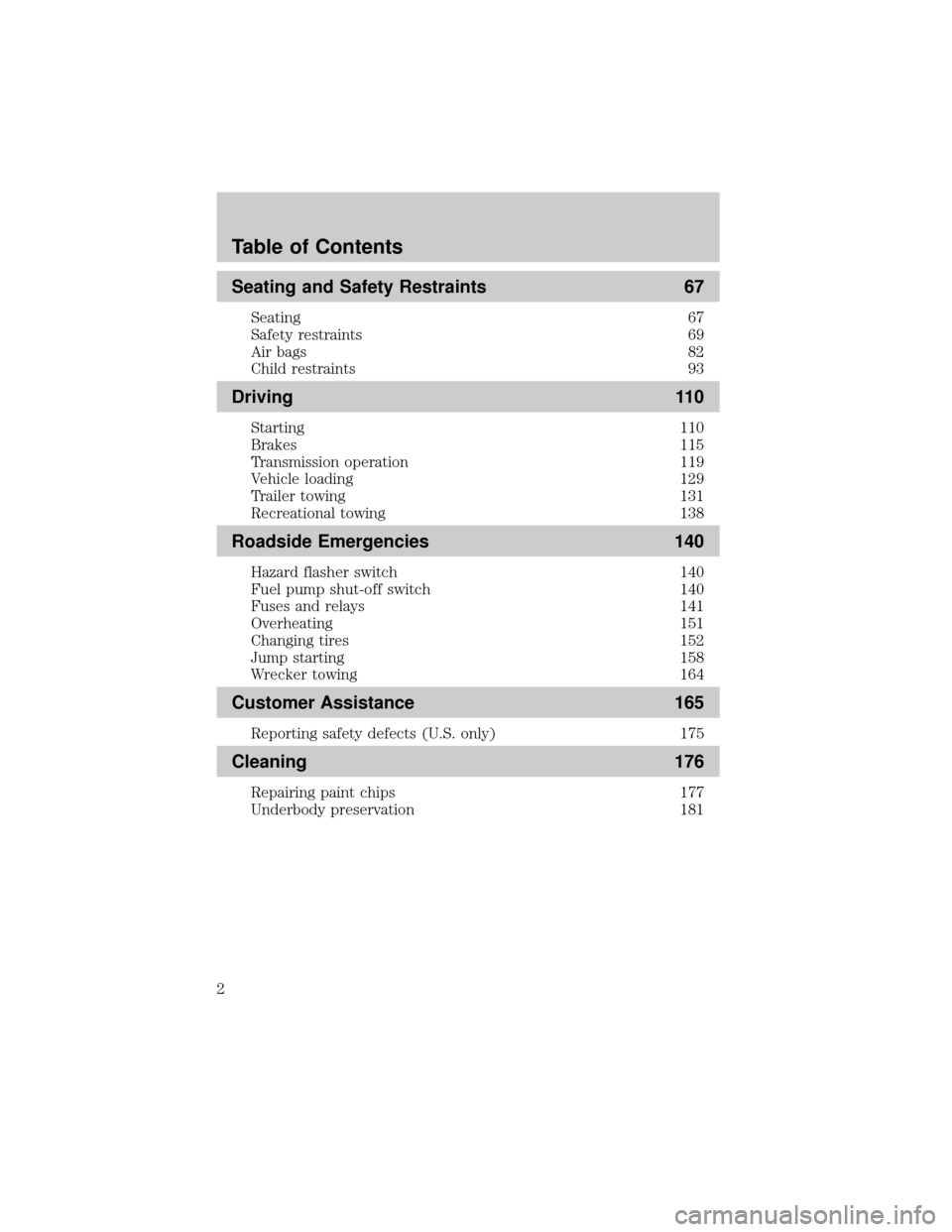
Seating and Safety Restraints 67
Seating 67
Safety restraints 69
Air bags 82
Child restraints 93
Driving 110
Starting 110
Brakes 115
Transmission operation 119
Vehicle loading 129
Trailer towing 131
Recreational towing 138
Roadside Emergencies 140
Hazard flasher switch 140
Fuel pump shut-off switch 140
Fuses and relays 141
Overheating 151
Changing tires 152
Jump starting 158
Wrecker towing 164
Customer Assistance 165
Reporting safety defects (U.S. only) 175
Cleaning 176
Repairing paint chips 177
Underbody preservation 181
Table of Contents
2
Page 4 of 248
CALIFORNIA Proposition 65 Warning
WARNING: Engine exhaust, some of its constituents, and
certain vehicle components contain or emit chemicals known to
the State of California to cause cancer and birth defects or
other reproductive harm. In addition, certain fluids contained in
vehicles and certain products of component wear contain or
emit chemicals known to the State of California to cause cancer
and birth defects or other reproductive harm.
CONGRATULATIONS
Congratulations on acquiring your new Mazda Motor Corporation
product. Please take the time to get well acquainted with your vehicle by
reading this handbook. The more you know and understand about your
vehicle the greater the safety and pleasure you will derive from driving
it.
For more information on Mazda Motor Corporation and its products visit
the following website:
²In the United States: www.mazdausa.com
²In Canada: www.mazda.ca
Additional owner information is given in separate publications.
This Owner's Guide describes every option and model variant available
and therefore some of the items covered may not apply to your
particular vehicle. Furthermore, due to printing cycles it may describe
options before they are generally available.
Remember to pass on the Owner's Guide when reselling the vehicle. It is
an integral part of the vehicle.
WARNING: In the event of an accident the Fuel pump shut-off
switch will automatically cut off the fuel supply to the engine.
The switch can also be activated through sudden vibration (e.g.
collision when parking). To reset the switch, refer to theFuel
pump shut-off switchin theRoadside emergencieschapter.
Introduction
4
Page 8 of 248
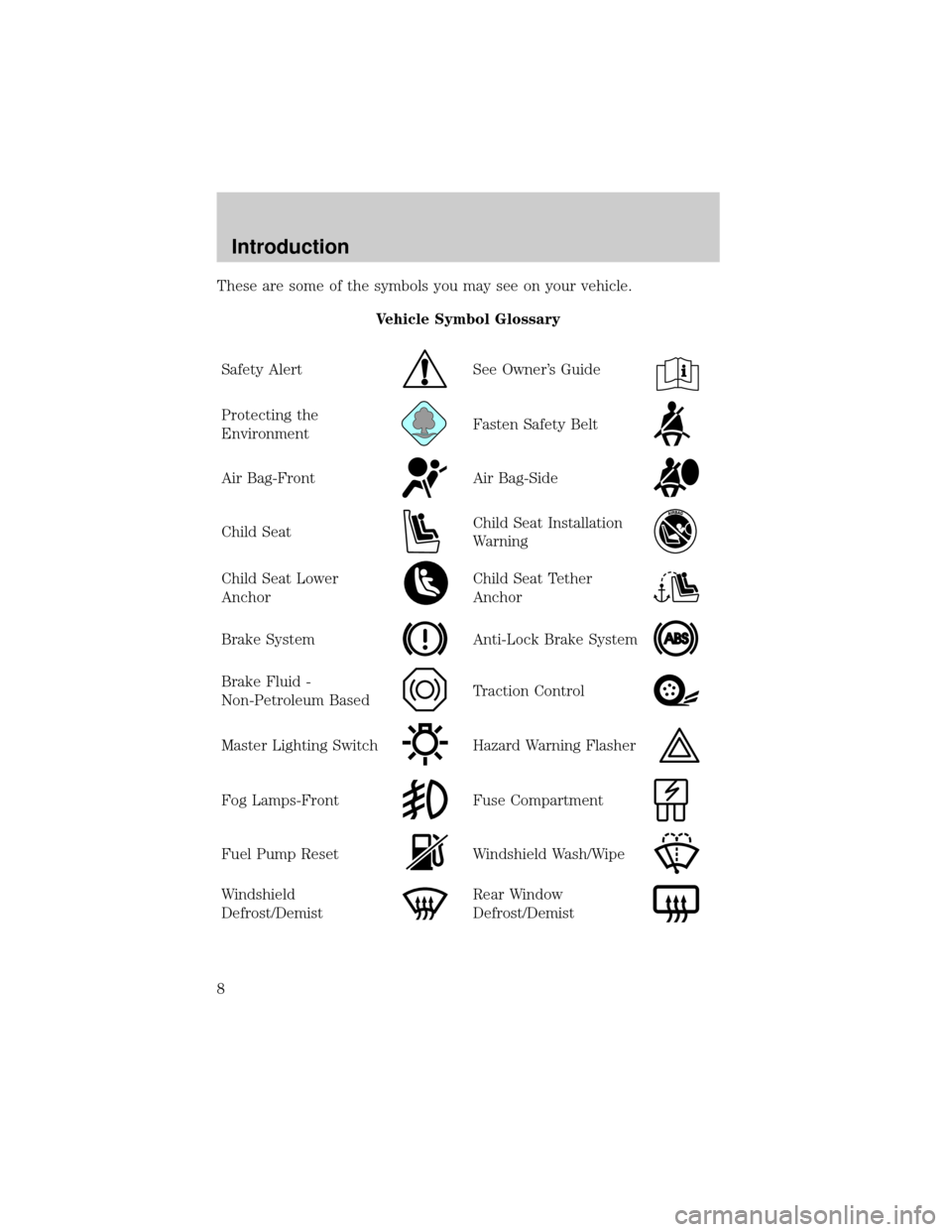
These are some of the symbols you may see on your vehicle.
Vehicle Symbol Glossary
Safety Alert
See Owner's Guide
Protecting the
EnvironmentFasten Safety Belt
Air Bag-FrontAir Bag-Side
Child SeatChild Seat Installation
Warning
Child Seat Lower
AnchorChild Seat Tether
Anchor
Brake SystemAnti-Lock Brake System
Brake Fluid -
Non-Petroleum BasedTraction Control
Master Lighting SwitchHazard Warning Flasher
Fog Lamps-FrontFuse Compartment
Fuel Pump ResetWindshield Wash/Wipe
Windshield
Defrost/DemistRear Window
Defrost/Demist
Introduction
8
Page 117 of 248
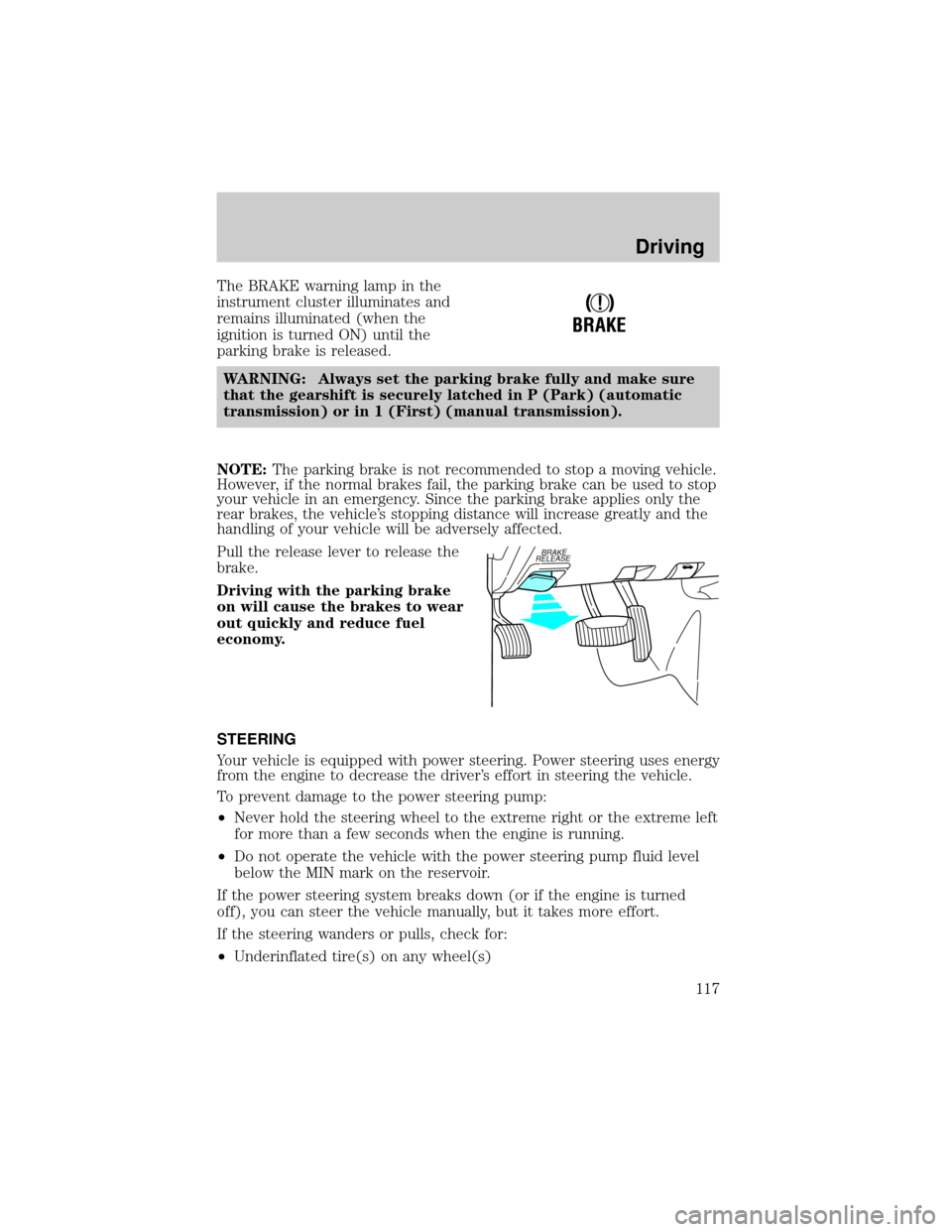
The BRAKE warning lamp in the
instrument cluster illuminates and
remains illuminated (when the
ignition is turned ON) until the
parking brake is released.
WARNING: Always set the parking brake fully and make sure
that the gearshift is securely latched in P (Park) (automatic
transmission) or in 1 (First) (manual transmission).
NOTE:The parking brake is not recommended to stop a moving vehicle.
However, if the normal brakes fail, the parking brake can be used to stop
your vehicle in an emergency. Since the parking brake applies only the
rear brakes, the vehicle's stopping distance will increase greatly and the
handling of your vehicle will be adversely affected.
Pull the release lever to release the
brake.
Driving with the parking brake
on will cause the brakes to wear
out quickly and reduce fuel
economy.
STEERING
Your vehicle is equipped with power steering. Power steering uses energy
from the engine to decrease the driver's effort in steering the vehicle.
To prevent damage to the power steering pump:
²Never hold the steering wheel to the extreme right or the extreme left
for more than a few seconds when the engine is running.
²Do not operate the vehicle with the power steering pump fluid level
below the MIN mark on the reservoir.
If the power steering system breaks down (or if the engine is turned
off), you can steer the vehicle manually, but it takes more effort.
If the steering wanders or pulls, check for:
²Underinflated tire(s) on any wheel(s)
!
BRAKE
BRAKE
RELEASE
Driving
117
Page 140 of 248
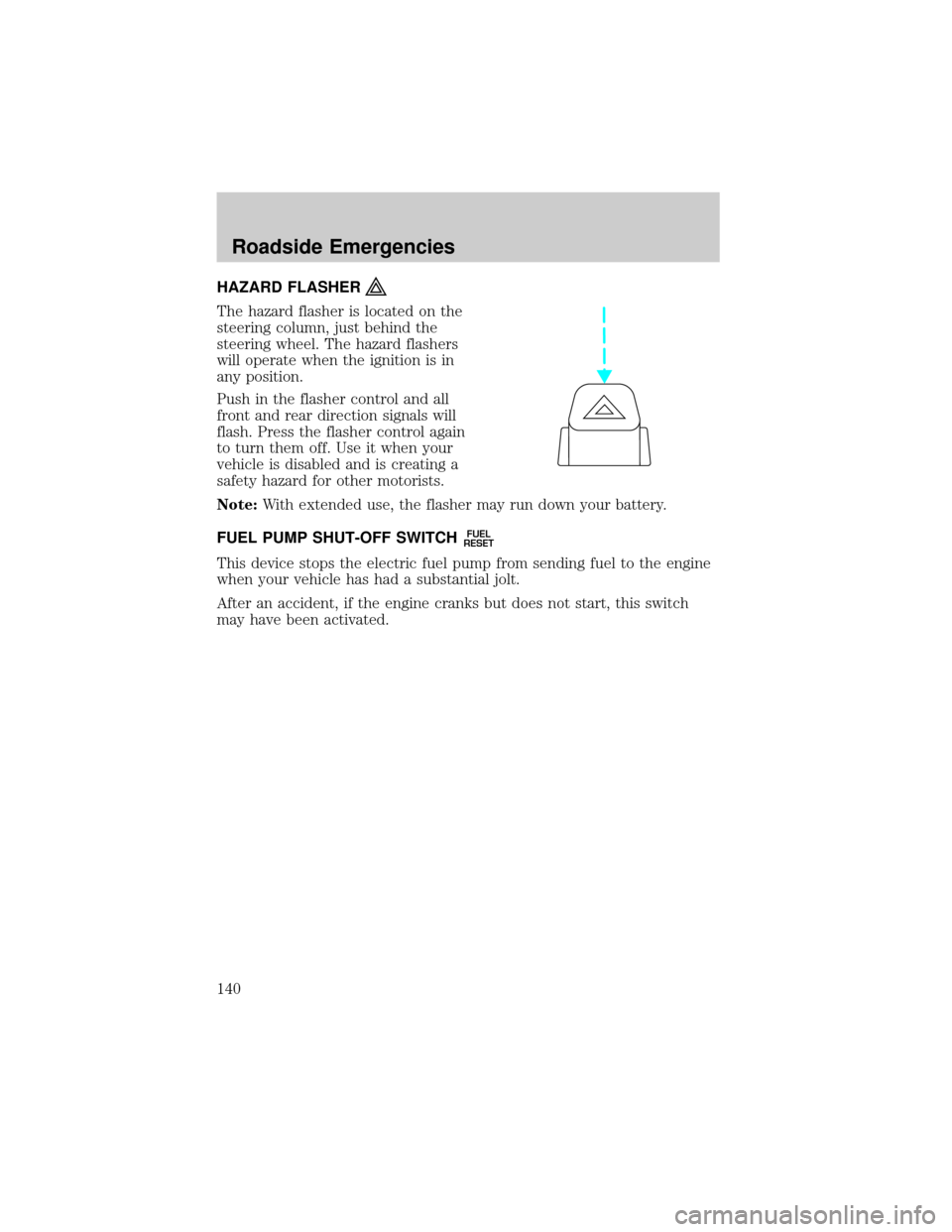
HAZARD FLASHER
The hazard flasher is located on the
steering column, just behind the
steering wheel. The hazard flashers
will operate when the ignition is in
any position.
Push in the flasher control and all
front and rear direction signals will
flash. Press the flasher control again
to turn them off. Use it when your
vehicle is disabled and is creating a
safety hazard for other motorists.
Note:With extended use, the flasher may run down your battery.
FUEL PUMP SHUT-OFF SWITCH
FUEL
RESET
This device stops the electric fuel pump from sending fuel to the engine
when your vehicle has had a substantial jolt.
After an accident, if the engine cranks but does not start, this switch
may have been activated.
Roadside Emergencies
140
Page 147 of 248

Fuse/Relay
LocationFuse Amp
RatingPower Distribution Box Description
13 Ð Not used
14 Ð Not used
15 Ð Not used
16 40A** Blower motor
17 20A** Auxiliary cooling fan
18 Ð Not used
19 Ð Not used
20 Ð Not used
21 10A* PCM memory
22 Ð Not used
23 20A* Fuel pump motor
24 30A* Headlamps
25 10A* A/C clutch relay
26 Ð Not used
27 Ð Not used
28 30A* ABS module
29 Ð Not used
30 15A* Trailer Tow
31 20A* Foglamp, Daytime Running Lamps (DRL)
32 Ð Not used
33 15A* Park lamp, Central security module
34 Ð Not used
35 Ð Not used
36 Ð Not used
37 Ð Not used
38 10A* Left headlamp low beam
39 Ð Not used
40 Ð Not used
41 20A* Heated oxygen sensors
42 10A* Right headlamp low beam
43 Ð (Resistor)
Roadside Emergencies
147
Page 148 of 248

Fuse/Relay
LocationFuse Amp
RatingPower Distribution Box Description
44 Ð Not used
45A Ð Wiper HI/LO relay
45B Ð Wiper park/run relay
46A Ð Fuel pump relay
46B Ð Trailer tow relay
47 Ð Starter relay
48 Ð Auxiliary cooling fan relay
49 Ð Not used
50 Ð Not used
51 Ð Not used
52 Ð Not used
53 Ð PCM Diode
54 Ð PCM Relay
55 Ð Blower motor relay
56A Ð A/C clutch relay
56B Ð Front washer pump relay
* Mini Fuses ** Maxi Fuses
Roadside Emergencies
148
Page 150 of 248

Fuse/Relay
LocationFuse Amp
RatingPower Distribution Box Description
14 Ð Not used
15 Ð Not used
16 40A** Blower motor
17 Ð Not used
18 Ð Not used
19 Ð Not used
20 Ð Not used
21 10A* Powertrain Control Module (PCM)
memory
22 Ð Not used
23 20A* Fuel pump motor
24 30A* Headlamps
25 10A* A/C clutch solenoid
26 Ð Not used
27 Ð Not used
28 30A* Anti-lock Brake System (ABS) module
29 Ð Not used
30 15A* Trailer tow
31 20A* Foglamps, Daytime Running Lamps (DRL)
32 Ð Not used
33 15A* Park lamp
34 Ð Not used
35 Ð Not used
36 Ð Not used
37 Ð Not used
38 10A* Left headlamp low beam
39 Ð Not used
40 Ð Not used
41 20A* Heated oxygen sensors
42 10A* Right headlamp low beam
43 Ð Not used
Roadside Emergencies
150
Page 151 of 248
Fuse/Relay
LocationFuse Amp
RatingPower Distribution Box Description
44 Ð Not used
45A Ð Wiper HI/LO relay
45B Ð Wiper park/run relay
46A Ð Fuel pump relay
46B Ð Trailer tow relay
47A Ð A/C clutch solenoid relay
47B Ð Front washer pump relay
48A Ð Fog lamps
48B Ð Fog lamp relay
51 Ð Not used
52 Ð Not used
53 Ð Powertrain Control Module (PCM) Diode
54 Ð Powertrain Control Module (PCM)
55 Ð Blower relay
56 Ð Starter relay
* Mini Fuses ** Maxi Fuses
OVERHEATING
If the temperature gauge indicates overheating and you experience
power loss, you hear a loud knocking or pinging noise, the engine is
probably too hot.
If this happens:
1. Drive safely to the side of the road and park off the right-of-way.
2. Shift the automatic transmission into P (Park) or the manual
transmission into the neutral position, and apply the parking brake.
3. Turn off the air conditioner.
WARNING: Steam from an overheated engine is dangerous. The
escaping steam could seriously burn you. Open the hood ONLY
after steam is no longer escaping from the engine.
4. Check whether coolant or steam is escaping from under the hood or
from the engine compartment.
²If steam is coming from the engine compartment:do not go near
the front of the vehicle. Stop the engine, then turn the ignition switch
Roadside Emergencies
151
Page 211 of 248

WARNING: Flexible fuel components and standard unleaded
gasoline fuel components are not interchangeable. If your
vehicle is not serviced in accordance with flexible fuel vehicles
procedures, damage may occur and your warranty may be
invalidated.
WARNING: When refueling always shut the engine off and
never allow sparks or open flames near the filler neck. Never
smoke while refueling. Fuel vapor is extremely hazardous under
certain conditions. Care should be taken to avoid inhaling
excess fumes.
WARNING: The flow of fuel through a fuel pump nozzle can
produce static electricity, which can cause a fire if fuel is
pumped into an ungrounded fuel container.
Use the following guidelines to avoid static build-up when filling an
ungrounded fuel container:
²Place approved fuel container on
the ground.
²DO NOT fill a fuel container while
it is in the vehicle (including the
cargo area/pickup bed).
²Keep the fuel pump nozzle in contact with the fuel container while
filling.
²DO NOT use a device that would hold the fuel pump handle in the fill
position.
Fuel Filler Cap
Your fuel tank filler cap has an indexed design with a 1/8 turn on/off
feature.
When fueling your vehicle:
1. Turn the engine off.
2. Carefully turn the filler cap counterclockwise 1/8 of a turn until it
stops.
3. Pull to remove the cap from the fuel filler pipe.
Maintenance and Specifications
211