steering wheel MAZDA MODEL B2300 TRUCK 2006 (in English) User Guide
[x] Cancel search | Manufacturer: MAZDA, Model Year: 2006, Model line: MODEL B2300 TRUCK, Model: MAZDA MODEL B2300 TRUCK 2006Pages: 268, PDF Size: 2.52 MB
Page 146 of 268
JOBNAME: No Job Name PAGE: 146 SESS: 1 OUTPUT: Tue Apr 12 14:52:56 2005
/ford_pdm/ford/own2002/mbs/mpdiff
has continuous vibration or shudder in the steering wheel while braking,
the vehicle should be inspected by an authorized
dealer.
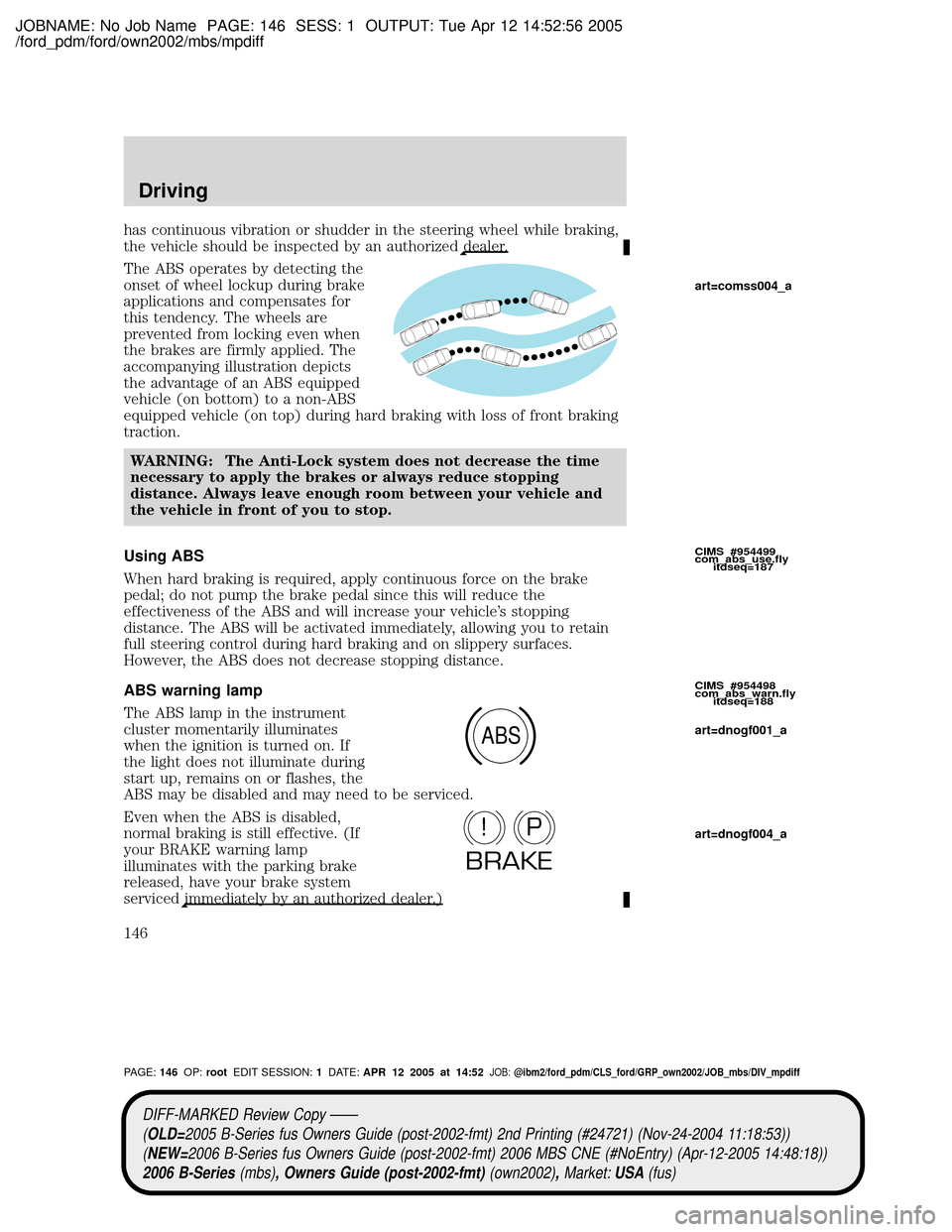
The ABS operates by detecting the
onset of wheel lockup during brake
applications and compensates for
this tendency. The wheels are
prevented from locking even when
the brakes are firmly applied. The
accompanying illustration depicts
the advantage of an ABS equipped
vehicle (on bottom) to a non-ABS
equipped vehicle (on top) during hard braking with loss of front braking
traction.
WARNING: The Anti-Lock system does not decrease the time
necessary to apply the brakes or always reduce stopping
distance. Always leave enough room between your vehicle and
the vehicle in front of you to stop.
Using ABS
When hard braking is required, apply continuous force on the brake
pedal; do not pump the brake pedal since this will reduce the
effectiveness of the ABS and will increase your vehicle's stopping
distance. The ABS will be activated immediately, allowing you to retain
full steering control during hard braking and on slippery surfaces.
However, the ABS does not decrease stopping distance.
ABS warning lamp
The ABS lamp in the instrument
cluster momentarily illuminates
when the ignition is turned on. If
the light does not illuminate during
start up, remains on or flashes, the
ABS may be disabled and may need to be serviced.
Even when the ABS is disabled,
normal braking is still effective. (If
your BRAKE warning lamp
illuminates with the parking brake
released, have your brake system
serviced
immediately by an authorized dealer.)
ABS
P!
BRAKE
CIMS #954499
com_abs_use.fly
itdseq=187
CIMS #954498
com_abs_warn.fly
itdseq=188
art=comss004_a
art=dnogf001_a
art=dnogf004_a
DIFF-MARKED Review Copy ÐÐ
(OLD=2005 B-Series fus Owners Guide (post-2002-fmt) 2nd Printing (#24721) (Nov-24-2004 11:18:53))
(NEW=2006 B-Series fus Owners Guide (post-2002-fmt) 2006 MBS CNE (#NoEntry) (Apr-12-2005 14:48:18))
2006 B-Series(mbs), Owners Guide (post-2002-fmt)(own2002),Market:USA(fus)
PAGE:146OP:rootEDIT SESSION:1DATE:APR 12 2005 at 14:52JOB:@ibm2/ford_pdm/CLS_ford/GRP_own2002/JOB_mbs/DIV_mpdiff
Driving
146
Page 148 of 268
JOBNAME: No Job Name PAGE: 148 SESS: 1 OUTPUT: Tue Apr 12 14:52:56 2005
/ford_pdm/ford/own2002/mbs/mpdiff
STEERING
Your vehicle is equipped with power steering. Power steering uses energy
from the engine to decrease the driver's effort in steering the vehicle.
To prevent damage to the power steering pump:
²Never hold the steering wheel to the extreme right or the extreme left
for more than a few seconds when the engine is running.
²Do not operate the vehicle with the power steering pump fluid level
below the MIN mark on the reservoir.
If the power steering system breaks down (or if the engine is turned
off), you can steer the vehicle manually, but it takes more effort.
If the steering wanders or pulls, check for:
²Underinflated tire(s) on any wheel(s)
²Uneven vehicle loading
²High crown in center of road
²High crosswinds
²Wheels out of alignment
²Loose or worn suspension components
TRACTION-LOK AXLE (IF EQUIPPED)
This axle provides added traction on slippery surfaces, particularly when
one wheel is on a poor traction surface. Under normal conditions, the
Traction-Lok axle functions like a standard rear axle. The axle may
exhibit a slight noise or vibration in tight turns with low vehicle speed.
This is normal behavior and indicates the axle is working.
PREPARING TO DRIVE
WARNING: Utility vehicles have a significantly higher rollover
rate than other types of vehicles.
WARNING: In a rollover crash, an unbelted person is
significantly more likely to die than a person wearing a safety
belt.
Your vehicle has larger tires and increased ground clearance, giving the
vehicle a higher center of gravity than a passenger car.
CIMS #244756
com_steering.04
itdseq=190
CIMS #954505
com_axle-statement.fly
itdseq=191
CIMS #954507
com_prep-to-drive.fly
itdseq=192
DIFF-MARKED Review Copy ÐÐ
(OLD=2005 B-Series fus Owners Guide (post-2002-fmt) 2nd Printing (#24721) (Nov-24-2004 11:18:53))
(NEW=2006 B-Series fus Owners Guide (post-2002-fmt) 2006 MBS CNE (#NoEntry) (Apr-12-2005 14:48:18))
2006 B-Series(mbs), Owners Guide (post-2002-fmt)(own2002),Market:USA(fus)
PAGE:148OP:rootEDIT SESSION:1DATE:APR 12 2005 at 14:52JOB:@ibm2/ford_pdm/CLS_ford/GRP_own2002/JOB_mbs/DIV_mpdiff
Driving
148
Page 157 of 268
JOBNAME: No Job Name PAGE: 157 SESS: 1 OUTPUT: Tue Apr 12 14:52:56 2005
/ford_pdm/ford/own2002/mbs/mpdiff
²If shifting out of 4X4 LOW, wait for the 4WD LOW light in the
instrument cluster to turnoffindicating the shift is complete.
Driving off-road with 4WD
Your vehicle is specially equipped for driving on sand, snow, mud and
rough terrain and has operating characteristics that are somewhat
different from conventional vehicles, both on and off the road.
How your vehicle differs from other vehicles
Trucks and utility vehicles can differ from some other vehicles. Your
vehicle may be higher to allow it to travel over rough terrain without
getting hung up or damaging underbody components.
The differences that make your vehicle so versatile also make it handle
differently than an ordinary passenger car.
Maintain steering wheel control at all times, especially in rough terrain.
Since sudden changes in terrain can result in abrupt steering wheel
motion, make sure you grip the steering wheel from the outside. Do not
grip the spokes.
Drive cautiously to avoid vehicle damage from concealed objects such as
rocks and stumps.
You should either know the terrain or examine maps of the area before
driving. Map out your route before driving in the area.
To maintain
steering and braking control of your vehicle, you must have all four
wheels ontheground and they must be rolling, not sliding or spinning.
Basic operating principles
²Do not use 4WD on dry, hard surfaced roads. Doing so will produce
excessive noise, increase tire wear and may damage drive components.
4WD modes are only intended for consistently slippery or loose
surfaces.
²Drive slower in strong crosswinds which can affect the normal steering
characteristics of yourvehicle.
²Be extremely careful when driving on pavement made slippery by
loose sand, water, gravel, snow or ice.
If your vehicle goes off the edge of the pavement
²If your vehicle goes off the edge of the pavement, slow down, but
avoid severe brake application, ease the vehicle back onto the
pavement only after reducing your speed. Do not turn the steering
wheel too sharply while returning to the road surface.
CIMS #83537
com_driving-offroad.02
itdseq=206
DIFF-MARKED Review Copy ÐÐ
(OLD=2005 B-Series fus Owners Guide (post-2002-fmt) 2nd Printing (#24721) (Nov-24-2004 11:18:53))
(NEW=2006 B-Series fus Owners Guide (post-2002-fmt) 2006 MBS CNE (#NoEntry) (Apr-12-2005 14:48:18))
2006 B-Series(mbs), Owners Guide (post-2002-fmt)(own2002),Market:USA(fus)
PAGE:157OP:rootEDIT SESSION:1DATE:APR 12 2005 at 14:52JOB:@ibm2/ford_pdm/CLS_ford/GRP_own2002/JOB_mbs/DIV_mpdiff
Driving
157
Page 158 of 268
JOBNAME: No Job Name PAGE: 158 SESS: 1 OUTPUT: Tue Apr 12 14:52:56 2005
/ford_pdm/ford/own2002/mbs/mpdiff
²It may be safer to stay on the apron or shoulder of the road and slowdown gradually before returning to the pavement. You may losecontrol if you do not slow down or if you turn the steering wheel toosharply or abruptly.
²It often may be less risky to strike small objects, such as highwayreflectors, with minor damage to your vehicle rather than attempt asudden return to the pavement which could cause the vehicle to slide
sideways out of control or roll over. Remember, your safety and the
safety of others should be your primary concern.
WARNING: Vehicles with a higher center of gravity such as
utility and four-wheel drive vehicles handle differently than
vehicles with a lower center of gravity. Utility and four-wheel
drive vehicles are not designed for cornering at speeds as high
as passenger cars any more than low-slung sports cars are
designed to perform satisfactorily under off-road conditions.
Avoid sharp turns, excessive speed and abrupt maneuvers in
these vehicles. Failure to drive cautiously could result in an
increased risk of loss of vehicle control, vehicle rollover,
personal injury and death.
If your vehicle gets stuck
If the vehicle is stuck it may be rocked out by shifting from forward and
reverse gears, stopping between shifts, in a steady pattern. Press lightly
on the accelerator in each gear.
Do not rock the vehicle if the engine is not at normal operating
temperature or damage to the transmission may occur.
Do not rock the vehicle for more than a few minutes or damage
to the transmission and tires may occur or the engine may
overheat.
WARNING: Do not spin the wheels at over 35 mph (56 km/h).
The tires may fail and injure a passenger or bystander.
Emergency maneuvers
²In an unavoidable emergency situation where a sudden sharp turn
must be made, remember to avoid ªover-drivingº your vehicle, i.e.,
turn the steering wheel only as rapidly and as far as required to avoid
the emergency. Excessive steering will result in less vehicle control,
not more. Additionally, smooth variations of the accelerator and/or
DIFF-MARKED Review Copy ÐÐ
(OLD=2005 B-Series fus Owners Guide (post-2002-fmt) 2nd Printing (#24721) (Nov-24-2004 11:18:53))
(NEW=2006 B-Series fus Owners Guide (post-2002-fmt) 2006 MBS CNE (#NoEntry) (Apr-12-2005 14:48:18))
2006 B-Series(mbs), Owners Guide (post-2002-fmt)(own2002),Market:USA(fus)
PAGE:158OP:rootEDIT SESSION:1DATE:APR 12 2005 at 14:52JOB:@ibm2/ford_pdm/CLS_ford/GRP_own2002/JOB_mbs/DIV_mpdiff
Driving
158
Page 159 of 268
JOBNAME: No Job Name PAGE: 159 SESS: 1 OUTPUT: Tue Apr 12 14:52:56 2005
/ford_pdm/ford/own2002/mbs/mpdiff
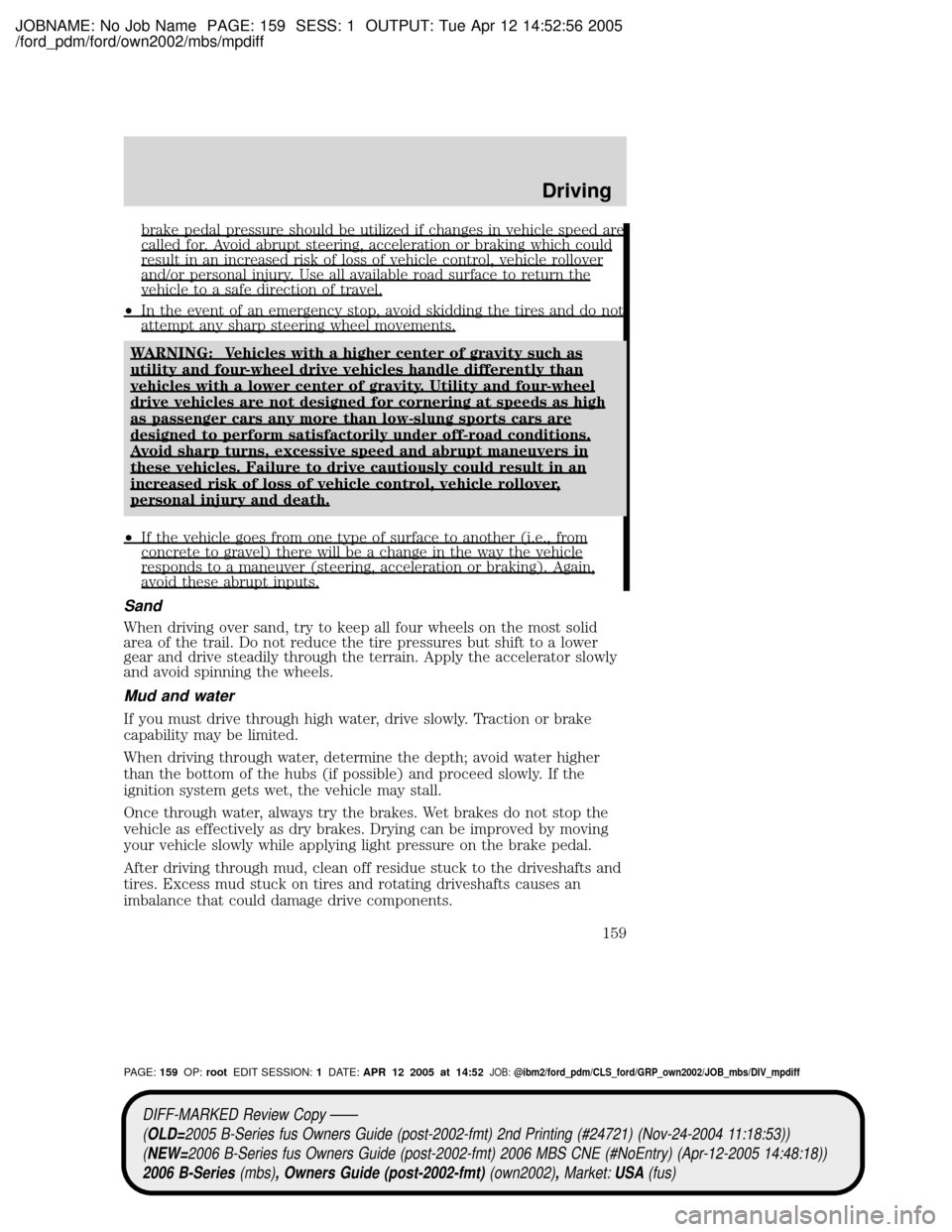
brake pedal pressure should be utilized if changes in vehicle speed arecalled for. Avoid abrupt steering, acceleration or braking which couldresult in an increased risk of loss of vehicle control, vehicle rolloverand/or personal injury. Use all available road surface to return thevehicle to a safe direction of travel.
²In the event of an emergency stop, avoid skidding the tires and do notattempt any sharp steering wheel movements.
WARNING: Vehicles with a higher center of gravity such as
utility and four-wheel drive vehicles handle differently than
vehicles with a lower center of gravity. Utility and four-wheel
drive vehicles are not designed for cornering at speeds as high
as passenger cars any more than low-slung sports cars are
designed to perform satisfactorily under off-road conditions.
Avoid sharp turns, excessive speed and abrupt maneuvers in
these vehicles. Failure to drive cautiously could result in an
increased risk of loss of vehicle control, vehicle rollover,
personal injury and death.
²If the vehicle goes from one type of surface to another (i.e., fromconcrete to gravel) there will be a change in the way the vehicleresponds to a maneuver (steering, acceleration or braking). Again,avoid these abrupt inputs.
Sand
When driving over sand, try to keep all four wheels on the most solid
area of the trail. Do not reduce the tire pressures but shift to a lower
gear and drive steadily through the terrain. Apply the accelerator slowly
and avoid spinning the wheels.
Mud and water
If you must drive through high water, drive slowly. Traction or brake
capability may be limited.
When driving through water, determine the depth; avoid water higher
than the bottom of the hubs (if possible) and proceed slowly. If the
ignition system gets wet, the vehicle may stall.
Once through water, always try the brakes. Wet brakes do not stop the
vehicle as effectively as dry brakes. Drying can be improved by moving
your vehicle slowly while applying light pressure on the brake pedal.
After driving through mud, clean off residue stuck to the driveshafts and
tires. Excess mud stuck on tires and rotating driveshafts causes an
imbalance that could damage drive components.
DIFF-MARKED Review Copy ÐÐ
(OLD=2005 B-Series fus Owners Guide (post-2002-fmt) 2nd Printing (#24721) (Nov-24-2004 11:18:53))
(NEW=2006 B-Series fus Owners Guide (post-2002-fmt) 2006 MBS CNE (#NoEntry) (Apr-12-2005 14:48:18))
2006 B-Series(mbs), Owners Guide (post-2002-fmt)(own2002),Market:USA(fus)
PAGE:159OP:rootEDIT SESSION:1DATE:APR 12 2005 at 14:52JOB:@ibm2/ford_pdm/CLS_ford/GRP_own2002/JOB_mbs/DIV_mpdiff
Driving
159
Page 162 of 268
JOBNAME: No Job Name PAGE: 162 SESS: 1 OUTPUT: Tue Apr 12 14:52:56 2005
/ford_pdm/ford/own2002/mbs/mpdiff
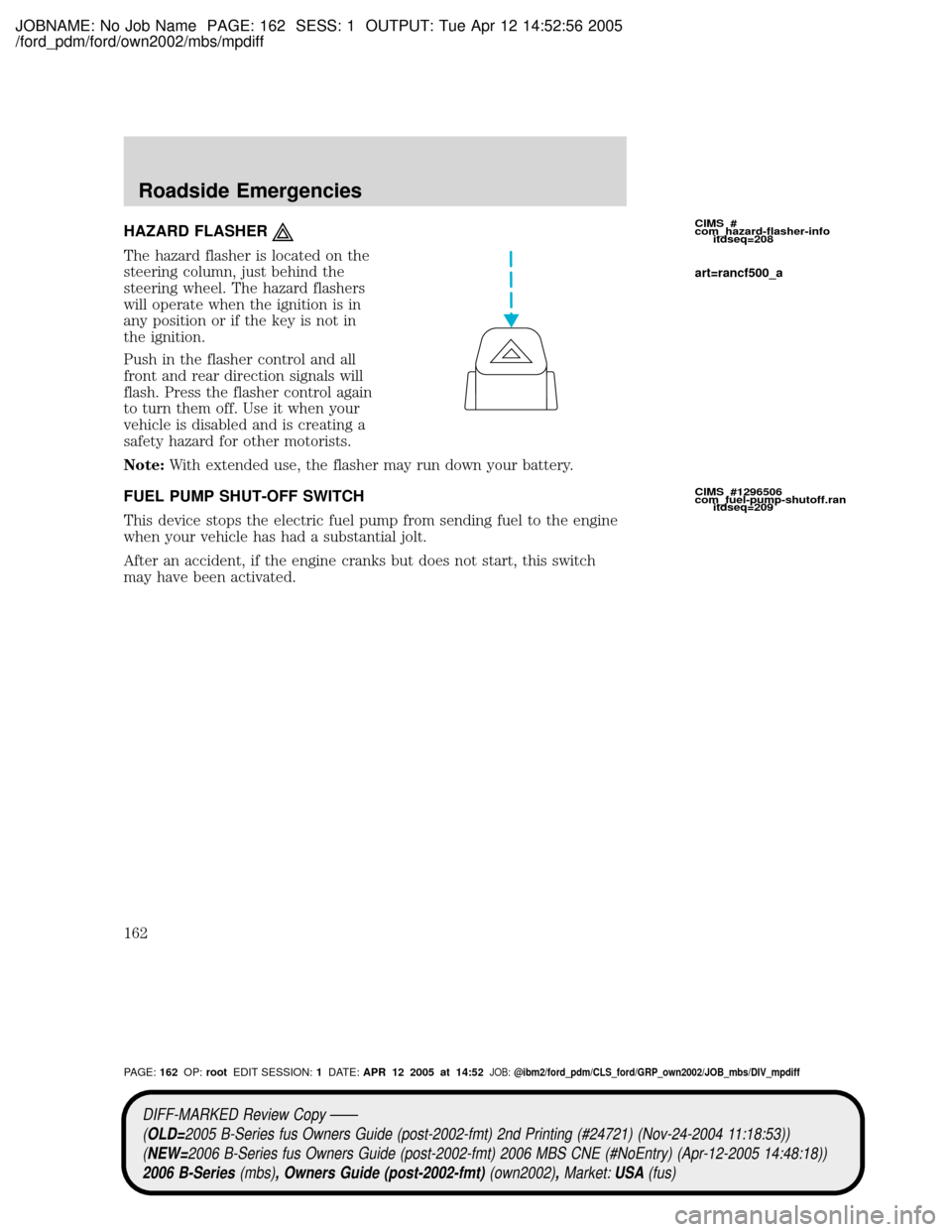
HAZARD FLASHER
The hazard flasher is located on the
steering column, just behind the
steering wheel. The hazard flashers
will operate when the ignition is in
any position or if the key is not in
the ignition.
Push in the flasher control and all
front and rear direction signals will
flash. Press the flasher control again
to turn them off. Use it when your
vehicle is disabled and is creating a
safety hazard for other motorists.
Note:With extended use, the flasher may run down your battery.
FUEL PUMP SHUT-OFF SWITCH
This device stops the electric fuel pump from sending fuel to the engine
when your vehicle has had a substantial jolt.
After an accident, if the engine cranks but does not start, this switch
may have been activated.
CIMS #
com_hazard-flasher-info
itdseq=208
CIMS #1296506
com_fuel-pump-shutoff.ran
itdseq=209
art=rancf500_a
DIFF-MARKED Review Copy ÐÐ
(OLD=2005 B-Series fus Owners Guide (post-2002-fmt) 2nd Printing (#24721) (Nov-24-2004 11:18:53))
(NEW=2006 B-Series fus Owners Guide (post-2002-fmt) 2006 MBS CNE (#NoEntry) (Apr-12-2005 14:48:18))
2006 B-Series(mbs), Owners Guide (post-2002-fmt)(own2002),Market:USA(fus)
PAGE:162OP:rootEDIT SESSION:1DATE:APR 12 2005 at 14:52JOB:@ibm2/ford_pdm/CLS_ford/GRP_own2002/JOB_mbs/DIV_mpdiff
Roadside Emergencies
162
Page 173 of 268
JOBNAME: No Job Name PAGE: 173 SESS: 1 OUTPUT: Tue Apr 12 14:52:56 2005
/ford_pdm/ford/own2002/mbs/mpdiff
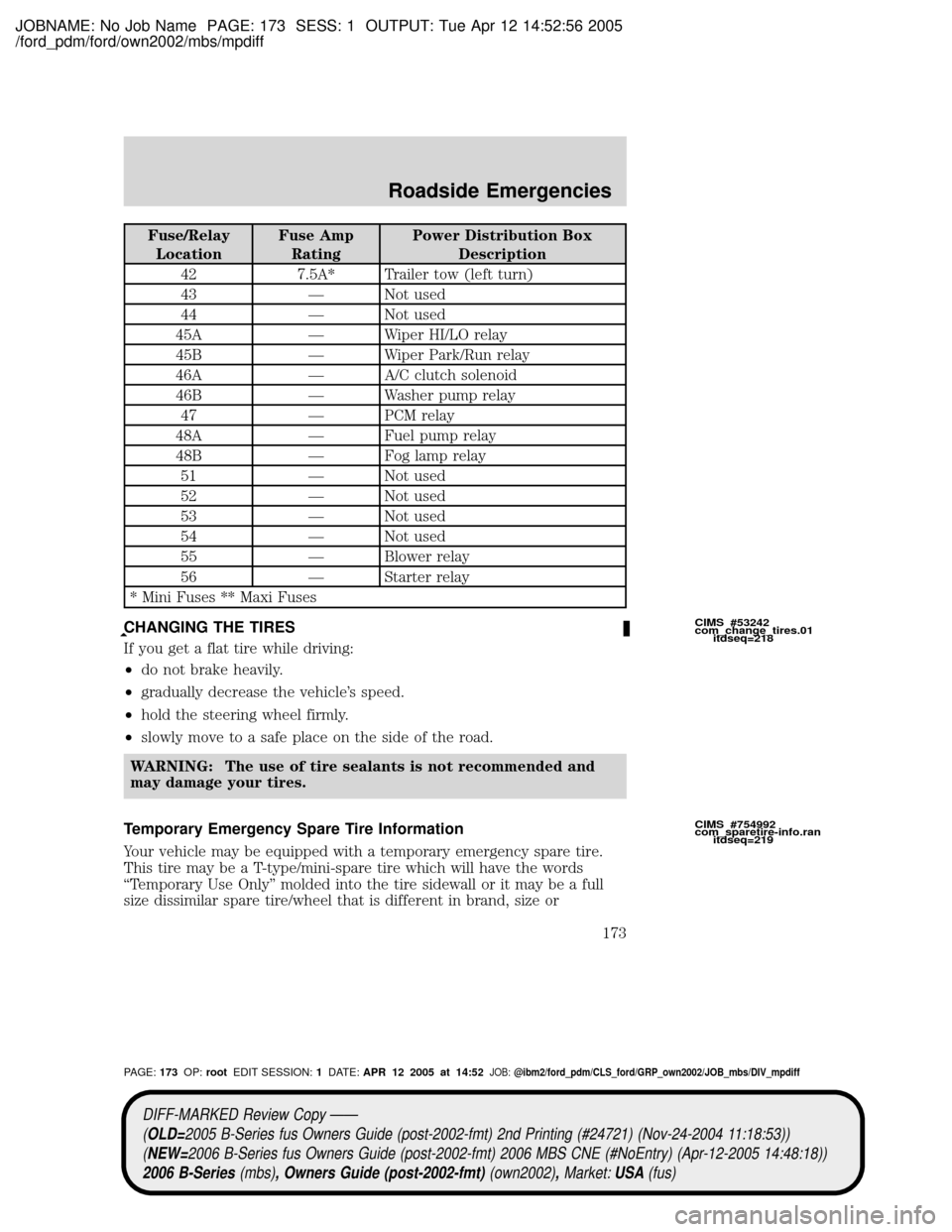
Fuse/Relay
LocationFuse Amp
RatingPower Distribution Box
Description
42 7.5A* Trailer tow (left turn)
43 Ð Not used
44 Ð Not used
45A Ð Wiper HI/LO relay
45B Ð Wiper Park/Run relay
46A Ð A/C clutch solenoid
46B Ð Washer pump relay
47 Ð PCM relay
48A Ð Fuel pump relay
48B Ð Fog lamp relay
51 Ð Not used
52 Ð Not used
53 Ð Not used
54 Ð Not used
55 Ð Blower relay
56 Ð Starter relay
* Mini Fuses ** Maxi Fuses
CHANGING THE TIRES
If you get a flat tire while driving:
²do not brake heavily.
²gradually decrease the vehicle's speed.
²hold the steering wheel firmly.
²slowly move to a safe place on the side of the road.
WARNING: The use of tire sealants is not recommended and
may damage your tires.
Temporary Emergency Spare Tire Information
Your vehicle may be equipped with a temporary emergency spare tire.
This tire may be a T-type/mini-spare tire which will have the words
ªTemporary Use Onlyº molded into the tire sidewall or it may be a full
size dissimilar spare tire/wheel that is different in brand, size orCIMS #53242
com_change_tires.01
itdseq=218
CIMS #754992
com_sparetire-info.ran
itdseq=219
DIFF-MARKED Review Copy ÐÐ
(OLD=2005 B-Series fus Owners Guide (post-2002-fmt) 2nd Printing (#24721) (Nov-24-2004 11:18:53))
(NEW=2006 B-Series fus Owners Guide (post-2002-fmt) 2006 MBS CNE (#NoEntry) (Apr-12-2005 14:48:18))
2006 B-Series(mbs), Owners Guide (post-2002-fmt)(own2002),Market:USA(fus)
PAGE:173OP:rootEDIT SESSION:1DATE:APR 12 2005 at 14:52JOB:@ibm2/ford_pdm/CLS_ford/GRP_own2002/JOB_mbs/DIV_mpdiff
Roadside Emergencies
173
Page 206 of 268
JOBNAME: No Job Name PAGE: 206 SESS: 1 OUTPUT: Tue Apr 12 14:52:56 2005
/ford_pdm/ford/own2002/mbs/mpdiff
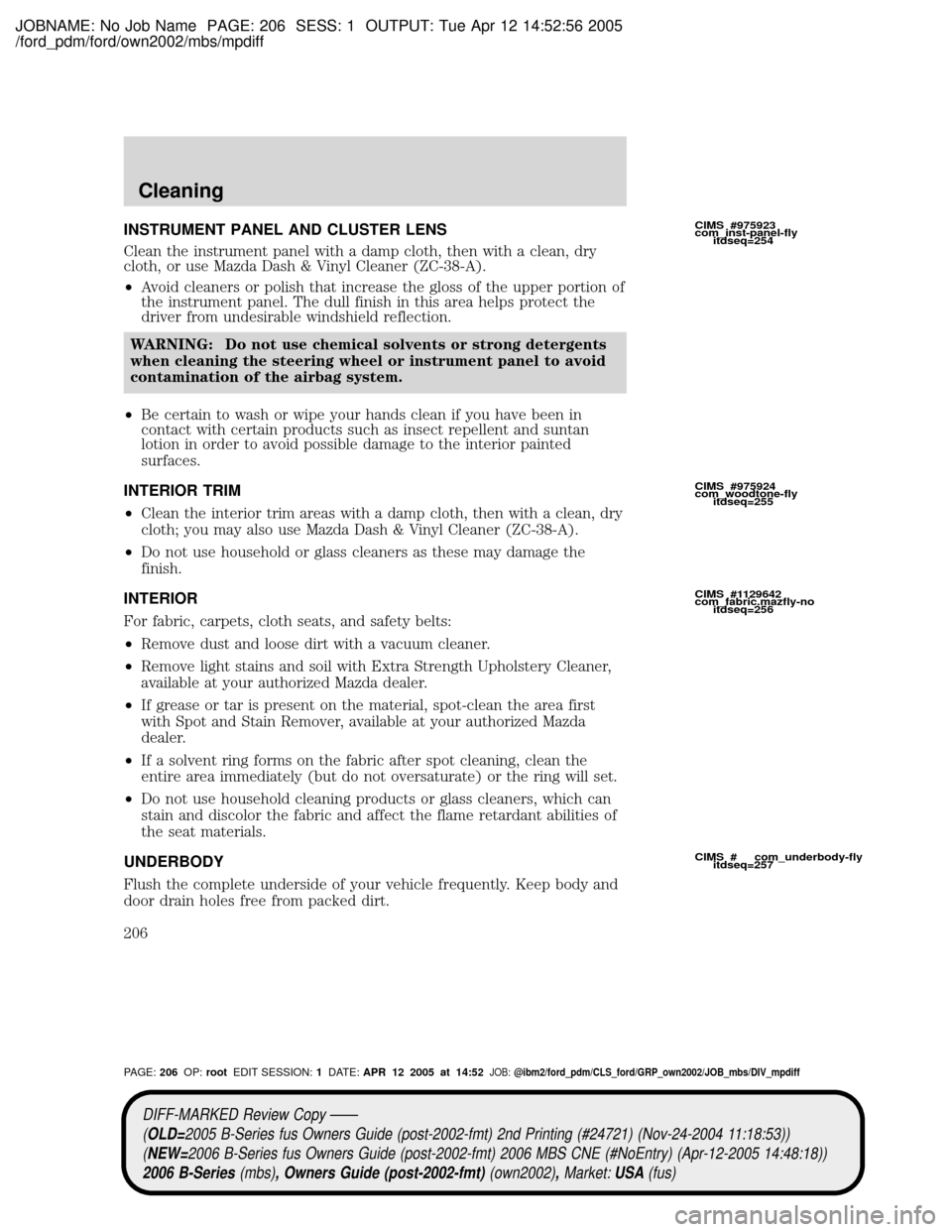
INSTRUMENT PANEL AND CLUSTER LENS
Clean the instrument panel with a damp cloth, then with a clean, dry
cloth, or use Mazda Dash & Vinyl Cleaner (ZC-38-A).
²Avoid cleaners or polish that increase the gloss of the upper portion of
the instrument panel. The dull finish in this area helps protect the
driver from undesirable windshield reflection.
WARNING: Do not use chemical solvents or strong detergents
when cleaning the steering wheel or instrument panel to avoid
contamination of the airbag system.
²Be certain to wash or wipe your hands clean if you have been in
contact with certain products such as insect repellent and suntan
lotion in order to avoid possible damage to the interior painted
surfaces.
INTERIOR TRIM
²Clean the interior trim areas with a damp cloth, then with a clean, dry
cloth; you may also use Mazda Dash & Vinyl Cleaner (ZC-38-A).
²Do not use household or glass cleaners as these may damage the
finish.
INTERIOR
For fabric, carpets, cloth seats, and safety belts:
²Remove dust and loose dirt with a vacuum cleaner.
²Remove light stains and soil with Extra Strength Upholstery Cleaner,
available at your authorized Mazda dealer.
²If grease or tar is present on the material, spot-clean the area first
with Spot and Stain Remover, available at your authorized Mazda
dealer.
²If a solvent ring forms on the fabric after spot cleaning, clean the
entire area immediately (but do not oversaturate) or the ring will set.
²Do not use household cleaning products or glass cleaners, which can
stain and discolor the fabric and affect the flame retardant abilities of
the seat materials.
UNDERBODY
Flush the complete underside of your vehicle frequently. Keep body and
door drain holes free from packed dirt.CIMS #975923
com_inst-panel-fly
itdseq=254
CIMS #975924
com_woodtone-fly
itdseq=255
CIMS #1129642
com_fabric.mazfly-no
itdseq=256
CIMS # com_underbody-fly
itdseq=257
DIFF-MARKED Review Copy ÐÐ
(OLD=2005 B-Series fus Owners Guide (post-2002-fmt) 2nd Printing (#24721) (Nov-24-2004 11:18:53))
(NEW=2006 B-Series fus Owners Guide (post-2002-fmt) 2006 MBS CNE (#NoEntry) (Apr-12-2005 14:48:18))
2006 B-Series(mbs), Owners Guide (post-2002-fmt)(own2002),Market:USA(fus)
PAGE:206OP:rootEDIT SESSION:1DATE:APR 12 2005 at 14:52JOB:@ibm2/ford_pdm/CLS_ford/GRP_own2002/JOB_mbs/DIV_mpdiff
Cleaning
206
Page 210 of 268
JOBNAME: No Job Name PAGE: 210 SESS: 1 OUTPUT: Tue Apr 12 14:52:56 2005
/ford_pdm/ford/own2002/mbs/mpdiff
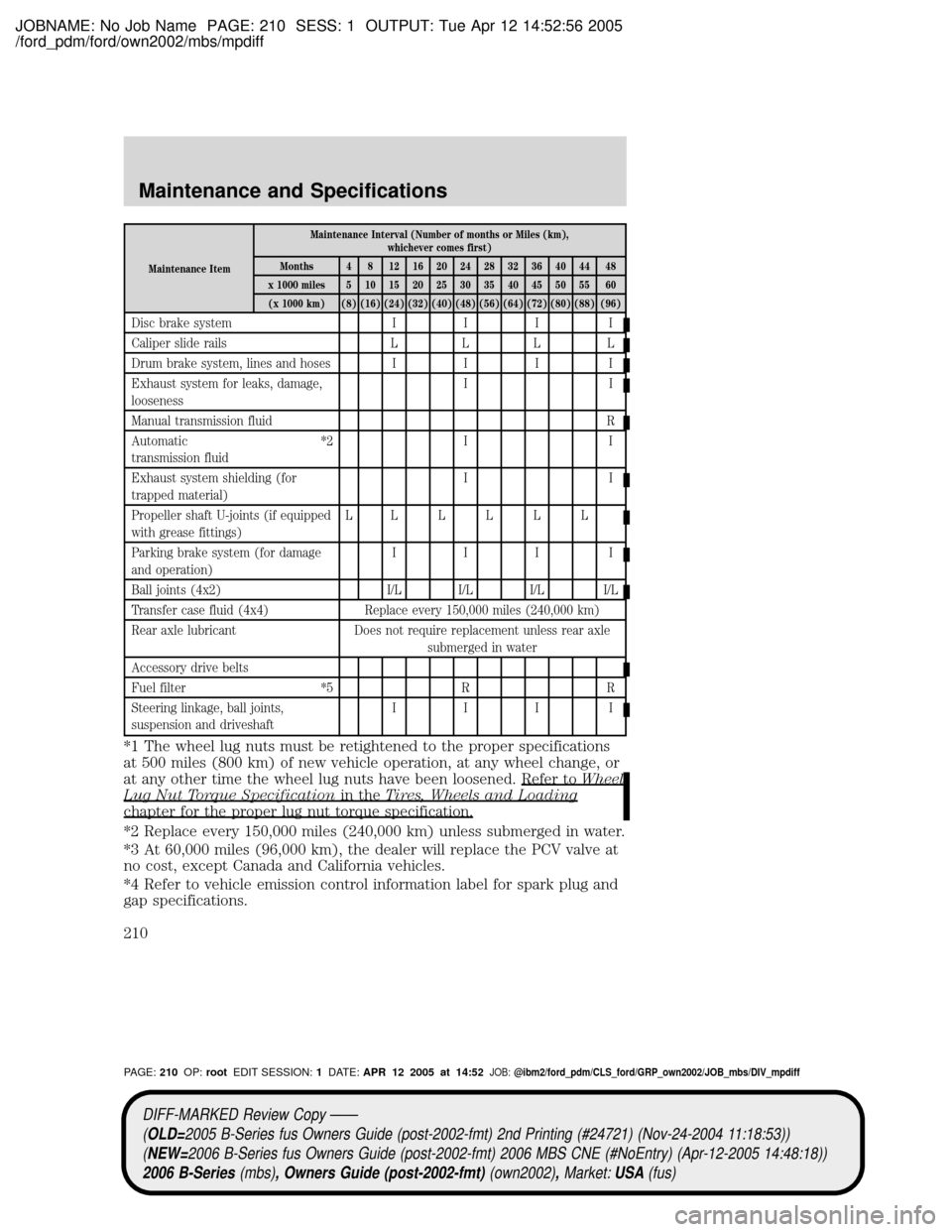
Maintenance ItemMaintenance Interval (Number of months or Miles (km),
whichever comes first)
Months 4 8 12 16 20 24 28 32 36 40 44 48
x 1000 miles 5 10 15 20 25 30 35 40 45 50 55 60
(x 1000 km) (8) (16) (24) (32) (40) (48) (56) (64) (72) (80) (88) (96)
Disc brake system I I I I
Caliper slide rails L L L L
Drum brake system, lines and hoses I I I I
Exhaust system for leaks, damage,
loosenessII
Manual transmission fluid R
Automatic
transmission fluid*2 I I
Exhaust system shielding (for
trapped material)II
Propeller shaft U-joints (if equipped
with grease fittings)LLLLLL
Parking brake system (for damage
and operation)III I
Ball joints (4x2) I/L I/L I/L I/L
Transfer case fluid (4x4) Replace every 150,000 miles (240,000 km)
Rear axle lubricant Does not require replacement unless rear axle
submerged in water
Accessory drive belts
Fuel filter *5 R R
Steering linkage, ball joints,
suspension and driveshaftIII I
*1 The wheel lug nuts must be retightened to the proper specifications
at 500 miles (800 km) of new vehicle operation, at any wheel change, or
at any other time the wheel lug nuts have been loosened. Refer toWheel
Lug Nut Torque Specificationin theTires, Wheels and Loading
chapter for the proper lug nut torque specification.
*2 Replace every 150,000 miles (240,000 km) unless submerged in water.
*3 At 60,000 miles (96,000 km), the dealer will replace the PCV valve at
no cost, except Canada and California vehicles.
*4 Refer to vehicle emission control information label for spark plug and
gap specifications.
DIFF-MARKED Review Copy ÐÐ
(OLD=2005 B-Series fus Owners Guide (post-2002-fmt) 2nd Printing (#24721) (Nov-24-2004 11:18:53))
(NEW=2006 B-Series fus Owners Guide (post-2002-fmt) 2006 MBS CNE (#NoEntry) (Apr-12-2005 14:48:18))
2006 B-Series(mbs), Owners Guide (post-2002-fmt)(own2002),Market:USA(fus)
PAGE:210OP:rootEDIT SESSION:1DATE:APR 12 2005 at 14:52JOB:@ibm2/ford_pdm/CLS_ford/GRP_own2002/JOB_mbs/DIV_mpdiff
Maintenance and Specifications
210
Page 212 of 268
JOBNAME: No Job Name PAGE: 212 SESS: 1 OUTPUT: Tue Apr 12 14:52:56 2005
/ford_pdm/ford/own2002/mbs/mpdiff
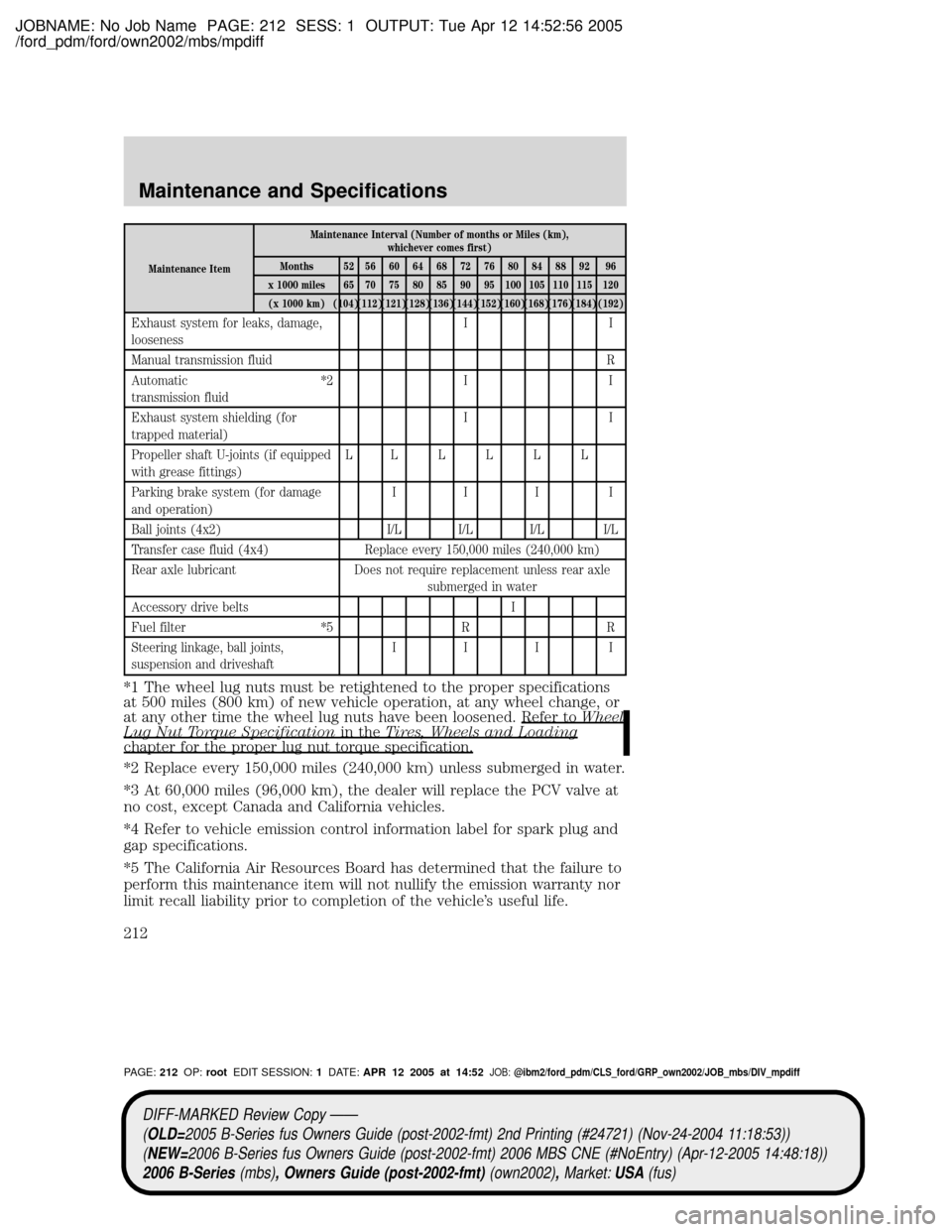
Maintenance ItemMaintenance Interval (Number of months or Miles (km),
whichever comes first)
Months 52 56 60 64 68 72 76 80 84 88 92 96
x 1000 miles 65 70 75 80 85 90 95 100 105 110 115 120
(x 1000 km) (104)(112)(121)(128)(136)(144)(152)(160)(168)(176)(184) (192)
Exhaust system for leaks, damage,
loosenessII
Manual transmission fluid R
Automatic
transmission fluid*2 I I
Exhaust system shielding (for
trapped material)II
Propeller shaft U-joints (if equipped
with grease fittings)LLLLLL
Parking brake system (for damage
and operation)III I
Ball joints (4x2) I/L I/L I/L I/L
Transfer case fluid (4x4) Replace every 150,000 miles (240,000 km)
Rear axle lubricant Does not require replacement unless rear axle
submerged in water
Accessory drive belts I
Fuel filter *5 R R
Steering linkage, ball joints,
suspension and driveshaftIII I
*1 The wheel lug nuts must be retightened to the proper specifications
at 500 miles (800 km) of new vehicle operation, at any wheel change, or
at any other time the wheel lug nuts have been loosened. Refer toWheel
Lug Nut Torque Specificationin theTires, Wheels and Loadingchapter for the proper lug nut torque specification.
*2 Replace every 150,000 miles (240,000 km) unless submerged in water.
*3 At 60,000 miles (96,000 km), the dealer will replace the PCV valve at
no cost, except Canada and California vehicles.
*4 Refer to vehicle emission control information label for spark plug and
gap specifications.
*5 The California Air Resources Board has determined that the failure to
perform this maintenance item will not nullify the emission warranty nor
limit recall liability prior to completion of the vehicle's useful life.
DIFF-MARKED Review Copy ÐÐ
(OLD=2005 B-Series fus Owners Guide (post-2002-fmt) 2nd Printing (#24721) (Nov-24-2004 11:18:53))
(NEW=2006 B-Series fus Owners Guide (post-2002-fmt) 2006 MBS CNE (#NoEntry) (Apr-12-2005 14:48:18))
2006 B-Series(mbs), Owners Guide (post-2002-fmt)(own2002),Market:USA(fus)
PAGE:212OP:rootEDIT SESSION:1DATE:APR 12 2005 at 14:52JOB:@ibm2/ford_pdm/CLS_ford/GRP_own2002/JOB_mbs/DIV_mpdiff
Maintenance and Specifications
212