spare tire MAZDA MODEL B3000 2002 Owners Manual (in English)
[x] Cancel search | Manufacturer: MAZDA, Model Year: 2002, Model line: MODEL B3000, Model: MAZDA MODEL B3000 2002Pages: 288, PDF Size: 2.94 MB
Page 104 of 288

If two previously programmed coded keys are not available, you must
bring your vehicle to your dealership to have the spare coded key(s)
programmed.
NOTE:Please read and understand the entire procedure before you
begin.
NOTE:This procedure must be completed within the specified times. If
not completed within the specified time period, the reprogramming
procedure must be restarted from the beginning.
1. Insert the first previously
programmedcoded keyinto
the ignition and turn the
ignition from 3 (OFF) to 4 (ON)
(maintain ignition in 4 (ON) for
at least one second).
2. Turn ignition to 3 (OFF) then 2
(LOCK) and remove the first
coded keyfrom the ignition.
3. Within ten seconds of removing
the firstcoded key,insert the second previously programmedcoded
keyinto the ignition and turn the ignition from 3 (OFF) to 4 (ON)
(maintain ignition in 4 (ON) for at least one second but no more
than ten seconds).
4. Turn the ignition to 3 (OFF) then 2 (LOCK) and remove the second
coded keyfrom the ignition.
5. Within 20 seconds of removing the secondcoded key,insert the
new unprogrammed key (new key/valet key) into the ignition and
turn the ignition from 3 (OFF) to 4 (ON) (maintain ignition in 4
(ON) for at least one second). This step will program your new key
to a coded key.
6. To program additional new unprogrammed key(s), repeat this
procedure from step 1.
If successful, the new coded key(s) will start the vehicle's engine and the
theft indicator will illuminate for three seconds and then go out.
If not successful, the new coded key(s) will not start the vehicle's engine
and the theft indicator will flash on and off and you may repeat steps 1
through 6. If failure repeats, bring your vehicle to your authorized Mazda
dealership to have the new spare key(s) programmed.
3
2
1
5
4
Locks and Security
104
Page 195 of 288
Temporary spare tire information
Your vehicle may have a temporary or conventional spare tire. The
temporary spare tire for your vehicle is labeled as such. It is smaller than
a regular tire and is designed for emergency use only. Replace this tire
with a full-size tire as soon as possible.
It is not recommended that the vehicle be operated in 4WD modes with
a temporary spare. If 4WD operation is necessary, do not operate above
speeds of 16 km/h (10 mph) or for distances above 80 km (50 miles).
WARNING: If you use the temporary spare tire continuously or
do not follow these precautions, the tire could fail, causing you
to lose control of the vehicle, possibly injuring yourself or
others.
When driving with the temporary spare tiredo not:
²exceed 80 km/h (50 mph) under any circumstances
²load the vehicle beyond maximum vehicle load rating listed on the
Safety Compliance Label
²tow a trailer
²use tire chains
²drive through an automatic car wash, because of the vehicle's reduced
ground clearance
²try to repair the temporary spare tire or remove it from its wheel rim
²use the wheel for any other type of vehicle
Conventional spare tire information
If you have the conventional spare tire, you can use it as a spare or a
regular tire. The spare is identical to the other tires on your vehicle,
although the wheel may not match.
Roadside Emergencies
195
Page 196 of 288
Location of the spare tire and tools
The spare tire and tools for your vehicle are stowed in the following
locations:
Tool Location
Spare tire Under the vehicle, just forward of
the rear bumper
Jack, jack handle, wheel nut
wrenchRegular Cab: behind seats and
underneath the jack and tools
cover
SuperCab: stowed in the passenger
side rear cab compartment or
behind the jump seat in a separate
tool bag
Four-door models: stowed behind
the front seats, between jump
seats and underneath jack and
tools cover.
Key, spare tire lock (if equipped) In the glove box
Removing the spare tire
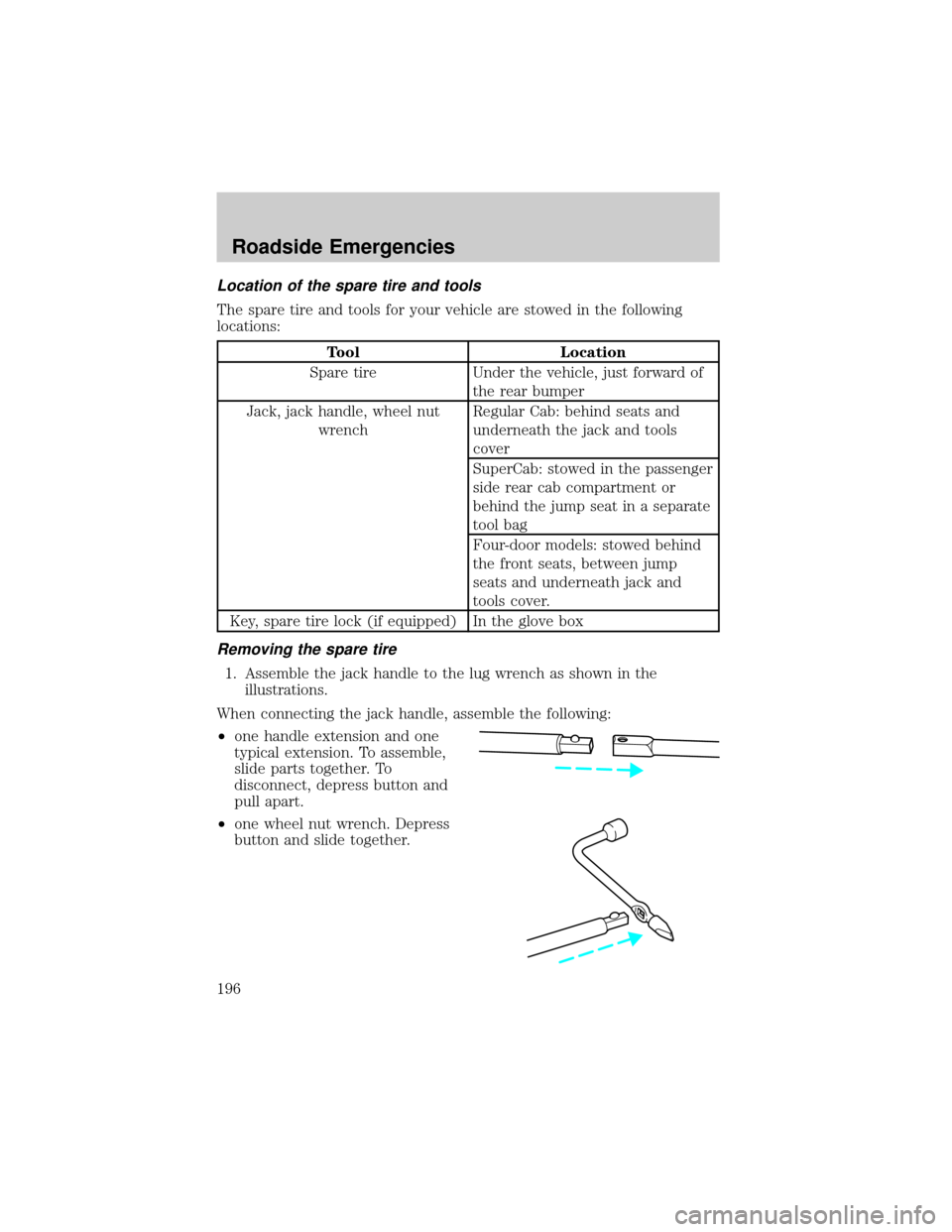
1. Assemble the jack handle to the lug wrench as shown in the
illustrations.
When connecting the jack handle, assemble the following:
²one handle extension and one
typical extension. To assemble,
slide parts together. To
disconnect, depress button and
pull apart.
²one wheel nut wrench. Depress
button and slide together.
Roadside Emergencies
196
Page 197 of 288
2. If equipped, unlock and remove
the spare tire carrier lock from
the rear access hole located just
above the rear bumper and
below the tailgate.
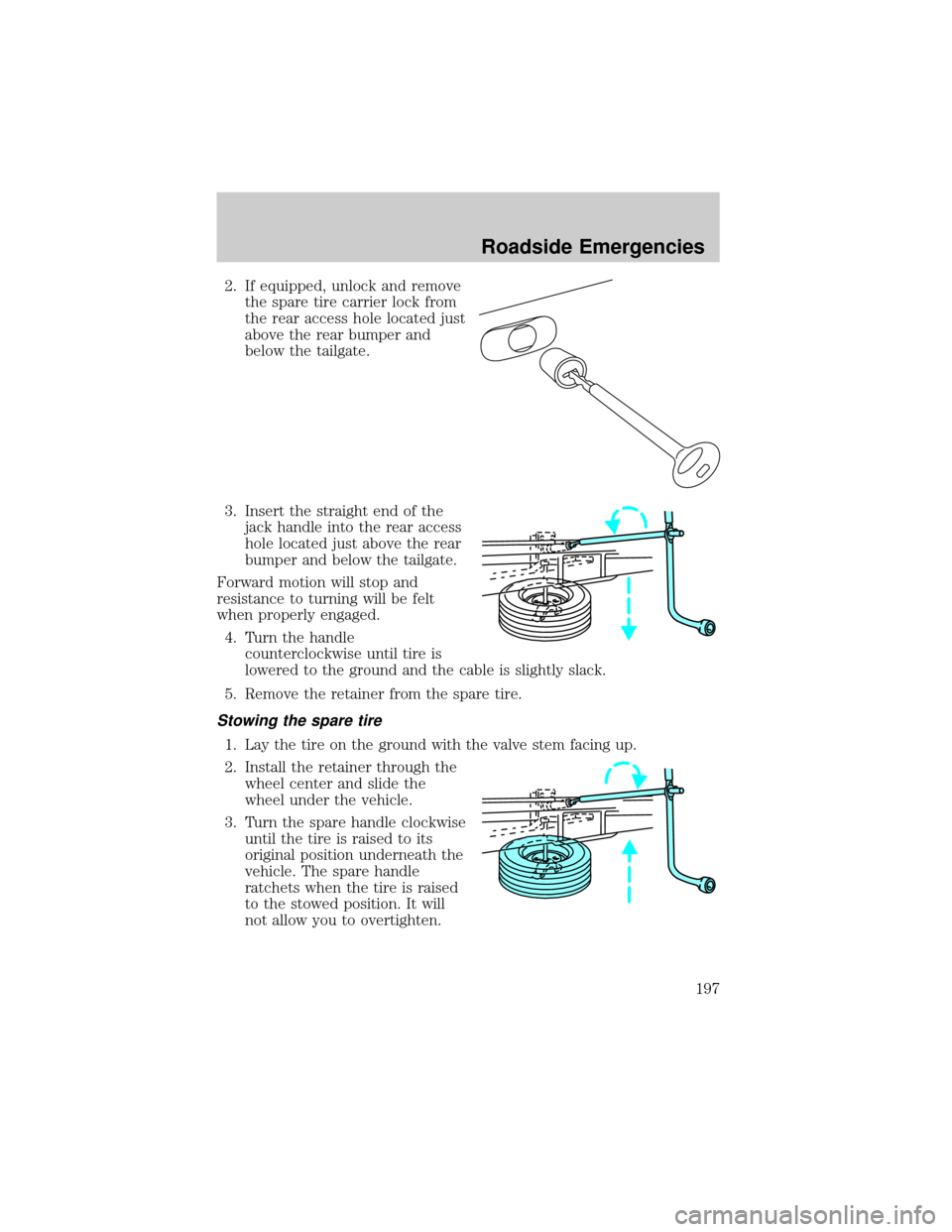
3. Insert the straight end of the
jack handle into the rear access
hole located just above the rear
bumper and below the tailgate.
Forward motion will stop and
resistance to turning will be felt
when properly engaged.
4. Turn the handle
counterclockwise until tire is
lowered to the ground and the cable is slightly slack.
5. Remove the retainer from the spare tire.
Stowing the spare tire
1. Lay the tire on the ground with the valve stem facing up.
2. Install the retainer through the
wheel center and slide the
wheel under the vehicle.
3. Turn the spare handle clockwise
until the tire is raised to its
original position underneath the
vehicle. The spare handle
ratchets when the tire is raised
to the stowed position. It will
not allow you to overtighten.
Roadside Emergencies
197
Page 198 of 288
4. If your vehicle is equipped with P265/75 R15 AT tires, do not stow a
flat or inflated full size spare tire in the spare tire carrier. The flat
full size tire should be stowed and tied down in the pickup box bed
until it can be repaired.
5. If removed, install the spare tire carrier lock on the access hole
above the bumper.
Tire change procedure
WARNING: When one of the front wheels is off the ground, the
transmission alone will not prevent the vehicle from moving or
slipping off the jack, even if the vehicle is in P (Park)
(automatic transmission) or R (Reverse) (manual
transmission).
WARNING: To prevent the vehicle from moving when you
change a tire, be sure the parking brake is set, then block (in
both directions) the wheel that is diagonally opposite (other
side and end of the vehicle) to the tire being changed.
WARNING: If the vehicle slips off the jack, you or someone
else could be seriously injured.
1. Park on a level surface, activate
hazard flashers and place
gearshift lever in P (Park)
(automatic transmission) or 1
(First) (manual transmission).
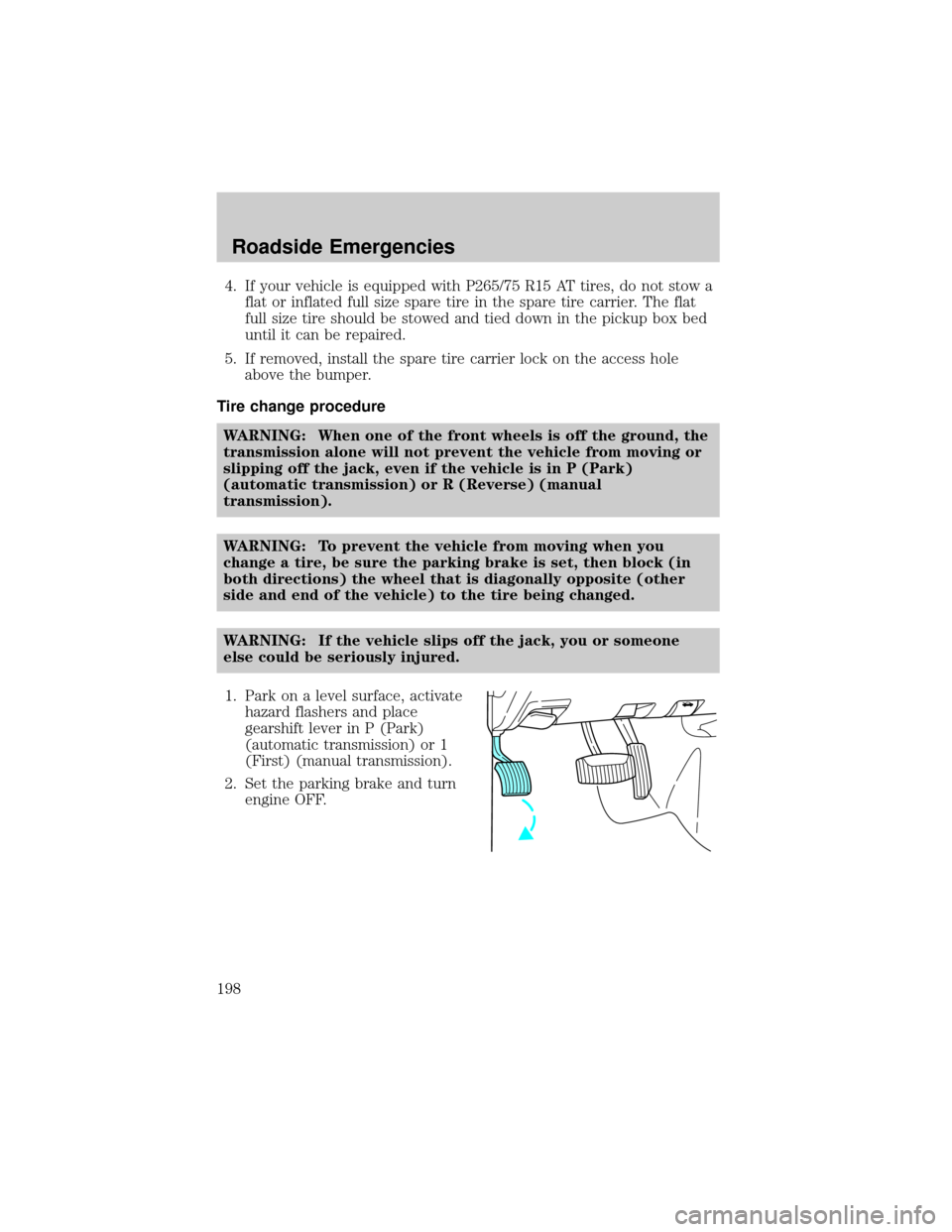
2. Set the parking brake and turn
engine OFF.
Roadside Emergencies
198
Page 200 of 288
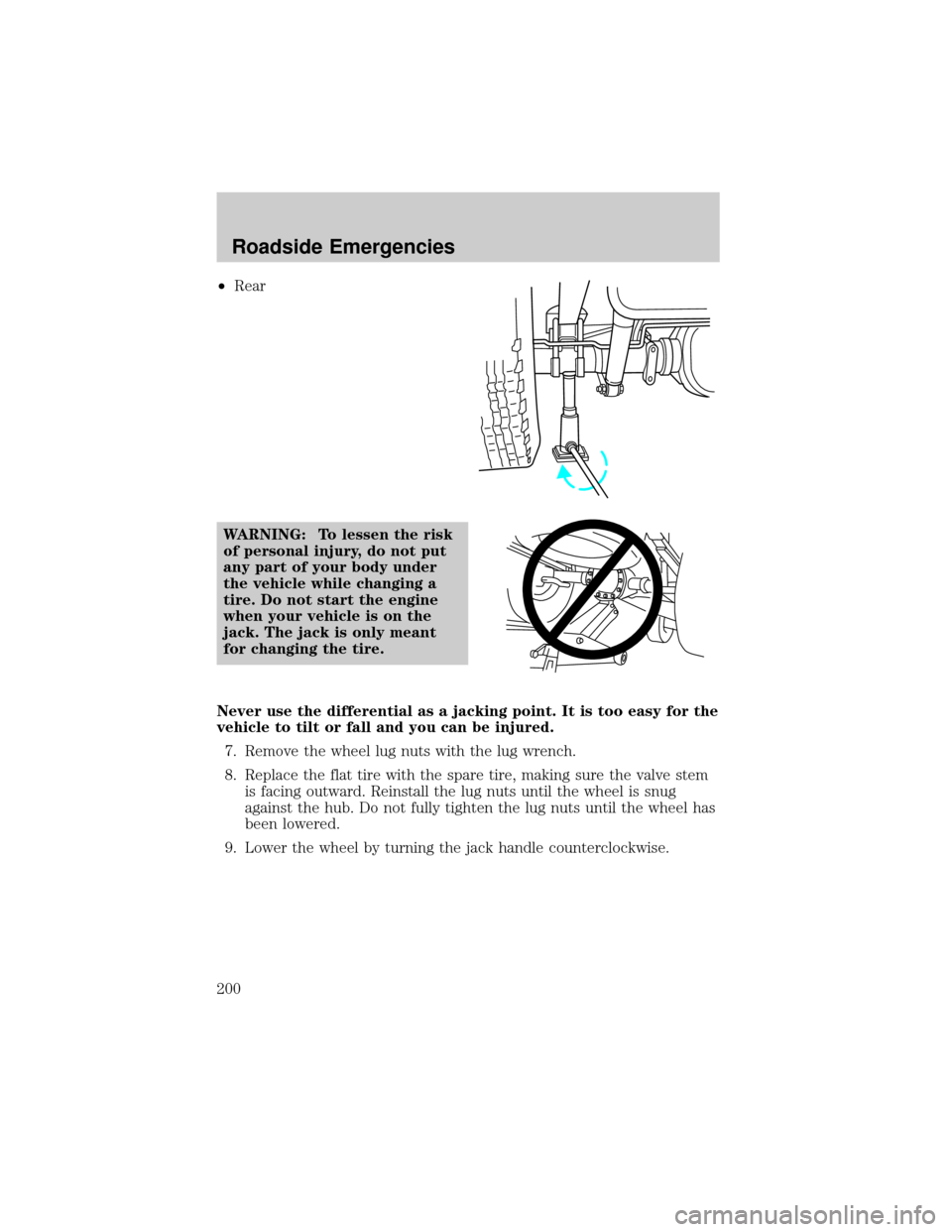
²Rear
WARNING: To lessen the risk
of personal injury, do not put
any part of your body under
the vehicle while changing a
tire. Do not start the engine
when your vehicle is on the
jack. The jack is only meant
for changing the tire.
Never use the differential as a jacking point. It is too easy for the
vehicle to tilt or fall and you can be injured.
7. Remove the wheel lug nuts with the lug wrench.
8. Replace the flat tire with the spare tire, making sure the valve stem
is facing outward. Reinstall the lug nuts until the wheel is snug
against the hub. Do not fully tighten the lug nuts until the wheel has
been lowered.
9. Lower the wheel by turning the jack handle counterclockwise.
Roadside Emergencies
200
Page 201 of 288
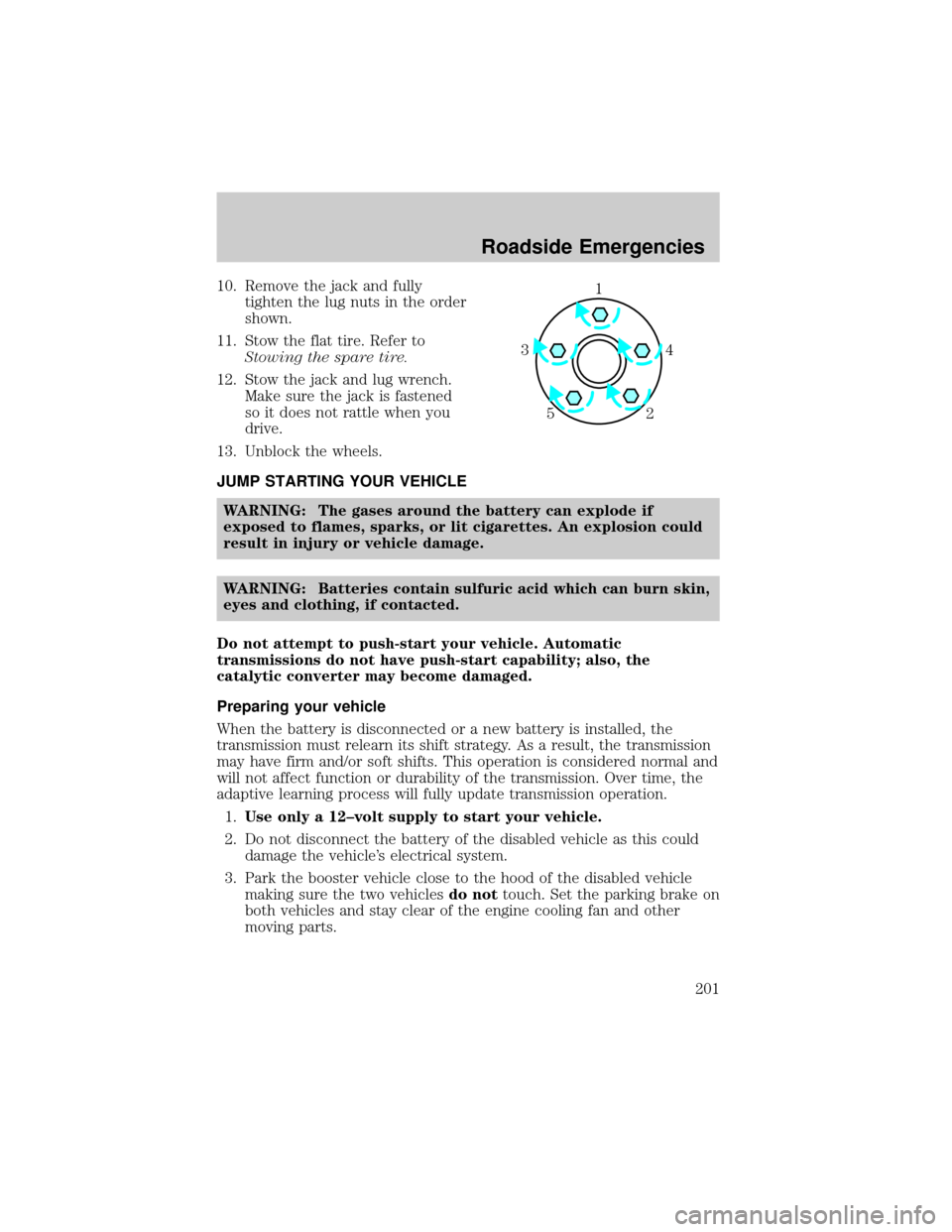
10. Remove the jack and fully
tighten the lug nuts in the order
shown.
11. Stow the flat tire. Refer to
Stowing the spare tire.
12. Stow the jack and lug wrench.
Make sure the jack is fastened
so it does not rattle when you
drive.
13. Unblock the wheels.
JUMP STARTING YOUR VEHICLE
WARNING: The gases around the battery can explode if
exposed to flames, sparks, or lit cigarettes. An explosion could
result in injury or vehicle damage.
WARNING: Batteries contain sulfuric acid which can burn skin,
eyes and clothing, if contacted.
Do not attempt to push-start your vehicle. Automatic
transmissions do not have push-start capability; also, the
catalytic converter may become damaged.
Preparing your vehicle
When the battery is disconnected or a new battery is installed, the
transmission must relearn its shift strategy. As a result, the transmission
may have firm and/or soft shifts. This operation is considered normal and
will not affect function or durability of the transmission. Over time, the
adaptive learning process will fully update transmission operation.
1.Use only a 12±volt supply to start your vehicle.
2. Do not disconnect the battery of the disabled vehicle as this could
damage the vehicle's electrical system.
3. Park the booster vehicle close to the hood of the disabled vehicle
making sure the two vehiclesdo nottouch. Set the parking brake on
both vehicles and stay clear of the engine cooling fan and other
moving parts.1
4 3
2 5
Roadside Emergencies
201
Page 231 of 288

²Note any changes in the sound of the exhaust or any smell or exhaust
fumes in the vehicle.
²Check for vibrations in the steering wheel. Notice any increased
steering effort or looseness in the steering wheel, or change in this
straight ahead position.
²Notice if your vehicle constantly turns slightly or ªpullsº to one side
when traveling on a smooth, level road.
²When stopping, listen and check for strange sounds, pulling to one
side, increased brake pedal travel or ªhard to pushº brake pedal.
²If any slipping or changes in the operation of your transmission occur,
check the transmission fluid level.
²Check automatic transmission Park function.
²Check parking brake.
At least monthly
²Check function of all interior and exterior lights.
²Check tires for wear and proper air pressure.
²Check engine oil level.
²Check coolant level in the coolant reservoir.
²Check washer fluid level.
At least twice a year (for example, every spring and fall)
²Check power steering fluid level.
²Check clutch fluid level (if equipped).
²Check and clean body and door drain holes.
²Check and lubricate all hinges, latches, and outside locks.
²Check and lubricate door rubber weather strips.
²Check parking brake for proper operation.
²Check lap/shoulder belts and seat latches for wear and function.
²Check air pressure in spare tire.
²Check windshield washer spray and wiper operation. Clean wiper
blades with clean cloth dampened with washer fluid.
²Check safety warning lamps (brake, ABS, air bag, safety belt) for
operation.
²Check cooling system fluid level and coolant strength.
Maintenance and Specifications
231
Page 268 of 288

INFORMATION ABOUT UNIFORM TIRE QUALITY GRADING
New vehicles are fitted with tires
that have a rating on them called
Tire Quality Grades. The Quality
grades can be found where
applicable on the tire sidewall
between tread shoulder and
maximum section width. For
example:
²Treadwear 200 Traction AA Temperature A
These Tire Quality Grades are determined by standards that the United
States Department of Transportation has set.
Tire Quality Grades apply to new pneumatic tires for use on passenger
cars. They do not apply to deep tread, winter-type snow tires,
space-saver or temporary use spare tires, tires with nominal rim
diameters of 10 to 12 inches or limited production tires as defined in
Title 49 Code of Federal Regulations Part 575.104(c)(2).
U.S. Department of Transportation-Tire quality grades:The U.S.
Department of Transportation requires Mazda to give you the following
information about tire grades exactly as the government has written it.
Treadwear
The treadwear grade is a comparative rating based on the wear rate of
the tire when tested under controlled conditions on a specified
government test course. For example, a tire graded 150 would wear one
and one-half (1 1/2) times as well on the government course as a tire
graded 100. The relative performance of tires depends upon the actual
conditions of their use, however, and may depart significantly from the
norm due to variations in driving habits, service practices, and
differences in road characteristics and climates.
Traction AA A B C
The traction grades, from highest to lowest are AA, A, B, and C. The
grades represent the tire's ability to stop on wet pavement as measured
under controlled conditions on specified government test surfaces of
asphalt and concrete. A tire marked C may have poor traction
performance.
NOTE:The traction grade assigned to this tire is based on
straight-ahead braking traction tests, and does not include acceleration,
cornering, hydroplaning or peak traction characteristics.
Maintenance and Specifications
268
Page 284 of 288

Mirrors
automatic dimming rearview
mirror ........................................86
cleaning ...................................221
side view mirrors (power) .......89
Motorcraft parts ........................255
O
Octane rating ............................254
Odometer .....................................20
Oil (see Engine oil) ..................238
Overdrive .....................................93
P
Panic alarm feature, remote
entry system ..............................100
Parking brake ............................155
Power distribution box
(see Fuses) ...............................188
Power door locks ........................97
Power point .................................84
Power steering ..........................156
fluid, checking and adding ....261
fluid, refill capacity ................272
fluid, specifications .........275±276
Power Windows ...........................85
Preparing to drive your
vehicle ........................................157
R
Radio ................................21, 45, 53
Radio reception .....................66±67
Relays ........................................183
Remote entry system .........97, 100illuminated entry ......................98
locking/unlocking doors .....97±99
panic alarm .............................100
replacement/additional
transmitters .............................101
replacing the batteries ...........100
Roadside assistance ..................181
S
Safety belts (see Safety
restraints) ....................17, 107±111
Safety defects, reporting ..........217
Safety restraints ................107±111
belt minder .............................115
cleaning the safety belts ........118
extension assembly ................114
for adults .........................108±110
for children .....................131±132
lap belt ....................................113
warning light and
chime ...........................14, 17, 114
Safety restraints - LATCH
anchors ......................................145
Safety restraints - tether
anchors ......................................140
Safety seats for children ..........135
Seat belts (see Safety
restraints) ..................................107
Seats ..........................................105
child safety seats ....................135
SecuriLock passive anti-theft
system ................................102±103
Servicing your vehicle ..............232
Snowplowing .................................7
Spare tire (see Changing the
Tire) ...........................................195
Spark plugs, specifications .......276
Index
284